
Chapter 4 of 29 · History of Money and Banking in the United States: The Colonial Era to World War II by Murray N. Rothbard
Part 1 - The History of Money and Banking Before the Twentieth Century
Part 1
A HISTORY OF MONEY AND BANKING IN THE UNITED STATES BEFORE THE TWENTIETH CENTURY
A HISTORY OF MONEY AND BANKING IN THE UNITED STATES BEFORE THE TWENTIETH CENTURY
As an outpost of Great Britain, colonial America of course used British pounds, pence, and shillings as its money. Great Britain was officially on a silver standard, with the shilling defined as equal to 86 pure Troy grains of silver, and with silver as so-defined legal tender for all debts (that is, creditors were compelled to accept silver at that rate). However, Britain also coined gold and maintained a bimetallic standard by fixing the gold guinea, weighing 129.4 grains of gold, as equal in value to a certain weight of silver. In that way, gold became, in effect, legal tender as well. Unfortunately, by establishing bimetallism, Britain became perpetually subject to the evil known as Gresham’s Law, which states that when government compulsorily overvalues one money and undervalues another, the undervalued money will leave the country or disappear into hoards, while the overvalued money will flood into circulation. Hence, the popular catchphrase of Gresham’s Law: “Bad money drives out good.” But the important point to note is that the triumph of “bad” money is the result, not of perverse free-market competition, but of government using the compulsory legal tender power to privilege one money above another.
In seventeenth- and eighteenth-century Britain, the government maintained a mint ratio between gold and silver that consistently overvalued gold and undervalued silver in relation to world market prices, with the resultant disappearance and outflow of full-bodied silver coins, and an influx of gold, and the maintenance in circulation of only eroded and “lightweight” silver coins. Attempts to rectify the fixed bimetallic ratios were always too little and too late.1
In the sparsely settled American colonies, money, as it always does, arose in the market as a useful and scarce commodity and began to serve as a general medium of exchange. Thus, beaver fur and wampum were used as money in the north for exchanges with the Indians, and fish and corn also served as money. Rice was used as money in South Carolina, and the most widespread use of commodity money was tobacco, which served as money in Virginia. The pound-of-tobacco was the currency unit in Virginia, with warehouse receipts in tobacco circulating as money backed 100 percent by the tobacco in the warehouse.
While commodity money continued to serve satisfactorily in rural areas, as the colonial economy grew, Americans imported gold and silver coins to serve as monetary media in urban centers and in foreign trade. English coins were imported, but so too were gold and silver coins from other European countries. Among the gold coins circulating in America were the French guinea, the Portuguese “joe,” the Spanish doubloon, and Brazilian coins, while silver coins included French crowns and livres.
It is important to realize that gold and silver are international commodities, and that therefore, when not prohibited by government decree, foreign coins are perfectly capable of serving as standard moneys. There is no need to have a national government monopolize the coinage, and indeed foreign gold and silver coins constituted much of the coinage in the United States until Congress outlawed the use of foreign coins in 1857. Thus, if a free market is allowed to prevail in a country, foreign coins will circulate naturally. Silver and gold coins will tend to be valued in proportion to their respective weights, and the ratio between silver and gold will be set by the market in accordance with their relative supply and demand.
SHILLING AND DOLLAR MANIPULATIONS
By far the leading specie coin circulating in America was the Spanish silver dollar, defined as consisting of 387 grains of pure silver. The dollar was divided into “pieces of eight,” or “bits,” each consisting of one-eighth of a dollar. Spanish dollars came into the North American colonies through lucrative trade with the West Indies. The Spanish silver dollar had been the world’s outstanding coin since the early sixteenth century, and was spread partially by dint of the vast silver output of the Spanish colonies in Latin America. More important, however, was that the Spanish dollar, from the sixteenth to the nineteenth century, was relatively the most stable and least debased coin in the Western world.2
Since the Spanish silver dollar consisted of 387 grains, and the English shilling consisted of 86 grains of silver, this meant the natural, free-market ratio between the two coins would be 4 shillings 6 pence per dollar.3
Constant complaints, both by contemporaries and by some later historians, arose about an alleged “scarcity of money,” especially of specie, in the colonies, allegedly justifying numerous colonial paper money schemes to remedy that “shortage.” In reality, there was no such shortage. It is true that England, in a mercantilist attempt to hoard specie, kept minting for its own prerogative and outlawed minting in the colonies; it also prohibited the export of English coin to America. But this did not keep specie from America, for, as we have seen, Americans were able to import Spanish and other foreign coin, including English, from other countries. Indeed, as we shall see, it was precisely paper money issues that led, by Gresham’s Law, to outflows and disappearance of specie from the colonies.
In their own mercantilism, the colonial governments early tried to hoard their own specie by debasing their shilling standards in terms of Spanish dollars. Whereas their natural weights dictated a ratio of 4 shillings 6 pence to the dollar, Massachusetts, in 1642, began a general colonial process of competitive debasement of shillings. Massachusetts arbitrarily decreed that the Spanish dollar be valued at 5 shillings; the idea was to attract an inflow of Spanish silver dollars into that colony, and to subsidize Massachusetts exports by making their prices cheaper in terms of dollars. Soon, Connecticut and other colonies followed suit, each persistently upping the ante of debasement. The result was to increase the supply of nominal units of account by debasing the shilling, inflating domestic prices and thereby bringing the temporary export stimulus to a rapid end. Finally, the English government brought a halt to this futile and inflationary practice in 1707.
But the colonial governments had already found another, and far more inflationary, arrow for their bow: the invention of government fiat paper money.
GOVERNMENT PAPER MONEY
Apart from medieval China, which invented both paper and printing centuries before the West, the world had never seen government paper money until the colonial government of Massachusetts emitted a fiat paper issue in 1690.4, 5 Massachusetts was accustomed to launching plunder expeditions against the prosperous French colony in Quebec. Generally, the expeditions were successful, and would return to Boston, sell their booty, and pay off the soldiers with the proceeds. This time, however, the expedition was beaten back decisively, and the soldiers returned to Boston in ill humor, grumbling for their pay. Discontented soldiers are ripe for mutiny, so the Massachusetts government looked around in concern for a way to pay the soldiers. It tried to borrow £3,000–£4,000 from Boston merchants, but evidently the Massachusetts credit rating was not the best. Finally, Massachusetts decided in December 1690 to print £7,000 in paper notes and to use them to pay the soldiers. Suspecting that the public would not accept irredeemable paper, the government made a twofold pledge when it issued the notes: that it would redeem them in gold or silver out of tax revenue in a few years and that absolutely no further paper notes would be issued. Characteristically, however, both parts of the pledge went quickly by the board: The issue limit disappeared in a few months, and all the bills continued unredeemed for nearly 40 years. As early as February 1691, the Massachusetts government proclaimed that its issue had fallen “far short” and so it proceeded to emit £40,000 of new money to repay all of its outstanding debt, again pledging falsely that this would be the absolute final note issue.
But Massachusetts found that the increase in the supply of money, coupled with a fall in the demand for paper because of growing lack of confidence in future redemption in specie, led to a rapid depreciation of new money in relation to specie. Indeed, within a year after the initial issue, the new paper pound had depreciated on the market by 40 percent against specie.
By 1692, the government moved against this market evaluation by use of force, making the paper money compulsory legal tender for all debts at par with specie, and by granting a premium of 5 percent on all payment of debts to the government made in paper notes. This legal tender law had the unwanted effect of Gresham’s Law: the disappearance of specie circulation in the colony. In addition, the expanding paper issues drove up prices and hampered exports from the colony. In this way, the specie “shortage” became the creature rather than the cause of the fiat paper issues. Thus, in 1690, before the orgy of paper issues began, £200,000 of silver money was available in New England; by 1711, however, with Connecticut and Rhode Island having followed suit in paper money issue, £240,000 of paper money had been issued in New England but the silver had almost disappeared from circulation.
Ironically, then, Massachusetts’s and her sister colonies’ issue of paper money created rather than solved any “scarcity of money.” The new paper drove out the old specie. The consequent driving up of prices and depreciation of paper scarcely relieved any alleged money scarcity among the public. But since the paper was issued to finance government expenditures and pay public debts, the government, not the public, benefited from the fiat issue.
After Massachusetts had emitted another huge issue of £500,000 in 1711 to pay for another failed expedition against Quebec, not only was the remainder of the silver driven from circulation, but, despite the legal tender law, the paper pound depreciated 30 percent against silver. Massachusetts pounds, officially 7 shillings to the silver ounce, had now fallen on the market to 9 shillings per ounce. Depreciation proceeded in this and other colonies despite fierce governmental attempts to outlaw it, backed by fines, imprisonment, and total confiscation of property for the high crime of not accepting the paper at par.
Faced with a further “shortage of money” due to the money issues, Massachusetts decided to press on; in 1716, it formed a government “land bank” and issued £100,000 in notes to be loaned on real estate in the various counties of the province.
Prices rose so dramatically that the tide of opinion in Massachusetts began to turn against paper, as writers pointed out that the result of issues was a doubling of prices in the past 20 years, depreciation of paper, and the disappearance of Spanish silver through the operation of Gresham’s Law. From then on, Massachusetts, pressured by the British Crown, tried intermittently to reduce the bills in circulation and return to a specie currency, but was hampered by its assumed obligations to honor the paper notes at par of its sister New England colonies.
In 1744, another losing expedition against the French led Massachusetts to issue an enormous amount of paper money over the next several years. From 1744 to 1748, paper money in circulation expanded from £300,000 to £2.5 million, and the depreciation in Massachusetts was such that silver had risen on the market to 60 shillings an ounce, ten times the price at the beginning of an era of paper money in 1690.
By 1740, every colony but Virginia had followed suit in fiat paper money issues, and Virginia succumbed in the late 1750s in trying to finance part of the French and Indian War against the French. Similar consequences—dramatic inflation, shortage of specie, massive depreciation despite compulsory par laws— ensued in each colony. Thus, along with Massachusetts’ depreciation of 11-to-1 of its notes against specie compared to the original par, Connecticut’s notes had sunk to 9-to-1 and the Carolinas’ at 10-to-1 in 1740, and the paper of virulently inflationist Rhode Island to 23-to-1 against specie. Even the least-inflated paper, that of Pennsylvania, had suffered an appreciation of specie to 80 percent over par.
A detailed study of the effects of paper money in New Jersey shows how it created a boom-bust economy over the colonial period. When new paper money was injected into the economy, an inflationary boom would result, to be followed by a deflationary depression when the paper money supply contracted.6
At the end of King George’s War with France in 1748, Parliament began to pressure the colonies to retire the mass of paper money and return to a specie currency. In 1751, Great Britain prohibited all further issues of legal tender paper in New England and ordered a move toward redemption of existing issues in specie. Finally, in 1764, Parliament extended the prohibition of new issues to the remainder of the colonies and required the gradual retirement of outstanding notes.
Following the lead of Parliament, the New England colonies, apart from Rhode Island, decided to resume specie payment and retire their paper notes rapidly at the current depreciated market rate. The panicky opponents of specie resumption and monetary contraction made the usual predictions in such a situation: that the result would be a virtual absence of money in New England and the consequent ruination of all trade. Instead, however, after a brief adjustment, the resumption and retirement led to a far more prosperous trade and production—the harder money and lower prices attracting an inflow of specie. In fact, with Massachusetts on specie and Rhode Island still on depreciated paper, the result was that Newport, which had been a flourishing center for West Indian imports for western Massachusetts, lost its trade to Boston and languished in the doldrums.7, 8
In fact, as one student of colonial Massachusetts has pointed out, the return to specie occasioned remarkably little dislocation, recession, or price deflation. Indeed, wheat prices fell by less in Boston than in Philadelphia, which saw no such return to specie in the early 1750s. Foreign exchange rates, after the resumption of specie, were highly stable, and “the restored specie system operated after 1750 with remarkable stability during the Seven Years War and during the dislocation of international payments in the last years before the Revolution.”9
Not being outlawed by government decree, specie remained in circulation throughout the colonial period, even during the operation of paper money. Despite the inflation, booms and busts, and shortages of specie caused by paper issues, the specie system worked well overall:
Here was a silver standard... in the absence of institutions of the central government intervening in the silver market, and in the absence of either a public or private central bank adjusting domestic credit or managing a reserve of specie or foreign exchange with which to stabilize exchange rates. The market... kept exchange rates remarkably close to the legislated par.... What is most remarkable in this context is the continuity of the specie system through the seventeenth and eighteenth centuries.10
PRIVATE BANK NOTES
In contrast to government paper, private bank notes and deposits, redeemable in specie, had begun in western Europe in Venice in the fourteenth century. Firms granting credit to consumers and businesses had existed in the ancient world and in medieval Europe, but these were “money lenders” who loaned out their own savings. “Banking” in the sense of lending out the savings of others only began in England with the “scriveners” of the early seventeenth century. The scriveners were clerks who wrote contracts and bonds and were therefore in a position to learn of mercantile transactions and engage in money lending and borrowing.11
There were, however, no banks of deposit in England until the civil war in the mid-seventeenth century. Merchants had been in the habit of storing their surplus gold in the king’s mint for safekeeping. That habit proved to be unfortunate, for when Charles I needed money in 1638, shortly before the outbreak of the civil war, he confiscated the huge sum of £200,000 of gold, calling it a “loan” from the owners. Although the merchants finally got their gold back, they were understandably shaken by the experience, and forsook the mint, depositing their gold instead in the coffers of private goldsmiths, who, like the mint, were accustomed to storing the valuable metal. The warehouse receipts of the goldsmiths soon came to be used as a surrogate for the gold itself. By the end of the civil war, in the 1660s, the goldsmiths fell prey to the temptation to print pseudo-warehouse receipts not covered by gold and lend them out; in this way fractional reserve banking came to England.12
Very few private banks existed in colonial America, and they were short-lived. Most prominent was the Massachusetts Land Bank of 1740, issuing notes and lending them out on real estate. The land bank was launched as an inflationary alternative to government paper, which the royal governor was attempting to restrict. The land bank issued irredeemable notes, and fear of its unsound issue generated a competing private silver bank, which emitted notes redeemable in silver. The land bank promptly issued over £49,000 in irredeemable notes, which depreciated very rapidly. In six months’ time the public was almost universally refusing to accept the bank’s notes and land bank sympathizers vainly accepting the notes. The final blow came in 1741, when Parliament, acting at the request of several Massachusetts merchants and the royal governor, outlawed both the land and the silver banks.
One intriguing aspect of both the Massachusetts Land Bank and other inflationary colonial schemes is that they were advocated and lobbied for by some of the wealthiest merchants and land speculators in the respective colonies. Debtors benefit from inflation and creditors lose; realizing this fact, older historians assumed that debtors were largely poor agrarians and creditors were wealthy merchants and that therefore the former were the main sponsors of inflationary nostrums. But, of course, there are no rigid “classes” of debtors and creditors; indeed, wealthy merchants and land speculators are often the heaviest debtors. Later historians have demonstrated that members of the latter group were the major sponsors of inflationary paper money in the colonies.13, 14
REVOLUTIONARY WAR FINANCE
To finance the Revolutionary War, which broke out in 1775, the Continental Congress early hit on the device of issuing fiat paper money. The leader in the drive for paper money was Gouverneur Morris, the highly conservative young scion of the New York landed aristocracy. There was no pledge to redeem the paper, even in the future, but it was supposed to be retired in seven years by taxes levied pro rata by the separate states. Thus, a heavy future tax burden was supposed to be added to the inflation brought about by the new paper money. The retirement pledge, however, was soon forgotten, as Congress, enchanted by this new, seemingly costless form of revenue, escalated its emissions of fiat paper. As a historian has phrased it, “such was the beginning of the ‘federal trough,’ one of America’s most imperishable institutions.”15
The total money supply of the United States at the beginning of the Revolution has been estimated at $12 million. Congress launched its first paper issue of $2 million in late June 1775, and before the notes were printed it had already concluded that another $1 million was needed. Before the end of the year, a full $6 million in paper issues was issued or authorized, a dramatic increase of 50 percent in the money supply in one year.
The issue of this fiat “Continental” paper rapidly escalated over the next few years. Congress issued $6 million in 1775, $19 million in 1776, $13 million in 1777, $64 million in 1778, and $125 million in 1779. This was a total issue of over $225 million in five years superimposed upon a pre-existing money supply of $12 million. The result was, as could be expected, a rapid price inflation in terms of the paper notes, and a corollary accelerating depreciation of the paper in terms of specie. Thus, at the end of 1776, the Continentals were worth $1 to $1.25 in specie; by the fall of the following year, its value had fallen to 3-to-1; by December 1778 the value was 6.8-to-1; and by December 1779, to the negligible 42-to-1. By the spring of 1781, the Continentals were virtually worthless, exchanging on the market at 168 paper dollars to one dollar in specie. This collapse of the Continental currency gave rise to the phrase, “not worth a Continental.”
To top this calamity, several states issued their own paper money, and each depreciated at varying rates. Virginia and the Carolinas led the inflationary move, and by the end of the war, state issues added a total of 210 million depreciated dollars to the nation’s currency.
In an attempt to stem the inflation and depreciation, various states levied maximum price controls and compulsory par laws. The result was only to create shortages and impose hardships on large sections of the public. Thus, soldiers were paid in Continentals, but farmers understandably refused to accept payment in paper money despite legal coercion. The Continental Army then moved to “impress” food and other supplies, seizing the supplies and forcing the farmers and shopkeepers to accept depreciated paper in return. By 1779, with Continental paper virtually worthless, the Continental Army stepped up its impressments, “paying” for them in newly issued paper tickets or “certificates” issued by the army quartermaster and commissary departments. The states followed suit with their own massive certificate issues. It understandably took little time for these certificates, federal and state, to depreciate in value to nothing; by the end of the war, federal certificate issues alone totaled $200 million.
The one redeeming feature of this monetary calamity was that the federal and state governments at least allowed these paper issues to sink into worthlessness without insisting that taxpayers shoulder another grave burden by being forced to redeem these issues specie at par, or even to redeem them at all.16 Continentals were not redeemed at all, and state paper was only redeemed at depreciating rates, some at the greatly depreciated market value.17 By the end of the war, all the wartime state paper had been withdrawn from circulation.
Unfortunately, the same policy was not applied to another important device that Congress turned to after its Continental paper had become almost worthless in 1779: loan certificates. Technically, loan certificates were public debt, but they were scarcely genuine loans. They were simply notes issued by the government to pay for supplies and accepted by the merchants because the government would not pay anything else. Hence, the loan certificates became a form of currency, and rapidly depreciated. As early as the end of 1779, they had depreciated to 24-to-1 in specie. By the end of the war, $600 million of loan certificates had been issued. Some of the later loan certificate issues were liquidated at a depreciated rate, but the bulk remained after the war to become the substantial core of the permanent, peacetime federal debt.
The mass of federal and state debt could have depreciated and passed out of existence by the end of the war, but the process was stopped and reversed by Robert Morris, wealthy Philadelphia merchant and virtual economic and financial czar of the Continental Congress in the last years of the war. Morris, leader of the nationalist forces in American politics, moved to make the depreciated federal debt ultimately redeemable in par and also agitated for federal assumption of the various state debts. The reason for this was twofold: (a) to confer a vast subsidy on speculators who had purchased the public debt at highly depreciated values, by paying interest and principal at par in specie;18 and (b) to build up agitation for taxing power in the Congress, which the Articles of Confederation refused to allow to the federal government. The decentralist policy of the states’ raising taxes or issuing new paper money to pay off the pro rata federal debt as well as their own was thwarted by the adoption of the Constitution, which brought about the victory of the nationalist program, led by Morris’s youthful disciple and former aide, Alexander Hamilton.
THE BANK OF NORTHAMERICA
Robert Morris’s nationalist vision was not confined to a strong central government, the power of the federal government to tax, and a massive public debt fastened permanently upon the taxpayers. Shortly after he assumed total economic power in Congress in the spring of 1781, Morris introduced a bill to create the first commercial bank, as well as the first central bank, in the history of the new Republic. This bank, headed by Morris himself, the Bank of North America, was not only the first fractional reserve commercial bank in the U.S.; it was to be a privately owned central bank, modeled after the Bank of England. The money system was to be grounded upon specie, but with a controlled monetary inflation pyramiding an expansion of money and credit upon a reserve of specie.
The Bank of North America, which quickly received a federal charter and opened its doors at the beginning of 1782, received the privilege from the government of its notes being receivable in all duties and taxes to all governments, at par with specie. In addition, no other banks were to be permitted to operate in the country. In return for its monopoly license to issue paper money, the bank would graciously lend most of its newly created money to the federal government to purchase public debt and be reimbursed by the hapless taxpayer. The Bank of North America was made the depository for all congressional funds. The first central bank in America rapidly loaned $1.2 million to the Congress, headed also by Robert Morris.19
Despite Robert Morris’s power and influence, and the monopoly privileges conferred upon his bank, it was perceived in the market that the bank’s notes were being inflated compared with specie. Despite the nominal redeemability of the Bank of North America’s notes in specie, the market’s lack of confidence in the inflated notes led to their depreciation outside its home base in Philadelphia. The bank even tried to shore up the value of the notes by hiring people to urge redeemers of its notes not to ruin everything by insisting upon specie—a move scarcely calculated to improve ultimate confidence in the bank.
After a year of operation, however, Morris, his political power slipping after the end of the war, moved quickly to end his bank’s role as a central bank and to shift it to the status of a private commercial bank chartered by the state of Pennsylvania. By the end of 1783, all of the federal government’s stock in the Bank of North America, which had the previous year amounted to five-eighths of its capital, had been sold by Morris into private hands, and all U.S. government debt to the bank had been repaid. The first experiment with a central bank in the United States had ended.20
At the end of the Revolutionary War, the contraction of the swollen mass of paper money, combined with the resumption of imports from Great Britain, combined to cut prices by more than half in a few years. Vain attempts by seven state governments, in the mid-1780s, to cure the “shortage of money” and reinflate prices were a complete failure. Part of the reason for the state paper issues was a frantic attempt to pay the wartime public debt, state and pro rata federal, without resorting to crippling burdens of taxation. The increased paper issues merely added to the “shortage” by stimulating the export of specie and the import of commodities from abroad. Once again, Gresham’s Law was at work. State paper issues—despite compulsory par laws—merely depreciated rapidly, and aggravated the shortage of specie. A historian discusses what happened to the paper issues of North Carolina:
In 1787–1788 the specie value of the paper had shrunk by more than fifty percent. Coin vanished, and since the paper had practically no value outside the state, merchants could not use it to pay debts they owed abroad; hence they suffered severe losses when they had to accept it at inflated values in the settlement of local debts. North Carolina’s performance warned merchants anew of the menace of depreciating paper money which they were forced to receive at par from their debtors but which they could not pass on to their creditors.21
Neither was the situation helped by the expansion of banking following the launching of the Bank of North America in 1782. The Bank of New York and the Massachusetts Bank (Boston) followed two years later, with each institution enjoying a monopoly of banking in its region.22 Their expansion of bank notes and deposits helped to drive out specie, and in the following year the expansion was succeeded by a contraction of credit, which aggravated the problems of recession.23
THE UNITED STATES: BIMETALLIC COINAGE
Since the Spanish silver dollar was the major coin circulating in North America during the colonial and Confederation periods, it was generally agreed that the “dollar” would be the basic currency unit of the new United States of America.24 Article I, section 8 of the new Constitution gave to Congress the power “to coin money, regulate the value thereof, and of foreign coin”; the power was exclusive because the state governments were prohibited, in Article I, section 10, from coining money, emitting paper money, or making anything but gold and silver coin legal tender in payment of debts. (Evidently the Founding Fathers were mindful of the bleak record of colonial and Revolutionary paper issues and provincial juggling of the weights and denominations of coin.) In accordance with this power, Congress passed the Coinage Act of 1792 on the recommendation of Secretary of Treasury Alexander Hamilton’s “Report on the Establishment of a Mint” of the year before.25
The Coinage Act established a bimetallic dollar standard for the United States. The dollar was defined as both a weight of 371.25 grains of pure silver and/or a weight of 24.75 grains of pure gold—a fixed ratio of 15 grains of silver to 1 grain of gold.26 Anyone could bring gold and silver bullion to the mint to be coined, and silver and gold coins were both to be legal tender at this fixed ratio of 15-to-1. The basic silver coin was to be the silver dollar, and the basic gold coin the $10 eagle, containing 247.5 grains of pure gold.27
The 15-to-1 fixed bimetallic ratio almost precisely corresponded to the market gold/silver ratio of the early 1790s,28 but of course the tragedy of any bimetallic standard is that the fixed mint ratio must always come a cropper against inevitably changing market ratios, and that Gresham’s Law will then come inexorably into effect. Thus, Hamilton’s express desire to keep both metals in circulation in order to increase the supply of money was doomed to failure.29
Unfortunately for the bimetallic goal, the 1780s saw the beginning of a steady decline in the ratio of the market values of silver to gold, largely due to the massive increases over the next three decades of silver production from the mines of Mexico. The result was that the market ratio fell to 15.5-to-1 by the 1790s, and after 1805 fell to approximately 15.75-to-1. The latter figure was enough of a gap between the market and mint ratios to set Gresham’s Law into operation so that by 1810 gold coins began to disappear from the United States and silver coins began to flood in. The fixed government ratio now significantly overvalued silver and undervalued gold, so it paid people to bring in silver to exchange for gold, melt the gold coins into bullion and ship it abroad. From 1810 until 1834, only silver coin, domestic and foreign, circulated in the United States.30
Originally, Congress provided in 1793 that all foreign coins circulating in the United States be legal tender. Indeed, foreign coins have been estimated to form 80 percent of American domestic specie circulation in 1800. Most of the foreign coins were Spanish silver, and while the legal tender privilege was progressively canceled for various foreign coins by 1827, Spanish silver coins continued as legal tender and to predominate in circulation.31 Spanish dollars, however, soon began to be heavier in weight by 1 to 5 percent over their American equivalents, even though they circulated at face value here, and so the American mint ratio overvalued American more than Spanish dollars. As a result, the Spanish silver dollars were re-exported, leaving American silver dollars in circulation. On the other hand, fractional Spanish silver coins—half-dollars, quarter-dollars, dimes, and half-dimes—were considerably overvalued in the U.S., since they circulated at face value and yet were far lighter weight. Gresham’s Law again came into play, and the result was that American silver fractional coins were exported and disappeared, leaving Spanish silver fractional coins as the major currency. To make matters still more complicated, American silver dollars, though lighter weight than the Spanish, circulated equally by name in the West Indies. As a result, American silver dollars were exported to the Caribbean. Thus, by the complex workings of Gresham’s Law, the United States was left, especially after 1820, with no gold coins and only Spanish fractional silver coin in circulation.32
THE FIRST BANK OF THE UNITED STATES: 1791–1811
A linchpin of the Hamiltonian financial program was a central bank, the First Bank of the United States, replacing the abortive Bank of North America experiment. Hamilton’s “Report on a National Bank” of December 1790 urged such a bank, to be owned privately with the government owning one-fifth of the shares. Hamilton argued that the alleged “scarcity” of specie currency needed to be overcome by infusions of paper and the new bank was to issue such paper, to be invested in the assumed federal debt and in subsidy to manufacturers. The bank notes were to be legally redeemable in specie on demand, and its notes were to be kept at par with specie by the federal government’s accepting its notes in taxes—giving it a quasi–legal tender status. Also, the federal government would confer upon the bank the prestige of being the depository for its public funds.
In accordance with Hamilton’s wishes, Congress quickly established the First Bank of the United States in February 1791. The charter of the bank was for 20 years, and it was assured a monopoly of the privilege of having a national charter during that period. In a significant gesture of continuity with the Bank of North America, the latter’s longtime Bank of North America president and former partner of Robert Morris, Thomas Willing of Philadelphia, was made president of the new Bank of the United States.
The Bank of the United States promptly fulfilled its inflationary potential by issuing millions of dollars in paper money and demand deposits, pyramiding on top of $2 million in specie. The Bank of the United States invested heavily in loans to the United States government. In addition to $2 million invested in the assumption of pre-existing long-term debt assumed by the new federal government, the Bank of the United States engaged in massive temporary lending to the government, which reached $6.2 million by 1796.33 The result of the outpouring of credit and paper money by the new Bank of the United States was an inflationary rise in prices. Thus, wholesale prices rose from an index of 85 in 1791 to a peak of 146 in 1796, an increase of 72 percent.34 In addition, speculation boomed in government securities and real estate values were driven upward.35 Pyramiding on top of the Bank of the United States’s expansion and aggravating the paper money expansion and the inflation was a flood of newly created commercial banks. Whereas there were only three commercial banks before the founding of the United States, and only four by the establishment of the Bank of the United States, eight new banks were founded shortly thereafter, in 1791 and 1792, and 10 more by 1796. Thus, the Bank of the United States and its monetary expansion spurred the creation of 18 new banks in five years.36
The establishment of the Bank of the United States precipitated a grave constitutional argument, the Jeffersonians arguing that the Constitution gave the federal government no power to establish a bank. Hamilton, in turn, paved the way for virtually unlimited expansion of federal power by maintaining that the Constitution “implied” a grant of power for carrying out vague national goals. The Hamiltonian interpretation won out officially in the decision of Supreme Court Justice John Marshall in McCulloch v. Maryland (1819).37
Despite the Jeffersonian hostility to commercial and central banks, the Democratic-Republicans, under the control of quasi-Federalist moderates rather than militant Old Republicans, made no move to repeal the charter of the Bank of the United States before its expiration in 1811 and happily multiplied the number of state banks and bank credit in the next two decades.38 Thus, in 1800 there were 28 state banks; by 1811, the number had escalated to 117, a fourfold increase. In 1804, there were 64 state banks, of which we have data on 13, or 20 percent of the banks. These reporting banks had $0.98 million in specie, as against notes and demand deposits outstanding of $2.82 million, a reserve ratio of 0.35 (or, a notes plus deposits pyramiding on top of specie of 2.88-to-1). By 1811, 26 percent of the 117 banks reported a total of $2.57 million; but the two-and-a-half-fold increase in specie was more than matched by an emission of $10.95 million of notes and deposits, a nearly fourfold increase. This constituted a pyramiding of 4.26-to-1 on top of specie, or a reserve ratio of these banks of 0.23.39
As for the Bank of the United States, which acted in conjunction with the federal government and with the state banks, in January 1811 it had specie assets of $5.01 million, and notes and deposits outstanding of $12.87 million, a pyramid ratio of 2.57-to-1, or a reserve ratio of 0.39.40
Finally, when the time for rechartering the Bank of the United States came in 1811, the recharter bill was defeated by one vote each in the House and Senate. Recharter was fought for by the Madison administration aided by nearly all the Federalists in Congress, but was narrowly defeated by the bulk of the Democratic-Republicans, including the hard-money Old Republican forces. In view of the widely held misconception among historians that central banks serve, and are looked upon, as restraints upon state or private bank inflation, it is instructive to note that the major forces in favor of recharter were merchants, chambers of commerce, and most of the state banks. Merchants found that the bank had expended credit at cheap rates and had eased the eternal complaint about a “scarcity of money.” Even more suggestive is the support of the state banks, which hailed the bank as “advantageous” and worried about the contraction of credit if the bank were forced to liquidate. The Bank of New York, which had been founded by Alexander Hamilton, in fact lauded the Bank of the United States because it had been able “in case of any sudden pressure upon the merchants to step forward to their aid in a degree which the state institutions were unable to do.”41
THE WAR OF 1812 AND ITS AFTERMATH
War has generally had grave and fateful consequences for the American monetary and financial system. We have seen that the Revolutionary War occasioned a mass of depreciated fiat paper, worthless Continentals, a huge public debt, and the beginnings of central banking in the Bank of North America. The Hamiltonian financial system, and even the Constitution itself, was in large part shaped by the Federalist desire to fund the federal and state public debt via federal taxation, and a major reason for the establishment of the First Bank of the United States was to contribute to the funding of the newly assumed federal debt. The Constitutional prohibition against state paper money, and the implicit rebuff to all fiat paper were certainly influenced by the Revolutionary War experience.
The War of 1812–15 had momentous consequences for the monetary system. An enormous expansion in the number of banks and in bank notes and deposits was spurred by the dictates of war finance. New England banks were more conservative than in other regions, and the region was strongly opposed to the war with England, so little public debt was purchased in New England. Yet imported goods, textile manufactures, and munitions had to be purchased in that region by the federal government. The government therefore encouraged the formation of new and recklessly inflationary banks in the Mid-Atlantic, Southern, and Western states, which printed huge quantities of new notes to purchase government bonds. The federal government thereupon used these notes to purchase manufactured goods in New England.
Thus, from 1811 to 1815 the number of banks in the country increased from 117 to 212; in addition, there had sprung up 35 private unincorporated banks, which were illegal in most states but were allowed to function under war conditions. Specie in the 30 reporting banks, 26 percent of the total number of banks of 1811, amounted to $2.57 million in 1811; this figure had risen to $5.40 million in the 98 reporting banks in 1815, or 40 percent of the total. Notes and deposits, on the other hand, were $10.95 million in 1811 and had increased to $31.6 million in 1815 among the reporting banks.
If we make the heroic assumption that we can estimate the money supply for the country by multiplying by the proportion of unreported banks and we then add in the Bank of the United States’s totals for 1811, specie in all banks would total $14.9 million in 1811 and $13.5 million in 1815, or a 9.4 percent decrease. On the other hand, total bank notes and deposits aggregated to $42.2 million in 1811 and $79 million four years later, so that an increase of 87.2 percent, pyramided on top of a 9.4 percent decline in specie. If we factor in the Bank of the United States, then, the bank pyramid ratio was 3.70-to-1 and the reserve ratio 0.27 in 1811; while the pyramid ratio four years later was 5.85-to-1 and the reserve ratio 0.17.
But the aggregates scarcely tell the whole story since, as we have seen, the expansion took place solely outside of New England, while New England banks continued on their relatively sound basis and did not inflate their credit. The record expansion of the number of banks was in Pennsylvania, which incorporated no less than 41 new banks in the month of March 1814, contrasting to only four banks which had existed in that state—all in Philadelphia—until that date. It is instructive to compare the pyramid ratios of banks in various reporting states in 1815: to only 1.96-to-1 in Massachusetts, 2.7-to-1 in New Hampshire, and 2.42-to-1 in Rhode Island, as contrasted to 19.2-to-1 in Pennsylvania, 18.46-to-1 in South Carolina, and 18.73-to-1 in Virginia.42
This monetary situation meant that the United States government was paying for New England manufactured goods with a mass of inflated bank paper outside the region. Soon, as the New England banks called upon the other banks to redeem their notes in specie, the mass of inflating banks faced imminent insolvency.
It was at this point that a fateful decision was made by the U.S. government and concurred in by the governments of the states outside New England. As the banks all faced failure, the governments, in August 1814, permitted all of them to suspend specie payments—that is, to stop all redemption of notes and deposits in gold or silver—and yet to continue in operation. In short, in one of the most flagrant violations of property rights in American history, the banks were permitted to waive their contractual obligations to pay in specie while they themselves could expand their loans and operations and force their own debtors to repay their loans as usual.
Indeed, the number of banks, and bank credit, expanded rapidly during 1815 as a result of this governmental carte blanche. It was precisely during 1815 when virtually all the private banks sprang up, the number of banks increasing in one year from 208 to 246. Reporting banks increased their pyramid ratios from 3.17-to-1 in 1814 to 5.85-to-1 the following year, a drop of reserve ratios from 0.32 to 0.17. Thus, if we measure bank expansion by pyramiding and reserve ratios, we see that a major inflationary impetus during the War of 1812 came during the year 1815 after specie payments had been suspended throughout the country by government action.
Historians dedicated to the notion that central banks restrain state or private bank inflation have placed the blame for the multiplicity of banks and bank credit inflation during the War of 1812 on the absence of a central bank. But as we have seen, both the number of banks and bank credit grew apace during the period of the First Bank of the United States, pyramiding on top of the latter’s expansion, and would continue to do so under the Second Bank, and, for that matter, the Federal Reserve System in later years. And the federal government, not the state banks themselves, is largely to blame for encouraging new, inflated banks to monetize the war debt. Then, in particular, it allowed them to suspend specie payment in August 1814, and to continue that suspension for two years after the war was over, until February 1817. Thus, for two and a half years banks were permitted to operate and expand while issuing what was tantamount to fiat paper and bank deposits.
Another neglected responsibility of the U.S. government for the wartime inflation was its massive issue of Treasury notes to help finance the war effort. While this Treasury paper was interest-bearing and was redeemable in specie in one year, the cumulative amount outstanding functioned as money, as it was used in transactions among the public and was also employed as reserves or “high-powered money” by the expanding banks. The fact that the government received the Treasury notes for all debts and taxes gave the notes a quasi–legal tender status. Most of the Treasury notes were issued in 1814 and 1815, when their outstanding total reached $10.65 million and $15.46 million, respectively. Not only did the Treasury notes fuel the bank inflation, but their quasi–legal tender status brought Gresham’s Law into operation and specie flowed out of the banks and public circulation outside of New England, and into New England and out of the country.43
The expansion of bank money and Treasury notes during the war drove up prices in the United States. Wholesale price increases from 1811 to 1815 averaged 35 percent, with different cities experiencing a price inflation ranging from 28 percent to 55 percent. Since foreign trade was cut off by the war, prices of imported commodities rose far more, averaging 70 percent.44 But more important than this inflation, and at least as important as the wreckage of the monetary system during and after the war, was the precedent that the two-and-a-half-year-long suspension of specie payment set for the banking system for the future. From then on, every time there was a banking crisis brought on by inflationary expansion and demands for redemption in specie, state and federal governments looked the other way and permitted general suspension of specie payments while bank operations continued to flourish. It thus became clear to the banks that in a general crisis they would not be required to meet the ordinary obligations of contract law or of respect for property rights, so their inflationary expansion was permanently encouraged by this massive failure of government to fulfill its obligation to enforce contracts and defend the rights of property.
Suspensions of specie payments informally or officially permeated the economy outside of New England during the panic of 1819, occurred everywhere outside of New England in 1837, and in all states south and west of New Jersey in 1839. A general suspension of specie payments occurred throughout the country once again in the panic of 1857.45
It is important to realize, then, in evaluating the American banking system before the Civil War, that even in the later years when there was no central bank, the system was not “free” in any proper economic sense. “Free” banking can only refer to a system in which banks are treated as any other business, and that therefore failure to obey contractual obligations—in this case, prompt redemption of notes and deposits in specie—must incur immediate insolvency and liquidation. Burdened by the tradition of allowing general suspensions that arose in the United States in 1814, the pre–Civil War banking system, despite strong elements of competition when not saddled with a central bank, must rather be termed in the phrase of one economist, as “Decentralization without Freedom.”46
From the 1814–1817 experience on, the notes of state banks circulated at varying rates of depreciation, depending on public expectations of how long they would be able to keep redeeming their obligations in specie. These expectations, in turn, were heavily influenced by the amount of notes and deposits issued by the bank as compared with the amount of specie held in its vaults.
In that era of poor communications and high transportation costs, the tendency for a bank note was to depreciate in proportion to its distance from the home office. One effective, if time-consuming, method of enforcing redemption on nominally specie-paying banks was the emergence of a class of professional “money brokers.” These brokers would buy up a mass of depreciated notes of nominally specie-paying banks, and then travel to the home office of the bank to demand redemption in specie. Merchants, money brokers, bankers, and the general public were aided in evaluating the various state bank notes by the development of monthly journals known as “bank note detectors.” These “detectors” were published by money brokers and periodically evaluated the market rate of various bank notes in relation to specie.47
“Wildcat” banks were so named because in that age of poor transportation, banks hoping to inflate and not worry about redemption attempted to locate in “wildcat” country where money brokers would find it difficult to travel. It should be noted that if it were not for periodic suspension, there would have been no room for wildcat banks or for varying degrees of lack of confidence in the genuineness of specie redemption at any given time.
It can be imagined that the advent of the money broker was not precisely welcomed in the town of an errant bank, and it was easy for the townspeople to blame the resulting collapse of bank credit on the sinister stranger rather than on the friendly neighborhood banker. During the panic of 1819, when banks collapsed after an inflationary boom lasting until 1817, obstacles and intimidation were often the lot of those who attempted to press the banks to fulfill their contractual obligation to pay in specie.
Thus, Maryland and Pennsylvania, during the panic of 1819, engaged in almost bizarre inconsistency in this area. Maryland, on February 15, 1819, enacted a law “to compel... banks to pay specie for their notes, or forfeit their charters.” Yet two days after this seemingly tough action, it passed another law relieving banks of any obligation to redeem notes held by money brokers, “the major force ensuring the people of this state from the evil arising from the demands made on the banks of this state for gold and silver by brokers.” Pennsylvania followed suit a month later. In this way, these states could claim to maintain the virtue of enforcing contract and property rights while moving to prevent the most effective method of ensuring such enforcement.
During the 1814–1817 general suspension, noteholders who sued for specie payment seldom gained satisfaction in the courts. Thus, Isaac Bronson, a prominent Connecticut banker in a specie-paying region, sued various New York banks for payment of notes in specie. He failed to get satisfaction, and for his pains received only abuse in the New York press as an agent of “misery and ruin.”48
The banks south of Virginia largely went off specie payment during the panic of 1819, and in Georgia at least general suspension continued almost continuously to the 1830s. One customer complained during 1819 that in order to collect in specie from the largely state-owned Bank of Darien, Georgia, he was forced to swear before a justice of the peace in the bank that each and every note he presented to the bank was his own and that he was not a money broker or an agent for anyone else; he was forced to swear to the oath in the presence of at least five bank directors and the bank’s cashier; and he was forced to pay a fee of $1.36 on each note in order to acquire specie on demand. Two years later, when a noteholder demanded $30,000 in specie at the Planters’ Bank of Georgia, he was told he would be paid in pennies only, while another customer was forced to accept pennies handed out to him at the rate of $60 a day.49
During the panic, North Carolina and Maryland in particular moved against the money brokers in a vain attempt to prop up the depreciated notes of their states’ banks. In North Carolina, banks were not penalized by the legislature for suspending specie payments to “brokers,” while maintaining them to others. Backed by government, the three leading banks of the state met and agreed, in June 1819, not to pay specie to brokers or their agents. Their notes immediately fell to a 15-percent discount outside the state. However, the banks continued to require—ignoring the inconsistency—that their own debtors pay them at par in specie. Maryland, during the same year, moved to require a license of $500 per year for money brokers, in addition to an enormous $20,000 bond to establish the business.
Maryland tried to bolster the defense of banks and the attack on brokers by passing a compulsory par law in 1819, prohibiting the exchange of specie for Maryland bank notes at less than par. The law was readily evaded, however, with the penalty merely adding to the discount as compensation for the added risk. Specie furthermore was driven out of the state by the operation of Gresham’s Law.50
In Kentucky, Tennessee, and Missouri, stay laws were passed requiring creditors to accept depreciated and inconvertible bank paper in payment of debts, else suffer a stay of execution of the debt. In this way, quasi–legal tender status was conferred on the paper.51 Many states permitted banks to suspend specie payment, and four western states—Tennessee, Kentucky, Missouri, and Illinois—established state-owned banks to try to overcome the depression by issuing large issues of inconvertible paper money. In all states trying to prop up inconvertible bank paper, a quasi-legal status was also conferred on the paper by agreeing to receive the notes in taxes or debts due to the state. The result of all the inconvertible paper schemes was rapid and massive depreciation, disappearance of specie, succeeded by speedy liquidation of the new state-owned banks.52
An amusing footnote on the problem of banks being protected against their contractual obligations to pay in specie occurred in the course of correspondence between one of the earliest economists in America, the young Philadelphia state Senator Condy Raguet, and the eminent English economist David Ricardo. Ricardo had evidently been bewildered by Raguet’s statement that banks technically required to pay in specie often were not called upon to do so. On April 18, 1821, Raguet replied, explaining the power of banks in the United States:
You state in your letter that you find it difficult to comprehend, why persons who had a right to demand coin from the Banks in payment of their notes, so long forebore to exercise it. This no doubt appears paradoxical to one who resides in a country where an act of parliament was necessary to protect a bank, but the difficulty is easily solved. The whole of our population are either stockholders of banks or in debt to them. It is not the interest of the first to press the banks and the rest are afraid. This is the whole secret. An independent man, who was neither a stockholder or debtor, who would have ventured to compel the banks to do justice, would have been persecuted as an enemy of society.53
THE SECOND BANK OF THE UNITED STATES, 1816–1833
The United States emerged from the War of 1812 in a chaotic monetary state, with banks multiplying and inflating ad lib, checked only by the varying rates of depreciation of their notes. With banks freed from redeeming their obligations in specie, the number of incorporated banks increased during 1816, from 212 to 232.54 Clearly, the nation could not continue indefinitely with the issue of fiat money in the hands of discordant sets of individual banks. It was apparent that there were two ways out of the problem: one was the hard-money path, which was advocated by the Old Republicans and, for their own purposes, the Federalists. The federal and state governments would have sternly compelled the rollicking banks to redeem promptly in specie, and, when most of the banks outside of New England could not, to force them to liquidate. In that way, the mass of depreciated and inflated notes and deposits would have been swiftly liquidated, and specie would have poured back out of hoards and into the country to supply a circulating medium. The inflationary experience would have been over.
Instead, the Democratic-Republican establishment in 1816 turned to the old Federalist path: a new central bank, a Second Bank of the United States. Modeled closely after the First Bank, the Second Bank, a private corporation with one-fifth of the shares owned by the federal government, was to create a national paper currency, purchase a large chunk of the public debt, and receive deposits of Treasury funds. The Second Bank of the United States’s notes and deposits were to be redeemable in specie, and they were given quasi–legal tender status by the federal government’s receiving them in payment of taxes.
That the purpose of establishing the Second Bank of the United States was to support the state banks in their inflationary course rather than crack down on them is seen by the shameful deal that the Second Bank made with the state banks as soon as it opened its doors in January 1817. At the same time that it was establishing the new bank in April 1816, Congress passed a resolution of Daniel Webster, at that time a Federalist champion of hard money, requiring that after February 20, 1817, the United States should accept as payments for debts or taxes only specie, Treasury notes, Bank of the United States notes, or state bank notes redeemable in specie on demand. In short, no irredeemable state bank notes would be accepted after that date. Instead of using the opportunity to compel the banks to redeem, however, the Second Bank of the United States, in a meeting with representatives from the leading urban banks, excluding Boston, agreed to issue $6 million worth of credit in New York, Philadelphia, Baltimore, and Virginia before insisting on specie payments from debts due to it from the state banks. In return for that agreed-upon massive inflation, the state banks graciously consented to resume specie payments.55 Moreover, the Second Bank and the state banks agreed to mutually support each other in any emergency, which of course meant in practice that the far stronger Bank of the United States was committed to the propping up of the weaker state banks.
The Second Bank of the United States was pushed through Congress by the Madison administration and particularly by Secretary of the Treasury Alexander J. Dallas, whose appointment was lobbied for, for that purpose. Dallas, a wealthy Philadelphia lawyer, was a close friend, counsel, and financial associate of Philadelphia merchant and banker Stephen Girard, reputedly one of the two wealthiest men in the country. Toward the end of its term, Girard was the largest stockholder of the First Bank of the United States, and during the War of 1812 Girard became a very heavy investor in the war debt of the federal government. Both as a prospective large stockholder and as a way to unload his public debt, Girard began to agitate for a new Bank of the United States. Dallas’s appointment as secretary of Treasury in 1814 was successfully engineered by Dallas and his close friend, wealthy New York merchant and fur trader John Jacob Astor, also a heavy investor in the war debt. When the Second Bank of the United States was established, Stephen Girard purchased the $3 million of the $28 million that remained unsubscribed, and he and Dallas managed to secure for the post of president of the new bank their good friend William Jones, former Philadelphia merchant.56
Much of the opposition to the founding of the Bank of the United States seems keenly prophetic. Thus, Senator William H. Wells, Federalist from Delaware, in arguing against the bank bill, said that it was
ostensibly for the purpose of correcting the diseased state of our paper currency by restraining and curtailing the overissue of bank paper, and yet it came prepared to inflict upon us the same evil, being itself nothing more than simply a paper-making machine.57
In fact, the result of the deal with the state banks was that their resumption of specie payments after 1817 was more nominal than real, thereby setting the stage for the widespread suspensions of the 1819–21 depression. As Bray Hammond writes:
[S]pecie payments were resumed, with substantial shortcomings. Apparently the situation was better than it had been, and a pretense was maintained of its being better than it was. But redemption was not certain and universal; there was still a premium on specie and still a discount on bank notes, with considerable variation in both from place to place. Three years later, February 1820, Secretary [of the Treasury] Crawford reported to Congress that during the greater part of the time that had elapsed since the resumption of specie payments, the convertibility of bank notes into specie had been nominal rather than real in the largest portion of the Union.58
One problem is that the Bank of the United States lacked the courage to insist on payment of its notes from the state banks. As a result, state banks had large balances piled up against them at the Bank of the United States, totaling over $2.4 million during 1817 and 1818, remaining on the books as virtual interest-free loans. As Catterall points out, “so many influential people were interested in the [state banks] as stockholders that it was not advisable to give offense by demanding payment in specie, and borrowers were anxious to keep the banks in the humor to lend.” When the Bank of the United States did try to collect on state bank notes in specie, bank President Jones reported, “the banks, our debtors, plead inability, require unreasonable indulgence, or treat our reiterated claims and expostulations with settled indifference.”59
From its inception, the Second Bank launched a spectacular inflation of money and credit. Lax about insisting on the required payment of its capital in specie, the bank failed to raise the $7 million legally supposed to have been subscribed in specie; instead, during 1817 and 1818, its specie held never rose above $2.5 million. At the peak of its initial expansion, in July 1818, the Bank of the United States’s specie totaled $2.36 million, and its aggregate notes and deposits totaled $21.8 million. Thus, in a scant year and a half of operation, the Second Bank of the United States had added a net of $19.2 million to the nation’s money supply, for a pyramid ratio of 9.24, or a reserve ratio of 0.11.
Outright fraud abounded at the Second Bank of the United States, especially at the Philadelphia and Baltimore branches, particularly the latter. It is no accident that three-fifths of all of the bank’s loans were made at these two branches.60 Also, the bank’s attempt to provide a uniform currency throughout the nation floundered on the fact that the western and southern branches could inflate credit and bank notes and that the inflated notes would wend their way to the more conservative branches in New York and Boston, which would be obligated to redeem the inflated notes at par. In this way, the conservative branches were stripped of specie while the western branches could continue to inflate unchecked.61
The expansionary operations of the Second Bank of the United States, coupled with its laxity toward insisting on specie payment by the state banks, impelled a further inflationary expansion of state banks on top of the spectacular enlargement of the central bank. Thus, the number of incorporated state banks rose from 232 in 1816 to 338 in 1818. Kentucky alone chartered 40 new banks in the 1817–18 legislative session. The estimated total money supply in the nation rose from $67.3 million in 1816 to $94.7 million in 1818, a rise of 40.7 percent in two years. Most of this increase was supplied by the Bank of the United States.62
The huge expansion of money and credit impelled a full-scale inflationary boom throughout the country. Import prices had fallen in 1815, with the renewal of foreign trade after the war, but domestic prices were another story. Thus, the index of export staples in Charleston rose from 102 in 1815 to 160 in 1818; the prices of Louisiana staples at New Orleans rose from 178 to 224 in the same period. Other parts of the economy boomed; exports rose from $81 million in 1815 to a peak of $116 million in 1818. Prices rose greatly in real estate, land, farm improvement projects, and slaves, much of it fueled by the use of bank credit for speculation in urban and rural real estate. There was a boom in turnpike construction, furthered by vast federal expenditures on turnpikes. Freight rates rose on steamboats, and shipbuilding shared in the general prosperity. Also, general boom conditions expanded stock trading so rapidly that traders, who had been buying and selling stocks on the curbs on Wall Street for nearly a century, found it necessary to open the first indoor stock exchange in the country, the New York Stock Exchange, in March 1817. Also, investment banking began in the United States during this boom period.63
Starting in July 1818, the government and the Second Bank began to see what dire straits they were in; the enormous inflation of money and credit, aggravated by the massive fraud, had put the Bank of the United States in real danger of going under and illegally failing to sustain specie payments. Over the next year, the bank began a series of heroic contractions, forced curtailment of loans, contractions of credit in the south and west, refusal to provide uniform national currency by redeeming its shaky branch notes at par, and seriously enforcing the requirement that its debtor banks redeem in specie. In addition, it purchased millions of dollars of specie from abroad. These heroic actions, along with the ouster of bank President William Jones, managed to save the Bank of the United States, but the massive contraction of money and credit swiftly brought the United States its first widespread economic and financial depression. The first nationwide “boom-bust” cycle had arrived in the United States, impelled by rapid and massive inflation, quickly succeeded by contraction of money and credit. Banks failed, and private banks curtailed their credits and liabilities and suspended specie payments in most parts of the country.
Contraction of money and credit by the Bank of the United States was almost unbelievable, total notes and deposits falling from $21.9 million in June 1818 to $11.5 million only a year later. The money supply contributed by the Bank of the United States was thereby contracted by no less than 47.2 percent in one year. The number of incorporated banks at first remained the same, and then fell rapidly from 1819 to 1822, falling from 341 in mid-1819 to 267 three years later. Total notes and deposits of state banks fell from an estimated $72 million in mid-1818 to $62.7 million a year later, a drop of 14 percent in one year. If we add in the fact that the U.S. Treasury contracted total Treasury notes from $8.81 million to zero during this period, we get the following estimated total money supply: in 1818, $103.5 million; in 1819, $74.2 million, a contraction in one year of 28.3 percent.64
The result of the contraction was a massive rash of defaults, bankruptcies of business and manufacturers, and liquidation of unsound investments during the boom. There was a vast drop in real estate values and rents and in the prices of freight rates and slaves. Public land sales dropped greatly as a result of the contraction, declining from $13.6 million in 1818 to $1.7 million in 1820.65 Prices in general plummeted: The index of export staples fell from 158 in November 1818 to 77 in June 1819, an annualized drop of 87.9 percent during those seven months. South Carolina export staples dropped from 160 to 96 from 1818 to 1819, and commodity prices in New Orleans dropped from 200 in 1818 to 119 two years later.
Falling money incomes led to a precipitous drop in imports, which fell from $122 million in 1818 to $87 million the year later. Imports from Great Britain fell from $43 million in 1818 to $14 million in 1820, and cotton and woolen imports from Britain fell from over $14 million each in 1818 to about $5 million each in 1820.
The great fall in prices aggravated the burden of money debts, reinforced by the contraction of credit. Bankruptcies abounded, and one observer estimated that $100 million of mercantile debts to Europe were liquidated by bankruptcy during the crisis. Western areas, shorn of money by the collapse of the previously swollen paper and debt, often returned to barter conditions, and grain and whiskey were used as media of exchange.66
In the dramatic summing up of the hard-money economist and historian William Gouge, by its precipitous and dramatic contraction “the Bank was saved, and the people were ruined.”67
THE JACKSONIAN MOVEMENT AND THE BANK WAR
Out of the bitter experiences of the panic of 1819 emerged the beginnings of the Jacksonian movement, dedicated to hard money, the eradication of fractional reserve banking in general, and of the Bank of the United States in particular. Andrew Jackson himself, Senator Thomas Hart “Old Bullion” Benton of Missouri, future President James K. Polk of Tennessee, and Jacksonian economists Amos Kendall of Kentucky and Condy Raguet of Philadelphia, were all converted to hard money and 100-percent reserve banking by the experience of the panic of 1819.68 The Jacksonians adopted, or in some cases pioneered in, the Currency School analysis, which pinned the blame for boom-bust cycles on inflationary expansions followed by contractions of bank credit. Far from being the ignorant bumpkins that most historians have depicted, the Jacksonians were steeped in the knowledge of sound economics, particularly of the Ricardian Currency School.
Indeed, no movement in American politics has been as flagrantly misunderstood by historians as the Jacksonians. They were emphatically not, as historians until recently have depicted, either “ignorant anti-capitalist agrarians,” or “representatives of the rising entrepreneurial class,” or “tools of the inflationary state banks,” or embodiments of an early proletarian anticapitalist movement or a nonideological power group or “electoral machine.” The Jacksonians were libertarians, plain and simple. Their program and ideology were libertarian; they strongly favored free enterprise and free markets, but they just as strongly opposed special subsidies and monopoly privileges conveyed by government to business or to any other group. They favored absolutely minimal government, certainly at the federal level, but also at the state level. They believed that government should be confined to upholding the rights of private property. In the monetary sphere, this meant the separation of government from the banking system and a shift from inflationary paper money and fractional reserve banking to pure specie and banks confined to 100-percent reserves.
In order to put this program into effect, however, the Jacksonians faced the grueling task of creating a new party out of what had become a one-party system after the War of 1812, in which the Democrat-Republicans had ended up adopting the Federalist program, including the re-establishing of the Bank of the United States. The new party, the Democratic Party, was largely forged in the mid-1820s by New York political leader, Martin Van Buren, newly converted by the aging Thomas Jefferson to the laissez-faire cause. Van Buren cemented an alliance with Thomas Hart Benton of Missouri and the Old Republicans of Virginia, but he needed a charismatic leader to take the presidency away from Adams and what was becoming known as the National Republican Party. He found that leader in Andrew Jackson, who was elected president under the new Democratic banner in 1828.
The Jacksonians eventually managed to put into effect various parts of their free-market and minimal-government economic program, including a drastic lowering of tariffs, and for the first and probably the last time in American history, paying off the federal debt. But their major concentration was on the issue of money and banking. Here they had a coherent program, which they proceeded to install in rapidly succeeding stages.
The first important step was to abolish central banking, in the Jacksonian view the major inflationary culprit. The object was not to eliminate the Bank of the United States in order to free the state banks for inflationary expansion, but, on the contrary, to eliminate the major source of inflation before proceeding, on the state level, to get rid of fractional reserve banking. The Bank of the United States’s charter was up for renewal in 1836, but Jackson denounced the bank in his first annual message, in 1829. The imperious Nicholas Biddle,69head of the Second Bank, decided to precipitate a showdown with Jackson before his re-election effort, so Biddle filed for renewal early, in 1831. The host of National Republicans and non-Jacksonian Democrats proceeded to pass the recharter bill, but Jackson, in a dramatic message, vetoed the bill, and Congress failed to pass it over his veto.
Triumphantly re-elected on the bank issue in 1832, President Jackson lost no time in disestablishing the Bank of the United States as a central bank. The critical action came in 1833, when Jackson removed the public Treasury deposits from the Bank of the United States and placed them in a number of state banks (soon labeled as “pet banks”) throughout the country. The original number of pet banks was seven, but the Jacksonians were not interested in creating a privileged bank oligarchy to replace the previous monopoly; so the number of pet banks had increased to 91 by the end of 1836.70 In that year, Biddle managed to secure a Pennsylvania charter for his bank, and the new United States Bank of Pennsylvania functioned as a much-reduced but still influential state bank for a few years thereafter.
Orthodox historians have long maintained that by his reckless act of destroying the Bank of the United States and shifting government funds to the numerous pet banks, Andrew Jackson freed the state banks from the restraints imposed on them by a central bank. Thus, the banks were supposedly allowed to pyramid notes and deposits rashly on top of existing specie and precipitate a wild inflation that was later succeeded by two bank panics and a disastrous deflation.
Recent historians, however, have totally reversed this conventional picture.71 In the first place, the record of bank inflation under the regime of the Bank of the United States was scarcely ideal. From the depths of the post-1819 depression in January 1820 to January 1823, under the regime of the conservative Langdon Cheves, the Bank of the United States increased its notes and deposits at an annual rate of 5.9 percent. The nation’s total money supply remained about the same in that period. Under the far more inflationist regime of Nicholas Biddle, however, the Bank of the United States’s notes and deposits rose, after January 1823, from $12 million to $42.1 million, an annual increase of 27.9 percent. As a consequence of this base of the banking pyramid inflating so sharply, the total money supply during this period vaulted from $81 million to $155 million, an annual increase of 10.2 percent. It is clear that the driving force for monetary expansion was the Bank of the United States, which acted as an inflationary rather than a restraining force upon the state banks. Looking at the figures another way, the 1823 data represented a pyramid ratio of money liabilities to specie of 3.86-to-1 on the part of the Bank of the United States and 4-to-1 of the banking system as a whole, or respective reserve ratios of 0.26 and 0.25. By 1832, in contrast, the Bank of the United States’s reserve ratio had fallen to 0.17 and the country as a whole to 0.15. Both sets of institutions had inflated almost precisely proportionately on top of specie.72
The fact that wholesale prices remained about the same over this period is no indication that the monetary inflation was not improper and dangerous. As “Austrian” business cycle theory has pointed out, any bank credit inflation sets up conditions for boom-and-bust; there is no need for prices actually to rise. The reason that prices did not rise was that the increased production of goods and services sufficed to offset the monetary expansion during this period. But similar conditions of the 1920s precipitated the great crash of 1929, an event that shocked most economists, who had adopted the proto-monetarist position of Irving Fisher and other economists of the day that a stable wholesale price level cannot, by definition, be inflationary. In reality, the unhampered free-market economy will usually increase the supply of goods and services and thereby bring about a gently falling price level, as happened in most of the nineteenth century except during wartime.
What, then, of the consequences of Jackson’s removal of the deposits? What of the fact that wholesale prices rose from 84 in April 1834, to 131 in February 1837, a remarkable increase of 52 percent in a little less than three years? Wasn’t that boom due to the abolition of central banking?
An excellent reversal of the orthodox explanation of the boom of the 1830s, and indeed of the ensuing panic, has been provided by Professor Temin.73 First, he points out that the price inflation really began earlier, when wholesale prices reached a trough of 82 in July 1830 and then rose by 20.7 percent in three years to reach 99 in the fall of 1833. The reason for the price rise is simple: The total money supply had risen from $109 million in 1830 to $159 million in 1833, an increase of 45.9 percent, or an annual rise of 15.3 percent. Breaking the figures down further, the total money supply had risen from $109 million in 1830 to $155 million a year and a half later, a spectacular expansion of 35 percent. Unquestionably, this monetary expansion was spurred by the still-flourishing Bank of the United States, which increased its notes and deposits from January 1830 to January 1832 from a total of $29 million to $42.1 million, a rise of 45.2 percent.
Thus, the price and money inflation in the first few years of the 1830s were again sparked by the expansion of the still-dominant central bank. But what of the notable inflation after 1833? There is no doubt that the cause of the price inflation was the remarkable monetary inflation during the same period. For the total money supply rose from $150 million at the beginning of 1833 to $267 million at the beginning of 1837, an astonishing rise of 84 percent, or 21 percent per annum.
But as Temin points out, this monetary inflation was not caused by the liberated state banks expanding to a fare-thee-well. If it were true that the state banks used their freedom and their new federal government deposits to pyramid wildly on the top of specie, then their pyramid ratio would have risen a great deal, or, conversely, their reserve ratio of specie to notes and deposits would have fallen sharply. Yet the banks’ reserve ratio was 0.16 at the beginning of 1837. During the intervening years, the reserve ratio was never below this figure. But this means that the state banks did no more pyramiding after the demise of the Bank of the United States as a central bank than they had done before.74
Conventional historians, believing that the Bank of the United States must have restrained the expansion of state banks, naturally assumed that they were hostile to the central bank. But now Jean Wilburn has discovered that the state banks overwhelmingly supported the Bank of the United States:
We have found that Nicholas Biddle was correct when he said, “state banks in the main are friendly.” Specifically, only in Georgia, Connecticut, and New York was there positive evidence of hostility. A majority of state banks in some states of the South, such as North Carolina and Alabama, gave strong support to the Bank as did both the Southwest states of Louisiana and Mississippi. Since Virginia gave some support, we can claim that state banks in the South and Southwest for the most part supported the Bank. New England, contrary to expectations, showed the banks of Vermont and New Hampshire behind the Bank, but support of Massachusetts was both qualitatively and quantitatively weak. The banks of the Middle states all supported the Second Bank except for those of New York.75
What, then, was the cause of the enormous monetary expansion of the 1830s? It was a tremendous and unusual expansion of the stock of specie in the nation’s banks. The supply of specie in the country had remained virtually constant at about $32 million, from the beginning of 1823 until the beginning of 1833. But the proportion of specie to bank notes, held by the public as money, dropped during this period from 23 percent to 5 percent, so that more specie flowed from the public into the banks to fuel the relatively moderate monetary expansion of the 1820s. But starting at the beginning of 1833, the total specie in the country rose swiftly from $31 million to $73 million at the beginning of 1837, for a rise of 141.9 percent or 35.5 percent per annum. Hence, even though increasing distrust of banks led the public to withdraw some specie from them, so that the public now held 13 percent of its money in specie instead of 5 percent, the banks were able to increase their notes and deposits at precisely the same rate as the expansion of specie flowing into their coffers.
Thus, the Jackson administration is absolved from blame for the 1833–37 inflation. In a sense, the state banks are as well; certainly, they scarcely acted as if being “freed” by the demise of the Bank of the United States. Instead, they simply increased their money issues proportionately with the huge increase of specie. Of course, the basic fractional reserve banking system is scarcely absolved from responsibility, since otherwise the monetary expansion in absolute terms would not have been as great.76
The enormous increase in specie was the result of two factors: first and foremost, a large influx of silver coin from Mexico, and second, the sharp cut in the usual export of silver to the Orient. The latter was due to the substantial increases in China’s purchase of opium instead of silver from abroad. The influx of silver was the result of paper money inflation by the Mexican government, which drove Mexican silver coins into the United States, where they circulated as legal tender. The influx of Mexican coin has been attributed to a possible increase in the productivity of the Mexican mines, but this makes little sense, since the inflow stopped permanently as soon as 1837. The actual cause was an inflation of the Mexican currency by the Santa Anna regime, which financed its deficits during this period by minting highly debased copper coins. Since the debased copper grossly overvalued copper and undervalued gold and silver, both of the latter metals proceeded to flow rapidly out of Mexico until they virtually disappeared. Silver, of course, and not gold, was flowing into the United States during this period. Indeed, the Mexican government was forced to rescind its actions in 1837 by shifting the copper coinage to its proper ratio. The influx of Mexican silver into the U.S. promptly ceased.77
A bank credit inflation the magnitude of that of the 1830s is bound to run into shoals that cause the banks to stop the expansion and begin to contract. As the banks expand, and prices rise, specie is bound to flow out of the country and into the hands of the domestic public, and the pressure on the banks to redeem in specie will intensify, forcing cessation of the boom and even monetary contraction. In a sense, the immediate precipitating cause is of minor importance. Even so, the Jackson administration has been unfairly blamed for precipitating the panic of 1837 by issuing the Specie Circular in 1836.
In 1836 the Jackson administration decided to stop the enormous speculation in Western public lands that had been fueled during the past two years by the inflation of bank credit. Hence, Jackson decreed that public land payments would have to be made in specie. This had the healthy effect of stopping public land speculation, but recent studies have shown that the Specie Circular had very little impact in putting pressure on the banks to pay specie.78 From the point of view of the Jacksonian program, however, it was as important as moving toward putting the U.S. government finances on a purely specie basis.
Another measure advancing the Jacksonian program was also taken in 1836. Jackson, embarrassed at the government having amassed a huge budget surplus during his eight years in office, ordered the Treasury to distribute the surplus proportionately to the states. The distribution was made in notes presumably payable in specie. But again, Temin has shown that the distribution had little impact on movements of specie between banks and therefore in exerting contractionist pressure upon them.79
What, then, was the precipitating factor in triggering the panic of 1837? Temin plausibly argues that the Bank of England, worried about inflation in Britain, and the consequent outflow of gold, tightened the money supply and raised interest rates in the latter half of 1836. As a result, credit contraction severely restricted the American cotton export trade in London, exports declined, cotton prices fell, capital flowed into England, and contractionist pressure was put upon American trade and the American banks. Banks throughout the United States—including the Bank of the United States—promptly suspended specie payments in May 1837, their notes depreciated at varying rates, and interregional trade within the country was crippled.
While banks were able to evade specie payments and continue operations, they were still obliged to contract credit in order to go back on specie eventually, since they could not hope to be creating fiat money indefinitely and be allowed to remain in business. Finally, the New York banks were compelled by law to resume paying their contractual obligations, and the other banks followed in the fall of 1838. During the year 1837, the money supply fell from $276 million to $232 million, a large drop of 15.6 percent in one year. Total specie in the country continued to increase in 1837, up to $88 million, but growing public distrust of the banks (reflected in an increase in the proportion of money held as specie from 13 percent to 23 percent) put enough pressure upon the banks to force the contraction. The banks’ reserve ratio rose from 0.16 to 0.20. In response to the monetary contraction, wholesale prices fell precipitately, by over 30 percent in seven months, declining from 131 in February 1837 to 98 in September of that year.
In 1838 the economy revived. Britain resumed easy credit that year, cotton prices rose, and a short-lived boomlet began. Public confidence in the banks unwisely returned as they resumed specie payment, and as a result, the money supply rose slightly during the year, and prices rose by 25 percent, increasing from 98 in September 1837 to 125 in February 1839.
Leading the boom of 1838 were state governments, who, finding themselves with the unexpected windfall of a distributed surplus from the federal government, proceeded to spend the money wildly and borrow even more extravagantly on public works and other uneconomic forms of “investment.” But the state governments engaged in rashly optimistic plans that their public works would be financed heavily from Britain and other countries, and the cotton boom on which these hopes depended collapsed again in 1839. The states had to abandon their projects en masse. Cotton prices declined, and severe contractionist pressure was put on trade. Furthermore, the Philadelphia-based Bank of the United States had invested heavily in cotton speculation, and the falling price of cotton forced the Bank of the United States, once again, to suspend payments in October 1839. This touched off a wave of general bank suspensions in the south and west, but this time the banks of New York and New England continued to redeem their obligations in specie. Finally, the Bank of the United States, having for the last time played a leading role in generating a recession and monetary crisis, was forced to close its doors two years later.
With the crisis of 1839 there ensued four years of massive monetary and price deflation. Unsound banks were finally eliminated; unsound investments generated in the boom were liquidated. The number of banks during these four years fell by 23 percent. The money supply fell from $240 million at the beginning of 1839 to $158 million in 1843, a seemingly cataclysmic drop of 34 percent, or 8.5 percent per annum. Prices fell even further, from 125 in February 1839 to 67 in March 1843, a tremendous drop of 42 percent, or 10.5 percent per year.
During the boom, as we have indicated, state governments went heavily into debt, issuing bonds to pay for wasteful public works. In 1820, the total indebtedness of American states was a modest $12.8 million; by 1830, it rose to $26.5 million. But then it started to escalate, reaching $66.5 million in 1835 and skyrocketing to $170 million by 1839. The collapse of money, credit banking, and prices after 1839 brought these state debts into jeopardy. At this point, the Whigs, taking a leaf from their forebears, the Federalists, agitated for the federal government to bail out the states and assume their debts.80 After the crisis of 1839 arrived, some of the southern and western states were clearly in danger of default, their plight made worse by the fact that the bulk of the debt was held by British and Dutch capitalists and that specie would have to be sent abroad to meet the heavy interest payments. The Whigs pressed further for federal assumption of the debt, with the federal government to issue $200 million worth of bonds in payment. Furthermore, British bankers put severe pressure on the United States to assume the state debts if it expected to float further loans abroad.
The American people, however, spurned federal aid, including even the citizens of the states in difficulty, and the advent of the Polk administration ended any prospects for federal assumption. The British noted in wonder that the average American was far more concerned about his personal debts to other individuals and banks than about the debts of his state. In fact, the people were quite willing to have the states repudiate their debts outright. Demonstrating an astute perception of the reckless course the states had taken, the typical American response to the problem, “Suppose foreign capitalists did not lend any more to the states?” was the sharp retort was, “Well who cares if they don’t? We are now as a community heels over head in debt and can scarcely pay the interest.”81 The implication was that the disappearance of foreign credit to the states would have the healthy effect of cutting off their wasteful spending—as well as avoiding the imposition of a crippling tax burden to pay for the interest and principal. There was in this response an awareness by the public that they and their government were separate and sometimes even hostile entities rather than one and the same organism.82
By 1847, four western and southern states (Mississippi, Arkansas, Michigan, and Florida) had repudiated all or part of their debts. Six other states (Maryland, Illinois, Indiana, Louisiana, Arkansas, and Pennsylvania) had defaulted from three to six years before resuming payment.
It is evident, then, that the 1839–1843 contraction was healthful for the economy in liquidating unsound investments, debts, and banks, including the pernicious Bank of the United States. But didn’t the massive deflation have catastrophic effects—on production, trade, and employment, as we have been led to believe? In a fascinating analysis and comparison with the deflation of 1929–1933 a century later, Professor Temin shows that the percentage of deflation over the comparable four years (1839–1843 and 1929–1933) was almost the same.83 Yet the effects on real production of the two deflations were very different. Whereas in 1929–1933, real gross investment fell catastrophically by 91 percent, real consumption by 19 percent, and real GNP by 30 percent; in 1839–1843, investment fell by 23 percent, but real consumption increased by 21 percent and real GNP by 16 percent. The interesting problem is to account for the enormous fall in production and consumption in the 1930s, as contrasted to the rise in production and consumption in the 1840s. It seems that only the initial months of the contraction worked a hardship on the American public and that most of the earlier deflation was a period of economic growth. Temin properly suggests that the reason can be found in the downward flexibility of prices in the nineteenth century, so that massive monetary contraction would lower prices but not particularly cripple the world of real production or standards of living. In contrast, in the 1930s government placed massive roadblocks on the downward fall of prices and wage rates and hence brought about severe and continuing depression of production and living standards.
The Jacksonians had no intention of leaving a permanent system of pet banks, and so after the retirement of Jackson, his successor, Martin Van Buren, fought to establish the Independent Treasury System, in which the federal government conferred no special privilege or inflationary prop on any bank; instead of a central bank or pet banks, the government was to keep its funds purely in specie, in its own Treasury vaults—or its “subtreasury” branches—and simply take in and spend funds from there. Van Buren finally managed to establish the Independent Treasury System, which would last until the Civil War. At long last, the Jacksonians had achieved their dream of severing the federal government totally from the banking system and placing its finances on a purely hard-money, specie basis.
THE JACKSONIANS AND THE COINAGE LEGISLATION OF 1834
We have seen that the Coinage Act of 1792 established a bimetallic system in which the dollar was defined as equaling both 371.25 grains of pure silver and 24.75 grains of pure gold—a fixed weight ratio of 15 grains of silver to 1 grain of gold. But bimetallism foundered on Gresham’s Law. After 1805, the world market value of silver fell to approximately 15.75-to-1, so that the U.S. fixed mint ratio greatly undervalued gold and overvalued silver. As a result gold flowed out of the country and silver flowed in, so that after 1810 only silver coin, largely overvalued Spanish-American fractional silver coin, circulated within the United States. The rest of the currency was inflated bank paper in various stages of depreciation.
The Jacksonians, as we have seen, were determined to eliminate inflationary paper money and substitute a hard money consisting of specie—or, at the most—of paper 100-percent-backed by gold or silver. On the federal level, this meant abolishing the Bank of the United States and establishing the independent Treasury. The rest of the fight would have to be conducted during the 1840s and later, at the state level where the banks were chartered. But one thing the federal government could do was readjust the specie coinage. In particular, the Jacksonians were anxious to eliminate small-denomination bank notes ($20 and under) and substitute gold and silver coins for them. They reasoned that the average American largely used these coins, and they were the ones bilked by inflated paper money. For a standard to be really gold and silver, it was vital that gold or silver coins circulate and be used as a medium of exchange by the average American.
To accomplish this goal, the Jacksonians set about to establish a comprehensive program. As one vital step, one of the Coinage Acts of 1834 readjusted the old mint ratio of 15-to-1 that had undervalued gold and driven it out of circulation. The Coinage Act devalued the definition of the gold dollar from the original 24.75 grains to 23.2 grains, a debasement of gold by 6.26 percent. The silver dollar was left at the old weight of 371.25 grains, so that the mint ratio between silver and gold was now fixed at a ratio of 16-to-1, replacing the old 15-to-1. It was unfortunate that the Jacksonians did not appreciate silver (to 396 grains) instead of debasing gold, for this set a precedent for debasement that was to plague America in 1933 and after.84
The new ratio of 16-to-1, however, now undervalued silver and overvalued gold, since the world market ratio had been approximately 15.79-to-1 in the years before 1834. Until recently, historians have assumed that the Jacksonians deliberately tried to bring in gold and expel silver and establish a monometallic gold standard by the back door. Recent study has shown, however, that the Jacksonians only wanted to give gold inflow a little push through a slight undervaluation and that they anticipated a full coin circulation of both gold and silver.85 In 1833, for example, the world market ratio was as high as 15.93-to-1. Indeed, it turns out that for two decades the Jacksonians were right, and that the slight 1-percent premium of silver over gold was not enough to drive the former coins out of circulation.86 Both silver and gold were imported from then on, and silver and gold coins both circulated successfully side by side until the early 1850s. Lightweight Spanish fractional silver remained overvalued even at the mint ratio, so it flourished in circulation, replacing depreciated small notes. Even American silver dollars were now retained in circulation since they were “shielded” and kept circulating by the presence of new, heavyweight Mexican silver dollars, which were exported instead.87
In order to stimulate the circulation of both gold and silver coins instead of paper notes, the Jacksonians also passed two companion coinage acts in 1834. The Jacksonians were not monetary nationalists; specie was specie, and they saw no reason that foreign gold or silver coins should not circulate with the same full privileges as American-minted coins. Hence, the Jacksonians, in two separate measures, legalized the circulation of all foreign silver and gold coins, and they flourished in circulation until the 1850s.88, 89
A third plank in the Jacksonian coinage platform was to establish branch U.S. mints so as to coin the gold found in newly discovered mines in Georgia and North Carolina. The Jackson administration finally succeeded in getting Congress to do so in 1835 when it set up branch mints to coin gold in North Carolina and Georgia, and silver and gold at New Orleans.90
Finally, on the federal level, the Jacksonians sought to levy a tax on small bank notes and to prevent the federal government from keeping its deposits in state banks, issuing small notes, or accepting small bank notes in taxes. They were not successful, but the independent Treasury eliminated public deposit in state banks and the Specie Circular, as we have seen, stopped the receipt of bank notes for public land sales. From 1840 on, the hard-money battle would be waged at the state level.
In the early 1850s, Gresham’s Law finally caught up with the bimetallist idyll that the Jacksonians had forged in the 1830s, replacing the earlier de facto silver monometallism. The sudden discovery of extensive gold mines in California, Russia, and Australia greatly increased gold production, reaching a peak in the early 1850s. From the 1720s through the 1830s, annual world gold production averaged $12.8 million, never straying very far from that norm. Then, world gold production increased to an annual average of $38.2 million in the 1840s, and spurted upward to a peak of $155 million in 1853. World gold production then fell steadily from that peak to an annual average of $139.9 million in the 1850s and to $114.7 million from 1876 to 1890. It was not to surpass this peak until the 1890s.91
The consequence of the burst in gold production was, of course, a fall in the price of gold relative to silver in the world market. The silver-gold ratio declined from 15.97 in January 1849 to an average of 15.70 in 1850 to 15.46 in 1851 and to an average of 15.32-to-1 in the eight years from 1853 to 1860.92 As a result, the market premium of American silver dollars over gold quickly rose above the 1-percent margin, which was the estimated cost of shipping silver coins abroad. That premium, which had hovered around 1 percent since the mid-1830s, suddenly rose to 4.5 percent at the beginning of 1851, and after falling back to about 2 percent at the turn of 1852, bounced back up and remained at the 4- to 5-percent level.
The result was a rapid disappearance of silver from the country, the heaviest and therefore most undervalued coins vanishing first. Spanish-milled dollars, which contained 1 percent to 5 percent more silver than American dollars, commanded a premium of 7 percent and went first. Then went the full-weight American silver dollars and after that, American fractional silver coins, which were commanding a 4-percent premium by the fall of 1852. The last coins left were the worn Spanish and Mexican fractions, which were depreciated by 10 to 15 percent. By the beginning of 1851, however, even these worn foreign silver fractions had gone to a 1-percent premium and were beginning to go.
It was clear that America was undergoing a severe small-coin crisis. Gold coins were flowing into the country, but they were too valuable to be technically usable for small-denomination coins. The Democratic Pierce administration saw with horror millions of dollars of unauthorized private small notes flood into circulation in early 1853 for the first time since the 1830s. The Jacksonians were in grave danger of losing the fight for hard-money coinage, at least for the smaller and medium denominations. Something had to be done quickly.93
The ultimate breakdown of bimetallism had never been clearer. If bimetallism is not in the long run viable, this leaves two free-market, hard-money alternatives: (a) silver monometallism with the dollar defined as a weight of silver only, and gold circulating freely by weight at freely fluctuating market rates; or (b) gold monometallism with the dollar defined only as a weight of gold, with silver circulating by weight. Each of these is an example of what has been called “parallel standards” or “free metallism,” in which two or more metal coins are allowed to fluctuate freely within the same area and exchange at free-market prices. As we have seen, colonial America was an example of such parallel standards, since foreign gold and silver coins circulated freely and at fluctuating market prices.94
The United States could have taken this opportunity of monetary crisis to go on either version of a parallel standard.95 Apparently, however, few thought of doing so. Another viable though inferior solution to the problem of bimetallism was to establish a monometallic system, either de facto or de jure, with the other metal circulating in the form of lightweight, and therefore overvalued, or “token” coinage. Silver monometallism was immediately unfeasible since it was rapidly flowing out of the country, and because gold, being far more valuable than silver, could not technically function easily as a lightweight subsidiary coin. The only feasible solution, then, within a monometallic framework, was to make gold the basic standard and let highly overvalued, essentially token, silver coins function as subsidiary small coinage. Certainly if a parallel standard was not to be adopted, the latter solution would be far better than allowing depreciated paper notes to function as small currency.
Under pressure of the crisis, Congress decided, in February 1853, to keep the de jure bimetallic standard but to adopt a de facto gold monometallic standard, with fractional silver coins circulating as a deliberately overvalued subsidiary coinage, legal tender up to a maximum of only $5. The fractional silver coins were debased by 6.91 percent. With silver commanding about a 4-percent market premium over gold, this meant that fractional silver was debased 3 percent below gold. At that depreciated rate, fractional silver was not overvalued in relation to gold, and remained in circulation. By April, the new subsidiary quarter-dollars proved to be popular and by early 1854 the problem of the shortage of small coins in America was over.
In rejecting proposals either to go over completely to de jure gold monometallism or to keep the existing bimetallic system, Congress was choosing a gold standard temporarily, but keeping its options open. The fact that it continued the old full-bodied silver dollar, the “dollar of our fathers,” demonstrates that an eventual return to de facto bimetallism was by no means being ruled out—albeit Gresham’s Law could not then maintain the American silver dollar in circulation.96
In 1857, an important part of the Jacksonian coinage program was repealed, as Congress, in an exercise of monetary nationalism, eliminated all legal tender power of foreign coins.97
DECENTRALIZED BANKING FROM THE 1830S TO THE CIVIL WAR
After the central bank was eliminated in the 1830s, the battle for hard money largely shifted to the state governmental arena. During the 1830s, the major thrust was to prohibit the issue of small notes, which was accomplished for notes under five dollars in 10 states by 1832, and subsequently, five others restricted or prohibited such notes.98
The Democratic Party became ardently hard-money in the various states after the shock of the financial crisis of 1837 and 1839. The Democratic drive was toward the outlawry of all fractional reserve bank paper. Battles were fought also, in the late 1840s, at constitutional conventions of many states, particularly in the west. In some western states, the Jacksonians won temporary success, but soon the Whigs would return and repeal the bank prohibition. The Whigs, trying to find some way to overcome the general revulsion against banks after the crisis of the late 1830s, adopted the concept of “free” banking, which had been enacted by New York and Michigan in the late 1830s. From New York, the idea spread outward to the rest of the country and triumphed in 15 states by the early 1850s. On the eve of the Civil War, 18 out of the 33 states in the Union had adopted “free” banking laws.99
It must be realized that “free” banking, as it came to be known in the United States before the Civil War, was unrelated to the philosophic concept of free banking analyzed by economists. As we have seen earlier, genuine free banking is a system where entry into banking is totally free; the banks are neither subsidized nor regulated, and at the first sign of failure to redeem in specie payments, a bank is forced to declare insolvency and close its doors.
“Free” banking before the Civil War, on the other hand, was very different.100 As we have pointed out, the government allowed periodic general suspensions of specie payments whenever the banks overexpanded and got into trouble—the latest episode was in the panic of 1857. It is true that bank incorporation was now more liberal since any bank that met the legal regulations could become incorporated automatically without lobbying for special legislative charters, as had been the case before. But the banks were now subject to a myriad of regulations, including edicts by state banking commissioners and high minimum capital requirements that greatly restricted entry into the banking business. But the most pernicious aspect of “free” banking was that the expansion of bank notes and deposits was directly tied to the amount of state government securities that the bank had invested in and posted as bond with the state. In effect, then, state government bonds became the reserve base upon which banks were allowed to pyramid a multiple expansion of bank notes and deposits. Not only did this system provide explicitly or implicitly for fractional reserve banking, but the pyramid was tied rigidly to the amount of government bonds purchased by the banks. This provision deliberately tied banks and bank credit expansion to the public debt; it meant that the more public debt the banks purchased, the more they could create and lend out new money. Banks, in short, were encouraged to monetize the public debt, state governments were thereby encouraged to go into debt, and hence, government and bank inflation were intimately linked.
In addition to allowing periodic suspension of specie payments, federal and state governments conferred upon the banks the privilege of their notes being accepted in taxes. Moreover, the general prohibition of interstate branch banking—and often of intrastate branches as well—greatly inhibited the speed by which one bank could demand payment from other banks in specie. In addition, state usury laws, pushed by the Whigs and opposed by the Democrats, made credit excessively cheap for the riskiest borrowers and encouraged inflation and speculative expansion of bank lending.
Furthermore, the desire of state governments to finance internal improvements was an important factor in subsidizing and propelling expansion of bank credit. As Hammond admits: “The wild cats lent no money to farmers and served no farmer interest. They arose to meet the credit demands not of farmers [who were too economically astute to accept wildcat money] but of states engaged in public improvements.”101
Despite the flaws and problems, the decentralized nature of the pre–Civil War banking system meant banks were free to experiment on their own with improving the banking system. The most successful such device was the creation of the Suffolk system.
A FREE-MARKET “CENTRAL BANK”
It is a fact, almost never recalled, that there once existed an American private bank that brought order and convenience to a myriad of privately issued bank notes. Further, this Suffolk Bank restrained the overissuance of these notes. In short, it was a private central bank that kept the other banks honest. As such, it made New England an island of monetary stability in an America contending with currency chaos.
Chaos was, in fact, that condition in which New England found herself just before the Suffolk Bank was established. There was a myriad of bank notes circulating in the area’s largest financial center, Boston. Some were issued by Boston banks which all in Boston knew to be solvent. But others were issued by state-chartered banks. These could be quite far away, and in those days such distance impeded both general knowledge about their solvency and easy access in bringing the banks’ notes in for redemption into gold or silver. Thus, while at the beginning these country notes were accepted in Boston at par value, this just encouraged some faraway banks to issue far more notes than they had gold to back them. So country bank notes began to be generally traded at discounts to par, of from 1 percent to 5 percent.
City banks finally refused to accept country bank notes altogether. This gave rise to the money brokers mentioned earlier in this chapter. But it also caused hardship for Boston merchants, who had to accept country notes whose real value they could not be certain of. When they exchanged the notes with the brokers, they ended up assuming the full cost of discounting the bills they had accepted at par.
A FALSE START
Matters began to change in 1814. The New England Bank of Boston announced it too would go into the money broker business, accepting country notes from holders and turning them over to the issuing bank for redemption. The note holders, though, still had to pay the cost. In 1818, a group of prominent merchants formed the Suffolk Bank to do the same thing. This enlarged competition brought the basic rate of country-note discount down from 3 percent in 1814 to 1 percent in 1818 and finally to a bare one-half of 1 percent in 1820. But this did not necessarily mean that country banks were behaving more responsibly in their note creation. By the end of 1820 the business had become clearly unprofitable, and both banks stopped competing with the private money brokers. The Suffolk became just another Boston bank.
OPERATION BEGINS
During the next several years city banks found their notes representing an ever smaller part of the total New England money supply. Country banks were simply issuing far more notes in proportion to their capital (that is, gold and silver) than were the Boston banks.
Concerned about this influx of paper money of lesser worth, both Suffolk Bank and New England Bank began again in 1824 to purchase country notes. But this time they did so not to make a profit on redemption, but simply to reduce the number of country notes in circulation in Boston. They had the foolish hope that this would increase the use of their (better) notes, thus increasing their own loans and profits.
But the more they purchased country notes, the more notes of even worse quality (particularly from faraway Maine banks) would replace them. Buying these latter involved more risk, so the Suffolk proposed to six other city banks a joint fund to purchase and send these notes back to the issuing bank for redemption. These seven banks, known as the Associated Banks, raised $300,000 for this purpose. With the Suffolk acting as agent and buying country notes from the other six, operations began March 24, 1824. The volume of country notes bought in this way increased greatly, to $2 million per month by the end of 1825. By then, Suffolk felt strong enough to go it alone. Further, it now had the leverage to pressure country banks into depositing gold and silver with the Suffolk, to make note redemption easier. By 1838, almost all banks in New England did so, and were redeeming their notes through the Suffolk Bank.
The Suffolk ground rules from beginning (1825) to end (1858) were as follows: Each country bank had to maintain a permanent deposit of specie of at least $2,000 for the smallest bank, plus enough to redeem all its notes that Suffolk received. These gold and silver deposits did not have to be at Suffolk, as long as they were at some place convenient to Suffolk, so that the notes would not have to be sent home for redemption. But in practice, nearly all reserves were at Suffolk. (City banks had only to deposit a fixed amount, which decreased to $5,000 by 1835.) No interest was paid on any of these deposits. But, in exchange, the Suffolk began performing an invaluable service: It agreed to accept at par all the notes it received as deposits from other New England banks in the system, and credit the depositor banks’ accounts on the following day.
With the Suffolk acting as a “clearing bank,” accepting, sorting, and crediting bank notes, it was now possible for any New England bank to accept the notes of any other bank, however far away, and at face value. This drastically cut down on the time and inconvenience of applying to each bank separately for specie redemption. Moreover, the certainty spread that the notes of the Suffolk member banks would be valued at par: It spread at first among other bankers and then to the general public.
THE COUNTRY BANKS RESIST
How did the inflationist country banks react to this? Not very well, for as one could see the Suffolk system put limits on the amount of notes they could issue. They resented par redemption and detested systematic specie redemption because that forced them to stay honest. But country banks knew that any bank that did not play by the rules would be shunned by the banks that did (or at least see its notes accepted only at discount, and not in a very wide area, at that). All legal means to stop Suffolk failed: The Massachusetts Supreme Court upheld in 1827 Suffolk’s right to demand gold or silver for country bank notes, and the state legislature refused to charter a clearing bank run by country banks, probably rightly assuming that these banks would run much less strict operations. Stung by these setbacks, the country banks played by the rules, bided their time, and awaited their revenge.
SUFFOLK’S STABILIZING EFFECTS
Even though Suffolk’s initial objective had been to increase the circulation of city banks, this did not happen. In fact, by having their notes redeemed at par, country banks gained a new respectability. This came, naturally, at the expense of the number of notes issued by the worst former inflationists. But at least in Massachusetts, the percentage of city bank notes in circulation fell from 48.5 percent in 1826 to 35.8 percent in 1833.
CIRCULATION OF NOTES OF MASSACHUSETTS BANKS (IN THOUSANDS)
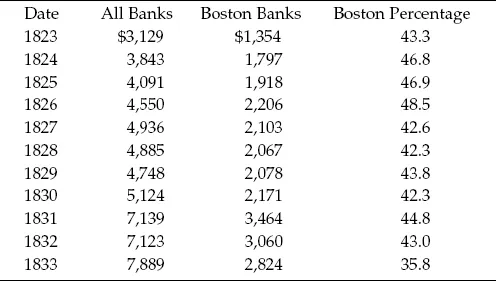
Source: Wilfred S. Lake, “The End of the Suffolk System,” Journal of Economic History 7, no. 4 (1947), p. 188.
The biggest, most powerful weapon Suffolk had to keep stability was the power to grant membership into the system. It accepted only banks whose notes were sound. While Suffolk could not prevent a bad bank from inflating, denying it membership ensured that the notes would not enjoy wide circulation. And the member banks that were mismanaged could be stricken from the list of Suffolk-approved New England banks in good standing. This caused an offending bank’s notes to trade at a discount at once, even though the bank itself might be still redeeming its notes in specie.
In another way, Suffolk exercised a stabilizing influence on the New England economy. It controlled the use of overdrafts in the system. When a member bank needed money, it could apply for an overdraft, that is, a portion of the excess reserves in the banking system. If Suffolk decided that a member bank’s loan policy was not conservative enough, it could refuse to sanction that bank’s application to borrow reserves at Suffolk. The denial of overdrafts to profligate banks thus forced those banks to keep their assets more liquid. (Few government central banks today have succeeded in that.) This is all the more remarkable when one considers that Suffolk—or any central bank—could have earned extra interest income by issuing overdrafts irresponsibly.
But Dr. George Trivoli, whose excellent monograph, The Suffolk Bank, we rely on in this study, states that by providing stability to the New England banking system, “it should not be inferred that the Suffolk bank was operating purely as public benefactor.” Suffolk, in fact, made handsome profits. At its peak in 1858, the last year of existence, it was redeeming $400 million in notes, with a total annual salary cost of only $40,000. The healthy profits were derived primarily from loaning out those reserve deposits which Suffolk itself, remember, did not pay interest on. These amounted to more than $1 million in 1858. The interest charged on overdrafts augmented that. Not surprisingly, Suffolk stock was the highest priced bank stock in Boston, and by 1850, regular dividends were 10 percent.
THE SUFFOLK DIFFERENCE
That the Suffolk system was able to provide note redemption much more cheaply than the U.S. government was stated by a U.S. comptroller of the currency. John Jay Knox compared the two systems from a vantage point of half a century:
[I]n 1857 the redemption of notes by the Suffolk Bank was almost $400,000,000 as against $137,697,696, in 1875, the highest amount ever reported under the National banking system. The redemptions in 1898 were only $66,683,476, at a cost of $1.29 per thousand. The cost of redemption under the Suffolk system was ten cents per $1,000, which does not appear to include transportation. If this item is deducted from the cost of redeeming National bank notes, it would reduce it to about ninety-four cents. This difference is accounted for by the relatively small amount of redemptions by the Treasury, and the increased expense incident to the necessity of official checks by the Government, and by the higher salaries paid. But allowing for these differences, the fact is established that private enterprise could be entrusted with the work of redeeming the circulating notes of the banks, and it could thus be done as safely and much more economically than the same service can be performed by the Government.102
The volume of redemptions was much larger under Suffolk than under the national banking system. During Suffolk’s existence (1825–57) they averaged $229 million per year. The average of the national system from its start in 1863 to about 1898 is put by Mr. Knox at only $54 million. Further, at its peak in 1858, $400 million was redeemed. But the New England money supply was only $40 million. This meant that, astoundingly, the average note was redeemed ten times per year, or once every five weeks.
Bank capital, note circulation, and deposits, considered together as “banking power,” grew in New England on a per capita basis much faster than in any other region of the country from 1803 to 1850. And there is some evidence that New England banks were not as susceptible to disaster during the several banking panics during that time. In the panic of 1837, not one Connecticut bank failed, nor did any suspend specie payments. All remained in the Suffolk system. And when in 1857 specie payment was suspended in Maine, all but three banks remained in business. As the Bank Commission of Maine stated,
The Suffolk system, though not recognized in banking law, has proved to be a great safeguard to the public; whatever objections may exist to the system in theory, its practical operation is to keep the circulation of our banks within the bounds of safety.
THE SUFFOLK’S DEMISE
The extraordinary profits—and power—that the Suffolk had by 1858 attained spawned competitors. The only one to become established was the Bank for Mutual Redemption in 1858. This bank was partially a response to the somewhat arrogant behavior of the Suffolk by this time, after 35 years of unprecedented success. But further, and more important, the balance of power in the state legislature had shifted outside of Boston, to the country bank areas. The politicians were more amenable to the desires of the overexpanding country banks. Still, it must be said that Suffolk acted toward the Bank of Mutual Redemption with spite where conciliation would have helped. Trying to force Mutual Redemption out of business, Suffolk, starting October 8, 1858, refused to honor notes of banks having deposits in the newcomer. Further, Suffolk in effect threatened any bank withdrawing deposits from it. But country banks rallied to the newcomer, and on October 16, Suffolk announced that it would stop clearing any country bank notes, thus becoming just another bank.
Only the Bank for Mutual Redemption was left, and though it soon had half the New England banks as members, it was much more lax toward overissuance by country banks. Perhaps the Suffolk would have returned amid dissatisfaction with its successor, but in 1861, just over two years after Suffolk stopped clearing, the Civil War began and all specie payments were stopped. As a final nail in the coffin, the national banking system Act of 1863 forbade the issuance of any state bank notes, giving a monopoly to the government that has continued ever since.
While it lasted, though, the Suffolk banking system showed that it is possible in a free-market system to have private banks competing to establish themselves as efficient, safe, and inexpensive clearinghouses limiting overissue of paper money.
THE CIVIL WAR
The Civil War exerted an even more fateful impact on the American monetary and banking system than had the War of 1812. It set the United States, for the first time except for 1814–1817, on an irredeemable fiat currency that lasted for two decades and led to reckless inflation of prices. This “greenback” currency set a momentous precedent for the post-1933 United States, and even more particularly for the post-1971 experiment in fiat money.
Perhaps an even more important consequence of the Civil War was the permanent change wrought in the American banking system. The federal government in effect outlawed the issue of state bank notes, and created a new, quasi-centralized, fractional reserve national banking system which paved the way for the return of outright central banking in the Federal Reserve System. The Civil War, in short, ended the separation of the federal government from banking, and brought the two institutions together in an increasingly close and permanent symbiosis. In that way, the Republican Party, which inherited the Whig admiration for paper money and governmental control and sponsorship of inflationary banking, was able to implant the soft-money tradition permanently in the American system.
GREENBACKS
The Civil War led to an enormous ballooning of federal expenditures, which skyrocketed from $66 million in 1861 to $1.30 billion four years later. To pay for these swollen expenditures, the Treasury initially attempted, in the fall of 1861, to float a massive $150 million bond issue, to be purchased by the nation’s leading banks. However, Secretary of the Treasury Salmon P. Chase, a former Jacksonian, tried to require the banks to pay for the loan in specie that they did not have. This massive pressure on their specie, as well as an increased public demand for specie due to a well-deserved lack of confidence in the banks, brought about a general suspension of specie payments a few months later, at the end of December 1861. This suspension was followed swiftly by the Treasury itself, which suspended specie payments on its Treasury notes.
The U.S. government quickly took advantage of being on an inconvertible fiat standard. In the Legal Tender Act of February 1862, Congress authorized the printing of $150 million in new “United States notes” (soon to be known as “greenbacks”) to pay for the growing war deficits. The greenbacks were made legal tender for all debts, public and private, except that the Treasury continued its legal obligation of paying the interest on its outstanding public debt in specie.103 The greenbacks were also made convertible at par into U.S. bonds, which remained a generally unused option for the public, and was repealed a year later.
In creating greenbacks in February, Congress resolved that this would be the first and last emergency issue. But printing money is a heady wine, and a second $150 million issue was authorized in July, and still a third $150 million in early 1863. Greenbacks outstanding reached a peak in 1864 of $415.1 million.
Greenbacks began to depreciate in terms of specie almost as soon as they were issued. In an attempt to drive up the price of government bonds, Secretary Chase eliminated the convertibility of greenbacks in July 1863, an act that simply drove their value down further. Chase and the Treasury officials, instead of acknowledging their own premier responsibility for the continued depreciation of the greenbacks, conveniently placed the blame on anonymous “gold speculators.” In March 1863, Chase began a determined campaign, which would last until he was driven from office, to stop the depreciation by controlling, assaulting, and eventually eliminating the gold market. In early March, he had Congress to levy a stamp tax on gold sales and to forbid loans on a collateral of coin above its par value. This restriction on the gold market had little effect, and when depreciation resumed its march at the end of the year, Chase decided to de facto repeal the requirement that customs duties be paid in gold. In late March 1864, Chase declared that importers would be allowed to deposit greenbacks at the Treasury and receive gold in return at a premium below the market. Importers could then use the gold to pay the customs duties. This was supposed to reduce greatly the necessity for importers to buy gold coin on the market and therefore to reduce the depreciation. The outcome, however, was that the greenback, at 59¢ in gold when Chase began the experiment, had fallen to 57¢ by mid-April. Chase was then forced to repeal his customsduties scheme.
With the failure of this attempt to regulate the gold market, Chase promptly escalated his intervention. In mid-April, he sold the massive amount of $11 million in gold in order to drive down the gold premium of greenbacks. But the impact was trifling, and the Treasury could not continue this policy indefinitely, because it had to keep enough gold in its vaults to pay interest on its bonds. At the end of the month, the greenback was lower than ever, having sunk to below 56¢ in gold.
Indefatigably, Chase tried yet again. In mid-May 1864, he sold foreign exchange in London at below-market rates in order to drive down pounds in relation to dollars, and, more specifically, to replace some of the U.S. export demand for gold in England. But this, too, was a failure, and Chase ended this experiment before the end of the month.
Finally, Secretary Chase decided to take off the gloves. He had failed to regulate the gold market; he would therefore end the depreciation of greenbacks by destroying the gold market completely. By mid-June, he had driven through Congress a truly despotic measure to prohibit under pain of severe penalties all futures contracts in gold, as well as all sales of gold by a broker outside his own office.
The result was disaster. The gold market was in chaos, with wide ranges of prices due to the absence of an organized market. Businessmen clamored for repeal of the “gold bill,” and, worst of all, the object of the law—to lower the depreciation of the paper dollar—had scarcely been achieved. Instead, public confidence in the greenback plummeted, and its depreciation in terms of gold got far worse. At the beginning of June, the greenback dollar was worth over 52¢ in gold. Apprehensions about the emerging gold bill drove the greenback down slightly to 51¢ in mid-June. Then, after the passage of the bill, the greenback plummeted, hitting 40¢ at the end of the month.
The disastrous gold bill was hastily repealed at the end of June, and perhaps not coincidentally, Secretary Chase was ousted from office at the same time. The war against the speculators was over.104, 105
As soon as greenbacks depreciated to less than 97¢ in gold, fractional silver coins became undervalued and so were exported to be exchanged for gold. By July 1862, in consequence, no coin higher than the copper-nickel penny remained in circulation. The U.S. government then leaped in to fill the gap with small tickets, first issuing postage stamps for the purpose, then bits of unglued paper, and finally, after the spring of 1863, fractional paper notes.106 A total of $28 million in postage currency and fractional notes had been issued by the middle of 1864. Even the nickel-copper pennies began to disappear from circulation, as greenbacks depreciated, and the nickel-copper coins began to move toward being undervalued. The expectation and finally the reality of undervaluation drove the coins into hoards and then into exports. Postage and fractional notes did not help matters, because their lowest denominations were 5¢ and 3¢, respectively. The penny shortage was finally alleviated when a debased and lighter-weight penny was issued in the spring of 1864, consisting of bronze instead of nickel and copper.107
As soon as the nation’s banks and the Treasury itself suspended specie payments at the end of 1861, Gresham’s Law went into operation and gold coin virtually disappeared from circulation, except for the government’s interest payments and importers’ customs duties. The swift issuance of legal tender greenbacks, which the government forced creditors to accept at par, ensured the continued disappearance of gold from then on.
The fascinating exception was California. There were very few banks during this period west of Nebraska, and in California the absence of banks was ensured by the fact that note-issuing banks, at least, were prohibited by the California constitution of 1849.108 The California gold discoveries of the late 1840s ensured a plentiful supply for coinage.
Used to a currency of gold coin only, with no intrusion of bank notes, California businessmen took steps to maintain gold circulation and avoid coerced payment in greenbacks. At first, the merchants of San Francisco, in November 1862 jointly agreed to refrain from accepting or paying out greenbacks at any but the (depreciated) market value, and to keep gold as the monetary standard. Any firms that refused to abide by the agreement would be blacklisted and required to pay gold in cash for any goods which they might purchase in the future.
Voluntary efforts did not suffice to overthrow the federal power standing behind legal tender, however, and so California merchants obtained the passage in the California legislature of a “specific contracts act” at the end of April 1863. The specific contracts act provided that contracts for the payment of specific kinds of money would be enforceable in the courts. After passage of that law, California businessmen were able to protect themselves against tenders of greenbacks by inserting gold coin payment clauses in all their contracts. Would that the other states, and even the federal government, had done the same!109 Furthermore, the private banks of deposit in California refused to accept greenbacks on deposit, newspapers used their influence to warn citizens about the dangers of greenbacks, and the state government refused to accept greenbacks in payment of taxes. In that way, all the major institutions in California joined in refusing to accept or give their imprimatur to federal inconvertible paper.
Judicial institutions also helped maintain the gold standard and repel the depreciated U.S. paper. Not only did the California courts uphold the constitutionality of the specific contracts act, but the California Supreme Court ruled in 1862 that greenbacks could not be accepted in state or county taxes, since the state constitution prohibited any acceptance of paper money for taxes.
The state of Oregon was quick to follow California’s lead. Oregon’s constitution had also outlawed banks of issue, and gold had for years been the exclusive currency. Two weeks after the agreement of the San Francisco merchants, the merchants of Salem, Oregon, unanimously backed gold as the monetary standard and refused to accept greenbacks at par. Two months later, the leading merchants of Portland agreed to accept greenbacks only at rates current in San Francisco; the merchants in the rest of the state were quick to follow suit. The Portland merchants issued a circular warning of a blacklist of all customers who insisted on settling their debts in greenbacks, and they would be quickly boycotted, and dealings with them would only be in cash.
Oregon deposit banks also refused to accept greenbacks, and the Oregon legislature followed California a year and a half later in passing a specific performance law. Oregon, too, refused to accept greenbacks in taxes and strengthened the law in 1864 by requiring that “all taxes levied by state, counties, or municipal corporations therein, shall be collected and paid in gold and silver coin of the United States and not otherwise.”110
In the same year, the Oregon Supreme Court followed California in ruling that greenbacks could not constitutionally be received in payment of taxes.
The banking story during the Civil War is greatly complicated by the advent of the national banking system in the latter part of the war. But it is clear that the state banks, being able to suspend specie and to pyramid money and credit on top of the federal greenbacks, profited greatly by being able to expand during this period. Thus, total state bank notes and deposits were $510 million in 1860, and by 1863 rose to $743 million, an increase in state bank demand liabilities in those three years of 15.2 percent per year.111
It is no wonder, then, that contrary to older historical opinion, many state banks were enthusiastic about the greenbacks, which provided them with legal tender that could function as a reserve base upon which they could expand. As Hammond puts it, “Instead of being curbed (as some people supposed later), the powers of the banks were augmented by the legal tender issues. As the issues increased, the deposits of the banks would increase.”112 Indeed, Senator Sherman (R-Ohio) noted that the state banks favored greenbacks. And the principal author of the greenback legislation, Representative Elbridge G. Spaulding (R-N.Y.), the chairman of the House Ways and Means subcommittee that introduced the bill, was himself a Buffalo banker.
The total money supply of the country (including gold coin, state bank notes, subsidiary silver, and U.S. currency including fractional and greenbacks) amounted to $745.4 million in 1860. By 1863, the money supply had skyrocketed to $1.435 billion, an increase of 92.5 percent in three years, or 30.8 percent per annum. By the end of the war, the money supply, which now included national bank notes and deposits, totaled $1.773 billion, an increase in two years of 23.6 percent or 11.8 percent per year. Over the entire war, the money supply rose from $45.4 million to $1.773 billion, an increase of 137.9 percent, or 27.69 percent per annum.113
The response to this severe monetary inflation was a massive inflation of prices. It is no wonder that the greenbacks, depreciating rapidly in terms of gold, depreciated in terms of goods as well. Wholesale prices rose from 100 in 1860 to 210.9 at the end of the war, a rise of 110.9 percent, or 22.2 percent per year.114
The Republican administration argued that its issue of greenbacks was required by stern wartime “necessity.” The spuriousness of this argument is seen by the fact that greenbacks were virtually not issued after the middle of 1863. There were three alternatives to the issuance of legal tender fiat money. (1) The government could have issued paper money but not made it legal tender; it would have depreciated even more rapidly. At any rate, they would have had quasi–legal tender status by being receivable in federal dues and taxes. (2) It could have increased taxes to pay for the war expenditures. (3) It could have issued bonds and other securities and sold the debt to banks and non-bank institutions. In fact, the government employed both the latter alternatives, and after 1863 stopped issuing greenbacks and relied on them exclusively, especially a rise in the public debt. The accumulated deficit piled up during the war was $2.614 billion, of which the printing of greenbacks only financed $431.7 million. Of the federal deficits during the war, greenbacks financed 22.8 percent in fiscal 1862, 48.5 percent in 1863, 6.3 percent in 1864, and none in 1865.115 This is particularly striking if we consider that the peak deficit came in 1865, totaling $963.8 million. All the rest was financed by increased debt. Taxes also increased greatly, revenues rising from $52 million in 1862 to $333.7 million in 1865. Tax revenues as a percentage of the budget rose from a miniscule 10.7 percent in fiscal 1862 to over 26 percent in 1864 and 1865.
It is clear, then, that the argument of “necessity” in the printing of greenbacks was specious, and indeed the greenback advocates conceded that it was perfectly possible to issue public debt, provided that the administration was willing to see the prices of its bonds rise and its interest payments rise considerably. At least for most of the war, they were not willing to take their chances in the competitive bond market.116
THE PUBLIC DEBT AND THE NATIONAL BANKING SYSTEM
The public debt of the Civil War brought into American financial history the important advent of one Jay Cooke. The Ohio-born Cooke had joined the moderately successful Philadelphia investment banking firm of Clark and Dodge as a clerk at the age of 18. In a few years, Cooke worked himself up to the status of junior partner, and, in 1857, he left the firm to branch out on his own in canal and railroad promotion and other business ventures. There he doubtless would have remained, except for the lucky fact that he and his brother Henry, editor of the leading Republican newspaper in Ohio, the Ohio State Journal, were close friends of U.S. Senator Salmon P. Chase. Chase, a veteran leader of the antislavery movement, fought for and lost the Republican presidential nomination in 1860 to Abraham Lincoln. At that point, the Cookes determined to feather their nest by lobbying to make Salmon Chase secretary of the Treasury. After heavy lobbying by the Cookes, the Chase appointment was secured, so Jay Cooke quickly set up his own investment banking house of Jay Cooke and Company.
Everything was in place; it now remained to seize the opportunity. As the Cookes’ father wrote of Henry:
I took up my pen principally to say that H.S.’s [Henry’s] plan in getting Chase into the Cabinet and [John] Sherman into the Senate is accomplished, and that now is the time for making money, by honest contracts out of the government.117
Now indeed was their time for making money, and Cooke lost no time in doing so. It did not take much persuasion, including wining and dining, for Cooke to induce his friend Chase to take an unprecedented step in the fall of 1862: granting the House of Cooke a monopoly on the underwriting of the public debt. With enormous energy, Cooke hurled himself into the task of persuading the mass of public to buy U.S. government bonds. In doing so, Cooke perhaps invented the art of public relations and of mass propaganda; certainly, he did so in the realm of selling bonds. As Kirkland writes:
With characteristic optimism, he [Cooke] flung himself into a bond crusade. He recruited a small army of 2,500 sub-agents among bankers, insurance men, and community leaders and kept them inspired and informed by mail and telegraph. He taught the American people to buy bonds, using lavish advertising in newspapers, broadsides, and posters. God, destiny, duty, courage, patriotism—all summoned “Farmers, Mechanics, and Capitalists” to invest in loans118
—loans which of course they had to purchase from Jay Cooke.
And purchase the loans they did, for Cooke’s bond sales soon reached the enormous figure of $1 million to $2 million dollars a day. Perhaps $2 billion in bonds were bought and underwritten by Jay Cooke during the war. Cooke lost his monopoly in 1864, under pressure of rival bankers; but a year later he was reappointed to keep that highly lucrative post until the House of Cooke crashed in the panic of 1873.
In the Civil War, Jay Cooke began as a moderately successful promoter; he emerged at war’s end a millionaire, a man who had spawned the popular motto, “as rich as Jay Cooke.” Surely he must have counted the $100,000 he had poured into Salmon Chase’s political fortunes by 1864 as one of the most lucrative investments he had ever made.
It is not surprising that Jay Cooke acquired enormous political influence in the Republican administration of the Civil War and after. Hugh McCulloch, secretary of the Treasury from 1865 to 1869, was a close friend of Cooke’s, and when McCulloch left office he assumed the post as head of Cooke’s London office. The Cooke brothers were also good friends of General Ulysses Grant, so they wielded great influence during the Grant administration.
No sooner had Cooke secured the monopoly of government bond underwriting than he teamed up with his associates, Secretary of the Treasury Chase and Ohio’s Senator John Sherman, to drive through a measure which was destined to have far more fateful effects than greenbacks on the American monetary system: the national banking system. The National Banking Acts destroyed the previously decentralized and fairly successful state banking system, and substituted a new, centralized, and far more inflationary banking system under the aegis of Washington and a handful of Wall Street banks. Whereas the effects of the greenbacks were finally eliminated by the resumption of specie payments in 1879, the effects of the national banking system are still with us. Not only was this system in place until 1913, but it paved the way for the Federal Reserve System by instituting a quasi–central banking type of monetary system. The “inner contradictions” of the national banking system were such that the nation was driven either to go onward to a frankly central bank or else to scrap centralized banking altogether and go back to decentralized state banking. Given the inner dynamic of state intervention to keep intensifying, coupled with the almost universal adoption of statist ideology after the turn of the twentieth century, which course the nation would take was unfortunately inevitable.
Chase and Sherman drove the new system through under cover of war necessity, but it was designed to alter the banking system permanently. The wartime ground was to set up national banks, which were so structured as to necessarily purchase large amounts of U.S. government bonds. Patterned after the “free” banking systems, this tied the nation’s banks with the federal government and the public debt in a close symbiotic relationship. The Jacksonian embarrassment of the independent Treasury was de facto swept away, and the Treasury would now keep its deposits in a new series of “pets”: the national banks, chartered directly by the federal government. In this way, the Republican Party was able to use the wartime emergency to fulfill the Whig-Republican dream of a federally-controlled centralized banking system able to inflate the supply of money and credit in a uniform manner. Meshing with this was a profound political goal: As Sherman expressly pointed out, a vital object of the national banking system was to eradicate the embarrassing doctrine of state’s rights and to nationalize American politics.119
As established in the bank acts of 1863 and 1864, the national banking system provided for the chartering of national banks by the Office of the Comptroller of the Currency in Washington, D.C. The banks were “free” in that any institution meeting the requirements could obtain a charter, but the requirements were so high (from $50,000 for rural banks to $200,000 in the bigger cities) that small national banks were ruled out, particularly in the large cities.120
The national banking system created three sets of national banks: central reserve city, which was only New York; reserve city, others cities with over 500,000 population; and country, which included all other national banks.
Central reserve city banks were required to keep 25 percent of their notes and deposits in reserve of vault cash or “lawful money,” which included gold, silver, and greenbacks. This provision incorporated the “reserve requirement” concept that had been a feature of the “free” banking system. Reserve city banks, on the other hand, were allowed to keep one-half of their required reserves in vault cash, while the other half could be kept as demand deposits (checking deposits) in central reserve city banks. Finally, country banks only had to keep a minimum reserve ratio of 15 percent of their notes and deposits; and only 40 percent of these reserves had to be in the form of vault cash. The other 60 percent could be in the form of demand deposits either at reserve city or central reserve city banks.
The upshot of this system was to replace the individualized structure of the pre–Civil War state banking system by an inverted pyramid of country banks expanding on top of reserve city banks, which in turn expanded on top of New York City banks. Before the Civil War, every bank had to keep its own specie reserves, and any pyramiding of notes and deposits on top of that was severely limited by calls for redemption in specie by other, competing banks as well as by the general public. But now, reserve city banks could keep half of their reserves as deposits in New York City banks, and country banks could keep most of theirs in one or the other, so that as a result, all the national banks in the country could pyramid in two layers on top of the relatively small base of reserves in the New York banks. And furthermore, those reserves could consist of inflated greenbacks as well as specie.
A simplified schematic diagram can portray the essence of this revolution in American banking:
Figure 1

Figure 1 shows state banks in the decentralized system before the Civil War. Every bank must stand or fall on its bottom. It can pyramid notes and deposits on top of specie, but its room for such inflationary expansion is limited, because any bank’s expansion will cause increased spending by its clients on the goods or services of other banks. Notes or checks on the expanding bank will go into the coffers of other banks, which will call on the expanding bank for redemption. This will put severe pressure on the expanding bank, which cannot redeem all of its liabilities as it is, and whose reserve ratio has declined, so it will be forced to either contract its loans and liabilities or else go under.
Figure 2
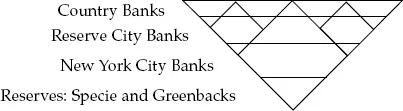
Figure 2 depicts the inverted pyramid of the national banking system. New York City banks pyramid notes and deposits on top of specie and greenbacks; reserve city banks pyramid their notes and deposits on top of specie, greenbacks, and deposits at New York City; and country banks pyramid on top of both. This means that, for example, if New York City banks inflate and expand their notes and deposits, they will not be checked by other banks calling upon them for redemption. Instead, reserve city banks will be able to expand their own loans and liabilities by pyramiding on top of their own increased deposits at New York banks. In turn, the country banks will be able to inflate their credit by pyramiding on top of their increased deposits at both reserve city and New York banks. The whole nation is able to inflate uniformly and relatively unchecked by pyramiding on top of a few New York City banks.
The national banks were not compelled to keep part of their reserves as deposits in larger banks, but they tended to do so—in the long run, so that they could expand uniformly on top of the larger banks, and in the short run because of the advantages of having a line of credit with a larger “correspondent” bank as well as earning interest on demand deposits at that bank.121
Let us illustrate in another way how the national banking system pyramided by centralizing reserves. Let us consider the hypothetical balance sheets of the various banks.122 Suppose that the country banks begin with $1 million in vault cash as their reserves. With the national banking system in place, the country banks can now deposit three-fifths, or $600,000, of their cash in reserve city banks, in return for interest-paying demand deposits at those banks.
The balance-sheet changes are now as follows:
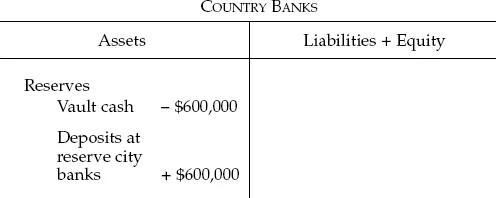
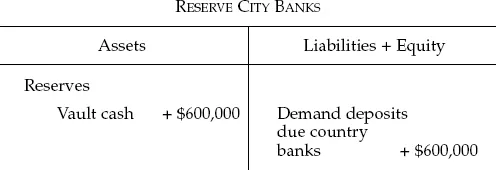
Total reserves for the two sets of banks have not changed. But now because the country banks can use as their reserves deposits in reserve city banks, the same total reserves can be used by the banks to expand far more of their credit. For now $400,000 in cash supports the same total of notes and deposits that the country banks had previously backed by $1 million, and the reserve city banks can now expand $2.4 million on top of the new $600,000 in cash—or rather, $1.8 million in addition to the $600,000 due to the city banks. In short, country bank reserves have remained the same, but reserve city bank reserves have increased by $600,000, and they can engage in 4-to-1 pyramiding of credit on top of that.
But that is not all. The reserve city banks can deposit half of their reserves at the New York banks. When they do that, then the balance sheets of the respective banks change as follows:
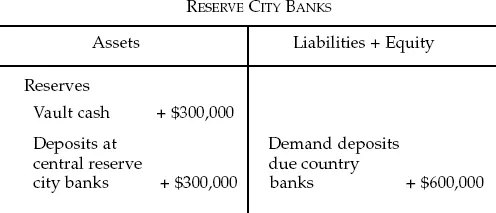
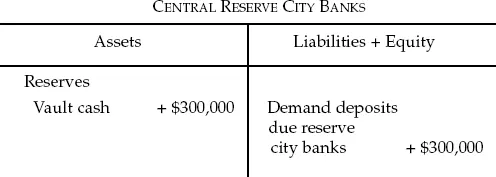
Note that since the reserve city banks are allowed to keep half of their reserves in the central reserve city banks, the former can still pyramid $2.4 million on top of their new $600,000, and yet deposit $300,000 in cash at the New York banks. The latter, then, can expand another 4-to-1 on top of the new cash of $300,000, or increase their total notes and deposits to $1.2 million.
In short, not only did the national banking system allow pyramiding of the entire banking structure on top of a few large Wall Street banks, but the very initiating of the system allowed a multiple expansion of all bank liabilities by centralizing a large part of the nation’s cash reserves from the individual state banks into the hands of the larger, and especially the New York, banks. For the expansion of $1.2 million on top of the new $300,000 at New York banks served to expand the liabilities going to the smaller banks, which in turn could pyramid on top of their increased deposits. But even without that further expansion, $1 million which, we will assume, originally supported $6 million in notes and deposits, will now support, in addition to that $6 million, $2.4 million issued by the reserve city banks, and $1.2 million by the New York banks—to say nothing of further expansion by the latter two sets of banks which will allow country banks to pyramid more liabilities.
In June 1874, the fundamental structure of the national banking system was changed when Congress, as part of an inflationist move after the panic of 1873, eliminated all reserve requirements on notes, keeping them only on deposits. This released over $20 million of lawful money from bank reserves and allowed a further pyramiding of demand liabilities.123 In the long run, it severed the treatment of notes from deposits, with notes tied rigidly to bank holdings of government debt, and demand deposits pyramiding on top of reserve ratios in specie and greenbacks.
But this centralized inverse pyramiding of bank credit was not all. For, in a way modeled by the “free” banking system, every national bank’s expansion of notes was tied intimately to its ownership of U.S. government bonds. Every bank could only issue notes if it deposited an equivalent of U.S. securities as collateral at the U.S. Treasury,124 so that national banks could only expand their notes to the extent that they purchased U.S. government bonds. This provision tied the national banking system intimately to the federal government, and more particularly, to its expansion of public debt. The federal government had an assured, built-in market for its debt, and the more the banks purchased that debt, the more the banking system could inflate. Monetizing the public debt was not only inflationary per se, it provided the basis—when done by the larger city banks—of other banks pyramiding on top of their own monetary expansion.
The tie-in and the pyramiding process were cemented by several other provisions. Every national bank was obliged to redeem the obligations of every other national bank at par. Thus, the severe market limitation on the circulation of inflated notes and deposits—depreciation as the distance from the bank increases—was abolished. And while the federal government could not exactly make the notes of a private bank legal tender, it conferred quasi–legal tender status on every national bank by agreeing to receive all its notes and deposits at par for dues and taxes.125 It is interesting and even heartening to discover that despite these enormous advantages conferred by the federal government, national bank notes fell below par with greenbacks in the financial crisis of 1867, and a number of national banks failed the next year.126
Genuine redeemability, furthermore, was made very difficult under the national banking system. Laxity was ensured by the fact that national banks were required to redeem the notes and deposits of every other national bank at par, and yet it was made difficult for them to actually redeem those liabilities in specie; for one of the problems with the pre–Civil War state banking system was that interstate or even intrastate branches were illegal, thereby hobbling the clearing system for swiftly redeeming another bank’s notes and deposits. One might think that a national banking system would at least eliminate this problem, but on the contrary, branch banking continued to be prohibited, and interstate branch banking is illegal to this day.* A bank would only have to redeem its notes at its own counter in its home office. Furthermore, the redemption of notes was crippled by the fact that the federal government imposed a maximum limit of $3 million a month by which national bank notes could be contracted.127
Reserve requirements are now considered a sound and precise way to limit bank credit expansion, but the precision can work two ways. Just as government safety codes can decrease safety by setting a lower limit for safety measures and inducing private firms to reduce safety downward to that common level, so reserve requirements can and ordinarily do serve as lowest common denominators for bank reserve ratios. Free competition can and generally will result in banks voluntarily keeping higher reserve ratios. But a uniform legal requirement will tend to push all the banks down to that minimum ratio. And indeed we can see this now in the universal propensity of all banks to be “fully loaned up,” that is, to expand as much as is legally possible up to the limits imposed by the legal reserve ratio. Reserve requirements of less than 100 percent are more an inflationary than a restrictive monetary device.
The national banking system was intended to replace the state banks, but many state banks continued aloof and refused to join, despite the special privileges accorded to the national banks. The reserve and capital requirements were more onerous, and at that period, national banks were prohibited from making loans on real estate. With the state banks refusing to come to heel voluntarily, Congress, in March 1865, completed the Civil War revolution of the banking system by placing a prohibitive 10-percent tax on all bank notes—which had the desired effect of virtually outlawing all note issues by the state banks. From 1865 on, the national banks had a legal monopoly on the issue of bank notes.
At first, the state banks contracted and disappeared under the shock, and it looked as if the United States would only have national banks. The number of state banks fell from 1,466 in 1863 to 297 in 1866, and total notes and deposits in state banks fell from $733 million in 1863 to only $101 million in 1866. After several years, however, the state banks readily took their place as an expanding element in the banking system, albeit subordinated to the national banks. In order to survive, the state banks had to keep deposit accounts at national banks, from whom they could “buy” national bank notes in order to redeem their deposits. In short, the state banks now became the fourth layer of the national pyramid of money and credit, on top of the country and other banks, for the reserves of the state banks became, in addition to vault cash, demand deposits at national banks, which they could redeem in cash. The multi-layered structure of bank inflation under the national banking system was intensified.
In this new structure, the state banks began to flourish. By 1873, the total number of state banks had increased to 1,330, and their total deposits were $789 million.128
The Cooke-Chase connection with the new national banking system was simple. As secretary of the Treasury, Chase wanted an assured market for the government bonds that were being issued so heavily during the Civil War. And as the monopoly underwriter of U.S. government bonds for every year except one from 1862 to 1873, Jay Cooke was even more directly interested in an assured and expanding market for his bonds. What better method of obtaining such a market than creating an entirely new banking system, the expansion of which was directly tied to the banks’ purchases of government bonds— from Jay Cooke?
The Cooke brothers played a major role in driving the National Banking Act of 1863 through a reluctant Congress. The Democrats, devoted to hard money, opposed the legislation almost to a man. Only a majority of Republicans could be induced to agree on the bill. After John Sherman’s decisive speech in the Senate for the measure, Henry Cooke—now head of the Washington office of the House of Cooke—wrote jubilantly to his brother:
It will be a great triumph, Jay, and one to which we have contributed more than any other living man. The bank had been repudiated by the House, and was without a sponsor in the Senate, and was thus virtually dead and buried when I induced Sherman to take hold of it, and we went to work with the newspapers.129
Going to work with the newspapers meant something more than mere persuasion for the Cooke brothers; as monopoly underwriter of government bonds, Cooke was paying the newspapers large sums for advertising, and so the Cookes thought—as it turned out correctly—that they could induce the newspapers to grant them an enormous amount of free space “in which to set forth the merits of the new national banking system.” Such space meant not only publicity and articles, but even more important, the fervent editorial support of most of the nation’s press. And so the press, implicitly bought for the occasion, kept up a drumfire of propaganda for the new national banking system. As Cooke himself related:
For six weeks or more nearly all the newspapers in the country were filled with our editorials [written by the Cooke brothers] condemning the state bank system and explaining the great benefits to be derived from the national banking system now proposed.
And every day the indefatigable Cookes put on the desks of every member of Congress the relevant editorials from newspapers in their respective districts.130
While many state bankers, especially the conservative old-line New York bankers, opposed the national banking system, Jay Cooke, once the system was in place, plunged in with a will. Not only did he sell the national banks their required bonds, he also set up new national banks which would have to buy his government securities. His agents formed national banks in the smaller towns of the south and west. Furthermore, he set up two large national banks, the First National Bank of Philadelphia and the First National Bank of Washington, D.C.
But the national banking system was in great need of a mighty bank in New York City to serve as the base of the inflationary pyramid for a host of country and reserve city banks. Shortly after the inception of the system, three national banks had been organized in New York, but none of them were large enough or prestigious enough to serve as the key fulcrum of the new banking structure. Jay Cooke, however, was happy to oblige, and he quickly established the Fourth National Bank of New York, capitalized at a huge $5 million. After the war, Jay Cooke favored resumption of specie payments, but only if greenbacks could be replaced one-to-one by new national bank notes. In his unbounded enthusiasm for national bank notes and their dependence on the federal debt, Cooke urged repeal of the $300 million legal limit on national bank note issue. In 1865, he published a pamphlet proclaiming that in less than 20 years national bank note circulation would total $1 billion.131
The title of the pamphlet Cooke published is revealing: How Our National Debt May Be A National Blessing. The Debt is Public Wealth, Political Union, Protection of Industry, Secure Basis for National Currency.132
By 1866, it was clear that the national banking system had replaced the state as the center of the monetary system of the United States. Only a year earlier, in 1865, state bank notes had totaled $142.9 million; by 1866 they had collapsed to $20 million. On the one hand, national bank notes grew from a mere $31.2 million in 1864, their first year of existence, to $276 million in 1866. And while, as we have seen, the number of state banks in existence was falling drastically from 1,466 to 297, the number of national banks grew in that same period, from 66 in 1863 to 1,634 three years later.
THE POST–CIVIL WAR ERA: 1865–1879
The United States ended the war with a depreciated inconvertible greenback currency, and a heavy burden of public debt. The first question on the monetary agenda was what to do about the greenbacks. A powerful group of industrialists calling for continuation of greenbacks, opposing resumption and, of course, any contraction of money to prepare for specie resumption, was headed by the Pennsylvania iron and steel manufacturers. The Pennsylvania ironmasters, who had been in the forefront of the organized protective tariff movement since its beginnings in 1820,133 were led here and instructed by their intellectual mentor—himself a Pennsylvania ironmaster—the elderly economist Henry C. Carey. Carey and his fellow iron manufacturers realized that during an inflation, since the foreign exchange market anticipates further inflation, domestic currency tends to depreciate faster than domestic prices are rising. A falling dollar and a rising price of gold, they realized, make domestic prices cheaper and imported prices higher, and hence function as a surrogate tariff. A cheap-money, inflationist policy, then, could not only provide easy credit for manufacturing, it could also function as an extra tariff because of the depreciation of the dollar and the rise in the gold premium.
Imbibers of the Carey gospel of high tariffs and soft money were a host of attendees at the famous “Carey Vespers”— evenings of discussion of economics and politics. Influential Carey disciples included economist and Pennsylvania ironmaster Stephen Colwell; Eber Ward, president of the Iron and Steel Association; John A. Williams, editor of the association’s journal, Iron Age; Representative Daniel Morrell, Pennsylvania iron manufacturer; I. Smith Homans, Jr., editor of The Bankers Magazine; and powerful U.S. Representative William D. Kelley of Pennsylvania, whose lifelong devotion to the interest of the ironmasters earned him the proud sobriquet “Old Pig Iron.” The Carey circle also dominated the American Industrial League, which spread the Carey doctrines of protection and paper money. Influential allies in Congress, if not precisely Carey followers, were the radical leader Representative Thaddeus Stevens, himself a Pennsylvania ironmaster, and Representative John A. Griswold, an ironmaster from New York.
Also sympathetic to greenbacks were many manufacturers who desired cheap credit, gold speculators who were betting on higher gold prices, and railroads, which as heavy debtors to their bondholders, realized that inflation benefits debtors by cheapening the dollar whereas it also tends to expropriate creditors by the same token. One of the influential Carey disciples, for example, was the leading railroad promoter, the Pennsylvanian Thomas A. Scott, leading entrepreneur of the Pennsylvania and the Texas and Pacific Railroads.134
One of the most flamboyant advocates of greenback inflation in the postwar era was the Wall Street stock speculator Richard Schell. In 1874, Schell became a member of Congress, where he proposed an outrageous pre-Keynesian scheme in the spirit of Keynes’s later dictum that so long as money is spent, it doesn’t matter what the money is spent on, be it pyramid-building or digging holes in the ground.135 Schell seriously urged the federal government to dig a canal from New York to San Francisco, financed wholly by the issue of greenbacks. Schell’s enthusiasm was perhaps matched only by that of the notorious railroad speculator and economic adventurer George Francis Train, who called repeatedly for immense issues of greenbacks. Train thundered in 1867:
Give us greenbacks we say, and build cities, plant corn, open coal mines, control railways, launch ships, grow cotton, establish factories, open gold and silver mines, erect rolling mills.... Carry my resolution and there is sunshine in the sky.136
The panic of 1873 was a severe blow to many overbuilt railroads, and it was railroad men who led in calling for more greenbacks to stem the tide. Thomas Scott; Collis P. Huntington, leader of the Central Pacific Railroad; Russel Sage; and other railroad men joined in the call for greenbacks. So strong was their influence that the Louisville Courier-Journal, in April 1874, declared: “The strongest influence at work in Washington upon the currency proceeded from the railroads.... The great inflationists after all, are the great trunk railroads.”137
The greenback problem after the Civil War was greatly complicated by the massive public debt that lay over the heads of the American people. A federal debt, which had tallied only $64.7 million in 1860, amounted to the huge amount of $2.32 billion in 1866. Many ex-Jacksonian Democrats, led by Senator George H. Pendleton of Ohio, began to agitate for further issue of greenbacks solely for the purpose of redeeming the principal of federal debts contracted in greenbacks during the war.138 In a sense, then, hard-money hostility to both inflation and the public debt were now at odds. In a sense, the Pendletonians were motivated by a sense of poetic justice, of paying inflated debts in inflated paper, but in doing so they lost sight of the broader hard-money goal.139 This program confused the party struggles of the post–Civil War period, but ultimately it is safe to say that the Democrats had a far greater proportion of congressmen devoted to hard money and to resumption than did the Republicans. Thus, Secretary of the Treasury Hugh McCulloch’s “Loan Bill” of March 1866, which provided for contraction of greenbacks in preparation for resumption of specie payments, was passed in the House by a Republican vote of 56–52, and a Democratic vote of 27–1. And in April 1874, the “Inflation Bill,” admittedly vetoed later by President Grant, which provided for expansion of greenbacks and of national bank notes, was passed in the House by a Republican vote of 105–64, while the Democrats voted against by the narrow margin of 35–37.140
In the meantime, despite repeated resolutions for resumption of specie payments in 1865 and 1869, the dominant Republican Party continued to do nothing for actual resumption. The Pendleton Plan was adopted by the Democrats in their 1868 platform, and the Republican victory in the presidential race that year was generally taken as a conclusive defeat for that idea. Finally, however, the Democratic sweep in the congressional elections of 1874 forced the Republicans into a semblance of unity on monetary matters, and, in the lame-duck congressional session led by Senator John Sherman, they came up with the Resumption Act of January 1875.
Despite the fact that the Resumption Act ultimately resulted in specie resumption, it was not considered a hard-money victory by contemporaries. Sherman had forged a compromise between hard- and soft-money forces. It is true that the U.S. government was supposed to buy gold with government bonds to prepare for resumption on January 1, 1879. But this resumption was four years off, and Congress had expressed intent to resume several times before. And in the meantime, the soft-money men were appeased by the fact that the bill immediately eliminated the $300 million limit on national bank notes, in a provision known as “free banking.” The only hard-money compensation was an 80-percent pro rata contraction of greenbacks to partially offset any new national bank notes.141 The bulk of the opposition to the Resumption Act was by hard-money congressmen, who, in addition to pointing out its biased ambiguities, charged that the contracted greenbacks could be reissued instead of retired. Hardmoney forces throughout the country had an equally scornful view of the Resumption Act. In a few years, however, they rallied as resumption drew near.
That the Republicans were generally less than enthusiastic about specie resumption was revealed by the Grant administration’s reaction to the Supreme Court’s decision in the first legal tender case. After the end of the war, the question of the constitutionality of legal tender came before the courts (we have seen that the California and Oregon courts decided irredeemable paper to be unconstitutional). In the large number of state court decisions on greenbacks before 1870, every Republican judge but one upheld their constitutionality, whereas every Democratic judge but two declared them unconstitutional.142
The greenback question reached the U.S. Supreme Court in 1867, and was decided in February 1870, in the case of Hepburn v. Griswold. The Court held, by a vote of 5–3, with all the Democratic judges voting with the majority and the Republicans in the minority. Chief Justice Salmon P. Chase, who delivered the decision denouncing his own action as secretary of the Treaury as unnecessary and unconstitutional, had swung back to the Democratic Party and had actually been a candidate for the presidential nomination at the 1868 convention.
The Grant administration was upset by Hepburn v. Griswold, as were the railroads, who had accumulated a heavy long-term debt, which would now be payable in more valuable gold. As luck would have it, however, there were two vacancies on the Court, one of which was created by the retirement of one of the majority judges. Grant appointed not only two Republican judges, but two railroad lawyers whose views on the subject were already known.143 The new 5–4 majority dutifully and quickly reconsidered the question, and, in May 1871, reversed the previous Court in the fateful decision of Knox v. Lee. From then on, paper money would be held consonant with the U.S. Constitution.
The national banking system was ensconced after the Civil War. The number of banks, national bank notes, and deposits all pyramided upward, and after 1870 state banks began to boom as deposit-creating institutions. With lower requirements and fewer restrictions than the national banks, they could pyramid on top of national banks. The number of national banks increased from 1,294 in 1865 to 1,968 in 1873, while the number of state banks rose from 349 to 1,330 in the same period. Total state and national bank notes and deposits rose from $835 million in 1865 to $1.964 billion in 1873, an increase of 135.2 percent or an increase of 16.9 percent per year. The following year, the supply of bank money leveled off as the panic of 1873 struck and caused numerous bankruptcies.
As a general overview of the national banking period, we can agree with Klein that
The financial panics of 1873, 1884, 1893, and 1907 were in large part an outgrowth of... reserve pyramiding and excessive deposit creation by reserve city and central reserve city banks. These panics were triggered by the currency drains that took place in periods of relative prosperity when banks were loaned up.144
And yet it must be pointed out that the total money supply, even merely the supply of bank money, did not decrease after the panic, but merely leveled off.
Orthodox economic historians have long complained about the “great depression” that is supposed to have struck the United States in the panic of 1873 and lasted for an unprecedented six years, until 1879. Much of this stagnation is supposed to have been caused by a monetary contraction leading to the resumption of specie payments in 1879. Yet what sort of “depression” is it which saw an extraordinarily large expansion of industry, of railroads, of physical output, of net national product, or real per capita income? As Friedman and Schwartz admit, the decade from 1869 to 1879 saw a 3-percent-perannum increase in money national product, an outstanding real national product growth of 6.8 percent per year in this period, and a phenomenal rise of 4.5 percent per year in real product per capita. Even the alleged “monetary contraction” never took place, the money supply increasing by 2.7 percent per year in this period. From 1873 through 1878, before another spurt of monetary expansion, the total supply of bank money rose from $1.964 billion to $2.221 billion—a rise of 13.1 percent or 2.6 percent per year. In short, a modest but definite rise, and scarcely a contraction.
It should be clear, then, that the “great depression” of the 1870s is merely a myth—a myth brought about by misinterpretation of the fact that prices in general fell sharply during the entire period. Indeed they fell from the end of the Civil War until 1879. Friedman and Schwartz estimated that prices in general fell from 1869 to 1879 by 3.8 percent per annum. Unfortunately, most historians and economists are conditioned to believe that steadily and sharply falling prices must result in depression: hence their amazement at the obvious prosperity and economic growth during this era. For they have overlooked the fact that in the natural course of events, when government and the banking system do not increase the money supply very rapidly, free-market capitalism will result in an increase of production and economic growth so great as to swamp the increase of money supply. Prices will fall, and the consequences will be not depression or stagnation, but prosperity (since costs are falling, too) economic growth, and the spread of the increased living standard to all the consumers.145
Indeed, recent research has discovered that the analogous “great depression” in England in this period was also a myth, and due to a confusion between a contraction of prices and its alleged inevitable effect on a depression of prices and its alleged inevitable effect on a depression of business activity.146
It might well be that the major effect of the panic of 1873 was, not to initiate a great depression, but to cause bankruptcies in overinflated banks and in railroads riding on the tide of vast government subsidy and bank speculation. In particular, we may note Jay Cooke, one of the creators of the national banking system and paladin of the public debt. In 1866, he favored contraction of the greenbacks and early resumption because he feared that inflation would destroy the value of government bonds. By the late 1860s, however, the House of Cooke was expanding everywhere, and in particular, had gotten control of the new Northern Pacific Railroad. Northern Pacific had been the recipient of the biggest federal largesse to railroads during the 1860s: a land grant of no less than 47 million acres.
Cooke sold Northern Pacific bonds as he had learned to sell government securities: hiring pamphleteers to write propaganda about the alleged Mediterranean climate of the Northwest. Many leading government officials and politicians were on the Cooke–Northern Pacific payroll, including President Grant’s private secretary, General Horace Porter.
In 1869, Cooke expressed his monetary philosophy in keeping with his enlarged sphere of activity:
Why should this Grand and Glorious Country be stunted and dwarfed—its activities chilled and its very life blood curdled by these miserable “hard coin” theories—the musty theories of a by gone age—These men who are urging on premature resumption know nothing of the great growing west which would grow twice as fast if it was not cramped for the means necessary to build RailRoads and improve farms and convey the produce to market.
But in 1873, a remarkable example of poetic justice struck Jay Cooke. The overbuilt Northern Pacific was crumbling, and a Cooke government bond operation provided a failure. So the mighty House of Cooke—“stunted and dwarfed” by the market economy—crashed and went bankrupt, touching off the panic of 1873.147
After passing the Resumption Act in 1875, the Republicans finally stumbled their way into resumption in 1879, fully 14 years after the end of the Civil War. The money supply did not contract in the late 1870s because the Republicans did not have the will to contract in order to pave the way for resumption. Resumption was finally achieved after substantial sales of U.S. bonds for gold in Europe by Secretary of the Treasury Sherman.
Return to the gold standard in 1879 was almost blocked, in the last three years before resumption, by the emergence of a tremendous agitation, heavily in the West but also throughout the country, for the free coinage of silver. The United States mint ratios had been undervaluing silver since 1834, and in 1853 de facto gold monometallism was established because silver was so far undervalued as to drive fractional silver coins out of the country. Since 1853, the United States, while de jure on a bimetallic standard at 16-to-1, with the silver dollar still technically in circulation though nonexistent, was actually on a gold monometallic standard with lightweight subsidiary silver coins for fractional use.
In 1872, it became apparent to a few knowledgeable men at the U.S. Treasury that silver, which had held at about 15.5-to-1 since the early 1860s, was about to suffer a huge decline in value. The major reason was the realization that European nations were shifting from a silver to a gold standard, thereby decreasing their demand for silver. A subsidiary reason was the discovery of silver mines in Nevada and other states in the West. Working rapidly, these Treasury men, along with Senator Sherman, slipped through Congress in February 1873 a seemingly innocuous bill which in effect discontinued the minting of any further silver dollars. This was followed by an act of June 1874, which completed the demonetization of silver by ending the legal tender quality of all silver dollars above the sum of $5. The timing was perfect, since it was in 1874 that the market value of silver fell to greater than 16-to-1 to gold for the first time. From then on, the market price of silver fell steadily, declining to nearly 18-to-1 in 1876, over 18-to-1 in 1879, and reaching the phenomenal level of 32-to-1 in 1894.
In short, after 1874, silver was no longer undervalued but overvalued, and increasingly so, in terms of gold, at 16-to-1. Except for the acts of 1873 and 1874, labeled by the pro-silver forces as “The Crime of 1873,” silver would have flowed into the United States, and the country would have been once again on a de facto monometallic silver standard. The champions of greenbacks, the champions of inflation, saw a “hard-money” way to increase greatly the amount of American currency: the remonetization of a flood of new overvalued silver. The agitation was to remonetize silver by “the free and unlimited coinage of silver at 16-to-1.”
It should be recognized that the silverites had a case. The demonetization of silver was a “crime” in the sense that it was done shiftily, deceptively, by men who knew that they wanted to demonetize silver before it was too late and have silver replace gold. The case for gold over silver was a strong one, particularly in an era of rapidly falling value of silver, but it should have been made openly and honestly. The furtive method of demonetizing silver, the “crime against silver,” was in part responsible for the vehemence of the silver agitation for the remainder of the century.148
Ultimately, the administration was able to secure the resumption of payments in gold, but at the expense of submitting to the Bland-Allison Act of 1878, which mandated that the Treasury purchase $2 million to $4 million of silver per month from then on.
It should be noted that this first silver agitation of the late 1870s, at least, cannot be considered an “agrarian” or a particularly Southern and Western movement. The silver agitation was broadly based throughout the nation, except in New England, and was, moreover, an urban movement. As Weinstein points out:
Silver began as an urban movement, furthermore, not an agrarian crusade. Its original strongholds were the large towns and cities of the Midwest and middle Atlantic states, not the country’s farming communities. The first batch of bimetallist leaders were a loosely knit collection of hard money newspaper editors, businessmen, academic reformers, bankers, and commercial groups.149
With the passage of the Silver Purchase Act of 1878, silver agitation died out in America, to spring up again in the 1890s.
THE GOLD STANDARD ERA WITH THE NATIONAL BANKING SYSTEM, 1879–1913
The record of 1879–1896 was very similar to the first stage of the alleged great depression from 1873 to 1879. Once again, we had a phenomenal expansion of American industry, production, and real output per head. Real reproducible, tangible wealth per capita rose at the decadal peak in American history in the 1880s, at 3.8 percent per annum. Real net national product rose at the rate of 3.7 percent per year from 1879 to 1897, while per-capita net national product increased by 1.5 percent per year.
Once again, orthodox economic historians are bewildered, for there should have been a great depression, since prices fell at a rate of over 1 percent per year in this period. Just as in the previous period, the money supply grew, but not fast enough to overcome the great increases in productivity and the supply of products. The major difference in the two periods is that money supply rose more rapidly from 1879 to 1897, by 6 percent per year, compared with the 2.7 percent per year in the earlier era. As a result, prices fell by less, by over 1 percent per annum as contrasted to 3.8 percent. Total bank money, notes, and deposits rose from $2.45 billion to $6.06 billion in this period, a rise of 10.45 percent per annum—surely enough to satisfy all but the most ardent inflationists.150
For those who persist in associating a gold standard with deflation, it should be pointed out that price deflation in the gold standard 1879–1897 period was considerably less than price deflation from 1873 to 1879, when the United States was still on a fiat greenback standard.
After specie resumption occurred successfully in 1879, the gold premium to greenbacks fell to par and the appreciated greenback promoted confidence in the gold-backed dollar. More foreigners willing to hold dollars meant an inflow of gold into the United States and greater American exports. Some historians have attributed the boom of 1879–1882, culminating in a financial crisis in the latter year, to the inflow of gold coin to the U.S., which rose from $110.5 million in 1879 to $358.3 million in 1882.151 In a sense this is true, but the boom would never have taken on considerable proportions without the pyramiding of the national banking system, the deposits of which increased from $2.149 billion in 1879 to $2.777 billion in 1882, a rise of 29.2 percent, or 9.7 percent per annum. Wholesale prices were driven up from 90 in 1879 to 108 three years later, a 22.5 percent increase, before resuming their long-run downward path.
A financial panic in 1884, coming during a mild contraction after 1882, lowered the supply of bank money. Total bank notes and deposits dropped slightly, from $3.19 billion in 1883 to $3.15 billion. The panic was triggered by an overflow of gold abroad, as foreigners began to lose confidence in the willingness of the United States to remain on the gold standard. This understandable loss of confidence resulted from the inflationary sop to the pro-silver forces in the Bland-Allison Silver Purchase Act of 1878. The shift in Treasury balances from gold to silver struck a disquieting note in foreign financial circles.152
Before examining the critical decade of the 1890s, it is well to point out in some detail the excellent record of the first decade after the return to gold, 1879–1889.
America went off the gold standard in 1861 and remained off after the war’s end. Arguments between hard-money advocates who wanted to eliminate unbacked greenbacks and soft-money men who wanted to increase them raged through the 1870s until the Grant administration decided in 1875 to resume redemption of paper dollars into gold at prewar value on the first day of 1879. At the time (1875) greenbacks were trading at a discount of roughly 17 percent against the prewar gold dollar. A combination of outright paper-money deflation and an increase in official gold holdings enabled a return to gold four years later, which set the scene for a decade of tremendous economic growth.
Economic recordkeeping a century ago was not nearly as well developed as today, but a clear picture comes through nonetheless. The Encyclopedia of American Economic History calls the period under review “one of the most expansive in American history. Capital investment was high;... there was little unemployment; and the real costs of production declined rapidly.”
PRICES, WAGES, AND REAL WAGES
This is shown most graphically with a look at wages and prices during the decade before and after convertibility. While prices fell during the 1870s and 1880s, wages only fell during the greenback period, and rose from 1879 to 1889.
The figures tell a remarkable story. Both consumer prices and nominal wages fell by about 30 percent during the last decade of greenbacks. But from 1879–1889, while prices kept falling, wages rose 23 percent. So real wages, after taking inflation—or the lack of it—into effect, soared.
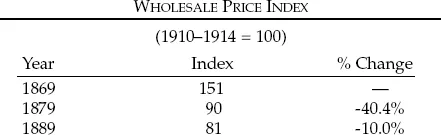

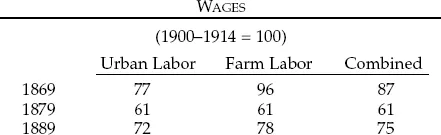
No decade before or since produced such a sustainable rise in real wages. Two possible exceptions are the periods 1909–1919 (when the index rose from 99 to 140) and 1929–1939 (134 to 194). But during the first decade real wages plummeted the next year—to 129 in 1920, and did not reach 1919’s level until 1934. And during the 1930s real wages also soared, for those fortunate enough to have jobs.
In any event, the contrast to this past decade is astonishing. And while there are many reasons why real wages increase, three necessary conditions must be present. Foremost, an absence of sustained inflation. This contributes to the second condition, a rise in savings and capital formation.
People will not save if they believe their money will be worth less in the future. Finally, technological advancement is obviously important. But it is not enough. The 1970s saw this third factor present, but the absence of the first two caused real wages to fall.
INTEREST RATES
Sidney Homer writes in his monumental History of Interest Rates, 2000 B.C. to the Present that “during the last two decades of the nineteenth century (1880–1900), long-term bond yields in the United States declined almost steadily. The nation entered its first period of low long-term interest rates,” finally experiencing the 3- to 3.5-percent long-term rates which had characterized Holland in the seventeenth century and Britain in the eighteenth and nineteenth: in short, the economic giants of their day.
To gauge long-term rates of the day, it is best not to use the long-term government bonds we would use today as a measure. The National Banking Acts of 1863–1864 stipulated that these bonds had to be used to secure bank notes. This created such a demand for them that, as Homer says, “by the mid 1870s [it] put government bond prices up to levels where their yields were far below acceptable rates of long-term interest.” But the Commerce Department tracks the unadjusted index of yields of American railroad bonds. We list the yields for 1878, the year before gold, and for 1879, and 1889.
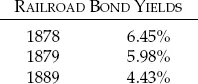
We stress that with consumer prices about 7 percent lower in 1889 than they had been the decade before, the real rate of return by decade’s end was well into double-digit range, a bonanza for savers and lenders.
Short-term rates during the last century were considerably more skittish than long-term rates. But even here the decennial averages of annual averages of both three- to six-month commercial paper rates and (overnight) call money during the 1880s declined from what it had been the previous decades:

A BURST IN PRODUCTIVITY
By some measures the 1880s was the most productive decade in our history. In their A Monetary History of the United States, 1867–1960, Professors Friedman and Schwartz quote R.W. Goldsmith on the subject:
The highest decadal rate [of growth of real reproducible, tangible wealth per head from 1805 to 1950] for periods of about ten years was apparently reached in the eighties with approximately 3.8 percent.
The statistics give proof to this outpouring of new wealth.
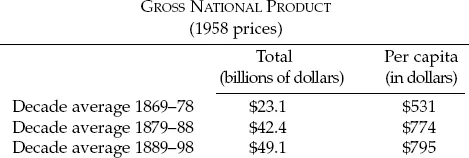
This dollar growth was occurring, remember, in the face of general price declines.
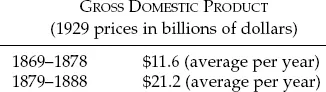
Gross domestic product almost doubled from the decade before, a far larger percentage jump decade-on-decade than any time since.
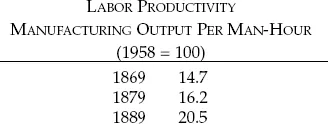
The 26.5-percent increase here ranks among the best in our history. Labor productivity reflects increased capital investment.
CAPITAL FORMATION
From 1869 to 1879 the total number of business establishments barely rose, but the next decade saw a 39.4-percent increase. Nor surprisingly, a decade of falling prices, rising real income, and lucrative interest returns made for tremendous capital investment, ensuring future gains in productivity.
This massive 500-percent decade-on-decade increase has never since been even closely rivaled. It stands in particular contrast to the virtual stagnation witnessed by the 1970s.
These five-year averages are not as “clean” as some other figures, but still show a rough doubling of total capital formation from the ‘70s to the ‘80s.
It has repeatedly been alleged that the late nineteenth century, the “golden age of the gold standard” in the United States, was a period especially harmful to farmers. The facts, however, tell a different story. While manufacturing in the 1880s grew more rapidly than did agriculture (“The Census of 1890,” report Friedman and Schwartz, “was the first in which the net value added by manufacturing exceeded the value of agricultural output”), farmers had an excellent decade.
So farms, farmland, productivity, and production all increased in the 1880s, even while commodity prices were falling. And as we see below, farm wage rates, even in nominal terms, rose during this time.

This phenomenal economic growth during the decade immediately after the return to gold convertibility cannot be attributed solely to the gold standard. Indeed all during this time there was never a completely free-market monetary system. The National Banking Acts of 1863–1864 had semi-cartelized the banking system.
Only certain banks could issue money, but all other banks had to have accounts at these. The financial panics throughout the late nineteenth century were a result of the arbitrary credit-creation powers of the banking system. While not as harmful as today’s inflation mechanism, it was still a storm in an otherwise fairly healthy economic climate.
The fateful decade of the 1890s saw the return of the agitation for free silver, which had lain dormant for a decade. The Republican Party intensified its longtime flirtation with inflation by passing the Sherman Silver Purchase Act of 1890, which roughly doubled the Treasury purchase requirement of silver. The Treasury was now mandated to buy 4.5 million ounces of silver per month. Furthermore, payment was to be made in a new issue of redeemable greenback currency, Treasury notes of 1890, which were to be a full legal tender, redeemable in either gold or silver at the discretion of the Treasury. Not only was this an increased commitment to silver, it was a significant step on the road to bimetallism which—at the depreciated market rates—would mean inflationary silver monometallism. In the same year, the Republicans passed the high McKinley Tariff Act of 1890, which reaffirmed their commitment to high tariffs and soft money.
Another unsettling inflationary move made in the same year was that the New York Subtreasury altered its longstanding practice of settling its clearinghouse balances in gold coin. Instead, in August 1890, it began using the old greenbacks and the new Treasury notes of 1890. As a result, these paper currencies largely replaced gold paid in customs receipts in New York.153
Uneasiness about the shift from gold to silver and the continuing free-silver agitation caused foreigners to lose further confidence in the U.S. gold standard, and to cause a drop in capital imports and severe gold outflows from the country. This loss of confidence exerted contractionist pressure on the American economy and reduced potential economic growth during the early 1890s.
Fears about the American gold standard were intensified in March 1891, when the Treasury suddenly imposed a stiff fee on the export of gold bars taken from its vaults so that most gold exported from then on was American gold coin rather than bars. A shock went through the financial community, in the U.S. and abroad, when the United States Senate passed a free-silver coinage bill in July 1892; the fact that the bill went no further was not enough to restore confidence in the gold standard. Banks began to insert clauses in loans and mortgages requiring payment in gold coin; clearly the dollar was no longer trusted. Gold exports intensified in 1892, the Treasury’s gold reserve declined, and a run ensued on the U.S. Treasury. In February 1893, the Treasury persuaded New York banks, which had drawn down $6 million on gold from the Treasury by presenting Treasury notes for redemption, to return the gold and reacquire the paper. This act of desperation was scarcely calculated to restore confidence in the paper dollar. The Treasury was paying the price for specie resumption without bothering to contract the paper notes in circulation. The gold standard was therefore inherently shaky, resting only on public confidence, and that was giving way under the silver agitation and under desperate acts by the Treasury.
Poor Grover Cleveland, a hard-money Democrat, assumed the presidency in the middle of this monetary crisis. Two months later, the stock market collapsed, and a month afterward, in June 1893, distrust of the fractional reserve banks led to massive bank runs and bank failures throughout the country. Once again, however, many banks, national and state, especially in the West and South, were allowed to suspend specie payments. The panic of 1893 was on. In a few months, Eastern bank suspension occurred, beginning with New York City. The total money supply—gold coin, Treasury paper, national bank notes, and national and state bank deposits—fell by 6.3 percent in one year, from June 1892 to June 1893. Suspension of specie payments resulted in deposits—which were no longer immediately redeemable in cash—going to a discount in relation to currency during the month of August. As a result, deposits became less useful, and the public tried its best to intensify its exchange of deposits for currency.
By the end of 1893, the panic was over as foreign confidence rose with the Cleveland administration’s successful repeal of the Sherman Silver Purchase Act in November of that year. Further silver agitation of 1895 endangered the Treasury’s gold reserve, but heroic acts of the Treasury, including buying gold from a syndicate of bankers headed by J.P. Morgan and August Belmont, restored confidence in the continuance of the gold standard.154 The victory of the free-silver Bryanite forces at the 1896 Democratic convention caused further problems for gold, but the victory of the pro-gold Republicans put an end to the problem of domestic and foreign confidence in the gold standard.
1896: THE TRANSFORMATION OF THE AMERICAN PARTY SYSTEM
Orthodox economic historians attribute the triumph of William Jennings Bryan in the Democratic Convention of 1896, and his later renominations for president, to a righteous rising up of the “people” demanding inflation over the “interests” holding out for gold. Friedman and Schwartz attribute the rise of Bryanism to the price contraction of the last three decades of the nineteenth century, and the triumph of gold and disappearance of the “money” issue to the price rise after 1896.155
This conventional analysis overlooks several problems. First, if Bryan represented the “people” versus the “interests,” why did Bryan lose and lose soundly, not once but three times? Why did gold triumph long before any price inflation became obvious, in fact at the depths of price contraction in 1896?
But the main neglect of the conventional analysis is the disregard of the highly illuminating insights provided in the past fifteen years by the “new political history” of nineteenth-century American politics and its political culture. The new political history began by going beyond national political issues (largely economic) and investigating state and local political contests.156 It also dug into the actual voting records of individual parishes, wards, and counties, and discovered how people voted and why they voted the way they did. The work of the new political history is truly interdisciplinary, for its methods range from sophisticated techniques for voting analysis to illuminating insights into American ethnic religious history.
In the following pages, we shall present a summary of the findings of the new political history on the American party structure of the late nineteenth century and after, and on the transformation of 1896 in particular.
First, the history of American political parties is one of successive “party systems.” Each party system lasts several decades, with each particular party having a certain central character; in many cases, the name of the party can remain the same but its essential character can drastically change—in the so-called “critical elections.” In the nineteenth century the nation’s second party system (Whigs v. Democrats), lasting from about 1832 to 1854, was succeeded by the third system (Republicans v. Democrats), lasting from 1854 to 1896.
Characteristic of both party systems was that each party was committed to a distinctive ideology clashing with the other, and these conflicting worldviews made for fierce and close contests. Elections were particularly hard fought. Interest was high since the parties offered a “choice, not an echo,” and so the turnout rate was remarkably high, often reaching 80 to 90 percent of eligible voters. More remarkably, candidates did not, as we are used to in the twentieth century, fuzz their ideology during campaigns in order to appeal to a floating, ideologically indifferent, “independent voter.” There were very few independent voters. The way to win elections, therefore, was to bring out your vote, and the way to do that was to intensify and strengthen your ideology during campaigns. Any fuzzing over would lead the Republican or Democratic constituents to stay home in disgust, and the election would be lost. Very rarely would there be a crossover to the other, hated party.
One problem that strikes anyone interested in nineteenth-century political history is: How come the average person exhibited such great and intense interest in such arcane economic topics as banking, gold and silver, and tariffs? Thousands of half-literate people wrote embattled tracts on these topics, and voters were intensely interested. Attributing the answer to inflation or depression, to seemingly economic interests, as do Marxists and other economic determinists, simply won’t do. The far greater depressions and inflations of the twentieth century have not educed nearly as much mass interest in economics as did the milder economic crises of the past century.
Only the findings of the new political historians have cleared up this puzzle. It turns out that the mass of the public was not necessarily interested in what the elites, or national politicians, were talking about. The most intense and direct interest of the voters was applied to local and state issues, and on these local levels the two parties waged an intense and furious political struggle that lasted from the 1830s to the 1890s.
The beginning of the century-long struggle began with the profound transformation of American Protestantism in the 1830s. This transformation swept like wildfire across the Northern states, particularly Yankee territory, during the 1830s, leaving the South virtually untouched. The transformation found particular root among Yankee culture, with its aggressive and domineering spirit.157
This new Protestantism—called “pietism”—was born in the fires of Charles Finney and the great revival movement of the 1830s. Its credo was roughly as follows: Each individual is responsible for his own salvation, and it must come in an emotional moment of being “born again.” Each person can achieve salvation; each person must do his best to save everyone else. This compulsion to save others was more than simple missionary work; it meant that one would go to hell unless he did his best to save others. But since each person is alone and facing the temptation to sin, this role can only be done by the use of the State. The role of the State was to stamp out sin and create a new Jerusalem on Earth.158, 159
The pietists defined sin very broadly. In particular, the most important politically was “demon rum,” which clouded men’s minds and therefore robbed them of their theological free will. In the 1830s, the evangelical pietists launched a determined and indefatigable prohibitionist crusade on the state and local level that lasted a century. Second was any activity on Sunday except going to church, which led to a drive for Sabbatarian blue laws. Drinking on Sunday was of course a double sin, and hence was particularly heinous. Another vital thrust of the new Yankee pietism was to try to extirpate Roman Catholicism, which robs communicants of their theological free will by subjecting them to the dictates of priests who are agents of the Vatican. If Roman Catholics could not be prohibited per se, their immigration could be slowed down or stopped. And since their adults were irrevocably steeped in sin, it became vital for crusading pietists to try to establish public schools as compulsory forces for Protestantizing society or, as the pietists liked to put it, to “Christianize the Catholics.” If the adults are hopeless, the children must be saved by the public school and compulsory attendance laws.
Such was the political program of Yankee pietism. Not all immigrants were scorned. British, Norwegian, or other immigrants who belonged to pietist churches (whether nominally Calvinist or Lutheran or not) were welcomed as “true Americans.” The Northern pietists found their home, almost to a man, first in the Whig Party, and then in the Republican Party. And they did so, too, among the Greenback and Populist parties, as we shall see further below.
There came to this country during the century an increasing number of Catholic and Lutheran immigrants, especially from Ireland and Germany. The Catholics and High Lutherans, who have been called “ritualists” or “liturgicals,” had a very different kind of religious culture. Each person is not responsible for his own salvation directly; if he is to be saved, he joins the church and obeys its liturgy and sacraments. In a profound sense, then, the church is responsible for one’s salvation, and there was no need for the State to stamp out temptation. These churches, then, especially the Lutheran, had a laissez-faire attitude toward the State and morality. Furthermore, their definitions of “sin” were not nearly as broad as the pietists’. Liquor is fine in moderation; and drinking beer with the family in beer parlors on Sunday after church was a cherished German (Catholic and Lutheran) tradition; and parochial schools were vital in transmitting religious values to their children in a country where they were in a minority.
Virtually to a man, Catholics and High Lutherans160 found their home during the nineteenth century in the Democratic Party. It is no wonder that the Republicans gloried in calling themselves throughout this period “the party of great moral ideas,” while the Democrats declared themselves to be “the party of personal liberty.” For nearly a century, the bemused liturgical Democrats fought a defensive struggle against people whom they considered “pietist-fanatics” constantly swooping down trying to outlaw their liquor, their Sunday beer parlors, and their parochial schools.
How did all this relate to the economic issues of the day? Simply that the leaders of each party went to their voting constituents and “raised their consciousness” to get them vitally interested in national economic questions. Thus, the Republican leaders would go to their rank and file and say: “Just as we need Big Paternalistic Government on the local and state level to stamp out sin and compel morality, so we need Big Government on the national level to increase everyone’s purchasing power through inflation, keeping out cheap foreign goods (tariffs), or keeping out cheap foreign labor (immigration restrictions).”
And for their part, the Democratic leaders would go to their constituents and say: “Just as the Republican fanatics are trying to take away your liquor, your beer parlors, and your parochial schools, so the same people are trying to keep out cheap foreign goods (tariffs), and trying to destroy the value of your savings through inflation. Paternalistic government on the federal level is just as evil as it is at home.”
So statism and libertarianism were expanded to other issues and other levels. Each side infused its economic issues with a moral fervor and passion stemming from deeply held religious values. The mystery of the passionate interest of Americans in economic issues in the epoch is solved.
Both in the second and third party systems, however, the Whigs and then the Republicans had a grave problem. Partly because of demographics—greater immigration and higher birth rates—the Democratic-liturgicals were slowly but surely becoming the majority party in the country. The Democrats were split asunder by the slavery question in the 1840s and ‘50s. But now, by 1890, the Republicans saw the handwriting on the wall. The Democratic victory in the congressional races in 1890, followed by the unprecedented landslide victory of Grover Cleveland carrying both houses of Congress in 1892, indicated to the Republicans that they were becoming doomed to be a permanent minority.
To remedy the problem, the Republicans, in the early 1890s, led by Ohio Republicans William McKinley and Mark Hanna, launched a shrewd campaign of reconstruction. In particular, in state after state, they ditched the prohibitionists, who were becoming an embarrassment and losing the Republicans large numbers of German Lutheran votes. Also, they modified their hostility to immigration. By the mid-1890s, the Republicans had moved rapidly toward the center, toward fuzzing over their political pietism.
In the meanwhile, an upheaval was beginning to occur in the Democratic Party. The South, by now a one-party Democratic region, was having its own pietism transformed by the 1890s. Quiet pietists were now becoming evangelical, and Southern Protestant organizations began to call for prohibition. Then the new, sparsely settled Mountain states, many of them with silver mines, were also largely pietist. Moreover, a power vacuum, which would ordinarily have been temporary, had been created in the national Democratic Party. Poor Grover Cleveland, a hard-money laissez-faire Democrat, was blamed for the panic of 1893, and many leading Cleveland Democrats lost their gubernatorial and senatorial posts in the 1894 elections. The Cleveland Democrats were temporarily weak, and the Southern-Mountain coalition was ready to hand. Seeing this opportunity, William Jennings Bryan and his pietist coalition seized control of the Democratic Party at the momentous convention of 1896. The Democratic Party was never to be the same again.161
The Catholics, Lutherans, and laissez-faire Cleveland Democrats were in mortal shock. The “party of our fathers” was lost. The Republicans, who had been moderating their stance anyway, saw the opportunity of a lifetime. At the Republican convention, Representative Henry Cabot Lodge, representing the Morgans and the pro-gold-standard Boston financial interests, told McKinley and Hanna: Pledge yourself to the gold standard—the basic Cleveland economic issue—and drop your silverite and greenback tendencies, and we will all back you. Refuse, and we will support Bryan or a third party. McKinley struck the deal, and from then on, the Republicans, in nineteenth-century terms, were a centrist party. Their principles were now high tariffs and the gold standard, and prohibition was quietly forgotten.
What would the poor liturgicals do? Many of them stayed home in droves, and indeed the election of 1896 marks the beginning of the great slide downward in voter turnout rates that continues to the present day. Some of them, in anguish at the pietist, inflationist, and prohibitionist Bryanites, actually conquered their anguish and voted Republican for the first time in their lives. The Republicans, after all, had dropped the hated prohibitionists and adopted gold.
The election of 1896 inaugurated the fourth party system in America. From a third party system of closely fought, seesawing races between a pietist-statist Republican Party vs. a liturgical-libertarian Democratic Party, the fourth party system consisted of a majority centrist Republican Party as against a minority pietist Democratic Party. After a few years, the Democrats lost their pietist nature, and they too became a centrist, though usually minority party, with a moderately statist ideology scarcely distinguishable from the Republicans. So went the fourth party system until 1932.
A charming anecdote, told us by Richard Jensen, sums up much of the 1896 election. The heavily German city of Milwaukee had been mainly Democratic for years. The German Lutherans and Catholics in America were devoted, in particular, to the gold standard and were bitter enemies of inflation. The Democratic nomination for Congress in Milwaukee had been obtained by a Populist-Democrat, Richard Schilling. Sounding for all the world like modern monetarists or Keynesians, Schilling tried to explain to the assembled Germans of Milwaukee in a campaign speech that it didn’t really matter what commodity was chosen as money, that “gold, silver, copper, paper, sauerkraut or sausages” would do equally well as money. At that point, the German masses of Milwaukee laughed Schilling off the stage, and the shrewdly opportunistic Republicans adopted as their campaign slogan, “Schilling and Sauerkraut” and swept Milwaukee. 162
The Greenbackers and later the pro-silver, inflationist, Bryanite Populist Party were not “agrarian parties”; they were collections of pietists aiming to stamp out personal and political sin. Thus, as Kleppner points out, “The Greenback Party was less an amalgamation of economic pressure groups than an ad hoc coalition of ‘True Believers,’ ‘ideologues,’ who launched their party as a ‘quasi-religious’ movement that bore the indelible hallmark of ‘a transfiguring faith.’” The Greenbackers perceived their movement as the “religion of the Master in motion among men.” And the Populists described their 1890 free-silver contest in Kansas not as a “political campaign,” but as “a religious revival, a crusade, a pentecost of politics in which a tongue of flame sat upon every man, and each spake as the spirit gave him utterance.” The people had “heard the word and could preach the gospel of Populism.” It was no accident, we see now, that the Greenbackers almost invariably endorsed prohibition, compulsory public schooling, and crushing of parochial schools. Or that Populists in many states “declared unequivocally for prohibition” or entered various forms of fusion with the Prohibition Party.163
The Transformation of 1896 and the death of the third party system meant the end of America’s great laissez-faire, hard-money libertarian party. The Democratic Party was no longer the party of Jefferson, Jackson, and Cleveland. With no further political embodiment for laissez-faire in existence, and with both parties offering “an echo not a choice,” public interest in politics steadily declined. A power vacuum was left in American politics for the new corporate statist ideology of progressivism, which swept both parties (and created a short-lived Progressive Party) in America after 1900. The Progressive Era of 1900–1918 fastened a welfare-warfare state on America which has set the mold for the rest of the twentieth century. Statism arrived after 1900 not because of inflation or deflation, but because a unique set of conditions had destroyed the Democrats as a laissez-faire party and left a power vacuum for the triumph of the new ideology of compulsory cartelization through a partnership of big government, business, unions, technocrats, and intellectuals.
History of Money and Banking in the United States: The Colonial Era to World War II
Read the whole book online · Book details
Free to read online and to download from this archive.