
Chapter 6 of 15 · Boundaries of Order: Private Property as a Social System by Butler Shaffer
Chapter 4: Boundary: What Can Be Owned
Chapter Four
Boundary: What Can Be Owned?
“That dog is mine,” said those poor children; “that place in the sun is mine.”
—Blaise Pascal1
Because “property” has meaning only within a social context, how it is to be owned and controlled defines the nature of a given society. An analysis of the concept must begin by identifying the functional elements of property, and inquiring into their personal and social implications. These elements—which will be explored at length in this and the following two chapters—are those of boundary, claim, and control. While these concepts will be discussed separately, it must be emphasized that they are as interconnected to an understanding of property as the heart, lungs, and circulatory system are to the functioning of the body. Our inquiry into each of these three elements will occasionally cross over from one to the other.
A discussion of the nature of property must begin by identifying the interest—the entity—that is subject to being owned. This is the boundary element, the “what” that can be owned, the definition of the property itself. We are familiar with “boundaries” as they relate to the ownership of real property—e.g., iron pipes driven into the ground at each corner of the property, or fence-lines encircling a piece of land—but we are less familiar with the conceptual nature of boundaries, and of the important role they play in defining the range of our decision making. Boundaries are the means by which liberty and peaceful order become integrated in society. As the saying “good fences make good neighbors” reminds us, it is the failure to identify and respect boundaries that is at the heart of our social conflicts.
The boundary element circumscribes not just the physical dimensions of an item of property but, more importantly, the identification of the extent of decision-making authority over such an interest. The boundary line that separates your land from mine, for instance, has less to do with describing the character of the land itself than with defining the limits of our respective decision-making. All property—even so-called “intangible” interests—has dimensions to it, even if their configurations are not visible. This means that all property must consist of an identifiable interest that can be subjected to the control, the will of one we call an owner.
Property boundaries are what make peaceful and productive society possible. They are a way of signifying to one another the range of our respective interests; telling us what it is over which each of us may “properly” exercise authority. In much the same way that the boundaries of a tennis court delineate the area within which the game is to be played —with each player staying on his side of the court and without trespasses from the fans—property boundaries describe the field within which owners may act without interference, or the necessity of securing permission from others.
It is important to emphasize that boundaries are not limitations on the decision-making authority of an owner; they only define what it is over which one has authority. Within the bounds of his or her property, the owner is an unfettered decision-maker. Let us assume that I own a brick, and I assert the authority to do whatever I want with what is mine. Would that proposition entitle me to throw my brick through your picture window without your permission? The answer is clearly “no.” I may exercise complete decision-making over what is mine, but not over what is yours. I may throw my brick through my picture window, or hit myself over the head with it, for in doing so I am exercising control only over what I own. To say that I may do as I will with what I own necessarily precludes me from doing as I will with what you own. Our respective property boundaries define—and thus limit—the range within which each of us may be unrestrained actors. As an owner, my decision making properly ends where my property boundaries end. Should I go beyond these limitations, I become a trespasser, just as you will if you forcibly prevent me from acting upon what is mine.
The following illustration may prove helpful in understanding this meaning of “boundaries.” Let us imagine that I have bought a new car, financing the purchase with a loan from a bank that insists upon a chattel mortgage to secure my obligation to repay the loan. Both the bank and I have property interests in the car. The boundaries of the bank’s interest preclude me from damaging or destroying the car, and may even obligate me, as a condition in our contract, to keep the car insured. Its interest does not, however, extend to being able to drive the car, or controlling where I might drive it, or who I might carry as passengers: these are property interests within my boundaries. Once I have repaid the loan, the bank’s interest evaporates, and my boundaries extend to the full decision-making authority over the car. With our respective boundaries clearly defined, there is no way that our property interests can be in conflict, unless one of us chooses to transgress the other’s interests.
This self-limiting nature of property boundaries is a crucial concept to grasp if one is to understand how privately-owned property is an essential system for harmonizing individual liberty and societal peace. “Life” requires both cooperation with and separation from other living beings, particularly members of our own species. A system of property is the social expression of this fact of nature—just as it is with other species— affording a principle for informally allocating the spatial and energy consumption needs of all life-sustaining activity. We are so accustomed to living under political systems that introduce division and conflict into our world by separating our lives and other property interests from our individual control, that we accept divisive definitions of property. Because the state trespasses upon us by presuming the authority to control our lives, we come to believe that such transgressions are an integral part of property ownership. We have become so conditioned to the practice of the state defining the legal scope of our decision making, that most of us cannot comprehend the idea of property as a self-defining system of social order. We conflate what is legal with what is rightful, and become insensitive to trespasses upon our property interests, and disrespectful of the boundaries of others. We become more concerned with what the law demands of us than with what we, or our neighbors, desire to do with what is ours.
It is essential to an understanding of the boundary concept that we be clear as to its mutually exclusive implications. Because we tend to confuse our ownership interests in property with the items of property themselves, we suppose that property interests can be in conflict. Let us imagine that you own a parcel of real estate, and you agree to sell me the mineral rights to this land. After the transaction has been completed, our respective spatial boundaries would look like this:
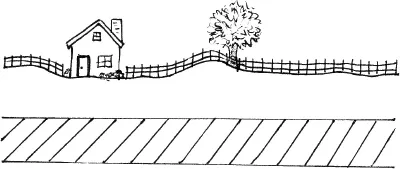
Figure 1.
The boundaries of what you own would consist of everything within the parcel (i.e., surface, subsurface, and air rights) except for the shaded portion (i.e., the mineral interests) that I now own. Because a contract is only an agreement to transfer ownership claims, the terms of our agreement redefine the boundaries of what each of us had owned previously. My mineral rights are not in conflict with, nor a restriction upon your property interests. The boundaries of what you own have been redefined, but your ownership control in what remains is as complete as it was before.
But what happens if my efforts to remove my minerals cause your house to subside: would that amount to a trespass or other interference with your property interests, and would this mean that my ownership interests (i.e., the right to control my mineral rights) are now in conflict with your interest in not having your property subside? Because contracts define the boundaries of the ownership interests being transferred, the answer to this question will depend upon what we had agreed to in our contract for the sale of the mineral rights. If I agreed to provide “subjacent support” in order to prevent subsidence, then our mutual boundaries would be defined to reflect this. My boundaries would again, be reflected by the shaded area, while yours would be enlarged, by our contract, to include the supports. Should I now attempt to remove these reinforcements, I would be trespassing upon your property interests, not by causing your house to subside, but by interfering with the support interest you had retained.
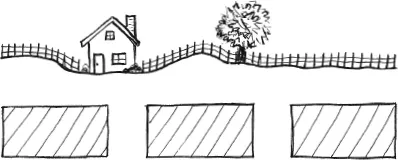
Figure 2.
The reverse of this hypothetical is subject to the same analysis. If, by contract, I have the right to remove all the minerals without providing subjacent support, the boundaries of your property interests will be defined in a more limited way, while my interests would now include the right to cause subsidence that was incidental to my mining operations. Since, presumably, the purchase price for these mineral rights would be higher in the latter situation than it would be were we to agree to provide for subjacent support, we can infer that the price differential reflects our mutual understanding that I am purchasing a larger property interest (with more extensive boundaries) when I do not have to provide support, and a smaller interest when I do have to provide such support. As long as each of us abides by our agreement, there is no way in which our respective property interests—as measured by clearly defined spatial boundaries—can come into conflict. While a conflict could arise from our failure to specify such boundaries with sufficient clarity, it is the imprecision of our boundaries, not the nature of the property itself, that generates the conflict. Conflict arises when the property interests of one person are trespassed by another. In this sense, a trespass is but the imposition of costs on others. If, in the face of an agreement that clearly accords me the right to remove my minerals without providing you support, you are able to get the courts to enjoin my actions, you would derive, at my expense, a property interest for which you had not negotiated. This is just one of the many ways in which the state violates property interests.2 Over the course of time, conditions may arise that neither of us had anticipated, leading us to modify the terms (the boundaries) of our contract. But in a system that respects individual autonomy and the inviolability of property interests, such an alteration—a novation—will arise, as did the initial agreement, from the parties themselves.
This hypothetical example is not simply a theoretical one. That a number of discrete property interests—each owned by a different person—may exist within one parcel of land, without conflict, is found in early California mining law. The same parcel of ground might be subject to one claim for placer mining (i.e., to extract minerals from sand or gravel by a washing process), to another claim for quartz-ledge mining, to yet another for fluming purposes (i.e., to divert water by means of an inclined channel), and to another claim for the diversion of spring or stream water on the parcel.3 Closer to home, urban properties usually exhibit multiple levels of ownership interests (e.g., a leasehold, mineral rights, mortgage interest, easements, and a landlord’s fee simple interest) within the same parcel of land, wherein different owners are able to conduct themselves without conflict. The language of the agreements creating these interests, along with public recordation that would give subsequent parties notice of such claims, would define the respective boundaries of each property interest.
Such tendencies for multiple levels of ownership in the same territory are not confined to humans, but are found in the division of boundaries among various species. It has been observed, for instance, that as many as five different species of warblers will feed on the same kind of worm in the same spruce tree, but with each species occupying different levels of the same tree. Likewise, such estuary sea life as oysters, mussels, gar pikes, and snappers—each with a different level of tolerance for the saltiness of sea water—will establish territorial boundaries based upon the varying degrees of salinity of the water.4
There is something about the functional nature of boundaries that extends far beyond their relevance to property alone. Because of the dualistic nature of our thinking, boundaries provide the means by which our minds separate and distinguish one concept or category from another. Through considerable effort or intuitive insight, we are often able to transcend the divisions created by our structured thinking, and to see the universe more holistically. Because such an awareness may help us dissolve the lines of separation that can keep us in deadly and destructive conflict with one another—a topic to which we shall return—I believe it is necessary to devote a broader inquiry into the role boundaries play in our lives, an examination that will then bring us back to their significance in matters involving property.
There is a symmetry at work in all of this, the recognition of which may help us integrate what the dualistic nature of our minds insists upon seeing as isolated, or even contradictory, phenomena. Light and darkness, and space and matter define each other’s boundaries in mutually exclusive ways. The movement of my fingers, for instance, alters the configuration of the space that surrounds them, redefining the relationship of each to the other. Any item of property I desire to claim derives its identity from the boundaries that surround it. So, too, the boundaries of your interests are necessary to a definition of what is mine (i.e., what is yours to control delimits what is mine, and vice-versa).
Our daily lives are unavoidably tied up with boundary questions. The work that we do (“that’s my job”), the homes in which we live, the computer websites through which we communicate with others, and our very sense of “self” are carefully delineated in terms of boundaries. Even the remarkable orderliness of freeway driving is dependent upon adherence to boundaries. Tens of thousands of motorists drive at high speeds, separated by a scant few feet of space, each endeavoring to stay in “his” or “her” lane, aware of the immediate life-and-death consequences of a mistake in judgment that might precipitate a boundary trespass we know as an “accident.” When we are aware of how our politically-generated boundary trespasses have their own destructive, anti-life implications, we might become as cautious in what we advocate as governmental policies as we are in the behavior of our fellow motorists.
Boundaries are dynamic information systems, whose qualities relate not just to defining property interests, but also to many areas of life. Learning, for example, is a process by which we cross the boundary that separates the known from the unknown. Learning consists of transcending, or even dismantling, the boundary lines by which we have categorized our prior experiences. An openness to the unfamiliar is essential to learning, just as the willingness to cross the boundaries separating the known and the structured from the unknown and the unstructured, is the mark of a creative person. On the other hand, we have organized our learning through neatly arranged concepts, categories, academic disciplines, belief systems, and other structures grounded in definitional boundaries. Those who have attached themselves to such formalized thinking—a trait one sees in ideologies, religions, and academia—are ever vigilant in seeking to preserve the inviolability of their boundaries. Boundaries play a very important role within academic disciplines. What university campus does not channel learning into rigidly-defined “disciplines,” and discourage speculative inquiries that have no recognized boundaries? What university departments do not remain on the alert for poachers from other disciplines, a phenomenon that has been given the territorial name of “turf wars?”
Economic analysis and the study of genetics are each concerned with changes that occur along the margin of events. The economist is interested in knowing how one additional unit of supply of a commodity will affect its price, while the geneticist—whose motto is “cherish your mutations”—learns much about biological processes by studying an organism whose structure deviates from the norm. Words and other intellectual concepts are distinguished by subtle nuances whose exclusive boundaries provide meaning, or “definition.” When we want to know the details of anything, be it a basic element, a chair, a particular fruit or vegetable, we speak of its “properties,” and do so in terms of boundary descriptions that differentiate the subject matter from all others. It is also noteworthy that, when Korzybski wrote of the distinction between abstractions and the reality they are intended to represent, he employed the property metaphor of “territory.” His observation reminds us to not confuse the boundaries separating the world from our thoughts about the world.
The universe is whole and interrelated, but in order to understand it, our mind compares and contrasts our experiences, looking for identifiable patterns. With the help of analogies and distinctions, we divide the world into discrete categories, each with its identifiable boundaries, and then deceive ourselves that such divisions represent reality. It is when we are playing around at the boundaries that separate these concepts—as when exploring contradictions—that which we begin to get intuitive glimpses of the underlying wholeness of the world. This is what makes boundaries such a magical, creative place, if only we can muster the courage to move into the realm of the unknown.
We can think of this territory beyond the known as a frontier, a realm within which uncertainty, autonomy, and spontaneity represent the norm, and where the turbulence of change is the continuing dynamic. It is at the boundary separating the frontier from the more established regions, the unstructured from the structured environments, that liberty and creativity often flourish. We are seeing such dynamics in the rapidly transforming world of computerized technology and the Internet. But to enter a frontier, be it of physical, intellectual, or psychological dimensions, we must be prepared to give up our attachments to whatever defined our interests in the structured world we are leaving behind.
If we desire to remain creative people, we must develop an appreciation for frontiers, and for the dynamics that take place at boundary lines where our present understanding confronts the unknown. In its earlier decades, America became as free, creative, and materially productive as it did because of its frontier nature. Its relatively unstructured social environment served as a frontier for millions of European immigrants who left the relative certainty of their institutionalized homelands for the opportunities existing in an uncertain land. Many of their Medieval ancestors, in their time, had left their subject status and gone to undeveloped lands in Europe. In these frontiers, they cleared forests and set up new settlements, an undertaking that “conferred liberty on the colonizers … [and] elevated them from slavery and serfdom.”5 Frontiers have long held out to men and women the promise that a portion of the world could become theirs to own and control for their purposes. In such environments, people have been free to innovate and adapt themselves to new situations without being compelled to conform to the demands of an established hierarchy of authority.
In the same way, the undeveloped West—a flexible concept that continually redefined itself as western Pennsylvania, then Ohio, then Nebraska, then Utah, then Oregon—served as a frontier for those living in the more institutionally established eastern states. When early Dutch settlers tried to impose a feudal system along the upper Hudson River, they found little interest expressed by those who had the option of easily moving elsewhere. The frontier served as a boundary separating the more established from the relatively undeveloped into which people could freely move. As such, frontiers provided environments of decentralized and limited political authority, wherein independence and alternative social systems could flourish. It was this relationship that pressured eastern states not to become too restrictive of the activities of those trying to further their interests. This arrangement provided Americans with an effective check upon the more established states’ tendencies for institutional rigidification and, in the process, allowed people to remain free and productive for many decades.6
Frontiers are not defined geographically as much as they represent a state of mind, a willingness to see opportunities in relative uncertainty. Imagination—the capacity to see beyond the boundaries of the known—has long been the frontier for creative minds. To believe that a physical environment by itself, without any volition on our part, has the power to transform us is to engage in mechanistic thinking. Indeed, there were many settlers in the early west, who, insisted upon what they perceived as the “protection” of the state (e.g., in the form of a military presence). Implicit in the dynamics along a frontier is the interplay between “stability” and “change;” between the established and the new, along with the existence of individuals capable of and willing to pursue alternative courses of action. The liberty to commit one’s life and property interests to such opportunities is central to this process. The implications of this have been noted by Alfred North Whitehead: “the vivid people keep moving on, geographically and otherwise, for men can be provincial in time, as well as in place.”7
One of the most significant boundaries we encounter is related to our learning and other creative activities. Having learned what we believe to be a sufficient body of knowledge, we resist efforts to think beyond the boundaries of the known (i.e., to “think outside the circle”) and to explore the unknown. Scientists, inventors, and philosophers have been among the more noted examples of persons discouraged or even threatened by those who insisted upon what one writer labeled “the saber-toothed curriculum.”8 The ways in which our minds create barriers (“boundaries”) that circumscribe our behavior were reflected in events leading up to the running of a sub-four-minute mile. For years, it was assumed that running a mile in less than four minutes was impossible, and while many came close none was able to accomplish the task until 1954, when the Englishman Roger Bannister ran the mile in 3 minutes, 59.4 seconds. It was not long after that boundary-breaking event that many other runners accomplished the same feat.
As our social world continues its apparent transformation into horizontal networks, we are likely to find ourselves at the boundaries of a new frontier: society itself. As decentralization expands the realms of our personal authority, we will find ourselves exploring radically new social assumptions concerning what it is appropriate for each of us to control, and how to freely cooperate and exchange with one another. We may then discover the informal systems of order and other spontaneous processes that work, beneath the surface of events in our lives, to instill the peaceful and productive conditions that make society decent. As we continue to explore such new territory, we may discover one another in totally new relationships, as well as the social harmony that arises as an unintended consequence of the pursuit of our respective self-interests.
The dynamics of chaos and complexity that help to transform our understanding of the world—including the organizational premises of our social systems—are particularly relevant to our inquiry. One of the central features in this emerging field of study involves the boundary transition that occurs when a system moves from linear regularity to chaotic turbulence. Bifurcation points represent boundaries, separating entropic and negentropic courses of conduct. As such, something either destructive or creative can occur along boundary lines. The study of such processes reveals patterns of heretofore undiscovered order embedded within our complicated world, regularities that take on the qualities of new boundaries. Related dynamics occurring along boundaries are seen in creative acts, wherein innovation confronts the outmoded; novelty challenges the status quo.
Humor seems to be a reflection of our unconscious mind’s awareness of the harmony found in seemingly contradictory relationships. Whether we are considering jokes, puns, sight gags, witticisms, irony, or satire, humor provides a pleasurable meaning because it gives us the opportunity to integrate what our conscious mind tells us is to be segregated. James Thurber described “humour” as “emotional chaos remembered in tranquility.”9 It operates along the boundary lines separating the expected from the unexpected, sometimes bouncing back and forth from one side of the line to the other, giving us glimpses of the complementary nature of the world. This is what gives puns their potency: a word or phrase used to communicate different meanings than when such expressions are used in a different context. Puns challenge the boundary lines of what we like to think of as the mutually-exclusive meanings of our abstractions.
Optical illusions also generate fuzziness along boundary lines. Is the staircase ascending or descending? Do we see a vase, or two faces looking at one another? Is it a beautiful woman, or an old lady? M.C. Escher developed a unique art style in which different objects shared common boundaries in one of the better-known expressions of symmetry. We find amusement in these patterns that alternate, but which our dualistic minds find difficulty in seeing simultaneously.
As we have seen, there is an unavoidable information loss in the use of abstractions—particularly words—as we endeavor to understand and negotiate with the world. Words must always be interpreted and, in our efforts to do so, we discover that they often have an elusive quality to them; that they can play tricks on us as we struggle to define their respective boundary lines. They have no inherent meaning, and when we turn to a dictionary for help, we discover that they can only be defined in terms of other words, other abstractions. We are familiar with the common role of synonyms, wherein different words may mean the same thing (e.g., “poetry” and “verse”). Even differing words of seemingly opposite denotation may be used synonymously. In modern usage, for example, “hot” and “cool” can have the same meaning, just as—in my teenage years—the phrase “what’s going on?” meant the same as “what’s coming off?” But the same word—a contronym—will sometimes have a diametrically opposed meaning. The word “sanction,” for instance, may mean either a form of approval or of punishment. “Custom” may refer to something that is common or, alternatively, something produced for special order. The word “oversight” can mean either to pay attention to something, or to fail to do so.
Many of our conflicts arise from a failure to acknowledge the hazy nature of all abstractions. Like Humpty Dumpty, we are inclined to the proposition that “when I use a word, it means just what I choose it to mean—neither more nor less.”10 Our world would become less strife-ridden were we to become aware that the boundaries of our concepts do not have the concrete and objective meanings we like to imagine they enjoy.
As a social system, boundaries have a dualistic quality: whether our relationships with others are peaceful or violent is reflected in the degree of respect we accord their inviolate nature. A socially troublesome aspect of boundaries is found in the practice of identifying ourselves through what Fritz Perls has called “ego-boundary” abstractions.11 We learn to identify ourselves in terms of collective abstractions. While our more distant ancestors identified themselves with their tribe, clan, or race, most of us modernly identify ourselves with our nationality, race, religion, social class, gender, ideology, economic interests, geography, or other abstractions.12 Through such thinking, we define “who we are” by reference to various social sub-groupings that are either institutional in nature, or are exploited for institutional purposes. Through this same thinking, we embroil ourselves in wars, genocides, racial confrontations, and even riots between competing fans over the outcome of soccer games. These are among the more violent consequences of our failure to respect the inviolability of one another’s “ego-boundaries.” We think of ourselves in terms of such abstractions, a holdover from the most primitive ways of regarding ourselves. We become integrated with those who share our boundaries, and alienated from those who are not encompassed within our borders.
It is not just that such categories describe us in some physically observable way (e.g., gender, skin color, age), but that we have learned to give them existential significance. They go to the essence of how we think of ourselves. We may identify ourselves by the color of our skin, but not of our eyes, because our minds have attached meaning to one set of abstract distinctions but not others. It would not be an exaggeration to suggest that, for most of us, our identities are our lives. If you doubt this, try describing yourself without making use of any collective abstractions. In the words of the caterpillar in Alice in Wonderland, “who are you?”
Ego-boundary thinking, another expression of our dualistic way of organizing our experiences, has collectivized our minds and created our world of institutionally-directed conflict and disorder. By identifying ourselves with any category of persons, we necessarily separate ourselves from those who are not part of our group. Being other than us, they become less than us. When the interests of one group come into contact with those of another, particularly along the boundary lines that divide one group from another, conflicts easily arise.
Political institutions thrive by encouraging the development of various group identities. Insisting upon maintaining the clear distinctions of our collective boundary lines, they help to foment conflicts among such groups and then offer to mediate the very differences it has been in the state’s interests to foster! It is a racket, which, if engaged in by private parties, would result in long prison sentences. Look at how easily governments have been able to mobilize their citizens into wars against other nations, or to create discord between “consumers” and “retailers,” “employers” and “employees,” “environmentalists” and “lumber companies,” “parents” and “school officials,” “gays” and “straights,” “immigrants” and “native-born,” along with racial, ethnic, religious, gender, and other sub-groupings of people. As the state expands the range of its decision making over our property, it necessarily enlarges the boundaries that separate us from one another while increasing the likelihood of personal and social conflict. The dispute that I might have with my neighbor over a fence line is, by its nature, localized. Given the personal, rather than abstract, nature of our relationship, our differences are likely to be resolved amicably. However, as we become drawn into politically generated quarrels with abstract categories of people whose existence may span the globe, the boundaries of our interests not only become more depersonalized, but take on global dimensions. Doesn’t this describe the deadly confrontations that set strangers against one another for no other reason than their being members of opposing nation-states or political or religious factions?
As our thinking becomes more abstract and institutionally centered, we tend to deprive ourselves of the qualities that make us human. The abstract differs from the concrete. Human beings function on the basis of blood, emotions, pain, fears, and dreams, while institutions—such as the state or corporations— tend to operate upon such abstractions as statistics, collective trends, and chain-of-command decision-making. The same person who can feel sadness over the death of an unknown child can, when identifying himself with the state, feel a sense of indifference to statistical reports of the wartime deaths of hundreds of thousands of civilians.
A moment’s reflection should make us aware of how our “ego-boundary” practices are based on the same dynamics as those at work in property. Each provides a way of asserting our will upon the world, to the end that we may develop and express our sense of who we are. One can think of ego identification as a form of claim staking in the world of collective identities. The patriot who reacts to the defiling of his nation’s flag; or the religious believer who takes angry offense at a cartoon that ridicules a man he regards as sacred, experiences every bit —if not more—the sense of being trespassed as is felt by a homeowner who has been the victim of a burglary. Perls has characterized the conflict that arises from such identity disputes as boundary clashes, which are more likely to occur along boundary lines than at a distance. For this reason, he adds, India is more likely to go to war with China, than with Finland.13
Ego-boundary trespasses abound in such areas as political and religious behavior. One very emotional, property-related issue has to do with the burning of an American flag as a form of political protest. The arguments on behalf of making flag burning a crime emphasize the state’s interest in protecting an image, a symbol that is used to mobilize people to identify with the nation-state. But how does one describe and locate an image or a symbol? What are its boundaries? Is it simply the cloth from which the flag was made? A reading of flag desecration statutes extends the offense to any representation of the flag, including a photograph or a school-child’s drawing thereof. Furthermore, the burning of an old flag is the institutionally accepted way of disposing of it, meaning that the state of mind of the burner defines the offense!
In order to have a trespass there must be a boundary to be trespassed. But when dealing with ego-boundaries, such qualities are the products of the mind; visions, impressions, sentiments, and other emotions fashioned, in a multitude of forms and meanings, from the unique experiences of each person. The flag burning issue is but one more illustration of the fallacy that politics unites people into a harmonious whole. Any nation is, after all, composed of millions of unique personalities, with diverse tastes, values, dreams, and opinions. We are simply too varied to permit an easy consolidation under collective images to which we attach a common meaning. To a war veteran, the flag may represent the virtue of obedience to authority, or a symbol of a sense of duty. To a war protester, it may represent either a symbol of collective violence or a nation’s commitment to an unrestrained freedom of individual expression. A dollar sign symbolizes totally different values to a follower of Ayn Rand than it does to an idealistic ascetic, just as a swastika conjures up divergent images and emotions to Jews, neo-Nazis, Buddhists, Tibetans, and American Indians.
Just how muddled most of us are with notions of property was expressed by a lawyer who defended flag desecration laws by arguing that, if burning the flag was an exercise of free speech, one would have to defend the painting of swastikas on synagogues as free speech. Such disordered thinking arises from a failure to clearly define one’s conceptual boundaries, adding to the general confusion over the meaning of property. A person who paints a swastika—or, for that matter, street-gang graffiti, or the phrase “John loves Mary”—on a building owned by another, is not engaging in free speech, but committing a trespass upon that property. It is the violation of the synagogue’s property boundaries—not the swastika itself—that makes this a trespass. Such an act extends one’s decision making beyond one’s own property boundaries and invades the boundaries of another—if a man chooses to paint a swastika on his own house, that would be an expression of free speech.
The example of the defiled synagogue would be more apropos to a situation in which an individual, without the permission of the owner, burns a flag owned by another. If Smith burned a flag owned by Jones, this would amount to a property trespass, as would Smith’s burning of Jones’ car. But flag desecration statutes are not designed to protect the property interests of flag owners, but the imagery through which political institutions function. Since images and symbolism, like art or pornography, have meaning and existence only within the minds of individuals, the state cannot identify any clear boundary that would give it a property interest in such imagery. For the state to insist upon the power to “protect” the inviolability of such images is to assert a property interest in the content of our minds.
One also finds such boundary line disputes in the phenomenon of philosophical, religious, or ideological allies engaging in more ferocious infighting with one another than they do with diametrically opposed groups. Marxists and lesser socialists, for instance, have often had more heated conflicts with one another than with the defenders of private capitalism. Likewise, one finds contemporary libertarians and conservatives reserving some of their most quarrelsome rhetoric for one another, rather than for their socialist opposition. The reason for this appears to be related to the fact that minor differences may blur boundary line distinctions and, in the process, cloud one’s sense of identity. Both ego and property boundaries require a continuing clarity of definition, particularly in an inconstant environment. When such definitions become unclear, as they always are when such abstract boundaries as race, religion, nationality, ideology, or politics are involved; or when your neighbor insists that the property line is two feet closer to your house than you believe it to be, conflict is likely to erupt. Nor should we be surprised to discover that, as political and social turbulence calls into question the future of existing systems, many people become eager supporters of the efforts of the state to resist such changes by the most repressive and violent means.
Ego-boundaries, like property boundaries, segregate us from one another. The overstepping of either can evoke anger and violence against the transgressor, although our reaction is likely to be subdued when a neighbor with whom we have regular, face-to-face dealings, walks across our lawn. But should an outsider intrude upon our ego-boundaries, the more abstract nature of the trespass may engender more intense violence, as one sees in wartime. Such are the energies prevailing along boundary lines that can erupt when violated.
Because ego-boundary conflicts are quite abstract, and often involve millions of people with little face-to-face contact, their violence is far more destructive than the more localized and transient nature of boundary disputes by owners. This fact, alone, should illustrate the advantages of decentralizing decision making away from political institutions and into the hands of individual property owners.
Whether we are differentiating the meanings of words, expanding the boundaries of our understanding, trying to reconcile seemingly contradictory experiences, fighting with a neighbor, or confronting our conflict-laden “ego-boundaries,” there is tremendous energy associated with activity along boundary lines. If we can begin to understand the nature of the energy contained within the boundary concept, we may gain valuable insights into the role that the inviolability of property boundaries plays in maintaining both free and orderly social systems. We may discover that much of the destructive energy that is regularly released into our world as conflict and violence is the product of the systematic disrespect for property boundaries in a variety of settings.
There is, admittedly, a paradoxical quality to property as it relates to social conflict. On the one hand, privately owned property provides what may be the most important mechanism for avoiding intra-species conflict. The biological and social purpose served by property boundaries is to recognize the existential significance of each person not only as his or her own purpose for being, but also as a means for the survival of the species. This is accomplished by separating those resources over which each of us will exercise our respective control. It is not simply an ideological preference, but a fact of nature, that no organism can survive without exclusive space to occupy and resources to consume. On the other hand, to claim a resource for oneself, to the exclusion of everyone else, is to divide oneself from others. Conflict is produced by division and yet property ownership seems to both produce and alleviate conflict.
This introduces us to another phenomenon that may further help us transcend the divisions generated by our dualistic thinking. There is an interrelated quality apparent to opposites which, when closely examined, provides intuitive glimpses of a more holistic universe. The seemingly irreconcilable but interdependent nature of the two aspects of a magnet, which introduces “polarization” into our vocabularies, clouds a unity that is immediately revealed when the magnet is cut in half to produce two magnets, each with a “north” and a “south” pole. One sees this unity of opposites in marketplace behavior. A free market involves the energetic pursuit of individual self-interest while, at the same time, it is dependent upon participants respecting the property interests of others. Buyers and sellers commit only their own resources, often with great risks involved, and absorb their own costs associated with their individual pursuits. In spite of all this self-serving activity, market participants end up benefiting others, even without intending to do so!
I suspect that when we encounter seemingly irresolvable discrepancies such as this, we may be straddling the boundary lines that our dualistic thinking employs to divide our experiences into discrete, manageable categories. Such ambivalence may provide us with the opportunity to see the world more holographically—to move beyond our divisive methods of thinking.14 William Blake’s “Contraries” come to mind. “Attraction and Repulsion, Reason and Energy, Love and Hate, are necessary to Human existence.”15
A paradox may only be our mind’s intuitive grasping of this fundamental interconnectedness. Niels Bohr’s “complementarity principle,” addressing the phenomenon of wave-particle duality in quantum mechanics, may have a social analogy to help us understand the seemingly paradoxical qualities of our individual and social behavior as reciprocal, symmetrical expressions of wholeness, rather than division. It is at boundaries that separation occurs. But it is at the same boundary lines that we have the opportunity to glimpse the integrated nature of the apparent opposites that our mind, alone, has created. With paradoxes, we are able to look across the boundary lines of separation and see our world in a more integrated manner. If this is so, a paradox should be a welcome signal for exploring the implications of our dualistic thinking—to bring about a synthesis of seemingly opposing elements and grasp their wholeness.
We may be assisted in our efforts by approaches taken in Eastern thought. In the philosophy of Taoism, the concepts of Yin and Yang help us transcend dualistic thinking that causes us to understand the universe in terms of mutually-exclusive categories. Such apparently opposing qualities as “hot” and “cold,” “day” and “night,” “happy” and “sad,” or “living” and “dead” can, with a change in perspective, come to be seen as complementary, interconnected characteristics. The concept of “virtue” is meaningless without its partner “sin,” just as “truth” and “falsity,” “rich” and “poor,” and “good” and “evil” have paired dependencies. It is our mind, alone, that insists upon the separation and, in so doing, helps to produce the absolutist mindset that plagues mankind.
As we continue to play with the novelty of holograms, optical illusions, and Escher drawings, we may be able to intuit the wholeness that lies hidden behind boundary lines. We might add to our playthings the Mobius strip—the puzzle created by half-twisting one end of a two-sided strip of paper and attaching it to the other end to create a one-sided surface. Each of these forms of amusement may provide insights into the holistic nature of boundaries that both separate us from one another— as an expression of individuality—and, as a consequence, allow us to cooperatively integrate ourselves in a sense of community with others.
If, as both Taoism and physics inform us, boundaries are not as precise as we imagine them to be, how do we resolve the paradox that all living things must retain exclusive control over specific space and negentropic resources if they are to survive? Is this an inherent contradiction or a failure to reason clearly, or a paradox whose apparent irreconcilability, like wave-particle duality,16 suggests that we may be at the frontier of a more profound social discovery? Contrary to collectivist thinking that is grounded in the divisive proposition that the lives of some may be sacrificed for the benefit of others, the private property principle may be the expression of a more holistic premise that could help extricate humanity from its collective destructiveness.
Because our individuality and need for autonomy is what each of us has in common with one another, is it not evident that only a system of personally owned property is consistent with both our personal and social interest to be free of conflict? Doesn’t the apparent conflict between individual and societal purposes—fashioned by ideologues as a rationale for state power—evaporate once we grasp the simple fact that conflict is a byproduct of boundary trespasses? As we endeavor to understand the significance of new models of social organization in which interconnectedness, autonomy, and autopoeisis are the principal characteristics, we would do well to consider the role of property boundaries as information systems through which we maintain our needs for both community and individuality. Such boundaries function much like DNA: to communicate the boundaries of our individual uniqueness even while continuing the life of the species itself.
The influence of boundaries is also at work in the development of our personalities. Because we are social beings, you and I learn “who” we are largely in terms of our relationships with one another. We do a lot of bumping into one another as we grow up, and learn from each other’s reactions the propriety of our respective actions. The realm of “manners” consists of informal attempts to define “proper” behavior—a term with obvious property connotations. We often employ property language to inform others that their behavior has gone too far: “don’t crowd me,” “give me my space,” and “keep your hands to yourself,” have become fence-lines we employ in our social claim-staking for what we regard as ours. As we respond to others, and experience their responses to us, we contribute to the development of one another’s sense of “self.” Thus who you and I are, and what is yours or mine to control, are determined by related processes of negotiation for our boundaries with one another.
A society in which peace and liberty prevail is dependent upon this mutually-exclusive nature of property boundaries. Because institutional interests depend upon confusion in our minds as to what decisions are or are not for us to personally make, it is not surprising that we should succumb to the idea that our individual interests could be inherently in conflict. Because boundary lines separate what is “yours” from what is “mine” to control, recognition of, and respect for, boundaries set the limits of our individual actions and, in the process, provide a functional basis for harmonious social behavior. Without a concept of individual ownership of property, human activity is inherently conflict-ridden, with most of us reduced to competing for the control of resources on the basis of violence. That such social discord accompanies the expansion of state power, with its inherent contempt for privately-owned property, should not amaze us. Every political system is nothing more than a mechanism that allows some to benefit at the expense of the many through violent takings of property. Modern society provides a clear reflection of the destructive consequences of failing to observe the inviolability of private interests. Only by describing and respecting separate and exclusive areas for each of us to control can such discord be eliminated in our world.
The significance of property boundaries is not confined to human behavior. Those who regard “property” interests as nothing more than a human invention to maintain existing interests in the world, must come to grips with the fact that various life forms—animal and plant alike—identify and defend the boundaries of their territorial interests. In landmark works that have helped to expand an awareness of the territorial nature of many other species—be they fish, birds, or mammals—Konrad Lorenz,17 Robert Ardrey,18 and Edward O. Wilson,19 provided empirical evidence for the role that respect for territorial boundaries plays in reducing conflict within various species. Members of a particular species will stake out a territorial claim, with their boundaries marked by urine, or the range of one’s warble or trumpet. Even molds and bacteria assert their territorial claims to fruits and vegetables by creating toxic substances to discourage trespassers.20 Boundaries operate as barriers that tend to discourage trespasses by outsiders, and thus give to the owner an exclusive realm within which to function. A trespass will invite a defensive response from the claimant, with the interesting result of the claimant being able to successfully resist the intrusion in the overwhelming majority of cases. As Ardrey has observed:
We may also say that in all territorial species, without exception, possession of a territory lends enhanced energy to the proprietor. Students of animal behavior cannot agree as to why this should be, but the challenger is almost invariably defeated, the intruder expelled. In part, there seems some mysterious flow of energy and resolve, which invests a proprietor on his home grounds. But likewise, so marked is the inhibition lying on the intruder, so evident his sense of trespass, we may be permitted to wonder if in all territorial species there does not exist, more profound than simple learning, some universal recognition of territorial rights.21
This overwhelming tendency for the territorial occupier to prevail against an intruder has also been acknowledged by Wilson, Lorenz, and others.22 Who has not witnessed this phenomenon in even the smallest dog’s indignant barking that wards off the invasion of its property by a much larger and stronger dog? Perhaps this disposition helps to account for the “home field advantage” in sports,23 or contributed to the American government’s difficulties in its wars against the Vietnamese and Iraqis, the Soviet Union’s problems in Afghanistan, and the Israeli government’s troubles in Lebanon.
This social role of property was noted, as early as 1878, by T.E. Cliffe Leslie:
A dog, it has been said, shows an elementary proprietary sentiment when he hides a bone, or keeps watch over his master’s goods. But property has not its root in the love of possession. All living beings like and desire certain things, and if nature has armed them with any weapons are prone to use them in order to get and keep what they want. What requires explanation is not the want or desire of certain things on the part of individuals, but the fact that other individuals, with similar wants and desires, should leave them in undisturbed possession, or allot to them a share, of such things. It is the conduct of the community, not the inclination of individuals, that needs investigation.24
Again, as Ardrey writes, most territorial contests are restricted to members of the same species. “A squirrel,” for instance, “does not regard a mouse as a trespasser.”25 For much the same reasons, we humans would tend to not look upon a bird as a trespasser if it built a nest in our bushes, but would be inclined to regard a homeless person as a trespasser if he took up residence in those same bushes.
There is an interesting photograph of a dozen or more male mouthbrooder fish, each occupying a hexagonally shaped territory whose boundaries are delineated in the sand of an outdoor tank of water. When one sees the efficiency with which these fish have gotten the maximum amount of usable space from what was available to them, and then compares this arrangement with the patterns we humans have created in subdividing our territories into housing developments, the parallels are remarkable.26
Those who insist that privately-owned property is nothing more than a fiction created by humans, or the creature of political and legal institutions, would do well to examine the behavior of other life forms. Such an anthropocentric vision expresses a fundamental ignorance of the nature of all living things to occupy and consume resources. Territory is the most fundamental fact of existence. Even plants, trees, and corals stake out and defend individual territorial boundaries. Other species have no known governments or laws and yet maintain a very high degree of respect for the territorial claims established by other members of their species. The territorial boundary not only informs others of the area within which the claimant intends to be the sole owner and occupier, but also determines where another may traverse without causing conflict.
Perhaps the violent, angry, and stagnant quality of life in many larger cities reflects our failure to understand the importance of individualized space and the need to respect one another’s boundaries in a crowded world. The study of astronomy informs us that it is the vast amount of space existing among galaxies, stars, and planets that prevents a destructive, gravity-driven collision of such bodies. Our cities may provide us the social equivalent of such insights, namely, that without a sufficient respect for the space that separates us, conditions may become too catastrophic to sustain life.
Since we use the boundary concept to inform one another of what we claim as ours to own and control, one of the first boundaries we ought to consider defining involves our most basic property interest: the ownership of our individual selves. If you and I do own ourselves, what is it that we own? At the most basic level, the boundaries of our selves can be defined in much the same way we describe other material entities, namely, by the three-dimensional nature of our bodies. There may be some debate as to whether these boundaries begin and end at the epidermis, or whether they might also consist of some hazily-defined “aura.” Nonetheless, the implicit recognition of the physical dimensions of the body as representing the minimal boundaries of self-ownership finds support not only in common speech (“your rights end where my nose begins”), but in the standard common law definition of a “battery” as “the least touching of another in anger.”27 Questions concerning abortion; the right to commit suicide, use drugs, decide whether or not to wear seat belts or a motorcycle helmet, or select one’s health practices; or whether a person continues to own his or her bodily organs once they have been removed from their body28 (an issue to which we shall return later) show that the question of how we define our personal boundaries is far from being resolved.
Similar problems of definitional uncertainty—largely the legacy of feudal thinking and early court decisions—are found in the law. In defining the boundaries of real property, the extent of “air rights” and “subsurface rights” are not subject to precise measurement. The old common law definition, untested by earlier technologies, was that rights to land extended from the center of the earth outward into infinite space. This concept never did satisfy the functional meanings of property ownership and has undergone great transformation as a result of such inventions as the airplane, radio and television, and space satellites.
As we have seen, it is a reflection of the social nature of property that each of us can freely negotiate with one another to redefine our boundaries, a practice which has even been observed in the territorial behavior of animals. While territorial claimants will be the most aggressive when a trespasser intrudes to the center of another’s claim, a greater tendency for boundary negotiation occurs at the periphery, where one animal’s territorial claim abuts a neighbor’s.29 Even on an informal level, our personal boundaries can have a flexible quality to them. We have each had the experience of being on a crowded elevator, with strangers shoving and pressing against us without a sense of being trespassed. But suppose that you are alone on an elevator, and a stranger gets on and presses up against you. You will now likely regard your boundaries to be trespassed, and even treat his intrusion as a personal threat.
In addition to self-ownership and real property interests, there are other tangible, personal property interests called chattels. Automobiles, clothing, furniture, cameras, computers, and books have spatial boundaries that are synonymous with the chattel itself (e.g., the boundary of a chair or a watch is the chair or watch itself). The physical nature of land is such that it is continuous and, thus, if we wish to claim ownership of some parcel we must create artificial boundaries as to what is ours, such as by putting a fence around it. With a chattel, on the other hand, the chattel and its boundaries are self-defining. They are one and the same unless, as we saw in the example of the car encumbered with a chattel mortgage, a bank also has a property interest. We can thus think of the boundaries of the car, itself, as self-defining while, at the same time, the boundaries of the respective ownership interests are more abstractly described.
It is when we are considering those interests that do not have a visible, material nature to them—what we call intangible property—that the boundaries are much more abstract and, therefore, more difficult to conceptualize and identify. Nevertheless, the same principles are at work here as they are with more tangible forms of property. Intangible property consists of such interests as patents, copyrights, contract rights, mortgages, bank accounts, corporate stock, promissory notes, computer systems and programs, electronically transmitted information, and the like. Does a bank, having secured a promissory note from you with a mortgage on your house, have a property interest in this arrangement? Yes, both as to the note and the mortgage.
As mentioned earlier, technological change has, for centuries, been creating new forms and systems that challenge the prevailing definitions of what can be owned. Computers are making their contributions to the uncertainties of the boundaries separating the tangible from the intangible. The ownership of computer programs was fairly easy to resolve in terms of traditional copyright principles. But the emergence of what is known as “virtual property” is forcing a rethinking of the boundary lines between what is “real” and what is “fantasy.”
Various complex online computer games make use of an intricate array of characters, objects, currencies, memberships, and other interests, with which a multitude of players compete to accomplish the game’s objective. In the course of doing so, players accumulate certain of the above categories of assets. Like the board-game of “Monopoly,” these assets might consist of the equivalent of a hotel on “Boardwalk.” Unlike the board-game, however, these online games create the unintended opportunity for players to go to a website, such as eBay, and auction one or more of their assets for real money. This practice has raised such questions as whether income taxes must be paid on the revenues so generated or whether, if the game should be discontinued before the purchaser of one of these assets has been able to exploit it in the game, a cause of action might lie against either (a) the seller of the asset, and/or (b) those responsible for shutting down the game.30
Because our industrialized culture places such an emphasis on material interests, we have a tendency to objectify intangible property interests by equating them with some physical manifestation, or memorandum, of their existence. But since the purpose of boundaries is to define the scope of the property interests we claim as our own, and since many of these interests have no three-dimensional quality to them, it should not confuse us to discover that the boundaries of intangible interests are, themselves, intangible. They consist almost entirely of words which, as we have seen, have an inherent fuzziness to them that must be interpreted.
Even the boundaries of our property interests in a bank account—one of our most valued assets—are difficult to identify in any material way. When, as a nine-year old, I opened a savings account for earnings from my paper-route, I imagined that the currency I deposited with the bank was being placed in a personal drawer or box, and should I wish to withdraw any of these funds, the bank would take the money from this container. Modern bank accounts consist largely of a series of “1” and “0” entries in a computer, with secondary evidence of such property provided by periodic bank statements.
Because of our fixation on materiality, it is a common mistake to assume that the stock certificate, or the signed contract, or the patent certificate, or the deed to real estate, is the property interest. While such documents are important, in a legal sense, as evidence of a property interest, they do not constitute the interest itself. Our common law system recognizes this fact. For instance, the loss of an insurance policy, or the destruction of a stock certificate or warranty deed, does not extinguish the underlying interest that such documents represent. A lost stock certificate, for instance, will be replaced by the issuing corporation. On the other hand, if the ownership interest were synonymous with the written instrument, it would be correct to classify the document as a chattel (e.g., old gold mining stock certificates of now defunct corporations may have collectors’ value, even though they no longer represent an ownership interest in the corporation). If a chattel is destroyed (e.g., a painting), the ownership interest is also destroyed, even though one may retain a property claim against the insurance company that had insured the value of that interest. Likewise, currency or a “bearer bond” is treated as an item of property in itself, which will not be replaced if it becomes lost or stolen.
The boundaries of our claims may also be defined temporally. A leasehold interest is of a fixed duration; a life estate terminates upon the death of its owner; while so-called “determin-able estates” may last until the happening of a specific event or, in the absence of such limiting occurrence, may run indefinitely. The Shasta Indian tribes of northern California allowed families to claim exclusive rights to tobacco plots, but for only one season.31 Likewise, among the Somalis, a herdsman who is the first to bring his animals to a pasture or watering site is entitled to the exclusive possession of same until such time as he leaves that location.32 In this same temporal vein, courts have awarded commodities investment firms property claims in the information they wire to their clients for a period of a few minutes33 The underlying assumption of such a holding was that, by the end of that time period, the information would have spread throughout the market, depriving it of its unique, exclusive boundaries.
I am fond of asking my students if they have ever “seen” or “signed” a contract, and almost all answer affirmatively. I then inform them that none of them has ever seen, or will ever see, or draft, or sign a contract, because a contract is a nonmaterial account of some presumed identical states of mind between or among two or more persons. While the contract, as an agreement, is real, it has no material nature to it, except as one can identify its electro-chemical constituency in the brain. But as a “thing” to be signed, or photocopied, or locked away in a safe, a contract has no physical existence. The written forms that we write up, sign, and have notarized are what lawyers themselves, often call a “memorandum of agreement,” and a memorandum is generally understood to be “an informal record of something that one wishes to remember.”34 The written memorandum becomes a chattel interest, but not the agreement itself. The boundary of a contract, then, is the presumed coalescence of the states of mind of the parties agreeing to it. It is this distinction that allows courts to “reform” the written expression of the contract where drafting mistakes have occurred that do not reflect the actual intentions of the parties.
Just as we strive for as much clarity as possible in defining the boundaries of the words we employ, we try to describe our property interests with great precision. Nevertheless, boundaries are simply another information system, an abstraction of reality. As such, they are as subject to Korzybski’s admonition as any of the other expressions of our mind. Still, the inherent haziness of all boundaries—particularly at the edges of what we seek to define—should not dissuade us from our efforts to make clear descriptions. We are creatures of language, and are bound to relate to and negotiate with our fellow humans through the use of words. Increased clarity in language is important in our efforts to reduce conflict. The inherent imprecision in such undertakings should, however, impress upon us the importance of a sense of humility, particularly when we are staring across the boundaries of what we regard as ours, into the face of another.
A number of years ago, in the city in which I live, two neighbors got into a boundary dispute. One man was trimming a hedge along the property line separating their respective lands. The second man thought the first was trimming rose bushes that were on his side of the boundary line. It is not clear whether this was so or not but, if true, it would have amounted to a trespass. What is clear is that, in a flash of anger, one man pushed the other to the ground, which was a trespass (battery) upon the man so attacked. The man who had been pushed called the police and had his neighbor arrested for criminal assault. The man, so charged, was later found guilty and given a fine. The man who had been pushed to the ground organized a neighborhood party to celebrate the conviction of the attacker, at which the attacker showed up with a rifle and shot a number of the revelers, killing some.
While one can find a number of boundary trespasses in this incident, including the killings, and while an insistence upon one’s inviolability is a worthy stance to take, the more important lesson for both men—as well as the neighbors—would have been to be a bit more humble in insisting upon the micro-measured specificity of their respective boundaries. Perhaps, if we can learn to have respect for one another’s ownership interests, we can also learn to more easily tolerate the errors and miscalculations of others.
Boundaries express both the divisions that separate us from one another, as well as the respect for our separatism that minimizes the conflict that would otherwise result therefrom. As such, boundaries represent a paradox that disguises deeper patterns of harmonizing truth. It is not just our ideas or motives that inject a sense of differentiation among us, but the entropic nature of our existence. Each of us must be able to exclude others from the use and consumption of resources necessary for our survival. This fact of nature includes the ability to consume other living things. Perhaps in being sensitive to the fact that what we have in common are our individual needs for negentropic behavior, we may discover why respecting one another’s boundaries may be the only peaceful—and most productive—way of resolving this dilemma.
It is well to remember the dualistic nature of property boundaries. When respected, individuals will be free not only from the trespasses of others, but to do as they will, regarding what is theirs. When disrespected, however, conflict and violence ensue and liberty is diminished. We should also heed Fritz Perls’s warnings about the potential for disputes to arise along boundary lines. If we fail to pay attention to the conflict-generating implications of our actions, we may find ourselves in deadly conflicts even as we go about trimming our rose bushes.
Boundaries of Order: Private Property as a Social System
Read the whole book online · Book details
Free to read online and to download from this archive.