
Chapter 590 of 943 · Business Tides: The Newsweek Era of Henry Hazlitt by Henry Hazlitt
Interest-Rate Tides
October 13, 1958
It was the contention of John Maynard Keynes, still accepted by many academic economists, that interest rates are a purely monetary phenomenon. In his own words: “The rate of interest is the reward for parting with liquidity for a specified period . . . a measure of the unwillingness of those who possess money to part with their liquid control over it.”
This theory not only ignores or contradicts most of what has been written by economists for the last two centuries, but is clearly contrary to the facts it presumes to explain. If Keynes’s theory were right, short-term interest rates would be highest precisely at the bottom of a depression, to overcome the individual’s reluctance to part with cash then. But it is in a depression that short-term interest rates tend to be lowest. If the “liquidity-preference” theory were right, short-term interest rates would be lowest at the peak of a boom, because confidence would be highest then, and everybody would be wishing to invest in projects and “things” rather than in money. But it is at the peak of a boom that short-term interest rates tend to be highest.
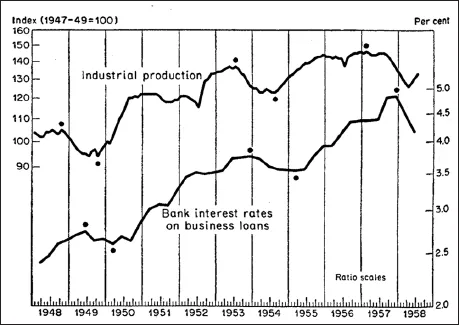
It is not easy to prove this relationship statistically, partly because so many influences govern interest rates, and partly because there is no “pure” index of “depression” and “prosperity.” But Geoffrey H. Moore, associate director of research of the National Bureau of Economic Research, who has done much work along this line, has at my request kindly furnished the data, and H. Irving Forman of the same organization has prepared the accompanying chart, comparing the Federal Reserve index of industrial production with bank rates on short-term business loans in the ten-year period running from 1948 through part of 1958.
The industrial production scale on the left and the interest-rate scale on the right are ratio scales, in order to bring out more clearly the proportional changes in the two indexes.
MONEY-RATE AND OUTPUT
The results show that the two indexes tend to go up or down together. Or, more strictly speaking, the industrial production index leads, and the interest-rate index lags. This is what we might expect. When production has been low, demand for loans is low and interest rates are low. As production increases, the demand for loans to expand production increases, and if the money and credit supply is not too “elastic,” interest rates tend to rise, but with a time lag. There is also a reciprocal and inverse influence of interest rates on production. Low interest rates tend to encourage borrowing for subsequent production, and high interest rates to discourage borrowing for subsequent production.
Business Tides: The Newsweek Era of Henry Hazlitt
Read the whole book online · Book details
This work is published under a Creative Commons licence. You may copy, share, and re-host it with attribution.