
Chapter 64 of 301 · Conceived in Liberty by Murray N. Rothbard
65. The Colonies in the First Decade of the Eighteenth Century
We have seen that the colonies in the first decade of the eighteenth century were again embroiled in projects for invasions of New France. Indeed, England had only four years of respite from war with France after the Treaty of Ryswick in 1697. In 1701 England and the other powers of Europe became involved in the War of the Spanish Succession, largely against the ambitions of Louis XIV. The war was marked by a series of expensive but futile attempts to invade Canada. Early expeditions failed to conquer Acadia, but a large expedition in 1709, having failed to mount an attack on Quebec, consoled itself by seizing Port Royal and the rest of Acadia. Another huge expedition was mounted against Quebec in 1711, but the invasion was so badly bungled that some ships were wrecked in a storm, and the rest hastily returned.
Peace between England and France came in 1713 with the Peace of Utrecht. Essentially beaten in the European war, France agreed to turn over Acadia (now Nova Scotia), Newfoundland, and Hudson’s Bay permanently to the English, and to recognize the Iroquois (among whom French Jesuits had made considerable headway) as being under English jurisdiction.
By the first decade of the eighteenth century, the previously highly disparate colonies had become far more uniform. The political structures of the colonies, in particular, were now more alike. By 1710 the great liberal revolutions of the 1670s and 80s had made their attempt and failed, but their failure at least succeeded in gaining a few crucial concessions from the ruling power. In each of the colonies, by 1710, a royal or proprietary governor ruled the territory. He appointed the Council and the lesser administrative and judicial bureaucracies, and ruled in alliance with a colonial oligarchy largely created by English rule, as well as with a bureaucracy of royal officialdom. The oligarchy received all manner of subsidies and privileges by virtue of its share in the control of the state apparatus; conspicuous among these privileges were arbitrary large land grants to favored individuals and groups. In each of the colonies an elected Assembly had emerged as the representative of the popular liberal forces, in continuing battle against the power of the royal officials and their appointed upper house.
Most of the provinces were now royal colonies, and even the proprietors were not the proud independent rulers of yore. Once feisty and independent Massachusetts had now been brought under the royal heel. New York, formerly a proprietary colony lacking any elected Assembly, was now a royal colony similar to the others, with an elected Assembly possessing the taxing power partially offsetting the royal appointees. The proprietary New Jerseys were now a single royal colony. New Hampshire too was finally established as a royal colony. Of the five proprietary colonies remaining in the first decade of the eighteenth century, two (the Carolinas) were soon to be forcibly transformed into royal provinces. Furthermore, the previously remarkable religious freedom and separation of church and state in the Carolinas was now replaced by an Anglican establishment serving a small minority, particularly in North Carolina. In Maryland, Lord Baltimore had been deprived of his proprietary, and though it was soon to be returned to the Baltimore family, it was returned as an Anglican colony. Gone was Maryland as a haven for Catholics from religious persecution. In short, the former uniqueness of the various proprietary, and self-governing, colonies had now disappeared, and there was little to distinguish the royal from the remaining proprietary colonies. The same was true for originally pacifist and anarchistic Pennsylvania; Pennsylvania and its sister proprietary Delaware had been made royal colonies; William Penn received them back only on the condition that he would mold his colonies into what had become the standard North American pattern. Of the original self-governing colonies of New England, only Connecticut and Rhode Island remained as anomalies, still in the seventeenth-century framework.
A proprietary always meant that there would be annoying attempts to collect feudal quitrents from the landowners. The Crown too tried to impose quitrents, but they proved, despite continuing efforts by the governors, to be virtually impossible to collect. The dissolution of the quitrent threat meant that true feudal tenure could not take hold in America, since the proprietary could not enforce its claims to feudal tribute. Even less could such plans as Maryland’s consciously created feudal hierachy of land claims persist under American conditions of abundant cheap land and individual independence. Of course, such feudalistic institutions as servitude and Negro slavery greatly increased the privileged ownership of large tracts of land. Fortunately, although the tobacco country of the Southern colonies and isolated areas such as the Naragansett Country and West New Jersey had large plantations, no permanent landlord-tenancy relations prevailed—even where arbitrary and privileged land grants had been extensive. For speculative land monopolists, perhaps wanting nothing better than to be feudal lords over a host of servants and subtenants, invariably decided to take their wealth quickly and reap speculative gains without suffering the risks of land ownership. The one crucial exception was New York, where receivers of huge land grants—the manors, following after the patroonships of the Dutch—decided to continue as landlords exacting rents from their tenants. Deciding to rent out and not to sell, the New York landlords thereby made the fateful decision to freeze land monopoly in existing huge tracts. Except for the master-slave relation, all major aspects of feudalism in the colonies disappeared rather quickly upon their introduction—New York, of course, excepted; here essentially feudal landholding continued for at least a century. As a result, New York’s growth, compared with that of the other colonies, was retarded.
Negro slaves were becoming an increasingly large part of the coerced labor force. They were used everywhere in the colonies, but especially and increasingly on the large plantations of the South.
The following tabulation is the estimated population of the American colonies in 1710 and 1680, the figures in parenthesis being the estimated number of Negroes (overwhelmingly slave).
AMERICAN POPULATION, 1710 AND 1680 (in thousands)
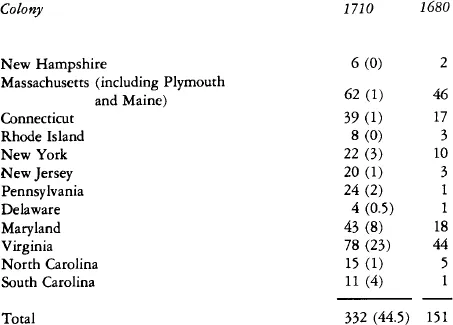
The table reveals the comparatively slow growth of New York, the phenomenal growth of Pennsylvania, and the high proportion of Negro slaves in Virginia and South Carolina.
The religious structure of the colonies was also becoming uniform, in a sense, by 1710. Whereas in the seventeenth century religious persecution in behalf of the dominant sect had been the norm, except in such maverick colonies as Rhode Island and North Carolina, by the eighteenth century religious freedom generally prevailed. But only partially, since many colonies had their established church: for example, the Puritan in Massachusetts, the Presbyterian in Connecticut, and the Anglican in the Southern colonies.
The noted historian Carl Becker once raised the question about the extent to which the American Revolution was a battle for “home rule” of the colonies vis-à-vis England, as opposed to a battle about “who should rule at home,” within the colonies. In short, to what degree was the Revolution “internal,” and to what degree “external?” We are now able to frame a judgment about this issue for the earlier revolutions of the late seventeenth century and for their aftermath. We have seen how revolution, in the 1670s and especially after 1688, swept almost every colony in America: from Bacon’s Rebellion in Virginia to Leisler’s in New York to the continuing state of revolution in the two New Jerseys. All of these revolutions may be classified as “liberal” and popular; in short, as essentially mass movements in behalf of libertarian objectives and in opposition to the tyranny, high taxes, monopolies, and restrictions imposed by the various governments. Separating the strands of “home rule” and “rule at home” is an artificial and misleading way of treating the problem. For the revolutionaries were battling against the oppressions of the state apparatus. This apparatus was certainly dominated by the “external” element, that is, the colonial governors appointed by the royal or proprietary rulers. But these governors created and then allied themselves with a “domestic” oligarchy. Through subsidies, taxes, privileges, monopolies, land grants, etc., the royal or proprietary governor and his Council formed an allied oligarchy, against which the people and their representatives in the lower house rebelled. The colonies, especially in New England, had been almost totally independent during most of the seventeenth century and deeply resented later English interference. But when these colonies rebelled, they did so not against England per se, but against the oppressions of the state, dominated by the English government. And the fact that the sudden weakening of English authority during the Glorious Revolution touched off these revolts in no sense negates this conclusion.
The liberal revolutions of the 1680s and 90s failed largely because the domestic oligarchs were propped up and reimposed by the English power. The Berkeleys and their successors, the Dudleys, the Androses, and the Hamiltons remained. But the revolutions were not a complete failure by any means. The populace was left with lower houses, Assemblies, willing to fight continually against oligarchic oppression, and they had a great tradition of revolution to look back upon and from which to gain inspiration. By the turn of the eighteenth century the English state had come to play a much greater and more direct role in the overall sum of governmental burdens on the American colonists. For by 1696 the structure of the Navigation Acts restricting colonial trade was complete, and a royal bureaucracy, replete with customs collectors and vice admiralty courts, began to impose itself on the colonies. The increasing weight of English imperial rule began to draw the brunt of popular liberal opposition.
Hence, by the turn of the eighteenth century, the revolutions of the late seventeenth century behind, the increasingly uniform American colonies had settled down to a period of uneasy balance. It was a balance filled with inner tension and conflict, but for most of the coming century, this conflict would no longer erupt into open confrontation or result in radical change. But when the eruption eventually occurred, it was to be an explosion that would change the face of the globe.
Conceived in Liberty
Read the whole book online · Book details
Free to read online and to download from this archive.