
Chapter 11 of 13 · Deep Freeze: Iceland's Economic Collapse by Philipp Bagus
Chapter 9 Concluding Remarks
The spectacular collapse of the Icelandic economy has attracted much interest. Often it is asserted that speculators or free-market reforms caused the downturn. Nothing could be farther from the truth.
Iceland is far from being a libertarian paradise. Despite former Prime Minister (and later CBI chairman) Davíð Oddsson’s free-market rhetoric and his affection for the Thatcher and Reagan eras, Iceland is close to the Scandinavian model of the welfare state. In 2007, its fiscal burden was ninth highest among nations in the OECD (41.4 percent of GDP, higher than both Germany and France).
Although there was deregulation and privatization of the banking sector, the Icelandic banking sector was very far from being a free market. It is true that banks could act freely, but they operated within a framework of government-created incentives, and it was these incentives that caused a business cycle. In fact, Iceland is a perfect example of an economic collapse caused by a national fiat paper money. Fiat paper money has nothing to do with free-market money. The privilege of fractional reserve banking (i.e., appropriating deposited money and engaging in credit expansion) violates a depositor’s property rights. The Central Bank of Iceland directed the credit expansion, expanded the monetary base, and assumed the role of an explicit lender of last resort. Central banking is one of the last bastions of government planning and socialism.1
While central banks in other developed nations at least nominally enjoy independence from the government that has granted their monopoly, in Iceland there was no doubt that the CBI was always a manifestation of political forces. Two of its three governors were direct political appointees. Davíð Oddsson, who presided over the CBI during its dramatic fall from grace, had previously been the Prime Minister of the nation (he was also not an economist but a lawyer by training). When it was apparent that the Central Bank had allowed the country’s finances to fall into a catastrophic state, the new Prime Minister, Johanna Sigurdorttir, ousted Oddsson. The lack of a strong rule of law constraining politicians was never bluntly exposed: “Johanna Sigurdorttir understood that she could not sack Davíð Oddsson outright; she could, however, make it clear that if he did not go of his own free will, she could rush through a law stipulating, for example, that the governor of the central bank had to have economic training.”2
The existence of a central bank that is prepared to help troubled banks greatly encourages credit expansion and maturity mismatching.3 The CBI was no more an advocate of a free market than other central banks are. It simply followed the credit expansion directed by the rest of the central banks, under the illusion that the artificial reduction of interest rates would be beneficial to the coordination of the economy. As a roller-over of last resort the CBI encouraged maturity mismatching, which was one of the two ingredients in the explosive cocktail that would blow up Iceland’s financial sector. The other main ingredient, currency mismatching, was encouraged by the illusion that currency swaps could protect against a rollover stoppage in the international wholesale markets.
It was not understood that credit expansion itself leads to this rollover stoppage. As credit expansion engenders malinvestment, an unsustainable situation develops. The economy becomes increasingly fragile. When currency mismatching is coupled with maturity mismatching—and a credit expansion relying on demand deposits is by definition maturity mismatching—even a relatively small disruption of liquidity will make the house of cards come toppling down. The collapse of Lehman Brothers in late 2008 did not cause the demise of Iceland’s economy; it simply exposed the errors that investors had made earlier.
The two primary factors exacerbated the maturity mismatch. First, the Central Bank of Iceland’s easy monetary policy fueled the move to short-term debt durations. As monetary policy primarily took effect at the short end of the yield curve, short rates were driven lower than the long rates. Because the money supply was continually expanding, short-term borrowing could be continually rolled over. Bankers and entrepreneurs could effortlessly profit by borrowing at artificially low short-term rates while investing in longer-term projects. When short-term credit disappeared, a bust swiftly ensued that exposed the unprofitability of these longer-term investment projects (primarily housing and aluminum smelting). The second factor that exacerbated the maturity mismatch was artificially low interest rates worldwide, which enabled Icelanders to borrow at further low interest rates. It became common to borrow sums denominated in Japanese yen, Swiss francs, euros, and U.S. dollars. This borrowing was not problematic as long as the króna maintained its value (indeed, increased in value), but the sharp drop in the value of the króna in 2008 quickly ended the foreign investment.
Entrepreneurs undertake all foreign-denominated investments with a degree of currency rate risk. As floating rates may adjust during the time between when a contract is struck and when it is fully paid, exchange rate movements can significantly alter the final repayment amount. Entrepreneurs factor for this added risk premium, and it is a disincentive to borrow excessively in a foreign currency. Icelanders seemed to ignore this risk factor during the boom, undertaking unnerving amounts of foreign-denominated debts while offsetting them with relatively few foreign assets or revenues.
The extreme degree of currency mismatching that the Icelandic banks engaged in can be partly explained by two factors.
First, many investors—both Icelandic and foreign—saw the International Monetary Fund as being capable of providing stability. With this implicit assurance in place, currency investors could sleep well knowing that Iceland had a good chance of being aided when or if its economy finally faltered.
Second, the Central Bank of Iceland provided an additional guarantee in 2001 when it explicitly promised to act as the lender of last resort. Secure in the knowledge that investments that went south would be covered, investors threw due diligence out the window and behaved with irrational exuberance. Banks could not compete with each other without taking on ever-riskier investments. Because borrowing in low-interest-rate foreign currencies added to profitability, banks faced a dilemma: either partake in the boom, regardless of how unsustainable it seems, or be driven out of business by your counterparts who do participate in it. Yet while the CBI was capitalized well enough in comparison to the pre-boom Icelandic banking system to function should the recession not subside quickly, it was woefully undercapitalized to assume a position of lender of last resort for the now much larger banking industry. More importantly, the CBI, which existed in part to combat insolvency scenarios, faced insolvency itself as it was overwhelmed by the liabilities of the private banking industry. Since it had explicitly pledged its support, the Central Bank was on the hook for any private sector losses.
Some other commentators have remarked that Iceland was an innocent victim. Had a global credit crunch not restricted liquidity its banking system could remain largely intact today. IMF mission chief to Iceland Mark Flanagan said as much in a recent interview:
[G]iven the large financial shock that ultimately hit not only Iceland, [sic] but the entire world, it would probably not have been possible to prevent the crisis in Iceland itself. And we need to think deeply about why this happened, and if more could have been done to prevent it, to make sure it never happens again.4
Nothing could be further from the truth. To believe that Iceland was an innocent bystander of the liquidity crisis of late 2008 would be to ignore Iceland’s economic policies over the previous decade, which had fostered an oversized, indebted, and mismatched banking system.
The Icelandic crisis was wholly avoidable. Nothing was sprung upon the economy without warning. Actions with unintended consequences, both by Icelandic policymakers and by the international community, resulted in one of the largest economic busts to disrupt a developed economy. The effects have been widespread. The economy has undergone drastic changes, and will need to go through many more if recovery is to strengthen. The Icelandic language carries some marks of the crisis. “Two thousand seven,” the last year of good times to roll by prior to the collapse, is now used as an adjective to describe excess. Icelanders now dismiss someone buying a new expensive car, throwing a luxurious party or taking an exotic vacation as being “so two thousand seven.” “Kreppa,” an Icelandic word usually used to denote “in a pinch” or “to get into a scrape,” is now synonymous with the financial crisis.5
The temptation for Iceland to join the European Monetary Union has proven strong in the aftermath of the worst financial crisis of the 21st century. The Icelandic public’s resolution against joining the European Union has strengthened over the past five years, and especially since the onset of the crisis. Figure 20 shows a compilation of various public polls inquiring whether Iceland should join the EU. Despite this widespread opposition among voters, the Althing voted on July 16, 2009 in favor of accession talks with the Union.6 The Icelandic government lodged a formal application to join the European Union on the same date, with official negotiations beginning on July 27, 2010.
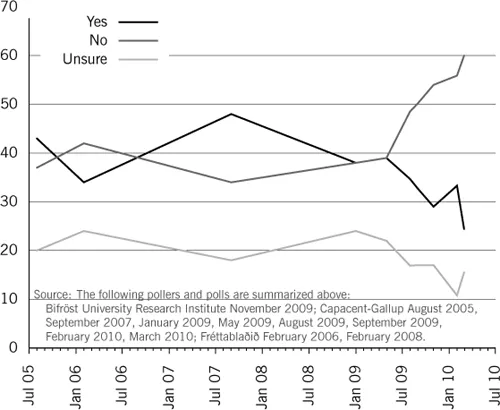
Figure 20: Public Opinion on Icelandic accession to the EU (August 2005–February 2010)
It is notable that Iceland already enjoys being a member of the EU’s single market (since 1994), and is a member of the Schengan Area (since 2001) which removes all border controls between member states. Opposition to joining both the EU and the Eurozone remained strong throughout the boom. Former Prime Minister Geir Haarde affirmed this hesitation to join the European Union as recently as March 31, 2006 at a speech hosted by the University of Iceland, “Our policy is not to join in the foreseeable future. We are not even exploring membership.”7 The European Union has made it clear that admittance to the Economic and Monetary Union (EMU), with its subsequent adoption of the euro, will not be possible without first ascending to full EU membership. While many Icelanders today see a growing attractiveness to euro adoption, few want the bureaucratic entanglements that will go along with EU membership.
Pressure to join the EU, with or without euro currency adoption has been waxing. The Social Democrat Prime Minister Jóhanna Sigurðardóttir has pushed for euro adoption as a response to the crisis’s aftermath. Iceland’s Business Minister, Gylfi Magnusson, favors EU membership as a way to stabilize the country’s currency, “The main benefits of EU membership at the moment would be the possibility of joining the exchange rate mechanism, and eventually adopting the euro.”8 One other “senior Icelandic official” has been quoted as saying, “The krona [sic] is dead. We need a new currency. The only serious option is the euro.”9 While euro-adoption provides a quick fix to the króna problem, joining the European Union, as the EU has made clear will be a necessary requirement for membership in the currency union, brings less clear advantages.
We may at this point question what benefit EU membership would bring that is not already forthcoming under inclusion in the European Economic Area. “EEA membership has been good for Iceland, which pays relatively little into EU funds, and runs its own farm and fish policies (it also escapes EU laws banning whaling).”10 Indeed, as Iceland’s Left-Green Political party has recently noted, “EU-membership would diminish the independence of Iceland even more than the EEA Agreement does and jeopardize Iceland’s control over its resources.”11 European Commissioner for Economic and Financial Affairs Olli Rehn has confirmed that Iceland’s access to its resources may be jeopardized, noting that although EU accession would be relatively easy for Iceland (potentially requiring less than one year of negotiations), it would not get any special treatment. Fishing quotas and whaling would likely be tough issues for Iceland to control during such negotiations. Given that the seafood industry accounts for thirty-seven percent of Iceland’s exports, and employs eight percent of the work force, having one of their key natural resources fall under the sway of the EU’s Common Fisheries Policy creates a cause for concern for the small island nation.12
In fact, while Rehn and other Europhiles encourage Iceland’s accession to the EU, it is difficult to find any well-placed rationale. As Rehn himself recently commented about Iceland’s admittance, “It is one of the oldest democracies in the world and its strategic and economic positions would be an asset to the EU.”13 It is difficult to say, to which exact economic positions Rehn refers. The country has, after all, just suffered the worst economic collapse of the 21st century, with a lasting recovery still uncertain. Iceland possesses two significant assets that are of strategic interest to the EU. First are rich fishing grounds that could be integrated into the EU’s Common Fisheries Policy for its own gain. Second is its strategic location in the North Atlantic—an aspect that has been exploited by foreign nations throughout Iceland’s history for military purposes. It is not immediately clear what advantages Iceland would gain by sacrificing either of these resources for EU admittance. Indeed, as former Prime Minister and then-chairman of the CBI Davíð Oddsson cautioned during an October seventeenth 2008 interview with the Wall Street Journal, “[i]f we were tied to the euro,… we would just have to succumb to the laws of Germany and France.”
More importantly, it is not immediately clear that admittance to the European Union, or adoption of the euro currency, would have staved off Iceland’s current woes. Other periphery EU countries suffered booms like Iceland, and still find themselves in the midst of recovery. The PIIGS countries—Portugal, Ireland, Italy, Greece and Spain—were not immune to these causes. Iceland may have suffered at the hands of an over-exuberant central bank, but this factor would not be removed by sacrificing monetary decisions to the ECB in Frankfurt. In fact, for several years leading up to its crisis, the Central Bank of Iceland modeled its liquidity rules on those of the ECB. We may say that they were only largely modeled after the ECB because for quite a while the Icelandic Rules were more stringent than those of the ECB.14 The CBI only slackened these rules in the late stages of the boom in an attempt to resemble those that existed within the ECB’s jurisdiction (in terms of collateral requirements, for example). The prolific printing of money by the ECB flowed into Iceland primarily by a reduction in the risk premium that investors were willing to place on Icelandic borrowing. Joining the common currency area would, if anything, increase the ease at which Frankfurt’s easy credit policy would be transferred to Reykjavík.
Nor is it clear that the European Union would be any more forthcoming with emergency funds when the time arose to combat the crisis. The Greek situation proved to be a difficult political fix in the early months of 2010. At the end of the day, the EU was not alone in bailing out the indebted Greeks. The IMF was also called in to provide emergency loans. Although a plausible fix for the crisis at hand, membership in the EU has a less than stellar historical record over the past few years at dealing with crises in its existing member states. Nor is it readily apparent that the EU has the funds to handle its existing crises, let alone a fresh one in the North Atlantic.
Iceland’s fate has already been sealed. An unsustainable boom must now give rise to a cleansing recession to clean the imbalances created over the past decade out of the system. Only then may a return to sustainable recovery, and growth, begin. With Iceland’s short-term sustainability more or less provided through by the emergency loans and swap agreements, the longer-term goal of growth must be centered upon. Addressing the monetary factors that enabled such a disproportionately sized banking system to develop is the crux of the road to recovery. The Icelandic tragedy would not have been possible in a free monetary and financial system. Commentators who have charged that “free-market reforms” should shoulder the burden of blame for the crisis must identify a much different cause. Peter Gumbel’s December 2008 assessment, written for CNN, that Iceland had become a “giant hedge fund” as a result of former Prime Minister Davíð Oddsson’s reforms misses a critical point. The reason that a tiny island country could become a major player in global finance was due to monetary factors. Easy money policies at home and abroad, as well as political guarantees (the effective socialization of losses) perverted the incentive structure of the previously reserved nation. The political nature of Icelandic monetary policy is now evident. A banking system that was given the legal privilege of employing fractional reserves reared a nation of prolific borrowers and excessive risk takers.
Under a 100 percent commodity standard (gold, for example), credit expansion is impossible by definition. If banks have to honor time-tested legal principles and maintain 100-percent reserves on their demand deposits, they cannot create money out of thin air. Even a fractional reserve gold standard like the monetary system that prevailed before the First World War would have limited the credit expansion.
More importantly, the explosive ingredient of currency mismatching would have been eliminated. If the world had been on a gold standard, currency mismatching and its dangers would have been impossible. Iceland could not have indebted itself massively in the short-term in its domestic currency or in mismatching foreign currencies, as both currencies would have been gold. Banks would have stayed solvent. Even if an individual bank had gotten into trouble, its small size would have made the economic repercussions manageable if a market-based capital injection became necessary. Lending would have been constrained, both in magnitude and in counterparty. There would have been no stock market boom or housing boom.
Foreign exchange rates would have been fixed according to the gold content of the currencies. The Icelandic gold króna would have fluctuated only negligibly relative to the other gold currencies. Small fluctuations would trigger opposite gold flows, which would arbitrage the gold currencies into line with their gold content. Consequently, Iceland would never have developed a distorted financial sector. Overconsumption would not have reigned, the currency would not have collapsed, and import problems would not have arisen. It was the Icelandic government’s move away from free-market principles and towards government interventionism that set the stage for the spectacular Icelandic tragedy. Only free-market principles and the restoration of property rights in the monetary sphere will prevent such tragedies in the future.
1Huerta de Soto, Money, Bank Credit and Economic Cycles, p. xxii.
2Boyes, Meltdown Iceland, pp. 197–98.
3Bagus, “Austrian Business Cycle Theory.”
4As quoted in Andersen, “Iceland Gets Help.”
5“Kreppanomics,” The Economist (October 9, 2008).
6Of sixty-three parliamentary votes cast, thirty-three were in favor of EU accession talks, twenty-eight against, and two abstentions (EurActiv, “Iceland’s Parliament Votes in Favour of EU Talks” [July 17, 2009].
7As quoted in Hjörtur J. Guðmundsson, “Slashing the Rumors: Iceland is Far From Adopting the Euro,” TEAM Europe (May 5, 2006).
8As quoted in BBC News, “Iceland Moves Towards Joining EU” (July 16, 2009).
9As quoted in Ian Traynor, “Iceland to be Fast-Tracked into the EU,” The Guardian (January 30, 2009).
10“Iceland Hunts the Euro,” The Economist (January 22, 2009).
11As quoted in Francesco Rossi, “Iceland’s Icesave Referendum: A Possible Outcome Suggested by Electoral Perspective,” Working paper (2010), p. 15.
12Leo Cendrowicz, “Iceland’s Urgent Bid to Join the E.U.,” Time (July 17, 2009).
13As quoted in Traynor, “Iceland to be Fast-Tracked.” Given the tenuous reasons promoting Icelandic membership in the European Union now coming forward, the words of Gier Haarde from almost five years ago are proving prescient, “[S]ince in Iceland the interest in joining the EU has rather decreased than increased in recent years, those in favour have found themselves in a growing despair to get Iceland into the union. As a consequence they try to use every imaginable and unimaginable opportunity to raise the EU issue, with catastrophic results” (as quoted in Guðmundsson, “Slashing the Rumors”).
14Friðriksson, “The Banking Crisis,” p. 7.
Deep Freeze: Iceland's Economic Collapse
Read the whole book online · Book details
This work is published under a Creative Commons licence. You may copy, share, and re-host it with attribution.