
Chapter 5 of 13 · Defending the Undefendable by Walter Block
I. SEXUAL 1 THE PROSTITUTE
Subject to ceaseless harassment by blue laws, church groups, chambers of commerce, etc., prostitutes nevertheless continue to trade with the public. The value of their service is proven by the fact that people continue to seek them out, despite legal and civic opposition.
A prostitute may be defined as one who engages in the voluntary trade of sexual services for a fee. The essential part of the definition, however, is “voluntary trade.” A magazine cover by Norman Rockwell some time ago illustrated the essence of prostitution, if not the specifics. It portrayed a milkman and a pieman standing near their trucks, each busily eating a pie and drinking milk. Both obviously pleased with their “voluntary trade.”
Those lacking sufficient imagination will see no connection between the prostitute entertaining her customer and the aforementioned milk and pie episode. But in both cases, two people have come together on a voluntary basis, in an attempt to mutually gain satisfaction. In neither case is force or fraud applied. Of course, the customer of the prostitute may later decide that the services he received were not worth the money he paid. The prostitute may feel that the money she was paid did not fully compensate her for the services she provided. Similar dissatisfactions could also occur in the milk-pie trade. The milk could have been sour or the pie underbaked. But both regrets would be after the fact and would not alter the description of these trades as “voluntary.” If all the participants were not willing, the trades would not have taken place.
There are those, women’s liberationists among them, who lament the plight of the poor downtrodden prostitute, and who think of her life as demeaning and exploitative. But the prostitute does not look upon the sale of sex as demeaning. After considering the good features (short hours, high remuneration), with the drawbacks (harassment by the police, enforced commissions to her pimp, uninspiring working conditions), the prostitute obviously prefers her work, otherwise she would not continue it.
There are of course many negative aspects experienced by prostitutes which belie the “happy hooker” image. There are prostitutes who are drug addicts, prostitutes who are beaten by pimps, and prostitutes who are held in brothels against their will. But these sordid aspects have little to do with the intrinsic career of prostitution. There are nurses and doctors who are kidnapped and forced to perform for fugitives from justice; there are carpenters who are drug addicts; there are bookkeepers who are beaten by muggers. We would hardly conclude that any of these professions or vocations are suspect, demeaning, or exploitative. The life of the prostitute is as good or as bad as she wishes it to be. She enters it voluntarily, qua prostitute, and is free to leave at any time.
Why then the harassment and prohibitions against prostitution? The momentum does not come from the customer; he is a willing participant. If the customer decides that patronization of a prostitute is not to his advantage, he can stop. Nor does the move toward prohibition of prostitution come from the prostitutes themselves. They have volunteered for their tasks, and can almost always quit if they change their minds about the relative benefits.
The impetus for the prohibition of prostitution is initiated by “third parties” not directly involved in the trades. Their reasons vary from group to group, from area to area, and from year to year. What they have in common is the fact that they are outside parties. They have neither stake nor standing in the matter, and should be ignored. To allow them to decide this matter is as absurd as allowing an outsider to decide about the trade between the milkman and the pieman.
Why then are the two cases treated differently? Imagine a league called the “decent eaters,” organized to espouse the doctrine that eating pie together with milk is evil. Even if it could be demonstrated that the league against pie-and-milk and the league against prostitution had identical intellectual merit—namely, none—the reaction to the two would still be different. The attempt to prohibit pie and milk would evoke only laughter but there would be a more tolerant attitude toward the attempt to prohibit prostitution. There is something in operation which staunchly resists an intellectual penetration of the prostitution question. Why has prostitution not been legalized? Though the arguments against this legalization are without merit, they have never been clearly assailed by the intellectual community as specious.
The difference between sexual trades such as the ones that take place in prostitution, and other trades, such as the pie-milk trade, seems to be based on, or at least connected to, the shame we feel, or are made to feel, at the prospect of having to “buy sex.” One is hardly “really a man,” nor in any way to be confused with an attractive woman, if one pays for sex.
The following well-known joke illustrates this point. A good looking man asks an attractive and “virtuous” woman if she will go to bed with him for $100,000.00. She is appalled by the offer. However, after some reflection she concludes that as evil as prostitution is, she could use the proceeds of the offer for charity and good works. The man seems charming, not at all dangerous or repugnant. She shyly says, “Yes.” The man then asks: “How about for $20.00?” The woman indignantly replies, “How dare you, what kind of woman do you think I am!” as she slaps his face. “Well we’ve already established what kind of woman you are. Now, we’re trying to establish the price,” he replies. The degree to which the man’s reply strikes a telling blow against the woman is a small measure of the scorn heaped upon individuals involved in this kind of endeavor.
There are two approaches which might combat the attitude that paying for sex is degrading. There is the frontal attack which simply denies that it is a wrong to pay for sex. This, however, would hardly convince those who think of prostitution as an evil. The other possibility would be to show that we are always paying for sex—all of us, all the time—and, therefore, we should not cavil at the arrangements between a professional prostitute and a customer.
In what sense can it be said that we all engage in trade and payments when we engage in sexual activity? At the very least, we have to offer something to our prospective partners before they will consent to have sex with us. With explicit prostitution, the offer is in terms of cash. In other cases, the trade is not so obvious. Many dating patterns clearly conform to the prostitutional model. The male is expected to pay for the movies, dinners, flowers, etc., and the female is expected to reciprocate with sexual services. The marriages in which the husband provides the financial elements, and the wife the sexual and housekeeping functions, also conforms clearly enough to the model.
In fact, all voluntary human relationships, from love relationships to intellectual relationships, are trades. In the case of romantic love and marriage, the trade is in terms of affection, consideration, kindness, etc. The trade may be a happy one, and the partners may find joy in the giving. But it is still a trade. It is clear that unless affection, kindness, etc., or something is given, it will not be reciprocated. In the same way, if two “nonmercenary” poets did not “get anything” from each other, their relationship too would terminate.
If there are trades, there are also payments. Where there are payments for relationships which include sexual congress such as marriage and in some dating patterns—there is prostitution—according to the definition of that term. Several social commentators have correctly likened marriage to prostitution. But all relationships where trade takes place, those which include sex as well as those which do not, are a form of prostitution. Instead of condemning all such relationships because of their similarity to prostitution, prostitution should be viewed as just one kind of interaction in which all human beings participate. Objections should not be raised to any of them—not to marriage, not to friendship, not to prostitution.
2
THE PIMP
From time immemorial, pimps have been treated as parasites who prey on prostitutes. But in a fair assessment, an examination of the true function of the pimp must be made.
An initial point requiring clarification is the claim that pimps use coercion and threats of violence to gather and keep prostitutes on their payrolls. Some pimps do, but does this fact justify condemning the profession itself? Is there any profession that does not have a single practitioner who is not guilty of foul play? There are bricklayers, plumbers, musicians, priests, doctors, and lawyers who have violated the rights of their fellow creatures. But these professions are not qua professions to be condemned in their entirety.
And so it should be with the profession of pimping. The actions of any one, or even of all pimps together, cannot legitimately be used to condemn the profession qua profession, unless the action is a necessary part of the profession. Now the profession of kidnapping small children for ransom is an evil profession, qua profession. Even though some kidnappers may perform good deeds, such as contributing a part of the ransom to charity, or even if all of them do so, the profession does not thereby become less of an abomination, because the action which defines it is evil. If the action which defines the profession of pimping were evil, then it should be condemned also. In order to evaluate pimping, any extraneous evil acts which may be committed by some pimps must be ignored as having little to do with the profession as such.
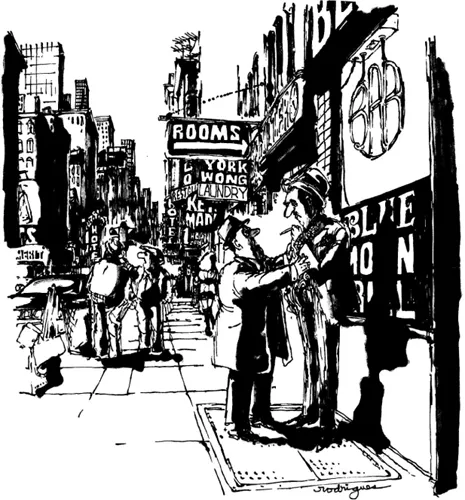
“Look, I’m her father, I’m only interested in her welfare—but she won’t listen to me! Please talk to her—tell her to come home with me to Akron. She’ll listen to you, you’re her pimp.”
The function of the pimp qua pimp is that of a broker. In the same way as do brokers of real estate, insurance, stock market shares, investments, commodity futures, etc., the pimp serves the function of bringing together two parties to a transaction at less cost than it would take to bring them together without his good offices. Each party to a transaction served by a broker gains from the brokerage, otherwise they would not patronize him. And so it is in the case of the pimp. The customer is spared useless or wasteful waiting and searching time. It is easier to phone a pimp for an assignation with a prostitute than to spend time and effort searching one out. The customer also has the security of knowing that the prostitute comes recommended.
The prostitute benefits too. She gains the time that would otherwise be spent in searching for the customer. She is also protected by the pimp—from undesirable customers, and from policemen, part of whose profession, qua profession, is to prevent prostitutes from engaging in voluntary trade with consenting adults. Assignations arranged by the pimp afford the prostitute additional physical security over street walking or bar hopping.
The prostitute is no more exploited by the pimp than is the manufacturer exploited by the salesman who drums up business for him, or the actress who pays an agent a percentage of her earnings to find new roles for her. In these examples the employer, by means of the employee’s services, earns more than the cost of hiring the employee. If this were not so, the employer-employee relationship would not take place. The relationship of the prostitute to the pimp (employer to employee), contains the same mutual advantages.
The professional pimp performs the necessary function of brokering. In this performance he is if anything more honorable than many other brokers, such as banking, insurance, and the stock market. They rely on restrictive state and federal laws to discourage their competition, whereas the pimp can never use the law to safeguard his position.
3
THE MALE CHAUVINIST PIG
The women’s liberation movement is an amalgam of different programs and composed of diverse groups with differing aims. The discriminating intellect may accept some of the aims, purposes, motivations, and programs of women’s liberation, and reject others. It would be folly to treat as equivalent a host of different values and attitudes merely because they have been packaged together. The views of the women’s liberation movement can be divided into four major categories—each of which requires a different approach.
COERCIVE ACTIONS TAKEN AGAINST WOMEN
Apart from murder, the most brutal coercive action taken against women is rape. Yet in this male dominated society rape is not always illegal. It is not illegal when perpetrated upon a woman by her husband. And, although rape is illegal when it occurs outside the “sanctity” of marriage, the way in which it is treated by the law leaves much to be desired. For one thing, if there was any previous acquaintanceship between the rapist and his victim, the court presumes that there was no rape. For another, in order to prove rape, it was necessary in many states until recently, that there be a witness to the crime. Furthermore, if friends of the rapist swore they had sexual intercourse with the victim, she could be characterized as “immoral,” and it becomes virtually impossible to obtain a conviction. If the victim is a prostitute, it is equally impossible to obtain a conviction. The reasoning behind the legal inability for a prostitute to be raped is the ludicrous view that it is impossible to compel a person to do that which she does willingly at other times.
One of the most attractive aspects of the women’s liberation movement is its support for greater penalties for rape, plus restitution to the victim. Previously people who occupied a comparable position on the political spectrum as do most of today’s feminists (e.g., liberals and leftists) urged lighter sentences for rapists and general mollycoddling of criminals. In their view, all crime, rape included, was caused mainly by poverty, family breakdown, lack of recreational facilities, etc. And their “solution” followed directly from this “insight”: more welfare, more parks and playgrounds for the underprivileged, counseling, therapy, etc. In contrast, the feminists’ insistence on stiffer jail sentences for rapists—and worse—comes like a breath of fresh air.
Although rape is the most striking instance in which the government acquiesces in coercive actions against women, there are others. Consider what is implied by the laws against prostitution. These laws prohibit trade between mutually consenting adults. They are harmful to women in that they prevent them from earning an honest living. If their anti-woman bias is not clear enough, consider the fact that although the transaction is just as illegal for the customer as for the seller, the male (customer) is almost never arrested when the female (seller) is.
Abortion is another case in point. Although inroads have finally been made, abortion is limited by obstructive rules. Both outright prohibition of abortion and abortion under present controls deny the great moral principle of self-ownership. Thus, they are throwbacks to slavery, a situation essentially defined by the barriers put up between people and their right of self-ownership. If a woman owns her body then she owns her womb, and she alone has the complete and sole right to determine whether to have a child or not.
The ways in which the government supports or is itself actively involved in coercing women are manifold. Until very recently, for example, women did not have the same rights as men to own property or to engage in contracts. There are still laws on the books that prevent married women, but not married men, from selling property or engaging in business without the permission of their spouses. There are stiffer entrance requirements for women than men at some state universities. The infamous tracking system in our public schools shunts young boys into “male” activities (sports and carpentry), and young girls into “female” activities (cooking and sewing).
It is important to realize that these problems all have two things in common: they are instances of aggressive force used against women and they are all inextricably bound up with the apparatus of the state. Although not widely appreciated, this is no more true of rape and prostitution than of the other actions and activities described. For what does it mean to say that women do not have the right to abort, to own property, or to set up businesses, except that women who engage in these activities will be stopped by state compulsion, fines, or jail sentences.
Clearly, both the government as well as individuals can discriminate. But only state and not private discrimination violate the rights of women. When a private individual discriminates, he (or she) does so with his (or her) own resources, in his (or her) own name. But when the state discriminates, it does so with resources taken from its citizenry and in the name of all of its subjects. This is a crucial difference.
If a private enterprise such as a movie discriminates, it runs the risk of losing money and possible bankruptcy. People opposing the discrimination may withhold funds or not patronize the institution. However, when the state discriminates, these people do not have this option, and there is no risk of bankruptcy. Even when people oppose discrimination in a state institution from which they can withhold funds, (students can, for example, at a state university) the state has other alternatives. It can make up for the dwindling funds from tax revenues, and these must be paid under threat of compulsion.
Even the pinches that women are subject to are inextricably bound up with the state apparatus. Contrast what happens when sexual harassment takes place within the confines of a private place (a department store) and when it takes place outside (on a street one block away from the store). When a woman is molested within the confines of a private place the whole force of the profit-and-loss free-enterprise system comes to bear on the problem. It is in the entrepreneur’s self-interest to apprehend and discourage offensive actions. If he does not, he will lose customers. There is, in effect, competition between store owners to provide safe and comfortable environments for customers. The ones who succeed to the greatest degree in their antipinching drive will tend to reap the greatest profits. The ones who fail, whether because they ignore the issue or are unsuccessful in implementing their programs, will tend to incur the greatest losses. This, of course, is not a guarantee that pinching and other offensive behavior will cease. It will always occur as long as people remain imperfectly moral. But this system does encourage, by profits and losses, those who are most able to control the situation.
Contrasted with what occurs in the public domain, however, the private system begins to look like perfection itself. In the public domain there is almost no incentive to deal with the problem. There is no one who automatically loses anything when a woman is pinched or otherwise harassed. The city police are supposedly charged with the responsibility, but they function without benefit of the automatic profit-and-loss incentive system. Their salaries which are paid for by taxation, are not related to performance and they suffer no financial loss when women are molested. It is clear then why most of this type of harassment occurs on the streets and not within shops and stores.
NONCOERCIVE ACTIONS TAKEN AGAINST WOMEN
Many actions taken against women are not, strictly speaking, coercive. For example, whistling, leering, derision, innuendo, unwelcome flirtation, etc. (Of course, it is often difficult to tell beforehand whether a flirtatious remark will be welcome or not.) Consider the sexual come-ons which continually occur between men and women. Although to many people, and especially those in the women’s movement, there is no real difference between this type of behavior and coercive acts, the distinction is crucial. Both may be objectionable to many women, but one is a physically invasive act, the other is not.
There are many other kinds of actions which fall into the same category. Examples include the use of sexual vulgarisms (“broad” or “piece of ass”), the advocacy of double-standard mores, certain rules of etiquette, the encouragement of the mental capacity of boys and not of girls, the societal opprobrium of women who participate in “male” athletic activities, “sexist” advertising, and the pedestals that women are placed upon.
There are two important points to be made with regard to these and other attitudes and behavior which may be offensive but not coercive. The first is that such noncoercive actions cannot legitimately be outlawed. Any attempt to do so would involve the mass violation of the rights of other individuals. Freedom of speech means that people have the right to say whatever they like, even to make possibly reprehensible and boorish statements.
The second point is more complicated and by no means obvious. To a considerable extent, these reprehensible but noncoercive actions are themselves fostered and encouraged by coercive statist activities which operate behind-the-scenes. For example, the widespread incidence of government ownership and management of land, parks, sidewalks, roads, businesses, etc. These coercive activities, based on illegitimate compulsory taxation, can be legitimately criticized. If they were eliminated, the unsavory but legal behavior they support would diminish, with the aid of the free market.
Consider as an example the case in which a (male) boss harasses a (female) secretary in an objectionable but noncoercive manner. We shall compare the situation when such activity takes place on public and private property. To analyze this, we must understand what the labor economist calls “compensating differentials.” A compensating differential is the amount of money just necessary to compensate an employee for the psychic losses that go with the job. For instance, suppose there are two job opportunities. One is in an air-conditioned office, with a good view, pleasant surroundings and pleasant coworkers. The other is in a damp basement, surrounded by hostile fellow workers. However, there is usually some wage differential large enough to attract an individual to the less pleasant job. The exact amount of the differential varies for different people. But it exists.
Just as a compensating differential must be paid to hire employees to work in damp basements, so it must be paid to female workers in offices where they are subject to sexual harassment. This increase in wages comes out of the boss’s pocket if he is a private businessman. Thus he has a strong monetary incentive to control his behavior and the behavior of those who work for him.
But the increase in wages is not paid by the boss of a government or government-supported enterprise! It is paid by the taxpayer’s money, which is not paid upon the deliverance of satisfactory services, but is collected by coercion. Thus the boss has less reason to exercise control. It is clear that this type of sexual harassment, in itself offensive but not coercive, is made possible by the coercive actions of the government in its role as tax collector. If taxes were paid voluntarily, the boss, even in a government office, would be subject to meaningful control. He would stand to lose money if his behavior offended his employees. But because he is supported by money from coercive taxation, his employees are at his mercy.
In like manner, contrast the situation where a group of men whistle, jeer, and make disparaging and insulting remarks to and about women passersby. One group does this on a publicly owned sidewalk or street, the other in a privately owned place such as a restaurant or shopping mall.
Now, under which condition is this legal but reprehensible behavior more likely to be ended? In the public sector, it is in no businessperson’s financial interest to end the harassment. Since by assumption this behavior is legal, the public police forces cannot do anything to stop it either.
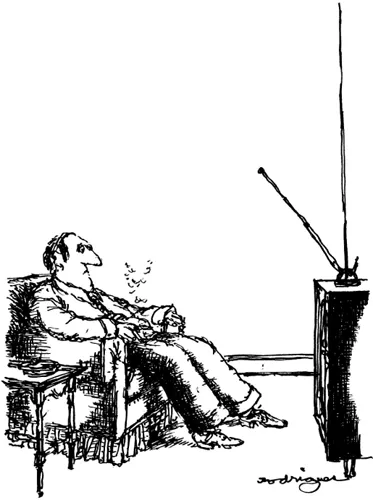
“This is mission control—Houston advises that Astronaut Mary Ellen Wilson is 26 hours into her menstrual cycle with only occasional bursts of anger directed toward Lt. Commander Joe Farley and Captain Ed Veidt interspersed with moderate sobbing.”
But in the realm of private enterprise, every entrepreneur who hopes to employ or sell to women (or to men who object to this maltreatment of women) has a strong pecuniary incentive to end it. This is why it is no accident that such harassment almost always takes place on public sidewalks or streets, and virtually never in department stores, restaurants, shopping malls, or other establishments which seek profits and care about their bottom line.
THE MALE CHAUVINIST PIG AS HERO
Consideration in some detail should be given to two grievous errors committed by the adherents of women’s liberation. It is for his good sense in opposing these programs that the male chauvinist pig can be considered a hero.
Laws compelling “equal wages for equal work.” The question is, of course, how to define “equal work.” If “equal work” is taken literally, it embraces all aspects of the employee’s productivity in the short run as well as in the long run, including psychic differentials, the discrimination of customers and other workers, and the ability of the employee to mesh with the likes, dislikes, and idiosyncrasies of the entrepreneur. In short, all these components must be weighted, if equal work is exactly the same as equal profitability for the entrepreneur. Only then, in the free market, workers with such equal abilities will tend to earn equal wages. If, for instance, women were paid less than men even though they were equally good workers in this sense, forces would be set up which, when carried to their conclusion, would insure equal pay. How? The employer would be able to make more money by replacing male workers with female workers. The demand for male workers would decrease, thus lowering male wages, and the demand for female workers would increase, raising female wages. Every employer who substituted a woman for a man would have a competitive advantage over the one who refused to do so. The profit maximizing employers would continually earn greater profits than would the discriminatory employers. The profit maximizers would be able to undersell the discriminators, and, other things being equal, eventually drive them into bankruptcy.
In actual point of fact, however, the proponents of equal wages for equal work do not have this strict type of equality in mind. Their definition of “equality” is equal years of schooling, equivalent skills, equivalent college degrees, and perhaps similar scores in qualification tests. However, individuals who are virtually identical with respect to such criteria can have vastly different abilities to earn profits for employers. For example, consider two workers, one male, one female, identical as far as test scores and college degrees are concerned. It is an indisputable fact that in the event of a pregnancy, it is far more likely for the woman to stay home and raise the child. Consideration of whether this custom is fair or not is not relevant. What is pertinent is whether it is factual or not. If the woman stays at home, interrupting a career or employment, she will be worth less to the employer. In this case, although the male and female candidates for the job might be identically qualified, in the long run, the man will be more productive than the woman and, therefore, more valuable to the employer.
Paradoxically, many pieces of evidence which indicate that men and women are not equally productive come from the women’s liberation movement itself. There are several studies in which women and men were first tested as groups, in isolation from one another, and then together, in competition with one another. In some cases, when the groups were tested in isolation, the women showed clearly that they had higher innate abilities than the men. Yet, when the two groups were tested in competition, the men invariably scored better than the women. Again, it should be emphasized that the concern here is not with the fairness of such occurrences, but with the effects. The point is that in the world of work, women will often find themselves in competition with men. If they constantly defer to men, and cannot do their best in competition with men, they are, in fact, of less help in procuring profits for the entrepreneur. If women are equal to men in test scores and are inferior to them when it comes to profit maximizing, then the equal pay for equal work law will prove disastrous for women.
It will be calamitous because the profit maximizing incentives will be turned around. Instead of the market exerting a strong steady push toward firing men and hiring women, employers will be motivated to fire women and hire men in their place. If he is forced to pay men and women the same wages, even though they are not equally productive, profits will be increased to the degree that male workers replace females. Employers who are inclined to take the feminist view, and insist on keeping woman workers, will have decreased profits, and lose their share of the market. The employers who prosper will be those who do not hire women.
It should be stressed that the tendency for women who are truly equal to men in productivity to receive equal wages exists only in the profit-and-loss free market. Only in free enterprise are there financial incentives to hire highly productive underpriced women, to “take advantage” of their plight, and thus to raise their wages.
In the government and nonprofit sectors, these profit incentives are, by definition, absent. It is hardly an accident, then, that virtually all real abuses of women in this respect take place in government and nonprofit areas such as schools, universities, libraries, foundations, social work, and public services. There are few allegations of underpayment to women in private enterprise fields such as computers, advertising, or the media.
LAWS COMPELLING NONDISCRIMINATION
McSorley’s is a bar in New York City that catered exclusively to men, until it was “liberated.” Under the banner of the new antidiscrimination law in New York State, women were served for the first time in the history of the establishment. This was hailed as a great progressive step forward by liberal, progressive, and women’s liberation factions. The basic philosophy behind the law and the attendant liberation of McSorley’s seems to be that it is illegitimate to discriminate between potential customers on the basis of sex.
If the problems with this philosophy are not readily apparent, they can be made so by considering several reductiones ad absurdum. If the philosophy were strictly adhered to, for example, would not separate bathrooms for men at “public” places be considered “discriminatory”? And separate residence halls for men? What about male homosexuals? They could be accused of “discrimination” against women. And aren’t the women who marry men discriminating against other women?
These examples, of course, are ridiculous. But they are consistent with the philosophy of antidiscrimination. If they are ridiculous, it is because that philosophy is ridiculous.
It is important to realize that all human actions imply discrimination in the only sensible definition of that much abused term: picking and choosing from available alternatives, the one which best serves his or her interests. There is no action taken by human beings which fails to accord with this dictum. We discriminate when we choose a toothpaste, decide upon a means of transportation, whom to marry. The discrimination practiced by the gourmet or wine taster is and can only be the discrimination practiced by all human beings. Any attack upon discrimination, therefore, is an attempt to restrict the options open to all individuals.
But what of the women’s option to drink at McSorley’s? Was their right to choose being violated? No. What they experienced was what a man experiences when a woman rejects his sexual advances. The woman who refuses to date a man is not guilty of violating his rights—for his rights do not include a relationship with her. That exists as a possibility, but not a right, unless she is his slave. In the same way, a man who wishes to drink in the company of other men is not guilty of violating women’s rights. For women’s rights do not include drinking with people who do not wish to drink with them. It is only in a slave society that this is not so. It is only in a slave society that the master can compel the slave to do his bidding. If the antidiscriminatory forces succeed in forcing their philosophy on the general public they will also succeed in forcing on the public the cloven hoof of slavery. To the extent that the male chauvinist pig succeeds in resisting these trends, he must be looked upon as a hero.
Defending the Undefendable
Read the whole book online · Book details
This work is published under a Creative Commons licence. You may copy, share, and re-host it with attribution.