
Chapter 33 of 50 · Failure of the 'New Economics' by Henry Hazlitt
Appendix D
INTEREST RATES AND BUSINESS CYCLES
It was the contention of John Maynard Keynes, still accepted by many academic economists, that interest rates are a purely monetary phenomenon. In his own words: “The rate of interest is the reward for parting with liquidity for a specified period... a measure of the unwillingness of those who possess money to part with their liquid control over it.”
This theory not only ignores or contradicts most of what has been written by economists for the last two centuries, but is clearly contrary to the facts it presumes to explain. If Keynes’s theory were right, short-term interest rates would be highest precisely at the bottom of a depression, to overcome the individual’s reluctance to part with cash then. But it is in a depression that short-term interest rates tend to be lowest. If the “liquidity-preference” theory were right, short-term interest rates would be lowest at the peak of a boom, because confidence would be highest then, and everybody would be wishing to invest in projects and “things” rather than in money. But it is at the peak of a boom that short-term interest rates tend to be highest.
It is not easy to “prove” this relationship statistically, partly because so many influences govern interest rates, and partly because there is no “pure” index of “depression” and “prosperity.” But Geoffrey H. Moore, associate director of research of the National Bureau of Economic Research, who has done much work along this line, has at my request kindly furnished the data, and H. Irving Forman of the same organization has prepared the accompanying chart,* comparing the Federal Reserve index of industrial production with bank rates on short-term business loans in the ten-year period running from 1948 through part of 1958.
The industrial production scale on the left and the interest-rate scale on the right are ratio scales, in order to bring out more clearly the proportional changes in the two indexes. The dots indicate comparative high and low points.
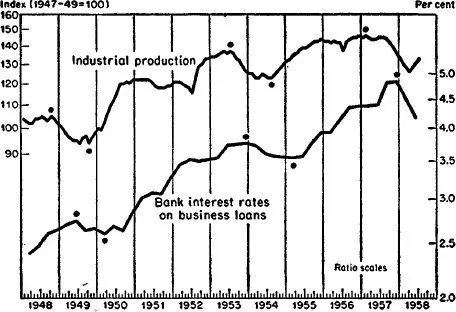
The results show that the two indexes tend to go up or down together. Or, more strictly speaking, the industrial production index leads, and the interest-rate index lags. This is what we might expect. When production has been low, demand for loans is low and interest rates are low. As production increases, the demand for loans to expand production increases, and if the money and credit supply is not too “elastic,” interest rates tend to rise, but with a time lag.
There is also, no doubt, a reciprocal and inverse influence of interest rates on production. Low interest rates (other things being equal) tend to encourage borrowing for subsequent production, and high interest rates to discourage borrowing for subsequent production.
The chart gives only short-term interest rates. For completeness long-term interest rates should be considered also. But the historical record does not lead to any substantial modification of the conclusions just reached. Those interested will find the relevant charts both in the monthly Federal Reserve Chart Book and in the Historical Supplement to it (both published by the Board of Governors of the Federal Reserve System). There they will find (e.g., on p. 21 of the monthly issue of October, 1958 and on p. 37 of the Historical Supplement of September, 1958) that short-term and long-term rates tend to go up and down together. From the monthly chart which covers only the period from the beginning of 1950 to the end of 1958 one might get the impression that short-term rates are almost always lower than long-term rates. From the historical comparisons running from 1865 to 1958, however, one may see that, until about 1929, short-term rates oscillated both above and below long-term rates and were as often higher as lower.
This is what theory would lead us to expect. The long-term interest rate for a given period is, at any moment, the composite speculative anticipation of what the average of future short-term rates will be over that period (corrected, in periods of deflation or inflation, for anticipations regarding the future real purchasing power of the currency unit). These speculative anticipations will of course often prove wrong. But long-term rates will tend to vary less erratically, and through a much narrower range, than short-term rates.
* I hasten to add that neither is responsible for the conclusions I have drawn from it. The chart accompanied an article of mine in Newsweek of Oct. 13, 1958.
Failure of the 'New Economics'
Read the whole book online · Book details
Free to read online and to download from this archive.