
Chapter 9 of 50 · Failure of the 'New Economics' by Henry Hazlitt
Chapter VIII INCOME, SAVING, AND INVESTMENT
1. Confusing Definitions
Chapter 6, “The Definition of Income, Saving, and Investment,” and Chapter 7, “The Meaning of Saving and Investment Further Considered” are among the most confused that even Keynes ever wrote. And upon their confusions are built some of the major fallacies in the General Theory.
Let us start with a sentence on page 55: “Furthermore, the effective demand [Keynes’s italics] is simply the aggregate income (or proceeds) which the entrepreneurs expect to receive....” This is loose writing, loose thinking, or both. Surely the “effective demand” cannot be what the entrepreneurs expect to receive, but what they do in fact receive. What they expect to receive must be merely what they expect the “effective demand” to be.
This confusion between expectations and realities, as we shall see, runs throughout the General Theory. Yet many Keynesians single out his treatment of expectations as Keynes’s great “contribution” to, or even “revolution” in, economics. “This process of bringing anticipations out from between the lines,” writes Albert G. Hart,1 “is nowhere more dramatically illustrated than in the work of Keynes.” Keynes himself confesses that in his Treatise on Money he “did not... distinguish clearly between expected and realized results.” (G. T., p. 77.) He repeatedly fails to do so also in his General Theory.
The aggregate demand function relates various hypothetical quantities of employment to the proceeds which their outputs are expected to yield; and the effective demand is the point on the aggregate demand function which becomes effective because, taken in conjunction with the conditions of supply, it corresponds to the level of employment which maximizes the entrepreneur’s expectation of profit (p. 55).
Particularly as he has not bothered up to this point to explain some of the leading terms employed, this is as choice a specimen of involution and technical gobbledygook as one is likely to find anywhere. But the General Theory is rich in such jewels, and we shall have occasion to examine the multiple facets of many of them before we are through. (I spare the reader footnote 2, p. 55, which weaves mathematical equations into already intricate verbal crochet work; but the curious may wish to consult it.)
We are now ready to proceed to Keynes’s definitions, respectively, of Income, Saving, and Investment, and of his reasons for finding saving and investment always equal.
But before we do this I must call attention to Keynes’s apology for the “considerable confusion” (p. 61) he caused in his Treatise on Money by his use of the terms there, and to his confession (p. 78) that “the exposition in my Treatise on Money is, of course, very confusing and incomplete.” It remains now to examine which is the more confusing— Keynes’s exposition and use of the terms in his Treatise on Money, or his exposition and use of the terms in the General Theory.
If Keynes gives any simple definition of national income in Chapters 6 and 7, I cannot find it. As we shall see, his concept of income seems to be subject to change without notice. I am willing to accept Professor Hansen’s word for it that: “Income in the current period is defined by Keynes as equal to current investment plus current consumption expenditures. Saving in the current period is, moreover, defined as equal to current income minus current consumption.” 2
Each of these key words, it will be noticed, is here defined in terms of the others. Such definitions are merely circular, and not in themselves enlightening. If we are told that X equals Y plus Z, then of course we know that Y equals X minus Z, and that Z equals X minus Y. Furthermore, if we know that X equals Y plus Z and that X also equals Y plus W, we know that W equals Z. But none of these transpositions or deductions can advance us very much until we have further knowledge of W, X, Y, or Z.
There are two chief questions to be asked concerning the use of terms and their definitions: (1) Is a given term and its definition clear and consistent? (2) Is a given set of terms or definitions more useful or enlightening than a more traditional set, or than possible alternatives? Let us now apply these two tests.
“Amidst the welter of divergent usages of terms,” writes Keynes (p. 61), “it is agreeable to discover one fixed point. So far as I know everyone has agreed that saving means the excess of income over expenditure on consumption.”
This definition, while at first sight apparently both simple and clear, ignores the vagueness in both the terms “saving” and “income.” Either of these may be conceived in terms of commodities, or purely in terms of money, or in terms of a mixture of commodities and money. If an automobile dealer, for example, takes 100 cars from a manufacturer in a given year, and sells only 75 of them, the 25 cars that he has been unable to get rid of may be regarded by some economists as part of his “income” during that year and part of his “savings” during that year. He himself, however, may measure his income and savings purely in terms of his cash position, and regard his unsold cars as a mere misfortune. They will probably be carried on his books at cost or at some other arbitrary valuation; but the dealer will only measure his “income” and “savings” in accordance with the money-price at which his surplus cars are ultimately unloaded. We shall return to some of these points later.
2. Why “Savings” Equals “Investment”
Our definition of income [continues Keynes] also leads us at once to the definition of current investment. For we must mean by this the current addition to the value of the capital equipment which has resulted from the productive activity of the period. This is, clearly, equal to what we have just defined as saving. For it is that part of the income of the period which has not passed into consumption (p. 62).
Now it is to be noticed here that Keynes has not only defined “investment” so that it is necessarily equal to “saving,” but he has also so defined it that “investment” and “saving” must be identical. He does not admit this clearly, however, until twelve pages later, at the beginning of Chapter 7: “In the previous chapter Saving and Investment have been so defined that they are necessarily equal in amount, being, for the community as a whole, merely different aspects of the same thing” (p. 74). But before he gets to this admission of identity, he has already made and expanded upon his contention of equality:
Whilst, therefore, the amount of saving is an outcome of the collective behavior of individual consumers and the amount of investment of the collective behavior of individual entrepreneurs, these two amounts are necessarily equal, since each of them is equal to the excess of income over consumption.... Provided it is agreed that income is equal to the value of current output, that current investment is equal to the value of that part of current output which is not consumed, and that saving is equal to the excess of income over consumption... the equality of saving and investment necessarily follows. In short—
Income = value of output = consumption + investment.
Saving = income — consumption.
Therefore saving = investment (p. 63).
Now if, following the symbols used by the Keynesians, we let income be called Y, consumption C, investment I, and saving S, we arrive at the famous formulas:
Y = I + C.
S = Y — C.
Therefore:
I = S.
All this is undeniable—provided we define these terms and symbols as Keynes in this chapter defines them. We cannot say that this use of these terms, or that these definitions, are wrong. If Keynes, in fact, had explicitly defined both “saving” and “investment” as meaning simply unconsumed output (which he never did do) then not only the equality but the identity of “saving” and “investment” would have been obvious.
But while, to repeat, no usage or definition of words can be arbitrarily dismissed as “wrong,” we may properly ask some questions of it. Is it in accordance with common usage? Or does it depart so much from common usage as to cause confusion—in the mind of the reader, or of the user himself? Does it help, or hinder, study of the problems involved? Is it precise, or vague? And finally, is it used or applied consistently?
We shall find, in fact, that Keynes’s definitions of “saving” and “investment” which make them necessarily equal (and, indeed, “merely different aspects of the same thing,” p. 74), have created great embarrassments for the Keynesians, and confusions and contradictions in the master. The embarrassments to the Keynesians come not only from the fact that Keynes had previously so defined “saving” and “investment” as to make them usually unequal (or occasionally equal only by a sort of happy accident), but from the fact that these General Theory definitions create many difficulties in subsequent Keynesian doctrines. In fact, Keynes abandons these definitions, without notice to the reader, in the latter part of the General Theory, and returns to his older concepts.
I have already referred to the apologies of one or two lines that Keynes makes (pp. 74 and 78) in the General Theory for the “very confusing and incomplete” definitions and exposition in his Treatise on Money. What he fails to point out, however, is that his whole concept of the terms is different, and that his whole theory of the relation of saving and investment has been radically changed. We do not have to do here with any mere differences in “definition” or in “exposition”; we have to do with the abandonment and repudiation of one of the major theories presented in the Treatise on Money. For in that treatise Keynes explains the whole Credit Cycle in terms of differences between “saving” and “investment.”
“We shall mean by Savings,” he writes, “the sum of the differences between the money-incomes of individuals and their money-expenditure on current consumption.3
It is to be noticed here that he defines “savings” specifically in terms of money incomes and expenditures. In his General Theory definitions, however, money is not explicitly mentioned either in defining savings or in defining investment. Keynes does declare, in defining investment in the General Theory: “Investment, thus defined, includes, therefore, the increment of capital equipment, whether it consists of fixed capital, working capital or liquid capital” (p. 75). He then adds: “The significant differences of definition... are due to the exclusion from investment of one or more of these categories” (p. 75).
Keynes’s definition of investment quoted in the General Theory, therefore, includes “liquid capital,” by which he apparently means both money and securities. But it surely merely adds confusion to call cash, for example, a part of “capital equipment.” This confuses Keynes himself as he proceeds.
Let us return to his use of the terms saving and investment, and the theory he builds around this use, in his Treatise on Money. Keynes there explains the whole Credit Cycle in terms of “Saving running ahead of investment or vice versa” (I, 178). “On my theory,” he writes, “it is a large volume of saving which does not lead to a correspondingly large volume of investment (not one which does) which is the root of the trouble.” 4
A hundred pages later on he is even more explicit: “It is not surprising that Saving and Investment should often fail to keep step. In the first place—as we have mentioned already—decisions which determine Saving and Investment respectively are taken by two different sets of people influenced by different sets of motives, each not paying very much attention to the other.” 5 And he adds, in the same paragraph: “There is, indeed, no possibility of intelligent foresight designed to equate savings and investment unless it is exercised by the banking system.” And at the end of the chapter he gives the reader to understand that this difference in effect describes “the genesis and life-history of the Credit Cycle.” 6
The distinction between “saving” and “investment” is, if anything, even more sharply drawn in Chapter 12 of the Treatise on Money:
This “saving” relates to units of money and is the sum of the differences between the money-incomes of individuals and their money-expenditure in current consumption; and “investment” relates to units of goods. The object of this chapter is to illustrate further the significance of the distinction between these two things.
Saving is the act of the individual consumer and consists in the negative act of refraining from spending the whole of his current income on consumption.
Investment, on the other hand, is the act of the entrepreneur whose function it is to make the decisions which determine the amount of the non-available output, and consists in the positive act of starting or maintaining some process of production or of withholding liquid goods. It is measured by the net addition to wealth whether in the form of fixed capital, working capital or liquid capital (I, 172).
It is significant that though Keynes here defines “saving” explicitly in terms of “units of money” and “investment” explicitly in terms of “units of goods,” he then surreptitiously (or absentmindedly) introduces the element of money in “investment” under the term “liquid capital.”
Small wonder that he himself later found the whole thing “very confusing!” It may be pointed out here that in the General Theory Keynes constantly uses a word like “income” without specifying or distinguishing between real income and money income. This leads to constant confusion. And as we shall see, when we do distinguish constantly and clearly between real income and money income, such plausibility as the Keynesian theories may have begins to wear off. His “system” needs this ambiguity and confusion.
3. Saving as the Villain
It will be noticed, also, that in the very terms of his definitions in the Treatise on Money, Keynes manages to disparage saving while commending investment. The truth is that saving has always been the villain in the Keynesian melodrama. As far back as The Economic Consequences of the Peace, (1920), the book that first brought Keynes into world notice, we find passages like this:
The railways of the world which [the nineteenth century] built as a monument to posterity, were, not less than the Pyramids of Egypt, the work of labor which was not free to consume in immediate enjoyment the full equivalent of its efforts.
Thus this remarkable system depended for its growth on a double bluff or deception. On the one hand the laboring classes accepted from ignorance or powerlessness, or were compelled, persuaded, or cajoled by custom, convention, authority and the well-established order of Society into accepting, a situation in which they could call their own very little of the cake that they and Nature and the capitalists were cooperating to produce. And on the other hand the capitalist classes were allowed to call the best part of the cake theirs and were theoretically free to consume it, on the tacit underlying condition that they consumed very little of it in practice. The duty of ‘saving’ became nine-tenths of virtue and the growth of the cake the object of true religion. There grew round the non-consumption of the cake all those instincts of puritanism which in other ages has withdrawn itself from the world and has neglected the arts of production as well as those of enjoyment. And so the cake increased; but to what end was not clearly contemplated. Individuals would be exhorted not so much to abstain as to defer, and to cultivate the pleasures of security and anticipation. Saving was for old age or for your children; but this was only in theory,—the virtue of the cake was that it was never to be consumed, neither by you nor by your children after you (pp. 19-20).
This is a typical example of the satire and prose style of the Bloomsbury School (of which Keynes was a prominent member along with Lytton Strachey), but it cannot be taken seriously as economics. Its main purpose is obviously pour épater le bourgeois; it illustrates the frivolity and irresponsibility which are recurrent in Keynes’s work. It is obviously absurd, for example, to say that labor “was not free to consume in immediate enjoyment the full equivalent of its efforts.” It was the capitalists who were doing the saving; the workers saved only to the extent that their incomes permitted and their own voluntary prudence prescribed. Labor then, as now, was getting the full amount of its marginal contribution to the value of the product. There was no “bluff” and no “deception.” As a result of this saving, the size of the “cake,” it is true, was growing practically every year. But more “cake” was also being consumed practically every year.
I have tried to illustrate what was happening in my Economics In One Lesson.7 As a result of annual saving and investment, total annual production increased each year. Ignoring the irregularities caused by short-term fluctuations, and assuming for the sake of mathematical simplicity an annual increase in production of 21/2 percentage points, the picture that we would get for an eleven-year period, say, would run something like this in terms of index numbers:
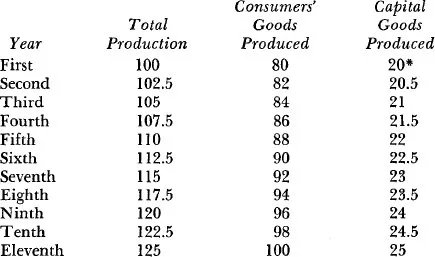
* This of course assumed the process of saving and investment to have been already under way at the same rate.
What I tried to illustrate by this table is that total production increased each year because of the saving, and would not have increased without it. The saving was used year after year to increase the quantity or improve the quality of existing machinery and other capital equipment, and so to increase the output of goods. There was a larger and larger “cake” each year. Each year, it is true, not all of the currently produced “cake” was consumed. But there was no irrational or cumulative consumer constraint. For each year a larger and larger cake was in fact consumed; until, at the end of the eleventh year in our illustration, the annual consumers’ cake alone was equal to the combined consumers’ and producers’ cakes of the first year. Moreover, the capital equipment, the ability to produce goods, was itself 25 per cent greater than in the first year. (My illustration of course assumed the long-run equality and identity of saving and investment.)
Now it is a notorious fact that in the nineteenth century, which Keynes is here deriding, there was not only continuous saving, and a tremendous increase in capital equipment, but a huge increase in population and a constant increase in the living standards of that population. Keynes himself, in fact, in the succeeding paragraph of the Economic Consequences, took the whole thing back. He was just having his little joke. But the problem is to know, even in his Treatise on Money and in his General Theory, when he is just having his little joke and when he is really in earnest. I suspect that he himself was sometimes a little confused on this point.
Benjamin M. Anderson, indeed, has suggested that Keynes’s confusion on the whole concept of savings and investment in the General Theory could be interpreted as due to an effort
to carry out a puckish joke on the Keynesians. He had got them excited in his earlier writings about the relation between savings and investment. Then, in his General Theory, he propounds the doctrine that savings are always equal to investment. This makes the theology harder for the devout follower to understand, and calls, moreover, for a miracle by which the disturbing factor of bank credit may be abolished.8
Keynes has certainly given his followers a great deal of embarrassment and trouble. Alvin H. Hansen, in his Guide to Keynes, tries manfully to save Keynes from himself:
“One source of confusion arose from the failure of his critics to realize that while investment and saving are always equal, they are not always in equilibrium. All this could have been avoided had Keynes made it clear from the outset that the equality of saving and investment does not mean that they are necessarily in equilibrium” (p. 59).
They can be equal but not in equilibrium, Hansen goes on to suggest, if there is a “lag” or “lagged adjustment” of some kind. I confess myself unable to follow this argument. It seems to me a self-contradiction; for it seems to assume that because of a “lag” in “adjustment” savings and investment are not always equal.
Paul A. Samuelson tries to save Keynes from himself by suggesting that “The attempt to save may lower income and actually realized saving.” On the other hand, “A net autonomous increase in investment, foreign bonds, government expenditure, consumption, will result in increased income greater than itself,” etc., etc.9
I do not know how far it is intentional and how far unintentional humor when Samuelson suggests that the obscurities and contradictions of the General Theory are an embarrassment for the anti-Keynesians rather than for the Keynesians. But he actually writes, as I have previously quoted: “It bears repeating that the General Theory is an obscure book so that would-be anti-Keynesians must assume their position largely on credit unless they are willing to put in a great deal of work and run the risk of seduction in the process.”
4. Keynesian Paradoxes
As we shall now see, however, Samuelson’s suggested escape from the Keynesian saving-investment dilemma corresponds closely with the exit that Keynes himself tries to take. But this only lands Keynes into more confusions and contradictions. There are so many of these, in fact, that it would be tedious and unprofitable to attempt to point out more than a few.
Keynes argues at times, as we have seen, that saving and investment are not only always equal but “merely different aspects of the same thing.” Yet he still keeps to his old habit of deploring saving while approving investment. So he must argue that saving reduces income and investment increases income—though “they are necessarily equal in amount,” and “merely different aspects of the same thing” (p. 74)!
From here on I find it impossible to follow his distinctions, oscillations, reverses, and contradictions. In a long section (pp. 81-85) we are told: “The prevalence of the idea that saving and investment, taken in their straightforward sense, can differ from one another, is to be explained, I think, by an optical illusion...” (p. 81). There follows a long explanation of the “two-sided” nature of an individual depositor’s relation to his bank. Then “the new-fangled view that there can be saving without investment or investment without ‘genuine’ saving” (p. 83) is described as erroneous: “The error lies in proceeding to the plausible inference that, when an individual saves, he will increase aggregate investment by an equal amount. It is true, that, when an individual saves he increases his own wealth. But the conclusion that he also increases aggregate wealth fails to allow for the possibility that an act of individual saving may react on someone else’s savings and hence on someone else’s wealth” (pp. 83-84). From this it somehow follows that it is “impossible for all individuals simultaneously to save any given sums. Every such attempt to save more by reducing consumption will so affect incomes that the attempt necessarily defeats itself” (p. 84).
In sum, we are apparently to understand that while saving and investment are “necessarily equal” and “merely different aspects of the same thing,” yet saving reduces employment and incomes and investment increases employment and incomes!
There is still another Keynesian paradox of savings (though they are “necessarily equal” to investment and “merely different aspects of the same thing”):
Though an individual whose transactions are small in relation to the market can safely neglect the fact that demand is not a one-sided transaction, it makes nonsense to neglect it when we come to aggregate demand. This is the vital difference between the theory of the economic behavior of the aggregate and the theory of the behavior of the individual unit, in which we assume that changes in the individual’s own demand do not affect his income (p. 85).
The only way in which we can make any sense whatever of this whole otherwise baffling passage is to assume that when Keynes uses the word “saving” he is thinking merely of the negative act of not buying consumption goods; but when he uses the word “investment” he is thinking merely of the positive act of buying capital goods. And he falls into this primary error because he forgets his own previous insistence that “saving” and “investment” are “necessarily equal” and “merely different aspects of the same thing.” He is, in fact, thinking in each case of only one side of the transaction: “Saving” equals merely the negative act of not buying consumption goods; “investment” equals merely the positive act of buying or making capital goods. Yet these two acts are both parts of the same act! The first is necessary for the second. An analagous thing happens in the realm of consumption goods alone. A man’s tastes change, and he switches from chicken to lamb. We don’t scold him at one moment for hurting the poultry raisers and praise him at the next for aiding the sheep raisers. We recognize that his purchasing power has gone in one direction rather than another, and that if he had not given up the chicken he would not have had the money to buy the lamb. Unless a man refrains from spending all his money on consumption goods (i.e., unless he saves), he will not have the funds to buy investment goods, or to lend to others to buy investment goods.
If I may anticipate here my own later argument and conclusions, there cannot be a given amount of real net investment in a community without an equal amount of real net saving. When we are talking in “real” terms, (net) saving and (net) investment are not only equal, but saving is investment. When we are talking in monetary terms, however, the problem is more complicated. In monetary terms today’s saving is not necessarily tomorrow’s investment, and today’s investment is not necessarily yesterday’s saving; but this is because the money supply may have contracted or expanded in the meanwhile.
To return to Keynes’s reasoning. Keynes has himself become entangled in the sort of naive and one-sided interpretation of the two terms, saving and investment, that so often trips up the man in the street when he talks of economic problems. We get some confirmation of this when Keynes writes:
In the aggregate the excess of income over consumption, which we call saving, cannot differ from the addition to capital equipment which we call investment.... Saving, in fact, is a mere residual. The decisions to consume and the decisions to invest between them determine incomes. (My italics, p. 64.)
Why savings should be a “mere residual” (whatever that may mean) I cannot say. But the sentence I have put in italics reveals the undercurrent of Keynes’s thinking. It is not production that determines incomes; it is not work that determines incomes; it is “the decisions to consume and the decisions to invest”!
It may be hard to imagine Robinson Crusoe as a Keynesian, but if he had been, when he returned to England, and the reporters had interviewed him at the pier, the results might have run something like this:
“How do you account for your big income when on the island?” the reporters might have asked.
“Very simple,” Crusoe would have replied. “I decided to consume an awful lot, and what I didn’t consume I decided to invest; and as a result, of course, my income grew and grew.”
“Wasn’t your income determined by what you produced?” one puzzled reporter might have asked.
“Produced? Worked?” Robinson Crusoe Keynes would have replied, “What nonsense! We have changed all that!”
What we have in this sentence (“The decisions to consume and the decisions to invest between them determine income”) is, in fact, a typical example of Keynes’s inveterate habit of describing causation not only from an arbitrary point, but rear-end foremost. It is true, of course, that in economic life cause and effect are continuous and endlessly recurrent, as in the chain of life. This is the truth expressed paradoxically in Samuel Butler’s definition: “A hen is only an egg’s way of making another egg.” Now this statement is not untrue, philosophically speaking, but it is confusing to common sense. For practical purposes (say for a poultry raiser or someone in the egg business) it is more useful to look at the subject from the hen’s point of view. So while Keynes’s method of treating consumption as a “cause” of production and income cannot be called entirely erroneous, it is certainly misleading, and in fact disastrous as the major premise for public policy. The orthodox and perhaps stodgy view that work and production are the primary cause of incomes, and make consumption possible, will be found far more useful in the long run, and far less likely to lead to the intoxicating assumption that prosperity and full employment can be made perpetual through government spending and the printing press.
5. Can Savings be Printed?
Before leaving this subject, it may be useful to explore a little further the possible sources of Keynes’s confusions. He has told us that “saving” and “investment” are “necessarily equal in amount, being, for the community as a whole, merely different aspects of the same thing” (p. 74). Eleven pages later he tells us that certain propositions “follow merely from the fact that there cannot be a buyer without a seller or a seller without a buyer” (p. 85).
This is a truism. Yet Keynes does well to state it explicitly; for it is astonishing how often it is forgotten by economists, by journalists, and by “practical” men. On a day when the stock market has had an unusual rise, one will see such headlines as “2,000,000 shares bought.” When it has had an unusual fall, the headlines are likely to read, instead, “3,000,000 shares sold.” Yet in the first case 2,000,000 shares must have been sold, and in the second case 3,000,000 shares must have been bought. In the first case public attention was fixed by the rise on the buying, whereas in the second case public attention was fixed by the fall on the selling. The difference is not, as journalists often carelessly or foolishly imply or state, that in the first case there was “more buying than selling,” or in the second “more selling than buying.” In both cases buying and selling had to be equal. No doubt there was a difference in the relative urgency of the buying and selling. To put the matter in another and more generalized form, there was a change in the valuation that both buyers and sellers put on shares. A rising market, in other words, is a sign not only that buyers are willing to bid more than on the day before, but that sellers insist on getting more. The converse is true as regards a falling market.
If we assume that, in the General Theory, Keynes is trying to apply the analogy of selling and buying to saving and investment (the “saver” being the one who puts aside the cash, and the “investor” the one who borrows it or uses it to buy raw materials or capital equipment), we encounter certain difficulties. In the first place, the “saver” and the “investor,” on these definitions, may often be the same person. This is not true (except perhaps occasionally for certain technical bookkeeping purposes) of the “buyer” and “seller.” It may often be difficult even for an individual entrepreneur, when he uses part of his net income to buy additional raw materials or capital equipment, to distinguish between his “saving” and his “investment.” They are both part of the same act. They are the same act. For he cannot buy the raw materials unless he has the money to buy them; and if he does buy them he does not have that money to buy goods for his own consumption.
But we get very little help from Keynes, even in the Treatise on Money, in learning precisely where to draw the line between “savings” and “investment.” If the reader will turn back, for example, to page 84, and to the quotation there from Chapter 12 of the Treatise on Money, he will find that the respective definitions are at once nebulous and biassed. Saving, we are told, “is the act of the individual consumer,” whereas investment “is the act of the entrepreneur.”
Now the definition of an act, one would suppose, would be expressed solely in terms of the act itself, without the irrelevant introduction of who does it. When an “individual consumer” saves, we are apparently to understand, he merely “negatively” refrains from spending. Yet it should be obvious that he also, necessarily, invests in cash or bank deposits. When an entrepreneur “invests” he is, according to Keynes, doing something “positive,” even if it is only adding to his “liquid capital”—i.e., doing precisely the same thing as the naughty consumer who is merely refraining from spending all his income!
It is impossible to make sense of the Keynesian definitions. But let us, in spite of Keynes’s own confusions, persist with his apparently intended analogy of the relationship of saving and investment to that of selling and buying. If buying and selling are merely two sides of the same act, then it is obviously silly to treat buying as virtuous and selling as wicked. It is no less silly to treat investing as virtuous and saving as sinful; or to argue, as Keynes does, that “saving” reduces income and employment while “investing” increases them.
If everybody tried to sell something and nobody bought it, there would simply be no sales. If there were suddenly greater urgency to sell than to buy, the practical result would be either an unreduced volume of sales at lower prices, or a somewhat reduced volume of sales at lower prices —depending on the relative willingness to buy and on other factors.
Similarly with saving and investment. When there is greater relative urgency to “save” than to “invest,” then the volume of saving and investment may be lower than formerly. In any case interest rates will tend to fall. But it does not follow that the decline of the urgency to invest (in anything other than cash or short-term securities) is wicked, or itself the basic cause of unemployment and depression. It is much more profitable to ask what it is that has caused the decreased urgency to invest.
But we are getting ahead of our present point, which has to do chiefly with the conception and definition, respectively, of “saving” and “investment.” What are the most useful definitions of saving and investment respectively?
The answer will depend largely on the particular problem which we are trying to clarify or to solve. In certain contexts there will be no need for distinguishing between them: we may treat them as interchangeable terms, meaning the same thing. (This is what Keynes really does in parts of the General Theory. “Saving” and “investment” are equal there not by some sort of continuous miracle; they are equal because they are so defined as to mean precisely the same thing!) In other contexts it may be useful to treat savings as referring merely to cash, and investment as referring to goods. And in still other contexts, more important than the distinction between “savings” and “investment” will be the distinction between money savings and real savings, money investment and real investment. 9
Keynes, as we shall see, only seldom and haphazardly makes these latter distinctions. On the contrary, he often works very hard to argue them away. The “savings” which result merely from increased bank credit (or, for that matter, from the mere printing of more fiat money), he argues, “are just as genuine as any other savings” (p. 83).
Of course if this were so, the problem of a community’s acquiring sufficient savings would never exist. It could simply print them!
It is not hard to understand why Keynes disapproves of “the new-fangled view that there can be... investment without ‘genuine’ saving” (p. 83). For this “new-fangled” view (properly interpreted) exposes the whole set of Keynesian “full employment” card tricks.
I have said that we may legitimately use “saving” and “investment” with different meanings in different contexts. We must be careful, however, of course, that our meanings are always unequivocal and our definitions explicit. Above all we must not shift meanings or definitions without explicit notice in the course of dealing with a particular problem.
1 In The New Economics, ed. by Seymour E. Harris, (New York: Alfred Knopf), p. 415.
2 Alvin H. Hansen, A Guide to Keynes, p. 58.
3A Treatise on Money, (New York: Harcourt-Brace, 1931), I, 126.
4Ibid., I, 179.
5Ibid., I, 279.
6Ibid., I, 291.
7 (New York: Harper, 1946), p. 198.
8Economics and the Public Welfare, (New York: Van Nostrand, 1949), pp. 398-399. Frank H. Knight at the time expressed even wider doubts concerning Keynes’s earnestness in the General Theory: “I for one simply cannot take this new and revolutionary equilibrium theory seriously, and doubt whether Mr. Keynes himself really does so.” The Canadian Journal of Economics and Political Science, February, 1937, p. 121.
9 Seymour E. Harris (ed.), The New Economics, p. 159.
9 And more important than any of these, perhaps, because it reveals the escape from the Keynesian confusions and contradictions on this point, is the distinction between prior savings and subsequent investment. But this discussion will be deferred to Chapter XVI.
Failure of the 'New Economics'
Read the whole book online · Book details
Free to read online and to download from this archive.