
Chapter 16 of 50 · Failure of the 'New Economics' by Henry Hazlitt
Chapter XV THE THEORY OF INTEREST
1. An “Unsettled Problem”
After presenting his own theory of interest, which he complacently calls “the general theory of the rate of interest,” Keynes devotes a chapter to a criticism of what he calls “The Classical Theory of the Rate of Interest,” together with an appendix to this chapter.
It is a mark of the curious intellectual provincialism of Keynes in economics, as I have already pointed out, that whenever he talks about the “classical” theory he seems to have in mind principally or solely Alfred Marshall and A. C. Pigou (though with occasional sarcastic sideswipes at Ricardo). This is not merely an Anglo-centric, but a Cantabrigia-centric view of economic history and theory. But Keynes does make occasional references to other writers, and in a sense he deals impartially with all: he distorts or caricatures, or quotes misleading excerpts from, the views he is ostensibly presenting.
Unfortunately, and despite the title and assumptions of Keynes’s Chapter 14, there simply is no accepted “classical theory” of the rate of interest. As Gottfried Haberler has written (Prosperity and Depression, 1941, p. 195): “The theory of interest has for a long time been a weak spot in the science of economics, and the explanation and determination of the interest rate still gives rise to more disagreement among economists than any other branch of general economic theory.” Though great progress has been made in the last eighty years or so (principally beginning with Jevons and Böhm-Bawerk), almost every writer on interest has his own theory, or at least his own special emphasis.
But we may divide current theories of interest into three broad categories: (1) productivity theories, (2) time-preference theories, and (3) theories which combine productivity and time-preference concepts. A fourth category (which, however, overlaps on all of these) consists of productivity, time-preference, or combined theories that also take account of disturbances caused by monetary factors. But the kind of purely monetary theory represented by Keynes is preclassical, mercantilistic, and man-in-the-street economics.
It is clear that if any of these three types of “orthodox” interest theory is right (if we are to lump under “orthodox,” as Keynes does, whatever is non-Keynesian) Keynes’s purely monetary theory must be wrong. It is, of course, not a sufficient criticism of Keynes’s theory to point this out. We should show that at least one of these “orthodox” theories is in fact correct. This forces us into a digression on positive theory. While I dislike to rush into territory where geniuses and angels have stumbled, I am afraid we have no choice. But we shall venture into the field by examining in turn each of three principal types of “real” interest theories, as expounded by their ablest spokesmen, and try to assess the strengths and weaknesses of each.
2. Productivity Theories
Let us begin by examining the productivity theory as expounded by Frank H. Knight:
The peculiar feature of interest which makes it a special problem for economics is that it is not a rent paid directly for the use of property in the concrete sense but is a repayment for the use of money (and as such takes the form of an abstract number, a ratio, or percentage). Yet while the borrower obtains and repays a money loan, it is the use of goods which the borrower wants and gets by means of the loan. If loans for consumption are left out of account, as they may well be since under modern conditions their terms depend upon those of loans for productive purposes, the rental or yield of goods the use of which is obtained by means of the loan provides under normal conditions the income paid out in the form of interest. Competition tends to bring about equality of return from equal investments; the ratio of this equalized return to investment is the rate of interest.1
This at first blush is a very persuasive statement, but it fails to explain the central problem of the rate of interest, which can only be answered by a recognition of the existence of time-preference. Professor Knight, in the article just quoted, goes on to discuss time-preference theories:
The competition of buyers and sellers [according to these theories] will set on income-yielding wealth a price which makes the amount demanded equal to the amount offered at that price. This price involves a uniform market rate of discounting future values. Thus if at the equilibrium point it takes $1 in hand to buy $1.05 payable one year from date, it will also take $20 to buy a piece of property yielding a perpetual income of $1 per year; all other income bearers will be valued on the basis of the same arithmetical proportion and the rate of interest will be 5 per cent....
The productivity theorists... do not question the validity of the time-preference reasoning but find that it lacks finality as an explanation under actual conditions....2
Knight’s discussion, here and elsewhere, seems to me to admit the need of time-preference as at least part of the explanation of interest, but to give it at best a subordinate role and to admit it through the back door. At times he explicitly repudiates it even while his general discussion implies it.
Nonetheless, it seems to me that a productivity theory of interest can be defended, at least partly, against one frequent criticism. This is made by Keynes in the General Theory:
Nor are those theories more successful which attempt to make the rate of interest depend on ‘the marginal efficiency of capital.’ It is true that in equilibrium the rate of interest will be equal to the marginal efficiency of capital, since it will be profitable to increase (or decrease) the current scale of investment until the point of equality has been reached. But to make this into a theory of the rate of interest or to derive the rate of interest from it involves a circular argument, as Marshall discovered after he had got half-way into giving an account of the rate of interest along these lines. For the “marginal efficiency of capital” partly depends on the scale of current investment, and we must already know the rate of interest before we can calculate what this scale will be. The significant conclusion is that the output of new investment will be pushed to the point at which the marginal efficiency of capital becomes equal to the rate of interest; and what the schedule of the marginal efficiency of capital tells us, is, not what the rate of interest is, but the point to which the output of new investment will be pushed, given the rate of interest (p. 184).
There are two errors in this criticism. The first, an error of phraseology, leads to the second, an error of logic. If Keynes is really speaking about “the marginal efficiency of capital” (the actual phrase he uses), then he is speaking only of a point on the curve or schedule of the efficiency or yield of capital. If the marginal efficiency of capital at any moment is conceived (as with any precise usage of terms it should be) merely as a point on the curve of the yield of capital, then the argument that Keynes is criticizing is indeed “circular,” and Keynes’s criticism is altogether valid.
But we have seen that Keynes uses his key terms very loosely and carelessly. Most of the time, when he refers to “the marginal efficiency of capital,” he does not mean the marginal efficiency of capital at all, but merely the efficiency of capital. (Or, technically, the curve of the-yield-of-capital-and-quantity-demanded.) In fact, as we have already had occasion to note, Keynes uses the marginal efficiency of capital as a synonym for “the investment demand-schedule”: “We shall call this the investment demand-schedule; or, alternatively, the schedule of the marginal efficiency of capital” (p. 136).
Now if, in the passage I have quoted above from page 184 of the General Theory, we substitute (except in the second sentence) the phrase “investment demand-schedule” for “marginal efficiency of capital,” we find that the argument that Keynes is criticizing is not circular but merely incomplete. For the market rate of interest would then be at the point at which the investment demand-schedule (or curve) intersected the savings supply curve. The investment demand-schedule would then influence (though not by itself determine) the rate of interest just as would the supply of savings.
Keynes was led into his error by following his master Marshall. On pages 139-140 he quotes a passage from Marshall’s Principles (6th ed., pp. 519-520) in which Marshall tries to show (and Keynes agrees) that attempting to arrive at a theory of interest by taking into account the productivity of capital goods is “reasoning in a circle.” But having accepted this reasoning as applied to the interest rate, Keynes draws back from applying it also, as Marshall does, to wages. “But was he not wrong,” asks Keynes in a worried footnote (p. 140), “in supposing that the marginal productivity theory of wages is equally circular?”
Marshall was, indeed, wrong in both cases. To argue that the expected yield from new investments, or the investment demand-schedule, doesn’t affect the interest rate is like arguing that buyers don’t affect the price of a commodity; they merely decide how much to buy at that price! Of course we cannot determine the price of a commodity merely by knowing the “demand curve”; we must also know the supply curve. It is too often forgotten that the full name of the “demand curve” (which Wicksteed called “an elliptical, ambiguous, and misleading phrase”)3 is “the curve of price-and-quantity demanded,” as the full name of the supply curve is “the curve of price-and-quantity-offered.” It is the point of intersection of these curves that determines price. Similarly (to anticipate), the investment demand curve, the savings supply curve, and the interest rate, are interdependent.
The real weakness of the naive productivity theories of interest is that they misconceive the relationship between “capital” and “yield.” As Irving Fisher has put it: “The statement that ‘capital produces income’ is true only in the physical sense; it is not true in the value sense. That is to say, capital value does not produce income value. On the contrary, income value produces capital value.... The orchard is the source of the apples; but the value of the apples is the source of the value of the orchard.” 4 If I may add another illustration, the hen produces the eggs, but the (discounted) value of the eggs produces the value of the hen.
People in the investment market, in fact, talk habitually more as economists talk. They recognize that the capital value is determined by the “yield,” not the other way round. Let us say that a (perpetual) bond is issued at a par value of $1,000 and pays interest of $40 a year, when the going long-term interest rate is 4 per cent. If the going long-term interest rate rises to 5 per cent, the market price of the bond will fall to $800. If the going long-term interest rate falls to 3 per cent, the market price of the bond will rise to $1,333.
3. Time-Preference Theories
But recognition of this relationship still does not solve the major problem of interest. This is to determine precisely why these particular relationships come to exist between capital values and yields. And in the solution of this problem the concept of time preference is essential. As Mises phrases it:
For the economist a problem is presented in the determination of prices for land, cattle, and all the rest. If future goods were not bought and sold at a discount as against present goods, the buyer of land would have to pay a price which equals the sum of all future net revenue....
If the future services which a piece of land can render were to be valued in the same way in which its present services are valued, no finite price would be high enough to impel its owner to sell it.5
Mises espouses a pure time-preference theory:
Time preference is a category inherent in every human action. Time preference manifests itself in the phenomenon of originary interest, i.e., the discount of future goods as against present goods....
Originary interest is the ratio of the value assigned to want-satisfaction in the immediate future and the value assigned to want-satisfaction in remoter periods of the future. It manifests itself in the market economy in the discount of future goods as against present goods. It is a ratio of commodity prices, not a price in itself. There prevails a tendency toward the equalization of this ratio for all commodities....
Originary interest is not a price determined on the market by the interplay of the demand for, and the supply of, capital or capital goods. Its height does not depend on the extent of this demand and supply. It is rather the rate of originary interest that determines both the demand for, and the supply of, capital and capital goods....
People do not save and accumulate because there is interest. Interest is neither the impetus to saving nor the reward or the compensation granted for abstaining from immediate consumption. It is the ratio in the mutual valuation of present goods as against future goods.
The loan market does not determine the rate of interest. It adjusts the rate of interest on loans to the rate of originary interest as manifested in the discount of future goods.6
This is so opposed to the layman’s ordinary way of thinking, and so opposed to what is found in the great majority of economic textbooks, that most readers will find the theory difficult to assimilate.
But it should be obvious that interest is peculiarly concerned with time. Contrary to Keynes’s belief, it is at least as much through the rate of interest as through the anticipated yield of new capital goods that “the expectation of the future influences the present” (p. 145). The rate of interest is involved in every price in which the time element enters. The price of a house is the discounted value of its future income. As Irving Fisher has insisted: “The rate of interest is the most pervasive price in the whole price structure.” 7 In fact, it is almost supererogatory to say that time-preference (or, if we prefer that term, time-discount) causes the rate of interest. Time-preference or time-discount is the rate of interest, looked at from another side. If I borrow $100 for one year at 5 per cent, this is another way of saying that I value $100 now more than $105 (which I then expect to surrender) one year from now. The interest rate may be stated, not only as an annual monetary payment which is a certain percentage of a loaned capital sum, but as a ratio between present and future capital sums. If people valued future goods as much as present goods, one would have to pay an infinite sum for the right to receive $5 a year perpetually. But as a matter of fact, if the current long-term interest rate is 5 per cent, one can buy the right to an infinite series of $5 a year for only $100.
Insurance companies are quite used to looking at the question of interest, not in terms of an annual rate of payment, but as a ratio between present and future sums. Assuming a current long-term interest rate of 5 per cent, one can pay only $61.39 for the right to receive $100 ten years from now; only $37.69 for the right to receive $100 twenty years from now; only $8.72 for the right to receive $100 fifty years from now, and so on.
A simple and striking form of the time-preference theory is put forward by the Mexican economist, Faustino Ballvé:
If the entrepreneur obtains money, he is able to have today what he could otherwise not have until tomorrow. When he obtains a loan, he buys time: the interest that he pays is the price of the advantage he obtains from having at his disposal immediately what he would otherwise have to wait for.8
Of course the borrower does not literally buy or borrow time. Each of us is allotted just twenty-four hours a day, and can neither buy nor sell any of it—at least not in its pure form. But the borrower does buy, or “hire,” the use of money (or of the assets that he can obtain with the money), and this use is of course use-in-time—the time for which the loan runs.
Other names for interest, therefore (or for the thing for which interest is paid), might be time-valuation, time-use, or time-usance. The old word usury, which originally meant merely interest, was, therefore (until it got its evil connotation of exorbitant interest), etymologically more descriptive than its modern substitute.
We are now in a better position to realize the fallacy of Keynes’s rejection of the “real” factors that determine the interest rate. The borrower pays interest not merely for money but usually for the assets he can obtain with money. He will therefore decide, in accordance with the interest rate that he is asked for money, whether, say, he will rent a house or borrow money and buy a house and pay interest on the purchase price. The person from whom he borrows is also free to decide whether he will himself use his funds to buy a house or lend the money out at interest on a mortgage to somebody else who wants to buy a house. There will thus tend to be an equilibrium between interest rates and rents of houses (minus depreciation and maintenance costs); or rather among the price of houses, the level of (net) rents and the level of interest rates; and each will affect the other.
4. Combined Interest Theories
This brings us to the third type of interest theory, which seeks to combine productivity and time-preference factors.
This third type of theory is sometimes disparagingly called “eclectic.” But the adjective is not justified if it is meant to imply that those who hold it select a little from the productivity theories and a little from the time-discount theories and fail to give any consistent explanation of interest. On the contrary, this third type of theory is really a combined theory. It seeks to unify what is true in the productivity theories with what is true in the time-discount theories. In the same way as the price of a commodity is explained as the point of intersection of the supply curve and the demand curve, so one form of the combined theory explains the interest rate as the point of intersection of the curve of supply of savings with the curve of investment demand.
The combined theory of the interest rate reached its highest and most elaborate expression in Irving Fisher’s great work The Theory of Interest (1930). Schumpeter called this “a wonderful performance, the peak achievement, so far as perfection within its own frame is concerned, of the literature of interest.” 9 It is not hard to understand his enthusiasm. Few persons, after reading Fisher, can fail to find Keynes’s discussion of interest superficial, haphazard, and even amateurish.
Fisher marshals the interplay of innumerable factors governing the rate of interest around two pillars of explanation: “Impatience” (time discount) and “Investment Opportunity” (“the rate of return over cost”).
F. A. Hayek has followed the Fisher theory in its general outlines, and explains the relation of the productivity factor to time-preference as follows:
The most widely held view is probably that, as in Marshall’s two blades of the scissors, the two factors [productivity and time-preference] are so inseparately bound up with each other, that it is impossible to say which has the greater and which the lesser influence.
Our problem here is indeed no more than a special case of the problem to which Marshall applied that famous simile, the problem of the relative influence of utility and cost on value. The time valuation in our case corresponds of course to his utility, while the technical rate of transformation is an expression of the relative costs of the commodities (or quantities of income at two moments of time).10
A complete positive theory of interest would have to take into account more factors than can be adequately discussed in a single chapter. If the market interest rate, for example, were in “complete” equilibrium, here are some of the things that would have to be equated:
1. The supply of, with the demand for, capital (i.e., the supply of savings with the demand for investment).
2. The price of capital instruments with their cost of production.
3. The income from capital goods with their price and their cost of production.
4. The “marginal yield of capital” with the rate of time-discount (time-preference).
5. The supply of loanable (monetary) funds with the demand for loanable funds.
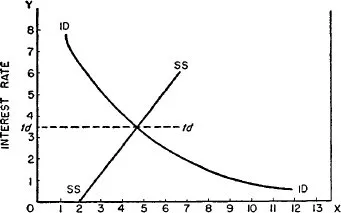
If we wished to illustrate these complex relationships graphically, we would produce an unintelligible maze of lines unless we were willing to use a set of diagrams rather than any single diagram. But the graph on the next page will illustrate one set of major relationships. The vertical line OY represents the interest rate; the horizontal line OX represents the annual volume of savings or investment demand measured, say, in billions of dollars. The curve ID represents investment demand. The lower the interest rate the greater the volume of investment demand; the higher the interest rate the less the volume of investment demand. The curve SS represents the supply of savings. As drawn, it assumes some savings even at a zero interest rate. The tendency of higher interest rates will be, within limits, to encourage a greater volume of savings.
But the slope and shape of the savings curve is more debatable than that of the investment demand curve. Some economists would maintain that within a wide range of interest rates the savings curve should be vertical—in other words, that the volume of savings is not greatly influenced by interest rates. Other economists would say that higher interest rates, within a certain range, might encourage more savings, but that above a certain rate the line should actually curve backwards toward the line OY—in other words, that very high interest rates may actually discourage saving because a high income from interest could be obtained from comparatively little saving.
Though the rate of interest and the supply of savings will of course influence each other, we must remember that the supply of savings may be to a large extent independent of the interest rate, just as the interest rate may be to some extent independent of the supply of savings. There would be some savings (as a reserve against contingencies) at a zero interest rate. Perhaps the most important line on this chart so far as the rate of interest is concerned is not, in the long run, either ID or SS, but td, the line of time-discount. For it is this, in the long run, that may determine, rather than be determined by, both the supply of savings and the investment demand.
In the diagram as drawn, the market rate of interest is in equilibrium with the time-discount rate at 31/2 per cent. The supply of savings and investment demand are also in equilibrium at that point. In any short-run period we may think of these quantities as all interdependent, rather than as determined primarily by the time-discount rate.
BILLIONS OF DOLLARS
Some readers may think that in the graph the investment-demand curve and the savings-supply curve are together sufficient to determine the interest rate at their point of intersection, and that there is no need or legitimate place for a third line, whether it is called time-discount or anything else. From the standpoint of the orthodox supply and demand curves they are right. (All diagrams of this sort are mere aids to thought, efforts to visualize hypothetical relations, never to be taken too literally.) But a supply-and-demand analysis of the interest rate, or of any competitive price whatever, while correct, is superficial, a mere first step. The next step is always to inquire what the particular supply and demand forces are and what causes them to be what they are.
Let us, as an illustration, take securities on the stock market. A stock, let us call it American Steel, is selling at 50 on the market. Why is it selling at that particular price? One answer, of course, is because “supply” and “demand” are at equilibrium at that price. But this only pushes the problem back a stage; it only poses it in another form. Why are supply and demand at equilibrium at that particular price? The answer is that the composite valuations put upon the stock by both buyers and sellers center for the moment at that point. Another way of putting this is that the valuations put on the stock by the marginal buyer and the marginal seller cross at that point. The last buyer must have valued the stock at more than $50, the last seller must have valued it at less than $50.
Now let us say that American Steel closes at 50 on Monday, but that after the close of the market the board of directors unexpectedly fails to declare the regular quarterly dividend. On Tuesday morning the stock opens 5 points down, at 45. It can be said, of course, that American Steel has fallen because the “supply” of the stock has increased and the “demand” has diminished. But obviously this is not the cause of the stock’s fall in value, but the consequence. Physically, there are no more shares of American Steel outstanding on Tuesday than there were on Monday. Physically, the number of shares bought and the number of shares sold exactly equal each other on Tuesday as they did on Monday. There were no transactions in the stock between the closing price of 50 on Monday and the suddenly lower opening price of 45 on Tuesday. The value of the stock has not fallen because of a change in the amount offered and the amount demanded. It is “supply” and “demand” that have changed because the value of the stock has fallen!
Putting the matter in another way, the individual valuations set upon the stock by both sellers and buyers have fallen because of the (generally) unexpected passing of the previous regular dividend.
The matter could, of course, be diagrammatically represented by the usual supply and demand curves crossing each other on Monday, with the demand curve moving to the left and the supply curve moving to the right on Tuesday. (Actually, the supply curve in this case is merely the demand curve of the present holders of the stock. The situation could be represented by placing the valuations of both holders and potential holders on a single demand curve on Monday and lowering the whole curve on Tuesday. However, as the price would be the point at which the valuations of the marginal seller and the marginal buyer crossed each other, it is graphically better to have a “supply” curve as well as a “demand” curve.) These curves indicate relationships, but not necessarily causation. It is the lowered valuation of the stock in the minds of both buyers and sellers that causes the change in the “supply” and “demand,” rather than the change in amount supplied and amount demanded that causes the lowered valuation.
In the same way, it is the composite time-preference or time-discount schedule in the minds of both borrowers and lenders that determines the rate of interest, the position of the investment demand curve and the position of the supply-of-savings curve, rather than the supply and demand curves which determine the composite time-preference point.
It may help some readers (even though the parallel is misplaced) to think of “normal” time-discount as the main factor governing the long-run “normal” rate of interest (rather than the ever changing constellation of day-to-day market rates of interest) much in the same way as cost-of-production “determines” the relative “normal” prices of commodities rather than their short-run market prices. In modern theory, of course, its cost of production does not “determine” the “normal” price of a commodity, but relative costs of production are part of the interdependent relationships among relative prices. As Wicksteed has put it: “One thing is not worth twice as much as another because it has twice as much ‘labor’ in it, but producers have been willing to put twice as much ‘labor’ into it because they know [expect] that when produced it will be worth twice as much, because it will be twice as ‘useful’ or twice as much desired.” 11
The same sort of cause-and-effect amendment that Wicksteed makes in the classical theory of the relation of cost of production to price must be made also in Böhm-Bawerk’s concept of the lengthening of the period of production. The fact that certain capital goods take longer to produce than others does not necessarily increase their value or productivity; but the expectation that certain capital goods will be more valuable or productive makes producers willing to undertake a longer period of production, if necessary, to secure them.
Each saver’s and entrepreneur’s time-preference or time-discount (including his estimate of the composite time-preference or time-discount of the community as a whole) will help to determine the current rate of savings or the current investment demand; but at any given moment the points of intersection of these supply and demand curves will “determine” market rates of interest.
5. Real Plus Monetary Factors
After this long excursion into positive theory, we can recognize much more clearly the nature of the fallacies in Keynes’s theory of interest. His main fallacy consists in ignoring or denying the determining influence of “real” factors on the rate of interest. It is true that the error of many of the classical economists was the opposite of this. In looking beyond “the monetary veil” at the real factors underneath, they forgot that both short-term and long-term loans consist after all, in money, and that both interest and principal are payable in money. This means that the theory of capital and interest must be understood in terms of money as well as in “real” terms, and that the monetary influences on the interest rate must be studied as well as the real influences. But Keynes made no new contribution when he jumped to the conclusion that therefore the interest rate is a purely monetary phenomenon. He merely returned to the pre-classical assumption of the mercantilists (as he himself, in his final chapters, came to recognize) and to what has always been the assumption of the man in the street.
Nor would he have been the first to discover, if he had discovered it, that both sets of influences, real and monetary, had to be recognized and reconciled in any complete theory of interest. That glory belongs to the Swedish economist, Knut Wicksell. The great contribution which Wicksell made to interest theory was to reconcile the “real” theories of interest as developed by the classical economists and amended by Jevons and Böhm-Bawerk, with what actually happens to interest rates in the day-to-day money market as the banker or the security investor confronts it. The real factors act through the monetary factors. Wicksell’s really general theory of interest (real-cum-monetary) was carried further by Irving Fisher and receives its most mature exposition in the work of Ludwig von Mises.12
Wicksell saw that it was both theoretically and actually possible for the Central Bank temporarily to depress interest rates by what are called “open-market operations.” When the Central Bank wishes to reduce interest rates it buys short-term (and sometimes long-term) obligations in the market and creates deposits or bank notes against them. By buying these short-term obligations and raising their capital value, it directly reduces market interest rates, and by creating bank deposits or even “cash,” it creates additional monetary funds to be thrown on the loan market, thus further tending to reduce interest rates. By doing this, in fact, the Central Bank could apparently reduce interest rates down to any figure where they were high enough to pay the mere operating costs of the banks.
This is the one germ of truth in Keynes’s purely monetary theory of interest rates. “Open market operations” are certainly practicable for bringing about temporary (which may sometimes mean rather prolonged) reductions in interest rates.
But Wicksell (and more clearly those who followed him) also recognized that the process did not end there. Interest rates are depressed, it is true, by buying short- and long-term obligations, by creating deposits—in brief, by manufacturing money. But this sets in train a series of forces which act the other way. The market interest rate for money can be kept below the “natural” rate only by continuous additions to the supply of money and credit. But these continuous additions to the money and credit supply eventually raise prices of commodities. And when these prices are raised, the larger amount of money now in circulation is needed to finance the same volume of physical transactions and production as was previously financed by the smaller volume of money. So the new money supplies are all used up in current production. If the attempt is made to issue new money still faster than the older supplies are already raising prices, the result might only be to raise prices (through general fear of inflation) even faster than the new money supplies were put out. In any case, lenders, fearing that further inflation was in the offing, would demand a higher interest return to insure them against the possible loss of the real capital value on their original loan.
So the process by which the Central Bank originally was able to lower interest rates, will now simply serve to raise them. And if the bank stops the open-market and other operations by which it lowered interest rates, the adjustment of prices to the new volume of money and credit will restore interest rates to the “natural” level and probably even beyond.
This is a brief, oversimplified, and inadequate description of the process. But it is sufficient to show that everything that is true in the Keynesian monetary theory of interest was already recognized by Wicksell, Fisher, Mises, Hayek, and others before Keynes wrote.
Keynes was undoubtedly acquainted with Wicksell’s work. He refers to it frequently in his Treatise on Money. Even in the General Theory he devotes one footnote of a couple of lines to “the ‘natural’ rate of Wicksell” (p. 183), and another couple of lines to him in connection with the “natural” rate of interest (p. 242). But, mysteriously, he never mentions Wicksell at all when he is making the same criticisms of the “classical” theory of interest as Wicksell had made a generation before the appearance of the General Theory. And in his left-handed reference (on p. 183) he alludes to Wicksell and Hayek with the disdainful intimation that they are much too subtle. He quotes from Ibsen’s Wild Duck: “The wild duck has dived down to the bottom —as deep as she can get—and bitten fast hold of the weed and tangle and all the rubbish that is down there, and it would need an extraordinarily clever dog to dive after and fish her up again” (p. 183).
But a theory is not necessarily wrong because it was too deep and subtle for Keynes. In his own theory of interest he certainly did not dive deep; he merely muddied shallow waters.
I am tempted to say that in rejecting both productivity and time-preference theories, or any combination of them, Keynes was left with no real theory of interest. But on second thought it is clear that he was flirting with the oldest theory of all—the Exploitation Theory. This was once described by Irving Fisher as the persistent idea that “to take interest is, necessarily and always, to take an unfair advantage of the debtor. This notion is something more than the obviously true idea that the rate of interest, like any other price, may be exorbitant. The contention is that there ought to be no interest at all.” After tracing the persistence of this notion through primitive societies, ancient Rome, and the Middle Ages, Fisher declared that, “Today the chief survival of the exploitation idea is among Marxian Socialists.”13 But Fisher wrote this some years before Keynes attempted still another revival in “modern” guise.
1The Ethics of Competition, and Other Essays, Article on “Interest,” (University of Chicago Press, 1935), pp. 257-258. (Originally printed in The Encyclopaedia of the Social Sciences, 1932.)
2Ibid., p. 258.
3 Philip Wicksteed, The Alphabet of Economic Science, 1888, (New York: Kelley & Millman, 1955), p. 97.
4The Theory of Interest (New York: Kelley & Millman, 1954), p. 55.
5 Ludwig von Mises, Human Action (New Haven: Yale University Press, 1949), pp. 522-523.
6Ibid., pp. 521, 523, 524.
7The Theory of Interest, p. 33.
8 My own translation from L’Economie Vivante, (Paris: SEDIF, 1957), p. 84. Dr. Ballvé wrote me (shortly before his untimely death) that a literal translation from the 1955 Mexican edition of the key sentence here would read: “Therefore, when he borrows money he is, in fact, borrowing time.”
9 Joseph A. Schumpeter, Econometrica, Vol. 16, No. 3, July, 1948.
10The Pure Theory of Capital (London: Macmillan, 1941), pp. 420-421.
11 Philip H. Wicksteed, The Alphabet of Economic Science, 1888. (New York; Kelley & Millman, 1955), p. 117.
12 Cf. Human Action, Chaps. 18, 19, and 20.
13The Theory of Interest, 1930, pp. 48-49.
Failure of the 'New Economics'
Read the whole book online · Book details
Free to read online and to download from this archive.