
Chapter 29 of 50 · Failure of the 'New Economics' by Henry Hazlitt
Chapter XXVIII THE KEYNESIAN POLICIES
1. Do Deficits Cure Unemployment?
In our chapter-by-chapter analysis of Keynesian theory we have had occasion to examine in passing the implied Keynesian policies and their probable consequences. But it may now be useful to discuss some of these main policies more explicitly.
In Keynesian policy, unemployment is never to be corrected by any reduction of money-wage-rates. Keynes recommends two main remedies. One is deficit spending (sometimes euphemistically called government “investment”). How good is this remedy? It was tried in the United States (partly because of Keynes’s recommendations) for a full decade. What were the results? Here are the deficit in the Federal budget, the number of unemployed, and the percentage of unemployed to the total labor force, year by year in that decade. All the figures are from official sources:
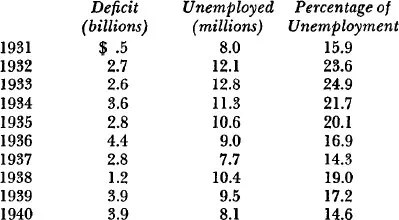
In the foregoing table the deficits are for fiscal years ending on June 30; the unemployment is an average for the full calendar year. (The deficit figures therefore lead the unemployment figures by six months.) Advocates of deficit spending, no doubt, will try to find a partial negative correlation between the size of the deficit and the subsequent number of unemployed. But the central and decisive fact is that heavy deficits were accompanied by mass unemployment. The average unemployment of the ten-year period was 9.9 millions, which was 18.6 per cent of the total working force.
The average deficit in this ten-year period was $2.8 billion, which was 3.6 per cent of the gross national product of the period. The same percentage of the gross national product of 1957 would mean an annual deficit of $15.6 billion.
2. Does Cheap Money Cure Unemployment?
The other main Keynesian remedy for unemployment is low interest rates, artificially produced by “the Monetary Authority.” Keynes incidentally admits (e.g., p. 205) that such artificially low interest rates can only be produced by printing more money, i.e., by deliberate inflation. But we may let this pass for the moment. The question immediately before us is: Do low interest rates prevent mass unemployment?
The policy of cheap money has had an even longer trial than the policy of planned deficits. Let us look at the record of interest rates and unemployment for the same period that we have just reviewed, adding, however, 1929 and 1930. In the table below, the first column after that of the years represents the average rate in each year (the average of daily prevailing rates) of prime commercial paper with a maturity of four to six months. I have chosen this rate rather than that on three-month Treasury bills because it is the most available statistical series reflecting the short-term interest rates at which business actually borrows. (Actually, the greatest volume of business borrowing from banks in the U.S. consists of “line-of-credit” loans; but these vary with the more sensitive commercial-paper rate.) The final column once again gives the percentage of unemployed to the total labor force. Both sets of figures are from official sources:
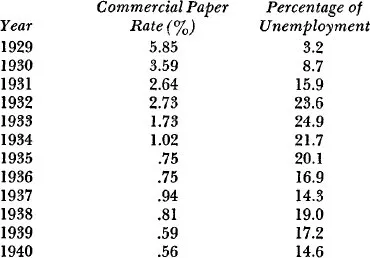
In sum, over this period of a dozen years low interest rates did not eliminate unemployment. On the contrary, unemployment actually increased as interest rates went down. In the seven-year period from 1934 through 1940, when the cheap money policy was pushed to an average infra-low rate below 1 per cent (.77 of 1 per cent) an average of more than 17 in every 100 persons in the labor force were unemployed.
Let us skip over the war years when war demands, massive deficits, and massive inflation combined to bring over-employment, and take up the record again for the last ten years:
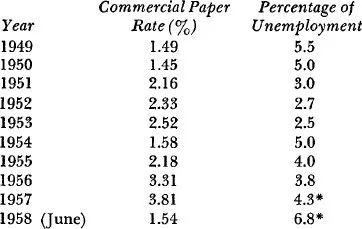
* (Unemployment percentages before 1957 are based on Department of Commerce “old definitions” of unemployment; for 1957 and 1958 they are based on the “new definitions,” which make unemployment slightly higher—4.2 per cent of the labor force in 1956, for example, instead of the 3.8 per cent in the table.)
It will be noticed in this table that though the commercial-paper interest rate in this period averaged 2.24 per cent, or three times as high as that in the seven years from 1934 through 1940, the rate of unemployment was not higher, but much lower, averaging only 4.2 per cent compared with 17.7 per cent in the 1934-40 period.
And within this second period itself the relationship of unemployment to interest rates is almost the exact opposite of that suggested by Keynesian theory. In 1949, 1950, 1954, and June of 1958, when the commercial-paper interest rate averaged about 1.5 per cent, unemployment averaged 5 per cent and over. In 1956 and 1957, when commercial-paper rates were at their highest average level of the period at 3.56 per cent, unemployment averaged only 4 per cent of the working force.
It is very difficult, if not impossible, to prove a positive proposition in economic theory by the use of statistics; but it is not difficult to disprove such a proposition (unless it is elaborately qualified) by statistics. We must conclude at least that neither deficit spending nor cheap money policies are enough by themselves to eliminate even prolonged mass unemployment, let alone to prevent unemployment altogether.
3. Race with the Printing Press
But these are the chief Keynesian remedies for unemployment. In 1936, reviewing the General Theory, which had appeared in the same year, Professor Jacob Viner ventured a prediction:
Keynes’s reasoning points obviously to the superiority of inflationary remedies for unemployment over money-wage reductions. In a world organized in accordance with Keynes’s specifications there would be a constant race between the printing press and the business agents of the trade unions, with the problem of unemployment largely solved if the printing press could maintain a constant lead and if only volume of employment, irrespective of quality, is considered important.1
This characterization has proved, in part, remarkably prophetic. There may be some doubt whether the problem of unemployment has been “largely solved.” But we have certainly been trying to solve it since 1936 in accordance with Keynes’s specifications, and we have certainly embarked upon a race between the printing press and the trade unions.
And our failure to solve the problem of unemployment even by this method is partly the result of a development Professor Viner could hardly have been expected to foresee: the spread of “escalator” clauses in labor contracts which provide not only for automatic increases with every increase in the cost of living, but for so-called “productivity” increases which come into effect whether marginal labor productivity actually increases or not.
The truth is that the only real cure for unemployment is precisely the one that Keynes’s whole “general theory” was designed to reject: the adjustment of wage-rates to the marginal labor productivity or “equilibrium” level. This does not mean a uniform en bloc adjustment of “the wage level” to “the price level.” It means the mutual adjustment of specific wage-rates and of prices of the specific products various groups of workers help to produce. It means also the adjustment of various wage-rates to each other and of various prices to each other. It means the coördination of the complex wage-price structure. It means the maintenance of a free, fluid, dynamic equilibrium, or a constant tendency toward such an equilibrium, through the economic system.
In sum, neither government spending, nor low interest rates, nor an increase in the money supply is either a necessary or a sufficient condition for the existence of full employment. What is necessary for full employment (using the word in a working, practical sense) is a proper relation among the prices of different kinds of goods and a proper balance between costs and prices, particularly between wages and prices. This functional balance will tend to exist when wage-rates are free and fluid and competitive, and not dictated by arbitrary union coercion. When this balance exists, full employment and maximized production and prosperity will tend to follow. When this balance does not exist, when wage-rates are pushed above the marginal product of labor, and profit margins are doubtful or disappear, there will be unemployment.
The presence or absence of monetary inflation, in brief, is by itself irrelevant to full employment. All that government policy needs to do, besides keeping the currency sound, is to enforce the laws against violence and intimidation, and to repeal the laws which confer exclusive legal privileges and immunities on union leaders, or abridge the freedom of employers and individual workers to bargain. As Professor Sylvester Petro has put it, the legal reforms needed “may all be subsumed under a single heading: Unqualified supremacy of the principle of free employe choice.” 2
1Quarterly Journal of Economics, LI (1936-1937), 149.
2 “Personal Freedom and Labor Policy,” (Institute of Public Affairs at New York University, 1958).
Failure of the 'New Economics'
Read the whole book online · Book details
Free to read online and to download from this archive.