
Chapter 19 of 28 · Gold, Peace, and Prosperity by Ron Paul
Money and the Constitution
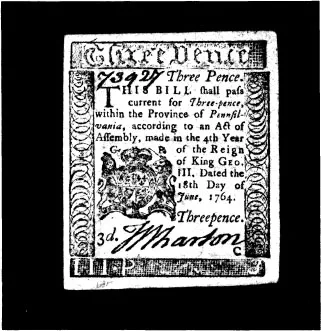
Legal tender Colonial paper money.
“It is apparent from the whole context of the Constitution, as well as the history of the times which gave birth to it,” said Andrew Jackson, “that it was the purpose of the Convention to establish a currency consisting of the precious metals.”
“The loss which America has sustained since the peace,” noted James Madison in Federalist Number 44, “from the pestilent effects of paper money on the necessary confidence between man and man, on the necessary confidence in public councils, on the industry and morals of the people, and on the character of republican government, constitutes an enormous debt against the State chargeable with this unadvised measure, which must long remain unsatisfied; or rather an accumulation of guilt, which can be expiated no otherwise than by a voluntary sacrifice on the altar of justice of the power which has been the instrument of it.”
“The emitting of paper money is wisely prohibited to the State Governments,” said Alexander Hamilton, “and the spirit of the prohibition ought not to be disregarded by the United States’ Government.”
Not only is inflation the result of the political demands of special interest groups, the career desires of politicians, and the ill-conceived motives of economists, it is also clearly unconstitutional.
Money of real value, gold or silver, was clearly intended by the Founding Fathers, as evidenced in their writings and in the Constitution. Their abhorrence of paper money stemmed from their experience with the Continental, and irredeemable Colonial paper money. That same abhorrence is becoming evident today as well, which is a healthy sign for those of us interested in developing a sound money system.
Gold, Peace, and Prosperity
Read the whole book online · Book details
This work is published under a Creative Commons licence. You may copy, share, and re-host it with attribution.