
Chapter 9 of 14 · In Restraint of Trade: The Business Campaign Against Competition, 1918-1938 by Butler Shaffer
6. The Natural-Resource Industries
Now here, you see, it takes all the running you can do, to keep in the same place. If you want to get somewhere else, you must run at least twice as fast as that.
—The Red Queen, in Through the Looking Glass
The campaign to instill a spirit of intraindustrial cooperation and self-regulation in business was quite intense in the so-called natural-resource industries, particularly petroleum and coal. Because of the significance of these industries to American economic life, the fundamental changes occurring within these industries and the similar problems shared by them, they shall be considered together in this chapter. Because of the inconstancy associated with vigorous and dynamic economic conditions, pressures were exerted by industry members for a more stabilized, equilibrium-based form of competition.
One of the most successful arguments employed by the natural-resource industries for gaining public acceptance of efforts to preserve existing market positions and stabilize prices was that free competition permitted the employment of greater quantities of natural resources that, it was argued, led to “waste.” The solution proposed was a simple one: enact legislation to “conserve” such natural resources in order to assure that future generations would not suffer from the prodigality of today. Conservation became a cause in which its advocates, wrapped in self-approbation, were able to polarize the issue as a choice between planned, intelligent use of scarce resources, on the one hand, and their wanton, reckless, and wasteful squandering, on the other. In popular sentiments toward thrift, many business organizations had a ready-made platform from which to gain support for objectives having to do more with reducing the impact of competition than preserving resources.1 Conservation served, quite well, the broader business purposes of controlling those aggressive competitive practices having the effect of creating lower and unstable prices.
Conservation was, because of its tendencies for controlling production, popular among businessmen. In early 1917, for instance, the U.S. Chamber of Commerce announced the results of a referendum in which 90 percent of the voting commercial organizations favored a proposition to allow firms in the natural-resource industries to enter into FTC-supervised cooperative agreements.2 Such a proposition reflected not only the cartelizing mood of the general business community but the compatibility of such attitudes as conservation and the restraint of competition. Whatever may have been the motives of others who were active in the conservation movement, it cannot be denied that certain business interests found the conservation arguments consistent with their objectives of restricting—and, hence, stabilizing—the quantities of production within various industries. This was especially true in many of the basic natural-resource industries—such as petroleum, coal, and lumber—where the relative ease of turning existing stands of timber into finished lumber, or the unpredictable discovery of large new oil fields, served to make production levels somewhat erratic.3 This irregularity had the effect of causing price levels to fluctuate as well, which prompted industry members to seek methods of bringing production, and with it the general price structure, within more stable and predictable parameters.
THE PETROLEUM INDUSTRY
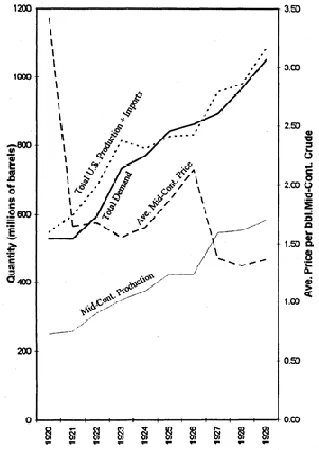
The condition that characterized the petroleum industry throughout the 1920s and on into the New Deal years was that of a highly competitive and rapidly expanding market that, at the same time, was experiencing a development of production exceeding the new demand. While, as figure 1 demonstrates,4 the industry was enjoying an increased demand for its products, it was enduring an even greater supply, resulting in a decline in prices. Annual national crude oil production totals of 442.9 million barrels in 1920 had risen to 713.9 million barrels in 1924, then to 770.9 million barrels in 1926, and then to 901.1 million barrels in 1927. The consequence was a general decline in the price level, further accentuated by the disruptive influences of newly discovered fields. Average prices for crude oil declined from just over $3.00 a barrel in 1920 to $1.25 a barrel by 1929.5
Because of such unstable conditions, no industry devoted more energy to seeking to stabilize trade conditions than the petroleum industry. The same rhetoric of “cooperative competition” that rang throughout other industries was present in the oil industry. The principal trade publication, the Oil and Gas Journal, editorialized that the same “spirit of co-operation, of fair play among rivals” was being evidenced in that industry. After attacking “radical price cutting”—which was but a reflection of the erratic production patterns occasioned by the discovery of new fields and the profit-maximizing efforts of individual firms—the editorial concluded: “[T]he new trend in American business methods is not going to be defeated. The education of business opinion … is bound to continue until selfishness in business is as universally condemned by public opinion as selfishness is socially.”6
Figure 1. Supply, Demand, and Prices of Crude Oil: 1920–1929
By the end of 1924, the combination of increased annual oil production and the aftermath of the Teapot Dome scandal exerted a strong influence for the adoption of a federal conservation program. Industry leaders, such as Henry L. Doherty of Cities Service Company, worked on behalf of political solutions to the problems of overproduction. In Doherty’s opinion, “only through the efforts of our Federal Government, can the oil problem be solved.”7 Doherty’s energies were not wasted, for in December 1924, Calvin Coolidge created the Federal Oil Conservation Board (FOCB), the function of which was largely investigatory and advisory in nature. The general reaction of industry representatives to the creation of the board was favorable; the hope was expressed that it could aid in bringing the production problem under control.8 Walter C. Teagle of Standard Oil (New Jersey) and William S. Farish of Humble Oil encouraged the industry to cooperate with the FOCB. Consistent with the spirit of “cooperative competition” that had permeated much of the business community, they recommended that the American Petroleum Institute (API) develop a “code of business ethics” covering each stage in the production and sale of petroleum.9
In April 1925, the so-called Committee of Eleven of the API issued a report that concluded that American oil reserves were not in any immediate danger of being depleted and that new production methods made the prospect of oil shortages highly unlikely. The report, which was prepared to counteract the anticipated support by the FOCB for conservation legislation, suggested that a free market, regulated by competitive prices, would best serve the industry. J. Howard Pew, himself an advocate of a free market for the petroleum industry, made good use of this report in challenging Doherty’s proposals for federal regulation. But by the time of its annual meeting in December 1926, the board of directors of the API opted for a compromise position between Pew and Doherty, which it found in a report by the FOCB that year recommending the control of production by the states and state encouragement of uniform state laws or interstate compacts. In the interest of harmonizing the differences of opinion within the industry, the FOCB’s report received the backing of the API, which then appointed a committee of its members to draft recommendations to be submitted to its board of directors for a legislative program that would allow producers to cooperate to restrict oil production. It is quite apparent that, while a few individuals like Pew and Gulf Oil’s G. S. Davison wanted a free market for oil and were content to allow competition to flourish, most members of the industry desired some sort of restriction in production, with the primary debate centering on federal control versus state control versus voluntary restrictions by the producers themselves.10
Beginning in 1926, the discovery of major new fields added to the production that was sending oil prices downward.11 The discovery of the fertile Seminole field in Oklahoma on 26 July 1926, introduced one of the most destabilizing influences that the American petroleum industry ever experienced and prompted new efforts by oilmen to obtain a workable system to limit oil production. The influence of Seminole is readily seen from production records that showed a daily output from that field of 192,500 barrels in January 1926 and 275,000 barrels in February, increasing steadily to 490,700 barrels by July. As new wells were brought into production, the sharp increase in supply led to a corresponding drop in prices in the Seminole area, with declines ranging from $2.69 to $2.10 a barrel on 17 November 1926, and a further drop to $1.28 a barrel by 12 March 1927. When one contrasts daily Seminole production with national figures, and then relates this total production to demand, a greater appreciation is had of the intensely competitive nature of the industry. The daily average total production of oil in March 1927, was 2,610,000 barrels, compared with 2,239,000 barrels for March 1926, while total demand was 2,350,000 barrels per day in March, 1927, compared with a daily average of 2,172,000 barrels in March 1926. Thus, while daily production was up by 16.5 percent over a comparable period a year earlier, demand was up by only 8 percent.12 By May 1927, with daily production at Seminole averaging some 350,000 barrels per day, crude oil prices in the midcontinent area dropped to a range of $1.10 to $1.15 per barrel.13
The additional production problem from Seminole, combined with the discovery of other highly productive fields, helped to create a condition that led to unstable patterns of production. Erich Zimmerman seems to accurately summarize the condition within the petroleum industry during the period of this study:
[I]t appears that the decade 1920–29 was one of increasing pressure build-up through rising stocks. The pressure rose further when the market crash of 1929 and the depression that followed brought on a sharp decline of demand. Pressure “blew the top” when in 1930 discovery of the largest domestic field, the East Texas Field, led to further large increases in production.14
A factor that contributed to efforts by many producers to maximize production within various fields was the failure of the legal system to provide identifiable property concepts for underground oil. Under the so-called law of capture, possession became the means for acquiring ownership in subsurface oil, thus providing an incentive for producers to maximize production, lest other producers in the same field recover the oil first. The common law courts—which had long regarded possession as an important element in establishing ownership over previously unowned property—failed to identify exclusive property interests in underground oil that would protect an owner’s pool from trespass by other producers. Had such property interests been recognized by the courts, producers would have been more inclined to make production decisions in accordance with market conditions, rather than seeking to acquire possession of petroleum before their competitors did. As a consequence, many industry members directed their attentions to the so-called common-pool problem, a condition created not so much by the market as by the failure of the legal system to adequately define and protect subsurface property rights.
Conditions such as these led to renewals of debates within the industry over the most desirable means of restricting petroleum output, with Henry Doherty repeatedly urging federally enforced unit operation of oil fields along with “voluntary” cooperation—with legal sanctions to be provided by the federal government—by members of the industry to restrict production. “Unit production” has been defined as “developing and operating an oil field as an entity under one management.”15 There was a basic split of opinion within the industry over this question of government compulsion, with officials of Standard Oil (New Jersey) and Humble Oil, and such men as G. S. Davison and J. Howard Pew voicing opposition, while Doherty and others—such as Mark Requa, a mining engineer who had served in the U.S. Fuel Administration during World War I—urged federal enforcement to solve the problem. Humble Oil took a position supporting “any character of legislation which will permit the orderly production of oil and gas from a pool,” whether through industry agreements or state regulatory bodies. Doherty’s devotion to a mandatory unit plan of operation was premised on his having “always believed that the majority should rule,” while opponents of the idea believed that unitization should be permitted but not required.16
In an effort to get at the immediate Seminole problem, a number of oil producers requested the State Corporation Commission of Oklahoma to intervene directly to regulate production.17 The commission had the power, since the enactment of prorationing legislation in 1915,18 to regulate the production of petroleum in order to eliminate what the statute defined as “waste.” While appearing to address itself to the waste of oil through seepage from storage tanks as well as the lateral movement of oil within pools, a closer reading of the statute evidences a concern more for the economic consequences to the industry than for the physical conservation of natural resources. The statute prohibited, for example, the taking of oil from the ground “at a time when there is not a market demand therefor at the well at a price equivalent to the actual value of the oil.” It went on to define “actual value” as “the average value as near as may be ascertained in the United States at retail of the by-products of such crude oil or petroleum when refined less the cost and a reasonable profit in the business of transporting, refining and marketing the same.” In order to eliminate the “waste” engendered by the low prices, the commission was authorized to issue orders prorating the quantity of allowable production (i.e., the maximum amount of production that would not lead to “waste”) among the existing producers. It seems rather clear that such “conservation” legislation was, in fact, directed toward the elimination of those conditions that lead to unstable prices in the industry. On 9 August 1927, the commission issued a prorationing order covering the Seminole field.19
Oil producers were greatly attracted to methods of control that combined industry-determined standards with adequate government enforcement. This was evident when a group of the nation’s largest operators selected Ray M. Collins to serve as a referee to enforce the production restrictions that had been agreed to by operators within the Seminole field. Collins was more than simply a peacemaker seeking voluntary resolutions of disputes among oil producers. He was, in fact, an appointee of the Oklahoma Corporation Commission who, along with an advisory committee of operators, was given the task of enforcing prorationing orders of the commission. His salary and expenses were paid by voluntary contributions from the producers within the area he was to supervise, an arrangement that could scarcely be considered free of any conflict of interest and identified the real beneficiaries of prorationing. In time, Collins’s authority was extended to cover new pools that opened up within the Seminole field, and he was empowered as a virtual “dictator” over Seminole, having final authority to establish production restrictions therein.
There may well be a seductiveness associated with the idea of conservation that fosters a benign neglect of the inherently cartelistic nature of the practices employed in the Seminole field. It would be difficult to imagine the same degree of public indifference to the creation of an industry-selected, government-backed “dictator” to control the production of shoes, foodstuffs, or consumer appliances in order to maintain a price level acceptable to the manufacturers of such goods. To be able to enjoy the benefits of a state-enforced monopoly and to have such a system popularly accepted as an example of “socially responsible” business behavior must surely stand as a high-water mark in industrial public-relations campaigns.
It was the opinion of leading executives within the industry that the program of control operating in the Seminole field would ultimately lead to the “unit pool-operation” long sought by Doherty, under which a government license had to be obtained before new drilling for oil could begin. In any event, the oil producers selected a committee to try to develop a permanent plan to limit production in “all producing areas in which there is a prospect of large new development.”20 The proration system that had begun at Seminole was later extended to the Yates Pool (1927) and Hendricks Pool (1928), both in Texas, and the Hobbs field (1930) in New Mexico and served as a foundation for conservation laws in various states.21
Due largely to their failure to work out a plan for the voluntary curtailment of production, operators in the midcontinent area directed their attentions to securing the assistance of the federal government to help establish a cooperative program to stabilize production. A meeting was held in New York City, attended by officials of the leading oil companies having operations in the midcontinent area, the purpose of which was to seek the most rigid method possible under the law for limiting production. One of those attending, William H. Gray, president of the National Association of Independent Oil Producers, outlined what, to his thinking, were the only two possible ways of solving the problems of the industry: “one of them is honest cooperation of the leaders of twelve large companies controlling 80 percent of the production of North and South America, and the other Federal regulation and control of this basic industry.”22 On 23 May 1927, a committee of leading oil representatives, headed by Walter Teagle, met with federal officials in Washington with a view to developing plans for restricting production. Two days later, another meeting was held in Teagle’s offices among representatives of the leading oil producers operating in the Seminole area in an effort to bring about an agreement curtailing production.23
During this same period, the Oil and Gas Association of Okmulgee, Oklahoma, an association of over two hundred independent producers in eastern Oklahoma, passed a resolution seeking to lay the blame for overproduction on, among other causes, useless rivalry and cutthroat competition among the various producers. The resolution went on to state that any efforts toward conservation should give first consideration to the small, independent producers, and declared that what the industry needed most was “an honest and sincere effort toward permanent stabilization.”24 Out of a fear that the larger oil companies would have greater influence with a federal agency, many independent oil producers looked upon state regulation as a preferable solution to the problems of the industry. Thus, the question that split most of the petroleum producers was not that of a free market versus governmental regulation, but rather the question of which level of government—state or federal—would be most beneficial to their respective interests.25
The desire for a legal environment that would allow intraindustrial agreements in order to stabilize the industry found its most vocal and persistent expression in the petroleum industry. One of the more prominent attorneys representing the oil industry, F. C. Proctor, attacked the antitrust laws for creating a hindrance to cooperative action on the part of oil companies to limit production. In his view, the “anti-trust laws must be so amended at once as to permit the oil industry through agreements to restrict production of oil, and … this is essential in the interests of the public.”26
As suggested earlier, there is no apparent danger to the public in producers joining together—provided it is done voluntarily and not as a matter of legal compulsion—in an effort to maintain certain levels of production and prices. In the first place, as Mancur Olson’s analysis demonstrates, such arrangements will tend to collapse due to the inherent conflicts between individual and collective interests in the industry. But even if such problems could be overcome, to the degree the agreed-upon price or production levels deviated from what would prevail in a more highly competitive environment, other existing firms (or new ones) would be motivated to take advantage of the extra-competitive profit margins that result from artificially higher prices. Not only is this theoretically true, it reflects the historic experiences with private efforts to circumvent competitive disciplines. Even within the petroleum industry—contrary to the expectations of many business critics who view any industry as a single-minded monolith—one of the major hindrances to trade and price stabilization through industry agreements came from those producers whose preferences for even greater profits made their cooperation with the moderating objectives of their competitors unlikely. While the antitrust laws interfered with the freedom of producers to enter into such agreements, such laws did not assure the existence of competition. The market—which, by definition, is void of legal restrictions upon entry, trade, and pricing practices—itself guarantees competition. On the other hand, the history of the antitrust laws has been one of interference with competition, not its encouragement.27
That government regulation has served to diminish rather than promote competition is nowhere more evident than in the petroleum industry. In 1927, for example, the industry was able to secure the enactment of legislation in California prohibiting the “unreasonable waste of natural gas.” The new law, steeped in the semantics of the conservation movement, was to be administered by the state oil and gas supervisor within the Department of Natural Resources. Upon a complaint filed by other operators, or on the initiative of the supervisor himself, a hearing would be conducted for the purpose of determining whether or not an unreasonable waste of gas exists within a given field and, if so, to issue an order restraining such waste. Enforcement of the law was provided for in the form of injunctions, fines, and, if necessary, imprisonment. As an assurance of industry control over the regulatory process, the statute provided for a review of the decisions of the supervisor by a district board of commissioners made up of petroleum operators elected from within the various producing districts.
An important section of this statute—one that reflected the perennial interests of most oil producers—provided for agreements by producers, enforceable within the courts as an exemption from the state antitrust laws, for the unit development of oil and gas fields. Such agreements, made binding by statute upon the “successors and assigns of the parties” entering into them, could also provide for operators agreeing upon “the time, location and manner of drilling and operating wells.”28
On the surface, there might appear to be nothing coercive in a statute that simply permits producers to enter into such agreements with one another, leaving nonsigners free to continue operating their own businesses as they see fit. However, a nonindustry supporter of the legislation considered this very possibility and concluded that due to “the inter-relation of the various provisions of the law,” pressure might easily be brought to bear to penalize the recalcitrant minority “on the grounds of gas wastage and abnormally high gas-oil ratios” and “to compel them to cooperate with the majority.”29 In other words, those producers who did not “voluntarily” agree with their competitors to the unit development of petroleum fields might well find themselves subject to a formal charge of engaging in “waste,” with the agreement providing a prima facie standard by which to judge “waste” and with the decision in such a case subject to the review of, presumably, these same competitors! It hardly needs suggesting that such an arrangement would be lacking in the impartiality normally attendant to the principles of judicial review and procedural due process.
As already indicated, efforts to deal with “waste” invariably confused physical with economic “waste.” It is true, of course, that a great deal of natural gas was allowed to escape in the production of petroleum. In the physical sense of the word, one could characterize this as “waste,” but to do so is only to substitute one’s personal preferences for those of other market participants. It is not uncommon for a person to be accused of wasting his or her time, money, or other resources when engaged in an activity that does not comport with the accuser’s sense of values. It is also to ignore the principle of the conservation of energy, which informs us that matter and energy can be neither created nor destroyed, but only transformed. As the study of chaos might suggest, what our limited understanding may perceive as “wasteful” conduct might only represent processes by which resources are being transformed into more orderly and complex systems.
In the economic sense, furthermore, there can be no such thing as a volitional act of “waste.” The value of any resource is reflected in its market price, and if owners of the resource make an inadequate effort to capture or retain it, it is because the costs of doing so are greater than the benefits to be derived by being able to sell it at the prevailing market price. Contrary to the views of many conservationists, it would constitute economic “waste” to compel a producer to expend more valuable resources in order to protect less valuable ones. In the same way that we are inclined to judge the behavior of others as “altruistic” or “selfish” depending upon the identity of our purposes with theirs, labeling another’s use of resources as “wasteful” reflects only the projection of our preferences onto the conduct of that other person.
That the conservation movement in the oil industry was motivated principally by economic considerations is further attested to in a report, to the governor of Kansas, written by an expert in the field of petroleum. In his view, the major producers, desirous of eliminating the smaller independent refiners and retailers, enlisted the backing of the FOCB “on the false plea that ‘over-production’ constituted ‘waste.’” The ensuing restrictions on production helped to limit the independents’ sources of oil and, eventually, led many of the smaller firms into bankruptcy.30
There is a fine line between the stated objective of conserving scarce resources and the real objective of stabilizing production at a level that will maintain prices desired by the industry. After all, if production increases at a greater rate than demand, there is—to the person unknowledgeable about economics—the appearance that the amount produced in excess of demand at a given price has been “wasted,” and that regulation of production is necessary to prevent such an “inefficient” use of resources. In point of fact, such production is not “wasted” at all, but is absorbed by buyers in the market through the mechanism of lowered prices that have the effect of increasing demand to clear the market. As Edward G. Seubert, president of Standard Oil (Indiana) testified before a congressional hearing in 1934:
Mr. Cole - You say there is an excessive supply of crude oil today. Where does it go?
Mr. Seubert -Well, speaking for my company, it is going in storage, both crude oil and refined products.
Mr. Cole - Then, speaking of the man who does not have storage facilities, where does it go?
Mr. Seubert - Well, it finds its way to the market,
Mr. Cole - None of it is wasted?
Mr. Seubert - Well, it is wasted in the fact it is put in the market at demoralizing prices and is wasting to the extent of demoralizing the general industry….31
That Seubert’s advocacy of government regulation of production was motivated principally by a desire to regularize competitive conditions within the industry was further borne out by his response to the question:
Mr. Wolverton - Is your suggestion for federal control based upon the necessity for conservation or stabilization of the industry?
Mr. Seubert - Well, primarily for stabilization of the industry and obviously the conservation element is coming along with it. I think that they are hand-in-hand.32
The so-called waste and demoralization in the petroleum industry were, in effect, a reaction of industry members to the fact of declining prices, a response hardly unique to petroleum. Similar efforts in other industries to seek stabilization of conditions through legislative programs have been documented, with the desire for the regularization of prices one of the main considerations.33 Stripped of its overtones of “social responsibility,” the conservation movement in petroleum can be seen for its self-serving motivations. As economist Fritz Machlup has observed with regard to proration regulations: “The chief purpose of production restriction is price maintenance, which is called ‘stabilization’ of the industry. It is made possible by large-scale collusive activity between oil companies and governmental authorities.” Former API president Amos Beaty echoed this same thought: “[M]uch that has been done in the oil and gas industry in the name of conservation is really stabilization.”34
The arguments on behalf of such gas waste laws often took strange turns. A consulting geologist, for instance, suggested that “higher prices reduce waste” and, therefore, that a higher protective tariff would help reduce waste, not only within the nations whose oil exports were reduced but in the United States as well. While it is true that there is a greater incentive to economize the use of a resource as its market value increases—such as by reduced consumption of the resource or increased use of substitutes—there is an apparent contradiction in the contention that an increased demand for domestic oil would tend to reduce waste and that a consequent decline in demand for foreign oil would also reduce waste in the foreign countries. Such statements were similar to the arguments offered, in later years, in defense of restricting the importation of foreign oil in order to encourage domestic exploration. That would, so the argument went, enhance U.S. oil supplies.35 The suggestion that reducing oil imports would help protect American reserves (that would now have a higher demand placed upon them) is rather specious, although it certainly received warm support from the industry. Actually, a decline in prices would tend to reduce oil production by the refiners until such time as prices rose to approach market equilibrium. An increase in tariffs with a consequent rise in prices would tend to encourage greater domestic production, and how such a state of affairs could preserve oil supplies is difficult to comprehend. On the other hand, one would have to be somewhat credulous to believe that petroleum interests were truly concerned about the depletion of reserves. What was uppermost in their minds was not the “waste” of the natural resource itself, but the decline in prices that led to the so-called economic waste that this same consultant described as “the effort of time, work and money by operators without profits proportionate to the hazards of the industry.”36 That the petroleum industry’s interest in conservation was basically opportunistic and directed toward the stabilization of prices can hardly be questioned. But again, there is nothing particularly sinister in members of an industry seeking to get as high a price as they can for their product, just as buyers desire to get the product at as low a price as possible. Rather than being critical of the self-interested motivation itself, it would be more fruitful to get a clear understanding of the manner in which political intervention, this time under the guise of “conservation,” was utilized to help promote such self-interest. Competition between sellers and between buyers tends to discipline the self-seeking behavior of all market participants, moderating their demands and expectations in anticipation of the responses of their respective competitors. Where such competitive influences are restrained by law, however, the capacity of the market to provide such discipline is diminished. When such restraints are sought by producers, the result is a reduction in those market influences that would tend to a lowering of prices.
It should be emphasized that, while industry members were desirous of maximizing profits, their immediate concern was to stabilize prices. Even though they would have preferred prices to stabilize at a high rather than a low level, oilmen wanted to be rid of the sharp fluctuations in price that, when high, encouraged more price-reducing production from the wildcatters. The advantage of a high price for their own production was, to the established firms, offset by the disadvantages of a subsequent lower price occasioned by the increased production. Price fluctuations tended to interfere with business decision-making by lessening the capacity to predict prices. It should also be noted that high prices for crude oil were a problem to companies that bought their crude from others (e.g., the independents).
The petroleum industry continued its efforts on behalf of achieving some form of control on production. Consistent with the response of so many other industries, “cooperation” and “self-regulation” became convenient slogans to rally industry on behalf of “rationalized production.” Such purposes, spiced with the emotional issue of “conservation,” helped to rally industry members during the 1920s and 1930s. As with other industries, one should not interpret appeals for “cooperation” among oil producers as evidencing any reluctance to invoke political power to achieve production and price stability. When, in 1927, James A. Veasey of the Carter Oil Company declared that compulsory legislation should be resorted to if the industry’s own conservation endeavors were unsuccessful, he doubtless expressed a common sentiment among members of his industry.37
The role that “business cooperation” was designed to play in regularizing prices and production was often-stated by industry leaders. In petroleum, as in other industries, there had developed a collective spirit that one oil executive was later to describe in these words: “We are living in the age of cooperation, not only as the man of the street thinks of it, but in the sense of a very much higher cooperative vein—an aim based on the fact that all industries are becoming visibly … interdependent.”38 The Oil and Gas Journal, speaking editorially in April 1928 of the efforts on behalf of “co-operation for conservation,” declared: “Many of the problems which have been considered impossible of solution under selfish competitive conditions will be found easy of solution when tackled in a co-operative spirit…. Competition that leads only to losses must eventually be succeeded by cooperation for the benefit of all.”39 This same journal had, earlier in the year, demonstrated that its real concern was not for such “conservation” purposes as the depletion of reserves, but the effect that increased production and intense competition had on the industry price structure: “Excessive competition begets excessive competition which sooner or later takes the form of price cutting. Then everybody in that area suffers.”40
Similar sentiment was expressed by E. P. Salisbury of Standard Oil (New Jersey), who foresaw a “fair return” to the industry “through the avoidance of wasteful production.” In his estimation,
Competition in the oil business, as in every other industry, will regulate itself, but as it is at present organized, its earnings cannot be sufficient without a larger measure of cooperative effort in the balancing of production and demand. … It seems inconceivable, and it certainly is undesirable, that an industry of such magnitude, concerned with the manufacture and distribution of products so essential to public welfare, should go through a period of intense uneconomic competition.41
As new oil fields were brought into production during the 1920s, the petroleum industry sought to cope with the ever-increasing sources of supply in a variety of ways. In 1928, for example, a number of oil companies established the “Long pool,” a cooperative effort under which its manager would purchase “distress gasoline” from the smaller independent refineries. The “Long pool” later came under attack by the U.S. Department of Justice, which alleged, among other charges, agreements on prices and the boycotting of those retailers who refused to adhere to a system of fixed prices in sales to their customers. In 1930, a consent decree enjoining such activities was agreed to by the defendants.42
Other proposals on behalf of the industry included one by Axtell T. Byles, president of the Tidewater Associated Oil Company and vice-president of the API, who recommended the establishment of a small committee—or even one person—to carry out a program of “rationalization” of production. Citing the need for cooperation in combating overproduction, Byles pointed out that the industry would not be able to maintain its profits unless stabilized production was achieved through some “central coordinating influence.” He observed that either cooperation from within the industry or control from outside it was needed to solve the problem—that “sound economics” must replace “destructive competition” in order “to conserve an indispensable and irreplaceable raw material for those who come after us.”43 William Farish looked to government and industry cooperation “to balance production with consumption.” Farish later declared, “We are interested in conservation; we are interested in proration or other forms of cooperative development and production whether voluntary or compulsory….” To accomplish this stability required, in Farish’s view, “additional power” being given to “conservation authorities.”44
Support for such proposals came from outside the industry as well. Craig B. Hazlewood, president of the American Bankers Association and vice-president of the Union Trust Company of Chicago, declared that some effective system for the positive control of production and distribution through a legal method of cooperation was needed in the petroleum industry.45 Voicing a similar proposal was J. S. Cullinan, former president of the Texas Company and retired chairman of the American Republics Corporation, who declared that the petroleum industry was in need of a “czar,” similar to those in existence in other industries, to resolve conditions within the industry. Among the recommended candidates for such a position, Cullinan named Herbert Hoover, General John J. Pershing, Edward N. Hurley (a man who had been a manufacturer, a president of the Illinois Manufacturers Association, and, during World War I, chairman of the FTC), and Julius H. Barnes.46 Cullinan later drafted a proposal to set up a coordinated program to curtail oil production through a nationwide system of cooperation. Cullinan proposed a minimum of a 20 percent reduction in production and stated that he would seek the aid of the president and other federal officials, as well as governors and other officials of the principal oil-producing states.47
The price-stabilization purposes of conservation programs were further evidenced by Sir Henry Deterding, managing director of Royal Dutch Shell Companies, who stated that conservation was “the only way to eliminate the evils of overproduction.” “Without conservation,” he went on, “the industry will continue to bring in new producing fields before they are needed; price wars will continue; oil profits will disappear.”48 Deterding went on to praise efforts by those within the industry—and the cooperation of state and federal agencies—to work out agreements and programs to control the production of petroleum, but noted that such efforts had run up against the antitrust laws. Like so many other industrialists, Deterding saw the solution as lying in a modification of the antitrust laws in order to bring them “into conformity with a program of conservation,” a program that, he maintained, “would apply to all industries because the oil industry is not alone subject to overproduction.” Deterding added that “[p]ossibly all industries and all nations are faced with the task of reinterpreting the term ‘conservation.’”49
Expressing the same sentiment was Charles E. Bowles, statistician and publicity director for the Independent Petroleum Association of America, who declared that the petroleum industry faced a menace from “super-efficiency and super-capacity” in the production and marketing of oil products. He added that “the super-capacity to produce crude oil far beyond the needs of refineries, and the super-capacity to produce refined products far beyond the needs of the public—absolutely demands control ofthat super-capacity.” Such control, he felt, should come from within the industry.50 The marketplace does, of course, provide a means for controlling the supply of a product to conform to consumer demand. That means, as we have seen, is the pricing mechanism. Any industry that found it had made a collective miscalculation of consumer demand would experience—if production exceeded demand—a decline in prices that would discourage additional production until such time as the market was cleared of any surpluses. However, as has been shown, the petroleum industry was faced not so much with the problem of anticipating consumer demand as with the presence of many producers who were willing to continue producing and selling petroleum at prices lower than what many others found acceptable. Mancur Olson’s observations illustrate the difficulties associated with getting industry members to make a collective effort to withhold petroleum from the market until the price level rose.
While industry representatives such as Walter Teagle were declaring that “[t]he oil industry is faced with financial chaos unless the government can help to extricate it from overproduction,”51 a few others, such as Treasury Secretary Andrew Mellon, were of the view that the market itself would make the necessary adjustments to relieve the problems of overproduction.52 To anyone unfamiliar with the incestuous relationship between industry and the political state, it might seem paradoxical that some businessmen would be arguing for government restraints on the market, at the same time some government officials were advocating market solutions to problems. It is the failure to understand the benefits, to the business system, of political structuring of the marketplace that accounts for so wide an acceptance of the notion that legislation regulating the production of petroleum was fostered by a social concern for the efficient management and use of natural resources.
Petroleum Marketing
Let us shift our attention from the production to the marketing of petroleum. The executive committee of the API endorsed the idea of a workable code of ethics for oil marketers. While distributors in some states opted for establishing codes through the FTC’s trade-practice conference procedures, others turned to the more direct political means of state statutes. Mississippi distributors were successful in getting a statute enacted in that state making it unlawful “to give or allow a rebate, bonus or concession of any kind … for the purpose of hindering, preventing or destroying competition.” While it might at first appear that not all rebates, bonuses, or concessions would violate the statute—but only those that interfered with competition—the statute went on to provide that the granting of such a price reduction was itself “prima facie evidence of the purpose to hinder, prevent or destroy competition.” The statute provided not only for injunctions, fines, and/or imprisonment for its enforcement, but for a forfeiture to the state of all sums received for sales at less than the prices listed by the seller, as well as a sum representing the amount of the bonus or gratuity. Then, in a section with obvious due-process ramifications, this state-enforced price-fixing scheme declared that the retention or reemployment of any person convicted under the statute was “prima facie evidence of notice and knowledge” of these violations, and the firm employing such person would be liable for penalties for any subsequent violations of the statute by that person.53 The severity of this statute attests to the vigor of the oil marketers’ reaction against trade practices utilizing price cutting as a tool of aggressive competition.
This response to price-cutting practices was made one year later in a code of marketing practices worked out by petroleum-industry members and the FTC at a trade-practice conference. The code was riddled with provisions attacking various practices, including lotteries, selling of products below cost, giveaways as sales inducements, and leasing and subleasing arrangements that had the effect of creating rebates. Each of these practices would result in a lower effective delivered price to the consumer, and many industry members desired to put an end to them. This conclusion is further confirmed in a section of the code prohibiting “any deviation from… posted prices… by means.. which may directly or indirectly permit the buyer to obtain gasoline or kerosene at a lower net cost to him.”54
The reaction of independent marketers to the code was mixed, but most seemed to favor it, provided their competitors went along with it. One man voiced the frustration associated with the enforcement of code provisions when he declared: “I signed one code of ethics and on the day it went into effect I changed my price to conform to it, only to lose a lot of gallonage to another company who would not change their price.” The concern for a too-rigorous form of competition was expressed by a number of distributors who spoke of the business that had been leaving them because of the practice of other dealers in offering lower prices. As one stated, “[W]e are merely holding our accounts against invasion, pending adoption of more constructive policies by our competition.” More than one said, “[W]e are ready and more than willing to stop the practice on the assurance from [our competitors] that they will not pirate on our business.” That not all distributors were enthusiastic about such a code is evident from one man who regarded the enforcement of “association made laws” as “repugnant to free born Americans.”55
The Depression Years
As if the Great Depression had not been enough, efforts of the petroleum industry to realize a desideratum of stability were shaken when, in late 1930, the East Texas oil fields were discovered. Increasing from a production level of some 105.7 million barrels in 1931 to 171.8 million barrels by 1933, the East Texas fields accounted for almost 19 percent of the total domestic production by the first year of the New Deal, a situation that only served to accentuate the production-control problems of the industry. As one might expect, crude oil prices plummeted.56 Comparing December crude oil prices in a few fields, one begins to feel the impact that unregularized production and the depression itself were having on the industry. In the Bradford-Allegheny fields of Pennsylvania, for example, crude oil prices averaged about $3.40 per barrel during the 1920s, but fell to $1.85 and $1.72 per barrel during 1931 and 1932, respectively. Likewise, in the Oklahoma-Kansas fields, prices during the 1920s averaged around $1.69 per barrel, but declined to $.77 and $.69 per barrel in 1931 and 1932; by early 1933, they had fallen to as low as $.25 a barrel. Within the Gulf Coast region, 1920–29 averages of $1.45 per barrel had slumped to $.80 and $.88 per barrel during 1931 and 1932, with 1931 summer prices in the East Texas fields dropping to as low as $.10 per barrel.57
Conditions in East Texas became so serious that in August 1931 the Texas legislature passed legislation for the “conservation” of oil.58 The governor of Texas responded to the situation by declaring the East Texas oil fields to be in “a state of insurrection, tumult, riot, and a breach of the peace” and placed these fields under martial law. While no evidence was adduced to show any actual or threatened violence, or any violations of state laws that could not have been handled through the judicial system, the governor sent some four thousand troops in to enforce the shutdown of existing wells. The governor had claimed that martial law was a necessary expedient to give the Texas Railroad Commission adequate time to conduct hearings and issue appropriate orders under the new law. The commission held such hearings on the question of establishing production controls, at which the oil producers seemed to be in agreement that a maximum production level of four hundred thousand barrels per day would be satisfactory for their purposes. The commission considered the evidence and, not surprisingly, issued an order restricting daily production to four hundred thousand barrels. By midsummer of 1932, crude oil prices had climbed to $.85 per barrel.
Early in 1932, the U.S. Supreme Court handed down a decision that declared Oklahoma’s prorationing statute to be a constitutional exercise of state power.59 The Court ruled that the right of oil producers “to take and thus to acquire ownership is subject to the reasonable exertion of the power of the State to prevent unnecessary loss, destruction or waste,” and that the limitation of production to conform to market demand was a valid exercise of such power.60 Heartened by this decision, the Texas legislature enacted, in November 1932, a statute similar to the Oklahoma statute and consistent with the long-sought objectives of the petroleum industry: rationalizing production to demand. Titled, appropriately, the “Market Demand Act,” the legislation expanded the authority of the Railroad Commission. It was brought into being a month before the U.S. Supreme Court handed down another decision, this one declaring the actions of the Texas governor in establishing martial law to be, under the facts of the case, a violation of due process.61 Consistent with the earlier Champlin case, however, the Court did declare that the right to the ownership of oil properties was “subject to reasonable regulation by the State” in the prevention of waste, a ruling that, although pleasing to leading oil spokesmen, provided yet another inroad on the private decision-making authority that is the essence of market activity. Such interference with the market came at the expense of providing the industry with a mechanism that could be used to stabilize production and, consequently, prices.
On the surface, it appeared that the East Texas problem had been resolved. However, by the spring of 1933, it was estimated by some producers that, in spite of the Railroad Commission establishing a four hundred thousand-barrels-per-day maximum on those fields, as many as eight hundred thousand barrels were coming in daily from East Texas, an amount comprising over 25 percent of the production totals for the entire United States. Such increased production, coupled with an approximate 5.6 percent decline in motor fuel consumption over the previous year, and a 2.5 percent decline in total demand for crude oil, led industry members to renew their pressures for political solutions to the problems. Amos L. Beaty, president of the API, responded to conditions in these words: “I cannot accept the theory of unrestrained production, and I believe the industry is well set against it. I believe not only in the curtailment of production by voluntary action of the industry, but in curtailment by statutory enforcement….”62
One of the more prominent oil men, C. B. Ames of the Texas Company, proposed as a solution to industry problems the establishment of a governmental agency that could approve or disapprove agreements among producers in order to promote greater stability. In his view,
Our individualistic competitive system has resulted in rapid, scientific progress. Much of this is entirely commendable, but much of it has resulted in excessive additions to fixed investment, and plant capacity has overrun the consumptive ability of the country…. The producer is unable to find a satisfactory market for his crude oil at a satisfactory price.
Ames then added that “[t] he unwise expansion of many producing companies into the marketing business, the outrageous multiplication of marketing outlets and the inordinate desire for volume regardless of profit have caused many unfair methods of competition.”63
This view is but a restatement of the position long held by many businessmen: that the unregulated entry of competing suppliers resulting in the unrestrained introduction of additional supplies of a given product was the principal cause of the intense competition that usually took the form of lowered prices. In other words, many business leaders believed that competition could be made more “workable” if only it were not so effective! To an existing supplier, content with his relative position in the market, nothing was more disturbing than to find himself confronted by new competitors who threatened to realign market relationships through “unfair methods of competition” (i.e., through methods that were effective in getting customers to shift their purchases from one supplier to another).
Ames was later to advocate a compact among the oil producing states whose purpose, of course, would be “to prevent waste and to protect the natural resources from premature exhaustion,” the same “conservation” stratagem examined earlier. Under such a plan, a centralized agency would have the task of forecasting demand for oil and then allocating production quotas to each of the oil-producing states. Within each state, this quota would be apportioned among the various producers. The consequence would be a tightly regulated cartel arrangement, made effective by the enforcement powers of the courts. In Ames’s view, this plan would not only prevent the waste of petroleum but would protect “the consumer against premature exhaustion of the supply.”64 As we have seen, those who have sought political means of promoting their own interests have often attempted to rationalize such efforts in terms of satisfying “altruistic” or “socially conscious” objectives. Ames’s contention that unrestricted competition—with its attendant low prices—had to be brought under control in order to protect consumers is all the more remarkable for its suggestion that consumers would benefit from a measure designed to raise prices.
By 1932, then, most oil industry representatives would probably have subscribed to William Farish’s appeal to “conservation” sentiments in describing business conditions: “[T]he greatest burden which the petroleum industry has brought upon itself through its inability to control its production of crude oil is, undoubtedly, the economic waste that has arisen through the over-expansion of manufacturing and distributing facilities.… The costs of marketing have pyramided and multiplied until they have become fantastic.”65
Oil and the New Deal
When FDR took office in 1933, he found the petroleum industry not unlike other industries that sought a workable method for stabilizing production and prices. The prorationing system, which relied upon voluntary cooperation for most of its effectiveness, was weakened by the general business decline of the preceding three and one-half years and, as in other voluntary systems that have sought to short-circuit normal marketplace functions, enforcement was found wanting. To a large extent, the struggle continued to be one between the major producers and the independents. Employing the economies-of-scale argument, the majors had always considered the oil business to be like the steel industry in that it required large, well-financed organizations in order to operate efficiently, and they looked upon the independents as meddlesome interlopers. As one might expect, the larger companies were the most faithful to the prorationing agreements. Defense of the system was made by one official of Humble Oil who declared: “Proration, properly understood,… does prevent the collapse of price due to inordinate over-supply, but it does not lead to an artificial price by the limitation of price below the reasonable demand for oil.”66
Even Harry Sinclair, who had long opposed prorationing, was brought around to the position of the other majors, and the prorationing advocates began a campaign to get the federal government to aid their cause by restricting from interstate commerce all oil produced in violation of state laws. Consistent with the tendency of other trade groups to label the more aggressive competitive practices as criminal, loathsome, and morally unwholesome, this oil was tagged “hot oil” by industry members. R. C. Holmes of the Texas Company picked up on this theme in a telegram to FDR in which he said that a “lawless element” threatened to “complete the destruction of the industry here and abroad,” while Business Week correctly summarized the thinking of the oil industry when it declared, “What it needs is more self control and enough governmental aid to enforce it.”67
An appreciation of the plight of the oil industry can be gleaned from a study of the wholesale price index for crude petroleum and petroleum products. Using 1913 as the base period (100.0), pricing patterns were as in table 6.1.68
Table 6.1. Pricing Patterns for Petroleum
Year |
Crude Petroleum |
Petroleum Products |
1920 |
358.3 |
222.1 |
1921 |
212.8 |
120.9 |
1922 |
193.9 |
123.3 |
1923 |
153.3 |
102.6 |
1924 |
172.4 |
99.3 |
1925 |
199.6 |
109.4 |
1926 |
210.5 |
114.3 |
1927 |
154.9 |
85.6 |
1928 |
147.2 |
86.6 |
1929 |
153.1 |
84.1 |
1930 |
136.8 |
71.4 |
1931 |
85.7 |
47.8 |
1932 |
101.9 |
52.0 |
1933 |
83.8 |
50.5 |
It is little wonder, then, that the oil industry faced the New Deal and Roosevelt’s recovery measure with a sense of optimism.
In May 1933, a bill providing for joint federal-state regulation of the petroleum industry was introduced into Congress. Known as the Marland bill and drafted by a group of oilmen, the measure proposed to give the secretary of the interior almost total control over petroleum (should the oil states fail to enact effective legislation), including not only the power to regulate production (including imports) but the authority to establish prices, determine wage rates, and fix the hours of labor. In addition, criminal sanctions and a tax on “hot oil” were provided to help deter violations of the regulated standards.69
Inasmuch as the Marland bill had come under consideration at the same time that Congress was dealing with the industrial recovery bill, the decision was made to incorporate the oil bill as a special provision in the more general recovery legislation. Thus, for purposes of assessing industry support of the concept of a government-enforced system of stabilized production and pricing, reaction to these two measures can be treated simultaneously. While there was some limited opposition from oilmen to injecting as much political supervision into the industry as was envisioned in these measures, it is nevertheless the case that most producers favored such an approach. Economic conditions had reached the point where some industry members were willing to try about anything rather than endure much more of the inconstancy that had characterized the depression years. This should not, however, cloud the fact that the principal firms in the petroleum industry had—since long before the depression—favored the establishment of effective machinery that would make pricing and production factors much more predictable and controllable by the industry itself. As was true with other industries, oilmen saw in the New Deal legislation more than just a response to the momentary problems caused by the depression. For them, it was an opportunity to realize long-sought anticompetitive objectives.
Support for such federal regulation of the industry was voiced by representatives of various petroleum trade associations and producers, including Wirt Franklin, president of the Independent Petroleum Association (IPA), who declared that the industry backed such proposed legislation “with practical unanimity.”70 Harry Sinclair added his support, saying: “While personally I share in the general aversion of business men to government control, I am willing to surrender my feelings at a time like this and to join in any effort which promises to hasten the end of the deplorable conditions that have existed in the past few years.”71 This bill was also endorsed by the Pennsylvania Grade Crude Oil Association, as well as by officials of the North Texas Oil and Gas Association, the Oklahoma Stripper Wells Association, and a number of other Texas oil associations. At the same time that Walter Teagle had been active in the preparation of the industrial recovery measure, James A. Moffett—also of Standard Oil (New Jersey)—had been working energetically on behalf of legislation to control the oil industry.72
Declaring that “over 90 per cent” of the oil industry strongly favored the Marland measure, Franklin assessed the attitude of other petroleum men as exhibiting a “willingness to get behind the President and the present administration, even though this means surrender of their liberty of action, in order to promote the common good.” Only a few individualists, according to Franklin, were opposing the bill.73
After many years of frustrating efforts to eliminate competitive instability, it was not surprising to find the petroleum industry’s proposals being directed toward the regularization of production and prices. Industry members supported measures under which the president of the United States would be permitted to establish maximum levels of petroleum production, with many going on to advocate the establishment of minimum and maximum prices for petroleum. There was a split of industry opinion on the latter point. Some, including most officials of Standard Oil (New Jersey), felt that if production controls were maintained, prices would stabilize automatically. Other industry people also believed in a system of code price-fixing at each level in the market. It was further proposed that the production, sale, or purchase of oil in excess of the maximums established by the president (i.e., “hot oil”) would constitute “unfair competition”; and, further, it was proposed that no new drillings could be undertaken without first obtaining the permission of the president.74 While all of these recommendations were defended on the traditional grounds of promoting the “conservation” of natural resources, it is quite evident that considerations of profitability were of foremost importance to members of the industry and constituted the raison d'être of such proposals. It would be difficult to imagine a more thorough politicization of economic activity—short of outright nationalization—than what was offered by the petroleum industry as an apparent solution to the “uncertainties” associated with free competition.
So influential was the petroleum industry in helping to draft the recovery bill that one section of the act75 authorized the president to prohibit the shipment in interstate commerce of “hot oil.” This section of the act was designed to augment the state laws by providing enforcement beyond the individual state boundaries. With this long-sought power to enforce limitations on production and the opportunity to put together a workable code of “fair competition,” the petroleum industry was hopeful of achieving a greater degree of trade stability.
The general attitude of petroleum industry members in embarking upon the NRA was, perhaps, most succinctly stated by Business Week: “Big interests believe they will fare best under the general industry control; little fellows are afraid of just that.”76 The Oil and Gas Journal was able to observe, however, that both the majors and independents were agreed that “no time should elapse before the police power should be applied to correct evils in the industry.”77
The hearings on the proposed NRA “code of fair competition” for the petroleum industry elicited countless replays of the “evils” of unrestricted competition that had plagued the oil producers for the past dozen years, and of the corresponding need for a government-enforced system to control production and, consequently, stabilize prices. Resurrecting the previous problems of enforcing prorationing laws, Axtell J. Byles, president of the API, referred to oil produced in excess of state quotas as “stolen oil” and said it had contributed to the demoralization of the industry. Wirt Franklin also observed that past failures to stabilize conditions were due to the lack of “cooperation” of the federal government. As the Oil and Gas Journal editorially queried: “There are obvious dangers and disadvantages in government intervention, but could … a federal partnership be worse than dictatorship by bootleggers and price cutters?"78
The debate within the industry over the content of the proposed Oil Code reflected the diverse competitive interests—interests that would ordinarily have been resolved by the impersonal machinations of the market’s pricing system, but which were now to be the subject of political maneuvering and manipulation. Proposals were offered for the establishment of production quotas, but the major argument that split the industry had to do with the setting of minimum prices. It was actively sought by the API, Wirt Franklin, and a number of oil company executives, such as Union Oil’s L. R. St. Clair. It was opposed by such industry leaders as J. Howard Pew, C. B. Ames, and Shell Oil’s Van Derwoude. The question of federal regulation of prices caused divisions not only within the industry but among officials of the same company. The small independents tended to favor both production controls and price-fixing, a position shared by Harry Sinclair and Standard Oil (California).79 After much politicking, a code was approved giving the code administrator the authority to establish production quotas and, if necessary, to regulate prices.80
The immediate effect of Oil Code controls on production and pricing—including restrictions on the creation of new productive capacity and controls on the amounts of additional inventories that could be stockpiled—was seen in the price structure of crude oil, which rose from a level of $.25 per barrel in May 1933, to $1.08 per barrel in October 1933.81 By 1934, conditions in the industry had so improved that R. L. Blaffer, president of Humble Oil, could declare: “We have emerged from a condition of chaos and threatened collapse of all conservation efforts … to a fair degree toward orderly production and termination of the wasteful and ruinous practices of the past.”82 Walter Teagle, meanwhile, continued expressing his support for the NRA.83
In spite of the so-called hot-oil provision of the Recovery Act, unstable prices (at least in the East Texas field) and “hot oil” continued to plague the industry. Then, in January 1935, the U.S. Supreme Court, in Panama Refining Company v. Ryan,84 declared this section of the act unconstitutional for having delegated legislative power to the executive branch without setting forth a “primary standard” for determining the scope of executive authority. This case was, as indicated earlier, but a prelude to Schechter, which brought the NRA to an end. Consistent with the responses from other industries, the directors of the API responded to the Schechter decision with a call to its members to continue a voluntary observance of the Oil Code labor provisions and, in order to cover the marketing as well as the production phases, urged a revision of the trade practice conference rules that had been approved in 1931.85
The oil industry was not as disappointed as other industries over the death of the NRA, since efforts to legislate solutions to production problems had long been under way within the industry. That the oil companies continued to favor such legislation not out of a desire to promote the conservation of resources per se but to control the production of petroleum in order to stabilize prices was reiterated in 1934 by API president Amos L. Beaty.86 This continuing sentiment for the stabilization of the industry via legislation was also confirmed late in 1934 by a resolution of the IPA endorsing the Thomas-Disney bill for the federal regulation of petroleum production. This association went on record favoring a limitation on the imports of foreign oil; the establishment of federal oil production quotas; the limitation of withdrawal of oil from storage; a “provision for planned orderly development of new pools by agreement of a majority of operators”; and the establishment of a federal agency to administer this law. Such an agency would have been comprised, in the view of the IPA, of the secretary of the interior plus either four or six other members who were “experienced in the oil industry,” an arrangement that would leave little doubt as to whose interests were to be served by this legislation. All in all, the IPA saw such a proposal as providing an opportunity to eliminate the “excessive production,” “economic waste,” and “demoralization of the industry” and to promote “stabilized conditions” for the petroleum industry.87
The IPA further supported the inclusion of a provision in such legislation allowing for the creation of compacts between oil-producing states to control production within federally established quotas. By the time the Panama Refining case had been decided, there had already been a growing amount of industry support-^-led by the API—for the idea of interstate oil compacts. By mid-1935, six states had, indeed, ratified the Interstate Compact to Conserve Oil and Gas.88
Following the Panama Refining decision, Congress wasted little time in passing the Connally Act,89 which prohibited the interstate shipment of “hot oil.” With this act augmenting, through federal enforcement, state efforts to control production through industry-dominated state regulatory bodies, the oil producers had no fear of a return to the highly competitive atmosphere of the 1920s. The combination of state controls over production and federal “hot oil” legislation assured to the industry the enforceability of the will of its dominant members over those who had not been disposed to “playing the game.” Walter Teagle seemed to sum up the feelings of most petroleum men in praising the effects of the NRA upon the industry and then voicing his confidence in the combined efforts of state authorities and oil producers to curtail production.90
THE COAL INDUSTRY
Like the petroleum industry, the coal industry experienced a great deal of instability in the years following World War I. As figure 2 demonstrates,91 the development of petroleum and natural gas as alternative fuel sources triggered the general decline of conditions within the bituminous coal industry. This factor, coupled with a World War I-generated increase in productive capacity, resulted in a marked increase in idle capacity during the period 1920–35. Prior to World War I, the coal industry operated, on the average, at 75 percent of capacity. This increased to 81 percent during the years 1916–20, but then began to fall off significantly. The wartime demand that led to coal prices rising from $1.13 per ton in 1915 to $3.75 per ton by 1920 understandably encouraged a proliferation in the number of mines. While, as figure 3 indicates,92 fifty-five hundred coal mines existed in 1915, just under nine thousand were producing by 1919. The end of a coal-consuming war that had fostered a 63 percent increase in mining capacity and a 27 percent increase in production over the prewar average combined with the rise of competing fuels to drive operating capacity and coal prices downward. As illustrated by the average number of days worked (see figure 3), average productive capacity fell to 67 percent in the 1920s and to 63 percent during the 1930s.93
Figure 2. Percentage of U.S. Energy Consumption Supplied by Alternative Fuels: 1900–1935 (percentage on B.T.U. basis).
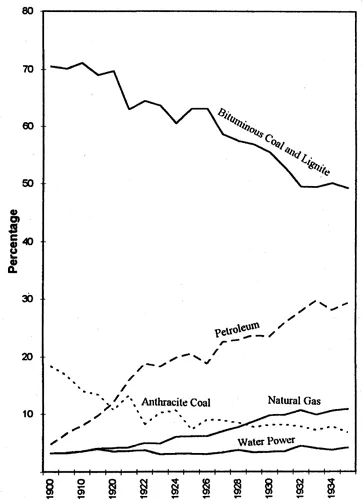
Figure 3. Number of Bituminous Coal Mines and Average Number of Days Worked Per Year: 1905–1935
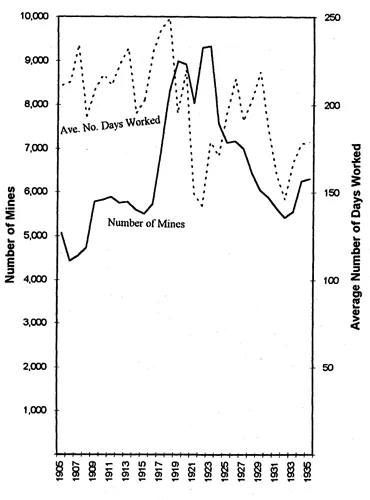
Figure 4. Production and Prices of Bituminous Coal: 1900–1935
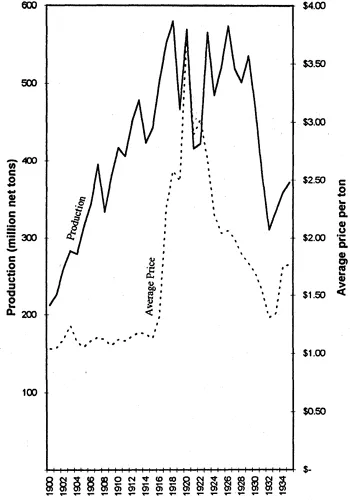
Coal prices reflected these changes. Following the lifting of price controls at the end of the war and a nearly 20 percent cutback in production occasioned by a lengthy strike by coal miners, 1920 prices rose to $3.75 per ton. From that point, however, as shown by figure 4,94 there followed an almost steady decline in prices to a low of $1.31 per ton in 1932. Industry profits mirrored these conditions. As Edward Devine, a member of the U.S. Coal Commission, demonstrated in his study of the profits of eighty-eight identical coal operators, net income and return on investment figures were unusually high in the years 1917,1918, and 1920 (see table 6.2).95 The economist Jacob Schmookler has suggested that the high prices enjoyed by coal operators during these years invited the development of new mines that, in ensuing years, contributed to the problem of idle capacity.96
Table 6.2. Profits of 88 Coal Operators, 1913–1922
Cents of net income per net ton produced |
Percent return on total investment in coal operations | ||
1913 |
.17 |
5.7 | |
1914 |
.13 |
3.8 | |
1915 |
.13 |
4.0 | |
1916 |
.21 |
7.2 | |
1917 |
.72 |
21.5 | |
1918 |
.61 |
16.3 | |
1919 |
.34 |
7.5 | |
1920 |
.89 |
20.3 | |
1921 |
.30 |
5.4 | |
1922 |
.36 |
7.1 |
There was another factor that added, to some extent, to increased capacity within the industry: the policies of the United Mine Workers union. The hard-line insistence by the UMW on maintaining high wage rates in the North, coupled with successful opposition by Southern operators to unionization, led to the growth of many new coal mines in the South. Schmookler suggests that the effect of such policies was to redistribute idle capacity from one region to another more than it was to increase the net amount of increased idleness.97 Schmookler’s subsequent findings suggest that union policies may be more causally related to the problem of increased idle capacity than he is prepared to admit. In his words, “This low-cost labor, in the main, made development of southern mines profitable. As these mines came into existence they inevitably captured markets of older, higher labor-cost operators, and made old capacity idle.”98
Whatever the relative influence of the various factors, there is little disagreement that the bituminous coal industry was plagued, in the 1920s, by competition from alternative fuel sources and by problems of overcapacity generated by the demands of World War I and, to some extent at least, the UMW. Prices and profits were depressed and many firms were eliminated. While business voices were understandably quick to attribute these depressed conditions to “the ruthlessness of the competitive struggle in recent years,”99 it seems more reasonable to treat falling prices and the demise of some companies as a reflection of the readjustment the industry had to make to the decline of coal relative to other fuels, and to government and union policies that exacerbated industry problems. When conditions become severe, there is a tendency to regard problems as the products of the malevolence of one’s competitors. It is well to remember, however, that even during the trying years 1929–33, the average annual production of coal was nearly 405.6 million tons, and the number of mines in operation averaged 5,714 per year. Coal prices during this same period averaged $1.53 per ton. This compares well with the pre-World War I years of 1910–16, in which average annual production was just over 445.6 million tons, the number of mines averaged 5,721 per year, and prices averaged $1.17 per ton.100 Put in its proper perspective, the coal industry is an example of a trade suffering less from “ruthless competition” than from the disruptive influences of governmental and union policies that worked opposite to changes taking place in the energy field and thus fostered miscalculation. As figure 2 indicates, many of the problems faced by the coal industry during these years were the consequence of increased competition from petroleum, natural gas, and electricity as energy sources. As these alternative forms of energy developed and brought with them new product lines that were dependent upon these new energy systems, coal experienced a concomitant decline in significance as a fuel source. It was the dynamics of change and growth rather than market failures that accounted for industry difficulties.
The “New Competition” and “Conservation” in the Coal Industry
Coal industry spokesmen joined leaders from other industries in attacks upon “selfish” and “unrestricted” competition. John C. Brydon, president of the National Coal Association (NCA) declared in 1923 that
Individual ideas regarding fundamental matters, when opposed to a majority idea in the interest of the general good, should be submerged. In matters which affect the industry as a whole, the minority should willingly subject themselves to the settled experience and convictions of the majority…. Selfishness and distrust must be forgotten.101
Mergers and consolidations had been employed in other industries in efforts to stabilize trade conditions. Alluding to the success of such practices in the coal industry, E. C. Mahan, who had succeeded to the presidency of the NCA, observed that while such a movement offered the only means of escape for the “victims of cut-throat competition,” it had failed to attract a wider acceptance due to the “strong spirit of individualism in the industry.” Mahan added: “When the operators of this country decide to discard a go-it-alone policy, the day of profit taking, in contrast to price cutting will have dawned.”102 Another industry executive, H. A. Glover of Knox Consolidated Coal Company, echoed the same thought, declaring that “we must relinquish our individuality in the interest of the common good.” Meanwhile, another president of the NCA, M. L. Gould, called for greater “co-operative effort” among competitors in working toward greater efficiency. According to Mel vin A. Traylor, president of the First National Bank of Chicago, such efforts could lead to greater stability within the coal industry. Traylor was of the view that competition between coalfields with a “fixed labor cost” and those with a “flexible labor cost” tended to encourage “overdevelopment” (i.e., “overproduction”) and, inferentially, price declines among producers. Traylor called for a “uniformity of labor standards” to alleviate such a problem, a recommendation that again suggests a rather apparent competitive advantage to higher-cost producers in increasing the costs of their more efficient, lower-cost competitors.103 The price stabilization tendencies of labor cost standardization would, in later years, lead many business interests to actively promote the enactment of minimum wage legislation, the Wagner Act, and other employment practice laws.
One also finds the previously discussed “conservation” arguments used as a rationale for price stabilization efforts in the coal industry. As with the petroleum industry, “conservation” was seen as a vehicle for regularizing the production that led to the fluctuation of prices. As Fritz Machlup has concluded: “In the coal industry, too, price maintenance has been the chief purpose of government regulation although the necessity of regulation has frequently been justified as a ‘conservation’ measure.”104
Industry “codes of ethics” were looked upon by coal producers as tools, along with “conservation” programs, for realizing stabilized production. In the words of C. E. Bockus, president of the NCA, such codes could supply “some restraint… upon the cut-throat competitive practices” in the industry.105 The related purposes of codes of ethics, trade practice conferences, and conservation efforts in the fuels industries can be seen in a code adopted through a trade-practice conference by the Southern Appalachian Coal Operators’ Association. The salient features of this code were provisions banning the shipment of coal on consignment and the sale of coal below cost when done to injure a competitor or control competition. The code contained an “open-price” section requiring the filing of minimum price schedules—along with any changes thereto—with the administering body. This code went into effect at a time when profits in the bituminous coal industry had declined to just over $2.545 million, down from $7.570 million for the preceding six-month period. The profit figure for the six-month period subsequent to the establishment of the code was over $8.385 million. No suggestion is being made that there was necessarily a causal relationship between this code of ethics and the general profit level for an entire industry. What is being pointed out, however, is the greater tendency of industries to be concerned about the ethical standards in their trades during periods of declining profits or the threat thereof than during periods of expansion, growth, and increasing profits.106 Firms that enjoyed increased profits during nonequilibrium periods were not heard to decry the market instabilities that produced such benefits. It was only when those same processes worked to their disadvantage—as when such firms lacked resiliency to respond to changes—that the inconstancies of trade were regarded as a problem!
Tying the “conservation” movement in with efforts on behalf of business “cooperation” and “self-regulation,” Bockus noted the advantages the European cartel system offered in allocating markets and setting prices for members of the cartel. He added that such practices were, unfortunately, prohibited by the Sherman and Clayton Acts. He commented upon the efforts of members of the industry, through trade practice submittals to the FTC, to improve trade conditions, but then observed:
[S]o long as the anti-trust laws remain unchanged, nothing can be embodied in those [trade practice conference] codes which provides for either the cooperative regulation of production or prices, or for any division of territory. And as it has been stated, these are the very practices on which the success of the European cartels is based.
Bockus then concluded by calling for a modification of the antitrust laws in order to permit members of the industry “the right to secure, by cooperative action, the continuous adjustment of the production of bituminous coal to the existing demand for it,” a procedure he felt would help insure “the prosperity of its operating companies.”107
In December 1931, some 137 coal producers operating in the Appalachian region created an exclusive selling agency for the collective marketing of their coal. Created in response to conditions in the industry, including severe price-cutting practices in the Southern states, the sales agency helped to moderate competition among the member firms through price-fixing. The U.S. Supreme Court was already on record, in the Trenton Potteries case,108 that price-fixing arrangements could not be defended as “reasonable” restraints of commerce under the Court’s previously enunciated “rule of reason.” Price-fixing, in other words, had been considered unreasonable per se. Nevertheless, the Court stepped aside from this doctrine in the Appalachian Coals case,109 upholding the coal operators’ sales agency system. Taking into account the depressed condition of the entire coal industry, the relatively small impact of this system, and the otherwise valid intentions of the producers “to remove abuses, [and] to make competition fairer,” the Court found the practice unobjectionable. The Court elaborated: “The fact that the correction of abuses may tend to stabilize a business, or to produce fairer price levels, does not mean that the abuses should go uncorrected or that cooperative endeavor to correct them necessarily constitutes an unreasonable restraint of trade.”110
The conflicting economic interests in the coal industry were evident in efforts to put together an NRA code. Over thirty proposed codes were submitted to NRA administrator Hugh Johnson before the Bituminous Coal Code was approved on 18 September 1933. Comprised of a national code authority and five geographical code authorities, the Bituminous Coal Code reflected the conditions that had long been an annoyance to industry members. Code sections regulated hours (by setting a forty-hour-per-week maximum), wages, the right of employees to engage in collective bargaining, and the elimination of unfair trade practices. Among the unfair trade practices detailed in the code were prohibitions against sales below a “fair market price,” with such prices determined by industry marketing agencies or code authorities. Also prohibited were allowances, discounts, credits, refunds, rebates, use of brokerage commissions, or prepayment of freight charges when the purpose or effect was to create price discrimination. Commercial bribery and sales to agencies representing industrial buyers were also proscribed, as were consignments of unordered coal. As in other industries, the bituminous coal industry took advantage of the NRA code system to attempt to reduce the intensity of competition.111
The NRA experience did little to dissuade the coal industry from advocating political intervention as a means of tempering competitive relationships among firms. By the end of 1934, Coal Age was able to comment that the fears of returning to the pre-NRA conditions had “triumphed over deepseated predilections for untrammeled freedom of action.” The New York Times reported, on the eve of the Schechter decision, that there was “virtually unanimous opposition” within the bituminous coal industry to terminating the NRA. The Schechter decision resurrected industry fears of a return to prior practices, prompting Coal Age to observe that “[t]he drift back to pre-code profitless prices and practices which began some months ago had become too pronounced for comfort.”112
Industry satisfaction with political direction was such that, following Schechter, the National Conference of Bituminous Coal Producers proposed new legislation that, among other things, sought to create a National Bituminous Coal Commission; to reestablish a code of fair competition containing the same unfair trade practices as condemned under the NRA code; to impose a 25 percent sales tax on the mine price of all coal, with 99 percent of such tax being refunded to any coal producer agreeing to abide by the code; and to create some twenty regional coal boards with the mandatory power to fix minimum prices and the permissive authority to set maximum prices for coal. The commission would also have the power to enforce industry-determined wage and hour standards, and to control and allocate coal production. With John L. Lewis providing the backing of the UMW, the legislation was rushed through Congress. Bearing the name “Guffey-Snyder Coal Act of 1935,” the new law was referred to as the “Bituminous Coal Conservation Act,” evidencing the popular tendency within the natural resources industries to identify practices designed for the regulation of prices, production, and trade practices as being synonymous with the efficient management of resources. As Machlup has pointed out, the fact that the measure had virtually nothing to do with conservation did not slow industry enthusiasm for its enactment. After the U.S. Supreme Court declared the law unconstitutional in the 1936 Carter Coal case, support was quickly mustered for the enactment of legislation that would permit price-fixing and yet avoid the practices found objectionable by the Court. The consequence was the Guffey-Vinson Act (Bituminous Coal Act of 1937), a legislative creation whose price-fixing provisions were later upheld by the Supreme Court.113
CONCLUSION
Since, by definition, the supplies of natural resources are limited to what is discovered in nature, efforts to control production (and thus prices) within such industries as petroleum and coal had to take the form of controlling the development of existing reserves. To this end, industry members found the “conservation” arguments an effective tool for gaining popular support for their cartelizing programs. Of course, economic analysis would suggest that the pricing mechanism of the market is itself the most efficient regulator of resource use. The price of any resource will rise or fall depending upon the relationship of the supply of that resource to its demand. Assuming a steady demand for a resource, if its availability should suddenly decrease, the users will allocate the shortage by bidding the price upwards. This, in turn, will decrease the demand for the resource and encourage exploration for more of the resource. Assuming a long-term or even permanent shortage of a resource, the increased price will cause users to better economize its use and/or to shift to substitute resources (for instance, by changing over from coal to natural gas for power). In either event, the market will respond to the relative scarcity of a resource by increasing its price; this, in itself, provides a natural and informal system for the “conservation” of resources.114 To suggest that extramarket practices must be resorted to in order to reduce “waste” totally misconceives the nature of resource use. In a market in which resource owners make decisions regarding the uses to be made as well as the prices and terms of such uses, there is no way that resources can be intentionally “wasted”: they can only be transformed. Their use is converted according to the demands made upon them in the market, with resource owners having an incentive to employ them in the satisfaction of those demands that promise the greatest return to the owner.
Every resource—which, by definition, is in “scarce” supply—is subject to the conservation argument. One could seek to control the employment of any resource, including human labor, by contending that private decision-making threatens supplies for future generations.115 The entire argument is especially suspect when one notes the popularity of conservation measures rising and falling within the various industries in a manner correlating, quite well, with economic conditions therein. One becomes even more suspicious when the arguments are advanced not by resource owners seeking to protect their assets from destruction, but by nonowners and owners of competitive resources seeking to interfere with the resource pricing decisions of others. That the sentiments for “conservation” within the natural resources industries amounted to little more than rationalizations of economic self-interest is evident from the behavior and the rhetoric of industry members during the years under study.
The dynamic changes occurring in the energy-producing industries afford an opportunity to examine public policy responses to nonequilibrium conditions. The preference of firms for competitive stability might be superficially understandable: the specter of extinction would seem threatening. But, as the study of entropy and chaos remind us, the survival of any system depends, in the long run, not only upon a resiliency to change, but a willingness to seek such changes. The seductiveness of a sense of permanence and equilibrium clouds the entropic nature of all orderly systems. Entropy—not some ideological bias in favor of free competition—dictates that we either remain vibrant and creative, or perish. Discoveries from the study of chaos are helping us to understand how the dynamical processes of nonequilibrium are essential to life-sustaining efforts to overcome entropy. By institutionalizing stability and rigidifying resiliency, the natural resource industries were threatening not only their own survival, but that of other firms and the economic system itself.
In Restraint of Trade: The Business Campaign Against Competition, 1918-1938
Read the whole book online · Book details
Free to read online and to download from this archive.