
Chapter 4 of 13 · Karl Marx and the Close of His System by Eugen von Böhm-Bawerk
II. The Theory of the Average Rate of Profit and of the Price of Production
THE THEORY OF THE AVERAGE RATE OF PROFIT AND OF THE PRICE OF PRODUCTION
THAT result is as follows: The “organic composition” (III, 172) of the capital is for technical reasons necessarily-different in the different “spheres of production.” In various industries which demand very different technical manipulations, the quantity of raw material worked up on one working day is very different; or, even, when the manipulations are the same and the quantity of raw material worked up is nearly equal, the value of that material may differ very much, as, for instance in the case of copper and iron as raw materials of the metal industry; or finally the amount and value of the whole industrial apparatus, tools, and machinery, which are utilized by each worker employed, may be different. All these elements of difference when they do not exactly balance each other, as they seldom do, create in the different branches of production a different proportion between the constant capital invested in the means of production and the variable capital expended in the purchase of labor. Every branch of economic production needs consequently a special, a peculiar “organic composition” for the capital invested in it. According to the preceding argument, therefore, given an equal rate of surplus value, every branch of production must show a different, a special rate of profit, on the condition certainly, which Marx has hitherto always assumed, that commodities exchange with each other “according to their values,” or in proportion to the work embodied in them.
And here Marx arrives at the famous rock of offense in his theory, so hard to steer past that it has formed the most important point of dispute in the Marxian literature of the last ten years. His theory demands that capitals of equal amount, but of dissimilar organic composition, should exhibit different profits. The real world, however, most plainly shows that it is governed by the law that capitals of equal amount, without regard to possible differences of organic composition, yield equal profits. We will let Marx explain this contradiction in his own words.
“We have thus shown that in different branches of industry varying rates of profit are obtained according to the differences in the organic composition of the capitals, and also, within given limits, according to their periods of turnover; and that, therefore, even with equal rates of surplus value, there is a law (or general tendency), although only for capitals possessing the same organic composition—the same periods of turnover being assumed—that the profits are in proportion to the amounts of the capitals, and therefore equal amounts of capital yield in equal periods of time equal amounts of profit. The argument rests on the basis which has hitherto generally been the basis of our reasoning, that commodities are sold according to their values. On the other hand, there is no doubt that, in reality, not reckoning unessential, accidental, and self-compensating differences, the difference in the average rate of profit for different branches of industry does not exist and could not exist without upsetting the whole system of capitalist production. It appears therefore that here the theory of value is irreconcilable with the actual movement of things, irreconcilable with the actual phenomena of production, and that, on this account, the attempt to understand the latter must be given up” (III, 181). How does Marx himself try to solve this contradiction?
To speak plainly his solution is obtained at the cost of the assumption from which Marx has hitherto started, that commodities exchange according to their values. This assumption Marx now simply drops. Later on we shall form our critical judgment of the effect of this abandonment on the Marxian system. Meanwhile I resume my summary of the Marxian argument, and give one of the tabular examples which Marx brings forward in support of his view.
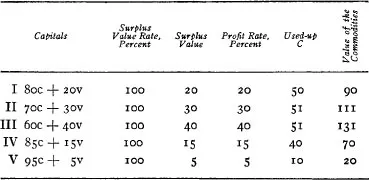
In this example he compares five different spheres of production, in each of which the capital employed is of different organic composition, and in making his comparison he keeps at first to the assumption which has been hitherto made, that commodities exchange according to their values. For the clear understanding of the following table, which gives the results of this assumption, it must be remarked that c denotes constant capital and v variable, and in order to do justice to the actual diversities of daily life, let us assume (with Marx) that the constant capitals employed are “worn out” in different lengths of time, so that only a portion, and that an unequal portion, of the constant capital in the different spheres of production is used up in the year. Naturally only the used-up portion of constant capital—the “used-up c”—goes into the value of the product, while the whole “employed c” is taken into account in reckoning the rate of profit.
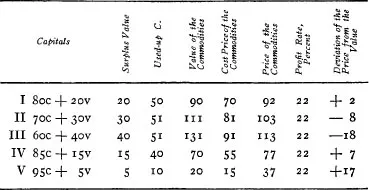
We see that this table shows, in the different spheres of production where the exploitation of labor has been the same, very different rates of profit, corresponding to the different organic composition of the capitals. But we can also look at the same facts and data from another point of view. “The aggregate sum of the capital employed in the five spheres is 500; the aggregate sum of the surplus value produced is no; and the aggregate value of the commodities produced is 610. If we consider the 500 as a single capital of which I to V form only different parts (just as in a cotton mill in the different departments, in the carding-room, the roving-room, the spinning-room, and the weaving-room, a different proportion of variable and constant capital exists and the average proportion must be calculated for the whole factory), then in the first place the average composition of the capital of 500 would be 500 = 390c + 110V, or, in percentages, 78c + 22V. Taking each of the capitals of 100 as being one fifth of the aggregate capital its composition would be this average one of 78c + 22V; and likewise to every 100 would accrue as average surplus value 22; therefore the average rate of profit would be 22 percent (III, 183-184). Now at what price must the separate commodities be sold in order that each of the five portions of capital should actually obtain this average rate of profit? The following table shows this. In it has been inserted the heading “Cost Price,” by which Marx understands that part of the value of commodities which makes good to the capitalists the price of the consumed means of production and the price of the labor power employed, but yet does not contain any surplus value or profit, so that its amount is equal to v + used-up c.
“Taken together,” comments Marx on the results of this table, “the commodities are sold 24-7 + 17 = 26 over their value, and 8 + 18 under their value, so that the variations in price mutually cancel each other, either through an equal division of the surplus value or by cutting down the average profit of 22 percent on the invested capital to the respective cost prices of the commodities, I to V; in the same proportion in which one part of the commodities is sold over its value another part will be sold under its value. And now their sale at such prices makes it possible that the rate of profit for I to V should be equal, 22 percent, without regard to the different organic composition of the capital I to V” (III, 185).
Marx goes on to say that all this is not a mere hypothetical assumption, but absolute fact. The operating agent is competition. It is true that owing to the different organic composition of the capitals invested in various branches of production “the rates of profit which obtain in these different branches are originally very different.” But “these different rates of profit are reduced by competition to a common rate which is the average of all these different rates. The profit corresponding to this common rate, which falls to a given amount of capital, whatever its organic composition may be, is called average profit. That price of a commodity which is equal to its cost price plus its share of the yearly average profit of the capital employed (not merely that consumed) in its production (regard being had to the quickness or slowness of turnover) is its price of production” (III, 186). This is in fact identical with Adam Smith’s natural price, with Ricardo’s price of production, and with the prix necessaire of the physiocrats (III, 233). And the actual exchange relation of the separate commodities is no longer determined by their values but by their prices of production; or as Marx likes to put it “the values change into prices of production” (III, 231). Value and price of production are only exceptionally and accidentally coincident, namely, in those commodities which are produced by the aid of a capital, the organic composition of which chances to coincide exactly with the average composition of the whole social capital. In all other cases value and production price necessarily and in principle part company. And his meaning is as follows: According to Marx we call “capitals which contain a greater percentage of constant, and therefore a smaller percentage of variable capital than the social average capital, capitals of higher composition; and contrariwise those capitals in which the constant capital fills a relatively smaller, and the variable a relatively larger space than in the social average capital are called capitals of lower composition.” So in all those commodities which have been created by the aid of capital of “higher” composition than the average composition the price of production will be above their value, and in the opposite case it will be under the value. Or, commodities of the first kind will be necessarily and regularly sold over their value and commodities of the second kind under their value (III, 193 ff. and often elsewhere).
The relation of the individual capitalists to the total surplus value created and appropriated in the whole society is finally illustrated in the following manner: “Although the capitalists of the different spheres of production in selling their commodities get back the value of the capital used up in the production of these commodities, they do not thereby recover the surplus value, and therefore profit, created in their own particular spheres, by the production of these commodities, but only so much surplus value, and therefore profit, as falls by an equal division to every aliquot part of the whole capital, from the total surplus value or total profit which the entire capital of society has created in a given time, in all the spheres of production taken together. Every 100 of invested capital, whatever its composition, secures in every year, or other period of time, the profit which, for this period, falls due to a 100 as a given part of the total capital. So far as profit is concerned, the different capitalists are in the position of simple members of a joint stock company, in which the profits are divided into equal shares on every 100, and therefore for the different capitalists vary only according to the amount of capital invested by each in the common undertaking, according to the relative extent of his participation in the common business, according to the number of his shares” (III, 186 ff.). Total profit and total surplus value are identical amounts (III, 204). And the average profit is nothing else “than the total amount of surplus value divided among the amounts of capital in every sphere of production in proportion to their quantities” (III, 205).
An important consequence arising from this is that the profit which the individual capitalist draws is clearly shown to arise not only from the work performed by himself (III, 201), but often proceeds for the most part, and sometimes entirely (for example, in the case of mercantile capital), from laborers with whom the capitalist concerned has no connection whatever. Marx, in conclusion, puts and answers one more question, which he regards as the specially difficult question: in what manner “does this adjustment of profits to a common rate of profit take place, since it is evidently a result and not a starting point?”
He first of all puts forward the view that in a condition of society in which the capitalist system is not yet dominant, and in which, therefore, the laborers themselves are in possession of the necessary means of production, commodities are actually exchanged according to their real value, and the rates of profit could not therefore be equalized. But as the laborers could always obtain and keep for themselves an equal surplus value for an equal working time—that is, an equal value over and above their necessary wants—the actually existing difference in the profit rate would be “a matter of indifference, just as today it is a matter of indifference to the hired laborer by what rate of profit the amount of surplus value squeezed out of him is represented” (III, 208). Now as such conditions of life in which the means of production belong to the worker are historically the earlier, and are found in the old as well as in the modern world, with peasant proprietors, for instance, and artisans, Marx thinks he is entitled to assert that it is “quite in accordance with facts to regard the values of commodities as, not only theoretically but also historically, prior to the prices of production” (111, 209).
In societies organized on the capitalist system, however, this changing of values into prices of production and the equalization of the rates of profit which follows certainly do take place. There are some long preliminary discussions, in which Marx treats of the formation of market value and market price with special reference to the production of separate parts of commodities produced for sale under conditions of varying advantage. And then he expresses himself as follows very clearly and concisely on the motive forces of this process of equalization and on its mode of action: “If commodities are … sold according to their values … very different rates of profit are obtained…. Capital withdraws itself, however, from a sphere with a low rate of profit, and throws itself into another which yields a higher profit. By this continual interchange, or, in a word, by its apportionment between the different spheres, as the rate of profit sinks here and rises there, such a relation of supply to demand is created as to make the average profit in the different spheres of production the same, and thus values are changed into prices of production” (III, 230).1
1 W. Sombart in the classical, clear, and comprehensive account of the concluding volume of the Marxian system which he lately gave in the Archiv für Soziale Gesetzgebung (Vol. VII, 1895, pp. 255 ff.), also regards the passages quoted in the text as those which contain the strict answer to the problem given (Ibid., p. 564). We shall have to deal later more at large with this important and ingenious, but critically, I think, unsatisfactory essay.
Karl Marx and the Close of His System
Read the whole book online · Book details
Free to read online and to download from this archive.