
Chapter 23 of 25 · Lessons for the Young Economist by Robert P. Murphy
ADVANCED LESSON 23 The Business Cycle
In this lesson you will learn:
- The typical elements of the business cycle.
- How government intervention causes the business cycle.
- The causes of mass unemployment.
The Business Cycle
The business cycle, also known as the boom-bust cycle, refers to the periodic rhythm that seems to plague market economies. Rather than enjoying uninterrupted growth, for some reason the people living in capitalistic economies experience alternating stages of prosperity and recession. On the upswing of the business cycle, businesses expand and hire workers, wages and prices rise, the stock market soars, and there is a general feeling of euphoria. However, for some reason the economy always starts to sputter, eventually giving in to a downturn in which workers lose their jobs, business sales and wages plummet, and the stock market falls or even crashes.
Most people, including even many fans of capitalism, believe that business cycles are an inherent property of the pure-market economy. Indeed because of this widespread perception, it is very popular for the government to engage in countercyclical policies, through which the alleged extremes of the market can be tamed. For example, many analysts would say that social welfare programs and progressive income taxes, beyond their other possible merits, also serve to “dampen” the ups and downs of the unregulated business cycle. During the boom period, people are pushed into higher tax brackets (because of rising incomes) and thus the government takes in extra revenue, which helps build up a cushion for the down times, and also helps “cool off” an “overheated” economy.1
Then when the bust occurs, government programs such as unemployment benefits and food stamps automatically kick in to provide needed income to people who have lost their jobs. In this way—according to the popular understanding—the slump in business activity doesn’t fall into a vicious downward spiral, where one round of layoffs leads to less money for consumers to spend, which in turn hurts business sales even further, and so on. The concept of countercyclical policies reflects one of the guiding themes in conventional discussions of economic policy, namely that the government (and Federal Reserve) should use their various powers to navigate the economy through the choppy waters of prosperity and recession. In this popular view, the goal or duty of the government and Federal Reserve is to give citizens a steady and smooth increase in living standards, without the wild swings that would allegedly occur in a purely free market.
By this point in the book, you should be skeptical of these typical claims of the ability of government intervention to “fix” things in the economy. We have already seen several examples where it was not the free market, but instead government intervention, that caused certain social problems—these included slumlords, drug gang violence, and apartment shortages in big cities.
Indeed, when it comes to macroeconomics—which is the study of the whole economy, rather than individual product or labor markets—there is an alternative viewpoint that blames business cycles on government intervention. According to this school of thought,2 the government causes a period of false prosperity when it artificially pushes down interest rates below their proper free-market levels. But the illusion cannot last forever, and at some point the economic house of cards collapses, leading to all of the things we associate with “recession.”
In an introductory book we can only provide you a sketch of this explanation for business cycles. We have saved this discussion for the final lesson because it will draw on several concepts from earlier lessons. Although some of the remaining material may be a bit too advanced for you, we urge you to digest as much as possible because it is crucial for citizens to understand the causes of the business cycle. If the theory presented in the following pages is correct, it means that governments not only create business cycles, but that the “medicine” they give during the recession phase is actually poison.
How Governments Cause the Business Cycle
In order to understand how government intervention could possibly be the cause of the familiar ups-and-downs of the business cycle, let’s first review what happens in a pure market economy when consumers decide to increase their saving.
Sustainable, Market-Driven Economic Growth
In Lesson 4 we explained how poor Robinson Crusoe, all alone on his tropical island, could improve his standard of living through discipline and foresight. By saving (rather than consuming) some of the coconuts he collected with his bare hands every day, Crusoe could build up a stockpile so that eventually he could begin investing his time and other island resources into building capital goods such as a long pole. With the pole and other capital goods, Crusoe’s labor would be vastly augmented in the future, so that he could enjoy more coconuts, fish, shelter, and leisure, compared to his situation when he first landed on the island.
In Lesson 10 we took these basic insights about Crusoe’s world and applied them to a modern market economy. In this setting it is also possible for people to cut back on their present consumption, in order to save and invest which allows them to enjoy a permanently higher standard of living in the future.
Recall the specific role that interest rates play in this process: When most people in the economy decide that they want to cut down their present spending in order to provide for their retirement (or to provide a bigger inheritance for their heirs), their decision causes interest rates to fall.3 The lower interest rates provide a signal for entrepreneurs to borrow more and invest in longer-term projects. This is because a given investment project—which has a certain number of years of money “going in” before the finished product can be sold and money can be “taken out”—will seem more or less profitable depending on the interest rates used to evaluate the timing of its expenses and revenues. As the market interest rate falls, the longer-term projects are penalized less and less, as it were, and entrepreneurs are given the green light to hire workers and buy raw materials to begin these projects.
The crucial thing to remember is that in a sustainable, market-driven expansion—where the interest rate falls because people are consuming less and saving more—the extra resources flowing into the new investment projects are coming from the sectors which are seeing a drop in sales. For example, if consumers are cutting back on restaurant dining and purchases of DVDs, in order to contribute more to their savings accounts every month, then restaurants will have to lay off waiters and waitresses, and some of the factories producing DVDs may have to shut down. These workers and other resources are then “freed up” to be absorbed into the expanding sectors, namely those industries that are growing because of the lower interest rate.
What actually happens in a sustainable, market-driven expansion is that workers and other resources are redeployed away from present consumption goods and into capital goods. It is the analog of Crusoe devoting some of his labor hours not on coconut gathering, but rather on pole construction. In both cases the ultimate objective, of course, is to enjoy a greater amount of consumer goods. But because of scarcity, there is a short-term tradeoff in which consumption actually drops in the present, in order to fund the construction of more capital goods. Eventually this abstinence more than pays for itself, but it’s important to remember that sustainable prosperity and economic growth rely on discipline and patience. Absent a new technological invention, or the discovery of new supplies of natural resources, there is no magical way to increase the productivity of labor so that everyone can consume more immediately and permanently.
Unsustainable, Government-Driven Economic Growth
Now let’s suppose that government officials do not have the patience that sustainable economic growth requires; they want the benefits of more investment without the pain of higher saving (i.e., reduced consumption). To this end, the central bank (the Federal Reserve in the United States) pushes down interest rates below their free-market level. The specific mechanism that the Federal Reserve uses is rather technical, but for our purposes you can simply imagine that it prints up new $100 bills and enters the loan market, offering to lend the new money at lower interest rates than the prevailing market rate. In effect, the Federal Reserve becomes a new supplier of loanable funds (which come from the printing press), and moves the supply curve to the right.
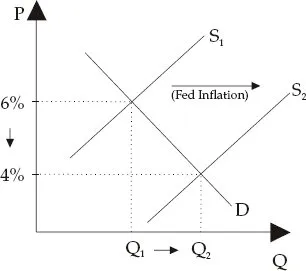
Market for Loanable Funds
Superficially, the results of this operation resemble a market-driven expansion. At the lower interest rate, entrepreneurs are given the green light to start longer-term projects. They hire workers and buy raw materials for enterprises that appeared unprofitable at the original market interest rate, but which now make sense given the “cheap credit” supplied by the Federal Reserve.
However, unlike the market-driven expansion, in the government-driven version there is no corresponding drop in consumer spending on restaurants, DVDs, and other retail sectors. On the contrary, these businesses are enjoying an increase in sales, because at the lower interest rate, people have less of an incentive to save and so they spend more on present enjoyments. In other words, while the entrepreneurs who make capital goods are seeing their businesses boom, so are the consumer sectors. It therefore seems that every sector is enjoying growth. The competition to hire new workers leads to increasing wage rates, which further contributes to the general feeling of prosperity.
But we know that this perception of euphoria must be an illusion. The government didn’t come up with a new scientific formula or stumble upon an unknown oil field; all it did was print up green pieces of paper and hand them out to entrepreneurs. This action by itself doesn’t alter the underlying facts of scarcity. It is physically impossible for the economy to produce more tractors and more television sets with the same amount of workers, raw materials, and equipment. In a market-driven expansion, consumers had to cut back on television sets (and other consumer goods) in order to allow for more tractors. Yet in the government-driven expansion, initially it seems as if the economy can have its cake and eat it too—that it can produce more capital goods and more consumer goods, without any waiting period. What’s going on?
The answer is that the government’s distortion of the interest rate has misled entrepreneurs. Remember that one of the functions of free-market prices is that they provide signals which help coordinate economic activity. By making it artificially cheap to borrow capital funds, the government has (loosely speaking) fooled investors into behaving as if there were more savings than actually exist. Therefore what the entrepreneurs in one part of the economy are trying to do with resources, does not mesh with what entrepreneurs in other parts are trying to do, and no one’s plans match up with how consumers expect to spend their paychecks.
You might think that such confusion and divorce from the actual economic facts would immediately reveal itself. After all, if NASA builds a rocket using false “laws” of physics or engineering, they realize their mistake pretty quickly. But when it comes to the false prosperity of a government-induced boom, it can sometimes take years before reality rears its head.
This delayed reaction is made possible by capital consumption. In other words, it actually is possible for the economy to suddenly produce more capital goods4 (tractors, drill presses, two-by-fours) and more consumer goods (TVs, iPods, bicycles) simultaneously—at least for a while. The tradeoff can be temporarily postponed if entrepreneurs ignore the wearing out of the existing capital stock.
In order to make anything—whether a consumer or a capital good—entrepreneurs must use existing tools and equipment. Regular usage results in depreciation, the wearing away or using up of these items. Even after Robinson Crusoe’s initial saving and investment have paid off, he still must periodically attend to maintenance on his pole, or to the gradual construction of a new pole to replace the old one when it becomes too tattered. The same is true for a modern market economy. In order to simply maintain the current standard of living, at least some output every year must go toward replacing the capital goods used up in that year’s production.
Now you should be able to understand the general outlines of how a false, government-driven expansion or boom is at least possible. The false prices (caused by printing up new money and injecting it into the financial markets) can mislead entrepreneurs, so that they unwittingly begin long-term projects for which there are not enough actual savings. The charade can continue for years, with everyone seeming to enjoy a higher standard of living, through “eating the seedcorn” and not plowing enough resources back into maintaining the existing economic structure. Of course the vast majority of people don’t realize this is occurring—on paper the business-people are making record profits, and are increasing the value of their enterprises. But once the bust occurs, and market prices quickly change to more realistic numbers, everyone will realize that they behaved foolishly during the boom period.
The Inevitable Bust Following an Artificial Boom
In the typical business cycle, the period of (apparent) prosperity tapers off once rising price inflation causes the central bank to raise interest rates. Recall that in Lesson 21 we learned that monetary inflation (other things equal) causes price inflation. This cause-and-effect relationship still holds, regardless of the purpose for the new money creation. When the central bank (the Federal Reserve in the United States) creates new money in order to increase the supply of loanable funds, there are two major distortions: (1) An artificial boom created by the lower interest rate which (falsely) signals an increased availability of savings, and (2) rising prices.
As the boom progresses, the central bank generally has to continue pumping ever increasing amounts of new money into the loan market, if it wishes to keep the “stimulus” going. In the first place, a simple one-shot injection of new money—a burst of, say, $1 billion over the course of a week—would quickly work its way through the loan market and into the broader economy. Interest rates would drop, but only temporarily. In order to keep the interest rate below the free-market level, the central bank needs to continually feed in new money.
However, even a continuous yet stable stream of new money might quickly lose its ability to fuel an economic boom, because entrepreneurs would adjust to the new condition and largely offset its impacts in their calculations. There is also the obvious fact that a given dollar amount—for example $1 billion a week in newly injected money—would have less and less impact, as the money stock grew over time. Finally and perhaps most significant, as the “real” problems of the unsustainable expansion began to appear, ever greater amounts of monetary inflation would be necessary to hide the growing imbalances in the structure of production.
For all these reasons, the central bank typically needs to pump in ever increasing amounts of new money, the longer it wants to sustain the apparent economic prosperity. But this eventually leads to worrying spikes in various prices, perhaps first hitting financial and commodity markets, but eventually showing up in prices at the grocery store. As the price inflation becomes progressively higher, more and more analysts and even the general public begin to question the central bank’s “easy money” and “cheap credit” policies.
At some point, therefore—and perhaps several years after the start of the monetary expansion—the central bank chickens out and at least slows the injection of new money into the loanable funds market. Interest rates begin to rise, closer to their true free-market level. As market prices become more accurate, many entrepreneurs realize they have behaved foolishly, and are overseeing half-finished, grandiose projects that clearly should never have been started. These entrepreneurs do what they can to salvage a bad situation. Some need to shut down immediately, lay off all their workers, and sell their equipment and inventory off to the highest bidders, to be incorporated into businesses that were not so completely taken in by the false reality of the boom period. Other businesses can afford to stay in business, but they suffer large losses and experience a period of belt-tightening.
The Causes of Mass Unemployment
The single most significant aspect of the business cycle—in both political and human terms—is the mass unemployment that occurs during the bust or recession phase. Yet ironically—and perversely—the very government policies that most people recommend to “help” the plight of the unemployed actually prolong the recession and sow the seeds for the next unsustainable boom.
The artificial prosperity of the boom period was fueled by the government’s interventions pushing down the interest rate. The “false” price of borrowing credit led entrepreneurs to borrow more than there was true savings available. Remember from Lesson 12 that the pure market interest rate serves to ration the available savings among all the competing borrowers, and that the process isn’t simply about money. There are real, physical resources involved as well. If workers and materials are devoted to building a new car factory that will take two years to complete, then those resources are “locked up” in the project for at least two years until they begin to “bear fruit” in the form of new cars.
During the artificial boom, too many of these long-term projects are started, because the false interest rate is too permissive. But the mere printing up of new money hasn’t actually created more workers or other resources to go around. It’s still the case that if work begins on a new car factory, it absorbs resources that could have been used elsewhere. If, during the early stages of the boom, too many projects are started, then it is physically impossible for them all to reach completion. The sooner the central bank chickens out and lets interest rates return to their appropriate level, the better, because then the entrepreneurs catch their mistakes sooner and stop digging themselves deeper into their mistaken projects.
When the boom collapses and turns into a bust, there is a period of confusion where everyone in the market needs to reevaluate his or her situation, in light of the shocking realization that the plans made during the boom were mistaken—and in some cases, very badly mistaken. If we step back and think about the adjustment process, during which the economy returns to a sustainable growth path, it must go something like this: Those resources that were drawn into unprofitable projects or sectors during the boom period, now need to be redirected elsewhere. And that requirement includes labor resources, meaning that people who happen to be working at extremely unprofitable businesses (but which seemed profitable during the boom) need to lose their jobs once the bust occurs.
For example, if six months’ work has been done on a new car factory that will take another 18 months to complete, but for which (in light of the new information) there won’t be enough car buyers to support its operations, then obviously the correct thing to do is to stop building it immediately. From the point of view of the whole economy, it’s not “compassionate” for the government to, say, use tax dollars to subsidize the company that owns the factory, in order to prevent the construction workers from being laid off, and to “create” jobs in the factory making cars that no one wants to buy. No, the correct thing to do is allow those workers and other resources (which can be salvaged) to flow into other projects or sectors that are actually profitable.
The problem with this “tough love” recommendation, of course, is that it takes time for the economy to rebalance itself after an artificial boom, especially if the boom has lasted years. Consequently, there could be a period of months or even longer for some of the displaced workers, where they can’t find a productive niche in the streamlined economy, in the wake of the bust. Rather than waiting for the “laissez-faire medicine” to work, many people would far prefer the government to step in and provide immediate relief.
Yet even here, it’s important to realize the actual function that a prolonged spell of large-scale unemployment serves. Remember the critical flaw with outright central planning, i.e., pure socialism: Without market prices and the profit-and-loss test, the central planner wouldn’t know how to make efficient use of the resources at his disposal. In the modern United States, for example, a would-be central planner would have no idea how many people “should” be brain surgeons, or construction workers, or school teachers, and let alone how many people within each of these broad totals should live in each particular city in the United States.
By the very same token, then, no person or even group of experts could possibly know the “right” way for the economy to adjust, in light of a collapsing boom. For example, consider the construction workers who built houses in Las Vegas during the great housing boom from the early 2000s through 2006. Clearly there were too many workers (and other resources such as lumber and nails) going into the Las Vegas housing industry during these years, and the “correct” thing to do would be for them to do something else with their labor time.
But what, specifically? Each construction worker in the Las Vegas area was a unique individual, with different skills, interests, and personal circumstances. The “correct” response of one worker may have been to get on a bus to Texas to take a job at an oil refinery. The correct response of another may have been to go back to graduate school and finish his Ph.D. in literature. And perhaps the correct response of a third worker would have been to take a huge pay cut flipping burgers in Vegas, waiting for the housing market to recover, because his wife held a great job as a personal assistant to a successful Vegas attorney.
Now that we have some idea of the scope of the problem, we see that the pure market economy is the best way to solve it. After the boom collapses, many workers realize that they can’t earn the same paychecks they had become accustomed to. That’s what it means to say the prosperity of the boom years was illusory—people really weren’t as rich as they thought. What happens then is that laid off workers begin looking for work, hoping to find a new job that offers a salary and other features comparable to their old job, and which doesn’t require them to move or (at least) to move to an area they detest.
It takes time for people to search for new positions. The longer an unemployed person searches, the better his new job is likely to be. However, the drawback of longer searches is that the unemployed person isn’t contributing anything directly to the economic system; he must live off of the output of others during his search.
Notice that all of these issues are given their due weight in the pure market economy. Each displaced worker is allowed the freedom to choose his or her new job, based on all the factors relevant to the individual; no government official decides where the worker “ought to go now.” At the same time, individuals bear the brunt of their delay in finding new work, because there are no government unemployment programs that (to put it bluntly) pay people not to find a new job.
As we have stressed throughout this book, economic analysis per se cannot decide which government policies are good and which are bad. But it can shed light on the results of particular policies, so that citizens and government officials can make informed decisions. In the case of mass unemployment, the issue is not simply a matter of cruelty versus compassion. By establishing a system of unemployment compensation, for example, the government reduces the earnings of employed workers, and makes it less attractive for profitable businesses to expand at the onset of the recession.
The government doesn’t create resources or wealth, it simply redistributes them. If there were no formal government scheme for unemployment insurance, individuals and businesses would still have the option of using their larger paychecks and profits (which would no longer be subject to contributions to the unemployment fund) to build up their savings in order to provide a cushion during times of economic hardship. Perhaps this free market cushion would in practice be smaller than the duration of unemployment checks established by the government, but again, what economics shows us is that there is a tradeoff involved. It is not a fact of engineering or chemistry to say how long unemployment relief should last; that is clearly an economic question.
For example, it would clearly be wasteful if the government established a rule saying that anyone laid off from his job could collect checks equal to 95% of his former salary, for up to 20 years, until he finds a new job. Even the most zealous advocates for the unemployed would admit that that hypothetical policy would be disastrous, and would in fact hurt workers (all things considered). But once we admit that there can be such a thing as unemployment benefits that are too “generous,” our knowledge of basic economics makes it hard to justify the government’s decision to provide benefits in excess of what would have occurred in a voluntary pure-market economy.
Finally, if the government were really interested in helping the unemployed, it would stop using the central bank to artificially suppress interest rates. If the government and public could resist the urge to meddle during a recession, and simply let the correct market prices redirect workers and resources to sustainable niches, there would be no need for further dislocations. Unfortunately, in practice the central bank often “cures” a recession simply by fueling the upswing of another unsustainable boom.
Lesson Recap...
- The business cycle is the regular pattern in market economies where there are a few years of a “boom” characterized by low unemployment, rising wages and corporate earnings, and the expansion of many businesses. After the boom there is a “bust” or recession, characterized by high unemployment, stagnant or even falling wages and corporate earnings, and the liquidation of many businesses.
- The government, acting through the central bank, causes the boom-bust cycle by interfering with the market interest rate. When the central bank creates new money and releases it into the credit markets, this artificially lowers the interest rate, giving a false signal to entrepreneurs to expand their operations and invest in long-term projects. People feel richer during the boom, but the prosperity is an illusion, because it is not based on genuine saving but instead on inflation. The inevitable crash is actually the market’s desirable readjustment to the underlying realities.
- During an unsustainable boom (generated by inflation in the credit markets), many workers and other resources are channeled into the wrong industries. After the recession sets in, the market must reallocate them to their proper niches. This shuffling of workers can take time, and appears as high rates of unemployment. Government efforts to “help”—such as sending checks to people without a job—prolong the period of high unemployment.
NEW TERMS
Business cycle / boom-bust cycle: The regular pattern in market economies where a “boom” period—characterized by low unemployment and prosperity—is followed by a “bust” or recession period—characterized by high unemployment and business failures.
Countercyclical policies: Standard government and Federal Reserve policies that are supposed to counteract the movements of the free market. For example, Keynesian economists would justify government deficits during a recession as a way to stimulate total spending and to boost employment.
Macroeconomics: The subdivision of economics that focuses on economy-wide issues such as price inflation and the business cycle.
Capital consumption: Achieving a higher standard of living (temporarily) by failing to invest enough in the maintenance of capital goods. “Eating the seedcorn,” metaphorically speaking.
STUDY QUESTIONS
- Why is the business cycle sometimes called the boom-bust cycle?
- Explain: “[I]n a sustainable, market-driven expansion—where the interest rate falls because people are consuming less and saving more—the extra resources flowing into the new investment projects are coming from the sectors which are seeing a drop in sales.”
- *Do central banks typically lower interest rates by imposing a price ceiling (analogous to rent control)?
- *How does capital consumption give the illusion that an economy can have its cake and eat it too?
- How does an unsustainable boom lead to mass unemployment?
Lessons for the Young Economist
Read the whole book online · Book details
This work is published under a Creative Commons licence. You may copy, share, and re-host it with attribution.