
Chapter 9 of 25 · Lessons for the Young Economist by Robert P. Murphy
LESSON 8 The Division of Labor and Specialization
In this lesson you will learn:
- The definitions of division of labor (specialization) and productivity of labor.
- The advantages of the division of labor.
- The principle of comparative advantage.
The Division of Labor and Specialization
In the last lesson we learned that the use of indirect exchange—especially when the practice is taken to its logical conclusion with the use of money—greatly enhances the scope for beneficial trades. However, a monetary economy doesn’t merely facilitate the rearrangement of already-existing finished goods. One of its chief benefits is to foster the division of labor, which means that people specialize in different tasks in order to produce the goods in the first place.
To put it in other words, in the previous lesson we were taking it for granted that there was a person called a “butcher” who spent his time preparing and selling meats, and a person called a “cobbler” who spent all day selling shoes (and shoe repair services). Yet this was putting the cart before the horse, because without indirect exchange and especially the use of money, trading options would be so limited that people would have to be largely self-sufficient. In other words, if a community of people only engaged in direct exchange, then no individual could probably afford to become a shoe cobbler—he might get scurvy if no one with vegetables needed his shoes fixed for a few months.
As we have seen, the use of money overcomes these limitations. Very complex chains of production and trading can be arranged, since at each step the sellers can unload their wares for money and then look for the lowest prices in their role as buyers. A shoe cobbler can buy goods and services from dozens of other professionals, even though some of them may have no need for the cobbler’s services. In effect, the use of money allows the cobbler to do a “favor” for a third party (say, a dentist) who then does a “favor” for the butcher (by fixing his teeth) who in turn does a “favor” for the cobbler (by giving him some of his bacon). Only through the use of money can very complex “favor swapping” occur, which makes it practical for people to “divide the labor” that needs to be done and allow individuals to specialize in particular tasks.
To grasp just how important the division of labor is, imagine a world without it. Rather than people specializing in various occupations and producing far more than they personally need, people instead try to be perfectly self-reliant. Each person (or each household at the very least) would grow his own food, make his own clothes, build his own furniture, perform his own dental and medical procedures, and so on. Clearly in such a world, most of the world’s current population would die within a month or two, and the small band of survivors would live a primitive existence, especially as the tools they used wore out, machines broke down, and gasoline supplies ran out.
Why would modern civilization collapse without the division of labor? The quick answer is that the productivity of labor would plummet. Remember that Robinson Crusoe, alone on his desert island, was able to improve his lot—was able to achieve a life that he considered more pleasant—by using his labor to transform his environment. We saw that through saving and investment (in order to create a pole out of branches and vines), Crusoe could greatly increase the productivity of his labor, meaning that he could increase the number of coconuts he could acquire per hour of labor.
But saving and investment is only one way to increase the productivity of labor. Another way is through the division of labor, where “the work” is divided up into different types of tasks, and individual workers specialize in one or a few tasks. Rather than each person growing his own food, making his own clothes, performing his own dental work, etc., with specialization some people grow all the food, and some other people do all the dental work, etc. In our society, we have special names for these two groups of people: farmers and dentists.
The productivity of labor is magnified greatly when it is “divided” in this fashion. Simply put, people can produce more total stuff when they specialize in their tasks, rather than everyone trying to produce a small portion of each item in the total pile of stuff. By having special individuals devote themselves exclusively to farming, and others exclusively to dentistry, there is more total food produced, and more cavities pulled, per year than would be possible without the division of labor. Since there is more total stuff to go around, everyone can eat more, wear more clothes, and so forth under the division of labor.
Why Specialization Makes Labor More Productive
Most people agree that if they had to grow their own food, make their own clothes, etc., they would be plunged into abject poverty. Even though the conclusion is sensible, it’s useful to spell out some of the specific reasons that specialization makes labor so much more productive:
- Less time wasted switching between tasks. Picture something as simple as three children cleaning up the table after dinner. Most likely, the kids can get the job done more quickly if they divide up the tasks and specialize, for the simple reason of cutting down on unnecessary walking. For example, one child can scrape the plates off into the garbage and carry the dishes to the sink. The second child can wash, and the third can dry. This system is much more efficient—they will all be done much sooner—than if each child grabbed a dish, scraped it into the garbage, then carried it over to the sink and washed it, then stepped to the right to dry the same dish and finally put it away. The same principle applies to other productive operations.
- Promotes automation. By taking a complicated task and breaking it down into its components, the division of labor promotes the use of automation (machinery). If everyone grew his own food in the backyard, it wouldn’t make sense for anyone to develop tractors. Even if we just consider a particular factory, its output will be higher if the workers specialize in their jobs within the factory because it’s then easier to incorporate machinery and tools to help them.
- Economies of scale. This is a generalization of the first two principles. For many operations, there are economies of scale at least up to a certain level of output. This principle means a doubling of inputs more than doubles the output. For example, if a chef switches from making enough pasta to feed one person to feeding fifty people, the time spent on preparation of the sauce, boiling the water, and so on certainly doesn’t increase fifty times. This principle alone explains why it makes sense for roommates to alternate preparing meals, rather than each roommate cooking a whole meal for him or herself every night. Another everyday illustration of economies of scale involves making a cup of coffee: Whether you want to make one cup or four, the prep work is largely the same, which is why people often ask, “I’m making coffee, anyone else want some?”
- Natural aptitude. So far our principles have shown that even if the whole world were filled with identical people, there would still be advantages from specialization. In the real world, of course, people are not identical. Some people are simply born to be better farmers than others—and this natural advantage can include geographical factors. For example, a strong boy in Idaho would probably be able to grow more potatoes per year than a sickly, bed-ridden boy in Idaho, but at the same time a strong boy in Florida can grow more oranges per year than even a strong boy in Idaho. And the bed-ridden boy in Idaho might be born with a wonderful knack for language, and thus makes a much better copy editor or novelist than either of the healthy boys who are much better equipped to be farmers.
- Acquired aptitude. The true advantages of the division of labor occur when people develop their natural aptitudes through training and practice, practice, practice. Someone who’s always had a “knack for numbers” in school would do a better job working at an accounting firm after graduating high school, compared to another high school graduate who always struggled with math. But if the student with good math skills then went to college and majored in accounting, his superiority would be even more pronounced. Finally, if we followed that same person and checked in at age 50, after he had spent twenty-eight years working as an accountant, then obviously he would be far more proficient at the job—meaning his labor would be much much more productive—than any other human who did not have such a background.
The above list is not meant to be exhaustive, but it lays out some of the main reasons that labor is so much more productive through specialization.
Enriching Everyone By Focusing on Comparative Advantage
It’s important to emphasize that the benefits of specialization can only be reaped when people are able to trade with each other. If some people focus on growing food, while others focus on building houses, then this arrangement only works if the farmers are allowed to trade their surplus food in exchange for some of the builders’ surplus houses. Otherwise the farmers will freeze and the builders will starve. Without the ability to move goods around the economy, the huge leap in “total output” (made possible by the division of labor) would be a hollow victory.
It’s easy enough to see the mutual benefits of specialization and trade when two people have different areas of expertise. For example, if Joe is really good at planting and harvesting wheat, whereas Bill is an expert at sewing pants, then it’s obvious that the two will both enjoy a higher standard of living if Joe concentrates on producing wheat while Bill concentrates on producing pants.
However, economists have discovered that the principle applies even in cases where one person is more productive in every possible way. In the jargon of economics, we can say that even if one person has an absolute advantage in every line of production, he or she still benefits by specializing in his or her comparative advantage, which is the field where the superiority is relatively greatest.
The principle of comparative advantage was traditionally used to illustrate the benefits of free trade in commodities between two nations, but for our purposes we can make the point quite easily with an example of two people in a monetary economy. Consider the table below:
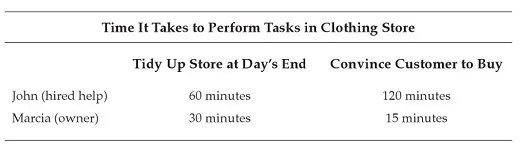
In the table above, we see the hypothetical performance times at a clothing store in the mall for John (hired help) and Marcia (the store’s owner). As the numbers indicate, Marcia is better at both making sales and at tidying up the store at the day’s end, in preparation for opening the next morning.
Because Marcia has the absolute advantage in both making sales and tidying up, you might at first think that it is most efficient for her to spread her workday among the two tasks, rather than bringing John into the picture. But that’s not correct. By hiring John and having him focus on taking out the trash, mopping the floors, etc. at the end of each day, Marcia can concentrate on her comparative advantage, which is making sales. In other words, Marcia can allow customers to stay in the store and browse for longer (thus making more sales), since she is delegating the necessary tidying up to John.
If Marcia is running her business in a monetary economy, it is quite simple for her to figure out whether it makes sense to hire outside help (John) or whether she should close the store early so that she can tidy up herself. For example, suppose that the typical customer purchase yields Marcia net earnings of $20.1 That means for every 15 minutes that Marcia devotes to helping customers on the floor, on average she brings in an extra $20 that she can pay herself. If Marcia has to kick the customers out early, so that she can spend the last 30 minutes of each day tidying up, on average she thereby loses out on $40 in potential income from her business.
Does it make sense for Marcia to hire John, who runs a cleaning service catering to stores in the mall? It depends what John charges for his services. So long as he is willing to charge less than $40 to come in and clean up Marcia’s store at the end of each day, it makes sense for Marcia to delegate these simple tasks to John. Since John is just a young guy with no significant skills, he is happy to charge just $15 for his hour of work. As these hypothetical numbers illustrate, there are large gains from trade between Marcia and John: It would be worth her while to pay someone up to $40 to tidy up her store, while John would be happy to do the job—which takes him an hour to complete—for anything more than $15. At any price in that range, both Marcia and John would consider the arrangement quite attractive.
Just to round out the discussion, notice that it would not make sense for Marcia to hire John to help her with making sales, or for John to quit the cleaning business and go into clothing retail. Because John is such a worse salesman than Marcia, he only makes a typical sale once every two hours (120 minutes). That means if John tried to replicate Marcia’s business and devoted himself to selling clothes, his net earnings would work out to an average of $20 every two hours, or a mere $10 per hour. John can make much more than that cleaning.
Our example has illustrated the principle of comparative advantage: Even though Marcia is more productive at both tidying up her store and in making sales, she still benefits from associating with John. Marcia has the absolute advantage in both tasks, but only the comparative advantage in making sales. (John has the absolute advantage in neither task, but he does have the comparative advantage in cleaning.)
Specialization and trade showers benefits on all participants, even when one of them is more technically capable than the others. As we will see in Lesson 19, the principle of comparative advantage applies to international trade just as much as it does to Marcia and John.2 A rich and productive country like the United States still benefits from trading with a “backward” country where the workers are less productive in every line of work and production.
Lesson Recap...
- One of the advantages of using money is that it allows people to specialize in different occupations.
- The division of labor (specialization) greatly enhances the productivity of labor. There is more total output when some people concentrate on growing food, others concentrate on building houses, others concentrate on treating illness, and so forth.
- Even someone who is more productive in every activity can still benefit from trading with people who are not as productive. Even in this case, both parties should focus on the areas in which they have the relative superiority—the comparative advantage—and trade some of the resulting output.
NEW TERMS
Division of labor / specialization: The situation where each person works on one or a few tasks, and then trades to obtain the things produced by others.
Productivity of labor: The amount of output a worker can produce in a certain period of time.
Economies of scale: A condition in which output will increase more than proportionally as inputs are increased. For example, there are economies of scale if doubling the amount of inputs leads to a tripling in output.
Absolute advantage: Occurs when a person can produce more units per hour in a particular task, compared to someone else.
Comparative advantage: Occurs when a person has the relative superiority in a particular task, when taking all other tasks into account. (Jim can have a comparative advantage in a certain task, even if Mary has the absolute advantage, because Mary might have an absolute advantage that’s even greater in something else.)
STUDY QUESTIONS
- What’s the connection between specialization and the productivity of labor?
- *If the world were filled with identical people, would specialization still be useful?
- Why is trade important for the division of labor?
- *Explain this statement: “The gains from trade in a case of absolute advantage are obvious, but they can be quite subtle in a case of comparative advantage.”
- Why is Marcia the storekeeper willing to pay up to $40 to have someone clean her store at the end of the day?
Lessons for the Young Economist
Read the whole book online · Book details
This work is published under a Creative Commons licence. You may copy, share, and re-host it with attribution.