
Chapter 4 of 20 · Men of Wealth: The Story of Twelve Significant Fortunes from the Renaissance to the Present Day by John T. Flynn
CHAPTER III The Rothschilds IMPERIALIST BANKERS
IN THE Rothschilds we come upon an elemental energy that can be described as nothing less than an organized appetite. The founders of this fortune were driven by nothing short of an acquisitive fury.
There were five brothers—Anselm, Solomon, Nathan, Carl, and James, in order of their ages—all devoted with a complete singleness of purpose to the hunt for money. One only possessed a mind of the first caliber—Nathan, to whose predatory imagination the house owned its dazzling rise. The House of Rothschild became in the Europe following the Napoleonic wars a five-headed octopus, an international banking house with headquarters in five countries—Nathan in London, James in Paris, Solomon in Vienna, Anselm in Frankfort, and Carl in Italy, listed in the order of their importance. The central office was in Frankfort and Anselm was the titular chief. But always Nathan was the real chief, and London during his life was the real capital of the Rothschild empire.
They were coarse, unlettered, graceless. Friedrich von Gentz, the hired shirt stuffer in chief, who sold his brilliant pen to gild their lowly origins, said privately that “they were vulgar and ignorant Jews” who pursued their craft “in accordance with the principles of naturalism, having no suspicion of a higher order of things.”
There are such things as “vulgar, ignorant Jews,” just as there are vulgar and ignorant Germans and Italians and Americans. The Rothschilds were coarse, illiterate, and brash.
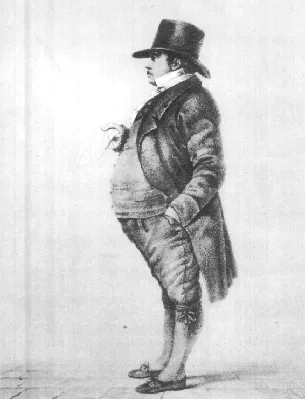
From a painting
NATHAN ROTHSCHILD
Nathan said of his children that he “wished them to give mind, soul, heart, and body to business.” They were interested not in business but in money. They sought money not to enjoy power; but power in order to make money. Veblen’s diagnosis of the acquisitive urge, as the craving to have what others have, to match the possessions of others, and to procure and exhibit the evidences of those possessions, did not apply to the Rothschilds any more than it applied to Hetty Green or Russell Sage. The rich James, escaping from the squalor of the Judengasse of Frankfort into the Paris of Napoleon, took quarters in a humble flat until he learned that he could do more business in the magnificent palace of Fouché. The time came when the brothers saw that palaces filled with works of art were better instruments of money getting. But they went in for magnificence to make more money and not for money to acquire magnificence.
They came upon the scene when a revolution greater than the French Revolution was changing the way of the world—the industrial revolution, out of which vast fortunes would be made. But it touched them not at all, as little, indeed, as the French Revolution touched an industrial genius like Robert Owen. They founded no industries, produced nothing, created nothing, invented nothing. The popular notion, fostered by some of their hired apologists, that they were the founders of the modern banking system, that they invented modern methods of foreign exchange, that they were the first international bankers, that they were the first to perfect the modern technique of distributing shares, and that they are entitled to the dubious glory of having first perfected the methods of security manipulation, is utterly without foundation.
There were international bankers two centuries before their time—the Fuggers, the Medici, the Frescobaldi, and the Bardi. There were great and powerful bankers in their own day against whom they were compelled to contend—the Barings in England and the brilliant Ouvrard, financier of Napoleon, in France; even in their own native Frankfort there were Gontard and Bethmann, ancestor of that von Bethmann-Hollweg who took the Germany of Kaiser Wilhelm into the First World War.
Their immense success was due to their immense preoccupation with the business of making money and to the acquisitive genius of one of their number. Certainly that success was almost fabulous. When the French mobs poured into the streets of Paris to destroy the Bastille and prepare Louis XVI for the headsman, the Rothschilds were isolated in the ghetto of Frankfort, matching in servility any of their neighbors in stepping from the sidewalk before the passing Christian Frankforter. When the Bourbon Louis XVIII returned to Paris after the Revolution and the Napoleonic eruption had run its course, he went to his throne with a million francs of expense money supplied by the Rothschild brothers. By that time they were the richest men in Europe.
Over the origins of the Rothschild fortunes some obscuring vapors hang—pestilential vapors partly, blown there by that archliar of history, the shirt stuffer.
How much falsehood history owes to the hired biographers and apologists of monarchs and statesmen and money kings! How the rich Maecenases in all ages, “patrons of art and letters,” have been responsible for the mendacious chronicles of their time that have flowed around their feet from the pens of grateful poets, essayists, historians, and even philosophers!
As the Rothschilds grew in wealth and power, and statesmen and noblemen and even kings hungered for their pounds and gulden, they could never rid themselves of the dark veil of race and culture which hung between them and their noble clients. The rich banker Bethmann of Frankfort might treat familiarly with Solomon in his office or at the Boerse, but Bethmann’s table was not open to him. The brothers might wear their ribbons and their titles and find themselves in the drawing rooms of impecunious finance ministers whose governments were in desperate need of funds, but there were still droves of snooty lords and ladies who drew away from the “upstart Jews” who still spoke with the crude accent of the Judengasse Yiddish, heavy on their consonants.
There was, therefore, one point on which they were most particular—the question of their origin. It was dogging their footsteps. In the salons of the great the brothers were unable to rid themselves of the odor of the old ghetto junkshop. They wished to have it settled, therefore, for all time that they were not upstarts, that they were as well born as some of those who lifted their nostrils at them; that they were the scions of a man of wealth, of high standing in the court circles of Hesse-Cassel, the financial adviser of a ruling house, bankers to whom the richest prince in Europe, when driven from his capital, had entrusted his whole fortune.
For this purpose they employed a gentleman, not unknown to fame, named Friedrich von Gentz. Gentz was the secretary of Metternich, Chancellor of Austria. He began life as a passionate supporter of the principles of the French Revolution; he ended as the aide of the most reactionary statesman in Europe. He was the author of many essays and several books, one of them a brilliant dissertation, On the State of Europe Before and After the French Revolution, which was translated into English at the time by John Charles Herries, Commissary General in the Liverpool cabinet, another intimate of the Rothschilds whom we shall meet anon.
Gentz was a man of scholarly attainments and charming manners who wrote excellent German prose. He made the perfect type of Tawney’s predatory scholar, who aches for the sweetmeats of life and, not knowing how to make money himself, fastens himself upon some rich patron whose resources he can tap. Gentz was not at all discriminating in his patrons. He was a sort of literary street walker. He took money from everyone who had need of a sustaining paragraph or a scrap of influence at the foreign office. He was a thoroughly corrupt writer who jotted down in his diary with keen satisfaction the record of the bribes he received, the Rothschilds’ name being among the most frequent.
Solomon Rothschild first met Gentz at Frankfort, preceding the Aix-la-Chapelle conference. The Rothschilds were seeking help in saving the Frankfort Jews from the cancellation of the privileges they had won under Napoleon’s regime. When Metternich reached Frankfort, Gentz presented Solomon. Solomon handed him 800 ducats. For a number of years thereafter the Rothschild ducats flowed into Gentz’ yawning pocket while the Gentz influence and tips flowed to the Rothschild banking house and the Gentz healing phrases flowed over the Rothschild fame.
In 1826 the Rothschilds paid Gentz a princely fee to plant in the popular Brockhaus Conversational Encyclopedia the story of the descent of the five brothers from the great banker of Frankfort. Solomon outlined what he wanted; Gentz wrote it in a pamphlet and contrived to have the pamphlet made the basis of the Brockhaus article. The article recounted the story of the flight of the wealthy Elector of Hesse before Bonaparte’s advancing armies after having confided his whole vast fortune to Meyer Anselm Rothschild. So well did he manage the fortune in the Elector’s absence that in its performance he sacrificed his own. When the Elector returned, old Meyer Anselm was able to restore the entire fortune intact with interest. And so grateful was the Elector that he insisted on Meyer retaining the use of the funds for several years more without interest.
This preposterous fiction has one prototype in modern burlesque humor—the story of the Jew who stood on Broadway throwing away five-dollar-bills while a Scotchman retrieved and returned them. For the Elector himself was the crustiest, most avaricious and suspicious gulden-squeezing old rascal in Europe. The whole tale is an invention fabricated by the Rothschilds—along with some other biographical fictions—to advertise the story that they were of excellent blood. There were many of excellent blood in the old Frankfort ghetto who bore their martyrdom with dignity and found surcease in the contemplation of the things of the spirit. But the Rothschild brothers were not of this number.
Meyer Anselm Rothschild, the father of these five dynamic sons, was born in the Frankfort ghetto in 1743. His father was a small tradesman who, perhaps, did a little moneychanging. The family, originally named Bauer, lived in a small, cramped ghetto dwelling that bore as its distinguishing mark a red shield. Thus they came by the name they later adopted.
Meyer was sent to a Talmudical college near Nuremberg to become a rabbi. But his father died when he was only twelve and he was forced to find work. He spent eight years in the bank of the Oppenheims in Hanover. His two brothers carried on the business in an even more crowded little shop that bore the sign of the saucepan. It sank to the level of a mere junkshop, dealing in the secondhand castoffs of the ghetto. Meyer returned from Hanover to join his brothers in trade. With the Oppenheims he had learned the business of coin collecting. He added this line to the secondhand trade. The brothers prospered after a fashion, the coin collecting forming but a small part of the business. The three made about two thousand gulden a year among them.
Meyer’s coin collecting, however, brought him into touch with some of the noble families around Frankfort who could afford this hobby, among them the officials of the Landgrave of Hesse-Cassel. He sold rare coins to the Landgrave though he never met him. This added to the prestige of the small shop, however, particularly when the Landgrave conferred on him the title of Crown Agent. The title meant little, corresponding roughly to the English designation of a royal trader who may use the term “By Appointment to His Majesty.”
He married the daughter of a prosperous tradesman—Guetele Schnapper, destined to be enveloped in a hazy glow of sentiment by biographers of her famous sons. She bore him twelve children—five of whom were those famous sons already named. In time one of Meyer’s brothers died and another drifted off for himself, leaving Meyer in sole possession of the shop zur Hinterpfan. And there he remained until 1785, when he was forty-three—a small tradesman, dealing chiefly in tea, coffee, sugar, and spices, changing money and expanding his coin-collecting business, getting along slowly.
In 1785 he moved to a new home which he bought. It was marked by a green shield. Thus the family of the Red Shield found themselves living at the sign of the Green Shield. It is a narrow dwelling—for it still stands—four stories high. The Rothschilds occupied one half, a secondhand dealer the other. Meyer’s shop was on the first floor. The family lived in severely cramped quarters above. And here in this small, crowded home in the Judengasse, with a secondhand store for a neighbor, the elder Rothschild remained until he died in 1812.
Meyer sought earnestly to get a little of the banking business of the rich Landgrave of Hesse who had given him the empty title of Crown Agent. He had struck up an acquaintance with Buderus, the Landgrave’s confidential financial agent. But even this failed to bring him anything more than some coin sales.
It was not until 1795 that he began to make large profits. In 1790 his earnings, according to Berghoeffer, were from 2000 to 3000 gulden a year. By this time he had three sons in the business. This was not a large annual profit to divide among four. But in 1795 the conquest of Holland by Napoleon had caused the collapse of the Amsterdam bourse and diverted much of that business to Frankfort. A war trade had grown up as soon as conservative Europe had launched her attack upon Napoleon in 1792. In 1795 Frankfort became the center of that trade. The three energetic and aggressive sons—Anselm, Solomon, and Nathan, the last then eighteen years old—were partners and had assumed the driving control of the business.
Yet even then the business was a small one—trading in cloth, sugar, tea, indigo, and textiles. It employed only the sons, two daughters in the shop, and one daughter-in-law. Frankfort began to sparkle with the profits of the war boom. It was full of rich citizens—a few years later an estimate showed eight hundred citizens with unencumbered cash of more than 50,000 gulden each. But the Rothschilds still shared with the secondhand store the small building at the sign of the green shield. As late as 1810, with only two years to live, at the age of sixty-seven, after the sons had gone far in the amassing of war profits, Meyer reconstituted the partnership and in the articles put the firm’s capital down as only 800,000 gulden. Two years later he died, still holding forth in his small shop, after several years of poor health. Whatever growth the business had after 1795 was due to the sons and not to Meyer Anselm himself.
Before proceeding further we must pause to have a look at William, Landgrave—and later Elector—of Hesse-Cassel, with whose fortunes the first flights of the House of Rothschild were made. In a book of money-makers this curious old prince might well rate a chapter for himself.
Hesse-Cassel was a small principality in central Germany and just north of Hanau of which Frankfort was the principal city. The ruling house had worked up for itself one of the most impudent rackets for making money. For a hundred years the landgraves made a business of forming and drilling armies and hiring them out to other rulers for war work. The biggest haul made by these drovers of men was by the Landgrave Frederick II, who hired 22,000 Hessian troops to George III for £3,191,000. These were the celebrated Hessians who won such a dark immortality in our Revolutionary War. William IX was the son of this Frederick. He had a small subsidiary principality of his own before his father’s death and, like a true scion of his father, he had his own small army which he too hired out to England, cleaning up a million or two for himself.
This William, however, had a special flair for finance and an acquisitive urge which amounted to a disease. He was a heavy investor all over Europe, particularly in England, a lender of money to tradesmen, financiers, and his fellow princes. So that in 1785 when his father died and he united his own fortune with the hereditary accumulations of his house he was, perhaps, the richest man in Europe.
As affairs on the Continent sank into the disorder which followed the French Revolution William kept a large part of his fortune in England. He invested heavily in consols, but he made numerous loans to statesmen, princes, bankers. The Prince of Wales borrowed £200,000 and the Duke of York and Clarence also owed him large sums. He made large advances to the Austrian emperor, the king of Prussia, and to most of the lesser potentates of the Holy Roman Empire. And if his brother rulers despised him for his traffic in his soldiers, he was none the less cultivated by them because they never knew when they would want access to the treasure box of this royal Shylock. But he did not overlook the small loan business. He spent his life haggling over notes and bills and interest rates, bargaining and scratching to squeeze the last drop of interest out of bankers and tradesmen and petty lords in his own domain.
He was a man of two passions. One was his gulden. The other was women. But apparently he was not a promiscuous roué. He adopted one mistress after another, but clove to her with a curious fidelity during her special chapter. He married Wilhelmina, daughter of Frederick V, King of Denmark. She brought him a dull soul and a frigid body. And so he turned for love to the wife of a master of his horse, whom, in turn, he turned adrift. Next he took up with the daughter of a commoner, by whom he had four children before his fidelity cooled and he tossed her back to her native purlieus. His next affair was with Rosa Wilhelmina Dorothea Ritter, educated, well born, assertive, who gave him eight children and forced him to give her an estate and a title—Frau von Lindenthal—before she incurred his displeasure by a flirtation with a subaltern. His next love was Juliane Albertine von Schlotheim, who added nine children to his collection of bastards. He induced the emperor to make her a countess and installed her in a palace. Thus he had twenty-four children, though less reliable historians endow the fecund old Turk with almost twice as many.
He provided for all these establishments. The support of so extensive a barnyard was a great burden, so the grasping prince who recruited an army and farmed out his soldiers like convicts shifted the burden of his bastard brood to the shoulders of his subjects by levying a special salt tax for their support. Some of his sons went into the military service of various kings. The most famous, or infamous, was that General Haynau—son of Frau von Lindenthal—who came to be known as the “Hyena of Brescia.”
Into the treasury of this prince flowed a continuous stream of remittances from England, Austria, Prussia, and all the smaller states of Europe. They came in the form of bills of exchange. Meyer Anselm, for years, petitioned the Landgrave to grant him the privilege of cashing some of his bills of exchange. He did succeed in doing some of this business. But when Meyer sought to do a little of the Landgrave’s banking business he was persistently excluded. As late as 1798, when Meyer was fifty-five, and William was making a loan of a million gulden to the Emperor of Austria, the Rothschilds could get no part of the transaction.
By 1800 the Rothschilds’ fortune had grown. But it was the product not of Meyer but of his energetic and resourceful sons. They then began to do some profitable business with the Landgrave. They got from him a loan of 160,000 thalers in 1801 and of 200,000 in 1802. The next year they broke the ice in a state banking operation. They handled a loan from the Landgrave to the King of Denmark, his relative. William wished to remain anonymous because he had been showing a poor mouth to his family. Buderus arranged to have the transaction handled by the Rothschilds. After this the firm continued to render more and more services to the prince.
But this was accomplished by the simple expedient of taking Herr Carl Frederick Buderus, the Landgrave’s confidential financial officer, into partnership. Put differently—the Rothschilds bought Buderus. This came to be the standard practice with the young men. They used money to buy what they wanted, including statesmen and their agents, as they were later to buy Gentz and as they bought sugar and indigo and other merchandise. Out of this corrupt arrangement Buderus became wealthy and died a millionaire.
They were now bankers and, to an increasing extent, thanks to Buderus’ intercessions, bankers for a prince who, if not an important man, was at least a rich one who lent money instead of borrowing it. But they were far from being more than a third-rate house.
In 1806 Napoleon established the Confederation of the Rhine, adding Hesse-Cassel to the kingdom of Westphalia, which he gave to his brother Jerome. His armies under General Lagrange occupied William’s capital and the terrified Landgrave, now raised to the dignity of Elector, fled for his life. He hid some 120 chests of papers and securities and valuables in his various castles and left his power of attorney with Buderus. He deposited with the Austrian ambassador for safekeeping several chests of live securities, bills of exchange, cash, and jewels.
This is the episode that Friedrich von Gentz made the basis of the yarn that the Elector had left his entire fortune in the keeping of the elder Rothschild. As a matter of fact, he left just two chests containing unimportant papers with the Rothschilds. The French immediately started a search for William’s effects. They found the hidden chests in his castles. But Lagrange, the French commander, reported that the assets found were worth four million instead of sixteen million. He delivered the unreported assets into the hands of Buderus. For this he received a bribe of 1,060,000 francs. The Rothschild home was raided. But the Rothschilds had received a tip of the coming search from Dalberg, the head of the Confederation of the Rhine stationed in Frankfort and Napoleon’s tool. The Rothschilds had bought him too with a loan and kept him bought with a succession of loans. The search of the house revealed little and was terminated before it was finished by a bribe to Savagner, the French police chief, and a modest loan of 300 thalers to the officer in immediate direction of the search. The first thing the Rothschilds looked for on a minister or his agent was the price tag. They learned that their money could buy almost anything.
We are now to look at the larger ingots of the Rothschild fortune in the casting. Up to 1806 their riches were like a victory at chess—an accumulation of small advantages. These riches were now about to swell swiftly into an immense tumorous growth.
The Frankfort brothers were making their modest accumulations up to 1795 in small-scale moneylending, handling bills of exchange, but chiefly in trading, in textiles, coffee, tea, sugar, and, perhaps, indigo. England was the great market for these things. Save for textiles, they flowed in from her colonies. In textiles, the industrial revolution was well under way, and she had become the chief wool-and cotton-cloth weaver of the world. But with the rise of the war trade these Rothschild profits began to soar. Nathan, then twenty-two, was sent to Manchester as a sort of buyer of cloth. This was a stroke of fortune, for Nathan was the family genius, and England was to be the financial capital of the world.
The young, short, obese Frankforter, looking almost comical, speaking but little English heavily macerated by the strange Yiddish pronunciation of his ghetto German, was a blaze of business energy. He boasted that he quickly multiplied his £20,000 capital to £60,000—but he was a most mendacious witness when boasting of his prowess as a money-maker. However, he did prosper amazingly. In 1804 he went to London to extend his operations.
There had been a pause in the fighting in Europe after the Treaties of Lunéville in 1801 and Amiens in 1802. But in 1803 England resumed naval warfare on France and by 1806 the whole Continent was aflame with the new assault upon Napoleon when Russia, Prussia, and Austria united in the attack. And once again, upon an even greater scale, the war profiteers proceeded to multiply their gains.
We now see Nathan leading his brothers in four swift episodes which were to land the five brothers among the richest houses in Europe. As late as 1810 they were unknown to official London as capitalists. In 1815 they were the bankers for the British government and the most powerful single unofficial force in Europe.
These four episodes were the smuggling trade against Napoleon’s commercial blockade of England, the traffic in Wellington’s bills and notes in the Peninsular war, the commission from the British government to convey funds to Wellington’s army in Portugal and Spain, and, finally, the difficult job of transporting the British subsidies to her allies on the Continent.
The first episode involved an adventure in large-scale smuggling. In 1806 Napoleon decided to crush England’s commerce, to strike the despised shopkeeper whose flourishing trade nourished the armies of England. He declared his famous commercial blockade. England replied with an embargo and a blockade of all French ports. As the whole Continent needed British goods desperately, what had been a profitable war trade now became a more profitable smuggling industry. The Rothschilds had been making large profits in this war trade. They now, under Nathan’s leadership, plunged into the smuggling adventure with all their resources.
Fortune favored them. With Nathan in England and the brothers on the Continent the firm was well equipped for the job. Moreover, Napoleon was soon to learn that the hand with which he sought to strangle England was also starving France; that the hated shopkeepers of perfidious Albion had upon their shelves merchandise that Frenchmen sorely needed. England too, which outwardly sealed the ports of France, found she needed markets in France and in Europe to create for her the credits essential to get funds to her allies. And so one necessity yielded to another. Napoleon, while publicly thundering destruction to the trade of England, managed to open a back door into France through which greatly needed supplies could be smuggled.
We had the spectacle of both governments winking at their decrees and smugglers actually squeezing past conniving officials the merchandise France wanted. Indeed, by a decree in the summer of 1810, the Emperor actually legalized and regulated the outlaw commerce. The bootleg captains clandestinely sneaked their contraband into France at Gravelines under the eyes and protection and patrol of the police at a port officially set aside for the traffic. The Rothschilds made the most of this.
But Nathan needed more capital. He saw with dismay the great profits others were making. His mind turned to the Elector of Hesse, an exile in Prussia. His brother Anselm was getting closer all the time to the Elector’s good graces—thanks to Buderus. The Rothschild house in Frankfort was handling more of the Elector’s loans and collections. And Nathan in London was managing the transmission of the interest on some £640,000 of the Elector’s investments in consols. Continental business and investments were subject to grave perils. Why should not the Elector invest the immense sums in interest and in principal that were flowing to him in English consols—and do it through Nathan? Nathan pressed Buderus to aid with his influence. But for some reason the Elector seems to have been suspicious of Nathan. However, after much pressure, Buderus convinced the Elector to follow Nathan’s advice. Thereafter an immense sum was put into Nathan’s hands for investment in English consols.
How much he got is not precisely clear. Rothschild boasted that it was £600,000. It was probably something less, about £550,000. But it was not all sent in one remittance. It was delivered to Nathan over a period of several years—in three installments. This was authorized in February, 1809. But Nathan did not buy consols with it. Instead he used it for his own purposes—appropriated it to his own uses, feeling sure, of course, that he could restore it when pressed. Here we have the banker-agent of the avaricious Elector using for his own purposes the funds entrusted to him by his principal, on the advice of that principal’s confidential financial official who was himself in the pay of the banker. And in the very month this was done Buderus’ partnership in the Rothschild firm was reduced to writing.
As Rothschild purchased no consols it was impossible for him to forward the Elector receipts for their deposit in the Bank of England. William became uneasy. He demanded the receipts. He prodded Buderus. For over two years Buderus quieted his fears with one explanation or another. But in the end he lost patience and confidence. He demanded the instant delivery of the evidence that his funds had been used as directed and he gave orders that no further sums should be remitted to Nathan.
This was an audacious enterprise. That Nathan persisted for nearly three years in the face of the Elector’s continuous demands is an evidence of his own daring calculations. The embargo furnished him a sort of excuse for his delays. And as consols were dropping in price he knew he could at any moment buy all that was needed to satisfy his noble patron. But the possession of these large funds was of the first importance to him in the enormously profitable smuggling and bill traffic during the period of the embargo. The profits of this were probably the chief source of the fortune the Rothschilds were rearing.
The next episode has to do with the Rothschilds and the difficulties of the Duke of Wellington on the Peninsula. And this historians have managed to envelope in no end of fog. One minimizes it. Another accepts Nathan’s own version that it was undertaken as a patriotic adventure to aid Lord Wellington in Portugal and Spain. Another describes it as the daring enterprise of a freebooter banker from which he made numberless millions and thus laid the groundwork of his whole fortune. And none clears up the procedure by which the enterprise was carried on. The facts as far as they may be unraveled follow.
In 1808 Napoleon forced his brother upon the throne of Spain. Madrid revolted and improvised a large army. England saw an opportunity in this to drive the usurper out of the Peninsula, and sent an army to Portugal. Wellington was one of its generals, but in 1809 became commander in chief.
The great problem was to get supplies to Wellington. Oporto and Lisbon were 600 and 800 miles from the nearest English port, and the sea was infested with enemy ships and privateers. Metal was too scarce to permit so much risk in its shipment, and Wellington needed money to pay his troops and purchase certain local supplies.
There grew up much the same bitter controversy about this as there had been between Lloyd George and the apologists of General Kitchener in the First World War over the inadequacy of supplies and funds. Wellington felt himself trapped. In desperation he began to purchase supplies from Portuguese merchants and to pay them with bills on the English Treasury. These bills were not much good in the hands of Portuguese and Spanish merchants until they were exchanged for gold or silver. Hence a trade sprang up in the notes, carried on by Sicilian, Italian, and Maltese bankers known as the “Cab,” with headquarters at Malta. They bought the notes from the local merchants at small prices and relayed them through a series of hands and discounts until they reached London.
This made everything Wellington bought cost several hundred per cent more than even the high war prices in vogue. The Treasury protested. Wellington hurled back criticisms at the Treasury and the Commissary General. He said bitterly that the government cared nothing about his armies. His men, he wrote, remained unpaid for two months and had to sell their shoes and clothing for food and medicines. He intimated that England should abandon the whole expedition. “A starving army is worse than none,” he complained. “We want everything and get nothing.” He protested against the red tape and inefficiency of the Commissary which “must trace a biscuit from London to the man’s mouth at the frontier.” He went so far as to threaten to embark his army out of Portugal, leaving England exposed to the peril of an invasion, when her king would then learn something of the horrors of war.
Being in the smuggling trade Nathan of course knew all about this. This traffic in notes was too enticing to be resisted. And he went into it. How deeply he actually went in and how he managed it are by no means clear. One account has it that he summoned his brothers, Carl and Solomon, and later James; that Carl traveled to the Spanish border and bought up the notes with gold, then returned, meeting his brother Solomon halfway, exchanging his bills for a fresh supply of coin brought by Solomon, who then made his way to the French coast where he met Nathan, with whom he again exchanged notes for gold, Nathan taking the Wellington bills to London and exchanging them for guineas.
Another account is that Nathan had merely cashed some of the bills from the Cab and later planned to enter the trade—without actually doing so—in order to help Wellington.
What is doubtless nearer to the truth is that the Rothschilds did deal extensively in the Wellington notes and, probably, would have dealt far more extensively if another incident had not intervened. How much Wellington issued in bills seems not to have been fixed by fiscal historians. It would be a very surprising fact if the whole amount exceeded a million pounds. It is also certain that he did this not as a regular thing but only when pressed by necessity. It is also known that a number of bankers shared this trade among them, that it was in progress for some time before the Rothschilds entered it. It is therefore altogether probable that they got merely a share of this traffic. Indeed, the English Commissary Herries himself, who was closest to the whole business, said that the Cab had for a time managed to establish a monopoly of the trade. We may therefore conclude that the Rothschilds got a good deal less than half of this trade.
It is also difficult to believe that so much gold could be transported by a single traveler. A hundred pounds of gold would be a very onerous burden to a man traveling through hostile country, swarming with spies, under difficulties of transportation hardly conceivable today. The number of trips that must have been made to transport as much as a million pounds, or half that much, would be quite beyond the physical resources of the brothers.
While the profit was great, a number of persons had to share in the discount and many hands had to be greased. So that we may safely assume that whatever profit the Rothschilds made out of this has been grossly exaggerated. But they did make a profit and a large one and they were, undoubtedly, preparing to make a greater one by a more intelligent means of transmission of gold to Wellington when circumstances shaped themselves, almost with the appearance of destiny, to put these five young men upon the express highway to fortune.
This new turn of affairs arose out of the following facts. Rothschild’s difficulty in the Wellington note traffic was gold. The guinea, said Herries, was an article of luxury. Every quarter of the globe was ransacked for specie. The Rothschilds, with their expanding trade areas, were doubtless able to gather a great deal. But there was a limit. In London a ship of the East India Company brought in a cargo of gold. According to custom, it was offered at public auction. Nathan Rothschild bought this for £800,000, using all the cash and credit he had, plus the funds of the Elector in his charge. In later years he said he planned to send this to Wellington. Some historians have accepted this version. But the notion that this predatory man entertained any such fantastic stratagem attended with so much risk is as preposterous as the yarn about his father sacrificing his whole fortune for the Elector and the Elector insisting on lending the Rothschilds all his cash without interest. He was merely planning to extend his traffic in the Wellington scrip and other war trade.
Rothschild was surprised to find himself summoned a day or two after this purchase to the office of John Charles Herries, Commissary General. The Commissary must have been no less surprised at the squat, blunt, Frankforter, looking and talking like a Jewish comedian taken from a London music-hall stage. Herries says that at this time Rothschild was wholly unknown in London official circles as a capitalist. Nathan was asked why he had bought the gold. What did he propose to do with it? It was the hour of fate for the Rothschilds. He might have lied—a course he would have pursued with as sweet a conscience as when he bought Buderus and other public officials. But he caught here a glance of the long turnpike of time. He told Herries why he had bought the gold—to buy Wellington’s bills. Herries said the government wanted the gold and Rothschild promptly sold it to him at a large profit.
But how was the Commissary General going to transmit it to Wellington? Rothschild said afterward the government didn’t know. Why not use the House of Rothschild to transport it? It had the resources. It had branches in England and on the Continent. It had agents in France and Spain. It had successfully transported gold overland to the traders who had taken Wellington’s bills. It could do the same thing for the government in a way the government could not do for itself. The House of Rothschild was an ally, deeply devoted to the interests of the Elector of Hesse and to the Austrian Emperor, and Nathan himself was a citizen of Britain.
Rothschild outlined to Herries how he would proceed. Herries reported it to the Prime Minister and the Finance Minister, who approved the plan heartily. And, in a trice, Nathan Rothschild, the unknown smuggler-banker, was established in the headquarters of the ministry, supervising the delicate operation of sending money to the irascible and clamorous Wellington.
Just how Rothschild did this remains in some doubt. Count Corti, his most reliable biographer, meticulous in his citation of authorities, says, in this instance without giving adequate authority, that the English gold was transported across the Channel to France; that there the Rothschilds exchanged it for bills upon certain bankers and thus, through a series of operations, got the bills into the hands of Wellington who could exchange them for specie with the bankers. The defects in this plan are too obvious to discuss.
But Mr. Herries says that the Rothschilds took English bills of exchange to Holland where they supervised the business of exchanging them for French coins. These coins were then sent by an English warship from the port of Hellevoetsluis in Holland to Lisbon. It would be bold indeed to say that Herries did not know how it was done, since the whole business was managed from his office. And if it is true it gives the lie to the whole romantic story of the perilous journeys of the venturesome brothers over mountainous country infested by brigands and armed enemy forces. We find Herries writing to the Prime Minister telling him of the “skillfulness and zeal” with which Nathan handled the transaction and how he had “already disbursed £700,000 in bills in Holland and Frankfort without the slightest effect upon the exchange market.”
But some gold was shipped across the Channel. Letters of James to Nathan intercepted by the French police revealed that some £120,000 had been sent to James at Paris. What is entirely probable is that the bulk of this business was done with bills but that some gold, perhaps a considerable amount, was shipped also. What the whole operation amounted to is also left to surmise. But we know from another source that in the year 1813 the whole amount of specie sent to Wellington by the British government amounted to £1,723,936 and 339,432 Spanish dollars. Probably the bulk of this was managed by Rothschild. And he doubtless was well paid by the British government. His pay must have been a commission and did not include the large profits in discounts. It was doubtless a generous profit, but it could not account for the immense wealth with which the Rothschilds appeared in Europe two years later.
But it did account for the most important advance they had ever made. For they were now soundly entrenched with the British government.
One incident of this operation, however, has not been sufficiently emphasized. It was one of those master strokes which exhibits these men as capable of strategic daring of the highest order. In the course of these transactions, either before or after the deal with Herries, James, the youngest brother, was sent to Paris. Solomon and Carl had been working more or less out of that center. But doubtless Solomon was needed at Frankfort. And it seems probable that Nathan saw the value of establishing a branch in Paris.
The brothers took advantage of the fact that Dalberg, primate of the Rhine Confederation at Frankfort, to whom they had made many advances for his personal account, was going to Paris upon the occasion of the birth of Napoleon’s son. Anselm loaned the venal Dalberg 80,000 gulden for the trip and got from him a passport for James and a letter of introduction to no less a person than Mollien, the Finance Minister of Napoleon. James went to Paris and called on Mollien. He informed him that his brother Nathan in London, as the representative of their house, was doing a large business in English-Continental trade and that he was shipping gold to France through Gravelines. This information intrigued the French minister, for there was nothing France desired more than British gold. He encouraged the young Frankforter to continue this trade and expressed the hope that his story was true.
There could have been but one reason for this step. The Rothschilds were shipping into France gold that was going to Wellington. If discovered by the police they would have to make an explanation. Here was an explanation. What is more, it was an explanation made in advance of discovery—and made directly to the Finance Minister himself. It was a dangerous expedient. James was putting himself in the hands of the French. He was trifling with a resolute and ruthless enemy. A false step here might have brought him to the block swiftly enough. It was foresight supplemented by action of a very audacious kind. But it was more. It was also a plan to get a footing in France. After all, Frankfort was in the hands of Napoleon. The Confederation of the Rhine was his satrapy. The brothers were already operating in both camps, with Nathan in England and the headquarters in Frankfort. Nathan was on terms of intimacy in the service of England; but Anselm was on terms of equal intimacy with Dalberg, Napoleon’s ruler of Frankfort, while at the same time maintaining confidential relations with the dispossessed Elector of Hesse and seeking further relationships with Austria. The brothers had their feet in all camps and were prepared to capitalize upon any result the war produced. Beyond doubt these moves proceeded from the fertile imagination of Nathan, who was now the recognized leader of the house.
The fourth episode revolved around the last mighty effort of England and her wobbly Continental allies to drive Napoleon out of France. The vast disaster of Russia had undermined the Emperor’s strength and reputation. It was a terrible economic blow to France. England rallied the allies to another great exertion of their united resources. In January, 1813, England agreed to send to Prussia and Russia large grants of money. Prussia was to get £666,666; Russia over a million. Each was to put new large levies of men into the field. Later in the year Austria, under Metternich’s leadership, abandoned Napoleon and threw in her lot with the allies. England promised Metternich a million pounds. Later this was more than doubled.
Herries, the English Commissary, was now charged with the difficult task of getting these sums to Prussia, Austria, and Russia. It was a delicate job. England could not send that much gold to the Continent out of her already depleted resources. But if she sent bills to her allies the effect would be disastrous on international exchange, particularly British exchange.
The reader would do well to understand this. If a man in England wishes to send a hundred pounds to a man in Berlin, he can send gold. But if he does not wish to send gold he may hunt around for some man in England who has a hundred pounds due him from a man in Berlin. This first Englishman may buy from the second his hundred-pound claim against the man in Berlin. He may then send that claim to the man in Berlin to whom he owes his hundred pounds. That Berliner may then collect the hundred pounds from the Berliner who owed the bill in England.
Thus in a city like Vienna there are always a number of merchants who have bills due to them by men in London. Bankers buy up or discount these claims against London merchants and sell them to other Viennese who want to pay bills in London. Thus there is always a demand in Vienna for bills due by men in England. And here is where the trouble begins. If the demand for the bills is small and the supply great, the price of these bills will drop. A man in Vienna who has a bill of a hundred pounds due to him from a Londoner may have to sell it for only ninety pounds because the supply of London bills is very great.
Now if England were to send to a city like Vienna £168,000 in bills, added to all the other bills in Vienna due by Londoners, the price of these London bills would fall disastrously. That, indeed, is precisely what happened. The Austrian finance minister complained that he had to sell a thousand-pound bill for six hundred pounds. Thus, while England sent a bill for a thousand, the Austrian government got only six hundred. The remaining four hundred was absorbed by the bill brokers and bankers.
As England had to send over many millions to Russia, Prussia, and Austria, she was anxious to find a way of doing this without depressing the price of British paper, so that her allies would receive a thousand pounds for every thousand-pound bill sent. To do this delicate job Herries again called in Nathan Rothschild. The banker was commissioned, first, to manipulate the foreign-bill market so that exchange would not be against England—that is, that English bills and pounds would not decline in price; and, second, that the money would be transmitted to her allies without loss and without upsetting the foreign-exchange market.
And this job Nathan, with the aid of his brothers, did with great skill in the face of many difficulties. He did this partly by “going around” the bill market and partly by manipulating it.
At this time a large trade was flowing between England and the Continent. Continental powers were buying more from England than they were selling. Therefore, the price of English bills on trade alone would have been favorable. But when to the bills due by England on commercial transactions were added the millions due by her on the subsidies she promised, the natural drift of the market was against English bills.
It was the bills for the subsidies which caused the trouble. But all these, so far as Prussia and Russia were concerned, were delivered to Rothschild. Thus, he had in his hands the surplus of English bills. Now if he could get in his hands also a large supply of the Continental bills, it would be possible for him to feed either English or Continental bills into the market as might be necessary to keep prices balanced. To put into his hands still further control of the exchange, he bought bills through his brothers and his agents directly from merchants in the leading European ports before these bills got into the regular bill market.
In this way, controlling enough of the two streams of bills—bills against England and bills against Continental countries—he was able to protect the English pound sterling from declining. Of course, he had to use a large amount of his own large resources on the Continent to purchase Continental bills and to hold them. And always, of course, there would be balances in gold to be settled by England. But these balances never got into the channels of trade. They did not have to leave England always. For the Rothschilds could receive the gold in their English house, retaining it there, and paying it out from their Frankfort or Paris houses. The whole transaction was complicated. But it was one which, as Herries said, kept Rothschild “in his [Herries’] rooms constantly.” The value of these services was all the more apparent by contrast with the difficulties encountered by Austria, which persisted until the war was over, in negotiating these subsidy transfers through her own Viennese bankers, to her great loss.
But the Rothschilds besieged the Austrian government for the privilege of servicing the transmission of the English subsidies. What they had done for the English government was quite unknown, the Wellington service remaining a profound secret, according to Herries, for twenty years. It was probably difficult for the Austrian officials to believe that these uncouth Jewish traders with their bad grammar, their harsh Yiddish, and their unlettered appeals could be such extraordinary financial wizards. Only one small transaction did they get from Austria—handling half of a remittance of only 9 million francs from Belgium. The Austrian finance minister explained that the whole amount was too large a sum for second-rate bankers to manage.
A mere incident was to turn the scales in their favor. Their rising wealth had stimulated the jealousy of both Christian and Jewish rivals in Frankfort. When Napoleon returned from Elba, every effort was made by Austria to draft the needed men for the troops. At Frankfort an effort was made to force two of the Rothschild brothers into the army. They appealed to Nathan. Nathan appealed to Herries. Herries wrote the Austrian ambassador at Frankfort. He outlined the immense importance of the work they were doing for Great Britain, the great sums involved, the delicacy of the operations, and “the English government is most anxious that this firm should not be annoyed in any way.” This note was sent to the foreign minister. It opened his eyes. It revealed that if he did not know who Rothschild was, it was his loss. It broke the ice at the Austrian finance offices, and thereafter the Rothschilds began to handle the Austrian business, too.
Their resources had become enormous. After Napoleon’s banishment Prussia was desperate for funds. Solomon Rothschild took £200,000 to the finance ministry himself from the British government. But the government said this was inadequate. On his own responsibility, out of the Rothschild funds, and without waiting for formal approval from England, Solomon handed over to the Austrian treasury another £150,000. Herries, of course, confirmed this. But this bold act and the display of large resources completely won the Prussian treasury. Solomon was made Commercial Adviser of the government.
Then came Napoleon’s defeat and the entry of the allies into Paris. The Count of Provence, soon to be crowned Louis XVIII of France, was living in Buckinghamshire. He was broke and applied to the English government for funds to assure his march to the throne in the style becoming a king. Nathan accepted the English government’s draft for five million francs in England, and when Louis arrived in France, James handed him the money. While all else had been done by Nathan in the darkest secrecy, this act he wished to be known. What more natural? The scion of a score of monarchs and a thousand years went to his throne with the francs of the poor and crusty bill merchant of Frankfort’s Jew street jingling in his pockets.
With this event the Rothschilds could boast that they were bankers in the service of England, France, Germany, Austria, to say nothing of Russia and the smaller states. The great, gleaming, golden road was opened before them.
In the midst of all this Meyer Anselm, the father, had died in Frankfort. Long before his death the business had been literally swept out of his hands by his energetic sons. He had been ill for several years. He had drifted more and more to the comforts of his Talmud. He was a quiet man, amiable, wholly lacking in that fierce energy which drove his sons. He was stricken in the temple and three days later—September 19, 1812—died at the house of the green shield in the Judengasse, where he had lived over his small shop for so many years.
Two hoary fictions cling about that bedside. One is that his five sons, with their daughters and mother, gathered about while the dying man delivered to the boys the moral testament by which they lived and which is epitomized in their coat of arms—Concordia, Integritas, Industria. The other is that there he bequeathed to them, like an expiring emperor, the five great financial provinces of Europe which they ruled so long afterward—Germany, Austria, England, France, and Italy.
When the old man lay dying, Nathan was in England, while Solomon, Carl, and James were either in Paris or the country contiguous to it, carrying on their trade in the Wellington bills. Anselm alone could have been there and he doubtless was.
As for the bequest of Europe’s five provinces, Carl did not go to do business in Italy until many years later, neither Solomon nor Anselm had done any business for Germany or Austria, James was a mere youth acting as Nathan’s subaltern in Paris in connection with the English business. Nathan had built up a flourishing business in London, but of no great importance yet.
When the old man was stricken on September 16 he hurriedly made his will. He wished to keep the business in the hands of the sons who had created it. And when he died and the will was opened, it turned out, as in the case of John D. Rockefeller and many other American millionaires, that he no longer owned any part of the firm.
In 1810 he had reorganized it. He had made it into a partnership with fifty shares. He was allotted twenty-four, Solomon and Anselm twelve each; Carl and James one each. Nathan was left out—doubtless the shares of the old Meyer included Nathan’s twelve.
But now in his will he declared that he had sold his interest to his five sons for 190,000 gulden—about $76,000—and that this constituted his whole estate. He left 70,000 gulden to his wife and the balance to his daughters. But he made it plain that after his death the sons were to be equal owners. He provided that the daughters should have no interest in the business or any right to see the books. He created, as Fugger did, a continuing dynasty or partnership, limited to those male heirs who took an active part in the business. And he enjoined upon all his children “unity, love, friendship.” After his death the headquarters of the house remained in Frankfort. Anselm, the eldest, became the titular head of the firm.
When Napoleon was definitively liquidated at Waterloo and Europe settled down to peace, every country was in a state of economic disorganization. Every country was loaded with debt. Every country was more or less dislocated by the changes that the industrial revolution was making in its economic structure. Every country was desperately in need of money.
At this moment the prestige of the Rothschilds, and particularly of Nathan in London, reached the highest point. No longer were they to be mere suitors for financial jobs from finance ministers. These lordly gentlemen were now to court the Rothschilds.
It is by no means clear precisely what was the chief source of their vast wealth. They had rendered invaluable service to the allies in transmitting large sums of money from one to the other. But they had not acted as lending bankers, though they did make occasional advances in the prosecution of the transmissal services. They were well rewarded, but it is difficult to believe that the reward was more than a commission and, though generous, could not account for the immense accumulations they turned up with when Napoleon went to St. Helena. They made large profits on the Wellington business, but that too could not have been the source of as large a fortune as they possessed. It is difficult to account for their wealth unless we conclude that the bulk of it was amassed in profits on war trade and the financing of war-trade profiteers and in speculation.
What they were worth is difficult to say. No accurate estimate exists. But all their biographers, most of whom are none too reliable, are agreed that they were, when the war ended in 1815, among the richest, if not the richest, men in Europe.
The brothers now wanted recognition. They had money; they needed prestige. They wanted ennoblement. And they proceeded to ask for their reward. They sought it from Austria, the last of the powers to recognize them. But just as the Rothschilds had groveled before these princely customers, now the ministers of Francis talked among themselves how they might hold the support of the powerful bankers. They were not left in doubt. The Rothschilds hinted that they wanted to be barons. It was embarrassing. What title could be given to these rich fellows: imperial and royal counselor? No, that was for eminence of another sort. Then let them have the prefix von before their name. But a privy counselor subjected this proposal to a devastating analysis. Why? he asked. What had these men done to command such distinction? They had performed the tasks entrusted to them well, but they had been in the employ of England and England had paid them well, doubtless, rewarding them with money, which is what they worked for. They had performed the service for which they were employed and had been compensated for it. What more should a businessman ask? All the talk about their punctual, reliable, honest, and efficient dealings—well, these are virtues expected of any banker. The argument that Austria should keep these men satisfied and friendly seemed to the privy counselor the silliest of claims. These men were businessmen. They had been begging Austria to give them its business. That is what they lived by. When Austria had profitable business, they would, like all bankers, jump at the opportunity for profits. When the business was not profitable, they would not touch it. They operated for profit. They would serve as long as that was available. But if it was deemed desirable for political reasons to reward these brothers—why, then, give each one a gold snuffbox bearing the emperor’s initials in diamonds.
The privy counselor was right. In 1822 Austria needed money badly. She asked the Rothschilds for a loan of 30 million gulden. The Rothschilds said—yes, they would lend the money, but would have to have the bonds at 70 per cent with interest payable in advance. The finance minister analyzed their offer. It meant the government would have to issue 42,875,000 gulden in bonds to get 26,796,875 in money. The interest would amount to 7½ per cent. The bankers would make 3,215,625 gulden. The government discovered that Herr Solomon von Rothschild was preparing to rook the royal treasury. It made inquiries elsewhere and discovered that bankers who had not been honored, who owed nothing to the imperial throne, foreign bankers, indeed, and for nothing more than a mere profit, were willing to do better than the von Rothschilds. The von Rothschilds did not get the business.
But it was some years later that this proof came. In 1816 the privy counselor was not listened to. The emperor raised Anselm and Solomon to the dignity of being von Rothschilds and a week later conferred the same honor upon Carl and James. Nathan, being an English subject, was left out. But six years later—in 1822—after the Rothschild house had risen to undisputed eminence as the first banking house of Europe, all of the brothers were made barons, including Nathan. But Nathan, to his dying day, never used the title.
It was at this point—when the war ended—that the Rothschilds moved into the upper altitudes of international banking in its most important sense, the issuance of government securities.
They had been bankers. They did a large bill-brokerage business. They speculated in bills. They made loans to all sorts of people. They handled a few small public loans for Denmark and some cities. They handled the funds of the Elector of Hesse-Cassel. They made great sums transmitting money for the great powers. But they had been rigidly excluded from the upper altitudes of banking, where the aristocrats of money reigned—the flotation of loans for governments. Their great wealth had been made in smuggling, in war trade, in financing war trade of merchants, in war bills, and in speculation in government securities.
Highly colored journalistic accounts of Nathan standing at his favorite pillar of the London Exchange, potbellied, somber, taciturn, inscrutable, sending the market up and down with his smiles and his frowns have been greatly overdramatized. The London Exchange was a market place for securities, but chiefly for government securities. Only a few corporate stocks were listed—those of the large trading companies. Government paper fluctuated violently at times during those troubled years and it was in this that speculation took place. Nathan carried on extensive operations on the floor in government paper and it is not at all improbable that the greater part of his fortune was made this way up to 1814. The art of manipulation had already been developed. The subtler and more delicate nuances of fraud for which exchanges are noted were well understood. These were not born with Daniel Drew and Jim Keane. Abraham Goldschmidt, “King of the Stock Exchange,” could plant a false scrap of news, let out a flock of fake rumors and tips, jiggle an issue as neatly as the gentlemen who sent Radio and American Can and Case Corporation bounding up and down in 1929.
Nathan Rothschild came to be known as one of the most daring and successful speculators of his time. With his brothers on the Continent and his agents everywhere he was able to collect inside information and to transmit it swiftly, as Jacob Fugger had done three hundred years before. There is a legend that exalts and debases Nathan Rothschild; one that admirers who love proficiency in slickness have loved to repeat but which, fortunately for his fame, is not true. It is the story of how he stood on one hill in Belgium while Napoleon stood on another, the Emperor directing the Battle of Waterloo, the banker watching the tide of fortune, and how, when Napoleon’s defeat was imminent, Rothschild fled from his high perch, made for the coast with relays of swift horses, set out in a chartered boat at night, and reached the Exchange next morning in time for the opening and before news of Wellington’s victory was known. There the brokers saw him by his familiar pillar, simulating dejection, selling consols. Knowing his facilities for inside news, his action precipitated a panic and a wave of selling, while through his agents he gathered in all the government paper that was offered, making a fresh fortune.
The story, of course, is not true. A mere glance at the dates and time and distances involved reveals that the feat was physically impossible. The Exchange had the news when it opened for business. Nathan did indeed get the news of the victory an hour before the government and he had the satisfaction of sending to the ministry the first word of the great event. That is all.
After the war, the history of the firm became the story of a large and ever-growing international banking house with branches in five countries, richer, more powerful than others, but following the pattern of banking as it had been developing for three hundred years.
Anselm, the oldest brother, remained in Frankfort. A fine banking house there was the firm’s headquarters. He himself managed the business of the firm with Prussia and Germany. But Frankfort became an unpleasant haunt for the Rothschilds for a while. The hot breath of hatred was on the poor Jewish family that had risen to such wealth. Napoleon brought to Frankfort at least one thing—legal equality for the Jews. This they bought from Dalberg, Napoleon’s venal ruler in the city. The old Jew street remained, but those only lived there who wished to. The elder Meyer remained until his death. Guetele, his widow, continued there until her death many years later. The sons had made their homes and their business headquarters outside that old prison street. But now Dalberg was gone. The Germans were again in possession. They refused to ratify the liberal dispensations of Napoleon. The Senate actually considered measures to force all Jews back into the ghetto. This would include the Rothschilds with all their millions and power.
At this point Anselm and his brother Solomon considered emigration. They would go elsewhere. This was a serious matter for Frankfort. Anselm spent 150,000 gulden a year upon his home. He dispensed 20,000 gulden in charities to all sorts of people. A procession of rich and eminent persons filed daily into Frankfort, seeking favors at the hands of the great banker, and spent money in the city. It would not do to lose so profitable a citizen. Accordingly, the family put pressure upon Metternich to force the Frankfort Senate to remove the Jewish disabilities. And in 1819 this was done, after a fashion. The ghetto was abolished but the Jew could own but a single piece of property. The race was limited to fifteen marriages a year. They were classified as citizens but as “Israelitish citizens”—a special subclass of citizen less favored than other Frankforters. But it was a great gain, even though in a very small area—Frankfort—and the Rothschilds were responsible for it. They used their power at court and their money. They kept the palm of Friedrich von Gentz, the commercialized publicist-secretary of Metternich, well greased; they loaned Metternich himself 900,000 gulden.
Solomon Rothschild found it necessary, because of the growing business with the Austrian court, to establish a house in Vienna. But Vienna was not free to the Jew. He therefore took quarters in the Empire Hotel. When the freedom of the city was given him in due course he took over the whole hotel and the adjoining building as the Rothschild home and banking house. After Aix-la-Chapelle in 1818 he became the chief banker of the Austrian government. Metternich wrote of him as “my friend Rothschild.” Metternich, the archangel of legitimacy, and Solomon Rothschild, the embodiment of upstartery, became fast allies for legitimacy, and wherever the great Austrian champion of absolutism went with his documents and his troops, the indispensable gulden of Solomon Rothschild flowed along to nourish the project. Somehow it got about that the fortunes of Austria and of the House of Rothschild were inextricably intertwined. Bethmann, his great rival banker, now completely overshadowed, said in 1822 that the continued prosperity of the Rothschilds was necessary to Austria.
James Rothschild, the youngest brother, who had gone to Paris when the affair of the Wellington bills was being managed, remained there, flourishing, after the best Rothschild manner. After the Bourbons returned to power he forged rapidly forward to become one of the first bankers of France. He moved from his modest flat and took over the palace of Fouché, Napoleon’s chief of police. He filled it with treasures of art, costly furnishings, and plate, and became a sort of patron of men of letters. He entertained lavishly and made loans with great discretion to many leaders and statesmen. He established the closest relations with Louis XVIII and Charles X, his successor. But when Polignac staged his ill-fated coup d’état for Charles and Parisians rushed to their beloved barricades to drive Charles from his throne and put Louis Philippe there in his stead, James Rothschild could look with satisfaction upon a new king whose investments he managed, to whom he loaned money, and with whom he had dealt on terms of the greatest intimacy. Thus James in Paris could fall upon his feet with the alleged liberal revolution of Louis Philippe while Solomon in Vienna held the pursestrings of the most implacable foe of liberalism. And though France had her great bankers—Laffitte and Casimir Périer, Delessert, Mallet, Hottinguer, and Ouvrard—the House of Rothschild rose above them all.
The state to which these men had arrived may be sensed from the following account of James by the poet Heine. “I like best to visit him at his office in the bank, where, as a philosopher, I can observe how people—not only God’s people but all others—bow and scrape before him. It is a contortion of the spine which the finest acrobat would find it difficult to imitate. I saw men double as if they had touched a Voltaic battery when they approached him. Many are overcome with awe at the door of his office as Moses once was on Mount Horeb when he discovered he was on holy ground.”
This was the man who as a boy was taught in Frankfort that he must step off the sidewalk and bow when a Christian approached.
A revolt in Naples was the occasion of the establishment of the last of the Rothschild houses. The people of Naples and Sicily revolted against Ferdinand I, the King who had been restored to his throne when Napoleon’s Murat had been driven away. They wanted a constitution. Ferdinand, under pressure, yielded. But Metternich promptly summoned a congress of monarchs at Leibach and got for Austria a commission to deal with Naples. Metternich sent an army of 40,000 men. But an army costs money, and Solomon Rothschild was asked to supply it. He did—first sixteen million and then much more. And Carl Rothschild was sent to Naples to act as financial adviser of the Neapolitan king. For four years Metternich’s soldiers remained quartered on the people of Naples, at their expense. Carl paid the bills, taking the bonds of the Neapolitan state. And there in Naples he remained, setting up the fifth of the Rothschild financial colonies. Thus this extraordinary family, in a space of a score of years, rose from the estate of a small firm of bill brokers and traders to be the most powerful financial institution in the world, with England, France, Germany, Austria, and Italy as its provinces.
The first phase of this adventure in money getting had been, as we have said, like the progress of the chess player, an accumulation of small advantages. The next was a sudden flight upward to great wealth by processes and methods that were not quite open to those lordly bankers who had accumulated constricting dignities along with their money. The third phase was the emergence into the realm of public-security banking, where the profits were magnificent. The final phase was dynastic.
There is no point in recounting all the national loans in which the Rothschilds figured as Europe, which had borrowed herself into disaster by war, now tried to borrow herself out. It was a paradise for the bankers, and the Rothschilds found themselves handling the largest loans either singly or with others for England, France, Austria, Prussia, Russia, Italy, and the smaller states. And here they were able to sink their arms into those rich pools of invisible profits which are the source of most vast fortunes.
The banker got a commission for floating a loan. But this made but a part and frequently a small part of his rewards. He underwrote a state bond issue, taking over at 60 bonds with a face value of 100. Having taken the issue and handed the money to the state, he then proceeded to boost the price on the bourse by the well-known methods of manipulation which the stockbroker and banker of today still insist are essential to his trade. It was not possible for him to hang on to the whole issue, but he usually kept as large a block for himself as his resources and expectations justified.
The Rothschilds were in some cases able to drive issues up to par before they unloaded their own holdings. The modern American and English banker does the same with corporate shares. In the financial world the banker, the broker, the institution organized to perform some function gets paid, as a rule, some modest and justifiable compensation for that service; but behind the scenes and out of sight there are that collection of slanted, semidark, questionable devices for making huge profits, which give to finance too often the character and ethics, if not the external appearance, of the racket. Out of all these things the firm of Rothschild was now prospering amazingly. Bethmann, the Frankfort banker, said that he had it on reliable authority that the five brothers were making six million gulden a year. In another decade they were far outstripping that.
One secret of their enormous power in their several national dependencies was that, unlike the modern American banker at least, their clients were governments rather than corporations—kings and emperors rather than board chairmen. The governments of Europe had gone in on a large scale for borrowing. This was not new. It was merely that war had become more expensive. And thus the governments of Europe fell into the hands of the bankers as the railroads and utilities of America have done in our time. The bankers cultivated ministers, bribed them and their agents, baldly as they did Gentz, more subtly by loans as they did Metternich. They entertained them, showered gifts upon their wives, as the Bardi and Peruzzi did three hundred years before. Also they found it necessary to penetrate government departments, as they did when they took Buderus into partnership, and as one of our great American banking houses has done for decades, with its members, its lawyers, its employees holding positions of importance and trust in the state and finance departments of the government, while recruiting its partners from men of power and influence in the administration of all parties. The ethics of the city party gangs, perfumed and rigged out in a frock coat and sprayed with the odors of sanctity, have characterized the public morals of investment bankers the world over.
But the Rothschilds beyond all question had that kind of intuitive feeling for money, for risks, for the chances that rise out of the elusive and generally unpredictable behavior of men that amounts to genius. At least one of them had it and the others were men of large talents in this one area of human activity. The record of their performances attests this. In the very difficult years preceding the panic of 1825—1823 to 1825—the Baring house made two loans, both of which defaulted. The Goldschmidts made three and the Ricardos one, all of which defaulted, while the Rothschilds made eight large international loans, all of which stood up. Out of twenty-six flotations by leading English bankers in those years, only ten escaped default, and eight of these were made by the Rothschild house.
But the Rothschilds until late in their careers apparently took little or no part in the creation of wealth in any country in which they operated. In those years from 1790 to 182 5, the most amazing change in the processes of producing goods was taking place—that industrial revolution which set the modern world off upon the machine age and changed its manners, its habits, its tastes, its governments. The revolution in the methods of producing textiles, wools, the introduction of steam, of railroads, of steam shipping, and a host of other technological developments came about rapidly. But the Rothschilds, so far as the records reveal, took no interest or part in this until all the spadework had been done. They did not finance industry. Indeed, few of the bankers did. And, above all, they stood aloof from corporate finance, which seemed to belong to a level below their lordly attention. Indeed Baring in the House of Commons denounced the growing flood of corporate stocks that was flooding the market, though it was quite small. In fact twenty years later, in the early ’forties, out of £1,118,000,000 of securities listed on the London Exchange, £894,000,000 were government issues and £46,800,000 were bank issues.
In later years, however, they did turn to industrial and commercial ventures, particularly as their vast resources increased and, as the result of industrial development, great opportunities appeared, involving less risk than in the earlier years of the new era—and when they saw the value of doing with corporate stocks what they had done with bonds, underwrite them, boost the price on the exchange, and unload at large invisible profits. Also they were drawn into certain large-scale private and semiprivate enterprises by reason of their close alliance with their respective governments. In England, Nathan’s son Lionel, after Nathan’s death, financed the purchase of the Suez Canal for England and backed the adventures in empire building of Cecil Rhodes. The French house came to the rescue of the Czar several times, on one occasion getting from him the important Baku oil concession that put the Rothschilds into competition with John D. Rockefeller until they sold out to Dutch Shell.
In France, James financed and built the Chemin du Nord, became its president, and it has remained in the family among its important possessions to this day. Later, in 1870, James’ son Alphonse financed the transfer of the huge 5,000,000-franc indemnity of France to Germany.
In Austria Solomon did some not-too-successful railroad financing. He organized the Credit Anstalt, Austria’s greatest bank until its disastrous collapse in 1931, and continued as the chief Austrian banker until his death.
Nathan died in 1836, leaving his son Lionel in command. James lived until 1868. Solomon died in 1826; Carl and Anselm in 1855. James’ son Alphonse assumed the leadership of the powerful French house. Anselm left no sons, and the house, managed by two nephews for a few years, gradually passed out of existence. Carl, in Naples, left his son Albert in control. But Naples was too troublous a spot. Italy was too much in ferment for successful banking under a banker who had little or no interest in his business. And so the Neapolitan house was closed. Gradually the Austrian branch sank into a place of unimportance. The French house became a mere investment trust for the extensive invested wealth of the family. The old banking house of Nathan in St. Swithin’s Lane remained, active and influential, but far from first among London bankers. Today, Rothschilds do not control any of London’s five big banks—the Midland, Barclay’s, Lloyds, National Provincial, or Westminster. No Rothschild is on the directorate of the Bank of England, but Nathan’s old enemy Baring is there.
Fortune magazine said a few years ago that there were then living thirty-seven persons of the Rothschild name. They are strangely different from those tough-fibered old gulden chasers of the Frankfort ghetto. A hundred years of wealth have softened some, mellowed some, vivified some. But the original energy is gone. The energy of those able three brothers, Nathan, James, and Solomon, has been succeeded now by the energy of mere money. There is no money-making energy like money itself. That vast bolus of wealth which two generations piled up is now endowed, through sheer investment, with more money-making power than the famed brothers possessed. The family is richer now than it was under them, but it is far from being as powerful. The Rothschild family is now just a bankroll.
It is difficult to leave these men without, like a symphonist, strumming for a few bars on one of the minor motifs of this piece. It has to do with the hardihood of the legends that have clustered about the Rothschild name. Nowhere is this better illustrated than in a single paragraph that appeared in one of our leading magazines several years ago. It represents in a nutshell the batch of fairy tales that three generations have had repeated to them over and over about the Rothschilds:
It was their guess about Napoleon that set them on their unique pedestal. The five brothers were clever enough to realize that for all his genius, for all his victories, Napoleon could not last. On that intuition they staked every penny. Nathan’s fabled advance news of the Battle of Waterloo gave the Rothschilds an opportunity to buy depressed securities in London. Even without that coup the day after Waterloo was to find all the established governments of Europe deeply in their debt. . . . They, especially Solomon Rothschild, guessed right about railroads, became the railroad builders of Europe. While Calvinist clergymen thundered against the steam engine and country squires complained that the filthy little teakettles on wheels were ruining the countryside, the Rothschilds and their sons were pouring out gold to lay tracks.
It would be difficult to find anywhere in history so many insupportable statements packed into so few sentences. Literally every statement is wrong. Yet the writer can hardly be censured since he was repeating what is to be found in innumerable biographies, histories, and essays, having their origin at least in part in the industry of inspired writers beginning with Gentz.
The Rothschilds did not realize that Napoleon could not last and did not stake their all on this conviction. On the contrary, they took excellent care to protect themselves against any eventuality. Nathan in England worked with the English ministry, but Anselm and Solomon in Frankfort worked on equally friendly terms with Napoleon’s rulers in Germany. They loaned nothing to the English government. They did make loans to Dalberg, head of Napoleon’s Confederation of the Rhine, both personally and to his state. James went to Paris where, while operating in collusion with Nathan, he maintained the friendliest relations with Count Mollien, Napoleon’s finance minister, and established an excellent reputation as a banker. Nathan, in London, observed the greatest caution in keeping under cover so that his activities would not injure his brothers on the Continent. They played the game safe and were in a position to capitalize on victory for either side. It was not until after the disaster at Leipzig and when Napoleon’s star was definitely setting and all Europe was betting against him that the Rothschilds became openly opposed.
Of course the story of Nathan’s Waterloo coup is pure fiction. And equally fictitious is the statement that the day after Waterloo found all the governments of Europe deeply in debt to the Rothschilds. No government owed them anything, unless perhaps the small government of Denmark, which is doubtful. Up to the defeat of Napoleon they played no part in the flotation of loans by European states. Had Napoleon routed Wellington at Waterloo, the Rothschilds would have lost nothing, save some good clients. Then follows the statement that they became the railroad builders of Europe. They built a single railroad—the Chemin du Nord in France. And this they built not when country squires were complaining that the filthy little teakettles ruined the countryside, but after most European railroads had been built and developed (there were at least seventy-five roads in England alone) by other men and the little teakettle locomotives had disappeared. There is a curious consistency in naming Solomon “especially” as the railroad builder. This fable is hoary with age. He built no road. He did finance in part a single road in Austria which had so unhappy a history that he quickly got out of it. James was the only one who built a railroad.
Men of Wealth: The Story of Twelve Significant Fortunes from the Renaissance to the Present Day
Read the whole book online · Book details
Free to read online and to download from this archive.