
Chapter 18 of 20 · Men of Wealth: The Story of Twelve Significant Fortunes from the Renaissance to the Present Day by John T. Flynn
CHAPTER XII J. Pierpont Morgan THE PROMOTER
THERE CAN BE no doubt that the two most considerable figures in the world of business in their time, if not in any time, were John D. Rockefeller and J. Pierpont Morgan. Rockefeller was pre-eminently the richest man of his day. Morgan would have to be left out of this volume if the size of his fortune alone were considered. There were many men during his life, as well as before and after, who were worth more than twice as much. But no man, either before or since, left upon the great art of money getting so important an influence.
These two business titans were essentially different. They were alike only in that both loved to sing hymns, both turned in their righteousness to the God of Zion, both loved to keep books, and both loved money. But they were wholly different in all things else. Morgan was the splendid Christian potentate; Rockefeller the humble parochial Sunday-school teacher. One was the pious, abstemious Baptist; the other the zestful user of all that the Giver of All Good Things bestowed upon his chosen people of the Episcopalian persuasion. Morgan was the brusque, irascible, arrogant, and terrifying autocrat; Rockefeller the most patient of collaborators. Rockefeller husbanded with miserly prudence the last ounce of health according to the best scientific counsel; Morgan, like another great citizen of Hartford, Mark Twain, attained to the age of seventy-six by violating all the laws of health. But at that Rockefeller, who outstripped him in wealth by many hundreds of millions, outlived him by twenty years. Most important, of course, Rockefeller was a creator of industries, a producer of wealth, and, beyond doubt, the most constructive philanthropist in our history. Morgan created no industries, produced very little wealth. He fastened himself upon the industries that other men created and learned the trick of sharing their wealth with other men. How much Rockefeller advanced or impaired the development of a sound economic life remains yet a subject of debate. But it is probable that no man in our history inflicted upon our economic system a deeper and more destructive wound than J. Pierpont Morgan.
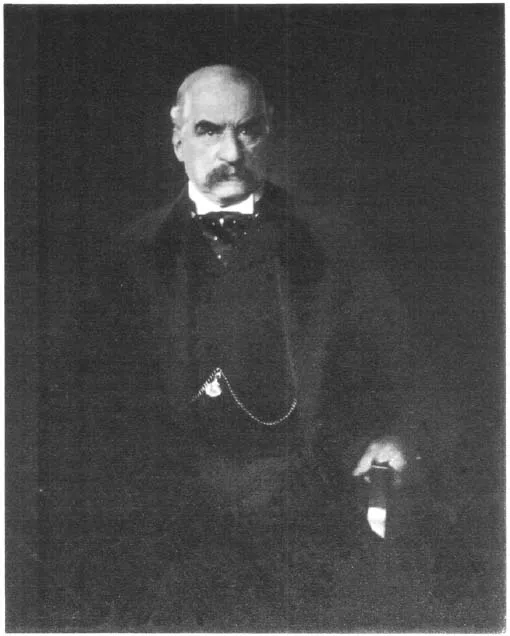
Steichen
J. P. MORGAN
It is not easy to disentangle the Morgan of flesh and blood from the Morgan of the biographers. According to one, he was an example of moral excellence, singing the old hymns his mother taught him, fraternizing with bishops, forgiving his enemies, loving those who hated him, visiting sick friends and going sorrowfully to their funerals, bouncing his grandchildren on his knees, and molding his numerous corporate reorganizations for the good of the country. Another sees him as the embodiment of all the seven deadly sins save sloth, alternating his episcopal confabs with visits to his mistresses, building parish houses for the dominies and theaters for the ladies, wrecking his rivals ruthlessly, and grasping with unexampled arrogance after money and power.
The man was magnificently endowed to play the role of financial imperator. There was the necessary bulk of bone and flesh. He was six feet tall, weighed two hundred pounds. Standing with feet apart, looking forward, he seemed poised to make a formidable advance. His head was large, craglike, well poised on his broad shoulders, his countenance rough-hewn. The upper lip, even as a boy, was heavy, and as he grew older, hidden behind his unruly mustache, it gave to his face an aspect of cruelty. His powerful jaws and rugged brow were drawn down in an imperious scowl. His bulbous nose accentuated the dark aspect of his visage. His large, wide-opened hazel eyes bent upon a visitor or suppliant with terrifying attentiveness and made him a formidable man in conference. Whoever met him came away to talk about the impression of energy and power. He possessed what might be called psychic power and majesty—those ectoplasmic tentacles that grappled people and held them helpless in his presence. Charles Mellen, New Haven railroad president, a Morgan satrap, confessed to a Senate committee that he stood in awe of Morgan, that when Morgan told him he was wrong, so vast was his respect for Morgan that he knew Morgan was right nine times out of ten. Morgan did not have by any means the intellectual endowment of the small ratlike Gould or the astute and realistic Harriman. But he had what none of them had, the Jovian mood, the principle of personal force, the imperial bearing that overawed and quelled opponents.
He was never a scholar. He collected first editions and manuscripts but read few of them. For years they were put away in a basement room so filled with such treasures that one could scarcely get in or out or find anything. But he was a wizard at figures. As a boy in high school his teacher said he was little short of a prodigy and could solve mentally problems in cubic root and numerous decimals. He could speak French and German because he had spent two years in a French school in Switzerland and two at the University of Göttingen. But he had no use for the classics. He could express himself in written English in a clear, direct, and vigorous style. Furthermore, even as a youth, he could put these excellent sentences down in a hand of great neatness and symmetry.
He had little understanding of music. He never went to a concert if he could avoid it. He occasionally attended an opera—he had a box—usually on the first night, thus beginning and ending the opera season. His taste in music did not rise above the hymns he had learned as a boy. He loved to sing them. His family insisted he could not follow any tune, even Yankee Doodle, but this judgment he indignantly protested.
His favorite hymn was Blessed Be the Tie that Binds, not an inappropriate sentiment for the master combiner. But he liked others—Jesus, Lover of My Soul and I Need Thee Every Hour—a phrase that became famous as a trade slogan of one of the pre-Volstead whiskies. He liked that one so much that he persuaded the moguls of Episcopalian music to admit it to their polite hymnal. He tried also to force in some old nonconformist Scottish religious ballad he liked, but even the great Pierpont Morgan could not get this barbarian religious folk song into the hymnal of God’s elite.
Throughout his life Morgan was an inveterate churchgoer. Rockefeller himself was not more faithful. He went to church at least once on Sundays and frequently twice. On shipboard he never missed divine service. He was a vestryman of St. George’s Church, where, on Sunday, God enjoyed the inexpressible privilege of beholding many proud millionaire heads bowed in humility and prayer. He was also a vestryman of the little church near Cragston, his country estate—the Highland Falls Church of the Innocents. Its name, of course, had no relation to the swarms of investors who bought the stream of securities that issued from the offices at Broad and Wall. He was a faithful and active participant in the temporal affairs of both institutions.
He had a fondness for bishops, who, indeed, were among his hobbies. In his youth one of his first adventures in collecting was bishops’ autographs—Episcopal bishops only, of course. In later life he collected the bishops themselves. Bishops of the Episcopal Church are good company. They are cultivated men with a fondness for the good life. They do not eschew vintage wines and French viands like so many of the evangelical brethren. He counted many friends among them. He was for years a lay delegate to the triennial conventions of the Episcopal Church.
At those gatherings he appeared surrounded by that magnificence that followed him everywhere and that recalls the appearance of the great banker he resembled most—Jacob Fugger—at the Congress of Vienna. At Minneapolis he leased a large residence and sent Louis Sherry, the famous caterer, ahead, with a flock of waiters, to prepare the entertainment for the bishops. At San Francisco he leased the Crocker mansion; the inevitable Louis Sherry assumed command of the arrangements, and all trains between New York and San Francisco were sidetracked to permit the Morgan special and its cargo of bishops to whiz to the coast without stop. At Richmond he took over the Rutherford House, added an additional bathroom, recarpeted the stairs, organized it under Sherry as major-domo for several weeks, and housed a flock of Episcopal guests and their wives.
These Morgan headquarters were referred to half humorously, half critically as Syndicate House. These triennial gatherings, which usually included a number of multimillionaires among the lay delegates, were sumptuary displays. A hotel proprietor, after one of these conventions, said that, though he had entertained business, sporting, and social gatherings of many sorts, he had never seen men spend so much money or women flaunt so much jewelry as these Episcopal delegates and their consorts.
In 1875 Morgan appeared as one of the sponsors of a Moody and Sankey revival. It was held in the old New York, New Haven & Hartford depot. Morgan took his family frequently to the meetings, sat on the platform, and joined lustily in the hymn singing. At the other end of the religious spectrum he served for a dozen years as the treasurer of the Cathedral of St. John the Divine and took an active part in organizing and managing its finances.
Morgan was orthodox in everything. The world he lived in was suited to his tastes, particularly after he had fixed it over upon its industrial front. He would doubtless have answered as his bosom friend, George F. Baker, did when asked by a Senatorial inquisitor if he did not think the world was all right as it was, and replied, “Pretty nearly.” God was a part of it; had always been; served a most useful purpose, helped to answer a lot of questions he had neither the time nor the taste to bother with. And so he accepted God as he did the institution of property and money and the church his parents had reared him in where he found the very best people. He was a believer in order and was deeply convinced that sin was a luxury that the poor could not be entrusted with. He was one of a group of righteous men like himself who sponsored that mighty policeman of the Lord, Anthony Comstock, in the organization of the Society for the Suppression of Vice.
He was superlatively choosy about his friends. Even as a boy in school he mixed with but few. But he was deeply devoted to them as well as to his family—his parents particularly. From the time he returned to America from school at Göttingen in 1857 to 1890, when his father died in Europe, he never let a ship leave for England without writing him a letter. Often he had to write these letters late at night after the rush of the day’s work. His father preserved them in a series of books in his library. Twenty years after his father died, Morgan, looking through them, put them into the furnace. That was in 1911, a year of magnate hunting. He was growing old, and these letters were full of news, comments, opinions on the events and men of his time.
During his business life he was never a student. He turned for relaxation to his hobbies of which he had many. During the horse and buggy era he liked a pair of trotters. He was fond of dogs—at least of breeding dogs. His collies were famous. He kept about fifty at Cragston. He would go for a horseback ride over the country with fifty scampering, yelping animals at his heels—a spectacle to make the peasants stare. It was the Morgan version of taking the dog around the block. But most of all he loved boats. There was a succession of Corsairs, which expanded their length and beam as Mr. Morgan’s beam as a banker broadened—first a small launch, then Corsair I, a long, low-hung rakish schooner, then Corsair II, a handsome ocean-going yacht that was taken over by the government as the U.S.S. Gloucester in the Spanish-American War; then Corsair III, a magnificent two-hundred-foot vessel upon which he sailed the seven seas and aboard which, tied up at port for long stretches, he would live and entertain. He was Commodore of the New York Yacht Club, and, in 1901, built the Columbia which raced against Thomas Lipton’s first Shamrock for the America’s Cup.
But most splendid of his hobbies was the collection of almost everything under the sun. He was a congenital collector. As a boy in school and in college he began by collecting pieces of broken stained glass, picked up around old European church ruins. When he left Göttingen for America he brought with him a couple of barrels of glass fragments which he later used to make a window or two in his beautiful library. He collected paintings—many of the greatest ever created—statuary, wood, bronze, stone antiquities, miniatures, cameos, etchings, first editions, original manuscripts, tapestries, brocades, cuniform tablets, ancient coins, medallions, vestments. Nobody has brought together such an accumulation of the original manuscripts of the great writers of all time as Mr. Morgan. In his later years he amused himself making catalogues of these treasures. The catalogues alone, magnificently illustrated in colors, cost a fortune. The size and importance of these collections may be seen from the fact that one catalogue of mere odds and ends ran to 157 pages.
Morgan gathered up these things because he liked collecting. But beyond a doubt the hobby contributed to the nourishment of his ego. It was part of another trait tucked away neatly amidst his other psychological equipment. It was one of his own partners who said:
Mr. Morgan is not a conscious advertiser, but he has a conscious genius for advertising, that is for getting on the first pages of newspapers. Many other men buy pictures and horses and keep yachts and go into public enterprises; but when he buys, it is always prize-winning horses or dogs or celebrated pictures and he has the finest steam yacht afloat and solely and individually owns the cup defender. He starts the building of the New York cathedral—the biggest church in the country. He heads the syndicate that built the largest and most beautiful covered arena (Madison Square Garden), the largest and finest opera (the Metropolitan) and the best situated and most beautiful club house (the Metropolitan Club) and makes the first subscription to every public object.1
Certainly he set the scenes amid which he moved for his stupendous act. His home at 219 Madison Avenue, his town house in London—Prince’s Gate—were filled with priceless treasures. He had a fine estate at Cragston in upper New York and another on Long Island. He inherited from his father his country home in England, Dover House. He had two shooting lodges, a fishing camp, a winter resort on Jekyl Island, while Corsair II was a sort of floating home that connected all the others. The world was filled with the fame of his wealth, his art treasures, his power. Monarchs received him with delight and even their flunkies looked at him with awe. Leopold of Belgium consulted him upon his personal investment problems. Edward VII visited him at Prince’s Gate and Dover House. Kaiser Wilhelm II came aboard his Corsair and lunched with him. The Pope honored him.
Everywhere crowds fought for a peep at him. In New York during the 1907 crisis, when he sat like an archangel in the midst of the whirlwind, directing the storm, people ran along beside his cab or brougham to look in at him. In Rome crowds gathered outside the Grand Hotel to see the American “King” to whom the art dealers flocked with the masterpieces of Europe. In London, where he had tried to grab the bus lines and finance a subway, peddlers sold upon the streets little discs to be worn on the coat bearing the legend LICENSE TO STAY ON THE EARTH, and signed J. P. MORGAN. Admiring bishops conferred upon him the title of J. Pierpontifex Maximus. In Rome he was called The Magnificent.
Self-sufficient, arrogant by nature, all this power and acclaim, we may be sure, did not diminish his arrogance. One of his biographers, infected with what Macaulay called the Leus Boswelliana, or disease of admiration, has described how he walked through crowded Wall Street. He did not dodge or zigzag or slacken his pace to accommodate himself to the presence of others. He barged along, as if he were the only man on the street, the embodiment of power and purpose. Thus he moved through the world. He walked as if he owned its highways. If there were others blocking his path and designs, he moved as if he were preceded by Roark Bradford’s Gabriel crying: “Make way! Make way, for the Lord God Jehovah!”
Morgan, being a royal figure, it has seemed necessary to his biographers to provide him with an aristocratic lineage. The first Morgan to arrive on this continent from England was Miles, who landed at Boston and shortly afterward went to some unclaimed acres on the site of what was one day to be Springfield, Massachusetts. “He spent a large part of his life,” says a member of the Morgan family in his life of the great man, “serving the community in which he lived and took his share of fighting. His services in helping lay the foundations of the Massachusetts Commonwealth were publicly recognized in 1879 when a statue was erected to his memory in Court Square, Springfield, where it stands today to be seen by all who motor by.”2
The implication—nay the assertion—is that the people of Springfield thus honored the services of one of their founding fathers. There in Court Square, sure enough, stands Miles in bronze. But there also upon the pedestal is chiseled the information that the statue was erected, not by the public, but “one of his descendants of the fifth generation”—probably J. P.’s father.
Farmer Miles was succeeded by three generations of Josephs. Joseph Morgan Number One was a weaver. Number Two was a farmer. Number Three was a tavernkeeper. All were doubtless thrifty and honest peasants—though Joseph Number Two served as a captain in the Revolutionary army. Number Three was the grandfather of J. Pierpont Morgan. He moved to Hartford and opened the Exchange Coffee House. But he expanded in time into something more than a dispenser of grog and victuals. He became a hotelkeeper; owned the City Hotel in Hartford and the New Haven House in New Haven. He accumulated a moderate fortune as a moneylender and real-estate investor and became interested in and a director of the then small Aetna Fire Insurance Company. Here was a stream of good, decent blood, but this series of ancestors hardly answers to the definition of aristocracy which means in its broadest connotation a “class of persons pre-eminent by reason of birth, wealth, and culture.”
Junius Morgan was the son of this last Joseph. He was born in Hartford in 1809, worked on his father’s farm, went to a good boarding school, and with his father’s aid became a partner in a wholesale drygoods store in Hartford—Howe, Mather & Co. Later he moved to Boston to become a partner in a larger firm of merchants, J. M. Beebe, Morgan & Company. This Junius Morgan was a man of great ability, who later moved to London as a partner of the famous George Peabody, the American who became a leading English banker. And when Peabody retired, Junius Morgan established his own banking house in London, where he continued to live and grow wealthy for the rest of his life. This was the father of J. Pierpont Morgan.
There was another ancestor of a very different breed—Morgan’s maternal grandfather, John Pierpont. What schoolboy has not recited Warren’s address:
Stand! The ground is yours my braves;
Will ye give it up to slaves?
John Pierpont, poet, preacher, reformer, friend of William Lloyd Garrison, wrote this recitation. He thundered against slavery. He was so far different from Junius Morgan and his father Joseph that, in his own words, his interest “was in the great breathing mass of humanity.”
In the old Hollis Congregationalist Church in Boston John Pierpont struck at so many kinds of human injustice that he irked the fastidious members of his congregation. Offended by his abolitionist views, some of them took advantage of his use of the word “whore” to brand him as immoral and call for his resignation. He resisted, demanded a trial, got one, was vindicated, and then resigned. He died at the age of eighty, the occupant of a small government office in Washington.
Here, united in the great banker Pierpont was good blood, but what different streams—the cold, Yankee, money-loving blood of the Morgans and the hot, rebellious blood of the old patriot reformer. There is, however, nothing odd about the fact that it was not to John Pierpont or even to Joseph Morgan, the Revolutionary soldier, that a statue was built, but to the farmer and sergeant of militia, Miles, in order to exhibit the “antiquity” of the Morgan line. Humble Miles was one of those ancestors who shine in the reflected glory of their descendants. If it were possible it was he who ought to have erected a statue to his descendant, Pip Morgan.
J. Pierpont Morgan was born April 17, 1837, in Hartford, two years before John D. Rockefeller. The day of his birth all of the banks in New York suspended specie payment. The next day those of Hartford followed suit. The future money king came into the world amid the din of crashing banks. He was baptized in the Congregationalist Church in Boston by John Pierpont and was called John Pierpont Morgan. No stranger monument could have been dedicated to the old battler of the Lord interested “in the great breathing mass of humanity.”
It is difficult to depict Morgan’s youth and young manhood to those who hold to the hero-villain theory of history. To millions he was and remains the image of the unfeeling despot. Because he was the central figure in so many episodes as the vicegerent of the Money Devil, it is not an easy matter for the black-white theorists of human nature to credit the softer elements of his nature. The political leader charged with stealing public funds, robbing ballot boxes, slugging rival candidates, and consorting with criminals is set down by those who do not know him personally as a sort of monster. But, on the other hand, those who know him and can testify that he is a devoted father, a loyal friend, and a generous neighbor find it equally difficult to believe that he is a grafter and gangster.
Those who believe the black patches in a man’s character are prepared to call him black; while those who are familiar with the white patches only are unwilling to believe there are any black ones. Prove that the district leader gives coal to the poor and worships his little daughter and you acquit him of robbing the public till. If Morgan venerated his father, lavished loving attention upon the purchase of a little bonnet for his mother, wept at singing the songs she taught him, folded an old schoolmate like General Joe Wheeler to his bosom, lifting him from the floor in an exuberant hug—then there was no water in U. S. Steel and the crime against the New Haven road is a fiction. It is almost impossible to establish in the popular mind the perfectly simple truth that a man may rob a railroad or pad a security issue or crush a business rival without being a monster.
Morgan seems to have had a very engaging youth. He did not go to school until he was nine years old. He went, in order, to the Point School, the Episcopal Academy in Hartford, the Pavillion School in Cheshire—a boarding academy—and three years later to the Public High School in Hartford.
In 1851 his father moved the family to Boston, where he became a partner in J. M. Beebe, Morgan & Company. And Pierpont was entered in the English High School where, a biographer observes, there was not to be found a single name of Irish, Italian, German, or any other nationality save English (unless we except Delano). There was nothing to poison the mind of the pure-blooded young American.
Two years later came the offer to Junius Morgan to join George Peabody in London. He accepted. European funds were moving in abundance into investment in the growing young continent. Peabody, a young Baltimore grocery clerk, had gone to old England, risen to power as a London banker, accumulated a vast fortune, and was now ready to retire to devote himself to philanthropy. His fortune had been made chiefly from handling British capital seeking investment in America. He wanted a young partner and knew and admired Junius Morgan, who had been handling some of his business in Boston.
When the Morgan family took up its life and residence in England, Pierpont was sent first to a select school at Vevey on Lake Geneva, called the Institute Sillig, which was a favorite with American families abroad. There he remained two years, when he was sent to the University of Göttingen. He registered for the classes in mathematics and philosophy. And after two years he concluded that his education was finished and prepared to leave for a business career. This was in 1857.
In these school years we see a more or less reserved boy, deeply attached to his family, a most faithful correspondent, with a fine mind for mathematics, but little taste for the humanities, little interested in athletics, fond of dancing, parties, the companionship of young ladies, faithful to his religious duties, keeping his money accounts meticulously, looking forward impatiently to going into business and longingly toward marriage—and with an American girl only.
“In Göttingen,” says Professor Harry Thurston Peck, “he won such distinction by his mathematical work as to receive the offer of a professor’s chair in that historic institution.” This has been repeated many times, along with Peck’s additional observation that “he inclined to the scholar’s life.” Professor Ullrich, a first-rate mathematician who taught him at Göttingen, advised Morgan against going into business and encouraged him by saying that after another year he could assure him a post as an instructor and, who knows, someday when the good Professor Ullrich should grow old, he (Pierpont) might look forward to becoming a professor of mathematics. Which is quite a different story. But Morgan was never the scholar type. He had a natural aptitude for figures and did well without too much effort.
He must have been an unusually straightforward boy. A letter brought to light by his son-in-law, Mr. Herbert L. Satterlee, written when he was only thirteen years old, exhibits him approaching a common problem of the schoolboy with a frankness, forthrightness, and directness that command admiration. Smarting under a punishment by his teacher, Miss Stevens, he wrote her with a most engaging directness:
I should like to inquire of you the reasons why you as a teacher and, of course, over me, only a scholar, should treat me in such an inhuman manner as to send me out of the class for laughing a little too loud which, I can assure you I am perfectly unable to control and which no punishment will cure me of. You cannot deny that I have not tried to behave better in class lately. If I wanted I could sit still (without saying a word) in a corner and suppose all the class were to do it would not you think that all the class were very stupid indeed and you would have to do all the talking, the scholars saying nothing.
Whereupon he informed her that he proposed to do something about it—namely, go to another class if she didn’t mend her ways.
When he left school he had a more or less fragmentary education, but he had been exposed to a number of cultural infections, had lived among cultured people for a number of years, could both speak and write French and German. He was indeed one of the few American industrial or money kings of his day who had enjoyed these advantages.
In the late summer or early fall of 1857 the young man from the English school in Boston, the French school at Vevey, and the German University of Göttingen stepped ashore at New York. A week later he sat down at his desk in the office of Duncan, Sherman & Company at 11 Pine Street, where the Bankers’ Trust building now stands. They were merchant-bankers, had close relations with George Peabody & Company of London, through whose influence young Morgan got this place. It wasn’t much of a place at that, since the salary was zero. But it was another school where he could learn the business of foreign exchange.
As he had come into the world amidst the clatter of crashing banks in 1837, so now he made his start in business amidst the excitement of the crisis of 1857. Commercial houses were going down, banks suspended specie payments, long lines formed at their tellers’ windows, dark news came from London that Peabody & Company were in difficulties, rumors terrified the young man at 11 Pine Street about his father’s failure. Peabody & Company were in trouble. The Bank of England had to come to their aid with three million dollars. Duncan, Sherman & Company were in trouble, and Junius Morgan in London had to extend a helping hand to them across the Atlantic.
New York was a very different city from that great metropolis over which this youth would one day cast so large a shadow. It was not precisely little old New York, for it had a population of about 700,000. But very little of that vast and complicated modern business machine with which Morgan played was yet formed. Business was concentrated down around Wall Street—stores, theaters, newspapers, as well as banks and brokerage offices. The number of corporations were few. Outside of the railroads, men in business owned their enterprises and put their own names over their shops and countinghouses. In the railroads there had been a bit of stockjobbing, but they were small affairs. The railroad giants had not yet begun to assemble their security machine. Even old Commodore Cornelius Vanderbilt was still in the shipping business.
There were millionaires—William B. Astor and Peter Lorillard, Cornelius Vanderbilt, Peter Cooper, Robert Goelet, Henry Brevoort, Peter Schermerhorn, August Belmont, and old Daniel Drew, not yet concerned with railroads but already battling Vanderbilt on the seas. The Stock Exchange was in the Wall Street district, but most of the trading was done on the street. On the corner of Broad and Wall was a broker named Frank Baker, now forgotten, of course. But the “Corner” where he once thrived is now an institutional spot in the world of capital. Young Morgan took a room some distance uptown in West Seventeenth Street.
This young Pierpont Morgan was the complete model of the ambitious young Christian gentleman eager to go forward in business. He cultivated a large acquaintance among the best families, made it a practice to spend Sunday evenings at the homes of these families, particularly where there were personable young ladies, sang hymns with them around the fireside, wrote faithfully to his family in London, attended scrupulously and with intelligence to his business, joined St. George’s Church at Stuyvesant Square, joined lustily in the hymn singing on Sunday mornings, and, when he went into business for himself, took his own pew.
He was paid nothing at Duncan, Sherman & Company and his first money was made in a speculation in coffee during a trip for the firm to New Orleans. He was learning the ways of the man with money and he itched to go into business for himself. And this he did sometime in 1860 or 1861. It was not a difficult plunge. After all, George Peabody & Company—his father’s London firm—was a wealthy and powerful dealer in American paper of all sorts, and the opening as a dealer in exchange was ready to hand for him. He took a small office at 54 Exchange Place, which he shared with an Englishman named James Tinker. Later he had some sort of partnership arrangement with Tinker, who thus got the distinction of being J. Pierpont Morgan’s first partner. It did not last long and Tinker seems to have vanished out of New York life and memory.
About the time he went into business for himself he also fell in love with a young woman named Amelia Sturgis. And this romantic episode forms one of the most appealing incidents in the life of this grim man. It revealed in him depths of tenderness which his later life in Wall Street concealed wholly from the public. She was perhaps the first or at least among the first young women he met when he arrived from Europe. His attachment to her deepened slowly but it was probably begun in those first meetings at Newport in the very first week he spent in America. In the spring and summer of 1861 he was completely immersed in the personal problem created by Mimi Sturgis’ condition. She had contracted tuberculosis. She was wasting away rapidly. There was very little that could be done then against the ravages of this dread enemy. Before the summer was over he made up his mind to marry Mimi, to give up his business and devote himself completely to saving her life.
Her parents tried to induce him to give up his chivalrous project. But he was not to be turned aside. And so in early October, in the Sturgis home in East Fourteenth Street, with only the family present, young Morgan carried the frail Mimi downstairs in his arms, held her at his side while the marriage ceremony was performed, and then tenderly lifted her again in his strong arms and bore her to the waiting carriage and on to the pier. They went to London and then to Algiers with its warm sun and then, as she continued to fade, to Nice. There she died four months after the marriage. Two months later, in May, he brought her body home and laid it to rest at Fairfield. This tragedy crushed him, for a time seemed to have broken his spirit and watered down his ambition to utter frustration. But slowly he took up the broken threads, brought his old Cheshire school friend, Jim Goodwin, into partnership with him, and set off again upon his course.
It is not pleasant to turn from this generous side and this instance of self-abnegation to a somewhat darker side of Morgan’s character—to the side that, unfortunately, left the deepest traces upon his country. For after all, Morgan’s generous impulses wrought their benefits upon that small number of men and women who were in his circle and in his class. His vast adventures in finance touched our whole society. If we would know why the young man who could carry a dying bride in his arms to marriage and abandon his business at its very start to save her life could be the same young man who could be the center of the two episodes we are now about to describe, the answer must be that Morgan was an insular man. In spite of all his widely scattered friends and interests over the whole world, he was a man who, spiritually and socially, lived upon a little island. That island, and the people on it—his family, his friends, those who moved close to him, his class—lay within the circle of Mr. Morgan’s sentimental perceptions. Those who lived on all the other islands—the “great breathing mass of humanity” so dear to old John Pierpont—lived in another world with which his sentimental and ethical relations were quite different.
On April 12, 1861, General Beauregard fired on Sumter in Charleston Harbor and, so far as the Civil War and America were concerned, the fat was in the fire. Lincoln called for 75,000 volunteers and then in July for 200,000 more. The calls were answered fully by men everywhere. But young Mr. Morgan did not go. He did not go because of his poor health, writes his son-in-law. He was not the only young man in business who did not go. Young Mr. Rockefeller did not go either. And a host of gentlemen, who were to become famous wealth getters and patriots and flag wavers later, did not go. Why one man goes to war and another remains at home is a problem in spiritual values not easy to resolve. Some remain away because they hate war. Some hold back because they hate the cause of the particular war. That sometimes takes more courage than going. Some go because they are too weak to refuse to go. Some go to escape other frustrations. Some go driven on by a romantic sense of patriotic duty. Others go because they like war, like guns, like the glamor and urge of military adventure. Many go through a quiet, heroic sense of simple duty.
War is a dirty business, messy, costly, and there are plenty of plain people whose lives do not matter to do the fighting. Why should precious lives, so full of promise, like Mr. Rockefeller’s or Mr. Morgan’s be offered up? Why Mr. Morgan did not go to war a year or two later is another matter. But it ought not to be difficult to understand why he did not go when the war began. In those early months, he was concerned not with killing but with saving. His mind was consumed with the hope of marrying Mimi Sturgis and taking her to the healing sunshine of northern Africa to save her life. And from August to May of the next year he was away from America; and her growing troubles were lost in his own tragedy.
But why did he not go later? When the draft came, because of the desperate need of men, Morgan hired a substitute, as did Mr. Rockefeller. This substitute he always referred to as the “other Pierpont Morgan” and, according to his family, always took an interest in him afterward. For the Pierpont Morgan, while the “other” Pierpont Morgan was fighting, there was more important work to be done.
Briefly, here is the story. The war caught the Federal government sadly unprepared. It needed arms, ammunition, horses, vessels, uniforms, and particularly rifles. Great numbers had been moved South and when the war came were quickly seized by the Confederate authorities. In addition to the 75,000 volunteers called in May, militia units were forming and frantic appeals for guns poured into the capital. These scarcities opened the way for the business adventurers of all sorts to prey upon the government.
Some years before the war, the War Department bought a large number of rifles known as Hall’s carbines. In 1857 the army inspecting officers condemned a large number of these carbines because they were of obsolete pattern, unserviceable, and had a defect that made loading them dangerous. In fact, there were cases of soldiers shooting their thumbs off in the act of loading. The carbines were ordered to be sold November 5, 1857, in an order issued by the chief of ordnance. Many were sold but about 5000 remained in the arsenal at Governor’s Island, New York, and the Frankford arsenal at Philadelphia.
In May, 1861, Arthur M. Eastman of Manchester, New Hampshire, offered to buy the remaining 5000 Hall carbines from the chief of ordnance, fixing one price for the better ones and a lower price for the more defective. The chief of ordnance agreed to sell them all to Eastman for $3.50 each—“serviceable and unserviceable.” He insisted also that Eastman must take them all at once and pay for them before delivery. Eastman was satisfied with the price, and in June the chief of ordnance wrote him that he had notified the arsenals at Governor’s Island and Frankford to deliver them on payments in cash.
Eastman, who had hoped to take the carbines out in lots, now confronted with a mass delivery, had to find the money. He made an arrangement with one Simon Stevens. Stevens had a more or less unsavory record in dealings with the government. But Eastman agreed to sell the carbines to Stevens for $12.50 each. Actually Stevens agreed to advance the money to Eastman—$20,000—to get the carbines and to take as his profit all over $12.50 he could get for them. Then on August 1, Stevens wired General John C. Fremont, in command in the West, that “I have 5000 rifled cast-steel carbines, breach-loading, new, at $22; government standard 48. Can I hear from you?” Fremont wired to ship with all possible haste.
It is necessary to have a clear picture of this transaction. When the offer to buy the guns was made men were being hurried South to the capital against a threatened attack from Virginia. Frantic efforts were being made in St. Louis, Fremont’s headquarters, for the defense of Missouri and a movement down the Mississippi. Then in July came the great disaster at Bull Run and the call for 200,000 men. In the midst of these events Eastman and Stevens proposed to buy from one department of the army the government’s rejected guns for $3.50 and sell them to another department of the army for $22. The guns would be shipped directly from one government arsenal to another.
This was possible only because the general in the field commanding in St. Louis did not know and could not know that the guns belonged to another army department when he bought them. The Ordnance Department could not know a general in the field was buying, since Fremont had no right to buy. There was a law against it. His right would have to depend on the extraordinary assumption of power by a commander in the field faced with an emergency. The schemers planned on a prospective investment of $17,500, a sale for $110,000, a profit of $93,000 less shipping, packing, and other costs, a profit made by selling to a general in the field guns that already belonged to the government and that the government did not send to him because they had been condemned.
Young Morgan, just starting in business, became a part of this conspiracy. Neither Eastman nor Stevens had the money and Morgan, through Stevens, agreed to furnish it. The transaction was carried through in the following manner. There were 4996 Hall carbines actually involved. Morgan sent his check for $17,486 to the Ordnance Department in payment of the whole purchase. The guns turned out not to be rifled. This had to be done. They were packed and shipped in lots. When 2500 had been shipped, the government’s check for $55,550 was sent to Morgan. Before the next 2500 were paid for the facts became known, the transaction was denounced in Congress, and payment was withheld pending an investigation. There was an investigation by a Congressional committee which denounced the transaction in the strongest terms. Morgan then made a claim for the balance due—$58,000; the government appointed a commission composed of J. Holt and Robert Dale Owen (son of the famous Robert Owen), and this commission confirmed the Congressional charges, but decided that, since the government had kept the carbines, the sellers should be paid at a fair valuation which it held to be $12.50. It awarded the claimants an additional $11,000. Stevens filed a claim for the whole amount of $58,000 with the Court of Claims, which held that the government had made a contract, was bound by it, and awarded the whole sum.
Roughly, the operation worked out thus. The whole sum received for the carbines was $109,912. Of this Eastman was to get $62,462 at $12.50 per carbine. Less the $17,486 paid for the carbines this would give him a profit of $44,976. And this would leave $47,450 as Stevens’ share to be split with Morgan. How it was split is not known. Morgan, of course, would get the money he advanced out of Eastman’s share. I say these are rough figures, because there were certain charges for packing, rifling, and so on that reduced these profits.
The story was brought to light, so far as I can judge, by Gustavus Myers, in 1910, in his widely read and quoted three-volume History of Great American Fortunes. It was repeated by many other writers. But J. P. Morgan never, during his life, made any reply or comment on it. Recently an attempt has been made by Mr. Herbert L. Satterlee to exculpate his deceased client and kinsman in a full-length biography. He makes the point that Morgan acted merely as a banker, lending money on a business transaction—one of hundreds passing over his desk daily—that he did not know Eastman, probably never heard of him, that Eastman had concealed even from Stevens that the guns were being bought from the government and were in its possession; that Morgan got merely his principal plus actual outlays and interest as his share; that he never made any claim on the government for anything; that in the investigations by the Congressional committee he was not called as a witness and was not mentioned in the proceedings save as having furnished the money, and that after he had received payment of his ordinary loan after the first shipment he had no further connection with the proceedings and no part in the suit before the Court of Claims, which was prosecuted by an entirely different banking house—Ketchum Sons & Company. He then adds with that superior air that characterizes all Morgan utterances that the original critic—Gustavus Myers—made these charges without consulting the records and that others repeated them without attempting to verify them after the fashion of the reckless journalistic historian. Myers’ famous history is referred to as “a book published in 1910,” which is the standard Morgan way of disdaining to dignify an unfavorable chronicler.
Of course Gustavus Myers supplied in his book the completest record of the sources whence his material was drawn. Mr. Lewis Corey, who repeated these charges, did the same thing. Mr. Carl Sandburg, in his painstaking life of Lincoln, The War Years, also refers to it at length. I have read all the source material completely and it is quite obvious that Mr. Myers, Mr. Corey, and Mr. Sandburg have done so. The most charitable explanation of Mr. Satterlee’s account is that he did not, but depended probably upon some hired assistant to bring him the facts, which were brought to him to his taste.
The assertion that Eastman did not tell Stevens and therefore Morgan that the guns were in possession of the government is a shocking dismissal of facts too obvious on the record to be misunderstood. And in the same class is the assertion that Morgan probably never heard of Eastman—having dealt only with Stevens.
First of all Morgan, who was advancing the money for the deal, insisted on a lien on the carbines. Is it conceivable that he did not know where the merchandise that was the basis of his lien was located? And as the guns upon which Morgan was advancing money were purchased from the army by Eastman and not Stevens he must have known of Eastman in the transaction. But as a matter of fact Morgan handled and paid for all the expenses of rifling and packing the carbines, and his check was made out to the government and delivered to the arsenals in New York and Philadelphia. The entry by the Ordnance Department on the transaction was “August 7, 1861—amount of draft on assistant treasurer, New York, from J. Pierpont Morgan, Esq., in payment of Hall’s carbines, purchased by A. M. Eastman, $17,486.” When the carbines were paid for the check came from the government for $55,550 made out to J. Pierpont Morgan. The whole money transaction was handled by him and he knew that he had paid the army for the carbines and had been paid for them by the government. He could not possibly fail to know that this was a sale to the government of its own carbines and he could not fail to know that they were bought for $3.50 and sold for $22.
That this hard-boiled and patriotic young man exhibited no curiosity about a transaction so strange on its face, upon which he was advancing so much money in his very first business year, is not to be credited even if the facts did not completely nullify so charitable an assumption. That it was just one of hundreds of transactions that went through his office is equally ingenuous. He was a young man who had just started in business, and his establishment consisted of a room at 54 Exchange Place which he shared with another man. This was not the busy J. P. Morgan of later years with hundreds of transactions flowing through the hands of clerks.
Mr. Satterlee makes the bald statement that when the first check of $55,550 was made to him he deducted his advance and certain other charges and then disappeared wholly out of the transaction and that he never made any claims for any further sums. This, of course, is palpably untrue. The claim for the remaining $58,000 before the Holt-Owen commission is officially reported as “Commission on Ordnance and Ordnance Stores: Purchase of Hall’s Carbines, Washington, June 12, 1862. The Commission Have the Honor to report as follows: Case No. 97—J. Pierpont Morgan, New York, Claim for payment of Ordnance Stores, Balance claimed $58,165.”
Odd indeed is the claim that when the Congressional committee was investigating the case it did not call Mr. Morgan as a witness. The committee was making these investigations in December, 1861. And at that time Mr. Morgan with his young bride was in Egypt. He left New York, October 7, and did not return until May of the following year.
As for the Holt-Owen commission, it had completed its investigation before Morgan returned. But there was no point in calling him. The commission was not concerned with the division of the profits between Stevens and Morgan, but with the claim itself. It held that Stevens had actually paid out $65,228.05 to Eastman for the guns (the price of the guns plus the cost of rifling plus the packing and other costs), that Stevens had collected $55,550 of this sum, and that therefore he was entitled to the difference plus $1,330.70 brokerage fee which Morgan’s office added and still claimed.
After the decision of the Holt-Owen commission, Morgan’s name does not appear in still further pressing for the $58,000. Another banking firm appears—Ketchum Sons & Company. This phase of the transaction remains unexplained. Morris Ketchum was an intimate friend of Morgan. He had been at one time connected with Junius Morgan. Moreover, he enjoyed certain relationships with General Fremont. During all this time Morgan spent a great deal of time at Ketchum’s home. Even the first draft of $55,550 was cashed by him. That first draft was not enough to cover the sum that Stevens was to pay Eastman for the rifles. That, doubtless, is why Morgan, associated with Stevens, made his claim to the Holt-Owen commission, for they had yet to get their profit. Whatever Stevens, Morgan, and Ketchum were to get out of this operation had to come out of that second payment.
What were the relative participations of Stevens, Morgan, and Ketchum is not clear. It is possible that Morgan, preparing to marry and leave America, put his interest in the hands of his friend Ketchum (we will see Morgan associated with Ketchum again during the war in a gold speculation), but that must be surmise. In the end they got it all as a result of the Court of Claims decision. But what remains for history is that this young man who, for whatever reasons seemed good, did not go to war then or later, did not also hesitate to engage in a transaction in which profiteers were buying guns out of a government arsenal for $3.50 and selling them to the army in the field for $22.
When the war got under way, gold became an object of the first importance. The government needed gold. So much had to be bought abroad, and the United States had by secession lost its greatest export commodity—cotton. Immediately the speculators went to work in the gold market. Salmon P. Chase, Secretary of the Treasury, went to New York and told the bankers that gold was more needed than troops and begged them to aid the government. The price of gold went up and down with the tide of war. When the Union was winning, gold went down. A Confederate victory sent it up again. Finally the Stock Exchange ended gold speculation. The papers denounced the speculators. But they continued their activities in the Gold Room in Exchange Place.
Morgan and Edward Ketchum, son of Morris Ketchum, who was mixed up in the Hall carbine affair, went into a gold speculation. Union victories had sent the price down. In September, 1863, it ranged between 126 and 129. The Federal army was threatening Charleston. The fall of Charleston would be a severe blow to the Confederacy. Importers and other buyers of foreign exchange who owed bills in London delayed paying them. They gambled that with the fall of Charleston gold would go lower.
Morgan and Ketchum gambled that Charleston would not be captured. Meanwhile the demand for exchange on London was piling up, but held in abeyance. What if they could add still further to the scarcity of gold? When the crisis arrived and merchants rushed to buy gold, the price would go up. If they had the gold they could reap the profit. They could produce the scarcity and provide themselves with the gold simply by buying at once and shipping it out of the country. The two young speculators, backed by the elder Ketchum, bought two millions of gold and shipped it to Peabody & Company in London. Charleston held out. Suddenly importers tried to buy sterling exchange. The price rose. As fast as those having gold sold, Ketchum, not known to be in the pool, bought it. Soon Morgan and his partner had in their hands much of the current supply. The price went to 171 before Morgan unloaded his stocks. He and his partner made $160,000 on the operation.
The newspapers poured scorn upon the heads of the speculators. Later The New York Times castigated the “knot of unscrupulous gamblers who care nothing for the credit of the country” for whom Congress ought to “order the erection of scaffolds for hanging.” It became so embarrassing to the government that Congress passed the Gold Act to stop it. Thus Mr. Morgan got his first taste of a thing he was to hate savagely in later life—government “interference.” He got his name in the paper again as one of a group of bankers that denounced the act as “one more instance of the utter lawlessness of Congress.”
Mr. Edward Ketchum, Morgan’s partner in this pretty business, kept up his gold speculations until he was ruined by the victory of the Union. He then stole $2,800,000 from his father’s firm and forged a million and a half in checks, was indicted, and sent to prison for four and a half years. The devout Christian would probably insist that the hand of divine justice intervened here, as Mr. Morgan was one of his victims to the tune of $85,000—just about his share of his gold winnings plus interest.
These two incidents—the carbines and the gold affair—throw a flood of light upon the acquisitive soul of Morgan, and indeed of his type. Young, reared in an atmosphere of culture, away from the sordid influences of moneyless men on the make, religious or at least pietistic, piping up on Sunday mornings and evenings his hymns of praise to the Almighty, fully able to understand the terrible issues that plunged his country at that time into one of the bloodiest wars in history, not willing to bear his part in the struggle, he could yet remain behind the lines as a partner in two ugly conspiracies—one to defraud the government in a sharper’s sale of arms, the other in a cold-blooded speculation against its most sensitive financial interests.
Why do men go to war? Why do other men remain away from war? The answer can be made only by some power capable of soul-searching more thorough than is open to us. Why did John Pierpont Morgan—when he was twenty-four to twenty-eight years of age—stay home and grow rich? Why did John Pierpont, his grandfather, at seventy-six enlist as a chaplain with the Twenty-sixth Massachusetts Regiment and go with them to the front until, camped on the Potomac, he had to leave because of his infirmities?
When the war was over Morgan was a rich young man. He reported a taxable income of $53,286 in 1864. He had married again—Miss Frances Tracy, daughter of Charles Tracy, wealthy lawyer, later partner of Boss Tom Platt and candidate for Mayor of New York against Van Wyck and Henry George. Also he had formed a new partnership. The firm was Dabney, Morgan & Company. He had worked under Charles W. Dabney, in Duncan, Sherman & Company. Old George Peabody, full of years and dollars, retired in London to use his millions in philanthropy and the firm in London became J. S. Morgan & Company.
The war over, money and energy began to flow into the railroads. Resourceful enterprisers and adventurers like Vanderbilt and Gould and Fisk and Roberts and Scott began to pick up all the little roads and make them into larger systems and inundate them with stocks and bonds. They fought among themselves. Millions of English capital poured into America through the house of Junius Morgan. The young Morgan in New York handled much of that business. Railroads were the coming thing—Pierpont Morgan could see that. He had an eye open to shoulder in on that front. His opportunity came in 1869 in a battle over a little road only 142 miles long. It was called the Albany & Susquehanna Railroad and ran from Albany to Binghamton. At Binghamton it connected with the Erie. And that was what started the fight.
Jay Gould and Jim Fisk had just beaten old Commodore Vanderbilt for control of the Erie. They were deep in those many glamorous larcenies that made Wall Street gasp. Gould wanted to get control of the Albany & Susquehanna for the Erie.
The road had been built largely with money subscribed by some twenty-two towns through which it passed. Its president was Joseph H. Ramsey. Ramsey was allied with the Delaware & Hudson Canal Company, which was interested in the Albany & Susquehanna because it connected with its valuable coal properties. Ramsey and the Delaware & Hudson were prepared to fight Gould. And thus the struggle became a war between the Erie Railroad and the rich and powerful coal company.
It began with Gould quietly buying up the shares of some of the towns that had subscribed to them and were probably glad to get rid of them. Ramsey retaliated by issuing 9500 new shares to offset the Gould acquisitions. The annual election was to be held September 7 at the company’s office, 262 Broadway, Albany. And both sides were busy getting votes.
As the election approached, Ramsey, at the suggestion of the Delaware crowd, asked J. Pierpont Morgan to take command of their fight. Morgan was still young—only thirty-two—but he had acquired a considerable reputation. Despite the fact that he was called to face two of the most audacious and unprincipled adventurers in America—the serpent Gould and the ruffian Fisk—he entered the battle full of zest. With Charles Tracy as his lawyer he went to Albany. The war had become a battle of lawsuits, injunctions, and contempt orders. Fisk was named receiver of the road in one proceeding before Gould’s personal kept judge, the infamous Barnard. Ramsey had another receiver named before another judge. Gould and Fisk got possession of the road at the Binghamton end. Ramsey’s forces operated it at the Albany end. It was not only a battle of legal process servers. It became a war of thugs and guns. Gould and Fisk led out their inevitable West Side gangsters and seized locomotives and depots, engaged in pitched battles with Ramsey’s men. Armed men stood in battle array on both sides of the track. Thus, running the road became impossible, and Governor Hoffman intervened by sending state troops and putting the road under the temporary management of a general of militia.
Thus matters stood as the rival forces, armed with proxies, appeared in Albany for the election. Jim Fisk arrived with a carload of thugs to whom proxies were delivered before they went to the railroad offices. He got a contempt order from a judge for the arrest of Ramsey, the president of the road, and when the election started Ramsey was held by the sheriff. By this time there were twenty-two lawsuits tying up the road, its officers, and its enemies. The office where the election was held was crowded with stockholders, officials, and about fifty of Jim Fisk’s roughs, who were, however, prevented from using violence through the vigilance of the police. In fact, the rival factions refused to recognize each other. They organized separately, despite the crush, named two sets of tellers, and from noon to one o’clock held two elections, naming two sets of directors. Morgan was elected director heading the Ramsey crowd.
A curious fable about this election, illustrating the great physical prowess of J. P. Morgan, has been told many times and is repeated in the Satterlee biography. It is an excellent example of that irresponsible form of journalistic history in which sources are ignored, upon which Mr. Satterlee looks with so much scorn, but here adopts so blithely. The story as told by son-in-law Satterlee runs as follows:
A few minutes before the hour of the meeting, Jim Fisk and a bunch of his followers came in the street entrance of the building and started up the stairs to the office of the company. Looking up they saw Ramsey and Pierpont at the head of the stairs. When they got to the top something happened very quickly. The portly Jim Fisk was knocked off his feet and fell back on the men who were coming up behind him. Those who were nearest to him were also thrown down the stairs. For a few minutes it was a free for all fight. The attacking party was completely taken by surprise and retired in disorder in the belief that there was a strong force up in the dark hallway behind Pierpont and Mr. Ramsey. Very punctually at the time for the meeting Pierpont and Mr. Ramsey somewhat hot and dishevelled, went into the office, locked the door and held the election.
It happens that the facts of this election were exhaustively examined by the Supreme Court in Albany and are on record in the Supreme Court Reports (55 Barbour, page 344 et seq.). Ramsey, one of the heroes of this mighty fracas, was under arrest and held by the sheriff in an adjoining room when Fisk and his gang arrived. All of them—some fifty or more were counted by witnesses—entered the offices unmolested. Fisk and his colleagues and his mobsters held an election in the same room with Morgan. Both elected boards and the whole proceeding was carried on quite peaceably. The tale of Morgan and Ramsey hurling Fisk and fifty gangsters down the stairs and putting them to flight is the kind of story Pharaohs had inscribed on their tombs.
The rival boards of course fled to the courts. The Supreme Court in Albany somehow managed to combine all of the multitudinous suits into one and decided that Morgan’s board was the legally elected one. Immediately upon the victory and on the day of the election Morgan went to New York and executed a lease of the Albany & Susquehanna to the Delaware & Hudson. He had whipped Gould and Fisk, who had whipped everybody else including Vanderbilt.
His shadow lengthened in Wall Street. He moved his family to a bigger house at 6 East Fortieth Street. He extended his energies to very respectable civic affairs. He took an active interest in organizing the YMCA, the Metropolitan Museum of Art, acquired a country estate at Cragston.
He had also outgrown his banking house. Anthony J. Drexel of Philadelphia asked him to join the Drexels in a New York banking house. The firm of Drexel & Company of Philadelphia had been founded by Francis M. Drexel, an immigrant portrait painter, the year Pierpont Morgan was born. Drexel had fought Jay Cooke’s Northern Pacific adventure, calling it another South Sea Bubble, dominated the Philadelphia Ledger, contested in Philadelphia for banking leadership with Cooke. The sons, Francis, Anthony, and Joseph, had succeeded to the business and wanted to establish the firm in New York. Morgan dissolved the firm of Dabney, Morgan & Company, and Drexel, Morgan & Company was born. Morgan became a full partner in the Philadelphia house of Drexel & Company and held a dominating interest in the New York house of Drexel, Morgan & Company. It was this firm which, in 1895, became J. P. Morgan & Co.
Presently he crossed swords with Jay Cooke. The Federal government was planning a $300,000,000 conversion operation. Since the second year of the Civil War federal financing had been going to Jay Cooke who, in a sense, preceded Morgan as the first great modern American banking overlord. Cooke, as a pioneer booster, boomed real-estate lots at the age of sixteen in Sandusky, Ohio, served as railroad ticket agent in Philadelphia, clerk in a banking house and partner in Clark & Dodge at twenty-one. Very soon he set up for himself and, before he was forty, rose to national fame as the financier of the Civil War. He sold three billion dollars of government paper by extravagant ballyhoo, made millions out of his war services, and translated his new influence into valuable government franchises, took over the dying promotion of the Northern Pacific, developed the stock-watering and distribution technique to new heights, bought Congressmen, bribed a vice-president, wined reporters, purchased editors, gave church bells, supported impecunious ministers, combined the qualities of money getting, corruption, temperance, and piety in successful proportions, built a magnificent residence with fifty-two rooms and a theater, and was generally rated as the great master financier of America.
In 1873 Cooke sought the whole of a $300,000,000 government-bond refunding issue. Drexel, Morgan & Company headed a syndicate that demanded that the issue be split between it and Cooke. Morgan won out and collaborated with Cooke in managing the issue. But it was a complete failure. The bankers could not sell more than one sixth of the loan. Cooke intimated that his “distinguished associates” had hampered the operation. But it was a victory for Morgan, since the hold of Cooke on Federal finance was broken. But that hold was coming to an end soon anyhow. In the fall of that year the inevitable depression appeared. Cooke’s fantastic Northern Pacific enterprise came its logical cropper. Cooke failed with it. His banking house closed and he disappeared as a factor in American finance. Cooke’s exit left the financial stage without a leading character, a dominating and colorful figure. In time Morgan would assume that role.
In 1879 the door swung wide for his entrance on the stage as the great American banker. William H. Vanderbilt, son and heir of the old Commodore, famed for saying, “The public be damned,” small-minded, arrogant, inept, timorous, owned eighty-seven per cent of the stock of the New York Central Railroad. That was too many eggs to have in one basket. The public thought so too, but for a different reason. They thought one man ought not to own so many eggs in so big a basket as this great railroad system. The New York legislature threatened the road as an attack on Vanderbilt. He decided to dispose of most of his holdings—rid the road of the curse of one-man control, rid himself of the dangers of loss. He selected J. Pierpont Morgan for the job. It had to be done secretly else the market price of the stock be ruined. A syndicate of Drexel, Morgan & Company, Morton, Bliss & Company, August Belmont, and Jay Gould bought 350,000 shares of Vanderbilt’s stock at 120 and quietly eased it out, mostly into the hands of English investors, without causing a ripple in the market. As part of the bargain Morgan exacted from Vanderbilt the concession that he (Morgan) would sit on the board of directors of the Central. To sit on that board for Morgan was to dominate it. And with this operation he rose at once to a commanding position, as the banker for the richest man in America and as the fiscal agent of the New York Central and one of its directors. And with this his career in the reorganization of American railroads was launched.
The modern arsenal of money-getting weapons now lay ready to hand for Morgan’s use. For centuries men had been slowly fabricating the instruments for accumulating wealth. It was a far cry from the crude and barbarous simplicity of the ancient Egyptian system by which the Pharaoh, under the fiction of divine ownership of his subjects and of the land they walked on, could cut himself in for a share of the production of a whole nation. Slowly through the centuries one device after another was invented to enable the strong man to take for himself a fraction of the product of many men. Generally the strong men rendered some service in return for this levy—but also generally the toll taken was out of proportion to the service. But in time the weapons were multiplied and refined—money, merchandising, credit, banks, bills of exchange, checks, machines, corporations, classes of securities, speculative exchanges with their bag of tricks.
All of these were available to Morgan. Pioneers had preceded him for centuries, experimenting with them and perfecting the techniques. The corporation—the mightiest weapon of all—was just coming into its full flower. Corporation charters were granted by legislative act and were few in number. Generally, industrial corporations consisted of a few stockholders who were the active managers as well as owners of the business. But the railroads had many stockholders. The corporation manager dominated the property. But even here in many cases the manager was the owner, as in the case of William H. Vanderbilt and his eighty-seven per cent of the New York Central stock. But already the promoter had squeezed himself in between the owners (stockholders) and managers, as in the case of Gould and Fisk. And this promoter was coming more and more to be a banker. This is what happened when Morgan sold Vanderbilt’s stock, leaving him a minority. He made his entry to the board of directors part of the bargain. Before many years passed William H. Vanderbilt dropped dead. And Morgan became and remained the dictator of the Central. He would have done so even if Vanderbilt had lived.
Later the easy issuance of corporate charters by mere registry would be developed and along with that would come the holding company—the right of one corporation to hold shares in another. A West Virginia Secretary of State would go to New York with the state’s seal and sell charters to anyone who wanted them on the easiest terms. New Jersey would adopt a corporation law legalizing holding companies, and one state after another would enter the competition for what was called “liberalized” corporation laws that would incorporate every exploitive and larcenous gadget that the rising tribe of corporation lawyers could invent. An Englishman named Ernest Terral Hooley in the early ’nineties would discover the precious device of preferred stock. He merged ten plants in England, worth $10,000,000; issued $10,000,000 in preferred and $10,000,000 in common against them. John W. Gates and Elbert Gary would hear about it and put the invention to work in America.
After that the primrose path of the promoter spread broad and unpoliced for the sharp-witted men. Morgan, of course, invented none of these things. But he conferred upon them one attribute they sadly needed. That was respectability. He possessed then and he acquired later upon a grander scale a thick encrustation of respectability. What Morgan did any adventurer in Wall Street could do without fear of branding as a rogue. He did what Gould did, though he resorted to none of those outright criminal stratagems that Gould used in extremis. But when he did them they lost the stigma of Gould.
Morgan, however, was something more than the financial adventurer that Gould was. He saw, as many did, that the railroads had for the most part fallen into the hands of adventurers. They were loaded with debts. Parallel lines had been built by men who were not so much interested in operating railroads as in building them. The construction company to build a road was a source of quick and fabulous profits. Hence roads were built without very much regard to their economic or commercial necessity. Sometimes they were built just for the builder’s profit. Sometimes there was the extra expectation of blackmailing the road with which they competed.
To J. P. Morgan this was intolerable. Competition was a force he surveyed with a hatred deeper even than Rockefeller’s. He was a lover of order—particularly of order administered by J. Pierpont Morgan. He liked peace, but a Roman peace—the Pax Morgana. He had another reason for condemning the existing railroad disorder. England continued to offer rich fishing grounds for Americans seeking investment money. Morgan’s firm, through Junius Morgan in London, had placed millions of English money in America. His English clients were deeply disturbed by their losses. He was now interested in railroads as a director and fiscal agent. Such lines were threatened. And thus he was drawn more and more into efforts to reorganize certain roads and finally into a comprehensive policy for intersystem agreements under which gradually the smaller roads could be absorbed into the bigger ones and the bigger ones would operate within agreed territorial limits. Today we call this “consolidation.”
His first important adjustment or rearrangement project was in connection with the New York Central and the Pennsylvania. He was fiscal agent for both. The two roads were at war about two small parasites that paralleled them.
The Western—a new road—paralleled and plagued the New York Central. The South Pennsylvania competed with and harassed the Pennsylvania. Each road accused the other of starting its special small enemy for blackmail purposes. Roberts of the Pennsylvania and William H. Vanderbilt of the Central were at sword’s point over this. In the end the Western went into bankruptcy and Morgan stepped in with a plan. He reorganized the Western, and after immense difficulty induced Vanderbilt to buy it, while he persuaded Roberts to buy the South Pennsylvania. Thus he established peace between these two great systems.
Morgan now went from one reorganization to another—the Baltimore & Ohio in 1887, the Chesapeake & Ohio in 1888, the Northern Pacific in 1891, the Erie, the Reading, and various smaller roads. His method was always the same, where possible. He rearranged the capital structure, scaled down bonds, preserved control in the stockholders, went on the board or put an agent there, and centered control of the road in his hands through a five-year voting trust.
Most important of these Morgan adventures in railroad reorganization was the creation of the Southern system. In 1893 the Richmond & West Point Terminal Company was a more or less loosely integrated system which, due to mismanagement and looting, was in receivership. Morgan reorganized it, brought together forty corporations into a single well-knit system with 7,000 miles of road, called it the Southern Railway, and took the whole thing completely into his control through a voting trust. But he increased its capital fatally and for twenty years this system did not pay a dividend.
By 1900 he was the most powerful figure in the railway world. Four men dominated the greatest systems—Morgan, Harriman, Gould, and Hill. Morgan’s power extended to the New York Central and Vanderbilt lines (19,500 miles), the Pennsylvania lines (18,220 miles), Hill’s Great Northern and Northern Pacific (10,373 miles), and to the roads he dominated more directly (19,000 miles).
Through all these chapters, out of which he was making a million or two or three every time he doctored a road, to say nothing of the profits of his continuous fiscal relations with them, he was hammering at the principle that competition among the roads was disastrous, that they should be formed into large integrated systems, and that these systems should operate under agreements to control rates, new construction, costs. Ultimately many years later the government would come around to this view and seek, very weakly and futilely, to bring about consolidation in the public interest. Morgan worked for that end, but he wanted it under an oligarchy of railroad presidents dominated by a few bankers, himself the chiefest. The scandals, crimes, and discriminations against shippers had finally in 1886 brought about the passage of the Interstate Commerce Law, but the law was feebly enforced and flouted by the managers and bankers.
Therefore, in 1888, he brought the leading road chiefs together at his home, talked harshly to them about their sins, and after much wrangling formed the Interstate Commerce Railroad Association to make effective his “community of interest” theory, to end rate wars and set up an agency to arbitrate differences. He called it a gentleman’s agreement. It was signed in January, 1889. But it achieved little. Then in 1890 he called the Western presidents and their bankers together. It was a more ambitious scheme to set up a self-governing agency over the Western roads. An advisory board was formed. Morgan thought it a great constructive step. “Think of it!” he exclaimed. “All competitive traffic between St. Louis and the Pacific in the hands of thirty men.” Nothing could have seemed more perfect to him save to have it in the hands of fifteen men—or better still five—or best of all one man, and that one J. Pierpont Morgan.
To Morgan in his many battles and designs victory became a habit. But one man drove him to cover. That was Edward H. Harriman. Harriman, son of an impecunious Long Island minister, started life during the war as a quotation boy on the Stock Exchange, speculated, had enough to buy a seat on the Exchange when he was twenty-one, and staged raid after raid, acting alone, until he had his own small fortune. He married the daughter of William J. Averill, who owned a small upstate railroad, became interested in that, bought out all the other stockholders, got a taste of railway management, and sold it to the Pennsylvania at a big profit. Still adding to his fortune as a combination broker and floor trader on the Exchange, he forced his way into Stuyvesant Fish’s Illinois Central directorate, then drove Fish out, hocked the credit of the Illinois Central to buy control of the Union Pacific when it collapsed in 1893, and when Collis P. Huntington died bought the Southern Pacific from his widow. He had ranged behind him the millions of the Standard Oil gang. He was small, frail, with a large head and secretive manner, a lone wolf in his operations, unhampered by Christian scruples though not lacking in Christian piety, was razor-sharp and lightning-swift in action, lacking in education but intellectually the superior of Morgan. This Harriman, with the Union Pacific, the Illinois Central, and the Southern Pacific and some small roads—a vast railroad empire of 26,000 miles—took J. Pierpont Morgan on the most disastrous battle of Morgan’s life for possession of the Northern Pacific Railroad.
There were three great railroads in the Northwest—the Northern Pacific controlled by Morgan, the Great Northern of James J. Hill (allied with Morgan), and the Union Pacific of Harriman.
There was also the Burlington (Chicago, Burlington & Quincy). Hill and Morgan wanted it in order to give the Great Northern and Northern Pacific entry into Chicago. Harriman wanted it also, for several reasons. He went into the open market quietly to buy its stock. But he couldn’t get enough. Hill at the same time was negotiating to get the Burlington and succeeded. The Northern Pacific and Great Northern bought it together, adding 8000 miles to their systems. Harriman asked Hill and Morgan to admit him and his Union Pacific to a third interest. He was refused. He notified Morgan and Hill in the grand manner of an offended sovereign that he considered this an unfriendly act. But, thought Morgan, what can he do about it? Morgan went to Europe well pleased. He disliked Harriman intensely.
But Harriman could do something. If he could not buy the Burlington, maybe he could buy Morgan’s Northern Pacific which owned half of the Burlington. Secretly, cautiously, he began buying stock. Robert Bacon, Morgan’s partner who was in charge of Morgan’s interests, was apparently quite naïve and suspected nothing, even though Harriman’s buying pushed the price of Burlington up. Another market operation on the floor, doubtless!
So completely did Harriman mask his movements that when the price of Northern Pacific went to 117, some Morgan allies unloaded to get the profit. One associate sold 30,000 shares. J. P. Morgan & Company sold 10,000. Northern Pacific directors sold a lot of the company’s own stock. It was all dropping into the Harriman net. Canny old Jim Hill, off in the Northwest, alarmed, hurried to New York. He roused Bacon from his innocent negligence. He went to Kuhn, Loeb & Company, Harriman’s bankers, and protested. Then he learned the truth. It was too late. Harriman had a majority of the common and preferred stock combined. Both classes of shares could vote.
A cable went to Morgan in Paris. He was in a towering rage. He stormed into the Paris office, lifting his voice and not in hymns. He wired to buy 150,000 shares. Morgan had one hope. Harriman had a majority of preferred and common combined, but not of common by itself. If Morgan could hold a majority of common, his board could call the preferred and thus kill Harriman’s majority. The contest for the common raged in one of the greatest Wall Street battles—Morgan’s immense resources against the bottomless moneybag of the Standard Oil gang behind Harriman.
The inevitable result was a corner—with Morgan and Harriman in possession of all available stock. The price of the stock went to 1000. The shorts were trapped. The rest of the market tumbled. U. S. Steel went from 46 to 24. Morgan formed a $20,000,000 syndicate to support it. He and Kuhn, Loeb agreed to settle with the shorts for 150. Harriman wanted to fight on, maintaining that calling of the preferred would be illegal. But the Standard Oil gang wanted to settle.
Morgan returned to America. A treaty was arranged. Five vacancies were created on the Northern Pacific board. Harriman was named to one of them. Morgan held control, but Harriman was inside. That was full of danger. To make all secure against another Harriman attack, Morgan and Hill organized the Northern Securities Company. Its stock was all owned by Great Northern and Northern Pacific. Their controlling shares of the Burlington stock were transferred to the Northern Securities Company—a holding company. Hill was made president. Morgan had twelve of the fifteen directors, Harriman three. The Union Pacific was still left out, and Harriman was angry. Three years later Theodore Roosevelt started his famous antitrust suit against the Northern Securities Company and the Supreme Court held the company illegal. The market went into another panic.
Morgan had won, but he and Hill had had a narrow escape. It was a severe blow to Morgan’s prestige. It was a blow at his pride. When the legal attack on Northern Securities was launched, Morgan went to the White House. He said to the President: “If we have done anything wrong send your man to my man and they can fix things up.” Roosevelt’s man was the Attorney General. Morgan’s man was his counsel. It would be as easy as that, he thought. It was the peeved suggestion of an angry monarch to a rival potentate. Morgan learned to his chagrin, disgust, and humiliation that there was a power higher than his. The decision was a difficult problem in unscrambling. Morgan said to his counsel: “You will have a pretty time of it unscrambling the eggs, putting them back in the shells and returning them to the original hens.”
But the job was done. And when Harriman’s Union Pacific got back its shares, it ultimately sold them for a profit of $58,000,000. Harriman was younger than Morgan. There was no other warrior worthy to do battle with him save Morgan and then only because of his superior position. What Harriman might have done later must remain an academic question. For the man was already ill, wasting away in the fires of his own fierce energies. Five years later he died, dominating directly or indirectly nearly 60,000 miles of track.
Up to 1895 Morgan’s fame in the financial world was larger than among the masses. In 1895 he attained that popular fame that John D. Rockefeller already possessed—fame of the same dubious variety. He became the central figure in a historic episode of national finance which hoisted him at once in the Populist West to notoriety as America’s Money Devil Number One.
All through 1894 and 1895 the country was in the grip of a baffling depression—unemployment, Coxey’s Army on the march, labor uprisings, the great railroad strike and Debs’ arrest, the farmers in despair, government revenue falling, the great gold-silver war brewing, the President and Congress at war.
The government had decided to redeem the greenbacks issued during the war. There were $350,000,000 of them outstanding. There was $150,000,000 of gold in the Treasury. A hundred million was deemed sufficient for redemption purposes.
But foreign exchange was running against us. Importers had to ship gold to Europe. They could take greenbacks to the Treasury and get gold. They did so in such volume that the Treasury’s gold was almost depleted.
On January 7, 1894, there was only $68,000,000 of gold left in the Treasury. Secretary of the Treasury Carlisle sold $50,000,000 of 5 per cent bonds at 117 through the New York bankers. That should have raised the gold reserve above a hundred million. It did—for a few weeks. But subscribers to the bond issue took greenbacks to the Treasury, redeemed them for gold, and gave that gold to the government in payment of the bonds. It produced but little new gold. Of all the gold paid in for the bonds, $24,000,000 came out of the Treasury.
Gold began flowing out of the Treasury again on note redemptions for shipment abroad. In November another loan of $50,000,000 was got through a banking syndicate and again half the gold to pay for the bonds was taken out of the Treasury.
In January, 1895, the Treasury’s gold was disappearing so rapidly that a crisis was at hand. In February there was only $45,000,000 left and $2,000,000 a day was flowing out to redeem notes. In this extremity Secretary Carlisle went to August Belmont, Democratic banker, and J. Pierpont Morgan for help. Morgan hastily organized a syndicate and proposed to furnish something over $65,000,000 in gold, taking U. S. bonds (4 per cent) at 104.4946 which meant 3.75 per cent interest. After much negotiation, during which Morgan and Belmont went to the White House for a long conference with Cleveland, the deal was closed. The government gave Morgan’s syndicate $62,315,400 in 4 per cent bonds and got from it $65,116,244.62 of gold. Morgan agreed that none of the gold would be taken from the Treasury; that half of the bond issue would be sold abroad and that the syndicate would guarantee “as far as able to protect the Treasury from further drafts of gold during the performance of the contract.” As a result of the bond issue the Treasury had $107,000,000 in gold by June.
This much debated transaction brought a scorching blast of abuse upon the heads of Morgan and the already much maligned Cleveland. The Western and Southern Senators said the President had sold out to the bankers. They charged that Morgan had squeezed the government. On the other side, there has been a lot of romantic nonsense about Morgan’s rescue of the government’s credit. “I had but one aim in the whole matter,” he told a Senate committee, “to secure the gold that the government needed and to save the panic and widespread disaster that was to follow if the gold was not gotten.”
Cleveland was denounced because this whole crisis was mixed up with the overshadowing money question. All United States bonds were payable in coin. This meant any coin—silver or gold. But Cleveland and the bankers wanted to change the law to make bonds payable in gold. Congress had resisted this. The silver groups declared it was an attempt to fasten the gold standard irrevocably on the government. Once the government elected to make its obligations payable in gold only, they felt the cause of bimetallism was lost. The episode assumed the character of a crucial test in the rising war between the silverites and the gold bugs and Cleveland and Morgan were looked upon as the arch devil bugs of gold. When the loan was made there was a stipulation for a lower rate of interest—3 per cent—if Congress would authorize gold bonds, and this infuriated the silver leaders, who of course ignored the proposal.
But Morgan was denounced also because of the hard bargain he had driven with the government—the high interest rate and the low price paid for the bonds. There is not the slightest doubt that he squeezed the inexperienced Cleveland, who was no financier, and the necessitous government he headed. He forced Cleveland to pay 4 per cent on $100 bonds to be sold for $104½ when outstanding 4 per cent U. S. bonds were selling on the market for III. And these same bonds for which the Morgan syndicate paid 104½ it sold in the open market for from 112 to 124—a fact that enraged the critics. “The terms,” says the conservative Alexander Dana Noyes3 “were extremely harsh; they [the bankers] measured with little mercy the emergency of the Treasury.”
Did Morgan save the credit of the United States? First of all, the credit of the United States was not near exhaustion. A government whose existing bonds are selling at a premium of 111 is not wanting in credit. And this new issue was oversubscribed six times in New York and ten times in London, men standing in line to get their shares at high prices. The fact that the bonds when issued went as high as 124 within two months of their release refutes the claim that the government’s credit was in danger.
There was a quarrel between the President and Congress about the government’s fiscal policy. The President wanted to make gold the basis of American bonds; bimetallists wanted to coin the seigniorage on silver. The government had silver for which it had paid $156,000,000. Congress wanted to coin that into $218,000,000 silver dollars—a seigniorage profit of $62,000,000. Congress passed the law to do that and Cleveland vetoed it. There were grave defects in the greenback redemption law and in the silver purchase law. All these resulted in a drain on gold that had to be corrected.
The bond issues hitherto issued did not correct this. And neither did Mr. Morgan’s bond issue. As a matter of fact, that bond issue did not meet the government’s problem any more than any of the preceding ones. Morgan’s guarantee to protect the Treasury against withdrawals of gold was unsuccessful. He attempted to do this by controlling international exchange. He took all of the bankers and banks in New York into the syndicate, and as the New York banks were the medium through which foreign exchange was handled, he effected a monopoly of that and thus expected to control it. He used his credit and that of the syndicate to establish large credits in London and for a time he did prevent the flow of gold out of the Treasury. The syndicate pushed the price of sterling exchange up to $4.90, shaving a good profit on that. And the inevitable competition was drawn into the market. When that happened Morgan’s control of foreign exchange was broken and gold began to move out of the Treasury.
Bond buyers and importers were again using greenbacks to redeem gold and send it abroad. By December the Treasury again had only $68,000,000 of gold. Cleveland had to resort to another bond issue and this time a bigger one than before—$100,000,000. But this time he did not make an exclusive contract with Morgan. He threw the issue open to the public. Over $580,000,000 was subscribed and the government got all the way from 110 to 120 for its bonds, instead of the 104½ paid by Morgan. The whole operation proved the groundlessness of Morgan’s contention to Cleveland that a popular offering would be a failure. And it disproved equally the claim that Morgan had acted as a patriot and that he had saved the credit of the nation. He was a banker, with the usual glass eye, scooping out of the opportunity the last ounce of profit for himself. He was the same Morgan who had shipped gold to London in a speculative scheme when the Treasury said gold was more needed than troops and who had participated in the sale of Hall’s carbines to the government. He was also the same Morgan who later told Owen Wister that a man always has two reasons for what he does: “the reason he gives and the real reason.”
In the end the government was rescued by a series of events, crop failures in Europe and rich harvests at home, hence big grain exports and a reversal of the gold movement. Moreover, new methods of extracting gold from ore appeared and new gold mines were opened. Nature did the job, not Morgan.
In the ’nineties the era of combination was in full swing. The antitrust law forbidding this sort of thing was passed in 1890. And this seemed to set into swift motion the very evil at which it was aimed. Cleveland and Harrison ignored the law. All sorts of little enterprises were uniting into larger ones. Many small plants were being brought together into local monopolies, regional monopolies. The age of steel had arrived, and steel plants of all sorts were growing larger. The industry was split up into provinces, each making certain standard shapes or products—iron, steel ingots, plates, tubes, rails, wire, and so on. In each of these lines there were numerous independent producers all engaged in vigorous, sometimes savage competition. They entered pools, cartels, trade agreements, in defiance of law, to curb competition, keep up prices, regulate production—the old struggle of enterprisers to govern the economic system in the interest of profits. Then they began to unite into larger units and then still larger ones until in the end the movement culminated in that colossal combination that is looked upon as J. Pierpont Morgan’s chef-d’oeuvre.
Each of these steel provinces produced its special Napoleon. Thus the wire and nail industry had its John W. Gates. Gates was the product of an Illinois village, had little or no schooling, turned barbed-wire salesman at twenty-two and quickly set up his own outlaw mill in St. Louis, defying patent laws. He spread out into four other plants and then in 1892 formed an amalgamation of these in the $4,000,000 Consolidated Steel & Wire Company. Four years later he promoted the union of this local amalgamation into a Western combination—the $24,000,000 American Steel & Wire Company of Illinois. Gates was a rotund, burly, jovial adventurer, born gambler, who would bet a thousand on a race between raindrops flowing down a railroad windowpane, sit in the Waldorf bar and play whist for ten dollars a point or croquet with H. H. Rogers for a thousand dollars a game, who combined organizing ability with his daring salesmanship and his gambling instincts. In these adventures in combination he was assisted by a collaborator of a very different stripe, the pious, Sunday-school picnicker and hymn-singing Elbert H. Gary, prosperous Chicago lawyer, who looked with puritanical distaste upon some of the simpler forms of guile but was the active and cunning and resourceful partner of Gates and later Morgan in one of the greatest stock-watering jobs in financial history.
Gary formed the Federal Steel Company, which was the fruit of a series of smaller combinations culminating in the company of which Gary became president, abandoning his law practice. And these Gary operations were done with the financial assistance of J. Pierpont Morgan.
By 1900 the steel industry had been pretty well trustified into a group of similar combinations—Federal Steel, National Steel, American Steel & Wire, American Steel Hoop, American Bridge, National Tube, American Tin Plate. Overshadowing all of them, of course, was Andrew Carnegie’s great Carnegie Steel.
Carnegie built one of the greatest of American fortunes. Born in Dunfermline, Scotland, coming to America at thirteen, bobbin boy in a textile mill, and getting his start as assistant to Tom Scott of the Pennsylvania Railroad, he bought a sixth interest in a small iron-ore concern and built it, by dint of great organization ability, extraordinary gifts of leadership, and ruthless competitive practices, to the greatest steel enterprise in the world. He differed from almost all of the industrial barons of his day. He had a grain of religion—only a grain—but he was a nonconformist and had none of the sanctimonious habits of men like Rockefeller, Gary, Harriman, and Morgan. He had a strong streak of social consciousness, was shocked when at thirty years of age he found he had made $50,000 in a year, vowed never to make more and forgot that vow bravely, tinkered with ideas about education and peace, and, around 1900, was toying with the notion of unloading his whole vast steel empire upon someone else.
Carnegie might well be the subject of a whole chapter in this book, were it not that his fortune, his methods, his place in the development of industry and money-making were of the same type as Rockefeller’s and were overshadowed by his. With the exception of Carnegie all of the men who dominated these various steel combinations were promoters—Gates, Gary, the Moore brothers, Daniel G. Reid, Converse. It was the age of the promoter. Many combinations then were made not because combination was essential for the industry but because it was a device by which promoters could make fabulous riches overnight.
The technique was simple. Brown and Smith own plants. They represent investments of $10,000,000 each. The promoter induces Brown and Smith to combine their plants. A new corporation is formed with $40,000,000 of stock divided into preferred and common. Brown and Smith each get $10,000,000 of preferred and $10,000,000 of common. The stock is listed on the Stock Exchange; by careful manipulation the price is forced up and unloaded on the public. Brown and Smith each have their $10,000,000 investment in cash and yet still hold a preferred claim for the same amount against the industry, in which, perhaps, they retain enough common to dominate the directors. The promoter who manages this gets a huge slice of the loot. And, in very large combinations where numerous plants were merged, the promoter sometimes turned up with the lion’s share and perhaps at the head of the corporation as in the case of the cunning Gary. In all of these combinations a huge volume of this watered stock had been created and distributed among the promoters. The promoters received millions in stock for which nothing was paid. In fact, when all of these combinations were completed and before the U. S. Steel Corporation was formed, the promoters had got $63,306,811 in fees and preferred stock. And all this water was in the constituent companies before Morgan combined them.
Morgan did this final job in 1901. He did not vision it himself. He had to be sold on the idea. There has been no lack of highly fictionized accounts of the parturition process that preceded the determination of the great man to bring about the merger. The impeccable, endlessly patient and subservient Gary did the chores, Morgan supplying the final “yes” or “no” and the moral grandeur and power to force the constituent promoters into line. The complete product—the United States Steel Corporation—still survives as a perfect example of the most modern method of growing rich, the method that was to be the most widely used from that day to this and from which countless millionaire fortunes were born.
Morgan organized a new corporation—United States Steel. This great holding company then purchased the stocks of Carnegie Steel, Federal Steel, National Steel, American Steel & Wire, American Tin Plate, American Sheet Steel, American Steel Hoop, National Tube, American Bridge, Lake Superior Consolidated Mines, and some smaller companies. The latter company was owned by John D. Rockefeller and had and has one of the richest iron-ore deposits in the world.
The United States Steel Corporation issued $1,402,846,423 in capital securities divided as follows:
| 5% bonds | $303,450,000 |
| Underlying bonds (assumed) |
80,963,680 |
| Preferred stock | 510,205,743 |
| Common stock | 508,227,000 |
The United States Commissioner of Corporations who investigated the combination reported that the value of the plants acquired was $682,000,000. This estimate had the tacit confirmation of Judge Gary. The average market value of the stocks of the companies combined was $700,000,000. Morgan supplied $25,000,000 cash for working capital. So the combined companies had an asset value, including Morgan’s cash, of not over $750,000,000. The total amount of the bonds and preferred stock issued for this was $813,655,743, or more than $50,000,000 more than their actual value. Thus, much of the preferred and all of the common—another half a billion—was pure water.
Thus, Morgan, the great constructive stabilizer and conservator, had evoked the greatest reservoir of watered stock in history. The man who posed as the archfoe of Gould and Fisk had now outdone them.
What did the Morgan firm get out of this? It acted as the manager of the banking syndicate that underwrote the whole operation. As manager it sold the 1,300,000 shares that the syndicate obtained. It received for these $90,500,000, according to the Commissioner of Corporations. After deducting the $25,000,000 cash paid the Steel Corporation, the $3,000,000 expenses of organization and of running the syndicate, there was left a clear profit of $62,500,000. This tremendous sum is what the bankers got for their work. Of this sum Morgan’s firm got $12,500,000 as syndicate managers before any part of the profit was distributed. It also shared in the division of the remaining $50,000,000 according to its share in the syndicate, which we may be sure was very large.
The stock of the U. S. Steel Corporation, as soon as issued, was listed on the New York Stock Exchange. And Morgan, as syndicate manager, proceeded to sell it. It belonged to the various organizers, as you will recall, so that whatever they sold it for went not to the corporation or into the steel industry but into the pockets of the promoters. Having listed it Morgan employed James R. Keene, greatest of market manipulators, to “make a market” for the stock by manipulation—buying and selling through various dummies and staging fake activity so that the price would be forced up and the shares could be unloaded on the public. During the first year the preferred sold from 69 to 101.3 and the common from 24 to 55. The promoters unloaded most of these shares on the public and translated their stock profits into cash. What they finally got for it all, of course, must be left to surmise. But it was one of the biggest hauls in Wall Street.
The entire issue of 5 per cent bonds ($303,450,000) was given to Andrew Carnegie along with $188,566,160 of the preferred stock as the price of Carnegie Steel. The balance of the preferred and common was distributed among the owners of the other constituent companies and the bankers.
Gould or Harriman or Vanderbilt or any of the great freebooters never did anything rawer than this. But this was not done by Gould or Fisk or Harriman, but by the eminently respectable, the almost painfully respectable and aristocratic J. Pierpont Morgan, and there flowed over its surface the gilt from the name of this great pious magnifico who presided over the hospitality of Syndicate House. In the coming years Morgan would repeat this dose many times. But much worse, thousands of great and little chevaliers d’industrie would repeat it, in their village industries, in their local state industries, and in all the great national utility and industrial and mercantile enterprises of the country until, in time, American industry would become engulfed in the inundation of corporate water mixed with red ink.
This period was one of extraordinary development because of the wave of revolutionary inventions that had created great new industries—the telephone, the telegraph, electricity in all its forms, power, light, transportation; the age of steel with its revolutionary consequences to construction; the age of amazing technological expansion and perfection—with its monster child, mass production—and of course along with these the swift expansion and perfection of the instruments of credit and control.
As quickly as one group of men either invented or developed a prosperous or promising enterprise around any new device, the banker-promoters pounced upon it with their bag of tricks for turning the ownership into liquid form—all if not most of it liquid water—and pouring this water out upon the nation’s investors in return for good hard cash. And foremost in these escapades was the great Morgan.
He began penetrating the telephone industry in 1902, and by 1906 he had the American Telephone & Telegraph Company under his thumb. Theodore Vail, for all his massive and leonine magnificence, was a compliant tool of the Morgans—so pliant indeed that during the war he illegally loaned $20,000,000 of the A. T. & T. funds to Great Britain, Morgan’s ally, and had to borrow the funds to do it. The A. T. & T., since Morgan took it in tow, has borrowed a billion dollars through the Morgan bank, and the Morgan firm has collected $40,000,000 in commissions from it.
In 1902 Morgan amalgamated five agricultural machinery corporations, including the big McCormick Harvester Company, into the International Harvester Company at an immediate profit to the firm of nearly $3,000,000. The company, of course, fell under the Morgan yoke through a voting-trust arrangement in which Morgan’s partners, Henry P. Davison and George W. Perkins, held control.
He reorganized and got control of the General Electric Company and superintended the spread of the General Electric—manufacturing company—into the field of power producer, acquiring power plants all over the country and building up one of the great power octopuses of the country, from which the plants were ultimately freed by the government.
There is no point in enumerating all of the departments of our economic life into which this powerful man thrust his arm because he had access to the money and had built up slowly a control over banks and insurance companies and industrial corporations and sources of raw materials and the men who operated all these things.
Many men, of course, made millions out of his plans, but it is difficult to say what happened to the countless investors on whom the promoters unloaded their stock. The buyers of United States Steel shares saw them go down to eight dollars a share three years after the organization. One of his creations was the International Mercantile Marine. He merged the Atlantic Transport, the American, Leyland, White Star, Dominion, and Red Star lines—American and British. The Cunard Line went in at first but pulled out. The Hamburg-American Line refused to have anything to do with it. The International was shockingly overcapitalized. Morgan put $50,000,000 into it, taking all the bonds, which he sold. He got besides $27,500,000 of stock. And he got complete control. He set out to market the issue but ran into trouble. Foreign countries countered with subsidies, while the American government failed to yield to the well-oiled conspiracy for American subsidies. The earnings of the lines were higher before the combination. The International Mercantile Marine suspended interest payments in 1914, just after Morgan’s death, and went into receivership. It did not pay dividends for twenty years.
Most disastrous to investors of all his adventures was in his own native New England, where, seemingly, he set out to exhibit his might. He took a perfectly sound railroad, the New York, New Haven & Hartford, organized it into an elaborate system of railroads, steamships, and trolley lines. He unloaded upon it a group of streetcar lines and smaller roads, many of which he had got possession of. He increased the mileage from 500 to over 2000 miles. He increased the capital from $93,000,000 to $417,000,000. Over $200,000,000 of this increased stock and bonds was used to buy up other properties, many of his own. He paid the most fantastic prices for what he bought. He gave $36,000,000 for the New York, Westchester & Boston which his man, Mellen, New Haven president, said was not worth ten cents a pound.
Morgan dominated the whole crazy patchwork with an iron hand. His arrogance was growing. His intolerance of discussion had become absolute. With a fist on the table he shut off debate. The road’s president, Mellen, said: “I have been called the office boy. I was proud of his confidence. I regard the statement that I was his man as a compliment.” The stocks and bonds of the New Haven were eased into the hands of over 25,000 stockholders, mostly in New England, and over 10,000 of them held no more than ten shares each. These securities were passed off upon New England investors by the persistent and corrupt debauchery of the New England press. Mellen testified the road paid out to a thousand little dailies and weeklies $400,000 a year. It held $400,000 of the bonds of the Boston Herald.
When this road failed, as was inevitable, it reduced to poverty thousands of aged people who had put their all into its securities upon their faith in the magician. No adventure of the reckless men who disgraced the financial world of the nineteen twenties—the Insulls, the Mitchells, the Wiggins—was worse than Morgan’s New Haven operation. The New York World, at the time, declared that the New Haven investors were “swindled, ruined and robbed by cold, calculating villainy.” All the cold, shameful facts about the New Haven infamy did not become known until after Morgan’s death. Then his son contended that Mellen had withheld from Morgan his illegal acts. Of course that defense will not stand for a moment. Doubtless there were many minor rascalities of Mellen that Morgan did not know of. But he was the architect and builder and ruthless dictator of the whole criminal structure.
In 1907 Morgan was seventy. He was now the magnifico. He had grown to look like an awesome moving-picture extra portraying Ghengis Khan or Tamerlane or some Mongol conqueror or Teutonic tribal chieftain. In October, 1907, he was in Richmond at Rutherford House surrounded by his favorite bishops—the Morgan “college of cardinals.” Theodore Roosevelt was hunting bear in the cane country of Louisiana. And in New York deep and terrifying tremors were heard under that boiling volcano, Wall Street.
Many farseeing men had warned the frenzied dollar hunters that they were riding for trouble. But always they knew better. The abuse of banking through the rise of the trust companies saw New York trust banks with only a dollar and a half in cash for every hundred dollars in deposits. “The stupid fetish of cash reserves,” laughed the ever-sapient superior persons along Broad Street. Fears of depression? “Old fogys!” said the sophisticates, “who do not realize that there will never be such things as 1873 and 1893 again.” The banker-promoters hurled into the market billions in securities. The beast was stuffed. It was getting ready for the regurgitation. By September plenty of this sophisticated confidence was gone. Then came the Heinze and Morse failures. Morse, ship and ice magnate, had got the National Bank of North America and his friend, F. Augustus Heinze, copper baron and gambler, had got the Mercantile National Bank. They used them in their personal speculations. Copper crashed. The market went to pieces. The Morse bank and the Heinze bank were facing bankruptcy. The vestrymen bankers lifted their pious eyebrows in horror at the unregenerate Morse and Heinze.
Essentially they were no worse than the other desperadoes—merely a little less refined and without the odor of sanctity, and that is all. Heinze had United Copper, which was underselling the Rockefeller Amalgamated, and the Standard Oil gang was out to get him. It took advantage of the market weakness to raid his United Copper stocks, send the price down, ruin him and his bank that he had misused as they had theirs. The Clearing House forced Heinze and Morse to withdraw. The Clearing House was dominated by Morgan. The speculators blamed Theodore Roosevelt, off in the Louisiana canebrakes.
The frightened bankers called for Morgan to return. He was in the Episcopal convention where the good dominies were jittery as the vote was being counted on some world-shattering amendment to the Book of Common Prayer. To calm the angry Christians Morgan rose alone and began singing: Oh Zion Haste! Thy Mission High Fulfilling! The convention took up the canticle and the angry theological emotions were dissolved in song. Then came to him a call from his partners, Perkins and Steel: “Oh Morgan Haste! Thy Mission High Fulfilling!” He left at once, got to New York Sunday just before the Clearing House demanded Heinze’s and Morse’s exit from New York banking as the price of rescuing the two banks.
Morgan went to his marble library, where he found many of the leading money kings of New York. Next day crowds lined up before the Knickerbocker Trust Company of James Tracy Barney. Barney was leagued with Morse and Heinze. Barney begged for aid. J. Pierpont Morgan refused it. The National Bank of Commerce, a Morgan-controlled bank, announced that it would not clear checks for the Knickerbocker Trust any more. The Knickerbocker closed its doors, and Barney committed suicide. With this most of the banks in New York City felt the strain of fleeing deposits. George Cortelyou, Roosevelt’s Secretary of the Treasury, went to New York. On October 25, to save the banks, at Morgan’s urgence, he deposited $25,000,000 of government money in them. A few moments later J. P. Morgan authorized Ransom H. Thomas, president of the New York Stock Exchange, to go over to the Exchange floor and announce that the banks would lend $25,000,000 of call money to the brokers. It was eight years later, at the Pujo Committee hearings, before it was learned that the government’s money had been used not to strengthen the banks but to relieve the call-money situation on the Stock Exchange and save the price of stocks—many of them worthless.
But this did not end the storm. Morgan sat in the west room of his library, playing solitaire, while partners and bankers sat in the east room, bringing proposals of rescue to him at intervals, like so many secretaries, and getting his imperial “yes” or “no.” His librarian asked him why he didn’t go into the other room and tell them what to do. He told her he didn’t know what to do, but that sooner or later they would hit on something. They did—Clearing House certificates instead of money. Morgan approved that and presently the convulsion came to an end.
But not before he had made good his statement that “I won’t take on all this unless I get what I want.”
Moore & Schley was supposedly one of the solidest brokerage houses in the Street. The firm held an immense amount of Tennessee Coal & Iron stock as collateral for loans. The stock had sunk in value, and Moore & Schley were faced with suspension. Colonel Oliver H. Payne, Standard Oil millionaire, a friend, loaned them large sums to tide them over and he was threatened with loss if Moore & Schley were not saved. Payne went to Morgan and suggested that United States Steel should buy Tennessee Coal & Iron. This would save Moore & Schley and Payne.
Gary wanted this company but was prevented by fear of antitrust laws from swallowing it. Gary and H. C. Frick went to Washington that night, called on Roosevelt before breakfast and told him the Steel Corporation was urged to take over the Tennessee Coal & Iron Company because an important house held great gobs of its stock and would crash if not thus saved. The name of the house was not disclosed, and Roosevelt supposed it was a trust company. He promised them immunity from prosecution, and before ten that morning Gary telephoned Morgan that the way was clear to grab the Tennessee Coal & Iron Company. It was not until the Stanley Commission investigation that it was learned that the whole operation was staged on one side to save, not a trust company, but a stockbroker, and on the other to enable the Steel Corporation to gobble up another competitor.
Before the transaction was completed it required an exertion of Morgan’s power. Stories of the weakness of the Trust Company of America made their way into the press. A run began on that bank. Oakleigh Thorne, its president, went to Morgan’s library for help. He got the help. But he had to agree to give up a huge block of stock of Tennessee Coal & Iron he held as security for a loan made to Payne and others and accept U. S. Steel stock instead. He owned 12,500 shares of unpledged stock himself and these too he had to give up to the Steel Corporation. The Steel Corporation, through Morgan, rounded up about $32,000,000 of these shares from banks and brokerage houses.
What was the secret of all this power? What was it that made it possible for Morgan to compel bankers to disgorge shares they wished to hold; to issue orders to corporation executives, to bang his fist on the table and order a vote of directors? The explanation is simple. The investment banker sells stocks and bonds. His clients are corporations. He sells them to those who have money. The nation’s money is lodged in its banks, insurance companies, trust companies, corporation treasuries. Morgan’s technique, therefore, was to get control of or to dominate directly or indirectly the corporations that issued securities; also to rule the money companies—banks, trust companies, and insurance companies—which had the money to buy or to lend.
For this reason, therefore, little by little he penetrated one railroad and industrial corporation after another by getting directorships for himself and his partners and his numerous satraps, by getting absolute control in many cases by means of voting trusts. Also slowly he made his way into the domination of many banks, trust companies, and insurance companies by the same means. The story of this spider’s web of interlocking interests and directorates has been told many times and has hardly been exaggerated. When the elder J. P. Morgan was alive the Pujo Committee of the House found that Morgan and his partners and the directors of his controlled trust companies and the First National and National City banks together, both Morgan financial provinces then, held:
118 directorships in 34 banks and trust companies with resources of $2,679,000,000.
30 directorships in 10 insurance companies having total assets of $2,293,000,000.
105 directorships in 32 transportation systems with a total capital of $11,784,000,000.
63 directorships in 24 producing and trading companies with total capitalization of $3,339,000,000.
25 directorships in 12 public utility corporations with capital of $2,150,000,000.
341 directorships in 112 corporations with aggregate resources or capitalization of $22,245,000,000.
These are the figures of Justice Brandeis and they are, as he observes, an understatement of the empire that Morgan built before he died.
It was this access to other people’s money that made his power possible. This is why it was possible for Mr. Morgan to say to a seeker after capital, with the air of one who owned it all, that he would let him have millions. They were his to command. And they were his to command for two reasons that have not been sufficiently stressed. Mr. Morgan was a man of immense personal power, but all his commanding psychic fluids, his blazing eyes and ruthless manner would not have served him but for two other weapons. One of them, of course, was the fact that he was in command on both sides of most situations; he was running the negotiations on both sides of the counter. He was, as banker, representing himself; as director, or voting trustee, representing the corporations from which he got his security issues, and as director, representing the bank or trust company or insurance company that supplied the money. Had some clerk in the purchasing department of a railroad been caught in such a transaction he would have been cashiered and prosecuted. Apparently the simple and direct injunction of Jehovah who said, “Thou Shalt Not Steal,” and of Christ who said, “No man can serve two masters,” did not apply to this pious superman. He would give praise to the Lord in the twenty-five hymns he knew by heart but he would make his own rules of behavior.
The other weapon was even more reprehensible and has been less understood. It is the preferred list. The House of Morgan when putting out an issue of stocks could allot a few hundred or a few thousand shares to exalted persons who were useful to them. Then, when the shares were listed and manipulated into good prices for distribution on the Exchange, these preferred persons would reap swift, handy, and rich profits, usually without putting up a cent. The men who enjoyed these favors were the presidents of the corporations who had securities to issue and the banks, trust companies, and insurance companies who had direct control of funds. Subservience to the House of Morgan meant continuous access to these pretty profits; disobedience meant being cut off from them. It was, then, nothing less than commercial bribery. The Steel Corporation was a Morgan client. The officers of that corporation were its employees. When they accepted money favors from Mr. Morgan they were not better than any small-bore clerk who takes money from the man who deals with his employer and who can be prosecuted for commercial bribery.
Mr. Justice Brandeis, in his famous little volume, Other People’s Money, has made the best description of how this worked:
J. P. Morgan (or a partner), a director of the New York, New Haven & Hartford Railroad, causes that company to sell to J. P. Morgan & Co. an issue of bonds. J. P. Morgan & Co. borrow the money with which to pay for the bonds from the Guaranty Trust Company, of which Mr. Morgan (or a partner) is a director. J. P. Morgan & Co. sell the bonds to the Penn Mutual Life Insurance, of which Mr. Morgan (or a partner) is a director. The New Haven spends the proceeds of the bonds in purchasing steel rails from the United States Steel Corporation, of which Mr. Morgan (or a partner) is a director. The United States Steel Corporation spends the proceeds of the rails in purchasing electrical supplies from the General Electric Company, of which Mr. Morgan (or a partner) is a director. The General Electric sells supplies to the Western Union Telegraph Company, a subsidiary of the American Telephone and Telegraph Company; and in both Mr. Morgan (or a partner) is a director. The Telegraph Company has an exclusive wire contract with the Reading, of which Mr. Morgan (or a partner) is a director. The Reading buys its passenger cars from the Pullman Company, of which Mr. Morgan (or a partner) is a director. The Pullman Company buys (for local use) locomotives from the Baldwin Locomotive Company, of which Mr. Morgan (or a partner) is a director. The Reading, the General Electric, the Steel Corporation and the New Haven, like the Pullman, buy locomotives from the Baldwin Company. The Steel Corporation, the Telephone Company, the New Haven, the Reading, the Pullman and the Baldwin companies, like the Western Union, buy electrical supplies from the General Electric. The Baldwin, the Pullman, the Reading, the Telephone, the Telegraph and the General Electric companies, like the New Haven, buy steel products from the Steel Corporation. Each and every one of the companies last named markets its securities through J. P. Morgan & Co.; each deposits its funds with J. P. Morgan & Co.; and with these funds of each, the firm enters upon further operations.
There was nothing new about all this. On a smaller scale it had been used by Gould and Fisk and others on the railroads. But it was reprobated and frequently called by its right name. Morgan, however, developed it, spread it to every conceivable area of business, sanctified it as he strode through the world with clergymen and bishops and men of power and position bowing and scraping before him. After his advent it became the pattern of American money getting. It came to its full flower in the ’twenties, when in all the little and big Wall Streets, in all the villages and cities of the land, little Morgans and bigger ones learned how to use this fatal and immoral device.
But while Morgan rose to power and approval among the large business interests, there was a rising tide of distrust, criticism deepening into anger. Roosevelt had denounced the “malefactors of great wealth,” looking toward Morgan, at a Gridiron dinner. Men like Bryan and La Follette had kept up an incessant barrage against all that he stood for. The muckrakers were in full career. The economic system began to tremble during Taft’s administration. There was no “glamour boy” in the White House now to save, while he castigated, them. And early in 1912, as the parties made ready for the campaign that would make Woodrow Wilson President, the House of Representatives, on the motion of Congressman Pujo of Louisiana, ordered an investigation of the “money trust.”
The late Samuel Untermeyer, distinguished New York lawyer and the most devastating of investigators, was named counsel of the committee. And then, for the first time, the methods, the back-stage scene-shifting, thunder-making, storm-making devices were brought to light, the schemes, conspiracies, leagues, secret agreements by which the vast power of the bankers was attained were made plain. That investigation is the most important document in the history of the times. Of course it did not prove that there was a money trust in the sense that one man controlled all the money power in America. But it did prove that a few powerful men, by various devious, corrupt devices, had attained a power over vast areas of the money world that was fatally antisocial.
The high point in the investigation was the appearance of Morgan on the witness stand in December, 1912. He was seventy-six years old. He answered the questions asked with apparent freedom. All that is remembered of it now is the statement quoted as if it were a text of Scripture, that a man’s credit is not based primarily on money or property but upon character. No one recalls how Untermeyer completely blasted that answer by showing how Morgan, like all other lenders of call money, loaned it out on the Stock Exchange to brokers who could hand over the securities and that the firm cared nothing about the persons who got the loans. His testimony, on the whole, was unimportant. Many if not most of his answers were preposterous. He not only denied that there was a money trust, but he denied that he exercised any power whatever—not the slightest—in any department of industry. He did not, so he insisted, control his own firm. He never acted for both sides in a transaction, even when he was banker for one side and director for another; a voting trust did not put any power to control in the hands of the trustees; those who could dictate the election of directors could exercise no control over the directors. It was all quite foolish were it not for the majestic figure of the witness.
But the investigation itself did prove much and out of it came that series of reforms inaugurated in the first term of Woodrow Wilson. But so far as changing the course of our development is concerned, turning aside the tide of combination, monopoly, bigness, it was all a waste of time. Much might have been done. But the war ruined it all. With the coming of the Great War, all of the “malefactors of great wealth” flocked to the capital to become patriots. Many of the corporations that were floundering in difficulties in the approaching depression were saved. The war deepened and intensified the whole drift toward combination and, along with the new technological developments that were just then taking on commercial value, laid the groundwork for the mad era that followed.
On January 4, following the inquisition by Untermeyer, Morgan sat in his library on Thirty-eighth Street, going through his papers and putting great numbers of them into the fire. He had been ill. He probably knew his summons might come at any moment. He was burning the evidence. On January 7, he sailed for a vacation in Egypt. He was taken ill in Egypt and hurried to Rome. There he died on March 31, 1913.
1J. Pierpont Morgan, an Intimate Portrait, by Herbert L. Satterlee, Macmillan, 1939.
2J. Pierpont Morgan, an Intimate Portrait
3Forty Years of American Finance by Alexander Dana Noyes.
Men of Wealth: The Story of Twelve Significant Fortunes from the Renaissance to the Present Day
Read the whole book online · Book details
Free to read online and to download from this archive.