
Chapter 166 of 178 · Mises: The Last Knight of Liberalism by Jörg Guido Hülsmann
22. Fragmentation of the Movement
THE EMERGENCE OF THE Austro-libertarian movement in America reached its high point in the year 1956. Ten years of continuous expansion ushered in a torrent of important publications and other breakthroughs. In 1955, Hans Sennholz published his first book. In early 1956, his wife Mary edited a Festschrift for Mises that documented the Austro-libertarian network of intellectuals. Mises himself published The Anti-Capitalistic Mentality and gave the opening address at the 1956 Mont Pèlerin Society meeting in Berlin on “The Permanent Inflation.” Also in 1956, Murray Rothbard received his Ph.D. in economics from Columbia University and Sennholz obtained his first position at Grove City College.
Nineteen fifty-six was also the year when Mises began to receive outward signs of recognition. Unlike several of his friends and colleagues, such as Hans Kelsen and Joseph Schumpeter, Mises had never been fortunate enough to receive prizes, honorary doctorates, prestigious positions, and influence in politics. He had spent his life swimming against the tide and by now he probably did not even expect the applause of his contemporaries. In 1937, the Vienna Kammer sought to have Mises promoted to the rank of a Hofrat or Court's Counselor—the highest rank attainable for non-political appointees among the Austrian civil servants—but Hitler's takeover prevented this. Mises then had to wait until he was almost seventy-five to receive public recognition. In June 1956, he was accorded a $15,000 William Volker Distinguished Service Award.1 A year later, he received an honorary doctorate from Grove City College, and other honors followed over the next few years. The most lasting sign of the veneration that Mises enjoyed in those days is the bronze bust that George Koether arranged to be made, also in 1956.
Recognition for lifetime achievement is usually accompanied by a winding down. So it was in the case of Mises and of the movement he inspired in the 1950s. In personal public appearances, he began to feel his age. He had never been an orator, but had always been impressive, especially in smaller settings, for his encompassing knowledge of the subject and for his lucid and systematic exposition. This flame shone for the last time at the Princeton Mont Pèlerin Society meeting in 1958, and in a series of lectures he gave in Buenos Aires in 1959. Thereafter, his frailty weighed ever more heavily2 He was increasingly hard of hearing and was soon unable to conduct seminar discussions without the assistance of Percy Greaves.
Mises during a NYU seminar
It was at this point that a strategic weakness of the burgeoning Austro-libertarian movement began to be felt quite painfully: the age gap. Between the almost-octogenarian Mises and his major thirty-something disciples—Sennholz, Rothbard, and Kirzner, in particular—there was no intermediate generation to take leadership from Mises's faltering hands. Henry Hazlitt and Leonard Read were the right age, but were thought of as mere popularizers of the ideas of others. They lacked the authority to lead what was after all an intellectual movement.3
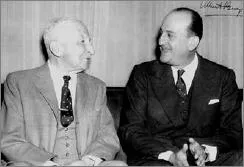
Mises and Alberto Benegas Lynch in Buenos Aires in 1959
The libertarian movement now came under the influence of those who were already intellectual authorities and in the prime age for leadership, but not really Misesians in the Austro-libertarian sense. By the early 1960s, Friedrich Hayek, Milton Friedman, and Ayn Rand had acquired solid reputations as writers and were ready for national recognition as the leaders of an intellectual movement. It was due to their unrivaled impact that in the 1960s Austro-libertarianism came to be largely supplanted by other libertarian and conservative movements. The most visible signs of this paradigm shift were the displacement of The Freeman by National Review (established in 1955), the takeover of the Mont Pèlerin Society by Chicago School neo-liberals in the 1960s, and the emergence of an organized Ran-dian or “Objectivist” movement.
All this occurred while American mass opinion was being converted to the gospel of interventionism and socialism. Mises must have been shocked about the results of a survey among American high-school seniors, as reported in a 1955 letter to the editor of the Wall Street Journal. Asked about their attitudes toward free enterprise, 82 percent said they did not believe that there was business competition in the United States; 60 percent said owners received too much profit; 76 percent believed owners got most of the gains from new machinery; 55 percent championed the postulate “from each according to ability, to each according to needs”; 61 percent rejected the profit motive as the driving force of the economic system; and 60 percent said workers should not produce all they could.4
Austro-libertarianism simmered on a low flame for the next two decades. It lingered as an underground movement centered around Hans Sennholz, Murray Rothbard, and, starting in the 1970s, also around Israel Kirzner and Ludwig Lachmann. The movement was further weakened through internal strife. The most important disagreement concerned the “anarchy” question: is a minimal state necessary to preserve a free society? The Rothbardian anarchists rejected the state entirely, claiming that its protection and contract-enforcement functions were (like all other services) better served by free-market competition than government monopoly. This stance cost them the support of the classical-liberal groups around Leonard Read and Hans Sennholz, who advocated minimal-state (or “minarchist”) solutions. Yet the coherence and radicalism of Rothbard's views attracted many of the brightest young minds, and when Austro-libertarianism reemerged as a powerful intellectual force in the 1980s and 90s—with the Ludwig von Mises Institute at its epicenter—it did so under the intellectual leadership of Murray Rothbard.
In the late 1950s and early 1960s, Mises witnessed the rise of an American “conservative” mass movement and of the neo-liberal Chicago School within the Mont Pèlerin Society. He saw some of his most promising students abandon their support for free enterprise.
Mises: The Last Knight of Liberalism
Read the whole book online · Book details
Free to read online and to download from this archive.