
Chapter 144 of 178 · Mises: The Last Knight of Liberalism by Jörg Guido Hülsmann
A Conference at Mont Pèlerin
Exactly one year after the establishment of the Foundation for Economic Education in New York, another organization was brought into existence to provide a forum for the exchange and development of ideas from a classical-liberal perspective. Unlike FEE, this organization did not have any permanent headquarters; it was conceived as a society of academic scholars, and it mainly consisted of annual meetings, which have subsequently taken place at different cities throughout the world. Most importantly, however, this society was founded in the spirit of neo-liberalism, and ever since, neo-liberal scholars, politicians, and journalists have represented the bulk of its members.54
The society was a follow-up to the 1938 Lippmann Colloquium that Louis Rougier had organized in Paris. This time, the initiative fell quite naturally into the hands of Hayek, who was well known on both sides of the Atlantic—due to the success of The Road to Serfdom and also because he was among the first western intellectuals to renew contacts with his continental counterparts after the war.55 In these meetings the idea of a libertarian association slowly emerged. Hayek certainly discussed the issue when he met Mises at the end of July 1946 in Mexico, but at that point there was not yet any concrete plan. From Mexico City he flew to Oslo, where Trygve Hoff organized a preparatory meeting to discuss rather vague plans for the establishment of a neo-liberal association of European intellectuals. There the plan for an “Acton-Tocqueville Society” must have taken shape.56 By the end of the year, he had found the necessary funds to sponsor the event from Swiss (through Hunold) and American (Volker Fund) sources, and he wrote a letter of invitation to some fifty persons for a ten-day conference in the Swiss Alps, at the foot of Mount Pèlerin on Lake Geneva.
Hayek was probably anticipating trouble with Mises: on the invitation letter to him, Hayek added a hand-written apology that he had not had the time to discuss his plan with him in any detail. His apprehension turned out to be correct. Mises went through the roof, writing to Hayek that he could not leave NYU in April and that he “abhorred the idea of going to Europe. I have seen enough decline already”57 At Hazlitt's request, he had written a four-page memorandum containing his “Observations on Professor Hayek's Plan.” Here he stated that many similar plans to stem the tide of totalitarianism had been pursued in the past several decades—he himself had been involved in some of these projects—and each time the plan failed because these friends of liberty had themselves already been infected by the statist virus: “They did not realize that freedom is inextricably linked with the market economy. They endorsed by and large the critical part of the socialist programs. They were committed to a middle-of-the-road solution, to interventionism.” At the end of the memorandum, he stated his main objection:
The weak point in Professor Hayek's plan is that it relies upon the cooperation of many men who are known for their endorsement of interventionism. It is necessary to clarify this point before the meeting starts. As I understand the plan, it is not the task of this meeting to discuss anew whether or not a government decree or a union dictate has the power to raise the standard of living of the masses. If somebody wants to discuss these problems, there is no need for him to make a pilgrimage to the Mount Pèlerin. He can find in his neighborhood ample opportunity to do so.58
In his letter to Hayek, he was more specific:
I am primarily concerned about the participation of Röpke, who is an outspoken interventionist. I think the same holds true for Brandt, Gideonse, and Eastman. All three of them are contributors to the purely socialist—even though decidedly anti-Soviet—New Leader.59
Still Mises did not rule out his participation, but he did suggest a postponement of the conference until September. This turned out to be impracticable, though, and Hayek undertook another attempt to convince his old mentor in early February. He downplayed the significance of Brandt, Gideonse, and Eastman's connections to the New Leader, mentioning that he himself had written for this magazine. But more importantly, he argued that the program of the conference was still quite open and that the main purpose of the meeting on Lake Geneva— and of subsequent meetings—would be to win over especially those historians and political scientists, who still harbored wrong ideas on a number of issues, but who were willing to learn.60 This seems to have been enough to convince Mises to attend. At Hayek's suggestion, he got in touch with the main sponsor of the conference, the Kansas City-based William Volker Fund, and within a week, travel arrangements were made through FEE.
It was probably the first time Mises personally got in touch with Harold W. Luhnow and the well-endowed Volker Fund. The contact would prove to be highly beneficial in the course of the next fifteen years, until the Fund was liquidated in the early 1960s.
German-born William Volker (1859–1947) had made a fortune with a home furnishing business he had established in 1882 in Kansas City.61 In 1911, after finally marrying at the age of 52, he became a philanthropist. He eventually established in 1932 a private fund to protect his capital against the encroachments of the tax code—especially the new income tax of 1916. It may have been Volker himself who approved the support of the Mont Pèlerin Society meeting, which took place some seven months before he died. But it is more likely that this was already the decision of his nephew, Harold Luhnow, who became the director of the Fund in 1944 and turned it into the principal sponsor of libertarian scholarship.62 Apparently Luhnow's main source of libertarian inspiration had been Loren Miller, who from 1942 to 1944 had been an executive of the Kansas City Civic Research Institute (a Volker Fund outfit), before he departed for the Detroit Bureau of Governmental Research—another source of funding of postwar libertarianism.
William Volker 1911
The influence of the Volker Fund radiated far beyond the United States. By the end of 1953, it paid the membership fees for virtually all non-U.S. members of the Mont Pèlerin Society.63 The Fund's cooperation with Mises was very close, especially after Luhnow hired former FEE employees Herbert and Richard Cornuelle.64
Most other libertarian think tanks and funds have been perverted over time, turning away from their initial principles. The Volker Fund escaped this fate. It was liquidated in the early 1960s, when its directorship fell into the hands of those who could not identify with the libertarian orientation of its founder.
The Mont Pèlerin Conference started on April 1, 1947 and lasted for ten days. Mises left New York on March 25, curious to see Europe again after almost seven years. The meeting had only a minimal agenda and left a great deal of leeway for the participants to determine the subjects they wished to discuss in the course of the next days.
Mises and Read, Harper, and Watts from FEE, as well as Hazlitt, and Davenport (Fortune Magazine) represented the Manchesterite fringe of the meeting. Hayek, Friedman, and Machlup were neo-liberals; people like Walter Eucken, Harry Gideonse, Bertrand de Jouvenel, Frank Knight, Michael Polanyi, Karl Popper, Wilhelm Röpke, and George Stigler were liberal social democrats. Maurice Allais and Lionel Robbins represented the far left of the Conference. Allais could not even bring himself to endorse the vague “statement of aims” that all other participants approved on April 8.
Mises and Walter Eucken at 1947 Mont Pèlerin
In his opening address Hayek set the agenda for the postwar ideological reconstruction of the classical-liberal movement. It involved, Hayek explained, on the one hand “purging traditional liberal theory of certain accidental accretions which have become attached to it in the course of time” and, on the other hand, “facing up to some real problems which an over-simplified liberalism has shirked or which have become apparent only since it has turned into a somewhat stationary and rigid creed.”65 As later developments would show, the concrete meaning of this program was (1) to exculpate classical liberalism from certain widely held criticism, for example, that the policies it had inspired had led to mass misery; (2) to distinguish the “modern” liberalism from its laissez-faire predecessor.
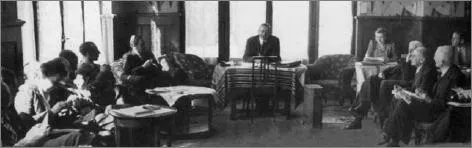
First meeting of the Mont Pèlerin Society in 1947; Robbins far left, Machlup, in front of left window, Hayek, center, group on right, Rappard, Mises, Eucken, Stigler
Some of the other scheduled talks, however, were more “neo” and less “liberal.” For example, the German economist Walter Eucken explained that anti-monopoly legislation was not sufficient to combat monopolies. Further legislative inference was needed in the field of corporate law, patent law, and trademark law. He championed two maxims of economic policy. First, although there was to be freedom of contract, this freedom was not to be allowed to limit in any way the freedom of contract of others. Second, monopolistic market participants should be forced to behave as if they were in “competition”— produce the same quantities and sell them at the same prices that would prevail under “competition.”
In short, Eucken dished up the same interventionist agenda that had already dominated the Lippmann Colloquium in 1938. At that time, Mises had been on his honeymoon in Paris, which might explain why his contributions to the discussions had been unusually tame. Nine years later, the honeymoon was over. He reacted with great determination and defended his laissez-faire position so vigorously that many years later his friend Lawrence Fertig still recalled the debate. Milton Friedman eventually concurred:
our sessions were marked by vigorous controversy over such issues as the role of religion and moral values in making possible and preserving a free society; the role of trade unions and the appropriateness of government action to affect the distribution of income. I particularly recall a discussion of this issue, in the middle of which Ludwig von Mises stood up, announced to the assembly “You're all a bunch of socialists,” and stomped out of the room, an assembly that contained not a single person who, by even the lowest standards, could be called a socialist.66
Friedman did not specify what he meant by “the lowest standards.” In any case, while Mises was able to hold socialists in high esteem, the incident showed that he had little patience with socialists parading as liberals. The exchange between Mises and his neo-liberal opponents set the tone in the Mont Pèlerin Society for years to come. Wilhelm Röpke would later pay a friendly tribute to Mises, even though the latter made “sarcastic comments upon the unenlightened spirit of so many of its members” including Röpke himself.67 Although the libertarians around Mises were a small minority, it was they who had the financial backing of the main American sponsors such as the Volker Fund, without which the Society would quickly have died out in those early years. As long as Mises took an active part in the meetings, therefore, it was impossible to move on to discussing the technical details of an approved government interventionism. Laissez-faire had made a comeback. It was not the majority opinion, but it was a debatable and debated political option—too much for some initial members such as Maurice Allais, who soon left the Society for precisely this reason.68
Mont Pèlerin in 1947
Despite fundamental disagreements, the meeting was a success. On April 9, some forty participants established the Mont Pèlerin Society and elected Hayek as their president.69
Mises: The Last Knight of Liberalism
Read the whole book online · Book details
Free to read online and to download from this archive.