
Chapter 8 of 178 · Mises: The Last Knight of Liberalism by Jörg Guido Hülsmann
Akademisches Gymnasium
In September 1892, shortly before his eleventh birthday, Mises entered the Akademische Gymnasium where he would be schooled for the next eight years. The gymnasium schools were very particular institutions, more demanding and quite dissimilar from their present-day successors. A product of the nineteenth-century Continental system of education, they can best be described as “a combination of high school and college.”23 The children of ambitious and well-to-do parents began attending around the age of ten, after four years of elementary training. Three gymnasium models were available: a classical model featuring eight years of Latin and six of Greek; a semi-classical with Latin and one or two modern languages; and a thoroughly modern option with only modern languages. Erik von Kuehnelt-Leddihn states that the classical model had more prestige than the others, but they were all demanding.
Often these very hard school years hung like a black cloud over families. Failure in just one subject required repetition of a whole year. This was the fate of Nietzsche, of Albert Einstein, and also of Friedrich August von Hayek! Young Mises, of course, got a classical education: the modern languages he learned privately.24
While at the Akademischen Gymnasium, Mises read Caesar, Livy, Ovid, Sallust Jugurtha, Cicero, Virgil, and Tacitus in Latin. In Greek, he studied Xenophon, Homer, Herodotus, Demosthenes, Plato, and Sophocles.25 One verse from Virgil so deeply impressed him that it became his maxim for a lifetime:
Tu ne cede malis sed contra audentior ito.26
(Do not give in to evil, but proceed ever more boldly against it.)
Many years later, he pointed out the crucial role that the immersion in classical literature—and the writings of the ancient Greeks in particular—played for the emergence of liberal social philosophy and thus in his own intellectual development:
It was the political literature of the ancient Greeks that begot the ideas of the Monarchomachs, the philosophy of the Whigs, the doctrines of Althusius, Grotius and John Locke and the ideology of the fathers of modern constitutions and bills of rights. It was the classical studies, the essential feature of a liberal education, that kept awake the spirit of freedom in the England of the Stuarts, in the France of the Bourbons, and in Italy subject to the despotism of a galaxy of princes. No less a man than Bismarck, among the nineteenth-century statesmen next to Metternich the foremost foe of liberty, bears witness to the fact that, even in the Prussia of Frederick William III, the Gymnasium, the education based on Greek and Roman literature, was a stronghold of republicanism.27
The Austrian schools had been reformed in 1851, at the beginning of the absolutist phase of Franz Joseph's reign. Under the leadership of Count Leo Thun von Hohenstein, the government seized control of secondary education, which had been the exclusive domain of the Catholic Church, and imposed a new curriculum that was meant to prepare the graduates for scientific studies and executive positions within the Austrian bureaucracy. The teaching of religion remained mandatory and was assured by representatives of the relevant religious organizations—Catholic priests and Jewish rabbis. But even the teaching of religion was supposed to be respectful of facts and laws established by scientific research.28
Public schooling had become compulsory in 1869. Children had to have four years of elementary school (which prepared them to be good subjects of the state) before they could enter a secondary school. The Gymnasien taught the humanities to the future elite of the country. Only about 5 percent of an age group was admitted. This number tells more about the nature of the gymnasium than any description of its curricula. To be admitted to a gymnasium was to be part of a tiny intellectual elite. It meant learning from teachers who were respectfully called “Herr Professor” and who were in fact the peers of today's college and university professors rather than of today's high-school teachers. (Positions at the universities were extremely rare.) And it meant being measured by standards that were incomparably higher than those of modern high schools.
Being among the best students did not guarantee a place in a gymnasium: tuition was high and outside assistance was rare. (Only one of Mises's classmates had such assistance.) But because the schools competed for the best pupils, they often waived the fees for exceptional young men who could not afford them—about 20 percent of the pupils in Mises's class. The typical gymnasium pupil was the intelligent son of middle-class or wealthy parents. Pupils with a working-class background were an exception.
While the gymnasium was the best type of school, the various Gymnasien were not equal in quality or reputation. The best schools were in Vienna, both in terms of the family background of the pupils and of the quality of the professors. The latter were often published scholars who actively engaged in research and made important contributions in their fields. For example, Ludwig's Latin teacher, Dr. Valentin Hintner, was a member of the Royal Prussian Academy of the Socially Beneficial Sciences in Erfurt.29
In Vienna, three schools stood above the rest: the There-sianum, the Schottengymnasium, and the Akademische Gymnasium. These were all-male schools. (Vienna girls were taught in separate gymnasien, yet they could take the graduation exam in one of the top schools.) Empress Maria Theresa had created the Theresianum in the mid-1700s as a “knight's academy”—a school to prepare young aristocrats for future responsibilities as administrative and political leaders of the empire. In Mises's day, it remained a school for the sons of the high aristocracy and admitted bourgeois pupils only as day students. Among the latter were Karl Lueger (who eventually became the first non-liberal mayor of Vienna), Rudolf Hilferding, and Joseph Schumpeter. There were, however, many families who abhorred the snobbish atmosphere of the Theresianum and preferred other schools such as the Benedictine Schottengymnasium, and the Akademische Gymnasium.30
The Akademische Gymnasium was the most thoroughly secularized secondary school in Vienna. It was therefore the favorite place of education for the sons of the liberal bourgeoisie, and in particular of Vienna's better Jewish families.31 In Ludwig's terminal class, nineteen out of thirty-five pupils were Jewish, thirteen Catholic, and two Protestant. The school had been established in 1453. Today it is located on Beethovenplatz, near the eastern Ringstrasse. The tall neo-gothic building was constructed in the 1860s with romantic towers and high windows on ivied brick walls. This is where Ludwig spent the next eight years. His weekly schedule in the first year: religion (2 hours), Latin (8 hours), German (4 hours), geography (3 hours), mathematics (3 hours), natural history (2 hours), calligraphy (1 hour). By and large, the same subjects were taught throughout the entire eight-year program; the only major exception was Greek, which was taught starting in the third year. Mises was one of the best students, although not at the very top (the only class where he truly excelled was history) and he eventually graduated sixth out of thirty-three pupils.
The pupils were however somewhat disenchanted with their school because of the dour indifference of their teachers. Before the 1851 liberal education reform under Thun-Hohenstein, the Austrian schools had been run by Catholic clerics. Accordingly, classroom instruction featured mainly Church history and philosophia perennis. After the reform, civil servants replaced the clerics. These new secular professors were entirely steeped in the traditions and mentality of the Austrian bureaucracy, and performed in the classroom with the same detached attitude of other state bureaucrats. Their main interest was not to educate students, but to present their material efficiently.32
Apart from the insufficient motivation of the teachers, there was another reason for student dissatisfaction, a reason that also explains the explosion of creative energies in Vienna that began in the liberal era. The schools did not offer enough intellectual stimulation for the Jewish boys, who came from families nurturing a long tradition of literacy and of careful and sustained intellectual work.
Then as now, young students endured school as a routine. It was not where they found their interests or passions. But while students today might look forward to sports or movies after school, their Viennese counterparts at the end of the nineteenth century looked forward to reading and writing what was not taught in school—in other words, to their real educations. In school, a fourteen-year-old would read the Latin and Greek classics; he stuffed his brain with the minutiae of German and European history, and he did so without enthusiasm. But after school he would devour modern writings on science and the arts. Why did these Viennese boys have such a different notion of having a good time from virtually all other generations at virtually all other places? The answer is, in brief: traditionalist Jewish culture let loose in a secular environment.
William Johnston observes:
Jews had enjoyed many centuries of literacy before the rest of Europe started to become literate in the eighteenth century. Thereafter Jews entered as if by predestination into professions that required facility with words.33
The true passion of these young men, who came from families that just a generation before had left the rural rabbinical order, was intellectual adventure in the secular realm—a pursuit unavailable to their ancestors. They threw themselves into literature, theater, opera, whatever aroused their curiosity. Raised to value religious scholarship, they found in Vienna the intellectual delights of the secular world.
Ludwig von Mises seems to have been a typical specimen of this generation. He recalled that his interest in history was piqued in 1888 when he read articles in a family journal on the lives of the German Kaisers, Wilhelm I and Friedrich III, who had died that year. He was then barely seven years old. According to his wife, he set out to write a history of the Crimean War when he was ten. After writing his first page, however, he abandoned the project when he discovered that an English historian had published ten volumes on the topic.34 During his gymnasium years, he devoured the writings of the German historians justifying the new Prussian supremacy in German lands. These readings provided a lifelong lesson. He realized that the acclaimed authors were in fact writing with a distinct bias.35 Thus, early on he trained the critical mind that would serve him so well throughout his life and eventually turn him into the twentieth century's greatest intellectual champion of liberty.
One of the few surviving photographs from his youth seems to forebode these events. Lew Rockwell comments:
I often think back to a photograph of Mises when he was a young boy of perhaps 12, standing with his father. He was wearing the traditional Austrian garb popular in the 1890s, and holding a racket for sports. The picture was grainy and distant. And yet you sense that there was something in Mises's eyes, a certain determination and intellectual fire, even at such a young age. His eyes seem knowing, as if he were already preparing himself for what he might face.... We look and try to discern what it was about him that caused him to be such a fighter, that caused him to stand while others fell, that gave him that sense of moral certitude to fight for enduring truths regardless of the political winds. Even in that grainy photograph, we have some sense that we see it in his eyes, that glimmer that reflects a heart that would never compromise with despotism but rather advance the truth of human freedom until his last breath.36
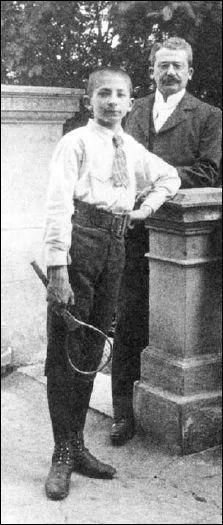
Ludwig von Mises with his father, Arthur, circa 1893
These things appear clearer today than they were at the time. Ludwig's passionate interest in the sciences was typical for boys of his background and generation. So was his enthusiasm for the arts. We must imagine him as a teenager standing in line before premieres at the Hofburgtheater or Volkstheater. After school he would meet friends such as Hans Kelsen at a café to read journals and discuss their discoveries.
The lives of Mises and Kelsen bear many surprising parallels that make this friendship particularly interesting. They were born in the same year and attended the same school. Later they would enter the same department at the University of Vienna, prepare for a scholarly career, and publish their first major treatises shortly before Word War I. Both became ardent defenders of the notion that there is no such thing as a science of ethics, but that all judgments of value are merely subjective. While Mises would become famous for his studies of a priori laws in economics, Kelsen became a pioneer of the “pure theory of law.” Also, both would marry women named Grete, move to the United States at the advent of World War II, and eventually die in the same year, far from Vienna—Mises in New York, and Kelsen in California.
Kelsen's family background was lower than average Akademische Gymnasium standards, while Mises's was higher. (Mises was the only aristocrat in his class.) This did not prevent the ambitious nobleman from befriending the ambitious son of a clerk and remaining his friend for a lifetime. It is likely that they became acquainted with the philosophy of Immanuel Kant, and especially with Kant's epistemology, at the same time, when they were about sixteen years old. German “idealistic” philosophy—the philosophy of Kant, Fichte, Hegel, and their followers—exercised an enormous influence on many young minds in Vienna, not least of all because these books had been on the Catholic index of forbidden works.
Kelsen was profoundly shaken by his confrontation with idealist philosophy. Through his reading of Kant, Kelsen had come to the conclusion that the reality of the exterior world was problematic. During the rest of his life he seems to have applied his early subjectivist interpretation of Kant to the field of law. As an old man, Kelsen still recalled his reading of Kant as a crucial juncture in his intellectual development.37
The philosopher from Königsberg did not have the same impact on Mises. In distinct contrast to Kelsen, Mises did not have a Kantian epiphany and then set out to reconstruct economic science in the light of this idealist philosophy. Rather, Mises started from case studies and moved up to ever wider generalizations and greater abstractions. Eventually, he would realize that he could not avoid dealing with epistemological questions and then stressed the a priori nature of economic laws. But even at this point, Kantian epistemology did not have a noticeable impact on his thought.38
Mises's true primary interest was in political history and political action. All the other disciplines he eventually came to master—law, economics, epistemology, political philosophy—were subservient to these primary goals. In his final exam in German at the Akademischen Gymnasium, he had to write an essay on the following question: “What are the moral inspirations that we derive from the study of the history of Austria?”39 Though his answer is lost, a statement that he made many years later gives us a hint as to what he might have written in May 1900. Speaking of the benefits of studying history, Mises wrote:
It opens the mind toward an understanding of human nature and destiny. It increases wisdom. It is the very essence of that much misinterpreted concept, a liberal education. It is the foremost approach to humanism, the lore of the specifically human concerns that distinguish man from other living beings.... Personal culture is more than mere familiarity with the present state of science, technology, and civic affairs. It is more than acquaintance with books and paintings and the experience of travel and of visits to museums. It is the assimilation of the ideas that roused mankind from the inert routine of a merely animal existence to a life of reasoning and speculating. It is the individual's effort to humanize himself by partaking in the tradition of all the best that earlier generations have bequeathed.40
The complicated political history of Austria was certainly interesting enough to attract the attention of a bright teenager. In fact, much of Mises's later work can be seen as an attempt to understand the problems of his age from the point of view of economic theory and social philosophy. But even more fundamentally, he was interested in practical questions: What could governments do to make their country a better place? Mises was never interested in merely collecting historical data. He wanted to explain history—to trace observed events back to their causes—and he wanted to apply these insights in practice. How did the political and social institutions of his fatherland come into being? What were the causes of ethnic and social strife and how could one combat them? What were the roots of imperialism? What were the causes of the great social progress of the nineteenth century, in rising literacy, declining infant mortality, and higher mass consumption?
All these questions and their answers were preliminaries to action. Given our knowledge about causes and effects in social life, what is to be done now? For example, how could one promote the welfare of the working classes now more than in past decades? A family tradition of commerce and social leadership had made young Mises used to seeing and seeking the bottom line. He brought this emphasis on results to the study of social life and social strife, which prepared him, as he would say, “to take an active part in the great issues of his age.” Thus he turned to the study of intellectual disciplines that promised to give guidance in political matters. And because the conflicts of his era—and ours—were largely economic ones, Mises ultimately became an economist. Many years later he wrote these lines:
All the political antagonisms and conflicts of our age turn on economic issues.
It has not always been so. In the sixteenth and seventeenth century the controversies that split the peoples of Western civilization into feuding parties were religious. Protestantism stood against Catholicism, and within the Protestant camp various interpretations of the Gospels begot discord. In the eighteenth century and in a great part of the nineteenth century constitutional conflicts prevailed in politics. The principles of royal absolutism and oligarchic government were resisted by liberalism (in the classical European meaning of the term) that advocated representative government. In those days a man who wanted to take an active part in the great issues of his age had to study seriously the matter of these controversies.... Only boors neglected to inform themselves about the great problems that agitated the minds of their contemporaries.
In our age the conflict between economic freedom as represented in the market economy and totalitarian government omnipotence as realized by socialism is the paramount matter. All political controversies refer to these economic problems. Only the study of economics can tell a man what all these conflicts mean. Nothing can be known about such matters as inflation, economic crises, unemployment, unionism, protectionism, taxation, economic controls, and all similar issues, that does not involve and presuppose economic analysis.... A man who talks about these problems without having acquainted himself with the fundamental ideas of economic theory is simply a babbler who parrot-like repeats what he has picked up incidentally from other fellows who are not better informed than he himself. A citizen who casts his ballot without having to the best of his abilities studied as much economics as he can fails in his civic duties.41
Economic conflicts were at the forefront of social dissension in Austria-Hungary during Mises's early years and were debated each day in the press, in new books, in cafés and in the streets. Let us look more closely then at the fundamental political problems of fin de siècle Austria.
Mises: The Last Knight of Liberalism
Read the whole book online · Book details
Free to read online and to download from this archive.