
Chapter 132 of 178 · Mises: The Last Knight of Liberalism by Jörg Guido Hülsmann
Dark Hours and New Plans
The money from the Rockefeller Foundation was not enough to live on, and in 1941 it was almost all the income they had. He had never known such destitution. His family had not been wealthy but they had always been comfortable, had always had help in the household. But now they could barely pay for a restaurant or for tickets to the theater or opera. Margit started training as a secretary.
Even more depressing was the ideological state of affairs in the very countries that were at present the bulwark against international Communism and National Socialism. Things had deteriorated considerably since his last trip to the States in 1931, when “progressive” interventionism was already at a previous high point. In the years of Roosevelt's New Deal, the political gospel preached from the press and the pulpits had shifted yet further to the left. The Soviet Union was now held in high regard and Communistic schemes were discussed seriously, while the free market was derided as an atavism of an unenlightened past. It was only a matter of time before the United Kingdom and the United States would become fascist or Communist or some variant thereof. Was this a future worth dying for? Without hope for the future, was it worth living in the present? Where were the voices of dissent, except for a scattered few like Henry Hazlitt and Lawrence Fertig? Where were the economists with enough backbone to resist the Keynesian temptation—the very embodiment of statist longings? How long could his disciples hold out, insecure as they were in their status as émigrés?
It was at this point that Hayek, to whom he must have confided his desperation, reassured him that he “need have no fear about my becoming converted to Keynesianism”—though for Hayek too the future looked bleak:
I agree entirely with what you say about the horrible state of economic thinking here and in the U.S.A. That at the present time when one can at least have some hope for the immediate future the long run outlook should be so dark is really dreadful.30
Mises did not believe he could contribute to turning the tide. His career was in a deep slump. He was completely at odds with the prevailing scientific fashions in the United States and he saw no way to have any impact on public opinion. Ironically, one factor that barred him from reaching an audience through his writings was that U.S. publishers strictly aimed at the mainstream. The greatest champion of capitalism could not make himself heard because in a world dominated by the statist ideology his books did not seem profitable enough to enjoy the support of commercial publishers. He wrote to Hayek:
I have been very busy these last months in writing my posthumous works. I do not believe that it will be possible for me to publish anything other than small articles in periodicals.31
Mises reached an absolute low point in April 1941. Margit had been ill since early March—a flu and sinus troubles—to the point that she could not even bring herself to keep up her diary. Mises, usually extremely discreet about his emotions, lamented in a letter to Hayek: “Margit is not yet totally recovered. The thing seems interminable.”32 It was also quite impossible to cheer her up because she was still anxious about the fate of her daughter. Thus he was left alone with his sorrows and apprehensions. He had left Switzerland because he refused to depend entirely on the goodwill of one party, the Swiss government. But in the United States he fared no better. All his money came from the Rockefeller Foundation, which made it clear to Mises what his status was now. While left-wing lunatics and the cranks of the imaginary science of quantitative economics received lucrative contracts with the New School of Social Research, Mises had to live on the equivalent of a post-doctoral stipend. And he was made to understand that even this amount was not meant as compensation for his service to economic science, but as something between a pension and charity for an old man who could not get along otherwise.
Mises was not a man to attach too much importance to material things. He once told Margit that, if she was after riches, she had married the wrong man. But neither was he the type of intellectual that Ayn Rand depicted in her novel Atlas Shrugged: the libertarian philosopher who in dire straits would descend stoically from his chair at the university to work behind the counter of a small-town burger joint. Had Mises ended up flipping hamburgers, his heart would have broken. And what would have happened to economics, the Austrian School, and human liberty if Mises had had to give up intellectual work? He had not yet published a single piece written in English. He had not yet encountered even one of his later-famous American students. He had left the world a revolutionary treatise on economics that nobody could read during the war, and which nobody would care about when the war was over. Mises would have remained an important figure in the history of economic thought, but the laissez-faire Austrian School would never have come into being.
These darkest days were not without some good news, even though it may have seemed insubstantial at first. Henry Hazlitt had brought Mises in touch with the New York Times, and in March 1941 Mises wrote his first editorial.33
In May 1941, he took part in the meetings of a group closely associated with the Austrian-American League. The group included Dietrich von Hildebrand, Richard von Schüller, Raoul Auernheimer, Erich Hula, and Otto Kallir (Nirenstein). The front man in the League was von Hildebrand, but the organizational driving force was the secretary, Otto Kallir, who had probably brought his cousin Mises on board. In June 1941, Mises and other members of this group formed the Austrian Committee to promote the independence of Austria after the end of the war. Leadership lay apparently in the hands of Richard von Schüller. Most members of the Committee were at least sympathetic to the prospect of reestablishing a monarchy in Austria. This alone would have been a decisive stumbling block for the cooperation of the Committee with Austrian expatriates of republican convictions, especially with the social democrats.34 They still could not agree on the fundamental principle of Austrian independence. They still pursued the old Anschluss agenda—this time without Hitler.35
Planning for after the war still occupied a prominent place in Mises's work. On May 20, 1941, he reported to Young that he had made good progress on his research project: a study of the social and economic problems of Central and Eastern Europe, which Mises hoped could serve as a basis for postwar reconstruction in this region. He said he would start writing it soon, and he must have finished it by mid-July, when he sent out copies to friends and colleagues. In this 43–page memorandum, Mises restated the political and economic case for the establishment of an East-European Union with a strong central government: growth through free trade and laissez-faire, response to the problems of linguistic minorities, and protection against the three mighty neighbors.36
In another paper that he had finished writing by the end of May, he pointed out that his plan for an Eastern Union would complement similar ideas for the establishment of a Western Union. This approach—the formation of political blocs, as they in fact eventually came to be established after World War II (NATO in the West and Warsaw Pact in the East)—was more promising than the approach of the League of Nations in the interwar period, which consisted in providing “for the lack of a peace ideology by the establishment of a bureau and a bureaucracy”37
The late spring of 1941 greeted Mises with a most welcome opportunity. He happened to meet again with Señor Montes de Oca, a high official of the Mexican Treasury and executive president of the Banco Internacional, whom he had known from his days with the International Chamber of Commerce. Luis Montes de Oca was a hard-nosed businessman and a great admirer of Mises's work. As early as 1937 or 1938 he had invited him to visit Mexico City for a series of lectures, but Mises had not accepted the invitation. It must have been a most pleasant surprise for both of them to meet again in good health in Manhattan, and Montes de Oca instantly renewed his invitation: Mises should come for two months to Mexico.38 It was the first true sign of recognition in eighteen months. Mises was happy, and Margit was happy that her husband was happy.
Mises and Montes de Oca also discussed the project of translating Mises's Socialism into Spanish. Montes de Oca proposed to do the translation himself from the French edition when Mises praised this edition for its accuracy and style. (Montes de Oca did not read German.) He also proposed a concrete price for the rights to the Spanish edition: $200—a month's salary for Mises at that point. All this was very good news, and as soon as his Mexican friend departed, Mises set out a syllabus for his projected visit to the National University of Mexico. He proposed eight lectures in English on the economics of capitalism, socialism, and interventionism; moreover, one lecture in French on the gold standard and managed currency; and also two seminars, one dealing with money and banking, the other with the “part played by economic and social doctrines in political controversies of today.” He sent these proposals to Montes de Oca on June 12.39
A few weeks later, Ludwig and Margit left Manhattan for a long vacation in New Hampshire's White Mountains. They traveled by train on July 16 and arrived on the same day at their destination: Glen House in Gorham, New Hampshire, at the base of Mount Washington, the highest peak in northeastern America. Almost every day they hiked in the mountains.40Although Mount Washington was a much-visited site, Ludwig and Margit were by themselves as soon as they were far enough away from the roads.41 The scenery of the White Mountains reminded them of the Alps—just the setting he needed to renew his strength, as in Europe he had needed to spend one month each year in those mountains. In the serenity of defiant rocks, cool air, and wide views, where sky and earth held court in splendid majesty, he too could elevate his mind again above the material circumstances into which great events had catapulted him. Here he considered again the big picture, and his place within it. It was probably here that Mises resolved himself to begin a new life in the United States, to become a citizen of the country, and to continue the fight for liberty from American soil.
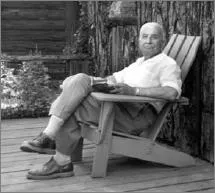
Mises on vacation in the White Mountains
Margit must have been extremely pleased to see her husband regaining energy to such an extent that he climbed most of Mount Washington's 6,288 feet.42 Near the end of their stay at Glen House, more good news came with the publication of the Atlantic Charter on August 14. The U.S. government seemed determined after all to support the United Kingdom in the war and to create a postwar order based on liberty.43
The holiday had come just in time. After the United States entered the war, vacationing was seen as unpatriotic and the Miseses abstained from it. Back in New York, he threw himself into work with new verve. From now on, things would improve in his life, slowly but steadily. In early October, he and Margit moved into the apartment where they would remain for the rest of their lives. (It was subject to rent control laws.) Margit had found the three-bedroom apartment at 777 West End Avenue in Manhattan.44
Mises's New York City West End apartment
Mises continued to work for a few weeks on the proposal for the establishment of an Eastern Democratic Union. By October, he had completed the memorandum, one of the first pieces that he himself had written in English and which contained his political testament for Eastern Europe. Mises's thoughts now turned to America. To Hayek he wrote:
As I do not want to increase further the collection of my posthumous works I am writing now in English. I hope that I will succeed to finish within a year a volume dealing critically with the whole complex of “anti-orthodox” doctrines and their consequences.
He went on:
Your essays on the Counter-revolution of Science are the most valuable contribution to the history of the decay of western civilization. I hope that you will pretty soon publish the whole book.
I am, however, rather skeptical in regard of the practical results of our endeavors. It seems that the age of reason and common sense is gone forever. Reasoning and thinking have been replaced by empty slogans.
A few days ago, Alvin Hansen delivered a lecture on post-war economic reconstruction. The old stories about full employment, scarcity of foreign exchange, the need for foreign exchange control and planning, more self-sufficiency etc. He did not even mention the problem of capital shortage. He seems to believe that taxing the rich would make it possible to maintain the pre-war standard of living of the masses. Two centuries of economic theory were in vain, as they could not kill the mercantilist prejudices. The audience—many ex-members of the Verein für Sozialpolitik—expressed full agreement with the lecturer.45
While they made preparations for the trip to Mexico, another piece of news made Mises's day and gave him hope for the future. On December 8, 1941, the United States declared war on Japan after the Japanese raid on Pearl Harbor. The Americans were finally in business. Nothing could save Hitler now. A few months later, Mises wrote to a friend, a German protestant minister in Massachusetts:
Of course, the war is a very unfortunate thing. But, you are quite right, it was inevitable and it has to be fought to the end. It is necessary to establish a new order where people who break the peace have to be treated like those who resort to violence within each country.46
Mises seems to have fallen back into what in more sober moments he called the dictatorship complex. He blithely assumed that the institutions entrusted with the “new order” would use their enormous power only for those purposes of which he, Mises, approved.47
The American entry into the war prompted various Austrian personalities to join forces and create more formal organizations to prepare the reconstruction of Austria after the war, which, they were sure, would end with an allied victory. Already in anticipation of the event, and prompted by Roosevelt and Churchill's Atlantic Charter, Richard von Coudenhove-Kalergi, a close ally of Otto von Habsburg, had submitted a petition to the U.S. government for a separate treatment of Austria after the war. Mises signed the petition, along with many other leading Austrian expatriates.48
After Pearl Harbor, the Austrian Committee assembled in several meetings during the month of December to discuss how to proceed. After a meeting on December 13, Mises prepared a one-page manifesto that outlined a political postwar order in Austria that would be based on the principle of individual liberty. The paper probably resulted from the discussions of this meeting; Mises wrote it but did not sign his name. In any case, the document enthusiastically welcomed the Atlantic Charter as the “constitution of a new community of all free people,” and it expressed the wish for an independent Austria after the war. According to the most important stipulations of the document, the new Austria would be a state of freedom and democracy, even though the question of the concrete form of state (parliamentary democracy, monarchy, etc.) was explicitly left open. Moreover, the new Austria would not insist on the title of a “sovereign” country, because sovereignty was no longer consonant with the spirit of the time, but would instead seek integration into an Eastern European Union and a new league of nations.
But the Austrian Committee was but one of many similar groups that started popping up, and Mises was also a member of Austrian Action, a group led by Ferdinand Count von Czernin.49It was clear that an effective representation of Austrian interests in America was impossible under these conditions, and the leaders of the various groups decided to join forces. In early February 1942, Mises, then in Mexico City, received a telegram with the invitation to join the newly formed Austrian National Committee. The telegram was signed by Walter Schuschnigg (possibly a relative of the last Chancellor of free Austria) and Hans Rott.50 Mises accepted membership, though he could not personally appear at the founding meeting in Manhattan, where his colleague Erich Hula represented him.51
Mises: The Last Knight of Liberalism
Read the whole book online · Book details
Free to read online and to download from this archive.