
Chapter 174 of 178 · Mises: The Last Knight of Liberalism by Jörg Guido Hülsmann
Last Honors
On October 20, 1962, Mises received the Austrian Medal of Honor (Ehrenzeichen) at the Austrian embassy in Washington. He had the embassy invite Otto Kallir for the luncheon. They also asked some of his other former students, probably those residing in Washington.51 In June 1963, he obtained an honorary doctorate from NYU; in 1964, an honorary doctorate in political science from University of Freiburg (Hayek was there during those years). In March 1969, probably in anticipation of his retirement, he was elected a Distinguished Fellow of the American Economic Association. His election may have been an attempt to influence the Nobel committee, which in the fall of the same year would grant the first Nobel Prize in economics. The prize went instead to Ragnar Frisch and Jan Tinbergen, economists who are all but forgotten today. Mises would never receive the Nobel Prize, but one year after his death, Hayek won it for his elaboration of the Misesian business cycle theory.
Mises with the Austrian Medal of Honor for Science and Art, October 1962
These official acknowledgements were gratifying, of course, but Mises did not pride himself too much on this type of recognition. Throughout his life, he remained dedicated more to his ideas than to the applause of his contemporaries. Thus he must have been even more pleased with the continued success of his books. Nymeyer had reprinted Planning For Freedom in 4,000 copies by September 1965.52 Jonathan Cape republished Socialism in 1969 and FEE ordered 1,000 copies. At the same time, Yale University Press ceded its rights to Bureaucracy, Omnipotent Government, and Theory and History, which were now republished by Arlington House.53
A young Arlington House senior editor by the name of Llewellyn H. Rockwell, Jr. was in charge of these projects. He had been a subscriber to The Freeman as a high-school student and in 1968 had moved to New York City, where he took part in FEE seminars and got in touch with George Roche.54 Rockwell only met Mises once, but he eagerly absorbed and digested his ideas. In 1982, he would establish the now famous Ludwig von Mises Institute.
A very different kind of recognition that he was happy to experience at the end of his life was the virtual vindication of his theory of economic calculation by the practitioners—the economists of the East Bloc. In the fall of 1967, a group of young economists in Communist-ruled Czechoslovakia had started reviving the socialist-calculation debate of the 1920s and 1930s in light of postwar experiences with centrally planned economies. One of them, Dr. Karel Kouba, entitled his study “Plan and Market in Socialism.” This was circulated for “internal” use of the Czechoslovak Academy of the Sciences. He studied Mises's original paper from 1920 and Hayek's later modification of the argument, as well as Oskar Lange's scheme for market socialism, about which he wrote: “Based on today's experiences one can say that this is a purely theoretical demonstration.” A colleague of Kouba's, Oldrich Kyn, went so far as to rehabilitate Mises's point of view in an article for the Ekonomická Revue, which had an international circulation and also reached Mises's desk.55 Another Czechoslovakian economist confided to Fritz Machlup: “We have now learned that Mises and Hayek were right and that Oskar Lange was an idealist.”56 A few months later, this intellectual rebellion ushered in the short-lived “Prague Spring” of 1968—almost eight months of political and economic liberalization, crushed by Soviet tanks.
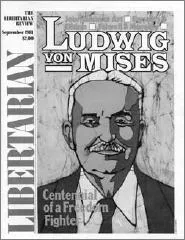
A commemorative issue of the Libertarian honoring Mises's 100th birthday
Most of all, Mises must have enjoyed the sort of recognition that comes from the concrete actions of people he had inspired. In April 1967, a man from Hollywood bound for the Vietnam War, made FEE his life insurance beneficiary. “In the event of my death I would want this money [$15,000] to be used only to place copies of Human Action by Ludwig von Mises in any libraries which will accept them.”57
On a lighter note, after a “Libertarian Conference” in Orange County, California, with Mises among the participants, local lefties carried around pictures of Marcuse, Mao, and others at a May Day demonstration on the UC Irvine campus. Mises's host wrote and asked Mises for photos to use in a counterattack.58
And on his ninetieth birthday, the CBS television show Spectrum featured a birthday special on Ludwig von Mises. The speaker, Jeffrey Saint John, called Mises “the de Tocqueville of modern economics” and observed that he had explained long ago that Nixon-style price controls are economic dictatorship and have in the past produced Communism, Nazism, and fascism.59 For the same occasion, Harper's IHS had sponsored a two-volume Festschrift, six copies of which were sent to Mises at the end of October. He was touched and commented to Margit: “The only good thing about being a nonagenarian is that you are able to read your obituaries while you are still alive.”60
However, there were a few magnificent obituaries that Mises would not be able to read.61
American Economic Review, “ In Memoriam: Ludwig von Mises, 1881–1973,” volume 64, no. 3 (June 1974): 518. Drafted (but unsigned) by Fritz Machlup:
Mises was certainly not a popular economist; by his blunt criticism of popular views and policies, by his unrelenting attacks on inflationism, interventionism, and socialism, and by his uncompromising steadfastness in arguing the case for private enterprise and free markets, he acquired as many intellectual enemies and detractors as any of the renowned economists of the twentieth century. At the same time, Mises was a beloved teacher and friend of a host of students who came to appreciate the integrity and profundity of his teachings in courses and seminars but particularly in his private seminars.
Bidinotto, Robert James. “Von Mises—A Final Salute.” Unbound! Boston: Individuals for a Rational Society 2, no. 1 (September-October 1973): 1–2:
Our age may well be labeled by future historians as “the Age of Mediocrity.” Nothing is so characteristic of this century as the ever-shrinking stature of men. Yet if these times are to be vindicated, it will be solely by the grace of a few lonely giants who stood tall and strode far, guided down unexplored paths by unflinching courage and unwavering vision....
On October 10, 1973, one of those giants fell....
Dr. Ludwig von Mises is dead at the age of 92. And it is difficult to conceive of any person in our time who has given the world so much, yet been rewarded so little in return.
Chamberlain, John. “Unsung Economist Who Was Prophet.” Chicago Tribune. Section 1 (October 13, 1973), p. 14:
Genuine innovators such as von Mises have to wait for death to gain their rightful recognition. It is all very unfair, but the truth does eventually catch up with the showmen, relegating them to the historical footnote positions where they belong.... Von Mises’ great work, Human Action, a study of the conditions needed to release an optimum amount of productive energy in a society... will live long as a monument to von Mises.
Daily Telegraph. U.K. “Ludwig von Mises.” (October 11, 1973):
With the death of Prof Ludwig von Mises yesterday, aged 92, the world's liberal economists lose their most prolific pen, and Austria loses the last lingering reminder of the intellectual pre-eminence of Vienna at the turn of the century....
As an authoritative exponent of liberal economics he has enjoyed a popularity, never foreseen, in the Asian liberal economies of Japan, Hong Kong and Formosa, and a respect, never foreseen, in the Communist countries, for his exposition of the impossibility of calculation in a full socialist society....
The gentle, witty but tenaciously logical teaching of von Mises in Europe and America earned him a loyal army of auxiliary writers and pamphleteers.
Hazlitt, Henry. Remarks at Mises's Memorial service, October 16, 1973, pp. 6–8. Multilithed by the Foundation for Economic Education (Irvington, N.Y.), pp. 6–8:
His outstanding moral quality was moral courage, the ability to stand alone, and an almost fanatical intellectual honesty and candor that refused to deviate or compromise an inch. This often cost him personally dear, but it set an ideal to strengthen and inspire his students and all the rest of us who were privileged to know him.
International Herald Tribute. “Economist Ludwig von Mises; Advanced Libertarian Theory” (October 12, 1973), p. 5:
Mr. von Mises was recognized as a brilliant contributor to economic thought not only by his disciples but also by many who disagreed radically with his political and social philosophy.
Kirzner, Israel M. Tribute in National Review 25, no. 45 (November 9, 1973): 1246, 1260:
To those who knew him, Ludwig Mises was, in the face of shocking neglect by so many of his contemporaries, a living exemplar of incorruptible intellectual integrity, a model of passionate, relentless scholarship and dedication. It will not be easy to forget these stern lessons which he so courageously personified.
McFalls, John, investment advisor. “The Passing of Ludwig von Mises.” Broadcast memorial to Ludwig von Mises, October 14–16, 1973, during Value-Action radio programs:
Mises was a master of synthesis. He brought wholeness out of the fractured field of economics. He was a scholar of great patience and integrity who believed that the movement toward collectivism and state intervention posed a grave threat to Western civilization.
Monatsblätter für Freiheitliche Wirtschaftspolitik. “Der letzte Liberale” [The last liberal] 11 (November 1973): 645:
With the passing of “the last liberal,” a liberal of the old school who occasionally said, “Liberalism, that is what I am,” the last survivor of the epoch-making Viennese School of Economics is gone at 92 years of age. Now honored by a diminishing band of followers, he has almost become a legend, on the one hand in the field of money and business cycle theory, and on the other hand and above all in the world of economic and political theory. (Translated from the German)
Peterson, William H. “Ludwig von Mises: In Memoriam.” The Wall Street Journal (October 12, 1973):
Mr. von Mises believed in choice. He believed that choosing among options determines all human decisions and hence the entire sphere of human action....
While man could destroy himself and civilization, he could also ascend—in a free society, i.e., a free economy—to undreamed-of cultural, intellectual and technological heights. In any event, thought would be decisive. Mr. von Mises believed in the free market of not only goods and services but of ideas as well—in the potential of human intellect....
He held that a free society and a free market are inseparable. He gloried in the potential of reason and man. In sum, he stood for principle in the finest tradition of Western Civilization.”
La Prensa. Buenos Aires. “Ludwig von Mises: Murió en Nueva York” [Ludwig von Mises: Died in New York] (October 18, 1973):
Mises’ life, his works and his conferences were all dedicated to rounding out the thesis that men are not automatons; they act rationally and the ideas that motivate them are the original cause of the course of history. His concepts make clear that government intervention leads inevitably not only to conflicts within a country, but also to international conflicts. (Translated from the Spanish)
Read, Leonard. Remarks at memorial service, October 16, 1973, pp. 8–9. Multilithed by the Foundation for Economic Education (Irvington, N.Y), pp. 8–9:
Ludwig Mises is truly—and I use this term in the present tense—a Teacher. More than two generations have studied under him and countless thousands of others have learned from his books. Books and students are the enduring monuments of a Teacher and these monuments are his. This generation of students will pass away but the ideas set in motion by his writings will be a fountain source for new students for countless generations to come.
Rothbard, Murray N. “Ludwig von Mises: 1881–1973.” Human Events. Washington, D.C. (October 10, 1973): 847.
Readers of Mises’ majestic, formidable and uncompromising works must have often been surprised to meet him in person. Perhaps they had formed the image of Ludwig Mises as cold, severe, austere, the logical scholar repelled by lesser mortals, bitter at the follies around him and at the long trail of wrongs and insults that he had suffered.
They couldn't have been more wrong; for what they met was a mind of genius blended harmoniously with a personality of great sweetness and benevolence. Not once has any of us heard a harsh or bitter word escape from Mises’ lips. Unfailingly gentle and courteous, Ludwig Mises was always there to encourage even the slightest signs of productivity or intelligence in his friends and students....
And always there as an inspiration and as a constant star. Inserted by Philip M. Crane in Congressional Record 119:159 (October 23, 1973) E6696- 6697.
Murray Rothbard later added:
When Mises died, and I was preparing an obituary, Professor Raico kindly sent me a deeply moving passage from Adonais, Shelley's great eulogy to Keats, that, as usual for Raico, struck just the right note in a final assessment of Mises:
For such as he can lend—they borrow not
Glory from those who made the world their prey:
And he is gathered to the kings of thought
Who waged contention with their time's decay,
And of the past are all that cannot pass away.62
Mises: The Last Knight of Liberalism
Read the whole book online · Book details
Free to read online and to download from this archive.