
Chapter 138 of 178 · Mises: The Last Knight of Liberalism by Jörg Guido Hülsmann
Libertarian Seedbeds
Many Americans had grown weary of the New Deal during the second term of President Roosevelt's administration. More and more people realized that their president had brought about a revolution in the American system of government. But the majority gave FDR a third term. The president promised to keep America out of the new European war that would eventually turn into World War II. When Roosevelt went back on his word, the majority started to wane. The population still stood behind the commander in chief in a time of war, but the disenchantment with New Deal policies became ever more manifest. People started listening to critical voices, and these voices could now be heard everywhere.
Isabel Paterson in The God of the Machine (1943) and Rose Wilder Lane in The Discovery of Freedom (1942) had delivered passionate and widely noticed indictments of the omnipotent state undermining individual liberty. John T. Flynn had exposed the socialist agenda and impact of the federal government's interventions in The Roosevelt Myth (1948) and As We Go Marching (1945). In early 1944, Felix Morley, John Chamberlain, and Frank Hanighen founded the weekly journal Human Events. Their mission was to educate the American public about the uncomfortable fact that their federal government had been taken hostage by socialist and Communist ideologues. The public also listened for the first time to the voice of two Austrian émigrés. Mises came out with two books in 1944: Omnipotent Government and Bureaucracy, both of which were calculated to diminish the faith in the necessity and expediency of solving social problems with the brutal force of state power. And in the same year Friedrich August Hayek published The Road to Serfdom, the book that made him famous.
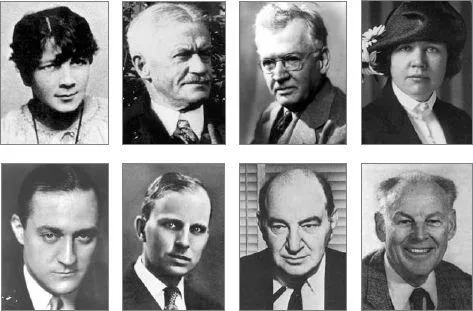
Top: Isabel Paterson, Albert Jay Nock, John T. Flynn, Rose Wilder Lane bottom: Henry Hazlitt, Benjamin Anderson, Frank Chodorov, and John Chamberlain
Intellectuals held no monopoly on critical inquiry into the nature and scope of the Roosevelt government. Ordinary citizens without any scientific pretensions now rediscovered the old American virtue of distrusting their government. Wherever they looked, they found their worst fears confirmed. And now they not only noticed, but also recorded and spread their discoveries. One example illustrates the situation: An entrepreneur from Houston running a small printing company had started wondering just how many federal agencies had actually been created under the New Deal. There was no ready reference for the information, so he decided to create one himself. He produced an alphabetical listing of all the agencies, the length of which must have been breathtaking—at least in those days. At first he had just printed a small number of flyers for his friends, acquaintances, and people on his local mailing list. The response was overwhelming. After a few months, he had sold almost 200,000 copies—and in each case it was the buyer who approached him.6
The most visible turning point for the fortunes of classical liberalism came on September 18, 1944. On this day, F.A. Hayek's book The Road to Serfdom appeared in the United States and met with huge and immediate success. Reader's Digest condensed the book and had more than one million copies distributed by the Book-of-the-Month Club.7 Overnight, Hayek became an international celebrity.
Nobody was more surprised by these events than Hayek and his publisher. There were four major factors to his unexpected success. First, Hayek did not come up with any new argument, but just gave a particularly eloquent and sophisticated presentation of a position that, before the war, had already found wide acclaim among the American public. The central argument of The Road to Serfdom was in fact that increased powers for government were tantamount to reduced sovereignty for the individual citizens, and that total government control turned the citizens into slaves—regardless of whether the totalitarian state was fascist or Communist. Second, the war years had dramatically accelerated this increase of powers of the U.S. federal government and thus raised awareness of and misgivings about this fact among a greater number of people. Third, again echoing other neo-liberals, Hayek defended what seemed to be a pragmatic middle-of-the-road solution that appealed to the American mind. He emphasized that he did not advocate laissez-faire but a new brand of liberalism.8 Fourth, and finally, Hayek weighed in with the full authority of an academic economist who was well-known and respected in the United Kingdom, a fact that to the present day can arouse Americans' intellectual inferiority complex.
For staunch defenders of liberty, Hayek's neo-liberalism was of course far too soft on government. The positive program of The Road to Serfdom left the government in control of economic life. The economy was still to be a planned one, with the government in charge of all the planning. Hayek merely suggested that this planning be for competition rather than the detailed control of all market participants. This was a naïve approach from any realistic political point of view, and some thought it was indefensible from an intellectual point of view as well. Commenting on Hayek's program, Frank Chodorov exclaimed: “How silly!” and made it clear that he thought the program verged on intellectual cowardice.9
Mises was very happy about the success of the book. However, he too thought that Hayek had made his case in misleading terms. Hayek had singled out economic planning as the root cause of the various policies that threatened political and economic freedom. But there is no danger in planning per se. The real question is: who should do the planning, and how should the plans be applied? Should there be only one plan imposed by the power of the state on all citizens? Or should there be many different plans, made by each individual or head of household? Mises emphasized this crucial distinction in a speech delivered on March 30, 1945 to the American Academy of Political Science. He left implicit the fact that his speech was a critical review of Hayek's book.10
A few days later, on April 3, Hayek arrived in New York to start a Road to Serfdom lecture tour. It was the first time he saw his old mentor in America.11 The book and the lecture tour trumpeted the dawn of a new era. The sale of thousands of copies signaled to everyone that the American population still harbored strong affections for liberal ideas, and that these feelings had huge political potential.
The most momentous initiative to exploit this potential was, we can see in retrospect, the decision of Leonard Read to quit his lucrative position at the Los Angeles chamber of commerce at the end of April 1945, and to move to New York as an Executive Vice President of the National Industrial Conference Board. Read sensed the potential for a huge interest in laissez-faire liberalism and its underpinnings in economic science à la Mises. And he understood that liberty had to be defended as an integrated whole, not in a piecemeal fashion with many concessions. But looking around in 1945, he was amazed to discover that there was not one institution to satisfy this demand for information, and certainly none ready to support or promote classical-liberal scholars and students. Many years later, he summarized his discoveries in four points:
Number one, [the freedom philosophy] wasn't issuing from any place on the face of the earth. Number two, there wasn't a magazine in the country that would take one of our articles. Three, there wasn't a book publisher that would take one of our books. Number four, just twenty-six years ago [in 1945] there did not exist a consistent literature of this philosophy written in modern American idiom. That's how far down the drain this philosophy was.12
The National Industrial Conference Board was an educational institution the purpose of which was to provide information about economic science and the functioning of the American economy to classroom teachers all over the country. Read had been hired along with Garet Garrett and others to establish a new nationwide educational program. The express purpose of the new program was to inform teachers, journalists, and intellectuals (the “secondhand dealers in ideas” as Hayek called them13) about the importance of individual liberty for economic prosperity and society at large. Read's mission was to raise the necessary funds.
Mises was aware of Read's effort. When, in May 1945, he received a request from Mr. Allman, the vice president of the Fruehauf Trailer Company, inquiring what could be done in terms of organizational work to give the “individual, private enterprise way of living and doing business” political leverage, Mises replied that friends of his were elaborating a plan for imminent action.14 He had probably talked again with Read about his pet project: the establishment of a libertarian journal of opinion. Human Events had been launched the year before, but Mises was not happy with its one-sided focus on anti-Communism. The problem was not just the increase of government interventionism in the name of Communist ideals; the problem was that the government intervened at all. A libertarian journal of opinion would have to educate the public about basic economic laws.
Mises: The Last Knight of Liberalism
Read the whole book online · Book details
Free to read online and to download from this archive.