
Chapter 14 of 178 · Mises: The Last Knight of Liberalism by Jörg Guido Hülsmann
Military Service and Death of His Father
On October 1, 1902 Mises presented himself as a one-year volunteer at the Imperial and Royal Division Artillery Regiment number 6 (later renamed the Imperial and Royal Field Cannon Regiment number 30).24 Jews had been subject to military obligations after 1788. They were usually employed in transport and the artillery, thus Mises was a typical case.25 He spent exactly one year in his regiment, which was stationed near Vienna, and returned on September 30, 1903 to his studies. In the following years, he was mobilized twice as a reserve officer within the same regiment, in 1908 and 1912, during political crises between Austria-Hungary and Russia. He would have to resume his duties in 1914, under even less pleasant circumstances.
The Austrian army had not won a war since the defeat of Napoleon in 1815. It had lost the Italian campaign in 1859 with the battle at Solferino and had also lost the important battle against the Prussian forces at Königgrätz in 1866. But this lack of success did not prevent it from enjoying an overwhelmingly positive reputation in all parts of the Habsburg empire. It was the most visible sign of the empire's unity and security. In those days, army troops and their activities were a highly visible element of everyday life. Where present-day troops are typically stationed away from cities, their activities hidden from the eyes of the average citizen, the Austro-Hungarian troops were stationed inside the towns and cities of the empire. They exercised within view of the civilian population and their appearance set a standard for discipline and elegance.
Of the old institutions of the empire, the army seems to have been the most democratic in character. The career of an officer was open to virtually all strata of the population, and officers paid each other tribute and solidarity regardless of social background. Most of them addressed one another in private conversation with the familiar “Du”—insinuating that each bearer of His Majesty's port epée was a nobleman and an equal among equals. Yet while recognition and prestige within the officer corps depended mainly on individual performance, admission to the higher ranks required admission to the Kriegsschule (war school), which necessitated personal connections. Here the old nobility had a net advantage whereas Jewish origin was a handicap.26
The bottom line was that the majority of ambitious and talented young men from low nobility or bourgeois circles were effectively deterred from considering a military career. Alumni from a gymnasium could obtain the commission of a reserve officer by volunteering for one year, and virtually all of them did this because of the military prestige it conveyed, which in turn was very helpful for obtaining employment in all other fields. Many of them volunteered directly after leaving the gymnasium and then enrolled in university afterward. Others, like Mises, chose to volunteer after the first two years of university because the service gave them a break from their intense studies. They received the officer's commission after a year of service and an easy-to-pass exam that certified their ability to be an officer.
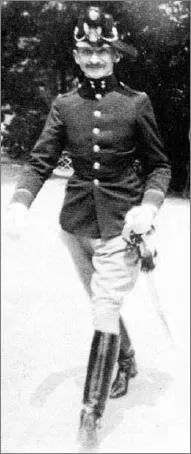
Lieutenant Mises of the Imperial and Royal Field Cannon Regiment 30
Mises was patriotic and proud to wear the uniform of the Imperial and Royal army, but he had no militaristic inclinations. He never related details or boasted about his one-year service. All in all, this period seems to have been unexciting for him.
It was also a sad period of his life, marked by three tragic deaths. One of the last times Ludwig saw his father alive was at the burial of his uncle Felix. As saddened as he was by his uncle's passing, it could not compare with the death of his father later the same year. Arthur von Mises had suffered from a gall bladder condition for years and regularly sought relief in health resorts. Following his brothers's death in the summer of 1903, Arthur and his wife went to Karlsbad. By September his condition had noticeably deteriorated so they left for Halberstadt where he underwent surgery on October 1. He died the same day. He was forty-nine. Ludwig attended his burial four days later.
On the day before, October 4, twenty-three your old Otto Weininger had killed himself, to the great consternation of his friends Kelsen and Mises. Suicide was in vogue in those days, especially among young people. Even Prince Rudoph, the Habsburg dauphin, had killed himself in 1889. Weininger sought a theatrical exit. Only six months after he had made a splash with the first edition of his Sex and Character, he rented an apartment in the house where Beethoven had died and shot himself on the master's piano.
Mises's father, Arthur Edler von Mises, at 42
Mises: The Last Knight of Liberalism
Read the whole book online · Book details
Free to read online and to download from this archive.