
Chapter 75 of 178 · Mises: The Last Knight of Liberalism by Jörg Guido Hülsmann
Socialism = Destructionism
Mises's analysis of socialism left nothing intact of the grandiose edifice that Marx and many other generations of socialist writers had worked to build.59 But then what was the true significance of socialism? The answer seemed by now to be apparent:
In fact Socialism is not in the least what it pretends to be. It is not the pioneer of a better and finer world, but the spoiler of what thousands of years of civilization have created. It does not build; it destroys. For destruction is the essence of it. It produces nothing, it only consumes what the social order based on private ownership in the means of production has created. Since a socialist order of society cannot exist, unless it be as a fragment of Socialism within an economic order resting otherwise on private property, each step leading towards Socialism must exhaust itself in the destruction of what already exists.60
The work of destruction had been under way for a long time. Intellectuals and artists had been at the forefront of this movement:
One can say without exaggeration that nothing has been prepared so thoroughly and from all sides for decades than the general collapse of European social order and morals, which we have experienced and still experience daily. All sciences and arts have contributed their part to it.61
Here Mises sounds not unlike Carl Ludwig Haller, one of the great nineteenth century European “reactionary” thinkers, who claimed that the egalitarian “spirit of destruction” characterized the Jacobin liberal movement and the French Revolution. Haller argued that egalitarian programs are always smashed on the hard rock of natural social inequalities. Rather than abandoning their impossible goal, the egalitarians set out to transform the world according to their scheme. They led a war against all forms of authority and all social institutions that sprang from them: scholarship, Church, priesthood, nobility, government, family, parents. But because this war merely destroyed the specific social bonds that resulted from inequalities, and not the factual existence of these inequalities, the Jacobins destroyed society. Anticipating Mises, he observed:
If not everything has collapsed, if we could salvage some fragments of society, this is only thanks to the material impossibility of executing [the Jacobin program], to the sometimes blatant nonsense and the happy inconsistency of human beings, even in evil things.62
Mises and Haller certainly agreed on the fact of egalitarian destructionism, but Mises did not join Haller in condemning all institutional innovation after the French Revolution. Neither did he join English professor F.J.C. Hearnshaw in representing socialism as systematized robbery. Bringing the notion of robbery into play was much too moralistic for Mises's taste. The point was a technical one: socialism was just impossible. Commenting on Hearnshaw, Mises wrote to a correspondent at the London School of Economics:
I entirely agree with you that it is quite wrong to consider socialism as robbery. The socialist system would be just as honest and fair as the capitalist one if a social order based on common ownership of the means of production was feasible.63
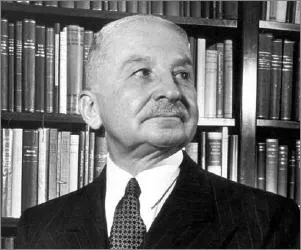
Mises in his study in the late 1940s
Mises: The Last Knight of Liberalism
Read the whole book online · Book details
Free to read online and to download from this archive.