
Chapter 109 of 178 · Mises: The Last Knight of Liberalism by Jörg Guido Hülsmann
Twilight in Vienna
The discussion of the epistemology of economics was continued in Mises's private seminar in Vienna, where his views found far more opposition (and more competently offered) than in Dresden. Several members of the seminar, including Felix Kaufmann and Robert Wälder, were also members of a discussion group of the positivistic philosophers, the Vienna Circle. These men brought a completely different perspective to the problems, and the clash of their views with the opinion of the seminar director was a highlight in the history of those gatherings. Much of the fame that later accrued to the seminar through the recollections of its prominent participants was due to the methodological debates in the last years of its existence. Mises characterized them as “vivid, even outright passionate.”143
The brilliance of the discussions in the academic year 1933–1934 happily combined with the presence of a significant number of distinguished guests. Mises was at this point more than just a well-known author. He was a recognized leader among German-speaking economists. After his election to the Board of the Verein für Sozialpolitik in early 1929, the private seminar attracted an increasing number of guests, especially from foreign countries. Alvin Hansen came in 1929, Frank Knight for a stint in May 1930, Carver, Batson, and others in 1931. But the absolute high point was in 1933–1934, when four scholars from Japan (Itschitani, Midutani, Otaka, Takemura), plus Hugh Gaitskell, Ragnar Nurkse, Karl Pribram, François Perroux, Gerhard Tintner, and Emmanuel Winternitz, to name just the more prominent guests, attended the sessions.144
On March 9, Mises gave the opening talk to a debate that would fill the next three months and which more narrowly concerned the question of whether economics was an aprioristic science of human action. Mises presented his case and also addressed the position of Kaufmann, who held that economic science was based on (potentially fictional) stipulations arrived at through conventions.145 Mises's paper highlights the reason why his position was not very convincing to the other participants. More than in his previous written essays, he stressed that economic theory was an a priori discipline because it could not be verified or refuted in laboratory experiments. This line of argument was rather unsatisfactory because it seemed to draw epistemological conclusions from a mere technical difficulty. At any rate, it was unpersuasive to the next four presenters.146
In the wake of the economic crisis in 1931, the Christian Socialists had proposed a coalition government to the socialists under Bauer. When Bauer refused, voters shifted increasingly to the Austrian National Socialists. Christian Socialists now believed that the best way to hold back the tide of national socialism was to use authoritarian methods to suppress opposition to the government. These tactics were decisively intensified after the National Socialists rose to power in Germany on January 30, 1933. Many observers expected that Austria too would now fall into their hands, especially since they supported their Austrian branch organization through media campaigns and terror bombings against the Austrian government and its allies.147
Desperate in its quest to stop the Nazi tide and keep Austria independent, the government under Engelbert Dollfuss concluded an alliance with Fascist Italy, but also resorted to authoritarian methods in its domestic policies.148 Dollfuss abolished the parliamentary republic, using a suitable opportunity on March 4, 1933 when all three presidents of the parliament stepped down in protest against a questionable procedure. The last of the three officially convened the parliament for March 15, but now Dollfuss stepped in, convinced the Christian Socialist parliamentary faction to support his coup d'état, and sent in the police to prevent a consolidation of the (pro-German) social democrats and German nationalists on March 15. In the course of the next few months, Dollfuss also abolished the Communist party and the Austrian branch of the German Nazi party. Henceforth he ruled dictatorially, on the basis of an emergency law passed in 1917. On May 20, he established the Vaterländische Front (Patriotic Front) to rally all forces loyal to the Austrian state. Dollfuss proclaimed at a rally on September 11, 1933 that his fatherland would now become the “socialist, Christian, and German State Austria, based on its estates and with a strong authoritarian leadership.”149
Ideologically, the Dollfuss regime relied on state-of-the-art Catholic political and social theory, as embodied in the writings of Othmar Spann and Pope Pius XI, both of whom glorified social order based on the respect of the professional Stände or estates.150 While Spann's views had a deep impact on the German-speaking world, his influence could not match Pius XI's encyclical Quadragesimo Anno (1931), which was a shot in the arm for the corporatist movement. As one of Mises's correspondents from Switzerland reported, young Catholic politicians were entirely imbued with its ideas, even more than those of Othmar Spann.151
In February 1934, the socialists rose one last time against the Dollfuss dictatorship, when the police tried to seize a social democratic arms depot in the provincial town of Linz. Dollfuss had their revolt bloodily repressed and lost no time using the opportunity to oust the social democrats from parliament. The leftover deputies then voted for a “new constitution” that in its essential lines returned to the pre-1907 constitutional model. Members of parliament were no longer elected by universal suffrage, but appointed from among members of the major “estates” such as landowners, clerics, labor unions, industrialists, etc. The new constitution was proclaimed on May 1, 1934. On July 25, 1934, Engelbert Dollfuss was murdered in the wake of an attempted national socialist coup d'état. German troops then marched onto the northern border of Austria and were called back only because Mussolini had concentrated his army on the southern border, pledging to guarantee the country's independence. From that day on, Austria's fate lay in the hands of the Italian government.152
In the course of these events, life in Vienna became increasingly unpleasant for Mises. As in World War I, there was once again an official government censor. For some years, Fritz Machlup had written weekly editorials for the Neue Freie Presse. He stopped in May 1934 when it became pointless to write on the few topics still free from censorship. At that point, Machlup received a Rockefeller stipend to go to the United States, following in the footsteps of Voegelin and Haberler. Now Mises himself would leave, to the great regret of his circle of friends and colleagues, who bid him farewell at the high point of their many years in his private seminar.
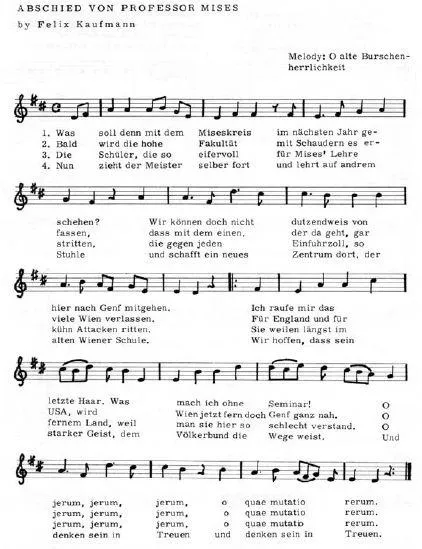
Felix Kaufmann rhymed one last time:
Farewell to Professor Mises
What is going to become of the Mises Kreis
In the year that's coming?
Geneva can't for all suffice,
My fingers won't stop drumming.
The question will not leave me be,
The seminar means everything to me...153
Das Mises-Kreis-Lied
Liebe Kinder, weil heute Freitag ist,
Gibt es Mises-Privatseminar.
Und dort geh ich hin, auch wenn ein Maitag ist,
Süß und duftend wie keiner noch war.
Denn der Blütenduft muß vergehen,
Doch die Wahrheit die bleibt bestehen.
Und die Wahrheit findest Du im Mises-Kreis
Jeden Abend zentner- und scheffelweis.
Fängt man richtig zu streiten erst an,
Denn Debatten die habn dort an Schan!
I geh heut abend zum Mises hin,
Weil ich so gern dort bin,
Man spricht ja nirgends so schon in Wien
Über Wirtschaft, Gesellschaft und Sinn.
Und willst Du recht das Verstehen verstehen,
Mußt à tout prix Du zu Mises auch gehn,
Weil man das nirgends sonst deutlich weiß
Als nur im Mises-Kreis.
Is auch ein Problem noch so konsistent,
Traut sich gar nicht zur Tiire herein,
Denn es weiß sehr wohl, daß Gefahr es rennt,
Aufgelost binnen kurzem zu sein.
Sind auch noch so hart manche Niisse,
Knackt man doch sie durch kluge Schliisse,
Bis die Kerne uns auf der Zung zergehn,
Wie sonst nur noch die siißen Pralineen,
Die ein glitiger Geist offeriert,
Daß das Schweigen nicht gar zu schwer wird.
(Refrain)
1st der Geist urn zehn Uhr mit Weisheit voll,
Flihit der Magen sich traurig und leer,
Doch erhalt er bald seinen Einfuhrzoll,
Denn wir gehn in den grünen Anker.
Dort ist die Frohlichkeit unser Motto
Bei Spaghetti und bei Risotto.
Wie die Zeit vergeht, keiner hatts gedacht,
Denn auf einmal schlagt es schon Mitternacht,
Doch jetzt kommt die genialste Idee:
Man geht noch in das Kunstlerkaffee.
(Refrain)
Manchmal denkt man sich, hat denn einen Sinn
Diese ganze Problemspalterei?
Draußen fließt derweil froh das Leben hin
Und selbst ist man so wenig dabei.
Wars nicht kliiger, im Strom zu schwimmen,
Als die Wasserkraft zu bestimmen?
Ließ man nicht besser alles Denken sein,
Lebte einfach froh in den Tag hinein
Und genosse des Augenblicks Rausch?
Doch man weiß ja, hier gibts keinen Tausch.
(Refrain)
The Song of the Mises Circle
Come and gather all around, it's Friday
Time for Mises's Privat Seminar.
I'll be there for sure, even if it's May
And the day is the sweetest thus far.
Oh, the fragrance fades, it is certain
But truth, you'll find, knows no curtain.
In the Mises Kreis, it's always center stage
Buckets full of truth, remain the latest rage.
And when you begin to debate,
You know that the hour will grow late!
You'll find me with Mises tonight, tonight
No longer do I need to roam.
Society, Economy and Truth, that's right
Are debated, defended, I'm home!
And if you desire Verstehen's made clear
At all costs, you must come, get yourself here!
For clarity, wisdom and truth entice,
Here at the Mises Kreis.
Do you know a problem full of nasty quirks,
Come escort it to Mises's door.
It will know full well this time that danger lurks
As it's whittled right down to its core.
Many shells, of course, know the same fate
Nuts so hard to crack, but at this rate
They will melt on tongues that know deductive prose,
Like the chocolate creams, our friend so kindly chose,
Making silence a happy refrain,
But now let us all sing again:
(Refrain)
Ten O'clock comes 'round, and wisdom's filled our minds,
But our bodies demand ever more.
That Green Anchor calls, and here our stomachs find,
Import tariffs to even the score.
Here's where ERE is our motto,
Have spaghetti, and eat risotto.
No one ever dreams how fast the time can race
Midnight rings, we take our favorite place
In that nice little Kunstler Café;
An ingenious end to the day.
(Refrain)
Oh the time, it comes, when we must question why,
Is such questioning really that smart?
Life goes on and on, it just keeps flowing by,
And we all play a very small part.
We could swim along, take no notice
Of the tide's direction, the world's focus.
Should we not, keep these thoughts at bay,
Push our cares aside, and relish what's today.
And yet there's no tradeoff at hand,
Somehow we must take a stand.
Mises: The Last Knight of Liberalism
Read the whole book online · Book details
Free to read online and to download from this archive.