
Chapter 18 of 68 · Money, Bank Credit, and Economic Cycles by Jesus Huerta de Soto
5. Credit Expansion and New Deposit Creation by the Entire Banking System
We have already observed the great capacity isolated banks have for creating fiduciary loans and deposits. In fact, they are normally able to double their money supply on their own. We will now see how the fractional-reserve banking system as a whole generates ex nihilo a much larger volume of deposits and brings about much greater credit expansion. Indeed, in this respect the fractional-reserve system produces effects resembling those of a monopolistic bank. We will base our demonstration on the most general case, a banking system comprised of a group of normal banks, each of which maintains cash reserves, c, of 10 percent. Also, on average, the customers of each fail to withdraw 20 percent of loans granted (or 20 percent of fiduciary media return to the bank because a significant number of the final recipients are also clients of the bank). Hence, k =20 percent.
Let us suppose that Mr. X deposits 1,000,000 m.u. in Bank A. The bank would then make the following entry in its journal:
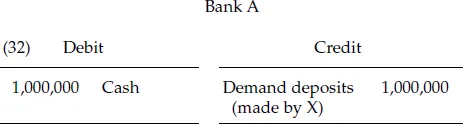
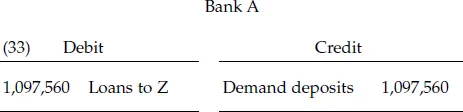
Bank A would then be able to create and grant loans to Z for a sum determined by the formula in [3]. The following entry would result:
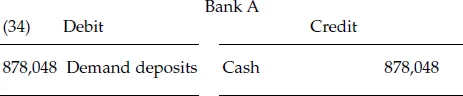
And since k =0.2, 80 percent of loans granted would be withdrawn, resulting in the following entry:
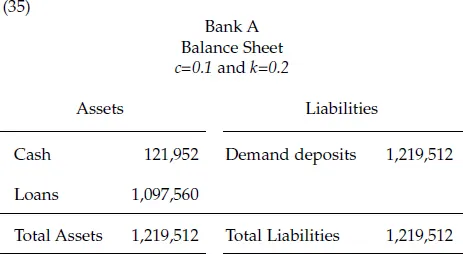
The balance sheet of Bank A following these entries would look like this:
Let us suppose that when Z withdraws his deposit he pays Y, who is a customer of Bank B and deposits the money there. Three entries parallel to the above three would result. Formula [3] would again be used to determine the amounts.
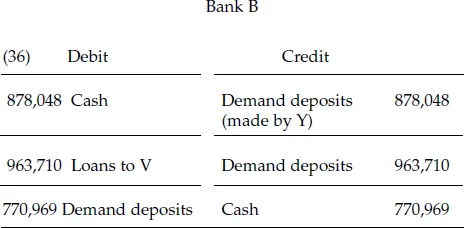
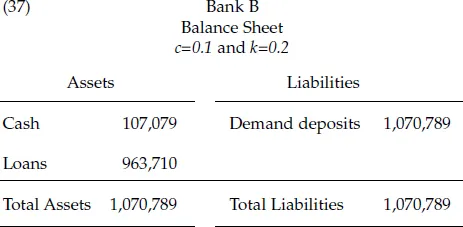
After these operations, Bank B's balance sheet would appear as follows:
If we imagine that V pays his debts to U, who in turn deposits the money he receives in his bank, Bank C, then the following journal entries would result:
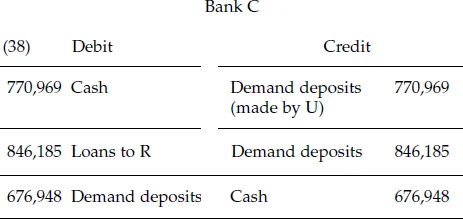
The bank would make this last entry when R withdraws 80 percent (k =0.2) of his loan from Bank C to pay his creditors (T, for example).
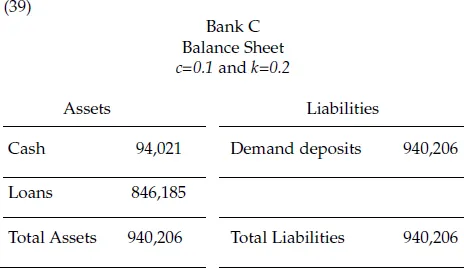
Once these operations have been completed, Bank C's balance sheet would appear as follows:
And if Creditor T, upon receiving the money he was owed, deposits it in his own bank, Bank D, these entries would result:
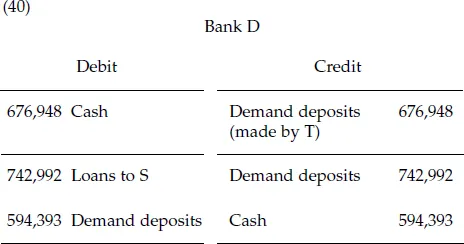
The bank would make this last entry in its journal when S pays his creditors.
At this point, Bank D's balance sheet would appear as follows:
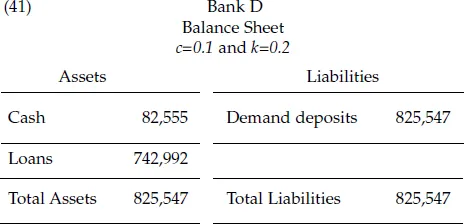
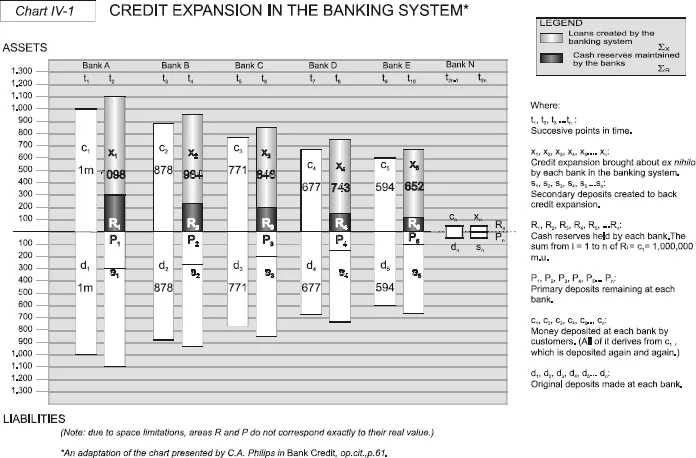
The process continues in this way, and the chain of deposits and loans extends to all banks in the system. Once the effects of the original deposit of 1,000,000 m.u. have completely disappeared, the total deposits created by the banking system would be the sum of the following sequence:
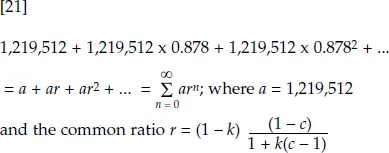
This is due to the fact that, in our example, r would be equal to 80 percent (1 – k) of the proportion of deposits newly created by each bank at each stage. This proportion comes from formula [3] and is equal to:

Therefore: [22]


And since |r| <1, we apply formulas [11] and [12].

Thus the sum of the deposits in the banking system, D, would be equal to:

In this example, ds1 represents Bank A's secondary deposits and equals 1,219,512 m.u.
The net credit expansion, x, brought about by the entire banking system would equal:
[25] x = D - d = 10,000,000 - 1,000,000 = 9,000,000
A summary of these results appears in Table IV-1 and Chart IV-1. Details are given for each member bank in the banking system.
CREATION OF LOANS IN A SYSTEM OF SMALL BANKS
Let us now suppose that all the banks in the system are very small. They each have a k equal to zero and a c equal to 0.1. If we follow the pattern of past entries, the journal entries for this banking system would look like this:
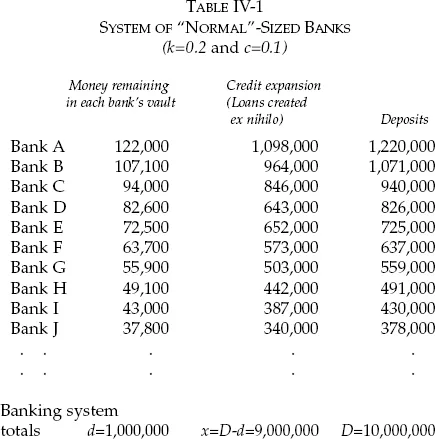
Note: The last three digits have been rounded.
When a demand deposit of 1,000,000 m.u. is made at Bank A:
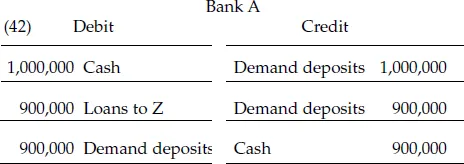
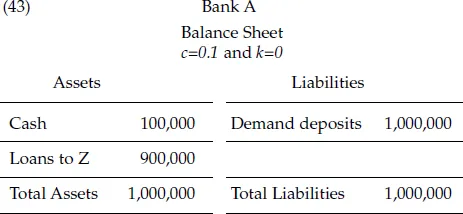
When Z withdraws 900,000 m.u. to pay Y, Bank A's balance sheet would appear as follows:
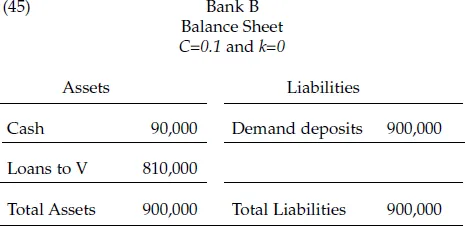
If Y, in turn, deposits the 900,000 m.u. in his bank, Bank B, also a small bank with a k equal to zero and a c equal to 0.1, the following journal entries would result:
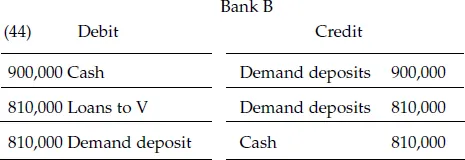
And Bank B's balance sheet would look like this:
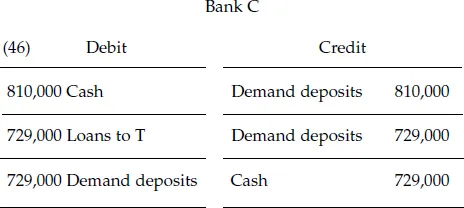
Now, if V withdraws the loan from his bank to pay U, and U deposits the money in his bank, Bank C, also a small bank with a k equal to zero and a c equal to 0.1, these would be Bank C's entries:
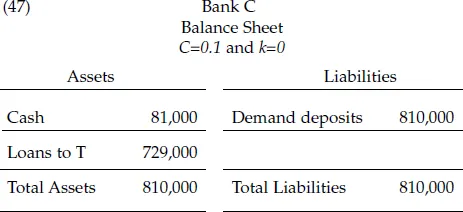
And Bank C's balance sheet would look like this:
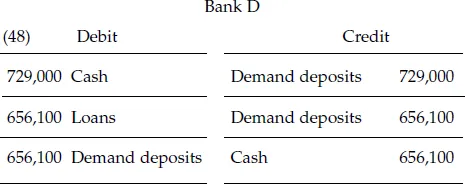
When T pays his creditor, S, and S deposits the money in his bank, Bank D, also small, with a k equal to zero and a c equal to 0.1, the following entries would result:
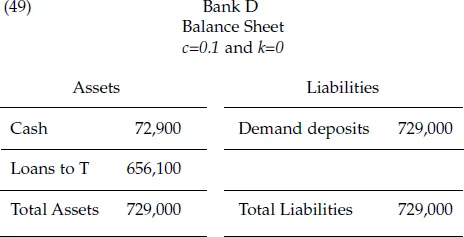
In turn, Bank D's balance sheet would appear as follows:
The total deposits in a system of very small banks is equal to the sum of a sequence identical to the one in formula [8], which referred to a monopolistic bank:
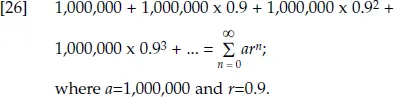
As shown in footnote 27, this sum is in turn equal to:

As a=d= 1,000,000 m.u. originally deposited, the total deposits would be indicated by the formula:

This formula is identical to the deposit multiplier in the case of a single, monopolistic bank [14].
Let us also remember that:

In view of the fact that the banking system is in this case composed of small banks and k =0, if we substitute this value for k in formula [28], we obtain r =1-c =0.9, which we already knew.
Therefore, an entire banking system comprised of small banks brings about a volume of deposits (10,000,000 m.u.) and a net credit expansion (9,000,000 m.u.) identical to those of a monopolistic bank for which k =1. These results are summarized in Table IV-2.
A system of small banks (where k =0) is clearly an exception within the overall banking system (where k is less than 1 but greater than 0). However, it is an easy example to understand and therefore in textbooks is generally the model used to explain the creation of credit money by the financial system.30
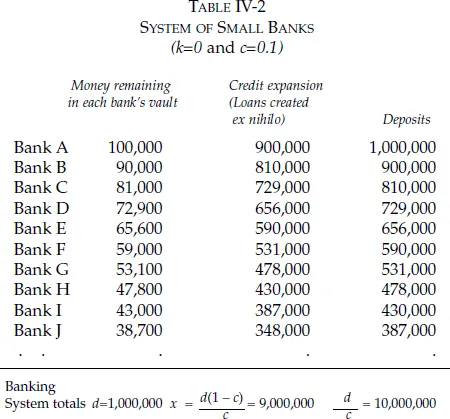
Note: The last three digits have been rounded.
It is also true that a banking system composed of one monopolistic bank (when k =1) is a unique instance within the broader category of isolated banks which expand deposits and loans.
To conclude, two particular cases lead to identical results regarding new loans created (9,000,000 m.u.) and the total volume of deposits (10,000,000 m.u.). The first case is a banking system made up of tiny banks, each with a k equal to zero. The second is an isolated bank with a k equal to one. Given that both cases are easy to comprehend, they are generally chosen as examples in textbooks to explain the creation of loans and the volume of deposits generated by the banking system. Depending upon the text, the author refers either to a system of tiny banks or to a single, monopolistic bank (or one whose customers are the final recipients of the loans it grants).31
Money, Bank Credit, and Economic Cycles
Read the whole book online · Book details
Free to read online and to download from this archive.