
Chapter 52 of 68 · Money, Bank Credit, and Economic Cycles by Jesus Huerta de Soto
6. Appendix on Life Insurance Companies and Other Non-Bank Financial Intermediaries
The analysis of the last four chapters has put us in a position to understand the important role true financial intermediaries play in the economy. Logically, we use the term true to describe those non-bank financial intermediaries which create ex nihilo neither loans nor the corresponding deposits, and which merely act as middlemen in the market in which present goods are exchanged for future goods. In other words, financial intermediaries simply take money from lenders offering present goods and hand it over to borrowers. In return for their service as mere intermediaries they receive a profit, which is generally small. This slender profit margin contrasts with the disproportionate gains the aggregate of banks accumulate when they create money ex nihilo in the form of loans, an activity they pursue thanks to the legal privilege which permits them to make self-interested use of most of the money deposited with them on demand.
Although with tiresome insistence banks are claimed to be the most important financial “intermediaries” in the economy, this is a baseless, unrealistic notion. Banks are essentially not financial intermediaries. Their main activity consists of creating loans and deposits from nothing (and is apart from their function as true financial intermediaries, a role of secondary importance, both quantitatively and qualitatively speaking).103 In fact banks and the banking system have not taken on a major role in modern economies because they act as financial intermediaries, but because they typically create loans, and thus deposits, ex nihilo, thereby increasing the money supply. Hence it is not surprising that banks are capable of distorting the productive structure and the behavior of economic agents, who find the great relative ease of acquiring present goods from a bank enormously tempting. In comparison, it is more difficult to obtain resources drawn from real voluntary savings. Saving always involves greater initial sacrifice and discipline on the part of third-party savers, and it is comparatively much harder to accomplish.
Therefore it is absurd to maintain, as is sometimes heard, that owing to the insufficient development of the capital market and of non-bank financial intermediaries, banks “have had no choice” but to take on a prominent role in the financing of production processes. Indeed the exact opposite is true. Banks’ expansionary capacity to grant loans from nothing inevitably robs the capital market and non-bank financial intermediaries of a significant part of their economic prominence, since the banking system, which can expand loans without anyone's having to first sacrifice immediate consumption by voluntarily saving, is always much more likely to grant a loan.
Once the general public begins to correctly identify the evils of bank credit expansion, to understand that the expansion process depends on a legal privilege no other economic agent enjoys, and to see that the process inevitably provokes consecutive cycles of boom and depression, the public will be able to instigate a reform of the banking system. Such a reform will be founded on the reestablishment of a 100-percent reserve requirement for demand deposits, i.e., on the application of traditional legal principles to banking operations. Once this reform has been introduced, the proper status will be restored to the capital market and to true financial intermediaries, i.e., non-bank intermediaries, who by their very nature, are those entrepreneurs who specialize in convincing economic agents of the importance and necessity of short-, medium- and long-term saving, as well as in efficiently connecting lenders and borrowers, spreading risk and taking advantage of the corresponding economies of scale.
LIFE INSURANCE COMPANIES
AS TRUE FINANCIAL INTERMEDIARIES
The social significance of life insurance companies sets them apart from other true financial intermediaries. In fact the contracts offered by these institutions make it possible for broad layers of society to undertake a genuine, disciplined effort to save for the long term. Indeed life insurance provides the perfect way to save, since it is the only method which guarantees, precisely at those moments when households experience the greatest need (in other words, in the case of death, disability, or retirement), the immediate availability of a large sum of money which, by other saving methods, could only be accumulated following a very prolonged period of time. With the payment of the first premium, the policyholder's beneficiaries acquire the right to receive, in the event of this person's death, for instance, a substantial amount of money which would have taken the policyholder many years to save via other methods.
Moreover life insurers develop and operate large commercial networks which specialize in emphasizing to families the fundamental importance of committing to long-term, disciplined saving, not only to prepare for the possible misfortunes associated with death, disability, or illness, but also to guarantee a decent income in case of survival beyond a certain age. Thus we could conclude that life insurance companies are the quintessential “true financial intermediaries,” because their activity consists precisely of encouraging long-term saving in families and channeling saved funds into very secure long-term investments (mainly blue-chip bonds and real estate).104The fact that life insurance companies do not expand credit nor create money is obvious, especially if one compares the contracts they market with banks’ demand deposit operations. The accounting entries typical of a life insurance company are as follows:
Once the company has convinced its customers of the importance of initiating a long-term plan of disciplined saving, the customers pay a premium to the company each year for the duration of the life insurance contract. The premiums are considered part of the insurance company's income, as shown below:
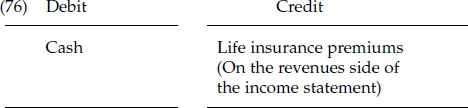
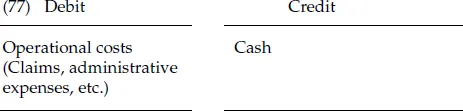
Life insurance companies use the premiums they receive to meet a series of operational costs, primarily claims costs, marketing and administrative expenses, and other expenses involved in the technical coverage of the risk of death, disability and survival. The entry which follows the payment of these technical costs appears below:
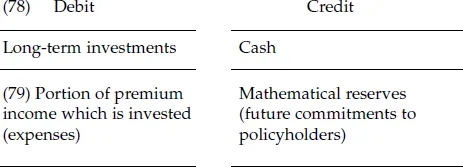
We should point out that operational costs absorb only a portion of the total amount paid in premiums to life insurance companies, which must reserve a significant part of their premium income to cover not only future risks (since companies charge constant annual premiums for the coverage of risks which increase in probability as policyholders grow older), but also the important saving component usually incorporated in the most popular types of life insurance. This second share of the premium total generates reserves in the form of long-term investments recorded as the insurer's assets and counterbalanced on the liability side by a mathematical reserve account, which shows the present actuarial value of the future commitments the insurance company makes to its policyholders. The corresponding entries are as follows:
The life insurance company's balance sheet would look like this:
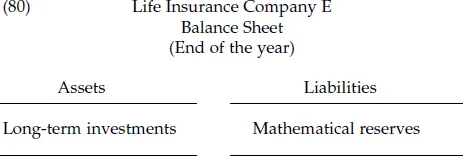
Obviously no money is created, and mathematical reserves, which represent the book value of future obligations to policyholders, correspond to the fact that the insured have handed over a certain quantity of present goods in exchange for a larger quantity of goods at an undetermined point in the future (when the contingency insured against—death, disability, or survival—takes place). Until the anticipated event occurs, policyholders lose the availability of their money, which becomes available to borrowers who receive it from the insurance companies. These borrowers are the issuers of the corresponding bonds and fixed-income securities the life insurance companies acquire. When life insurance companies invest in real estate, they do so directly, thus taking on the role of important real estate owners devoted to renting their properties to the public.
The income statement of the life insurance company appears as follows
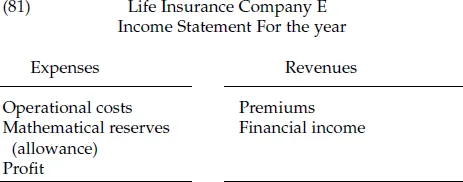
It is clear that insurers’ accounting profit arises from the difference between revenues (premiums and financial income) and expenses (operational costs and those resulting from increases in mathematical reserves). Insurance companies usually make a very modest profit which has three possible sources: claim profit (i.e., the company may overestimate the number of claims in its calculation of premiums), profit derived from operational, administrative costs (administrative expenses included in the calculation of premiums may be greater than the company's real costs), and finally, financial, profit (financial revenues may exceed the “technical interest rate” used in the calculation of premiums). Furthermore competition in the market has led life insurance companies to pass on a large part of their yearly profits to their policyholders, since life insurance contracts now commonly include profit-sharing clauses, which increase customers’ insured capital annually without increasing premiums. Thus from an economic standpoint, regardless of its legal status (whether a corporation or a mutual company), a life insurance company becomes, at least partially, a sort of “mutual company” in which the policyholders themselves share in the company's profits.
The institution of life insurance has gradually and spontaneously taken shape in the market over the last two hundred years. It is based on a series of technical, actuarial, financial and juridical principles of business behavior which have enabled it to perform its mission perfectly and survive economic crises and recessions which other institutions, especially banking, have been unable to overcome. Therefore the high “financial death rate” of banks, which systematically suspend payments and fail without the support of the central bank, has historically contrasted with the health and technical solvency of life insurance companies. (In the last two hundred years, a negligible number of life insurance companies have disappeared due to financial difficulties.)
The following technical principles are traditional in the life insurance sector: assets are valued at historical cost, and premiums are calculated based on very prudent technical interest rates, which never include a component for inflation expectations. Thus life insurance companies tend to underestimate their assets, overestimate their liabilities, and reach a high level of static and dynamic solvency which makes them immune to the deepest stages of the recessions that recur with economic cycles. In fact when the value of financial assets and capital goods plunges in the most serious stages of recession in every cycle, life insurance companies are not usually affected, given the reduced book value they record for their investments. With respect to the amount of their liabilities, insurers calculate their mathematical reserves at interest rates much lower than those actually charged in the market. Hence they tend to overestimate the present value of their commitments on the liabilities side. Moreover policyholders take advantage of the profits insurance companies bring in, as long as the profits are distributed a posteriori, in accordance with the above-mentioned profit-sharing clauses. Logically the amounts of such profits cannot be guaranteed a priori in the corresponding contracts.105
SURRENDER VALUES AND THE MONEY SUPPLY
Life insurance contracts commonly offer an option by which the company, at the request of the policyholder, redeems the policy via the payment of a certain sum in cash. This option, which is generally included in all types of life insurance, with the exception of those which cover solely the risk of death or survival, can be exercised whenever the policyholder desires, following the initial period stipulated in the policy (normally two or three years). This contractual clause could give the impression that a life insurance policy could also serve as a tool for legally implementing a monetary demand-deposit contract. Nevertheless we know that demand-deposit contracts are characterized by their essential cause, which lies in the safekeeping obligation and in the depositor's ability to withdraw the money deposited at any time. Therefore life insurance differs fundamentally from demand deposits. The following factors prevent any confusion between the two:106
First, life insurers have traditionally sold their products as long-term saving tools. Hence when customers buy life insurance they are undoubtedly motivated by a desire to begin setting aside and saving a portion of their income for the long term, in order to build up capital for use when their families need it most. From the standpoint of the contract's cause, as well as the policyholder's subjective ends, present goods are clearly handed over and the full availability of them lost, in exchange for the guarantee of a substantial income or capital under certain future circumstances (those in which a family's need may be greatest, such as the death of a provider or survival beyond a certain age).
Second, most life insurance operations do not permit the possibility of obtaining the surrender value immediately, i.e., from the moment the contract is signed and the money is paid. Instead there is generally a waiting period, which, depending upon the market and legislation, varies in length from two to three years. Only after this initial period does the customer acquire the right to a surrender value.
Third, surrender values do not approximate the total amount paid to the insurance company in premiums, since they are reduced by the initial costs of the policy, which are amortized over the entire duration of the policy and which, for technical and business reasons, tend to be rather high and are paid when the policy is purchased. Moreover the surrender value normally includes a penalty fee in favor of the insurer to further encourage customers to carry their policies to maturity. Thus it is obvious that life insurance operations have been designed to discourage the surrender option as much as possible, so that policyholders are only willing to exercise it in situations of urgent family need or when they wish to change insurance companies. Therefore subjectively speaking, we must conclude that for most customers traditional life-insurance operations do not mask deposit contracts.107
THE CORRUPTION OF TRADITIONAL LIFE-INSURANCE PRINCIPLES
Despite the above considerations, we must acknowledge that in recent times, under the pretext of a supposedly beneficial “deregulation of financial markets,” the distinct boundaries between the institution of life insurance and the banking sector have often been blurred in many western countries. This blurring of boundaries has permitted the emergence of various supposed “life insurance” operations which, instead of following the traditional principles of the sector, have been designed to mask true demand-deposit contracts which involve an attempt to guarantee the immediate, complete availability to the policyholder of the money deposited as “premiums” and of the corresponding interest.108 This corruption, which we touched on in chapter 3, has exerted a very negative influence on the insurance sector as a whole and has made it possible for some life insurance companies to market deposits in violation of traditional legal principles and thus to act, in different degrees, as banks, i.e., to loan money actually placed with them on demand deposit. Hence various life insurance companies have begun to take part in the banking process of credit expansion, which damages the productive structure and causes economic cycles and recessions. Furthermore these companies have done serious harm to the insurance industry itself, which has been the object of increasing state and central-bank intervention and has lost many of the fiscal advantages it had always enjoyed in the past, advantages justified in light of the considerable benefit the institution produces in fostering long-term saving among broad sectors of society.109 At any rate we intend the theoretical analysis performed in this book to give life insurers back their self-confidence and their trust in the positive nature of the traditional institution of which they form a part and to encourage a clear separation between life insurance and the banking “business,” which is foreign to it. As we know, this “business” not only lacks the necessary juridical foundation, but also provokes economic effects highly detrimental to society. In contrast the institution of life insurance rests on an extraordinarily solid legal, technical-actuarial, and financial foundation. When life insurance companies are faithful to the traditional principles of the sector, not only do they not hamper peaceful economic growth; they are actually essential and extremely beneficial in terms of fostering long-term saving and investment and hence, the sustainable economic development of society.
OTHER TRUE FINANCIAL INTERMEDIARIES: MUTUAL FUNDS AND HOLDING AND INVESTMENT COMPANIES
Other true financial intermediaries which would become even more developed if the privileges currently enjoyed by banks were eliminated are mutual funds, holding and investment companies, leasing and finance corporations, etc. All of these institutions receive present goods from savers and, in their capacity as intermediaries, transfer these goods to final borrowers. Though none of these institutions has the ability of life insurance to guarantee a substantial income from the first moment should a fortuitous event occur (death, disability, survival), it is obvious that they would all become more prominent, even more than they are now, if banks were obligated to maintain a 100-percent reserve ratio, and thus were to lose their power to grant loans from nothing. In particular, mutual funds would take on a very important role, in the sense that economic agents would invest their excess cash balances through them and would be able to obtain immediate liquidity by selling their shares, though at secondary-market prices, never at their nominal value. The same applies to holding companies and other financial and investment institutions, which have on many occasions gone through a process of corruption and assault very similar to that of life insurance, a process of “innovation” consisting of the design of different formulas for “guaranteeing” the corresponding “investors” the immediate availability of their money, i.e., the possibility of retrieving their “savings” at the nominal value at any time. For instance, as we saw in chapter 3 in connection with different types of financial operations, clauses containing agreements of repurchase at a predetermined price are among the abusive legal devices generally used to mask true “demand deposit” contracts in other institutions completely unrelated to banking.110 From an economic standpoint, as such procedures have spread, the contracts and institutions in question have begun to produce the same harmful effects as fractional-reserve banking. Therefore as we will see in the following chapters, any proposal to reform the banking system must include a plan to quickly identify different abusive legal procedures which could be conceived to mask true fractional-reserve, demand-deposit contracts. Such procedures must be curtailed, as they go against general legal principles and seriously disrupt the harmonious process of economic coordination.
SPECIFIC COMMENTS ON CREDIT INSURANCE
Finally we should briefly mention credit insurance operations, which have spontaneously emerged in developed economies. In exchange for a premium, these policies guarantee that in the event that the customers of insured business and industrial enterprises cannot pay their debts, which are usually paid within a certain period (thirty, sixty, ninety days, etc.) using a given financial instrument (for example, a bill of exchange), the insurance company will pay a percentage of the total corresponding debt (between 75 and 95 percent), thus taking it over and later collecting the amount from the delinquent customer. Therefore credit insurance addresses a real need which arises in markets. It responds to a set of circumstances which derives from the credit that different industrial and business enterprises habitually extend to their customers. Such credit corresponds, economically speaking, to a traditional operation in which savers, generally capitalists who own a business, advance financial resources for a time to workers and owners of the original means of production, as well as to their customers, whom they grant a period of several days or months to pay their debts. Logically, this credit customers receive always requires a prior sacrifice on the part of certain economic agents, who must reduce their consumption and save the corresponding resources to make these easy payment terms possible. Hence customer credit cannot be generated from nothing, but always obliges someone (the owners of the company offering the credit) to save first. In the absence of distortions caused by bank credit expansion, credit insurance fulfills a particularly important economic function. The large databases of credit insurance companies enable them to classify customers according to their default risk. These credit insurance companies also provide legal collection services, taking advantage of significant economies of scale beyond the scope of their individual clients.
The problem emerges when bank credit expansion distorts all credit markets and provokes recurrent cycles of boom and recession. In fact in the boom stage fed by credit expansion, multiple unrealistic investment projects are artificially launched, and many market operations are financed in installments and covered by credit insurance. As a result, companies specializing in credit insurance take on systematic risks which, by their very nature, are not technically insurable. Indeed the process of expansion must reverse sooner or later, and widespread bankruptcies, suspensions of payments, and liquidations of unsuccessful investment projects will reveal the errors committed. Consequently, in modern economies subject to the distorting effects of credit expansion, credit insurance is of a cyclical nature, which prevents it from surviving recession stages in the absence of a series of safeguard clauses to protect it from the same fate suffered on a large scale by overoptimistic entrepreneurs who unduly lengthen their investment projects in the expansionary boom stage. Of these clauses the following stand out: those which establish deductibles and waiting periods on the payment of claims, depending upon the amount, and that which requires an adjudication of bankruptcy, which, due to the sheer length of bankruptcy proceedings, tends to involve a long delay, which allows the insurance company, meanwhile, to make the necessary collections and maintain the necessary financial stability.111
Successive cycles of boom and depression invariably pose a formidable challenge to credit insurance companies, which apart from their traditional services (collections, customer risk classification, etc.), perform an additional one: during economic booms they accumulate important financial reserves, which they later use in crises and recessions to systematically satisfy the much larger claims filed during these periods. In any case we must recognize that the legal precautionary measures adopted to this point have been insufficient to prevent the failure and liquidation of some of the most prominent credit insurers in the western world during each of the recent crises which have erupted in the West. We must also acknowledge that the institution of credit insurance will always be highly vulnerable to stages of recession, particularly while banks continue to operate with a fractional reserve.112
Money, Bank Credit, and Economic Cycles
Read the whole book online · Book details
Free to read online and to download from this archive.