
Chapter 12 of 29 · Money, Sound and Unsound by Joseph T. Salerno
10. An Austrian Taxonomy of Deflation— with Applications to the U.S.
CHAPTER 10
An Austrian Taxonomy of Deflation—With Applications to the U.S.
Deflation has been all over the news for the last two years. Financial journalists, market pundits, business forecasters, economic columnists, Fed governors and mainstream macroeconomists are all spooked by the specter of price deflation in the U.S. During this time we have been inundated with dire warnings of the looming prospect of a possibly catastrophic deflation in the U.S. Articles bearing such grizzly and creepy titles as “The Deflation Monster Still Lives,” “The Specter of Deflation,” “Deflation Boogeyman Haunts Fed,” “The Greatest Threat Facing the U.S. Economy: Deflation,” “Why We Should Fear Deflation,” and “Deflation: Making Sure ‘It’ Doesn’t Happen Here” abounded in the financial press and among the publications of such august and stodgy economic think tanks as the American Enterprise Institute and the Brookings Institution.1 Recently, the International Monetary Fund held an economic forum entitled “Should We Be Worried About ‘Deflation’?” to discuss a report it commissioned on the global risks of deflation.2
As their titles suggest, these articles delineate chilling scenarios for the American economy. Not only do these and other articles contend that deflation is close at hand but many of them assert or imply two additional propositions: first, that the effects of deflation are an unmitigated disaster for economic activity and welfare; and, second, that the Federal Reserve System needs to take prompt action to head off such devastation to the economy. In particular, their authors argue that the Fed must dexterously shift gears and become a deflation fighter rather than the staunch and valiant inflation-fighter it supposedly has been for the last two decades. A few authors even question whether the Fed is now constitutionally capable of making such a shift—as if any central bank would be unwilling or unable to create massive quantities of new money, given even the lamest of excuses.
Most of the growing host of deflation-phobes prudently leave the precise details of the impending deflationary debacle to our imagination with vague and foreboding references to the Great Depression in the U.S. in the early 1930s or to the experience of Japan since 1998. However, others, such as market pundit Donald L. Luskin, a self-proclaimed “unreconstructed supply-sider,” delight in conjuring up lurid deflationary scenarios. According to Luskin,3 deflation is:
going to be a world of hurt. If you thought inflation was a nightmare, wait till you live with a deflation. Prices of everything eventually go down—stocks, real estate, wages … the whole thing. You’re a little poorer every day.… And if You’re in debt then you’re really in trouble. You’ll have to make those same mortgage payments even though the value of your house is going down every month.… But that doesn’t mean that deflation is any bed of roses for lenders either. Sure, it’s nice to have locked in a stream of payments in money that will buy you more and more apples and paper clips and houses as prices collapse. But you’ll never get the money, because the borrowers will all default.4
But regardless of whether they indulge in such rhetorical excesses or state their case dispassionately in formal academic jargon, contemporary deflation-phobes fail to distinguish between the several different phenomena that are commonly jumbled together under the rubric of “deflation.” And because modern macroeconomics was born of John Maynard Keynes’s obsessive deflation-phobia,5 academic macroeconomists are the most likely of all to be muddled about deflation. They are not inclined or equipped to give a coherent account of the separate economic processes designated as “deflationary”; nor are they able to ascertain which kinds of deflationary processes are “benign” and represent an improvement of economic efficiency and welfare and which kinds are “malign” and impair economic productivity and well-being by distorting monetary calculation.
Fortunately, Austrian monetary theory, which was developed primarily by Ludwig von Mises and Murray N. Rothbard, provides us with the means to cut through the tangle of anti-deflationist fallacies that we have lately been bombarded with and to neatly sort out the different types of deflation.6 The remainder of the paper is divided as follows. Deflation is defined in Section 2. Austrian monetary theory is utilized to identify and analyze the different kinds of deflation in Section 3, distinguishing between deflations that are natural and benign tendencies of a progressing free-market economy and deflation that results from malign intervention in the economy by government and its central bank and cripples monetary exchange and calculation. Section 4 contains a critique of the most common fallacies perpetrated by contemporary deflation-phobes. We conclude with an analysis of the likelihood that the U.S. economy is or soon will be in the throes of a deflationary recession.
The Definition of Deflation
Before World War II, when the terms “inflation” and “deflation” were used in academic discourse or everyday speech, they generally meant an increase or a decrease in the stock of money, respectively. A general rise in prices was viewed as one of several consequences of inflation of the money supply; likewise, a decline in overall prices was viewed as one consequence of deflation of the money supply. Under the influence of the Keynesian Revolution of the mid–1930s, however, the meanings of these terms began to change radically. By the 1950s, the definition of inflation as a general rise in prices and of deflation as a general fall in prices became firmly entrenched in academic writings and popular speech. We can ignore here the question of whether or not this change in usage enhanced conceptual clarity and analytical precision in dealing with monetary problems.7 The point is that today when professional economists and members of the lay public utter or write the term “deflation,” they invariably mean a decline in the overall prices of commodities and services purchased by the “average” consumer as expressed in a price index such as the CPI. Movements in the prices of consumer goods are relevant for identifying the existence and degree of inflation or deflation because consumer goods are the final output and, hence, the rationale, of all economic activity. Moreover, as Carl Menger, the founder of Austrian economics has taught us, the prices of the myriad of intermediate and original inputs into the production process, broadly categorized as capital goods, labor and natural resources, are ultimately “imputed” via an entrepreneurial market process from the prices of consumer goods. Thus when economists, business forecasters, and Alan Greenspan scrutinize indexes of input prices such as the PPI or indexes of raw commodity prices, they do so because they incorrectly believe that changes in these indexes are harbingers of future changes in general consumer prices, as if input prices determined product prices rather than the other way around.
Defined as a general fall in consumer prices, deflation implies an increase in the value or purchasing power of the monetary unit— in the U.S. an increase in the amount of consumer goods that can be purchased for a dollar. Now there are a number of factors that tend to increase the value of the dollar. These deflationary factors and the processes they initiate may be benign or malign in their effects on productive efficiency and consumer welfare, depending on whether they result from the voluntary choices of laborers, capitalists, entrepreneurs, and consumers or from the coercive intervention of a government central bank such as the Fed. As we shall see, while the deflation-phobes have bemoaned the imaginary evils of deflationary scenarios that have not occurred and that actually would produce net benefits for consumers if they did, they have completely ignored the one kind of deflation that has actually materialized repeatedly in the last two decades and is truly a malign influence on consumer sovereignty and welfare.
Deflation: Good and Bad
According to Austrian theory, the value of money, which is the inverse of overall consumer prices, is determined by supply and demand like the individual prices of its component consumer goods. An increase in the value of a dollar, and a corresponding decline in overall dollar prices, may thus proceed either from an expansion of the demand for money or a contraction of the supply of money or a combination of both. There are four basic causes of deflation—two operating on the demand side and two on the supply side of the “money relation.”8 The economic processes associated with these factors may be categorized as “growth deflation,” “cash-building deflation,” “bank credit deflation,” and “confiscatory deflation.” Each is analyzed in turn below and its effect on economic efficiency and consumer welfare is appraised.
Growth Deflation
Let us begin with the demand side. One component of the demand for money is the total quantity of the various commodities and services that sellers supply to the market in exchange for money. The aggregate supplies of goods therefore constitutes what Austrian economists call the “exchange demand” for money, because by selling goods, including their own labor services, people are exercising a demand to acquire and hold money.9 Hence, if supplies of certain goods in the economy increase due, for example, to increased saving and investment in additional capital goods or to technological progress, as has typically occurred in the historical market economy, then, all other things equal, their producers will be induced by competition to offer more units of their product for a dollar. As we are assuming that the supply of dollars remains fixed, the exchange value of a dollar will thus be bid up. This means that buyers will need to give fewer dollars than previously to obtain a given good and prices will fall.
This is precisely the process that occurred in the past three decades in the consumer electronics and high-tech industries, such as hand calculators, video game systems, personal computers, and DVD players. As a consequence of rapid technological improvement and its embodiment in additional capital investments, labor productivity increased phenomenally in these industries, driving down unit costs of production and increasing profit margins. Since the resulting expansion of the supplies of goods forthcoming from these industries outstripped the expansion of the supply of dollars during this period, the effect was a spectacular drop in the prices of high-tech products and a corresponding rise in the dollar’s purchasing power in terms of these products. Thus, for example, a mainframe computer sold for $4.7 million in 1970; today one can purchase a PC that is 20 times faster for less than $1,000.10 The substantial price deflation in the high-tech industries did not impair and, in fact, facilitated the enormous expansion of profits, productivity and outputs in these industries. This is reflected in the fact that in 1980, computer firms shipped a total of 490,000 PC’s while in 1999 their shipments exceeded 43 million units despite the fact that quality-adjusted prices had declined by over 90 percent in the meantime.11
The price deflation that was observed in the past three decades in selected high-growth industries, however, was not unprecedented or even unusual. In fact, historically, the natural tendency in the industrial market economy under a commodity money such as gold was for general prices to persistently decline as accumulation of capital and advances in industrial techniques led to a continual expansion in the supplies of goods. Thus throughout the nineteenth century and up until World War I a mild deflationary trend prevailed in the industrialized nations as rapid growth in the supplies of goods outpaced the gradual growth in the money supply that occurred under the classical gold standard. For example, in the U.S. from 1880 to 1896, the wholesale price level fell by about 30 percent, or by 1.75 percent per year, while real income rose by about 85 percent, or around 5 percent per year.12 Aside from infrequent discoveries of major new sources of gold, this deflationary trend was only interrupted during periods of major wars, such as the Napoleonic wars in Europe and the American Civil War, which the belligerent governments invariably financed by printing paper fiat money.
In recent years we have seen a continuing growth deflation in China. In the four years from 1998 to 2001, real GDP has increased at an annual average rate of 7.6 percent. The average of general retail prices declined in each of those years; the declines ranged from 0.8 percent to 3.0 percent.13
The fall in the sale prices and average production costs of consumer goods during the growth process does not necessarily entail a decline in the selling price of labor. If the supply of labor is fixed then money, or “nominal,” wage rates will remain constant. while “real” wage rates rise to reflect the increase in the marginal productivity of and employers’ demand for labor as the purchasing power of every dollar earned rises with the decline of consumer prices.
Needless to say, both sound economics and common sense tell us that the effect of growth deflation on economic activity and consumer welfare is entirely benign, because it is the result of the voluntary exchanges of property titles among resource-owners, capitalist-entrepreneurs, and consumers. These monetary transactions generate a natural increase in the value of money as a necessary complement to the growth of real wealth and income and the greater satisfaction of human wants that they yield.
Cash-Building Deflation
Although a handful of mainstream macroeconomists might be persuaded that price deflation associated with economic growth is benign, they would all scoff at the view that “hoarding,” a second factor tending toward price deflation, enhances economic prosperity and well-being.14 Hoarding occurs when an individual deliberately chooses to reduce his current spending on consumer goods and investment assets below his current income, preferring to add the unspent income to his cash balance held in the form of currency and checkable, or otherwise instantly accessible, bank deposits. Hoarding is nothing but an increase in the individual’s “cash balance,” that is, the amount of money that the individual keeps on hand over a period of time. The behavior described as hoarding may be more aptly labeled “cash building,” a term that has the additional virtue of freedom from the negative connotations that burden the word “hoarding.”
Cash building usually stems from a more pessimistic or uncertain attitude toward the future, caused possibly by the onset of a recession, a natural disaster or the imminent prospect of war. It may even result from speculation on the happy prospect that prices may fall in the near future as a result of economic growth or for other reasons. Under such circumstances, market participants appraise the value of the services yielded by a dollar in hand more highly than before relative to the services of the consumer goods or interest yield on investment goods that currently can be purchased for that dollar. All other things equal, including the number of dollars in existence, this increase in the demand to hold money will result in the bidding up of the market value of the dollar in terms of all goods. A pervasive price deflation will result, causing shrinkage of the aggregate flow of dollars spent and received in income per period of time.
Despite the reduction in total dollar income, however, the deflationary process caused by cash building is also benign and productive of greater economic welfare. It is initiated by the voluntary and utilityenhancing choices of some money holders to refrain from exchanging titles to their money assets on the market in the same quantities as they had previously. However, with the supply of dollars fixed, the only way in which this increased demand to hold money can be satisfied is for each dollar to become more valuable, so that the total purchasing power represented by the existing supply of money increases. This is precisely what price deflation accomplishes: an increase in aggregate monetary wealth or the “real” supply of money in order to satisfy those who desire additional cash balances.
We should note here that the fall in money expenditure that accompanies this process implies a fall in nominal wage rates as well as in consumer goods’ prices, although the real wage rate—the amount of goods and services the laborer can purchase with his money wages— remains roughly unchanged. Nevertheless, if there is interference with the free exchange of property titles on the labor market that renders the money price of labor downwardly inflexible, such as minimum wage laws or laws that grant unions exclusive privileges as bargaining agents in particular firms or industries, then unemployment and a decline in economic activity will result. However, the consequent recession or depression does not result from cash-building deflation per se, but from the coercive political attempt to impede the exchanges of property titles that bring about the increase in the value of money desired by consumers.
Bank Credit Deflation
1. Bank Runs
There are also two major factors that have historically operated on the supply of money to produce deflation. The first is a decline in the supply of money that results from a contraction of fractionalreserve bank credit. This may occur either because during a financial crisis the depositors call upon the banks en masse to redeem their demand deposits and notes in cash, or because the central bank undertakes a deliberate policy to contract bank credit in order to arrest an inflationary boom in progress or to undo the effects of a previous runaway inflation and restore a depreciated currency to a specie standard. Let us deal with bank runs first.
Before World War II, bank runs generally were associated with the onset of recessions and were mainly responsible for the “bank credit deflation” that almost always characterized these recessions. Bank runs typically occurred when depositors lost confidence that banks were able to continue redeeming the titles—represented by bank notes and demand deposits—to the property they had entrusted to the banks for safekeeping and which the banks were contractually obliged to redeem upon demand. This property was usually gold and silver money, and the fractional reserve banks were not in a position to discharge their contractual obligations to all its rightful owners at once because they had created multiple titles to this property in the course of their lending operations. This meant that the outstanding stock of instantaneously redeemable notes and checking and savings deposits was expanded to a large multiple of the commodity money reserves the banks kept on hand. During financial crises, bank runs caused many banks to fail completely and most of their notes and deposits to be revealed for what they essentially were: worthless titles to nonexistent property. In the case of other banks, the threat that their depositors would demand cash payment en bloc was sufficient reason to induce them to reduce their lending operations and build up their ratio of specie reserves to note and deposit liabilities in order to stave off failure. These two factors together resulted in a large contraction of the money supply and, given a constant demand for money, a concomitant increase in the value of money.
Once again our judgment must be that deflation, even when caused by a contraction of bank credit amidst numerous bank failures, has a salutary effect on the economy and enhances the welfare of market participants. For it is initiated by a voluntary and contractual redemption of property titles to money by bank depositors who perceive that fractional reserve banks are no longer functioning to safely and securely store their cash balances. When any firm that trades on its trustworthiness, be it a financial services firm, an armored car company, or a law firm, loses the confidence of its customers or clients that it is operating in their best interests, it will be rapidly purged from the market by an adjustment process that reallocates resources and improves the welfare of consumers. Bank credit deflation represents just such a benign and purgative market adjustment process.
In fact in the era before the 1930s when the natural flexibility of prices and wage rates prevailed and was not impeded by legal constraints, bank credit deflations in the U.S. were swift and did not cause severe economic dislocations. A brief review of one such episode is instructive.
In the fall of 1839 there occurred a financial crisis in the U.S. that resulted from a massive expansion of the money supply during the 1830s initiated by the legally privileged Second Bank of the United States. From the peak of the business cycle in 1839 to its trough in 1843, the money supply contracted by about one-third (34 percent), almost one-quarter of the nation’s banks collapsed (23 percent), including the Bank of the United States, and wholesale prices fell by 42 percent. Despite—or rather because of—the massive deflation of prices, real GNP and real consumption actually increased during this period by 16 percent and 21 percent, respectively. However, real investment did decline during this period by 23 percent, which was a benign development, because the malinvestments of the previous inflationary boom needed to be liquidated.15 Unfortunately such benign episodes of property retrieval have been forgotten in the wake of the Great Depression. Despite the fact that the bank credit deflation that occurred from 1929 to 1933 was roughly proportional in its impact on the nominal money supply to that of 1839–1843, the rigidity of prices and wage rates induced by the “stabilization” policies of the Hoover and early Roosevelt administrations prevented the deflationary adjustment process from operating to effect the reallocation of resources demanded by property owners. With the free exchange of property titles thus hampered, the economy contracted by roughly one third and consumption fell by one-fifth during the years from 1929 to 1933.16
2. Contractionary or Deflationary Monetary Policy
When national central banks eventually took legal custody of the public’s gold deposits, they went beyond their original function of “lender of last resort” during financial crises and assumed discretionary power to manipulate the nation’s money supply, that is, to “conduct monetary policy.” This occurred in the United States in 1917.17As the custodian of the nation’s gold reserves, the central bank would on occasion deliberately engineer bank credit deflation in order to avert or mitigate an impending financial crisis provoked by its previous inflationary policy. This “contractionary” or “deflationary”18 monetary policy was usually invoked after a bank credit expansion in order to arrest and reverse an outflow of the stock of nationalized gold reserves abroad and to forestall depositors’ loss of faith in the banking system, which would inevitably have culminated in the dreaded bank runs discussed above. This policy was implemented at first by raising the discount rate on collateralized central bank loans to commercial banks and later by open market sales of government securities to the public. The result of this policy was a contraction in outstanding bank credit and deposits and a reduction in the overall money supply.
How are we to classify such a deliberate reduction in the money supply by a central bank? Superficially, it appears to be a malign and arbitrary interference in the functioning of the market process on a par with monetary expansion, which misallocates resources and reduces the welfare of property owners. However, in evaluating the policy one must bear in mind the concrete institutional circumstances. A central bank operating within the framework of a gold standard has in effect arrogated to itself the monopoly of warehousing the gold deposits of the public. Its so-called “liabilities” in the form of bank notes and reserve deposits are not money per se but merely instantaneously redeemable property titles to the money commodity housed within its vaults. By issuing deposits and notes in excess of its gold reserves, it is creating and multiplying fictitious claims to property that have no counterpart in real goods and that derange market processes and arbitrarily redistribute real wealth and income. The destruction of such pseudo titles to the money commodity is no less a benign development than the eradication of counterfeit titles to any other type of nonexistent property.
Certainly, it is an uncontroversial conclusion of value-free economic analysis that markets work more efficiently in serving consumers when the creation and exchange of counterfeit property titles to stocks of nonmonetary commodities are suppressed. For example, a large and reputable land development and real estate management company may begin contracting for the sale of fully furnished vacation homes in remote locations to more than one buyer, confident that multiple buyers will never occupy the same home simultaneously. Nevertheless this practice would still alter prices in this and related markets and alter the distribution of income and wealth and the structure of consumer demands throughout the economy. The discovery and elimination of this scam would reorient prices and quantities to more accurately reflect the scarcities of concrete goods. Hence, the economist would remain strictly within the bounds of Wertfreiheit in appraising this new constellation of market outcomes as superior to the old in terms of social welfare. Similarly, in carrying out a contractionary monetary policy, the central bank is merely ceasing to violate its contractual obligation to maintain the integrity of its depositors’ titles to their stored money balances, and, therefore, the consequent readjustment of the purchasing power of money to the real scarcity of the money commodity implies a value-neutral judgment that social welfare has been enhanced.
Some will object that the economic distortions caused by monetary expansion occur only while the new money is being injected into the economy, so that a subsequent monetary contraction is unnecessary and only burdens the economy with further distortions. However, this objection does not take into account the fact that deflationary monetary policy has generally been implemented while the economy is still undergoing an inflationary boom and, therefore, operates to counteract and reverse the tendencies towards malinvestment and arbitrary redistribution of wealth that have not yet been consummated. In addition, and more important, any economic dislocations that may occur during deflation are the inevitable concomitant of a transition process back toward the original regime of pure commodity money. Given the historical market process in which it evolved, this regime is demonstrably consistent with the preferences of property owners and the mutually beneficial exchanges of genuine property titles that improve (ex ante) social welfare. The ultimate cause of the inflationary problems and the transitional deflationary problems is the central bank’s facilitating and encouragement of the creation of unbacked bank notes and deposits in the first place.
Moreover, the nature and severity of these transitional deflationary problems are too frequently taken for granted and bear closer scrutiny. While a contractionary monetary policy will result in a tendency for the value of money to increase as overall prices decline, this does not present a serious problem in economic theory or history as long as markets are permitted to clear without the interference of political authorities. A case in point is the post-World War I American depression of 1920–21. From 1915 through 1919, the Fed stimulated a massive inflationary bubble. This was partly the result of the reduction of reserve requirements mandated by the Federal Reserve Act of 1913 and partly due to the Fed’s efforts to accommodate deficit financing of the huge expenditures associated with World War I and its aftermath.
During this five-year period the money supply (M2) was increased at an average annual rate of 15.5 percent. Prices as measured by the GNP price deflator rose from 1916 to 1920 by 15.4 percent per annum while the CPI increased by 14.1 percent per annum from 1917 to 1920. The Fed began to recognize the dangerously inflationary nature of its policies in 1919 and raised its discount rate from 4 percent to 4.75 percent in December 1919, to 6 percent in January 1920, and to 7 percent in June 1920, where it held fast until May 1921. The consequence was a steep decline in the annual rate of growth in the money supply to 2.9 percent in 1920 and to –7.5 percent in 1921, causing the GDP deflator to decline by 16.6 percent in 1921 and 8.1 percent in 1922, while the CPI dropped by 10.9 percent in 1921 and 6.3 percent in 1922. Wholesale prices dropped even more precipitously, diving by 36.8 percent in 1921 and plummeting by an incredible 56 percent from mid-1920 to mid-1921. The fall in nominal wage rates was more moderate, but, nonetheless, as one Keynesian observer19 noted, “wage decreases were both general and substantial” and outside of agriculture wage rates fell by nearly 11 percent over the two-year period 1921–1922. Despite—or because of—this massive and broad-based price deflation, however, the economy began to recover by August 1921, eighteen months after the downswing had started in January 1920.20
Modern commentators on the 1920–21 Depression, to the extent that they have taken note of it, tend to be surprised by its brevity, given the sharp, policy-induced deflation that accompanied it and the extreme reluctance of political and monetary authorities to undertake stimulatory measures to mitigate its severity. One of the leading Keynesian authorities on “business fluctuations,” Robert A. Gordon described this depression thusly:
The downswing … was severe … but relatively short. Its outstanding feature was the extreme decline in prices.… Government policy to moderate the depression and speed recovery was minimal. The Federal Reserve authorities were largely passive.… Nor was any use made of fiscal policy.… In short, the federal budget was deflationary while the downswing was in progress.… Despite the absence of a stimulative government policy, however, recovery was not long delayed.21
The monetarist macroeconomic historian Kenneth Weiher22 predictably blamed the Fed for the depression, arguing, “the Fed earned all the criticism it has since received for inaction. In the face of such a severe contraction, accompanied as it was by unprecedented deflation, the Fed did nothing.” And yet Weiher23 appeared to be baffled by the fact that such a Fed-engineered “contraction-deflation of historic proportions” did not lead to total financial and economic ruin and that the economy rapidly and smoothly returned to prosperity. As Weiher24 was forced to admit: “The Fed was not really called on to act as a lender of last resort to the banking system, because the system never really faced a major liquidity crisis. Why such relative calm persisted compared with the situation in earlier contraction periods is unclear.”
If contractionary monetary policy is benign when the central bank exists within the institutional framework of a classical gold standard, how would we evaluate such a policy implemented in a pure fiat money system? For example, the current U.S. dollar is a pure name with no functional link whatsoever to a specific weight of gold or any other market-produced commodity. Surely in this system a contraction of the money supply engineered by the Fed is purely arbitrary and cannot be remotely linked to an improvement in social welfare? But this situation is not as simple as it seems and it requires deeper analysis before we can arrive at an informed welfare judgment.
For purposes of argument, let us begin with the assumption that deflation is just as damaging in its economic effects as is inflation of equal magnitude. Then ceteris paribus, that is, in a “stationary” or nogrowth economy with a constant demand for cash balances, a 3 percent per annum contraction in the stock of fiat dollars should cause no more concern than a 3 percent expansion of the stock of dollars. With economic effects thus placed temporarily to one side, political and psychological factors always operate to make monetary inflation much more dangerous than monetary deflation, as Hayek courageously warned at the height of the Keynesian era in 1960:
It is, however, rather doubtful whether, from a long-term point of view, deflation is really more harmful than inflation. Indeed, there is a sense in which inflation is infinitely more dangerous and needs to be more carefully guarded against. Of the two errors, it is the one much more likely to be committed. The reason for this is that moderate inflation is generally pleasant while it proceeds, whereas deflation is immediately and acutely painful.… The difference between inflation and deflation is that, with the former, the pleasant surprise comes first and the reaction later, while, with the latter, the first effect on business is depressing. There is little need to take precautions against any practice the bad effects of which will be immediately and strongly felt; but there is need for precautions wherever action which is immediately pleasant or relieves temporary difficulties involves much greater harm that will be felt only later.… It is particularly dangerous because the harmful aftereffects of even small doses of inflation can be staved off only by larger doses of inflation. Once it has continued for some time, even the prevention of further acceleration will create a situation in which it will be very difficult to avoid a spontaneous deflation.… Because inflation is psychologically and politically so much more difficult to prevent than deflation and because it is, at the same time, technically so much more easily prevented, the economist should always stress the dangers of inflation.25
Hayek’s argument clearly explains why a monopoly central bank in a fiat money regime is never likely to choose a contractionary monetary policy and why, especially under current conditions, fear of deflation is completely groundless. Moreover, granting our premise that equal amounts of inflation and deflation have equally pernicious economic effects, a case can be made based on Hayek’s argument that the central bank should err on the side of deflation, because a mildly deflationary monetary policy is far less dangerous in the long run than the mildly inflationary policy of “inflation targeting” recommended by a consensus of contemporary economists.26 Of course, Hayek himself was opposed to monetary deflation and referred to it as an “error” in the passage quoted above. It is not our aim here to construct a case for a particular fiat money policy based on its long-run costs and benefits. Rather it is to challenge the initial premise that the welfare effects of deflationary and inflationary monetary policies are symmetrical by elucidating the purely economic advantages yielded by a deliberate reduction of the supply of fiat money—advantages which have been overlooked even by leading Austrian monetary theorists.
Writing in Human Action in 1949, Mises27 emphasized the psychological reasons underlying the broad popular appeal of “inflation and expansion” and the even more widespread and violent opposition to “deflation and contraction” in terms very similar to Hayek’s. However, in his earlier Theory of Money and Credit, which was written before the dread of falling prices had been entrenched and universalized among the public by the Keynesian misinterpretation of the Great Depression, Mises attributed much greater weight in the resistance to monetary contraction to the narrow economic interests of the ruling class or “caste,” whose members: (1) control or have access to the funds disbursed by the State; and (2) tend to be debtors rather than creditors. As Mises incisively noted:
Restrictionism [or “deflationism”] demands positive sacrifices from the national exchequer when it is carried out by the withdrawal of notes from circulation (say through the issuance of interest-bearing bonds or through taxation) and their cancellation; and at the least it demands from it a renunciation of potential income by forbidding the issue of notes at a time when the demand for money is increasing. This alone would suffice to explain why restrictionism has never been able to compete with inflationism.… But furthermore … an increase in the value of money has not been to the advantage of the ruling classes. Those who get an immediate benefit from such an increase are all those who are entitled to receive fixed sums of money. Creditors gain at the expense of debtors. Taxation, it is true, becomes more burdensome as the value of money rises; but the greater part of the advantage of this is secured, not by the state, but by its creditors. Now policies favoring creditors at the expense of debtors have never been popular.… Generally speaking, the class of persons who draw their income exclusively or largely from the interest on capital lent to others has not been particularly numerous or influential at any time in any country.28
Now, like Hayek, Mises29 opposed a deflationist policy and went on to argue that it was deeply erroneous even in the case in which a country was attempting to revalue its depreciated currency in order to return to the gold standard at the previous mint par, as Great Britain did after both the Napoleonic wars and World War I. To avoid monetary contraction, Mises favored a restoration of gold parity at or near the currently prevailing price of gold. Even Murray Rothbard, although he was an enthusiastic proponent of bank credit deflation that results from spontaneous bank runs, generally refrained from advocating a deliberate contraction of the money supply engineered by the central bank under an existing fiat money regime. Thus, he referred to “the crucial British error” and “fateful decision” of returning to the gold standard in the 1920s at the prewar parity. For Rothbard,30 “The sensible thing to do would have been to recognize the facts of reality, the fact of the depreciated pound, franc, mark, etc., and to return to the gold standard at a redefined rate: a rate that would recognize the existing supply of money and price levels.” Additionally, in his proposals for the restoration of a 100-percent gold standard in the United States, he conspicuously eschewed a contraction of the supply of fiat dollars as a transition policy.31
Nonetheless, when combined with Mises’s explanation of the opposition of the ruling elites to monetary contraction, Rothbard’s positive analysis of the distribution effects of deflation reveals the asymmetric welfare effects between monetary expansion and monetary contraction and suggests that the latter policy can indeed play a benign role in the transition back from a fiat money to a full-bodied commodity money. According to Rothbard deflationary bank credit contraction:
in a broad sense, takes away from the original coercive gainers [from credit expansion] and benefits the original coerced losers. While this will certainly not be true in every case, in the broad sense much the same groups will benefit and lose, but in reverse order from that of the redistributive effects of credit expansion. Fixed-income groups, widows and orphans, will gain, and businesses and owners of original factors previously reaping gains from inflation will lose.32
Now, Rothbard was referring here to the consequences of a bank credit contraction induced by the bank runs that occur during the downswing of a business cycle. But his analysis may be generalized to the case described by Mises above in which the money supply is contracted by the liquidation of central bank notes composing a fiscal surplus. A modern Austrian welfare analysis of this case, which might be called “fiscal deflation,” is interesting because it presents a potential route back to a 100-percent gold dollar from our present fiat dollar.
In order to analyze the case within the context of contemporary institutions, it is necessary to provide some technical details of the relationship between the U.S. Treasury and the Fed. The Treasury maintains deposit balances at the Fed and at the commercial banks. The latter are called “tax and loan accounts” and are the temporary abode of funds that it has borrowed and collected in taxes. The Treasury makes its disbursements from its general working balances held at the regional Fed banks. When it needs to replenish the latter, it transfers funds from its tax and loan accounts at the commercial banks. All other things equal, this shifting of Treasury funds from commercial bank deposits to Fed deposits reduces reserves in the commercial banking system and exerts contractionary pressure on the money supply. To avoid this, the Treasury tries to coordinate expenditures from its general working balances at the Fed with drafts on its tax and loan accounts at commercial banks, since the recipients of the Treasury’s spending quickly redeposit the funds in commercial banks, replenishing bank reserves.33
Now, fiscal deflation requires that a portion of the funds collected in tax and loan accounts be transferred to the Fed where they are either cancelled or “spent” on programmed increases in required reserves for commercial bank deposits by distributing them on a prorated basis among the reserve deposits held at the Fed by commercial banks. In either case, the money supply would decrease, but we are interested in analyzing the latter case as one possible method of restoring a 100-percent gold dollar.
Let us assume, for example, that the fiat money stock is $1,000, all held in commercial bank demand deposits, and that the required reserve ratio is 10 percent. If all banks are fully loaned out, they are holding $100 in required reserves in reserve deposits at the Fed. When the Treasury shifts a surplus of, say, $20 to its general account at the Fed, it will leave the commercial banks with only $80 in reserves and the money supply will eventually shrink by $200 to $800. The Fed will then mandate an increase in the required reserve ratio to 12.5 percent and simultaneously the Treasury will “spend” its surplus funds by transferring them to the reserve deposits of the commercial banks, permitting them to meet the new reserve requirement with total bank reserves once again equal to $100 but now supporting only $800 of demand deposits. In the following year, the Treasury again runs a surplus of $20 (which at the new higher purchasing power of money exceeds in real terms the prior year’s surplus). Following the same procedure of disposing of the fiscal surplus, the money supply shrinks by another 20 percent, or by $160 to $640, and the Fed raises the required reserve ratio to 100/640 or 15.63 percent. In the next round, again assuming a surplus of $20, the money supply would be contracted by $128 or 20 percent to $512 and the required reserve ratio raised to 19.53 percent.34 This fiscal deflation of the fiat money stock will continue until demand deposits are backed 100 percent by reserves, at which point the Fed would be abolished and the dollar rendered convertible into gold along the lines suggested by Rothbard35 to yield a pure gold dollar.
The purpose of the foregoing exercise was not to present an optimal plan for restoring a pure commodity money, but to highlight certain features of a policy of monetary contraction and deflation that are crucial to distinguishing its welfare effects from those of a policy of expansion and inflation. To begin with, almost all current macroeconomics textbooks characterize “seignorage” or “the revenue raised through the printing of money” as an “inflation tax” on money holders that adds to the existing tax burden on the private sector.36 In sharp contrast, because deflationary monetary policy has been considered beyond the pale at least since World War II, it would be difficult to find one modern macroeconomics textbook that recognizes, let alone applies a name to, the opposite effect, which results when the State destroys money via fiscal deflation. Mises and Rothbard, in their respective writings quoted above, generally recognized this effect but did not name it or elaborate its welfare implications.
We may identify this effect by the French term rabattage, which signifies a diminution or abatement—in this case, of the fiscal burden of government on the private economy. In the fanciful scenario of fiscal deflation outlined above, the rabattage effect comes about in the following way. The Treasury is deprived of a part of the funds appropriated through taxation. As a result, government expenditures are reduced, in both nominal and real dollars, because the spending occurs before the increase in the purchasing power of money caused by the fiscal deflation has taken place. Likewise, the recipients of pure transfers from and the suppliers of resources to government suffer an immediate fall in their nominal subsidies and selling prices while the prices of the goods they purchase remain near pre-existing levels, thus causing a decline in their real incomes. Ceteris paribus, as these separate spending-and-income chains that emanate from government progress, intersect, and reinforce one another throughout the economy, the monetary demands for more and more goods decline and their prices progressively adjust to the reduced stock of money. The final outcome of this deflationary adjustment process is that real income is distributed from the net “tax consumers,” that is, the political-bureaucratic establishment and its subsidized constituencies and privileged resource suppliers, back to the taxpayers who originally produced the income in voluntary market activities.
By way of contrast, the seignorage effect of inflationary finance operates to enlarge the real incomes of government and the direct recipients of government largesse and purchases, precisely because these groups gain access to the newly created money at the outset of the inflationary adjustment process. Those who “pay” the seignorage are the receivers of fixed incomes as well as entrepreneurs and resource owners who do not sell to government and are therefore forced to endure progressively rising buying prices until their selling prices rise much later in the process.37
In thus altering the income distribution in favor of taxpayers and to the disadvantage of political tax consumers, the rabattage effect of fiscal deflation results in a new structure of consumer demands and pattern of resource pricing and allocation that more accurately reflect the preferences of those who earn income from the production and exchange of goods on the market. From the standpoint of Austrian welfare economics this result represents an improvement in social welfare and economic efficiency because, even if the precise pre-tax pattern of income and wealth distribution is not restored, fewer resources are siphoned off from producers in the social division of labor, mitigating the distortion of economic calculation inherent in all government activities.38 To put it another way, all government interventions have direct effects on the utility of the targeted victim or victims and indirect effects on monetary calculation and the efficiency of the economy at large, and these effects are analytically separable.39 Thus the rabattage effect, even though it may not restore the pre-intervention wealth and income positions of the original taxpayers, certainly does improve economic efficiency by forcing political tax consumers to disgorge some of the expropriated resources and permitting the market to reallocate productive resources to the service of consumers who earn their livelihood through production for voluntary exchange.40
In light of the rabattage effect, the monetary contraction associated with fiscal deflation therefore must be judged as socially benign. In contrast, all other things equal, the seignorage effect is socially malign and destructive of economic efficiency because inflationary finance permits a further appropriation of property by the nonproductive, tax-consuming political sector and a corresponding misallocation of resources. In short, at a given level of taxation, fiscal deflation lightens the fiscal burden on the market economy and diminishes the calculational chaos inevitably induced by government expenditures, whereas inflationary finance intensifies the fiscal burden and promotes the spread of calculational chaos.
There is another effect of fiscal deflation that is socially benign, which has an admittedly narrower application than the rabattage effect but is important nonetheless. In the example of fiscal deflation presented above, the monetary contraction involved an ongoing increase in the required reserve ratio toward 100 percent. This deflationary process effectively involves the extinguishing of pseudo property titles to the money commodity, in this case the paper currency embodying the fiat dollar. As argued above, the suppression of fictitious property titles to any commodity ends the distortion of economic calculation and realigns the pattern of productive activities with actual underlying resource scarcities.
It bears reiteration that deflationary monetary policy is not the only, or necessarily the best, route back from a fiat to a commoditybased currency. But it is one route and it has succeeded historically, e.g., in Great Britain after the Napoleonic wars and in the United States after the Civil War. The latter episode bears particular scrutiny. From the beginning of 1875 until specie payments were resumed on January 1, 1879, the U.S. money stock contracted by about 8.6 percent, as estimated by James Kindahl.41 Yet from 1876 through 1879, real GDP growth averaged a phenomenal 5.20 percent per year, a growth rate that exceeded the average annual growth rate for the period 1876–1913 by more than 25 percent.42 As a result of the coexistence of monetary contraction and real output growth, during the period 1876–1879 the CPI declined by 3.96 percent per year while the GDP deflator fell at an annual rate of 3.82 percent.43
The remarkably high rate of real output growth during a period of monetary contraction and declining prices—a period that was identified by the NBER as the longest contraction in U.S. history— even led Friedman and Schwartz44 to obliquely question the conventionally held relationship between falling prices and real output:
The contraction [of 1873–1879] was long and it was severe— of that there is no doubt. But the sharp decline in financial magnitudes, so much more obvious and so much better documented than the behavior of a host of poorly measured physical magnitudes, may well have led contemporary observers and later students to overestimate the severity of the contraction and perhaps even its length. Observers of the business scene then, no less than their modern descendants, took it for granted that sharply declining prices were incompatible with sharply rising output. The period deserves much more study than it has received precisely because it seems to run sharply counter to such strongly held views.
We might suggest here that perhaps the rabattage effect associated with fiscal deflation and bank failures during this period contributed to this sharp growth spurt of real output. Real resources that had been absorbed in wasteful uses by government or in propping up business malinvestments precipitated by previous bank credit expansion were now released through deflationary rabattage to be more efficiently allocated by entrepreneurs responding to the anticipated demands of fellow producers in the social division of labor.
Finally, although our hypothetical example of fiscal deflation above was constructed primarily to highlight the socially benign effects of rabattage and the suppression of pseudo-titles to money balances, it does point out another social advantage of State money destruction over money creation. Whereas inflationary finance never moves us closer to a commodity money (and risks hyperinflation and the abolition of money in the bargain should the State’s hunger for seignorage revenues exceed certain bounds), fiscal deflation, if carried out properly, conceivably moves the fiat monetary regime back toward its original roots in a market commodity.
Confiscatory Deflation
As suggested above, not all types of deflation are the outcome of benign market processes. There does exist an emphatically malign form of deflation that is coercively imposed by governments and their central banks and that violates property rights, distorts monetary calculation and undermines monetary exchange. It may even catapult an economy back to a primitive state of barter if applied long and relentlessly enough. This form of deflation involves an outright confiscation of people’s cash balances by the political and bureaucratic elites. Yet confiscatory deflation has been almost completely ignored by our current deflation-phobes, despite the fact that it has occurred quite a few times in the last two decades—in Brazil, the former Soviet Union, and Argentina in the 1980s, in Ecuador in the late 1990s, and recently again in Argentina. In fact, one of the only economists to identify and condemn confiscatory deflation as a malignant attack on economic efficiency, consumer welfare, and property rights was Murray Rothbard.45
Confiscatory deflation is generally inflicted on the economy by the political authorities as a means of obstructing an ongoing bank credit deflation that threatens to liquidate an unsound financial system built on fractional reserve banking. Its essence is an abrogation of bank depositors’ property titles to their cash stored in immediately redeemable checking and savings deposits.
A glaring example of confiscatory deflation occurred recently in Argentina. In 1992, after yet another bout of hyperinflation, Argentina pegged its new currency, the peso, to the U.S. dollar at the rate of 1 to 1. In order to maintain this fixed peso/dollar peg, the Argentine central bank pledged to freely exchange dollars for pesos on demand and to back its own liabilities, consisting of peso notes and commercial bank reserve deposits denominated in pesos, almost 100 percent by dollars. Unfortunately this arrangement—which inspired confidence in international lenders because it was approved by the IMF and therefore carried its implicit bailout guarantee—did not prevent a massive and inflationary bank credit expansion. As investment dollars flooded into the country, they found their way into the central bank, enabling it to expand the amount of reserves available to the commercial banks. As fractionalreserve institutions, the latter in turn were able to inflate bank credit in concert by multiplying bank deposits on top of each new dollar or peso of reserves. As a result, Argentina’s money supply (M1) increased at an average rate of 60 percent per year from 1991 through 1994.46 After declining to less than 5 percent in1995, the growth rate of the money supply shot up to over 15 percent in 1996 and nearly 20 percent in 1997. (See Appendix 1 for a graph of the growth of Argentine monetary aggregates.) With the peso overvalued as a result of inflated domestic product prices and with foreign investors rapidly losing confidence that the peso would not be devalued, the influx of dollars ceased and the inflationary boom came to a screeching halt in 1998 as the money supply increased by about 1 percent and the economy went into recession. In 1999, money growth turned slightly negative, while in 2000 the money supply contracted by almost 20 percent.
The money supply continued to contract at a double-digit annual rate through June of 2001. In 2001, domestic depositors began to lose confidence in the banking system and a bank credit deflation began in earnest as the system lost 17 percent or $14.5 billion worth of deposits. On Friday, November 30, 2001 alone, between $700 million and $2 billion of deposits—reports varied—were withdrawn from Argentine banks. Even before the Friday bank run, the central bank only possessed $5.5 billion of reserves ultimately backing $70 billion worth of dollar and convertible peso deposits. President Fernando de la Rua and his economy minister, Domingo Cavallo, responded to this situation on Saturday, December 1, announcing a policy that amounted to confiscatory deflation to protect the financial system and maintain the fixed peg to the dollar. Specifically, cash withdrawals from banks were to be limited to $250 per depositor per week for the next 90 days and all overseas cash transfers exceeding $1,000 were to be strictly regulated. Anyone attempting to carry cash out of the country by ship or by plane was to be interdicted. Finally, banks were no longer permitted to issue loans in pesos, only in dollars, but as it turns out this was a futile and desperate ploy to restore confidence in the peso and prevent its depreciation by insinuating that an imminent “dollarization” of the economy was being contemplated. Depositors were still able to access their bank deposits by check or debit card in order to make payments. Still, this policy was a crushing blow to poorer Argentines, who did not possess debit or credit cards and who mainly held bank deposits not accessible by check.
Predictably, Cavallo’s malign confiscatory deflation dealt a severe blow to cash businesses and, according to one report, “brought retail trade to a standstill.”47 This worsened the recession, and riots and looting soon broke out that ultimately cost 27 lives and millions of dollars of damage to private businesses. These events caused a state of siege to be declared and eventually forced President de la Rua to resign from his position two years early.
By January 6, 2002 the Argentine government, now under President Eduardo Duhalde and Economy Minister Jorge Remes Lenicov conceded that it could no longer keep the inflated and overvalued peso pegged to the dollar at the rate of 1 to 1 and it devalued the peso by 30 percent to a rate of 1.40 pesos per dollar. Even at this official rate of exchange, however, it appeared the peso was still overvalued because pesos were trading for dollars on the black market at far higher rates. The Argentine government recognized this and instead of permitting the exchange rate to depreciate to a realistic level reflecting the past inflation and current lack of confidence in the peso, it intensified the confiscatory deflation imposed on the economy earlier. It froze all savings accounts above $3,000 for a year, a measure that affected at least one-third of the $67 billion of deposits remaining in the banking system, of which $43.5 billion were denominated in dollars and the remainder in pesos. Depositors who held dollar accounts not exceeding $5,000 would be able to withdraw their cash in 12 monthly installments starting one year in the future, while those maintaining larger dollar deposits would not be able to begin cashing out until September 2003 and then only in installments spread over two years. Peso deposits, which had already lost one-third of their dollar value since the first freeze had been mandated and faced possible further devaluation, would be treated more liberally. They would be paid out to their owners starting in two months but this repayment would also proceed in installments. In the meantime, as one observer put it, “bank transactions as simple as cashing a paycheck or paying a credit card bill remained out of reach of ordinary Argentines.”48
Mr. Lenicov openly admitted that this latest round of confiscatory deflation was a device for protecting the inherently bankrupt fractional reserve system, declaring, “If the banks go bust nobody gets their deposits back. The money on hand is not enough to pay back all depositors.”49 Unlike the bank credit deflation that Lenicov was so eager to prevent, which would have permitted monetary exchange to proceed with a smaller number of more valuable pesos, confiscatory deflation tends to abolish monetary exchange and propels the economy back to grossly inefficient and primitive conditions of barter and self-sufficient production that undermine the social division of labor.
Indeed, the regime of confiscatory deflation was beginning to “demonetize” the Argentine economy by the end of 2002. Corn, soybeans, sunflowers, and wheat had “become a preferred legal tender in Argentina, often more welcome than cash, because they are priced in dollars.” Automobile sales had fallen by 61 percent in 2002 and rural dealerships began bartering for grain contracts, called trueques, to stay afloat. Ford Motor Company, General Motors, and Toyota Motor implemented countrywide sales pitches and programs to teach their employees how to trade vehicles for grain. In Rosario, the grain capital of Argentina, the Ford dealership swapped 50 cars for grain in a three-month period. Daimler Chrysler introduced a “Grain Plan” which permitted Argentine customers to use grain to purchase Mercedes-Benz, Chrysler, Jeep, and Dodge vehicles. A farm equipment maker swapped $9.5 million of farm machinery for corn, sorghum, soybeans, and wheat and bought Toyota pickup trucks for its fleet with some of the grain received. Even a few insurance companies were considering plans to accept premiums in grain. Predictably, farmers began withholding some of their product, in effect treating grain hoarded in their silos as cash balances. Thus 25 percent of the soybean crop went unsold in 2002 compared to only 10 percent the previous year.50
Interestingly, many of the deflation-phobes in academia, the media, and supranational bureaucracies hailed the Argentine confiscatory deflation as a responsible “austerity measure,” turning a blind eye to its devastating economic effects. This is unfortunate because there exists an effective and benign deflationary remedy that would solve the problem. The solution is for the Argentine government to recognize and adjust its policy to the reality of property—and the reality is that bank deposits are no longer (and really never were) par value property titles to fixed quantities of pesos and dollars. These currencies do not exist in the fractional-reserve banking system in anywhere near the quantities needed to pay off depositors. In economic reality, a bank’s deposits are a claim on its loan and investment portfolio, including its cash reserve. Therefore, every bank in Argentina should be immediately handed over to its depositors, that is, transformed into a managed mutual fund. The ownership titles or “equity shares” in each mutual fund would be prorated among the former depositors in accordance with their share of the predecessor institution’s deposit balances. The result would be a bank credit deflation that would result in a one-shot, swift and sharp contraction of the money supply down to the level of the monetary base, which is equal to the amounts of peso and dollar currencies held by the public plus the peso and dollar reserves held by the banks. While nominal prices and wage rates would have to be readjusted sharply downward, the value of the peso would rise commensurately, monetary exchange and calculation would be restored, and the allocation of resources and distribution of property titles would once again be determined by market processes.51
Deflation Fallacies
While blithely ignoring coercive political expropriation of the public’s bank deposits, deflation-phobes exhibit an obsessive and misplaced concern with voluntary, market-driven deflation. Although deflation-phobia ranges across the spectrum of current schools of macroeconomic thought, the most numerous and vociferous group of contemporary deflation-phobes consists of the financial journalists, economic consultants, market pundits and conservative think-tank policy wonks who are more or less closely linked with supply-side economics. Donald L. Luskin, Bruce Bartlett, Richard Rahn, and Larry Kudlow are some of the supply-siders who have weighed in with antideflationist articles. The supply-side anti-deflation program can be boiled down to three basic propositions, each of which rests on fallacious assumptions.
The first proposition is that the prices of gold and other raw commodities are extremely sensitive to changes in monetary conditions and are therefore they are good predictors of future movements of general consumer goods’ prices, which tend to respond much more slowly to such changes. As Bruce Bartlett52 wrote, “When one sees a sustained fall in sensitive commodity prices—those that lead changes in the general price level—one can predict that eventually this trend will work its way through the economy as a whole.” According to Rahn,53 since all major commodity indexes had fallen by double-digit percentages during 2001 and many commodity prices had fallen well below their levels of 10 years earlier, a deflation, possibly as severe as Japan’s, loomed. The declines in CPI and PPI indexes in the fourth quarter of 2001 supposedly represented the first whiff of this onrushing deflation.
The fallacious assumption underlying this proposition is that there always exists a positive relationship between movements in raw commodity prices and movements in consumer prices. However, as the Austrian theory of the business cycle teaches, consumer goods’ prices and capital goods’, including raw commodity, prices change relative to one another during the different phases of the cycle and may very well vary in absolutely opposite directions during a recession.
Since World War II recessions have generally been precipitated by the Fed reducing the rate of growth of bank reserves and hence of the money supply, rather than absolutely contracting bank reserves and money. All other things equal, the immediate result is a reduction in the creation of bank credit, which leads directly to a higher interest rate that discourages business borrowing for investment projects. The subsequent constriction of investment spending causes the prices of capital goods to begin to fall both absolutely and relative to consumer goods’ prices. The latter are generally still increasing at the start of a recession under the pressure exerted by past injections of new money that reaches consumers only after it has been spent by business investors. As profits in the capital goods industries turn negative and profit prospects for planned and partly finished investment projects in these industries suddenly dim, the demand for raw industrial commodities and other inputs specific to the production of capital goods declines precipitously and their prices plunge even further. Shaky capital goods’ firms also scramble to acquire cash and stave off financial default and bankruptcy by liquidating their inventories of highly marketable industrial commodities, and this puts additional downward pressure on industrial commodity prices.
Meanwhile, because the Fed has typically continued to expand bank credit and money during postwar recessions (although at a slower pace), the prices of consumer goods never do stop rising as the persistent injections of new money from “monetized” government deficits and more slowly growing bank loans and investments work their way through the economy to consumers. This vital lesson has been illustrated time and again in the series of inflationary recessions or “stagflations” that the U.S. has suffered through since 1969, during which the prices of consumer goods rose without interruption right through the recession phase of the cycle despite plunging commodity prices.
Unfortunately the supply-siders have never learned this lesson taught by theory and history, although they might have had they paid more attention to Murray Rothbard. Writing in an earlier era of deflation-phobia, the mid-1980s, Rothbard gave a definitive response to those, including supply-siders, who claimed then that a fall in a handful of industrial commodity prices presaged a general deflation:
The fact that industrial commodity prices have fallen sharply means precisely nothing for the reality or the prospect of inflation or deflation. Industrial commodity prices always fall in recessions. They fell in the steep 1973–74 recession and they fell very sharply throughout [the recessions of] 1980 and 1981.… What was the impact of commodity prices on inflation or deflation? Precisely zero. The point is that consumer prices kept rising anyway, throughout these recessions and through the generally depressed period from 1980 to 1983.… Most laymen and economists think of industrial commodity or wholesale prices as harbingers of the move of consumer prices, which are supposed to be “sticky” but moving in the same direction. But they are wrong. One of the most important and neglected truths of business cycle analysis is that consumer prices and capital goods or producer prices move in different directions. Specifically, in boom periods capital goods or producer prices rise relative to consumer prices, while in recessions, consumer prices rise relative to producer prices. As a result, the fact that industrial commodity prices have been falling in no sense presages a later fall in consumer prices. Quite the contrary.54
The second proposal of the supply-side program relates to the proper role of the Fed in averting this deflation. As Luskin colorfully described this role,
The job of the Fed is to play a monetary Goldilocks—to provide just the right amount of money in the economy. The right amount isn’t some arbitrary level of M1 or M2 or some other so-called measure of the money supply. In fact the supply of money is like any other supply—the supply of apples or the supply of paper clips—the “right” amount is the amount that satisfies demand.… So as the demand for money fluctuates, and as the economy’s need to use it for transactions fluctuates, the job of the Goldilocks Fed is to supply just the right amount of money to keep the price of money constant.55
Now, first of all Luskin has—quite inadvertently to be sure—hit on a perfect analogy for the Fed. In fact Goldilocks surreptitiously redistributed property from a hapless and unsuspecting family of bears to herself, offering no property in exchange for the food and shelter she wantonly expropriated. This is precisely what occurs when the Fed creates new fiat money for whatever reason: the first recipients of this newly-created money, whether they be the government and its subsidized constituencies or banks lending newly-created dollars and their client firms borrowing at artificially low interest rates, are able to acquire titles to real property without the necessity of having first produced and exchanged property on the market. The result is a concealed and arbitrary redistribution of real income and wealth in favor of those who receive and spend the new money before prices have risen at the expense of firms and laborers whose selling prices and wage rates rise only after a lapse of time during which most of the prices of the things they purchase have already risen. Even if the Fed were to create just enough additional money to offset a growth deflation and maintain consumer prices roughly unchanged, it would still be distorting the market’s distribution of property in favor of those who were immediate recipients of the monetary injection and were able to take advantage of the falling prices. Belated recipients of the new money and, especially, people living on fixed money incomes would have to purchase at unchanged prices and would thereby be deprived of the share of extra real income that would have accrued to them had consumer prices been permitted to fall in line with increased productivity.
Another fallacy embedded in the Fed-as-Goldilocks analogy relates to Luskin’s misconception of the role of the pricing process in ensuring that the optimal quantities of goods are produced. It is incorrect to assert, as Luskin does, that the “right” amount of any good, such as paper clips or apples, is the amount that satisfies demand at the previously existing price. In fact, as we saw above with respect to the computer industry, the optimal quantity of PC’s is determined by the profit maximizing decisions of competing firms in the industry. When productivity is growing rapidly and per-unit costs are declining rapidly, the attempt to maximize prospective profit results in an excess supply of the good at the previous market price. The free market ensures that the price then falls to once again precisely adjust the quantity supplied to the quantity demanded. In other words, from moment to moment, it is the continual variation of prices that ensures that the “right” quantity of any good is always supplied; the market economy does not operate to assure that the supply will always vary to perfectly satisfy demand at a price that is previously fixed once and for all. And it is just so for the money supply: if an excess demand for money emerges as a result of economic growth, the market phenomenon of growth deflation will ensure that the purchasing power of money rises, producing an increase in aggregate monetary wealth that exactly satisfies the extra demand. A Goldilocks Fed continually varying the money supply in order to maintain the purchasing power of money forever constant—even if it could be trusted to do so—is just as nonoptimal as computer firms supplying only the number of PC’s that pegs their price at, let us say, the 1980 level.
Finally, it should be pointed out that Hayek56 brilliantly demolished the argument in favor of a Goldilocks central bank that was put forth by a much earlier and more distinguished generation of deflation-phobes in the late 1920s.57 Although Hayek58 never used the term “deflation-phobes,” he did refer to “the victims of that uncritical fear of any kind of fall in prices which is so widespread today, and which lends a cloak to all the more refined forms of inflationism”—a perfect characterization of contemporary deflation-phobes. In his critique, which was based on Austrian business cycle theory, Hayek pointed out that any attempt by the central bank to stabilize the price level of consumer goods by increasing the quantity of money during a period of rapid technological progress and capital investment inevitably drives the interest rate down below the level that equates the supply of voluntary savings with the business demand for investment funds. This gap is filled by the evanescent “forced savings” embodied in the newly created money that the central bank injects into credit markets. Once the bank credit expansion ceases or slows down, however, the forced savings vanish and the interest rate re-attains the higher level consistent with the intertemporal consumption preferences of consumers. In the meantime the artificial reduction of the interest rate falsifies the profit calculations of entrepreneurs and distorts their investment decisions, generating an unsustainable real investment boom—or “bubble” in contemporary jargon—followed inevitably by a bust when the interest rate rises again. It is during the recession that the cluster of malinvestments is revealed and liquidated and the production of capital and consumer goods is readjusted to the quantity of voluntary savings. Hayek concluded with the warning that any attempt to obstruct the benign deflationary process that accompanies economic growth by manipulating the quantity of money paradoxically leads to the very economic collapse that deflation-phobes of every era are so desperate to avoid:
So long as the volume of money in circulation is continually changing, we cannot get rid of industrial fluctuations. In particular, every monetary policy which aims at stabilizing the value of money and involves, therefore, an increase of its supply with every increase of production, must bring about those very fluctuations which it is trying to prevent.59
The third and final component in the supply-siders’ anti-deflation program is to formulate a rule to guide the Fed in performing its Goldilocks role. This rule is a price-level rule that focuses on—what else?—sensitive commodity prices. According to Rahn,
the Fed needs to say explicitly that it is adopting price-level targeting again, and that it is going to look at sensitive commodity prices as the indicator of where prices are headed rather than the CPI and other lagging indicators. The Fed should look at a market basket of commodities; if prices in the basket rise above a predetermined range, the Fed reduces the money supply and vice versa.60
Unfortunately, this rule may at times operate to promote a massive inflation because, as we saw above, industrial commodity prices and consumer prices move in opposite directions during periods of recession and financial crisis. By following this rule the Fed may very well accelerate an already high growth rate of the money supply and intensify inflation in the U.S. while reacting to a precipitous decline in industrial commodity prices caused, for example, by foreign financial crises like those that struck in Asia in 1997 and 1998. For example, the DJ-AIG Commodity Index in early February 2002 stood 10 percent below its level in 1991, and nearly 20 percent below its level of one year before, despite the fact that the monetary aggregate MZM (for “money of zero maturity”) grew by 15.8 percent and AMS (for Austrian money supply) grew by 12.3 percent in 2001.61 In these circumstances, if the Fed had heeded the advice of the supply-siders, who all purport to be unconcerned by the rate of growth of the money supply, by immediately ratcheting up money growth from its already high rate to a rate sufficient to rapidly increase commodity prices by 10 to 20 percent, they would have set the stage for a hyperinflation. And this would all have been in the name of averting a deflation whose only evidence was a small isolated decline in the fourth quarter 2001 CPI (–0.6 percent on an annualized basis) during a year in which the CPI rose 1.8 percent and the median CPI increased 3.9 percent.62 Of course the feared deflation never materialized as the CPI climbed by 2.2 percent and the median CPI by 3.0 percent in 2002.
As noted above the supply-siders are by no means the only current macroeconomists afflicted with deflation-phobia. Recently, the doyen of monetarism, Milton Friedman,63 wrote “the current rate of monetary growth of more than 10% is sustainable and perhaps even desirable as a defense against contraction and in reaction to the events of Sept. 11.”64 Also, the moderate Keynesian John H. Makin,65 an economist associated with the establishment Republican think tank, the American Enterprise Institute, recently referred to the current recession as a “deflationary one” on the basis of the substantial fall in the October 2001 PPI index and the decline in one-year inflation expectations from September to November 2001. Makin went on to argue, the Fed has no choice but to race to cut short-term interest rates faster than inflation and inflation expectations are falling.… After all, combating recession, especially this deflationary one, requires a real Fed funds rate of zero, and with expected inflation of 1 percent or below, a 1 percent nominal Fed funds rate is necessary to push real rates down to zero.66
So fearful was Makin that even zero short-term real rates alone would be insufficient to arrest and reverse this imagined deflationary recession that he also advocated that President Bush’s fiscal stimulus package be increased in size and that the Democrats be invited in on the spending boondoggle. According to Makin,67 the President “should suggest that the package be enlarged to $200 billion, with the Democrats allowed to specify $100 billion worth of their favorite spending increases while Republicans can specify $100 billion worth of their favorite tax cuts.” Deflation fallacies are legion and in this section we have dealt only with some of the grosser fallacies that are current in order to illustrate the relevance of the Austrian taxonomy of deflation. A much more subtle, but no less specious, argument for fearing deflation, specifically anticipated deflation, is a staple of almost all recent writings on deflation by academic macroeconomists and is implicit in Makin’s remarks quoted in the preceding paragraph. According to this argument, “The root reason to fear deflation is that the nominal interest rate is bounded below by zero.”68 It would take us too far afield to address this argument in detail here. Suffice it to say, however, that this argument involves a fundamental misfocus on the “loanable funds” market as the basic determinant of the real rate of interest and completely ignores the fact that the loan rate is a mere epiphenomenon of the “natural” rate of interest or the uniform rate of price spreads between inputs and outputs. The latter constitutes the time-preference return to capitalist investment in all processes and stages of the integrated production structure. Ceteris paribus, any general anticipation of a rise in the purchasing power of money will therefore be reflected immediately in lowered entrepreneurial bids for, and prices of, inputs, and these lowered prices will instantaneously re-establish the preexisting nominal (and real) rate of return on investment and therefore on funds loaned to investing capitalist-entrepreneurs.69
Conclusion: The Prospect for Deflation in the U.S.
So what is the prospect for an imminent deflation in the U.S.— for an actual sustained fall in consumer prices—that so terrifies so many contemporary macroeconomic analysts and forecasters? The answer derived from our theoretical analysis of deflation above is: practically none. Year-over-year growth in real GDP for 2001 was a measly 0.1 percent, not surprising for a recession year, and 2.9 percent for 2002. The recovery has slowed down substantially the last quarter of 2002 and first quarter of 2003, with real GDP growing at an annualized rate of 1.4 percent in both quarters. As a slow recovery is widely expected to continue through 2003, this implies that the factor of growth deflation will be negligible for a while.
There does exist some evidence that a cash-building deflation process is operating. The ratio of total nominal income from current production as quantified in the nominal GDP aggregate (NGDP) to the money supply as defined by AMS, fell by 6.5 percent, from 6.48 in the 4th quarter of 2000 to 6.06 in the 4th quarter of 2001. The NGDP/AMS ratio fell by a further 2.3 percent in 2002 before increasing slightly by 0.7 percent in the first quarter of 2003. The NGDP/MZM ratio fell by 15.7 percent in 2001, followed by a 3.9 percent decline in 2002. The ratio stabilized in the first quarter of 2003. This indicates that during the recession and early stages of the halting recovery people were devoting a greater part of their income to holding cash balances, which generally occurs as a result of the greater uncertainty and pessimism that a recession and related financial collapses, such as the Enron debacle, introduce into their future income prospects. The higher value placed on ready cash relative to other opportunities for disposing of money places a downward pressure on the prices of consumer goods. This is a short-term phenomenon, however, and tends to reverse itself as recession nears an end and perceived income prospects brighten, as appears to be happening in 2003.
This brings us to the supply side of the money relation. During 2000, the AMS aggregate actually contracted by 1.29 percent after having risen by an annual average rate of 6.47 percent in the previous three years. After growing by an average of 12 percent per year in 1998 and 1999, the MZM grew by 8 percent in 2000. (See Appendix 2 for graphs of the growth of U.S. monetary aggregates.) There is no doubt that this sudden decline in monetary growth precipitated the current recession. However, the Fed’s aggressive rate cutting in 2001 resulted in explosive growth in the money supply in 2001, with AMS growing by 12.33 percent and MZM by 15.78 percent. Monetary expansion slowed somewhat in 2002 but still continued at a rapid pace with AMS increasing by 6.38 percent and MZM by 12.78 percent. In the first six months of 2003, AMS has grown at an annual rate of 4.22 percent—but at a 12 percent annual rate in the final four months of this period—while MZM has risen at an annual rate of 6.56 percent, and by nearly 8 percent per year in the final four months. So any deflationary tendency proceeding from the relatively tight monetary policy in 2000 and the large increase in the demand for money during 2001 has since been swamped by the Fed’s reversion to a massively expansionary money policy.
Finally there is no evidence that Americans are losing confidence in the banking system and poised to set off a much-needed purgative bank credit deflation à la Argentina. The currency/checkable deposit ratio rose very slightly in 2001 from 0.96 to 0.98, implying that there was a slight net withdrawal of currency from the banks by depositors. And even if a bank run did develop in the event that the fragile recovery failed and the economy plunged into a double-dip recession featuring additional high profile collapses among American corporations and financial institutions, there is very little probability that the Greenspan Fed would allow it to run its natural course. The Fed would sooner impose a “bank holiday,” that is, an Argentine-style confiscatory deflation, to buy time in order to orchestrate a massive inflationary bailout of the financial system.
Whether the current recovery strengthens, which appears to be the current consensus, or whether unforeseen events in the financial arena abort it, we will see a hefty rise in consumer prices in the next few years. In other words, an existing or imminent deflation in the U.S. is a chimera conjured up by those unfamiliar with sound, Austrian monetary theory.
Appendix A
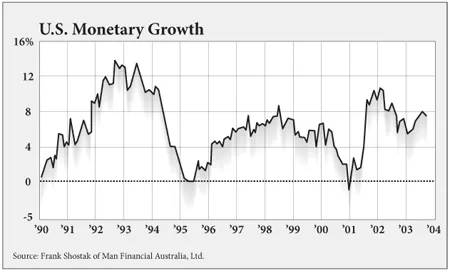
Paul Woodward / Mises Institute
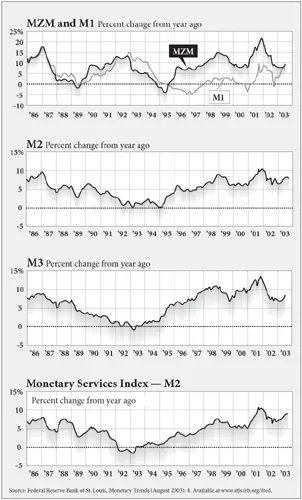
Paul Woodward / Mises Institute
Bibliography
Anderson, Benjamin M. 1979. Economics and the Public Welfare: A Financial and Economic History of the United States, 1949–1946, 2nd ed. Indianapolis, Ind.: Liberty Press.
Bartlett, Bruce. 2001. “The Deflation Dilemma: To Be Concerned or Not to Be?” National Review Online Financial (November 20).
Bernanke, Ben S. 2003. “A Perspective on Inflation Targeting.” Presented at the Annual Washington Policy Conference of the National Association of Business Economists. Washington, D.C. (March 25).
Bernanke, Ben S., and Frederic S. Mishkin. 1997. “Inflation Targeting: A New Framework for Monetary Policy?” Journal of Economic Perspectives 11 (Spring).
Bernstam, Michael S., and Alvin Rabushka. 2002. “Capital Swap à la Russe for Argentina.” Hoover Institution Public Policy Inquiry. Russian Economy (June 6). Http://www.russianeconomy.org./comments/060602.html.
Bullard, James B. and Charles M. Hokayem. 2003. “Deflation, Corrosive and Otherwise.” Federal Reserve Bank of St. Louis National Economic Trends (July): p. 1.
Cox, W. Michael, and Richard Alm. 1999a. Myths of Rich and Poor: Why We’re Better Off Than We Think. New York: Basic Books.
____. 1999b. “The New Paradigm.” In Federal Reserve Bank of Dallas 1999 Annual Report.
Degen, Robert A. 1987. The American Monetary System: A Concise Survey of Its Evolution Since 1896. Lexington, Mass.: D.C. Heath.
DeLong, J. Bradford. 1999. “Why We Should Fear Deflation.” Brookings Papers on Economic Activity (Spring). http://www.j-bradford-delong.net.
Dow Jones and Company. 2002. “Markets Diary.” Wall Street Journal (February 5): p. C1.
Federal Reserve Bank of Cleveland. 2002. “Deflation.” 2002 Annual Report. http://www.clevelandfed.org/Annual02/Essay.pdf.
____. 2003. Economic Research and Data. http://www.clevelandfed.org.
Friedman, Milton. 2002. “The 1990s Boom Went Bust. What’s Next?” wsj.com (January 22).
Friedman, Milton, and Anna J. Schwartz. 1971. A Monetary History of the United States: 1867–1960. Princeton, N.J.: Princeton University Press.
Gordon, Robert Aaron. 1974. Economic Instability and Growth: The American Record. New York: Harper and Row.
Harding, W.P.G. 1925. The Formative Period of the Federal Reserve System: During the World Crisis. New York: Houghton Mifflin.
Hayek, Friedrich A. [1939] 1969. “The Paradox of Saving.” In Profits, Interest, and Investment and Other Essays on the Theory of Industrial Fluctuations. New York: Augustus M. Kelley.
____. [1960] 1972. The Constitution of Liberty. Chicago: Henry Regnery.
Keynes, John Maynard. [1936] 1964. The General Theory of Employment, Interest, and Money. New York: Harcourt, Brace and World.
Kindahl, James K. [1961] 1971. “Economic Factors in Specie Resumption: The United States, 1865–1879.” In The Reinterpretation of American Economic History, Robert W. Fogel and Stanley L. Engerman, eds. New York: Harper and Row.
Luskin, Donald L. 2001. “The Greatest Threat Facing the U.S. Economy: Deflation.” Capitalism-Magazine.com (November 23).
Makin, John H. 2001. “The Deflation Monster Lives.” Economic Outlook (December).
Mankiw, N. Gregory. 2003. Macroeconomics, 5th ed. New York: Worth Publishers.
Meyer, Laurence H. 2001. “Inflation Targets and Inflation Targeting.” Federal Reserve Bank of St. Louis Review 83 (November/December).
Mises, Ludwig von. [1953] 1980. The Theory of Money and Credit, 2nd ed., H.E. Batson, trans. Indianapolis, Ind.: Liberty Classics.
____. 1998. Human Action: A Treatise on Economics, Scholar’s Edition. Auburn, Ala.: Ludwig von Mises Institute.
____. 1993. Man, Economy, and State: A Treatise on Economic Principles, 2nd ed. Auburn, Ala.: Ludwig von Mises Institute.
Moore, Leslie. 2002. “For Wary Argentines, The Crops Are Cash.” New York Times on the Web (December 1). http://www.nytimes.com.
Philips, C.A, T.F. McManus, and R.W. Nelson. [1937] 1972. Banking and the Business Cycle: A Study of the Great Depression in the United States. New York: Arno Press.
Rahn, Richard W. 2001. “Defeating Deflation.” Wall Street Journal (November 19).
Ranlett, John G. 1977. Money and Banking: An Introduction to Analysis and Policy. New York: John Wiley and Sons.
Reuters. 2001. “Riots and Looting in Argentina as Austerity Plan Bites.” New York Times on the Web (December 19). http://www.nytimes.com.
Rogoff, Kenneth, Manmohan S. Kumar, Laurance Ball, Vincent Reinhart, and Kim Scoenholtz. 2003. Transcript of an IMF Economic Forum: Should We Be Worried About ‘Deflation’? Washington, D.C. (May 29). http://www.imf.org.
Rohter, Larry. 2002. “Argentina Is Still Shaky Despite Currency Measures.” New York Times on the Web (January 11). Http://www.nytimes.com.
Rothbard, Murray N. 1970. Power and Market: Government and the Economy. Menlo Park, Calif.: Institute for Humane Studies.
____. 1983. The Mystery of Banking. New York: Richardson and Snyder.
____. 1984. “What’s Ahead: Resurging Inflation or Sudden Deflation.” Jerome Smith’s Investment Perspectives (November).
____. 1990. What Has Government Done to Our Money? 4th ed. Auburn, Ala.: Ludwig von Mises Institute.
___. 1993. Man, Economy, and State: A Treatise on Economic Principles. 2nd ed. Auburn, Ala.: Ludwig von Mises Institute.
____. 1994. The Case Against the Fed. Auburn, Ala.: Ludwig von Mises Institute.
____. 1995. “Deflation: Free or Compulsory.” In Making Economic Sense. Auburn, Ala.: Ludwig von Mises Institute.
____. 1997. “The Austrian Theory of Money.” In The Logic Of Action One: Method, Money, and the Austrian School. Cheltenham, U.K.: Edward Elgar.
____. 2000. America’s Great Depression. 5th ed. Auburn, Ala.: Ludwig von Mises Institute.
Salerno, Joseph T. 1987. “The ‘True’ Money Supply: A Measure of the Supply of the Medium of Exchange in the U.S. Economy.” Austrian Economics Newsletter 6 (Spring). This article can be downloaded from www.mises.org.
____. 1993. “Mises and Hayek Dehomogenized.” Review of Austrian Economics 6 (2).
____. 1999. “Money and Gold in the 1920s and 1930s: An Austrian View.” Freeman 49 (October).
____. 2002. “Understanding Argentina.” Daily Article (May 28). Mises.org.
Samuelson, Paul A. 1967. Economics: An Introductory Analysis, 7th ed. New York: McGraw-Hill.
Samuelson, Robert J. 2001. “The Specter of Deflation.” Washington Post Online (November 21).
Shostak, Frank. 2001. Ord Minnett Jardine Fleming Futures Daily Report (July 20).
Temin, Peter. 1969. The Jacksonian Economy. New York: W.W. Norton.
Weiher, Kenneth. 1992. America’s Search for Monetary Stability: Monetary and Fiscal Policy Since 1913. New York: Twayne Publishers.
From: “An Austrian Taxonomy of Deflation—With Applications to the U.S.,” The Quarterly Journal of Austrian Economics 6, no. 4 (2003): 81–109.
1 See, for example, John H. Makin, “The Deflation Monster Lives,” Economic Outlook (December 2001); Robert J. Samuelson, “The Specter of Deflation,” Washington Post Online (November 21, 2001); Donald L. Luskin, “The Greatest Threat Facing the U.S. Economy: Deflation,” Capitalism-Magazine.com (November 23, 2001); J. Bradford DeLong, “Why We Should Fear Deflation,” Brookings Papers on Economic Activity (Spring 1999). http://www.j-bradford-delong.net; Richard W. Rahn, “Defeating Deflation,” Wall Street Journal (November 19, 2001); and Bruce Bartlett, “The Deflation Dilemma: To Be Concerned or Not to Be?” National Review Online Financial (November 20, 2001).
2 Kenneth Rogoff, Manmohan S. Kumar, Laurance Ball, Vincent Reinhart, and Kim Scoenholtz, Transcript of an IMF Economic Forum: “Should We Be Worried About ‘Deflation’?”, Washington, D.C. (May 29, 2003). Available at: http://www.imf.org.
3 Luskin, “The Greatest Threat.”
4 Ibid.
5 John Maynard Keynes, The General Theory of Employment, Interest, and Money (New York: Harcourt, Brace and World, [1936] 1964), p. 269.
6 The seminal work on Austrian monetary theory is Mises’s Theory of Money and Credit, 2nd ed., trans. H.E. Batson (Indianapolis, Ind.: Liberty Classics, [1953] 1980). Mises’s more mature statement of monetary theory can be found in Human Action: A Treatise on Economics, Scholar’s Edition (Auburn, Ala.: Ludwig von Mises Institute, [1953] 1980), pp. 395–475. Murray N. Rothbard’s comprehensive restatement and elaboration of Misesian monetary theory is contained in his treatise Man, Economy, and State: A Treatise on Economic Principles, 2nd ed. (Auburn, Ala.: Ludwig von Mises Institute), pp. 160–200, 661–764. For two shorter and very lucid treatments of Austrian monetary theory, see Murray N. Rothbard, What Has Government Done to Our Money? 4th ed. (Auburn, Ala.: Ludwig von Mises Institute); idem, “The Austrian Theory of Money,” in The Logic of Action One: Method, Money, and the Austrian School (Cheltenham, U.K.: Edward Elgar, 1997), pp. 297–320.
7 For a discussion of how the meaning of the words inflation and deflation was progressively transformed, see Joseph T. Salerno, “Money and Gold in the 1920s and 1930s: An Austrian View,” Freeman 49 (October, 1999), pp. 31–33 [reprinted here as Chapter 16]. Mises (Human Action, pp. 419–21) argues that the modern definition of these terms is inexpedient for the purposes of scientific discourse.
8 This term was coined by Mises (Human Action, p. 408) as a shorthand expression for the relation between the supply of and the demand for money.
9 For a discussion of the “exchange demand” as a component of the total demand for money, see Rothbard, Man, Economy and State, p. 662.
10 W. Michael Cox and Richard Alm, Myths of Rich and Poor: Why Wer’e Better Off Than We Think (New York: Basic Books, 1999), p. 45.
11 W. Michael Cox and Richard Alm, “The New Paradigm,” in Federal Reserve Bank of Dallas 1999 Annual Report.
12 Milton Friedman and Anna J. Schwartz, A Monetary History of the United States: 1867–1960 (Princeton, N.J.: Princeton University Press, 1971), pp. 94–95.
13 Federal Reserve Bank of Cleveland, “Deflation,” 2002 Annual Report, p. 10. Available at http://www.clevelandfed.org/annual02/Essay.pdf.
14 For example, in the 2002 Annual Report of the Federal Reserve Bank of Cleveland (“Deflation,” p. 8) we find the following amazing statement: “[T]here are circumstances in which deflation can be a characteristic of a healthy economy—namely, during productivity-driven booms.”
15 The data in this paragraph can be found in Peter Temin, The Jacksonian Economy (New York: W.W. Norton, 1969), pp. 155–65.
16 For a description of the policies of the Hoover administration that impeded the bank credit deflation and the recession-adjustment process in general, see Murray N. Rothbard, America’s Great Depression, 5th ed. (Auburn, Ala.: Ludwig von Mises Institute, 2000), pp. 209–337.
17 The Amendment to the Federal Reserve Act of June 21, 1917 mandated that only reserve deposits held at the Federal Reserve banks would be counted as legal reserves of member banks, resulting in a centralization of gold reserves at the Fed (C.A. Philips, T.F. McManus, and R.W. Nelson, Banking and the Business Cycle: A Study of the Great Depression in the United States [New York: Arno Press, [1937] 1972], pp. 24–25; and W.P.G. Harding, The Formative Period of the Federal Reserve System: During the World Crisis (New York: Houghton Mifflin, 1925), pp. 72–74. As Benjamin Anderson (Economics and the Public Welfare: A Financial and Economic History of the United States, 1914–1946, 2nd ed. [Indianapolis, Ind.: Liberty Press, 1979], p. 56) pointed out, the theory underlying this Amendment was “not very clear” but “in 1916 and in early 1917 there was a very definite practical consideration that we might be involved in war, and that it was important that the gold of the country be concentrated in a central reservoir as a basis for war finance.” So the centralization of gold reserves in the Fed was undertaken with the definite intention of facilitating an inflationary monetary policy.
18 In this context we will use these two terms interchangeably to describe a policy-induced reduction or “contraction” of the money supply that results in a fall, or “deflation,” of prices. The two terms describe aspects of a single economic process that are related as cause and effect or as means and end.
19 Robert Aaron Gordon, Economic Instability and Growth: The American Record (New York: Harper and Row, 1974), p. 22.
20 Accounts of the Depression of 1920–21 and the preceding inflationary boom can be found in in Kenneth Weiher, America’s Search for Monetary Stability: Monetary and Fiscal Policy Since 1913 (New York: Twayne Publishers, 1992), pp. 26–37; Robert A. Degen, The American Monetary system: A Concise Survey of Its Evolution Since 1896 (Lexington, Mass.: D.C. Heath, 1987), pp. 30–40; Gordon, Economic Instability and Growth, pp. 21–22; and Anderson, Economics and the Public Welfare, pp. 61–89.
21 Gordon, Economic Instability and Growth, pp. 21–22.
22 Weiher, America’s Search for Monetary Stability, p. 34.
23 Ibid., p. 37.
24 Ibid., p. 36.
25 Friedrich A. Hayek, The Constitution of Liberty (Chicago: Henry Regnery, [1960] 1972), pp. 330, 332, 333.
26 On inflation targeting, see Ben S. Bernanke, “A Perspective on Inflation Targeting,” Presented at the Annual Washington Policy conference of the National Association of Business Economists. Washington, D.C. (March 25, 2003); Ben S. Bernanke and Frederic S. Mishkin, “Inflation Targeting: A New Framework for Monetary Policy?” Journal of Economic Perspectives 11 (Spring 1997); and Laurence H. Meyer, “Inflation Targets and Inflation Targeting,” Federal Reserve Bank of St. Louis Review 83 (November/December 2001). At an IMF conference recently Laurence Ball (Kenneth Rogoff, et al., Transcript of an IMF Economic Forum: Should We Be Worried About ‘Deflation’? Washington, D.C. [May 29, 2003], p. 14. http://www.imf.org.) advocated an inflation target in the 2 to 4 percent range, proclaiming, “there’s absolutely no evidence that that level of inflation has any economic cost we need to worry about.” It is noteworthy that in the 1960s “Old” Keynesians such as Paul Samuelson (Economics: An Introductory Analysis, 7th ed. [New York: McGraw-Hill, 1967], p. 135) considered rates of inflation of the magnitude aimed at in this New Keynesian monetary policy as “a new disease—a tendency for anything like an approach to full employment to lead to ‘creeping inflation.’”
27 Mises, Human Action, pp. 564–65.
28 Mises, Theory of Money and Credit, pp. 263–64.
29 Ibid., pp. 265–68.
30 Rothbard, What Has Government Done to Our Money?, pp. 94–95.
31 Rothbard has presented two different proposals for transforming the present U.S. fiat dollar into a 100 percent gold dollar, which are outlined, respectively, in Murray N. Rothbard, The Mystery of Banking (New York: Richardson and Snyder, 1983), pp. 263–69 and idem, The Case Against the Fed (Auburn Ala.: Ludwig von Mises Institute, 1994), pp. 145–51.
32 Rothbard, Man, Economy, and State, p. 865.
33 A very clear and comprehensive discussion of the effects of Treasury activities on the money supply can be found in John G. Ranlett, Money and Banking: An Introduction to Analysis and Policy (New York: John Wiley and Sons, 1977), pp. 218–34.
34 The nominal constancy of the fiscal surplus is assumed only for purposes of illustration and is not crucial to the social welfare inferences drawn in the text below. In this case, it assures a 20 percent per annum contraction of the money supply. A much more realistic and mild contraction, say 2 or 3 percent per year, would not change the conclusions of the welfare analysis. It should be noted, however, that a fixed rate of monetary contraction requires a fixed nominal dollar surplus and therefore an increasing real surplus. In contrast, an annually recurring surplus that is constant in real terms will result in a continually declining rate of monetary contraction.
35 Rothbard, Mystery of Banking, pp. 263–69.
36 N. Gregory Mankiw, Macroeconomics, 5th ed. (New York: Worth Publishers, 2003), p. 88.
37 For Austrians, seignorage is simply the first link in the chain of distribution effects that characterize the inflationary adjustment process. See, for example, Mises, Theory of Money and Credit, pp. 153–68; idem, Human Action, pp. 408–11; Rothbard, Mystery of Banking, pp. 47–53; idem, Man, Economy, and State, pp. 709–12, 850–53.
38 The case that all government expenditures introduce calculational chaos and economic inefficiencies into the market process that are separate from, and superadded to, the effects of taxation is elaborated in in Murray N. Rothbard, Power and Market: Government and the Economy (Menlo Park, Calif.: Institute for Humane Studies, 1970), pp. 125–49. See Joseph T. Salerno, “Mises and Hayek Dehomogenized,” Review of Austrian Economics 6(2): pp. 130–31 for the argument that the “preferences and demands” of the participants in the social division of labor “must serve as the sole and ultimate standard of socially efficient resource use” and that the market demands of tax consumers falsify monetary calculation and lead to “a socially inefficient reallocation of productive resources.”
39 For the formulation of this distinction between direct and indirect effects of government intervention and its application in a comprehensive analysis of a myriad of government interventions, see Rothbard, Power and Market.
40 Mises’s argument against monetary contraction because “those who are enriched by the increase in the value of money are not the same as those who were injured by the depreciation of money in the course of the inflation” thus fails because it only takes account of the direct utility effects and ignores the indirect rabattage effects (Mises, Theory of Money and Credit, p. 266).
41 It is true, as Friedman and Schwartz (Monetary History, p. 82) pointed out, that the decrease in the money stock was not attributable solely to the Treasury’s fiscal deflation because both the deposit/reserve and deposit/currency ratios declined as a result of financial crises and bank failures during this period. Nonetheless the stock of “high-powered money” did shrink as the stock of inconvertible greenbacks held as reserves by the banks and currency by the public contracted from $414 million in 1874 to $382 million in 1878 (James K. Kindahl, “Economic Factors in Specie Resumption: The United States, 1865–1879,” in The Reinterpretation of American Economic History, eds. Robert W. Fogel and Stanley L. Engerman [New York: Harper and Row, [1961] 1971], p. 475).
42 James B. Bullard and Charles M. Hokayem, “Deflation, Corrosive and Otherwise,” Federal Reserve Bank of St. Louis National Economic Trends (July 2003): p. 1.
43 Ibid.
44 Friedman and Schwartz, Monetary History, pp. 87–88.
45 Murray N. Rothbard, “Deflation: Free or Compulsory,” in Making Economic Sense (Auburn, Ala.: Ludwig von Mises Institute, 1995).
46 Data on Argentina’s money supply are provided by Frank Shostak, Ord Minnett Jardine Fleming Futures Daily Report (July 20, 2001).
47 Reuters, “Riots and Looting in Argentina as Austerity Plan Bites,” New York Times on the Web (December 19, 2001). http://www.nytimes.com.
48 Larry Rohter, “Argentina Is Still Shaky Despite Currency Measures,” New York Times on the Web (January 11, 2002). http://www.nytimes.com.
49 Quoted in Ibid.
50 The examples cited in this paragraph may be found in Leslie Moore, “For Wary Argentines, The Crops Are Cash,” New York Times on the Web (December 1, 2002). http://www.nytimes.com.
51 For more detail on this proposal, see Joseph T. Salerno (“Understanding Argentina,” Daily Article (May 28, 2002). http://www.mises.org). Michael S. Bernstam and Alvin Rabushka (“Capital Swap à la Russe for Argentina,” Hoover Institution Public Policy Inquiry. Russian Economy (June 6, 2002). http://www.russianeconomy.org./comments/060602.html) propose a similar plan to reform Russia’s banking system.
52 Bartlett, “The Deflation Dilemma.”
53 Rahn, “Defeating Deflation.”
54 Murray N. Rothbard, “What’s Ahead: Resurging Inflation or Sudden Deflation,” Jerome Smith’s Investment Perspectives (November 1984).
55 Luskin, “The Greatest Threat.”
56 F.A. Hayek, “the Paradox of Saving,” in Profits, Interest, and Investment and Other Essays on the Theory of Industrial Fluctuations (New York: Augustus M. Kelley, [1939] 1969).
57 Hayek’s seminal article, “The Paradox of Saving” (1969), was originally published in German in 1929 and first appeared in English in 1931, effectively refuting Keynes’s “deficiency of aggregate demand” and “paradox of thrift” arguments at least half-a-decade in advance in the two most important scientific languages of the time.
58 Hayek, “The Paradox of Saving,” pp. 253–54.
59 Ibid., pp. 262–63.
60 Rahn, “Defeating Deflation.”
61 Unless otherwise noted the statistics cited in this paper have been computed from data available in the Federal Reserve Economic Data (FRED) database on the Internet at www.stls.frb.org/fred2. The DJ-AIG Commodity Index can be found in Dow Jones and Company, Inc. 2002. The AMS aggregate is computed by Frank Shostak. For a description and justification of the AMS aggregate see Joseph T. Salerno, “The ‘True’ Money Supply: A Measure of the Supply of the Medium of Exchange in the U.S. Economy,” Austrian Economics Newsletter 6 (Spring 1987). This article can be downloaded from www.mises.org.
62 The median CPI was developed by economists Michael F. Bryan and Stephen G. Cecchetti and is calculated by the Federal Reserve Bank of Cleveland. A short description of the aggregate and its rationale and its time series can be found in Federal Reserve Bank of Cleveland (2003). From the Austrian perspective, this statistic gives a far better “understanding” of fluctuations in the purchasing power of money because it is less aggregative than the standard CPI index and is more consistent with the Austrian notion of a “swarm” of individual and particular prices rising and falling together while constantly changing positions relative to one another. The metaphor of a bee swarm whose overall variations in altitude are reflected to different degrees in each of its individual members is sharply opposed to the metaphor of a “price level” uniformly changing like the level of a body of water, a misleading metaphor that has been entrenched in mainstream monetary thought at least since Irving Fisher’s writings in the early twentieth century.
63 Milton Friedman, “The 1990s Boom Went Bust. What’s Next?” wsj.com (January 22, 2002).
64 To be fair, Friedman (ibid.) did add the caveat, “continuation of anything like that rate of monetary growth will ensure that inflation rears its ugly head once again.”
65 Makin, “The Deflation Monster Lives.”
66 Ibid.
67 Ibid.
68 DeLong, “Why We Should Fear Deflation.”
69 For a critique of the argument that a premium (discount) on the nominal interest rate results from anticipated inflation (deflation) in order to maintain the real rate, see Rothbard, Man, Economy, and State, pp. 693–98.
Money, Sound and Unsound
Read the whole book online · Book details
This work is published under a Creative Commons licence. You may copy, share, and re-host it with attribution.