
Chapter 27 of 28 · Pearl Harbor: The Story of the Secret War by George Morgenstern
Notes
This book was completed before publication by the Government Printing Office of the official proceedings of the Joint Congressional Committee to investigate the attack upon Pearl Harbor. Where the transcript of committee proceedings was available, citations of testimony are referred to the transcript; otherwise, references are to the specific dates of hearings on which testimony was given. These may be checked against the daily hearings as published by the Government Printing Office.
Other sources, with abbreviations employed in the Appendix, are as follows:
AP—Associated Press
APH—Army Pearl Harbor Board: Text as printed in extra number of the United States News, Sept. 1, 1945.
Atlantic—Battle Report: The Atlantic War, by Comdr. Walter Karig, USNR; Lieut. Earl Burton, USNR, and Lieut. Stephen L. Freeland, USNR (Farrar and Rinehart, Inc., New York, 1946).
BR—Battle Report: Pearl Harbor to Coral Sea, by Comdr. Walter Karig, USNR, and Lieut. Wellbourn Kelley, USNR (Farrar and Rinehart, New York, 1944).
Chron.—Events Leading Up to World War II: Chronological History, 1931-1944 (House Document No. 541, United States Government Printing Office, Washington, 1944).
CR—Congressional Record
CT—The Chicago Tribune
Fed. Reg.—Federal Register
For. Rel. I and II—Papers Pertaining to Foreign Relations of the United States: Japan, 1931-1941. Two volumes (House Document No. 339, United States Government Printing Office, Washington, 1943).
Grew—Ten Years in Japan, by Joseph C. Grew (Simon and Schuster, New York, 1944). Submitted before the Joint Congressional Committee on the Investigation of the Pearl Harbor Attack as Exhibit 30.
Hart Report—Investigation of the Pearl Harbor Attack by Adm. Thomas C. Hart, USN, retired.
How War Came—How War Came, by Forrest Davis and Ernest K. Lindley (Simon and Schuster, New York, 1942).
Huie—The Case against the Admirals, by William Bradford Huie (E. P. Dutton, New York, 1946).
Intercepts—Pearl Harbor: Intercepted Japanese Diplomatic Messages, Joint Congressional Committee, Exhibit 1.
JCC—Joint Congressional Committee on the Investigation of the Pearl Harbor Attack: daily hearings.
Kimmel—Statement of Rear Adm. Husband E. Kimmel, USN, retired, to Joint Congressional Committee, Jan. 15, 1946; 108 pages (mimeograph).
Maj.— Majority Report of the Joint Congressional Committee (United States Government Printing Office, Washington, 1946).
Min.—Minority Report of the Joint Congressional Committee (United States Government Printing Office, Washington, 1946).
NCI—Report of the Naval Court of Inquiry which investigated the Pearl Harbor attack: Text as printed in extra number of the United States News, Sept. 1, 1945.
NYT—The New York Times
Papers—Public Papers and Addresses of Franklin D. Roosevelt: 1936 Volume, Random House, New York; 1937-1940 Volumes, Macmillan, New York.
Peace—Peace and War: United States Foreign Policy, 1931-1941 (United States Government Printing Office, Washington, 1943).
Puleston—The Armed Forces of the Pacific, by Capt. W. D. Puleston, USN (Yale University Press, New Haven, 1941).
R.—Report of the Presidential Commission to Investigate Pearl Harbor, headed by Associate Justice Owen J. Roberts.
Safford—Statement of Capt. L. F. Safford, USN, to Joint Congressional Committee, Feb. 1, 1946 (22 pages, mimeograph). Incorporated in transcript of the committee, pp. 9622-54.
Stimson—Statement of former Secretary of War Henry L. Stimson to Joint Congressional Committee, March 21, 1946 (68 pages, mimeograph). Incorporated in volume 70 of the committee transcript.
Tr.—Report of Proceedings before the Joint Committee on the Investigation of the Pearl Harbor Attack (Ward and Paul, Washington, official reporters).
NOTES ON FOREWORD
1. Brittanica Book of the Year, 1938-1942, p. 1511.
2. Tr., p. 8693.
3. The Army Pearl Harbor Board was appointed pursuant to the provisions of Public Law 339, Seventy-eighth Congress, approved June 13, 1944, and by order dated July 8, 1944, of the adjutant general, War Department. The board was directed “to ascertain and report the facts relating to the attack made by Japanese armed forces upon the Territory of Hawaii on Dec. 7, 1941, and to make such recommendations as it may deem proper.” The board held sessions beginning July 20, 1944, and concluded its investigation on Oct. 20, 1944. Its record and exhibits cover 3,357 printed pages. Members of the board were Lieut. Gen. George Grunert, president; Maj. Gen. Henry D. Russell, and Maj. Gen. Walter A. Frank.
4. The Navy Court of Inquiry was appointed pursuant to the provisions of Public Law 339, Seventy-eighth Congress, approved June 13, 1944, and by order dated July 13, 1944, of the Secretary of the Navy James Forrestal. The court was ordered to “inquire into the attack made by Japanese armed forces on Pearl Harbor, Territory of Hawaii, on 7 December 1941 . . . and will include in its findings a full statement of the facts it may deem to be established. The court will further give its opinion as to whether any offenses have been committed or serious blame incurred on the part of any person or persons in the naval service, and in case its opinion be that offenses have been committed or serious blame incurred, will specifically recommend what further proceedings should be had.” The court held sessions beginning July 24, 1944, and concluded its inquiry on October 19, 1944. The record of its proceedings and exhibits covers 1,397 printed pages. Members of the court were Adm. Orin G. Murfin, retired, president; Adm. Edward C. Kalbfus, retired, and Vice Adm. Adolphus Andrews, retired.
5. The inquiry conducted by Adm. Thomas C. Hart, United States Navy, retired, was initiated by precept dated Feb. 12, 1944, from Secretary of the Navy Frank Knox to Adm. Hart “For an Examination of Witnesses and the Taking of Testimony Pertinent to the Japanese Attack on Pearl Harbor, Territory of Hawaii.” The precept stated “. . . Whereas certain members of the naval forces, who have knowledge pertinent to the foregoing matters, are now or soon may be on dangerous assignments at great distances from the United States . . . it is now deemed necessary, in order to prevent evidence being lost by death or unavoidable absence of those certain members of the naval forces, that their testimony, pertinent to the aforesaid Japanese attack, be recorded and preserved, . . .” This inquiry was commenced on Feb. 12, 1944, and was concluded on June 15, 1944. The record of its proceedings and exhibits covers 565 printed pages.
6. Tr., Vol. 1, p. 8.
7. CR, p. 8480, Sept. 6, 1945.
8. The majority report of the committee stated, “An effort was made to elicit all facts having an immediate or remote bearing on the tragedy of Dec. 7, 1941. It is believed the committee has succeeded through its record in preserving for posterity the material facts concerning the disaster” (Maj., p. XIV).
The minority report differed. “When all the testimony, papers, documents, exhibits, and other evidence duly laid before the committee are reviewed,” it said, “it becomes apparent that the record is far from complete” (Min., p. 3).
The difficulties under which the committee prosecuted its investigation are outlined as follows in the minority report:
“The committee did not have an opportunity to cross-examine any of the high civil executive principals in the Pearl Harbor affair. President Roosevelt and Secretary Knox had died before the committee was created. Harry Hopkins, who was intimately and officially associated with President Roosevelt, died shortly after the committee began its work. The ill health of Secretary of War Stimson and Secretary of State Hull prevented the committee from getting the full benefit of their knowledge, except for the information they voluntarily furnished. . . .
“These difficulties were supplemented by even greater ones stemming from Presidential restraints on the committee and from the partisan character of the committee itself.
“Even before the committee commenced its work, it was confronted with an order issued on Aug. 28, 1945, and signed by President Truman, which severely limited the power of the committee to gain access to the full facts. The order is as follows (Tr., Vol. 1, p. 26):
‘AUGUST 28, 1945.
‘Memorandum for—The Secretary of State.
The Secretary of War.
The Secretary of the Navy.
The Attorney General.
The Joint Chiefs of Staff.
The Director of the Budget.
The Director of the Office of War Information.
‘Appropriate departments of the government and the joint chiefs of staff are hereby directed to take such steps as are necessary to prevent release to the public, except with the specific approval of the President in each case, of—
‘Information regarding the past or present status, technique or procedures, degree of success attained, or any specific results of any cryptanalytic unit acting under the authority of the United States government or any department thereof.
HARRY S. TRUMAN.”
‘Restricted.
“It was not until Oct. 23, 1945, that President Truman made the order less stringent by a new order. The modification left much to be desired.
“The application of the new order was limited to the State, War, and Navy Departments. It relaxed the secrecy of records only so far as ‘the Joint Committee” was concerned, while it continued to prevent ‘individual’ members of the committee from searching records as responsible members of Congress either alone, in groups, or even when accompanied by committee counsel. By one way or another, control over papers, records, and other information remained in the hands of the majority party members.
“The President’s October order also contained the unfortunate phrase ‘any information in their possession material to the investigation,’ which provided a cloak for those reluctant to yield information requested by members of the committee. It was always possible to confront individual members with the view that the papers, data, and information desired was not ‘material to the investigation.’ Decisions were made by the majority ruling out evidence as ‘not material to the investigation’ without members of the committee ever seeing the material about which the decision was made.
“No subsequent modifying orders wholly removed these restrictions. In an order of Nov. 7, 1945, President Truman relaxed restraints on executives of the government in order that they may speak freely to individual members of the committee, but the order closed with the direction: ‘This does not include any files or written material.’
“In this fashion every facility and concession afforded to members of the joint committee was hedged about with troublesome qualifications and restraints. The relaxation of restraints was often publicized while the continuing qualifications were but little discussed. The effect was to restrict individual members of the committee in practice while the appearance of their freedom of operations was held out to the public. In justice to committee counsel and to individual majority members of the committee, efforts made by them to overcome these restrictions should be recognized. It is a great tribute to their fairness that the committee did not break up over this issue but continued to work despite the handicaps which were never wholly removed.
“The plain fact that an investigation could not be an investigation if committee members remained mere spectators, persuaded some members that restraints on their freedom were not justified. The flimsiness of the argument for restrictions became even more evident when permission to search files and other records was denied by majority vote to individual members even when accompanied by committee counsel. Rightly or wrongly it was inferred from this that there was a deliberate design to block the search for the truth.
“Such a view was supported by the knowledge that restrictions on individual members of congressional investigatory bodies were contrary to the best practices in other investigations. Some celebrated instances were recalled. Speaking in the Senate on Nov. 9, 1945, during one of the discussions on committee powers, the Senator from Montana (Mr. Burton K. Wheeler) observed:
“‘I concur in what the Senator from Illinois has said with reference to the authorizing of a single member of the committee to hold hearings. I have served on a good many investigations since I have been a member of the Senate, and some very important ones. I assisted to quite an extent in the Teapot Dome investigation carried on by my colleague, Senator Walsh, of Montana, and likewise I carried on the investigation of the Department of Justice. I was a minority member of the committee.
“‘In all my experience with any investigating committee, I have never known of any one member of a committee not being permitted to go and look over the files in any department of the government of the United States. This is the first time I have ever known anything of that kind being questioned. . . .
“‘. . . I call attention to the fact that in the Daugherty investigation I sent for files myself, I asked for files from the attorney general of the United States, Mr. Daugherty. He refused to give them to me. I have forgotten the ground he stated, but at any rate he refused to give them to me. When he did so, the President of the United States, Mr. Coolidge, called him in and asked for his resignation, and Mr. Daugherty was eliminated from the office of attorney general. After that time, when the new attorney general was appointed, every single file I ever asked for, as a minority member of the committee, was furnished to me.
“‘. . . As I have stated, my colleague, Senator Walsh, of Montana, was a minority member of the committee investigating the Teapot Dome situation. I know of my own personal knowledge that he got from the department, and from officials in the department, information which he afterward used, and if he had not been permitted to do that, and if I had not been permitted to do it, I am sure there would have been a complete failure of the investigation of the Department of Justice. (Congressional Record, Vol. 91, No. 198, November 9, 1945, p. 10755.)’
“Another instance is the more recent one in which President Truman himself is well versed. As Senator, Mr. Truman headed a distinguished committee bearing the popular designation ‘The Truman Committee’ (now the Mead Committee). The cardinal principle of the Truman Committee in the four years during which it won the respect and confidence of the American people, rested on the proposition that every individual member of the committee was wholly free to search for any information deemed by him to be relevant wherever and whenever he thought it could be found. Never once did the chairman or the majority of the committee refuse to recognize that right and that responsibility of each individual member.
“Untrammeled freedom of individual committee members in these instances did not produce chaos or disorder as was argued would be the case in the Pearl Harbor inquiry. On the contrary, the procedure and results in each case did honor to the committees concerned and proved salutary for the nation. Complete concurrence with the most admirable outline of the purposes and scope of the investigation of the events leading up to Pearl Harbor and our entry into the World War as presented to the Senate by the author of the resolution at the time of its introduction and hearty approval of much that has been done by the committee must not blind us to the extent to which the investigation lived up to its advance billing by its distinguished sponsor.
“At the very inception the tested practices in investigations of this character that had demonstrated such extraordinary success in the entire history of the Truman Committee were very definitely rejected and neither of the two members of the committee who had received rather extended training under the then Senator Truman was allowed to follow the course in the investigation of Pearl Harbor that had repeatedly produced most gratifying results in his earlier experience.
“This firm refusal by the committee majority, consisting of six Democrats as against four Republicans, at the very outset to allow the scope to individual members even with every safeguard proposed against the alleged danger of abuse was both unfortunate and disquieting.
“Everything that has since developed must be viewed in the light of this iron curtain that was thus imposed.
“Permission was asked to conduct exploration for certain missing records. Vigorous and public denial was made—presumably on executive authority—that any records were missing. Subsequently it developed that several records were missing and most inadequate explanations were supplied. How any public interest could possibly have been prejudiced by affording any opportunity to examine the manner of keeping records of this character has never been satisfactorily explained.
“These incidents revealed a disquieting determination to keep entire control of the investigation in the hands of the committee majority who were thus put in the unusual position of arrogating to themselves the capacity to conduct an impartial and adequate investigation of their own administration. The history of human conduct furnishes few precedents to justify such confidence.
“Some of the effects of majority decision as well as gaps in the data and testimony due to other causes illustrate the great difficulty surrounding the work of the committee.
“Secretary Stimson declined to appear on the ground that his health did not permit him to undergo strain. Access to his diary was denied by majority vote.
“To accommodate Secretary Stimson because of his illness, Senator Ferguson on March 6, 1946, submitted 176 questions as part of the official record for Secretary Stimson to answer as if propounded in open hearing of the committee (Tr., Vol. 70, pp. 14437 ff.).
“Secretary Stimson did not answer any of these questions, and the committee made no effort to insist upon his answering these questions, which were highly pertinent to the inquiry.
“Later, Senator Ferguson submitted a supplementary list of 61 questions to be answered in the same manner (Tr., Vol. 70, p. 14476). Secretary Stimson answered these questions in writing, and his answers are part of the record. These answers did not, however, make up for the deficiencies in the failure to answer the earlier list of 176 questions.
“Secretary Hull made three appearances, in the course of which he gave his official version of the matters before the committee and was briefly examined by the counsel, but minority members of the committee were not permitted to cross-examine him. When his answers to written interrogatories from committee members proved unresponsive, there was no way to secure further information from him.
“The diary of former Ambassador Joseph C. Grew was likewise denied to the committee. The assertion of its confidential character was somewhat belied by its submission for examination to certain individuals with a view to its commercial publication.
“The denial to the committee of the Stimson and Grew diaries was particularly obstructive because these principles placed excerpts of the diaries in the record and withheld the rest. This was contrary to the prime rule in American law that if part of a document is put into the record by a witness in his own behalf, the court is entitled to demand the whole of the document. Concerning each of these diaries the committee, by majority vote, refused to issue subpenas for their production.
“Many messages, probably several hundreds, between Winston Churchill and President Franklin D. Roosevelt received prior to Dec. 7, 1941, were not available to the committee, although there is good reason to believe that they bore on the gathering crisis. Other messages between Mr. Churchill and the British embassy and American authorities were made available to the committee, but our government replies or action taken were not so available.
“The former Prime Minister of Great Britain was in this country not on official business while hearings of this committee were going on. His intimate knowledge of affairs leading up to Pearl Harbor would have cleared up many gaps in the evidence. By majority vote, a request for the appearance of Mr. Churchill was refused.
“President Roosevelt’s secretary, Miss Grace Tully, was permitted to determine for herself and the committee and the country what portions of the official correspondence of the late President had any relevancy to Pearl Harbor. This could hardly be a satisfactory substitute for the responsibility placed upon this committee.
“One of the very important questions concerning the defense of Hawaii dealt with the delays in building airfields and the failure to install radar and other warning devices. Members of the committee sought to inquire into the performance of one Col. Theodore Wyman in this connection, but the committee decided against it.
“The whole question of whether or not it would have been possible to avoid war by proper diplomatic action and thus avert the Pearl Harbor tragedy was left largely unexplored.
“We are permitted only occasional glimpses into this realm but these are fascinating. . . .
“In short, the committee labored under great difficulties and was not in possession of the full historical record pertinent to the case before it. Nevertheless an investigation was made and an amazing amount of material was developed in the limited time allowed to cover such a vast field. It is the duty of the committee to render a report, regardless of the inadequacies of evidence, if sufficient facts are at hand to pass on the issues of responsibility for the catastrophe at Pearl Harbor. A careful review of the evidence is convincing enough that these issues can be decided now” (Min., pp. 3-8).
Representative Keefe, in a statement of “additional views” appended to the majority report, said:
“This investigation has not brought to light all the facts about Pearl Harbor. We have been denied much vital information. Mr. Stimson did not answer certain important interrogations which, in consideration of the state of his health, were submitted to him in writing. He has also denied to the committee his diary entries for the days Dec. 2 to Dec. 6, 1941. These were significantly omitted from his written statement. Mr. Hull’s health permitted only a brief appearance before us and no examination by the minority members of the committee. Written interrogatories were submitted as to when he first saw or obtained information as to the contents of certain vital intercepted messages, including the 1:00 P.M. message. Mr. Hull answered: ‘I do not recall the exact times that I first saw or learned of the contents of the messages you cite’ (Tr., 14316). ‘I do not recall’ was an answer frequently received from other important witnesses. Messrs. Maxwell Hamilton, Eugene Dooman and Stanley Hornbeck, State Department officials who played important roles in 1941 in our Far Eastern diplomacy, have not testified. We have been denied Ambassador Grew’s diary. In December, 1941, Gen. Bedell Smith was secretary to the general staff of the Army. He did not testify. His possible knowledge of the distribution of intercepted messages to Gen. Marshall on Saturday evening, Dec. 6, was not investigated. Adm. (then Capt.) Glover was the duty officer in the office of the chief of naval operations on Dec. 6, 1941. His log for that night contained the vital information about Mr. Stimson’s interest in precise locations of the ships of the Pacific fleet. Adm. Glover sent the committee a telegram but did not testify. Mr. Welles’s memoranda of Atlantic Charter conferences was obtained from State Department only after his oral testimony before us had been completed” (Maj., pp. 266 S and T).
9. CT, Nov. 21, 1945, 2:6.
10. Senate Document No. 244.
11. In his statement of additional views, Representative Keefe said (Maj., p. 266-A):
“Throughout the long and arduous sessions of the committee in the preparation of the committee report, I continuously insisted that whatever ‘yardstick’ was agreed upon as a basis for determining responsibilities in Hawaii should be applied to the high command at Washington. This indicates in a general way my fundamental objection to the committee report. I feel that facts have been marshaled, perhaps unintentionally, with the idea of conferring blame upon Hawaii and minimizing the blame that should properly be assessed at Washington.
“A careful reading of the committee report would indicate that the analysis of orders and dispatches is so made as to permit criticism of our commands in Hawaii while at the same time proposing a construction which would minimize the possibility of criticism of those in charge at Washington.
“I think that the facts in this record clearly demonstrate that Hawaii was always the No. 1 point of danger and that both Washington and Hawaii should have known it at all times and acted accordingly. Consequently I agree that the high command in Hawaii was subject to criticism for concluding that Hawaii was not in danger. However, I must insist that the same criticism with the same force and scope should apply to the high command in Washington. It is in this respect that I think the tenor of the committee report may be subject to some criticism.
“I fully agree with the doctrine relating to the placing of responsibility on military officers in the field and their resulting duty under such responsibilities. I agree that they must properly sustain this burden in line with the high and peculiar abilities which originally gave them their assignments.
“In the execution of their vitally important duties, however, the officers at the front in the field are fairly entitled to all aids and help and all information which can reasonably be sent to them from the all-powerful high staff command in Washington. If both commands are in error, both should be blamed for what each should have done and what each failed to do respectively. The committee report, I feel, does not with exactitude apply the same yardstick in measuring responsibilities at Washington as has been applied to the Hawaiian commanders. I cannot suppress the feeling that the committee report endeavors to throw as soft a light as possible on the Washington scene.”
12. The Joint Congressional Committee conducted hearings on 70 days between Nov. 15, 1945, and May 31, 1946, receiving 183 exhibits and taking 15,000 pages of testimony from 43 witnesses. Testimony and exhibits of seven previous investigations were available to the committee: the inquiries of the Roberts Commission, Adm. Hart, the Army Pearl Harbor Board, the Navy Court of Inquiry, Col. Clarke, Maj. Clausen, and Adm. Hewitt. The records of these investigations total 9,754 printed pages of testimony from 318 witnesses, and 469 exhibits were filed with them. The records of these proceedings have been incorporated in the record of the Joint Congressional Committee, which encompasses approximately 10 million words (Maj., p. XIV).
NOTES ON CHAPTER I: WAR
1. Neville Chamberlain, Sept. 30, 1938.
2. See testimony of Baron Constantin von Neurath, former German foreign minister, at Nuernberg war crimes trials, reported in AP dispatch, June 24, 1946. Neurath asserted that signers of the Munich pact could have halted Hitler’s aggressions even after the absorption of Czechoslovakia.
3. Poland No. 1, 1945: His Majesty’s Stationery Office, Cmd. 6616, p. 4.
4. Ambrose Bierce, The Devil’s Dictionary (Tower Books Edition), p. 22.
5. AP dispatch from Tokyo, Dec. 19, 1945. (Konoye memoirs introduced as JCC Ex. 173.)
6. See dispatch of L.S.B. Shapiro, NYT, March 19, 1946, 10:4. Mr. Shapiro reported: “The key to Russia’s expansion program in Europe and the Near East has fallen into the hands of the State Department in Washington. Captured German documents detailing the final conversations between Russian Foreign Minister Vyaches-lav Molotov and German Foreign Minister Joachim Ribbentrop in the spring of 1941 have been collated and compared with the reports of American envoys and military attachés in European capitals at that time, with the result that Washington now possesses exact pictures of the aims and desires that lie behind the current Soviet troop movements and diplomatic pressures.
“A few weeks before Germany attacked Russia in June, 1941, Mr. Molotov traveled to Berlin in a final effort to divert the Wehrmacht spearheads, which were then clearly gathering for a thrust to the east. The transcript of these last conversations between Mr. Molotov and Ribbentrop became, in 1945, the chief objective of intelligence teams of every victorious nation scouring the ruins of the Third Reich.
“This correspondent has learned, on reliable authority, that the prized transcript was in a batch of captured German documents that were dispatched to Washington during the winter. From sources in an undisputable position to know the facts, I have learned that the salient points of the transcript are as follows:
“Mr. Molotov was coldly received by Ribbentrop, who interrupted the conversations abruptly at frequent points to consult with Hitler. The latter arranged his affairs to make himself quickly available to Ribbentrop at all stages of the conversations.
“The Soviet emissary arrived with authorization from the Kremlin to offer to Germany full military alliance in return for certain territorial concessions after victory, which were permanent possession of all Polish territory then occupied by Soviet forces; incorporation of Lithuania, Estonia, Latvia, and the Karelian Isthmus, Bessarabia and Bukovina into the Soviet Union; complete control of the Dardanelles, a free hand in Iraq and Iran, and enough of Saudi Arabia to give the Soviets control of the Persian Gulf and the Gulf of Aden guarding the approaches to the Red Sea.
“Ribbentrop questioned Mr. Molotov closely on whether he would interpret the terms of a full military alliance as necessarily meaning joining the war in the west. Russia would guarantee Germany’s eastern and southeastern flanks, and her own military program in the Near East would constitute military aid of an important nature.
“After numerous conferences with Hider, Ribbentrop arrived at certain private conclusions. The first was that Russia’s territorial demands were too great for acceptance. Secondly, Ribbentrop felt that even if these were suitable, he could not accept Russia’s friendly assurances at face value and that Germany would still require a huge force on her eastern frontiers to watch Russia’s every move.
“These decisions were put to Mr. Molotov in an extremely stormy final session and the conference broke up shortly thereafter.
“In the light of current Russian moves, this transcript has now assumed importance. American diplomats have known for several months that the apparently confusing Russian pressure all over the globe would be consolidated finally in a push toward the Persian Gulf.”
7. JCC, Jan. 3, 1946.
8. Ibid., Jan. 4, 1946.
9. CT, Dec. 7, 1941, 13:2.
10. Papers, 1939 vol., pp. 201-5.
11. Address to Reichstag, April 28, 1939.
12. Grew, p. 493.
13. Brittanica Book of the Year, 1938-1942, p. 1385.
14. Capt. A. H. McCollum testified before the Joint Congressional Committee (Tr., p. 9260) that “I had . . . for many years felt that in the event of an outbreak of hostilities between the United States and Japan that the Japanese would make a very definite attempt to strike the fleet at or near the commencement time of those hostilities.”
The following committee examination of Capt. McCollum (Tr., pp. 9275-6) develops the same theme:
Question: “And you always felt that if the Japs were going to strike with her fleets the place to start was by attacking our fleet?”
Captain McCollum: “That is correct.”
Question: “The place they would start would be by attacking the fleet.”
Captain McCollum: “They not only would do that, but that there was historical precedent, if the Japanese wished to start a war with us. Their war with China in 1895 was started that way; their war with Russia in 1907 was started that way; their war against Germany in Tsingtao in 1914 was started in that way. . . . Attacking their fleet and timing a declaration of war on presentation of the final notes.”
15. How War Came, p. 4.
16. NYT, Dec. 7, 1941, 1:4.
17. How War Came, p. 5.
NOTES ON CHAPTER II: MOUNT NIITAKA
1. Most of this chapter is based upon the testimony of Adm. T. B. Inglis before the Joint Congressional Committee Nov. 17, 1945. See Tr., pp. 430 ff.
2. Official American and Japanese estimates on the number of planes in the attacking force disagree. The American Navy estimates navy targets at Pearl Harbor were attacked by 105 Jap planes (testimony of Adm. Inglis, Tr., p. 145). The United States Army estimates that 105 enemy planes also attacked army targets on Oahu (testimony of Col. Bernard Thielen, Tr., p. 145). The total of enemy planes thus would be 210. From Japanese sources, Adm. Inglis testified that the attacking force consisted of 361 planes, supplemented by a combat patrol of 18 fighters launched before the takeoff of the attacking force (Tr., pp. 453-4). Three Zero type float planes were assigned to pre-dawn reconnaissance, according to Japanese accounts (Tr., p. 454). Capt. Mitsue Fuchida, commander of the flight groups in the attack, stated (AP dispatch from Tokyo, Oct. 16, 1945) that 350 planes participated.
3. Richard E. Lauterbach, “Secret Jap War Plans,” Life Magazine (March 4, 1946), p. 18.
4. Edwin Mueller, “Inside Story of Pearl Harbor,” Reader’s Digest, (April, 1944), pp. 25-27.
5. AP dispatch from Tokyo, Oct. 25, 1945.
6. Ibid.
7. AP dispatch from Tokyo, Oct. 16, 1945.
8. Tr., p. 457.
9. AP dispatch from Tokyo, Sept. 8, 1945.
10. NYT, Dec. 6, 1942, 1:1.
11. JCC, Jan. 24, 1946.
12. AP dispatch from Tokyo, Oct. 25, 1945.
13. JCC, Dec. 12, 1945.
14. William Bradford Huie, The Case against the Admirals (E. P. Dutton, 1946), pp. 153-54.
15. JCC, Jan. 19, 1946.
16. Ibid., Jan. 21, 1946.
17. Ibid., Feb. 1, 1946.
18. AP dispatch from Pearl Harbor, Dec. 6, 1945.
NOTES ON CHAPTER III: THE RISING SUN
1. BR, p. 11.
2. JCC, Dec. 15, 1945.
3. Ibid., Feb. 1, 1945.
4. Ibid.
5. Tr., pp. 83-84.
6. BR, pp. 12-17; Tr., pp. 83-86.
7. Ibid., pp. 39-41.
8. APH, p. 45.
9. BR, pp. 17-18. Capture of the sampan was disputed by Adm. Inglis (Tr., p. 86) on the ground that no entry concerning the matter appeared in the “Ward’s” administrative log. No direct testimony was taken from the commander or crew of the destroyer.
10. BR, p. 15.
11. JCC, Feb. 20, 1946.
12. Radar operations at Oahu are reported extensively in Tr., pp. 75-82, and APH, pp. 33, 38-40, 44.
13. APH, p. 33.
14. Tr., p. 81; JCC, Jan. 26, 1946; Tr., p. 230.
15. APH, p. 33.
16. Ibid., p. 17.
17. NCI, p. 64.
18. APH, pp. 44-45.
19. BR, pp. 23-26; APH, p. 35.
20. APH, p. 35.
21. Tr., pp. 233-36.
22. BR, p. 26.
23. APH, p. 197; BR, pp. 27 and 36.
24. JCC, Jan. 24, 1946.
25. JCC, Ex. 100. It still is not clear whether Sakamaki reconnoitered the harbor before his submarine came to grief.
26. Tr., p. 456; APH, p. 45.
27. Tr., p. 50.
28. BR, pp. 28-29.
29. Adm. Inglis (Tr., p. 90) estimates that the first attack was at Ewa, at 7:53 A.M.
30. BR, p. 42. Also see pp. 18-19 and 38.
31. Estimates on American plane losses vary. Adm. Inglis (Tr., p. 460) gives Navy losses at 102 aircraft, and Col. Thielin (ibid.) Army losses at 96.
32. APH, p. 43.
33. JCC, Nov. 15, 1945, Navy ex., item 9.
34. Tr., p. 87; BR, p. 30.
35. Tr., p. 91; NCI, p. 67; BR, p. 32.
36. Tr., p. 98; BR, pp. 36, 57, 73.
37. Tr., pp. 130-31.
38. The following tabulation of damage to the fleet is based upon Navy ex., item 15, introduced before JCC, Nov. 15, 1945:
“Arizona,” 33,100 tons: sank at her berth after being hit by one or more aircraft torpedoes and about eight heavy bombs. One bomb, estimated at 2,000 pounds, exploded the forward magazines. The ship was considered to be a total wreck except for material which could be salvaged.
“California,” 32,600 tons: sank at her berth as a result of two aircraft torpedo hits and one or more near-bomb misses. Also hit on starboard upper deck by a large bomb which caused a powder fire. Resting on bottom after attack with quarterdeck under 12 feet of water and port side of forecastle under three feet of water.
“West Virginia,” 31,800 tons: sank at her berth after four or five aircraft torpedo hits and at least two bomb hits. Rested on bottom with all spaces flooded up to two or three feet below main deck.
“Oklahoma,” 29,000 tons: capsized at her berth within eight to eleven minutes after receiving four aircraft torpedo hits. The hull was 20 to 30 degrees from being upside down, with a considerable portion of the bottom and starboard side above water.
“Nevada,” 29,000 tons: ran aground and was subsequently beached after being struck by one or more aircraft torpedoes and eight bombs. Two other bombs were near misses, causing rupturing of the hull on the port and starboard bows, respectively. Superstructure wrecked.
“Utah,” 19,800 tons: capsized at berth after being struck by two, and possibly three, aerial torpedoes. Ship was within a few degrees of being exactly upside down.
“Cassin,” 1,500 tons: struck by one bomb, while a second exploding aft between her and the “Downes” knocked her partly off the drydock blocking and caused her to capsize against the “Downes” in a crazy mass of twisted metal. This resulted in a serious structural failure amidships. Fires swept the ship; the hull, besides showing more than 200 holes, was wrinkled by extreme heat.
“Downes,” 1,500 tons: struck by two bombs and left ablaze from stem to stern, the resultant heat causing oil in her bunkers to reach the flash point and explode. Torpedo warheads in the starboard tube were set off and blew out the main deck and starboard side of the vessel in that area, damaging boilers and engines. A serious oil fire following the explosion caused extensive damage to both the “Downes” and “Cassin.” The hull of the “Downes” was riddled with more than 400 holes.
“Shaw,” 1,500 tons: hit by one bomb while docked in floating drydock number 2 and by many fragments from another bomb which struck the drydock. Fire followed, resulting in blowing up of forward magazine and breaking of the ship’s back just ahead of the number 1 stack. When the drydock settled at a 15-degree list, the “Shaw’s” upper works were still above the surface.
“Vestal,” 9,435 tons: struck by two bombs. One hit forward and caused no great damage. The other struck aft and exploded in the hold, causing a large number of fragment holes through the shell. Flooding aft caused the after part of the vessel to submerge to the main deck. The “Vestal” was beached to prevent further sinkage.
“Oglala,” 6,000 tons: sunk by one aircraft torpedo which passed under the ship and exploded against the starboard side of the “Helena.” Vessel sank slowly and capsized against 10-10 dock about an hour and a half later.
Floating drydock number 2: this large drydock took five bomb hits. It was set afire and its watertight compartments holed by more than 150 fragments. It settled with one side of the drydock still above water.
“Pennsylvania,” 33,100 tons: one bomb hit near the starboard side 5-inch gun. Damage from the explosion was considerable but did not extend below the second deck. One gun was put out of commission.
“Maryland,” 31,500 tons: two bomb hits in the forecastle. One of these bombs passed through the port side of the ship about 12 feet under water and exploded, wrecking flats and bulkheads in that area.
“Tennessee,” 32,300 tons: two 15-inch shells fitted with fins for use as aerial bombs struck numbers 2 and 3 turrets. Flames spreading from the oil fire on the nearby “Arizona” caused serious damage aft.
“Helena,” 10,000 tons: hit on starboard side by aircraft torpedo, causing flooding of numbers 1 and 2 firerooms and forward engine room. The starboard engine was seriously damaged.
“Honolulu,” 10,000 tons: damaged by large bomb which passed through deck and exploded 15 or 20 feet from the port side, causing considerable damage to the hull and resulting in flooding of storerooms and magazines.
“Raleigh,” 7,050 tons: hit by one aircraft torpedo amidships on port side, flooding the forward half of the machinery plant. Also hit by one bomb which passed through three decks and out the ship’s side, exploding about 50 feet away. Serious flooding occurred on the port side aft.
“Curtiss,” 13,880 tons: struck on starboard crane by Japanese airplane out of control. This resulted in some wreckage and fire damage. One bomb struck the forward end of the port side hangar, exploding on the second deck. The explosion and resulting fire caused a great amount of wreckage and loss of material.
39. Tr., pp. 458-59.
NOTES ON CHAPTER IV: THE SCAPEGOATS
1. AP dispatch from Tokyo, Dec. 12, 1945.
2. Ibid., Oct. 25, 1945.
3. CR, vol. 87, part 9, 77th congress, 1st session, pp. 9506, 9536-37.
4. CT, Dec. 8, 1941, 1:7.
5. NYT, Dec. 12, 1941, 4:1.
6. CR, vol. 87, part 9, 77th congress, 1st session, pp. 9652-53, 9665-67.
7. Peace, pp. 848-49.
8. CT, Dec. 9, 1941, 4:2.
9. Ibid., 4:3.
10. United States News, April 19, 1946, p. 24-B.
11. How War Came, p. 4.
12. NYT, Dec. 16, 1941, 1:7.
13. BR, pp. 81-82.
14. Tr., pp. 6221-48, especially pp. 6223 and 6237. In his “Summary and Recommendations,” Knox made no accusation against Kimmel or Short.
15. JCC, Jan. 5, 1946.
16. NYT, Dec. 18, 1941, 1:1.
17. Ibid., Dec. 17, 1941, 9:1.
18. See address made by Roberts as chairman of mass meeting of Council for Democracy in Madison Square Garden Aug. 19, 1941: NYT, Aug. 20, 1941, 1:7.
19. CT, Jan. 25, 1942, 1:6.
20. Maj., p. 269.
21. JCC, Dec. 19, 1945.
22. Ibid., Jan. 19, 1946.
23. Ibid., Jan. 25, 1946.
24. Ibid., Jan. 16, 1946.
25. Tr., Vol. 42, pp. 8007-8.
26. Ibid., pp. 8544-45.
NOTES ON CHAPTER V: THE BASING OF THE FLEET
1. Papers, 1940, pp. 193-94.
2. Puleston, pp. 214-15.
3. JCC, Dec. 19, 1945.
4. That simple logic dictated an attack upon the fleet at Pearl Harbor is attested by the minority report of the Joint Congressional Committee (pp. 28-30):
“The fleet was stationed at Pearl Harbor in a large measure, if not entirely, for the purpose of exercising a deterring effect on the aggressive propensities of the Japanese government during the diplomatic negotiations and of making the government more likely to yield to the diplomatic representations of the United States in matters of policy. This was done contrary to the advice of the commander-in-chief of the U. S. Fleet, Adm. Richardson (who was removed because of protest on that issue), and with which Adm. William D. Leahy, former chief of naval operations agreed (Tr., Vol. 6, p. 916). The fleet could produce this effect only as an instrument of war that constituted a potential threat to the Japanese; that is, a powerful instrument which could be used effectively to strike Japanese armed forces if they moved too far southward in the direction of British, Dutch, and/or American possessions in that region.
“Having determined to move far southward and having moved far on the way early in December toward that region, the Japanese were warned by every principle of sound naval strategy to destroy, if possible, the American fleet at Hawaii on their left flank.
“High authorities in Washington definitely knew from a message received from Ambassador Winant in London at 10:40 A.M. Dec. 6, 1941 (Washington time) that two large Japanese forces had been seen sailing toward the Kra Peninsula and were distant only fourteen hours in time (Ex. 21). Washington authorities should have known, therefore, that this would bring the strategic principle of what to do about Hawaii into immediate military calculations. They took no steps to alert Hawaii.
“The Japanese were fully aware of this strategic principle in December, 1941, as their attack on Pearl Harbor demonstrated. . . .
“Judging by the testimony and documents before the committee, most of the high authorities in Washington, especially after the Atlantic conference in August, 1941, so concentrated their attention on American-British-Australian-Dutch plans for combined actions against the Japanese in Southeastern Asia that they failed to give sufficient, if any, careful consideration to the strategic principle which enjoined the Japanese to destroy, if they could, the American fleet at Hawaii on their left flank before advancing too deeply into southeastern waters. . . .
“The whole raison d’etre of the powerful naval and military installations in Hawaii, as publicly announced, was defense against a Japanese attack. Preparations for defense against attack necessarily implied the possibility of an attack. . . .
“Witnesses before the committee, it may be noted, in extenuation of their lack of emphasis on the probability of an attack on Pearl Harbor, called attention to the fact that Japanese agents were also reporting on the military and naval installations of the United States at Panama, the Philippines, the West Coast, and other points. But to men, competent, careful, and watchful, men alert on their all-around and indivisible responsibility, this fact provided no excuse whatever for minimizing the probability of an attack on Pearl Harbor any more than at any other American outpost. Nor does it excuse the failure of Washington authorities to note that far greater detail was being asked for by the Japanese about Hawaii at a time when Japanese movements in the Southwestern Pacific had to contend with the strategic position of Hawaii where the real American striking force, the fleet, rested.
“A full review of the testimony and documents before the committee confirms the conclusion reached by the Army Pearl Harbor Board after its survey of relevant facts: ‘We must therefore conclude that the responsible authorities, the Secretary of the Navy and the Chief of Staff in Washington, down to the generals and admirals in Hawaii, all expected an air attack before Pearl Harbor (that is Dec. 7, 1941).’ As a general statement, when testifying after the Pearl Harbor attack, they did not expect it. Apparently the only person who was not surprised was the Secretary of War, Mr. Stimson, who testified: ‘Well, I was not surprised!’ “
5. JCC, Jan. 30, 1946.
6. Ibid., Nov. 19-20, 1945.
7. JCC, Ex. 9, Stark to Richardson, May 7, 1940.
8. Ibid., Richardson to Stark, May 13, 1940.
9. JCC, Nov. 20, 1945.
10. Ibid., Jan. 4, 1946.
11. Ibid., Nov. 19, 1945.
12. Papers, 1940, p. 517.
13. JCC, Nov. 20, 1945.
14. Ibid.
15. Ibid., Jan. 5, 1946.
16. Ibid.
17. Ibid., Nov. 23, 1945.
18. Ibid., Nov. 26, 1945.
19. Ibid., Nov. 20, 1945.
20. Ibid., Ex. 9, Richardson to Stark, Oct. 22, 1940.
21. JCC, Nov. 21, 1945.
22. Ibid., Nov. 20, 1945.
23. Ibid., Jan. 2, 1946.
24. Secret testimony before Roberts Commission, submitted to JCC Jan. 10, 1946.
25. JCC, Nov. 21, 1945.
26. Ibid., Jan. 15, 1946.
27. Ibid., Jan. 5, 1946.
28. Ibid., Jan. 21, 1946.
NOTES ON CHAPTER VI: BLUEPRINT FOR DEFEAT
1. APH, 12.
2. JCC, Nov. 15, 1945, Army Exhibit I, p. 5.
3. APH, pp. 18, 19, 20.
4. JCC, Dec. 6, 1945.
5. APH, p. 12.
6. APH, p. 13.
7. Tr., p. 7905.
8. APH, p. 15.
9. JCC, Dec. 6, 1945.
10. APH, p. 39.
11. JCC, Jan. 24, 1946; APH, p. 38.
12. JCC, Jan. 24, 1946.
13. APH, p. 15.
14. Ibid.
15. JCC, Feb. 2, 1946.
16. Tr., p. 7976.
17. Ibid., p. 8004.
18. Kimmel, Jan. 15, 1946, p. 65.
19. Ibid., pp. 66-68.
20. Ibid., p. 69.
21. Ibid., p. 71.
22. JCC, Dec. 3, 1945.
23. Ibid.
24. APH, p. 22.
25. Ibid., p. 23.
26. Huie, pp. 93-94.
27. JCC, Ex. 13.
28. JCC, Feb. 18, 1946. On March 20, 1946, a month after the regular daily hearings of the committee were concluded, the facts on this subject were confused by admission of committee exhibit 172, a War Department memorandum to committee counsel. The representations made in this document were seized by the committee majority in its report (pp. 164-65) in order to advance the argument that lend-lease did not affect the state of the Hawaii defenses. The majority report states:
“In the case of 210 B-17’s and B-24’s, Army heavy bombers adaptable for distant reconnaissance, delivered between Feb. 1 and Nov. 30, 1941, none were shipped under lend-lease and a total of 113 were sold for cash to foreign countries; 12 B-17’s were shipped to Hawaii and 35 to the Philippines.
“With respect to Navy planes, there were no lend-lease transfers of long-range patrol bombers or scout bombers during the same period. Of a total of 835 Navy planes of all types delivered during this period, Feb. 1 to Nov. 30, 582 were delivered to the Navy and 253 to foreign countries (Britain, Canada, Australia, the Netherlands, and Norway) under cash transactions. Of the 582 planes delivered to the Navy, 218 were sent to the Hawaiian area, 146 of the planes being assigned to carriers.
“It appears that of 3,128 Army and Navy planes of various types delivered between Feb. 1 and Nov. 30, 1941, only 177 were shipped under lend-lease to foreign countries and none of these were capable of performing distant reconnaissance. The record is clear, therefore, that the chief of staff and the chief of naval operations did not prejudice our own defenses in approving excessive allocations to foreign governments.”
The minority report (pp. 50-55) arrives at entirely different conclusions:
“It becomes important, therefore, to consider what defensive equipment was essential to protect the Pearl Harbor base, whether such defensive equipment was supplied, and, if not, the reasons for such failure.
“The character of the defensive equipment necessary for the defense of the Pearl Harbor base is not seriously in dispute. The base most essential, being located on an island, approachable from all directions, the first protective equipment necessary was a sufficient number of long-distance patrol planes to permit proper distance reconnaissance covering a 360° perimeter. The evidence indicates that to supply such a reconnaissance program would require approximately 200 patrol planes, with a sufficient supply of spare parts to keep the planes in operation, and a sufficient number of available crews to permit a continuous patrol.
“Base defense also required sufficient fighter planes to meet any attack which might be considered possible. This would require approximately 175 planes.
“The second class of essential defense equipment was a suitable number of antiaircraft batteries with suitable and sufficient ammunition and sufficient experienced crews for ready operation.
“The third class of defense equipment were torpedo nets and baffles. It would be necessary for a considerable portion of the fleet to be in Pearl Harbor at all times, fueling and relaxation of men together with ship repairs requiring the ships in the fleet to have constant recourse to the base at more or less regular intervals. The mobility of the Pearl Harbor base was limited, and ships using the base were in a more or less defenseless situation except for the defense power of their own ship batteries. . . .
“Approximately four-fifths of the damage to the fleet upon the attack was the result of torpedoes fired by torpedo-bombing planes attacking the base at low altitudes. Against such an attack, anti-torpedo baffles and nets would have been of extraordinary value. . . .
“The fourth class of defense equipment for the base lay in the newly discovered device known as radar, which before Dec. 7 had been sufficiently perfected to permit the discovery of approaching planes more than 100 miles away. . . .
“The record discloses that from the time the fleet arrived at Pearl Harbor until the attack on Dec. 7, the high command at Hawaii, both in the Army and the Navy, frequently advised the military authorities at Washington of the particular defense equipment needs at the Pearl Harbor base (Exhibits 53 and 106). Nowhere in the record does any dissent appear as to the reasonableness, or the propriety, of the requests for defense equipment made by the high command in Hawaii. On the contrary, the necessity for such equipment was expressly recognized and the only explanation given for a failure to provide the equipment was that by reason of unavoidable shortages, the requested defense equipment at Hawaii could not be supplied.
“It was asserted that more equipment had been provided for Hawaii than for any other base, and this is probably correct. The trouble with such an explanation is that Hawaii was the only nonmainland base charged with the defense of a major part of our Pacific fleet, and the equipment supplied to Hawaii was admittedly insufficient. The Philippines received much equipment which might well have gone to Hawaii, because Hawaii could have been defended, whereas no one expected the Philippines to be able to stand a direct Japanese onslaught. Gen. Marshall reported to the President in March, 1941 (Exhibit 59), that ‘Oahu was believed to be the strongest fortress in the world’ and practically invulnerable to attack and that sabotage was considered the first danger and might cause great damage.
“The government made the Atlantic theater the primary theater and the Pacific theater a secondary and a defense theater. We raise no issue as to the propriety of such decision, but we cannot fail to point out that such decision resulted in the failure of the military authorities in Washington to supply the Pearl Harbor base with military defense equipment which everyone agreed was essential and necessary for the defense of the base and the fleet while in the base. As we have said, such a more or less defenseless condition imposed increased peril upon the Pacific fleet, so long as it was based at Pearl Harbor. . . .
“The record discloses that the Army and Navy had available, between Feb. 1 and Dec. 1, 1941, an abundance of long distance patrol planes suitable for reconnaissance purposes. Exhibit 172 shows that the Army received between Feb. 1 and Dec. 1, 1941, approximately 600 long distance bombers capable of flying loaded missions of 1,250 miles or more. Of these 12 went to Hawaii and 35 went to the Philippines. During the same period the Navy received approximately 560 similar long distance bombers, of which approximately 175 were assigned to carriers in the Pacific. During the same period the Army received approximately 5,500 antiaircraft guns, of which 7 went to Hawaii and 100 to the Philippines. If it be true that it was found necessary to send this equipment elsewhere, as we assume, still it would seem that Hawaii instead of having high priority, occupied a subordinate position. . . .
“The fleet itself had been depleted by assignments to the Atlantic theater, and the man supply for plane service had likewise been used as a reservoir from which to supply reserve demands for that theater. . . .
“The lack of material does not appear to be the fault of a failure of appropriations by Congress to the Army and Navy. . . .
“The fatal error of Washington authorities in this matter was to undertake a world campaign and world responsibilities without first making provision for the security of the United States, which was their prime constitutional obligation.”
The record of Congress in providing for the nation’s defense between the advent of President Roosevelt and Pearl Harbor is described by Representative Keefe in his statement of additional views appended to the majority report of the Joint Congressional Committee (pp. 266-U and V):
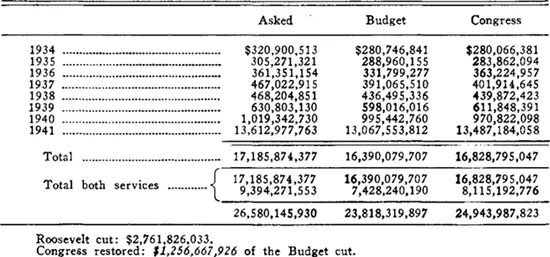
“The record clearly demonstrates how the Army and Navy get the funds needed for national defense. The Army and Navy are required to submit their respective estimates each year to the Bureau of the Budget. This bureau acting for the President conducts hearings and finally makes recommendations to the President as to the amounts to be recommended to the Congress for appropriation. The Congress is in effect the people of America. The record discloses that in the fiscal years 1934 to 1941, inclusive, the Army and Navy jointly asked for $26,580,145,093. This is the combined total of Army and Navy requests made to the Bureau of the Budget. In the same period the President recommended to the Congress that it appropriate to the combined services $23,818,319,897. The Congress actually made available to the Army and Navy in this period $24,943,987,823. Thus it is apparent that the President himself recommended to the Congress in the fiscal years 1934 to 1941, inclusive, that it appropriate for the Army and Navy $2,761,826,033 less than had been requested by the Army and Navy. The people’s representatives in the Congress gave to the Army and Navy in the form of appropriations and authorizations for expenditure $1,256,667,926 more than the President had recommended in his budget messages to the Congress.
“The mere recital of these undisputed figures should dispose of the contention that ‘the country is as much to blame as any individual in this final situation that developed in Pearl Harbor.’”
Representative Keefe submitted for ready reference a complete statement:
29. Tr., p. 8005.
30. JCC, Dec. 6, 1945.
31. APH, p. 44; JCC, Ex. 5.
32. JCC, Nov. 15, 1945, Ex. 5, pp. 11-12.
33. APH, pp. 40-41, 44.
34.Ibid., p. 44.
35. BR, p. 34.
36.Ibid., p. 58.
37.Ibid., p. 90.
38. Tr., p. 6230.
39. BR, p. 60.
40.Ibid., p. 50. (Adm. Inglis testified Nov. 15, 1945, that the Navy fired 1,685 rounds of 5-inch/.38 caliber anti-aircraft ammunition during the attack, 1,523 rounds of 5-inch/.25 caliber AA, 1,741 rounds of 3-inch/.50 caliber AA, and 275,807 rounds of machine gun ammunition.)
41. CT, Jan. 11, 1946, 6:2.
42. JCC, Jan. 26, 1946.
43. NCI, p. 65.
44. JCC, Feb. 18, 1946.
45.They Call It Pacific (Viking, 1943), p. 306.
46. APH, p. 22.
47. Kimmel, p. 24.
48. JCC, Nov. 19, 1945.
49. Kimmel, p. 24.
50. NCI, p. 67.
51.Ibid., p. 74.
52.Ibid., p. 82.
53.Ibid., p. 85.
54. Kimmel, p. 25.
55. NCI, p. 74.
56. Tr., pp. 6223-25.
57. JCC, Dec. 15, 1945.
NOTES ON CHAPTER VII: BACK DOOR TO WAR
1. Papers, 1936, p. 206.
2. Papers, 1937, pp. 406-11.
3.Vital Speeches of the Day, Dec. 15, 1938, p. 147.
4. Papers, 1939, p. 3.
5. Denied by Roosevelt: Papers, 1939, pp. 114-15.
6. Papers, 1939, p. 212.
7.Ibid., p. 557.
8. Chron., p. 223.
9. Papers, 1940, p. 263.
10. NYT, June 21, 1940, 1:1.
11. Papers, 1940, pp. 673-74.
12. Chron., p. 254.
13. Address to Commons, Aug. 20, 1940.
14. NYT, Aug. 29, 1940, 1:7.
15. Chron., p. 255; Papers, 1940, pp. 391-407.
16. Papers, 1940, pp. 428-31.
17.Ibid., p. 517.
18.Ibid., p. 563.
19. JCC, Nov. 19, 1945.
20. Papers, 1940, p. 607.
21.Ibid., pp. 633-44.
22. Radio address, Feb. 9, 1941.
23. NYT, Jan. 25, 1941, 1:8.
24. Chron., p. 273.
25. CT, June 15, 1946, 2:4.
26.How War Came, p. 187; Chron., p. 277.
27. Chron., p. 283; NYT, May 30, 1941, p. 5.
28. Fed. Reg., Vol. 6, p. 2897; Chron., p. 284.
29. NYT, June 25, 1941, p. 1.
30. Chron., p. 288.
31.How War Came, p. 286.
32. Chron., p. 293; Peace, pp. 717-20.
33.World Almanac, 1942, p. 88.
34. Peace, pp. 737-43.
35.Ibid., pp. 767-72.
36.Ibid., pp. 787-88.
37. Chron., p. 304.
38. JCC, Jan. 3, 1946.
39.Ibid., Dec. 31, 1945.
40. Tr., pp. 6149-50.
41. JCC, Ex. D-2, Nov. 23, 1945.
42. JCC, Jan. 3, 1946.
43.Ibid.
44. Atlantic, pp. 35-37; Saturday Evening Post (Feb. 26, 1944), p. 16.
45. JCC, Jan. 3, 1946; Tr., p. 6152.
46. JCC, Jan. 3, 1946.
47.Ibid., Dec. 31, 1945.
48.Ibid., Jan. 3, 1946.
49. Tr., p. 6150.
50.Ibid., p. 6151.
51.Ibid., pp. 6155-56.
52.Ibid., p. 6286.
53. JCC, Dec. 6, 1945.
54.Ibid., Nov. 30, 1945.
55.Ibid., Nov. 29, 1945.
56.Ibid., Feb. 12, 1946.
57. Tr., p. 6287.
58. JCC, Jan. 29, 1946.
59. Kimmel, p. 16.
60. JCC, Dec. 6, 1945.
61. Kimmel, p. 16.
62. JCC, Jan. 16, Jan. 18, 1946.
63.Ibid., Nov. 16, 1945.
64. Tr., p. 6237.
65. JCC, Dec. 6, 1945.
66. CT, Oct. 19, 1944, 1:3.
67. NYT, Dec. 27, 1941, 1:1.
68. APH, p. 34.
69. NCI, p. 62.
70.Ibid.
71. Kimmel, p. 15.
72. AP dispatch in CT, May 9, 1946, 13:4.
73. John T. Flynn, The Truth about Pearl Harbor, p. 14.
74. Grew, pp. 402-3.
75. Intercepts, pp. 200-202.
75a. Chicago Daily News, Sept. 30, 1946, 5:3, 4.
76.Ibid., pp. 228-29.
77. NYT, Dec. 9, 1941, 1:7.
78.How War Came, p. 315.
79. NYT, Nov. 30, 1941, 1:5.
80.Time, Aug. 7, 1939.
81. Chron., p. 256.
82.Ibid., p. 289.
83. NYT, Dec. 2, 1941, p. 6.
84. For. Rel. II, p. 531.
85. Peace, p. 696.
86. For. Rel. I, pp. 517-63.
87. Peace, p. 422.
88.Ibid., p. 475.
89. Grew, p. 295.
90. For. Rel. II, pp. 211-15.
91.Ibid., pp. 216-18.
92.Ibid., pp. 218-19.
93.Ibid., p. 222.
94.Ibid., pp. 222-23.
95.American Metal Market, Vol. LI, No. 215 (Nov. 4, 1944).
96. For. Rel. II, p. 224.
97.Ibid., p. 225.
98. Chron., p. 258.
99. NYT, Dec. 1, 1940, p. 1.
100. Peace, pp. 623, 626.
101.Ibid., pp. 631-37.
102. NYT, April 26, 1941, p. 7; ibid., Jan. 24, 1941, p. 4.
103. Peace, pp. 704-5.
104. NYT, July 26, 1941, p. 5.
105. Fed. Reg., Vol. 6, p. 3825.
106. Chron., p. 295.
107. NYT, July 19, 1941, 2:8; Dec. 21, 1941, 27:3.
108.Ibid., July 13, 1941, 14:6.
109.Ibid., June 29, 1941, 9:1.
110. For. Rel. II, pp. 263-64.
111.Asia and the Americas, special section, Vol. XLV, No. 12 (December, 1945).
112. JCC, Jan. 21, 1946.
113.Ibid., Nov. 24, 1945.
NOTES ON CHAPTER VIII: A, B, C, D’s
1. NYT, Dec. 7, 1941, 1:7.
2. CT, Dec. 7, 1941, 10:3.
3.Ibid.
4. JCC, Feb. 12, 1946.
5.Ibid., Nov. 19, 1945.
6.Ibid., Dec. 10, 1945.
7.Ibid., Nov. 19, 1945.
8. Tr., pp. 6207-9.
9. JCC, Dec. 6, 1945, Ex. 49, B-1.
10.Ibid., Ex. 50, B-2.
11.Ibid., Jan. 5, 1946.
12. In his campaign speech at the Navy Yard at Bremerton, Washington, August 12, 1944, President Roosevelt said, “We were not allowed to fortify Guam nor did we fortify Wake or Midway or Samoa.”
Representative Keefe, in his statement of additional views attached to the majority report of the Joint Congressional Committee (pp. 266-V and W), states:
“Another subject that has been bandied about the country for a number of years relates to what has been frequently referred to as the failure or refusal of Congress to fortify the island of Guam. The contention has been made that Congress refused to appropriate money to fortify the island of Guam and that as a result of such failure the entire war in the Pacific in its initial stages was lost to the Japanese.
“The fact is that no proposal was ever submitted to the Congress involving the fortification of Guam. The Navy did request an appropriation of five million dollars for the purpose of dredging the harbor at Guam (Stark testimony, Tr., pp. 6546-47). The first request of the Navy was rejected by the Congress. Thereafter, the appropriation requested by the Navy was passed with only one vote against it. The dredging operation was being carried on when war broke out with Japan.
“It is interesting to note that ‘Rainbow No. 5,’ which is the Joint Chiefs of Staff world-wide war plan, placed the island of Guam in Category ‘F’ (Tr., p. 6535). The following questions and answers tell the story:
Mr. KEEFE. Now, I would like to ask a question which bothered me with respect to your Rainbow No. 5, which places the island of Guam in what is called Category F.
Adm. STARK. I have the category here.
Mr. KEEFE. Now will you state for the record what Category F means?
Adm. STARK. Yes, sir. We have that, I am sure. This is out of Joint Action, Army and Navy, and refers to degrees of preparation, and they are put in categories of defense, A, B, C, D, E, and F.
Mr. KEEFE. Well, take Guam to start with. That is in F. Now give us what Category F means.
Adm. STARK. Category F: “Positions beyond the continental limits of the United States which may be subject to either minor or major attack for the purpose of occupation but which cannot be provided with adequate defense forces. Under this category the employment of existing local forces and local facilities will be confined principally to the demolition of those things it is desirable to prevent falling into the hands of the enemy.”
Mr. KEEFE. Then, so far as Guam was concerned, at the time this basic war plan was devised it was the considered opinion of both the Army and Navy that it could not be defended and it therefore was placed in Category F that required those on the island, through demolition or otherwise, to destroy anything of value to the enemy and to permit it to be taken?
Adm. STARK. Yes, sir.
Mr. KEEFE. And to surrender?
Adm. STARK. Yes, sir.
Mr. KEEFE. That is right, is it not?
Adm. STARK. That is correct, yes, sir (Tr., p. 6537).
Mr. KEEFE. Now, at the time of the attack on Guam and the capture of Guam by the Japs were improvements on the harbor being made at that time or had they been completed?
Adm. STARK. They had not been completed. Of course, I recall very clearly the legislation with regard to that. I do not know just what their status was at this moment. I had obtained from Congress the appropriation, I believe it was $6,000,000, for certain improvements to the harbor. You recall the first year I lost it by six votes, and the following year it went through almost unanimously, only one vote being opposed to it. Just how far we had gotten along with that I do not recall at the moment.
Mr. KEEFE. With those improvements completed, Guam would still be in Category F, would it not?
Adm. STARK. In the same category, Category F. The improvements were not such as improved the defense of Guam but very little.
Mr. KEEFE. Even with the improvements that were requested and contemplated the Island of Guam, in the opinion of the Joint Army and Navy Board, could not be successfully defended due to the power that Japan had in the mandated islands surrounding it, is that right?
Adm. STARK. That is correct (Tr., p. 6547).
“These simple facts as disclosed to the public for the first time in these hearings should effectively dispose of the contention that ‘Congress refused to fortify the Island of Guam, and hence the United States suffered tremendous loss in the initial stages of the war with Japan.’”
13. p. 245.
14. JCC, Ex. 49, B-1, p. i.
15. Tr., pp. 5573-74.
16. JCC, Feb. 12, 1946.
17. Of these agreements the majority report of the Joint Congressional Committee (pp. 168-71) remarks:
“A great deal of inquiry was made during the course of proceedings to determine whether the government of the United States had entered into an agreement with Great Britain and the Netherlands committing this nation to war upon Japan in the event British or Dutch possessions were attacked by the Japanese. It is clear from evidence before the committee that no agreement was entered into in this regard. The President and his Cabinet, while momentarily expecting an attack by Japan, recognized and observed the constitutional mandate that this government could only be committed to war by a declaration of the Congress.
“Recognizing the inevitable consequences of the tripartite pact, representatives of the War and Navy departments participated during 1941 in a series of staff conversations with military and naval experts of Great Britain, Canada, and the Netherlands. The first of these, meetings, initiated by the chief of naval operations and limited to American and British representatives, was held in Washington from Jan. 29 to March 27, 1941. The official report of the conversations, referred to as ‘ABC-1,’ points out specifically that the discussions were held with a view ‘to determine the best methods by which the armed forces of the United States and British Commonwealth, with its present allies, could defeat Germany and the powers allied with her, should the United States be compelled to resort to war.’ The report states clearly that the plans to accomplish this purpose, as embodied in the report, were subject to confirmation by the highest military authorities in the United States and Great Britain and by the governments of both countries as well. This was in accord with the joint statement of the position the American representatives would take, made by the chief of naval operations and the chief of staff on January 27 at the outset of the conversations.
“‘ABC-1’ was approved by the chief of naval operations and the Secretary of the Navy and by the chief of staff and the Secretary of War, thereafter being submitted to the President on June 2, 1941. On June 7 the President returned ‘ABC-1’ without formal approval, pointing out that since the plan had not been finally approved by the British government, he would not approve it at that time but that in case of war the report should be returned to him for approval.
“Shortly after the staff conversations in Washington military and naval representatives of the United States, Great Britain, and the Netherlands conferred in April of 1941 at Singapore in order to draft a plan for the conduct of operations in the Far East based on ‘ABC-1.’ In the instructions sent the commander-in-chief of our Asiatic fleet prior to the Singapore conversations it was emphatically pointed out that the results of such conversations were likewise subject to ratification by the governments concerned and were to involve no political commitment by the United States. The report of the conversations, referred to as ‘ADB,’ explicitly recognized that no political commitments were implied. Nevertheless, the chief of naval operations and the chief of staff withheld their approval feeling that some of the statements in the report had political implications. One of the proposals of the Singapore conference, however, was subsequently incorporated as a recommendation in the joint memoranda of Nov. 5 and 27 which the chief of staff and the chief of naval operations submitted to the President; i. e., that military counter-action should be undertaken in the event Japan attacked or directly threatened the territory or mandated territory of the United States, the British Commonwealth, or the Netherlands East Indies, or if the Japanese moved forces into Thailand west of 100° east or south of 10° north, Portuguese Timor, New Caledonia, or the Loyalty Islands. . . .
“From all of the evidence, as earlier indicated, there is no basis for the conclusion that an agreement had been effected committing the United States to war against Japan in the event of an attack by her upon the British or the Dutch. It is indisputable that the President and his Cabinet contemplated presenting the problem to the Congress should our position in the Far East become intolerable. Further, the reports of the 1941 staff conversations contain clear disclaimers of any political commitments and the voluminous records relating to these conversations will be searched in vain for any suggestion that an agreement binding the United States to go to war was made. Additionally, all the witnesses who were questioned on the point—including the ranking military and naval leaders of the country at the time—testified that in these meetings the constitutional prerogative of the Congress to declare war was scrupulously respected. The preliminary planning done at these conferences manifested commendable foresight and indeed our military leaders would have been inexcusably negligent had they not participated in these conversations in the face of the clear pattern of conquest mapped out by the Axis. This planning saved precious time and lives once Japan struck.
“While no binding agreement existed, it would appear from the record that the Japanese were inclined to the belief that the United States, Britain, and the Netherlands would act in concert. . . .”
The reader may compare this easy dismissal of the effect of the agreements with the findings of the minority (pp. 12-14):
“There is additional evidence for the conclusion that in January, 1941, President Roosevelt then became convinced that the war was a global war and that his decisions as chief executive and commander-in-chief must thenceforward be made with reference to that conviction. This evidence is as follows: Beginning in January, 1941, representatives of the American armed forces and representatives of British and Dutch armed forces on the suggestion of the United States started a series of conversations in respect of cooperation against Japan in the Far East. Out of these subsequent conversations were developed American-British-Dutch war plans for combined operations against Japan if Japanese armed forces started hostile actions against British, Dutch, or American possessions in the Far East. President Roosevelt approved these plans, ‘except officially,’ as Adm. Stark testified.
“The President’s commitment to Great Britain was foreshadowed by understandings previously reached between American; British, and Dutch military authorities. In a memorandum to the President dated Nov. 27, 1941 (Ex. 17), Gen. Marshall and Adm. Stark stated:
“‘After consultation with each other, United States, British, and Dutch military authorities in the Far East agreed that joint military counteraction against Japan should be undertaken only in case Japan attacks or directly threatens the territory or mandated territory of the United States, the British Commonwealth, or the Netherlands East Indies, or should the Japanese move forces into Thailand west of 100° East or south of the 10° North, Portuguese Timor, New Caledonia, or the Loyalty Islands.’
“The agreement referred to by Adm. Stark and Gen. Marshall, was reached at conferences in Singapore in April, 1941, between United States, British, and Dutch military authorities in the Far East. . . .
“While the President did not approve written agreements on these understandings he and the high authorities in Washington acted with the British and Dutch just as if a binding pact had been made. Likewise the Japanese acted upon the same belief that the United States, Britain, and Netherlands East Indies were working together. There is ample evidence in the record to this effect. (Ex. I, p. 205—Tokyo to Berlin dispatch: Id. p. 227, Washington to Tokyo dispatch.)
“Subsequent American diplomatic negotiations with Japan were based upon the principle of cooperation with Great Britain, the Dutch Netherlands, China, and Australia. No separate over-all plan for the simple defense of American possessions against Japan was developed by the armed forces of the United States between January, 1941, and Dec. 7, 1941, with a view to safeguarding American interests separately. After the Japanese attack on Dec. 7, American, British, Dutch, and Australian operations in the Pacific theater were conducted on the cooperative principle which had governed the military and naval conversations and planning between January and December, 1941. . . .”
18. Kimmel, p. 9.
19.Ibid.; JCC, Ex. 44 E.
20. Kimmel, p. 10.
21. JCC, Dec. 5, 1945.
22. Tr., p. 8555.
23.Ibid., p. 8557.
24. Kimmel, p. 41.
25. JCC, Dec. 31, 1945.
26. Tr., p. 6321.
27. JCC, Dec. 10, 1945.
28. Tr., p. 6291.
29.Ibid., pp. 6312-14; JCC, Dec. 20, 1945.
30. Tr., p. 6315.
31. JCC, Feb. 20, 1946.
32. Tr., p. 6198.
33.Ibid., p. 6204.
34. Intercepts, p. 111.
35.Ibid., p. 227.
36.Ibid., p. 173.
37.Ibid., p. 192.
38.Ibid., p. 238.
39. Address to Commons, NYT, Jan. 28, 1942, 1:4.
40. Radio address, NYT, Feb. 16, 1942, 1:3.
41. AP dispatch from London, June 21, 1944, in CT, same date, 1:2.
NOTES ON CHAPTER IX: MEETING AT SEA
1. JCC, April 9, 1946.
2. Welles’s “Memorandum of Conversation,” upon which this account of the Atlantic conference is based, was introduced before the JCC as Exhibits 22-B, 22-C, and 22-D on Nov. 23, 1945.
3.How War Came, p. 10.
4. The minority report of the Joint Congressional Committee (pp. 14-15) emphasizes a subsidiary agreement reached at the Atlantic conference:
“The danger of war with Japan formed a principal theme of discussion between President Roosevelt and Prime Minister Churchill at the Atlantic conference in August, 1941, and agreements or understandings reached by President Roosevelt and Prime Minister Churchill at that conference were based on a common program for dealing with Japan and close cooperation between the United States and Great Britain in diplomatic, military, and naval affairs in respect of the Far East as well as the Atlantic. Their chief understandings as thus far disclosed by official records were three in number:
“(1) Common diplomatic actions warning Japan against taking any further steps in dominating neighboring countries by force or threat of force.
“(2) Occupation of the Azores by the armed forces of the United States with protective assistance by British armed forces in guarding against a possible Nazi thrust from the mainland.
“(3) Cooperation between the United States and Great Britain in ‘the policing of the world’ during a transition period following the close of the war. . . .
“It is scarcely thinkable that in his discussions with Prime Minister Churchill at the Atlantic conference in August, 1941, President Roosevelt would have assumed that the United States was to cooperate with Great Britain in ‘the policing of the world’ for a transition period after the war unless he was then certain that at some stage in the development of the war the United States would become involved in it.”
5. Peace, p. 714.
6. JCC, Nov. 24, 1945.
7.Ibid., Dec. 15, 1945.
8. Radio address, NYT, Aug. 25, 1941, 1:8.
9. NYT, Nov. 11, 1941, 1:1.
10. Grew, p. 478.
11. Tr., pp. 6298-6303.
12. The majority report of the Joint Congressional Committee (pp. 304-5) debates this question inconclusively:
“The evidence before the committee does not show whether or not the British government took ‘parallel action’ to the warning given Japan by President Roosevelt. Undersecretary Welles testified before the committee that he took it for granted that the British government took such parallel action and that the records of the State Department would probably show that (Tr., p. 1279), but Secretary Hull testified, and the State Department has advised the committee, that its files contain no record of any such action (Tr., p. 14, 306; 4480). Furthermore, as late as Nov. 30 (Washington time), Prime Minister Churchill sent a message to the President saying that ‘one important method remains unused in averting war between Japan and our two countries, namely a plain declaration, secret or public as may be thought best, that any further act of aggression by Japan will lead immediately to the gravest consequences. . . . We would, of course, make a similar declaration or share in a joint declaration’ (Ex. 24); and the evidence further shows that on Dec. 7 the Prime Minister submitted to President Roosevelt a draft of a proposed warning to Japan (Tr., pp. 13738-40). On the other hand, on Aug. 25, 1941, in an address reporting to Parliament on the Atlantic conference, the Prime Minister said:
“‘But Europe is not the only continent to be tormented and devastated by aggression. For five long years the Japanese military factions, seeking to emulate the style of Hitler and Mussolini, taking all their posturing as if it were a new European revelation, have been invading and harrying the 500,000,000 inhabitants of China. Japanese armies have been wandering about that vast land in futile excursions, carrying with them carnage, ruin and corruption, and calling it “the Chinese incident.” Now they stretch a grasping hand into the southern seas of China. They snatch Indo-China from the wretched Vichy French. They menace by their movements Siam, menace Singapore, the British link with Australasia, and menace the Philippine Islands under the protection of the United States.
“‘It is certain that this has got to stop. Every effort will be made to secure a peaceful settlement. The United States are laboring with infinite patience to arrive at a fair and amicable settlement which will give Japan the utmost reassurance for her legitimate interests. We earnestly hope these negotiations will succeed. But this I must say: That if these hopes should fail we shall, of course, range ourselves unhesitatingly at the side of the United States (Tr., 1355-56; 4480-4481).’
“While Secretary Hull testified that he knew of no parallel action taken by the British other than this address (Tr., 14306), which was broadcast by radio, Undersecretary Welles testified that in his opinion this address did not constitute ‘parallel action’ of the kind proposed by Mr. Churchill to the President, and that in Mr. Welles’s judgment such action would necessarily have had to have been in the form of an exchange of diplomatic notes (Tr., 1356).”
Again (p. 302) the majority report says:
“The evidence before the committee is conflicting as to whether or not Prime Minister Churchill promised President Roosevelt that the British government would take action parallel to that to be taken by the United States government.
“The only contemporaneous records of the Atlantic conference before the committee are three memoranda prepared by Undersecretary Welles (Ex. 22-B, 22-C, 22-D). Those memoranda show that the procedure outlined by President Roosevelt differed substantially from that envisaged in Prime Minister Churchill’s proposal. As there described by Mr. Welles, the President’s procedure did not call for parallel action by either the British or Dutch governments, or for keeping Russia informed, as Mr. Churchill had proposed. Nor, as in the case of Mr. Churchill’s proposal, was the precise phraseology of the warning to Japan prescribed, it being left entirely up to the President. Mr. Welles testified that the promise given by the President to Mr. Churchill ‘was limited to the fact that a warning would be given’ (Tr., p. 142), and that the only agreement reached between the President and the Prime Minister was ‘that the President made the promise to Mr. Churchill that the government of the United States, in its own words and in its own way, would issue a warning to the Japanese government of the character which actually was made by the President on Aug. 17’ (Tr., p. 1428).
“While it is true that Mr. Welles testified that the promise made by President Roosevelt was to ‘take parallel action with the British government in warning the Japanese government’ (Tr., p. 1235-6) and that he ‘took it for granted Mr. Churchill must have made that statement’ (i. e., promised to make a parallel warning) to the President (Tr., 1446), it is also true that when asked directly whether the President had told him that Mr. Churchill had promised to make a parallel warning, Mr. Welles said, ‘The President in his conversation with me, so far as I remember, did not make that specific statement’ (Tr., p. 1446). Moreover, as previously noted, the Welles’ memoranda neither state nor indicate that any such promise was made by Mr. Churchill (Ex. 22-B, 22-C, 22-D), and there is no evidence before the committee showing that action parallel to the President’s warning to Japan was ever taken by the British government. On the other hand, both ‘Peace and War’ (Ex. 28, p. 129) and ‘Foreign Relations of the United States, Japan 1931-1941’ (Ex. 29, vol. II, p. 345) refer to an ‘agreement’ to take parallel action made by President Roosevelt and Prime Minister Churchill, though, of course, neither of these purports to be a contemporaneous account of the Atlantic conference. Likewise, in his testimony before the committee, Secretary Hull referred to such an ‘agreement,’ though again Secretary Hull did not attend the Atlantic conference (Tr., p. 1116).”
13. JCC, Nov. 24, 1945.
14.Ibid., Nov. 27, 1945.
15. Intercepts, p. 197. (In this message Nomura used the phrase “on the 17th of this month,” but evidently was referring to the warning of Aug. 17. Neither the account in For. Rel. II (pp. 740-43) or in Intercepts (pp. 141-43) of the conversation of the Japanese emissaries and Roosevelt on Nov. 17 shows the President to have voiced any additional warning.)
16. For. Rel. II, p. 139.
17.Ibid., p. 143.
18. JCC, Nov. 28, 1945.
19.Ibid., Dec. 21, 1945.
20. For. Rel. II, pp. 525-26.
NOTES ON CHAPTER X: THE LAST OF THE JAPANESE MODERATES
1. Grew, p. 446.
2.Ibid., p. 359.
3.Ibid., p. 361.
4.Ibid., p. 362.
5.Ibid., p. 363.
6. JCC, Nov. 27, 1945.
7. Grew, p. 369.
8.Ibid., p. 365.
9. For. Rel. II, pp. 388-89.
10.Ibid., p. 391.
11.Ibid., p. 331.
12.Ibid., pp. 398-402.
13.Ibid., p. 407.
14.Ibid., pp. 420-22.
15.Ibid., pp. 428-34.
16.Ibid., p. 440-41.
17.Ibid., p. 447.
18.Ibid., pp. 454-55.
19.Ibid., pp. 486-92.
20.Ibid., p. 485.
21.Ibid., p. 509.
22. NYT, July 17, 1941, 1:5; July 19, 1:4.
23. For. Rel. II, p. 496.
24.Ibid., p. 267.
25. Grew, p. 334.
26. Peace, pp. 569-72.
27. JCC, Nov. 27, 1945.
28. Tr., pp. 6339-40.
29.Ibid., pp. 6341-42.
30.Ibid.
31. Peace, p. 88.
32. Tr., p. 6353.
33.Ibid., pp. 6344-53.
34. For. Rel. II, pp. 516-20.
35.Ibid., p. 525.
36.Ibid., pp. 533-34.
37.Ibid., p. 526.
38.Ibid., p. 529.
39.Ibid., pp. 534-35.
40.Ibid., p. 549-50.
41.Ibid., pp. 552-53.
42.Ibid., pp. 554-55.
43.Ibid., p. 402.
44.Ibid., p. 550.
45.Ibid., p. 553.
46.Ibid., p. 565.
47.Ibid., p. 568.
48.Ibid., pp. 572-73.
49.Ibid., p. 571.
50.Ibid., p. 576.
51.Ibid., pp. 576-77.
52.Ibid., p. 592.
53.Ibid., p. 588.
54. AP dispatch from Tokyo Dec. 19, 1945, in CT, Dec. 20, 1945.
55. For. Rel. II, p. 628.
56. Intercepts, pp. 33-36.
57. Peace, p. 754.
58. For. Rel. II, pp. 645-50.
59. Grew, p. 444.
60. For. Rel. II, pp. 352-54.
61.Ibid., p. 662.
62. Grew, p. 456.
63. For. Rel. II, p. 692.
64. Grew, p. 481-82.
65.How War Came, p. 287.
66. AP dispatch from Tokyo, Dec. 16, 1945, in CT Dec. 17, 5:3.
NOTES ON CHAPTER XI: DIPLOMACY FOR D-DAY
1. The ambitious designs of the Japanese militarists were described in the majority report of the Joint Congressional Committee (pp. 295-6) as follows:
“On June 22, 1941, Germany had invaded Russia. The German attack upon Russia had precipitated a series of events in Japan which were to have far-reaching effects upon Japanese-American relations. It had quickened the appetites of those in the Japanese government who believed that then, or never, Japan’s destiny was in her own hands. Intensive consideration had immediately been given in Tokyo to the question whether Japan should not attack Russia at once (Ex. 173, Konoye Memoirs, p. 16). Foreign Minister Matsuoka in particular had urged this course. According to the memoirs of Prince Fumimaro Konoye, the Japanese Premier at the time, the attention of the government became so centered upon this question that the American counter-proposal of June 21, which by that time had been received in Tokyo from the Japanese ambassador in Washington, became completely side-tracked until after an Imperial Conference with Emperor Hirohito on July 2 (Japan time) (Ex. 173, Konoye Memoirs, pp. 16, 18). At that conference the question of war with Russia had been temporarily shelved in favor of ‘an advance into the southern regions,’ and it had been decided that, first of all, the plans ‘which have been laid with reference to French Indo-China and Thai will be prosecuted, with a view to consolidating our position in the southern territories’ (Ex. 173, Konoye Memoirs, p. 70; cf. Ex. 1, pp. 1-2). It is now known that at the Imperial Conference on July 2 (Japan time) it was also decided that, in case the diplomatic negotiations with the United States should break down, ‘preparations for a war with England and America will also be carried forward;’ that all plans, including the plan to use Japan’s military strength to settle the Soviet question if the German-Russian war should develop to Japan’s advantage, were to be carried out—
“‘in such a way as to place no serious obstacles in the path of our basic military preparations for a war with England and America’;
and that—
“‘In case all diplomatic means fail to prevent the entrance of America into the European war, we will proceed in harmony with our obligations under the tripartite pact. However, with reference to the time and method of employing our armed forces we will take independent action’ (Ex. 173, Konoye Memoirs, p. 71).
“The following report of the Imperial Conference on July 2 (Japan time) had been cabled by the Japanese foreign minister to the Japanese ambassadors in the United States, Germany, Italy, and Russia, the same day:
“‘(National Secret)
“‘At the conference held in the presence of the Emperor on July 2 “The Principal Points in the Imperial Policy for Coping with the Changing Situation” were decided. This Policy consists of the following two parts. The first part “The Policy” and the second part “The Principal Points.” (I am wiring merely the gist of the matter.) Inasmuch as this has to do with national defense secrets, keep the information only to yourself. Please also transmit the content to both the naval and military attaches, together with this precaution.
“‘The Policy.
“‘1. Imperial Japan shall adhere to the policy of contributing to world peace by establishing the Great East Asia Sphere of Co-prosperity, regardless of how the world situation may change.
“‘2. The Imperial Government shall continue its endeavor to dispose of the China incident, and shall take measures with a view to advancing southward in order to establish firmly a basis for her self-existence and self-protection.
“‘The Principal Points.
“‘For the purpose of bringing the CHIANG Régime to submission, increasing pressure shall be added from various points in the south, and by means of both propaganda and fighting plans for the taking over of concessions shall be carried out. Diplomatic negotiations shall be continued, and various other plans shall be speeded with regard to the vital points in the south. Concomitantly, preparations for southward advance shall be re-enforced and the policy already decided upon with reference to French Indo-China and Thailand shall be executed. As regards the Russo-German war, although the spirit of the Three-Power Axis shall be maintained, every preparation shall be made at the present and the situation shall be dealt with in our own way. In the meantime, diplomatic negotiations shall be carried on with extreme care. Although every means available shall be resorted to in order to prevent the United States from joining the war, if need be, Japan shall act in accordance with the Three-Power Pact and shall decide when and how force will be employed (Ex. 1, pp. 1-2).’
“It is worthy of note that this intercepted Japanese message, which was translated and available in Washington on July 8 (Washington time), did not mention the decisions at the Imperial Conference respecting the United States.
“Commencing immediately after the Imperial Conference, Japan had proceeded with military preparations on a vast scale, calling up from one to two million reservists and conscripts, recalling Japanese merchant vessels operating in the Atlantic Ocean, imposing restrictions upon travel in Japan, and carrying out strict censorship of mail and communications.”
Although Ambassador Nomura described the occupation of Indo-China as necessary to safeguard Japan’s food supplies and to frustrate foreign powers bent upon encircling Japan, a diplomatic message of July 14, 1941, from Canton to Tokyo (Ex. 1, p. 2) stated:
“Subsequent information from the military officials to the Attachés is as follows:
“1. The recent general mobilization order expressed the irrevocable resolution of Japan to put an end to Anglo-American assistance in thwarting her natural expansion and her indomitable intention to carry this out, if possible, with the backing of the Axis but, if necessary, alone. Formalities, such as dining the expeditionary forces and saying farewell to them, have been dispensed with. That is because we did not wish to arouse greatly the feelings of the Japanese populace and because we wished to face this new war with a calm and cool attitude.
“2. The immediate object of our occupation of French Indo-China will be to achieve our purposes there. Secondly, its purpose is, when the international situation is suitable, to launch therefrom a rapid attack. This venture we will carry out in spite of any difficulties which may arise. We will endeavor to the last to occupy French Indo-China peacefully but, if resistance is offered, we will crush it by force, occupy the country and set up martial law. After the occupation of French Indo-China, next on our schedule is the sending of an ultimatum to the Netherlands Indies. In the seizing of Singapore the Navy will play the principal part. As for the Army, in seizing Singapore it will need only one division and in seizing the Netherlands Indies, only two . . .”
2. Grew, p. 460.
3. For. Rel. II, p. 697.
4. AP dispatch from Tokyo Dec. 18, 1945, in CT Dec. 19.
5. For. Rel. II, pp. 703-4.
6.Ibid., p. 704.
7.Ibid., p. 679.
8. AP dispatch from Tokyo Sept. 6, 1945, in CT Sept. 7; AP dispatch from Tokyo Sept. 20, 1945, in CT Sept. 21, 3:3.
9. Grew, p. 470.
10. Paul V. Horn, “Effects of Allied Economic Blockade on Japan,” The Conference Board Economic Record, III: 22 (Nov. 25, 1941), 509-12.
11. For. Rel. II, p. 705.
12.Ibid., p. 706.
13.Ibid., pp. 709-10.
14.Ibid., p. 716.
15.Ibid., pp. 710-14.
16.Ibid., p. 710.
17.Ibid., p. 718.
18.Ibid., p. 720.
19.Ibid., pp. 731-34.
20.Ibid., pp. 736-37.
21.Ibid., pp. 740-43.
22.Ibid., p. 745.
23.Ibid., p. 746.
24.Ibid.
25.Ibid., p. 747.
26.Ibid., pp. 759-61.
27.Ibid., p. 789.
28.Ibid., p. 757.
29.Ibid., p. 756.
30.Ibid., pp. 754-55.
31.Ibid., p. 760.
32.Ibid., pp. 763-64.
33. JCC, Nov. 23, 1945.
34. Grew, p. 483.
35.Ibid., p. 486.
36. For. Rel. II, pp. 148-49.
37.Ibid., pp. 377-78.
38. JCC, Nov. 23, 1945.
39. Stimson, p. 47.
40. JCC, Nov. 23 1945.
41.Ibid.
42.Ibid.
43.Ibid., Nov. 24, 1945.
44. APH, p. 51.
45. The terms of this proposed agreement were:
“1. The government of the United States and the government of Japan, both being solicitous for the peace of the Pacific, affirm that their national polices are directed toward lasting and extensive peace throughout the Pacific area and that they have no territorial designs therein.
“2. They undertake reciprocally not to make from regions in which they have military establishments any advance by force or threat of force into any areas in Southeastern or Northeastern Asia or in the southern or the northern Pacific area.
“3. The Japanese government undertakes forthwith to withdraw its forces now stationed in southern French Indo-China and not to replace those forces; to reduce the total of its force in French Indo-China to the number there on July 26, 1941; and not to send additional naval, land, or air forces to Indo-China for replacements or otherwise.
“The provisions of the foregoing paragraph are without prejudice to the position of the government of the United States with regard to the presence of foreign troops in that area.
“4. The government of the United States undertakes forthwith to modify the application of its existing freezing and export restrictions to the extent necessary to permit the following resumption of trade between the United States and Japan in articles for the use and needs of their peoples:
“(a) Imports from Japan to be freely permitted and the proceeds of the sale thereof to be paid into a clearing account to be used for the purchase of the exports from the United States listed below, and at Japan’s option for the payment of interest and principal of Japanese obligations within the United States, provided that at least two-thirds in value of such imports per month consist of raw silk. It is understood that all American owned goods now in Japan, the movement of which in transit to the United States has been interrupted following the adoption of freezing measures shall be forwarded forthwith to the United States.
“(b) Exports from the United States to Japan to be permitted as follows:
“(i) Bunkers and supplies for vessels engaged in the trade here provided for and for such other vessels engaged in other trades as the two governments may agree.
“(ii) Food and food products from the United States subject to such limitations as the appropriate authorities may prescribe in respect of commodities in short supply in the United States.
“(iii) Raw cotton from the United States to the extent of $600,000 in value per month.
“(iv) Medical and pharmaceutical supplies subject to such limitations as the appropriate authorities may prescribe in respect of commodities in short supply in the United States.
“(v) Petroleum. The United States will permit the export to Japan of petroleum, within the categories permitted general export, upon a monthly basis for civilian needs. The proportionate amount of petroleum to be exported from the United States for such needs will be determined after consultation with the British and the Dutch governments. It is understood that by civilian needs in Japan is meant such purposes as the operation of the fishing industry, the transport system, lighting, heating, industrial and agricultural uses, and other civilian uses.
“(vi) The above stated amounts of exports may be increased and additional commodities added by agreement between the two governments as it may appear to them that the operation of this agreement is furthering the peaceful and equitable solution of outstanding problems in the Pacific area. “
5. The government of Japan undertakes forthwith to modify the application of its existing freezing and export restrictions to the extent necessary to permit the resumption of trade between Japan and the United States as provided for in paragraph 4 above.
“6. The government of the United States undertakes forthwith to approach the Australian, British, and Dutch governments with a view to those governments taking measures similar to those provided for in paragraph 4 above.
“7. With reference to the current hostilities between Japan and China, the fundamental interest of the government of the United States in reference to any discussions which may be entered into between the Japanese and the Chinese governments is simply that these discussions and any settlement reached as a result thereof be based upon and exemplify the fundamental principles of peace, law, order, and justice, which constitute the central spirit of the current conversations between the government of Japan and the government of the United States and which are applicable uniformly throughout the Pacific area.
“8. This modus Vivendi shall remain in force for a period of 3 months with the understanding that the two parties shall confer at the instance of either to ascertain whether the prospects of reaching a peaceful settlement covering the entire Pacific area justify an extension of the modus vivendi for a further period.” (JCC, Ex. 18).
46. Stimson, p. 46; APH, p. 51.
47. Stimson, p. 49.
48. Tr., pp. 6161-67.
49.Ibid., pp. 6171-72.
50.Ibid., p. 6173.
51. Stimson, p. 51.
52. Tr., pp. 6181, 6184-85.
53.Ibid., pp. 6191-93.
54.Ibid., p. 6194.
55.Ibid.
56.Ibid., p. 6196.
57.Ibid., pp. 6199-6201.
58.Ibid., pp. 6201-3.
59. The influence of other governments upon the decision to reject the modus vivendi was discussed by Secretary Hull as follows:
“The Chinese government violently opposed the idea. The other interested governments were sympathetic to the Chinese view and fundamentally were unfavorable or lukewarm. Their cooperation was a part of the plan. It developed that the conclusion with Japan of such an arrangement would have been a major blow to Chinese morale” (Tr., p. 1146).
The minority report of the Joint Congressional Committee says of these events:
“A modus vivendi was under discussion with Japan in November 1941 to run for three months. This had been strongly urged by the War and Navy authorities in order to supply absolutely essential time for preparation. Secretary Stimson and Knox went over the terms of this document and advised Secretary Hull that it adequately protected our interest.
“Suddenly the modus vivendi was dropped from the agenda and there was substituted the Hull message which was followed shortly after by the attack on Pearl Harbor.
“Early on the morning after the delivery of the Hull message Lord Halifax arrived at the State Department. He found Mr. Welles in charge and asked him what has become of the modus vivendi. Mr. Welles replied that it was dropped because of Chinese lack of interest. Lord Halifax intimated a continuing British interest and Mr. Welles significantly replied: ‘That is not the way London sounded yesterday.’
“The message from Churchill of the preceding day certainly bears out the Welles observation. The committee was told by the State Department that there is no record of any telephone conversations between Mr. Churchill and President Roosevelt. This certainly invites inquiry.
“The Halifax early morning visit in apparent ignorance of the Churchill message of the day before and of the decision to drop the modus vivendi is not in tune with usual British diplomatic procedure.
“Whether or not the Japanese would have accepted the modus vivendi must remain a matter of opinion.
“Whether or not it should have been submitted is a matter on which light might well be shed.
“Particularly is this the case when we have the testimony of Gen. George C. Marshall that a delay by the Japanese from December, 1941, into January, 1942. might have resulted in a change of Japanese opinion as to the wisdom of the attack because of the collapse of the German front before Moscow in December, 1941.
“Whether or not such a development would have been one to be desired must remain for future investigation when more of the diplomatic history of the closing months of 1941 can be more thoroughly explored” (Min., pp. 7-8).
A more extended comment on the modus vivendi follows:
“Besides the President’s instructions or suggestions, Secretary Hull had before him the ‘outline of a proposed basis for agreement between the United States and Japan,’ which had been carefully prepared by Henry Morgenthau Jr., secretary of the treasury. Henry Morgenthau’s ‘outline’ with a covering note, dated Nov. 19, 1941, was presented to Secretary Hull, initialled M. M. H. (Maxwell M. Hamilton, chief of the division of Far Eastern affairs). The covering note informed Secretary Hull that all the senior officers of the division concurred with Mr. Hamilton in the view that ‘the proposal is the most constructive one I have seen.’ Mr. Hamilton urged Secretary Hull to give most careful consideration to the proposal promptly, and suggested that the Secretary make copies of the proposed ‘outline’ available to Adm. Stark and Gen. Marshall and arrange to confer with them as soon as they had had an opportunity to examine the ‘outline’ (Exhibits 18, 168).
“With the President’s instructions or suggestions and Secretary Morgenthau’s ‘outline’ before him, Secretary Hull considered the terms of a possible agreement with Japan as the basis of a general settlement or an indefinite continuation of negotiations in connection with the Japanese proposal for a modus vivendi. This is no place to give a fifty-page summary of the record of the events connected with Secretary Hull’s operations. Nor is it necessary to discuss the merits of the case. But the following recital of facts illustrates the confusion and lack of cooperation that prevailed in administration circles.
“Secretary Hull drafted a memorandum for at least a kind of truce with Japan.
“Secretary Hull discussed his proposals with British, Dutch, and Australian representatives in Washington.
“Secretary Hull had a conference on the proposals with Secretary Stimson and Secretary Knox at his office on Nov. 25. Of this conference Secretary Stimson noted in his diary:
’Hull showed us the proposal for a three months’ truce, which he was going to lay before the Japanese today or tomorrow. It adequately safeguarded all our interests, I thought as I read it, but I don’t think there is any chance of the Japanese accepting it, because it was so drastic’ (Tr., Vol. 70, p. 14417).
“The next day, Nov. 26, Secretary Hull told Secretary Stimson over the telephone that he had about made up his mind not to give the proposal for the three months’ truce to the Japanese but ‘to kick the whole thing over.’ Under pressure coming from Chiang Kai-shek, Winston Churchill, and others, relative to the modus vivendi. Secretary Hull refrained from making an independent decision on this important step and it appears he was led to decide it without thought of the military capacities necessary to back up our diplomatic position. On that day, Nov. 26, Secretary Hull, with the approval of President Roosevelt, kicked the whole thing over and sent to the Japanese the now famous memorandum which Japan treated as an ultimatum. In taking this action Secretary Hull gave no advance notice to Gen. Marshall and Adm. Stark, who were then preparing their second careful memorandum to the President begging for a postponement of war with Japan until the Army and Navy could make better preparation for waging it. Moreover, it should be noted that Secretary Hull did not give to the British and Australian representatives any advance information about his sudden decision ‘to kick the whole thing over.’
“When Secretary Hull, with the approval of President Roosevelt, made this decision on Nov. 26 and handed his memorandum to the Japanese ambassadors on Nov. 26, he was practically certain that the Japanese government would reject his proposals and that a break in relations would be a highly probable consequence of his action.
“For this statement there is sufficient evidence from Secretary Hull himself. In his account of the meeting with the Japanese representatives, when he presented the memorandum to them, Secretary Hull reported that, after reading the document, Mr. Kurusu said ‘that when this proposal of the United States was reported to the Japanese government, that government would be likely to “throw up its hands”; that this response to the Japanese proposal (the so-called modus vivendi proposal from Tokyo) could be interpreted as tantamount to the end of the negotiations.’ So certain was Secretary Hull of the coming breach that, according to his account, he declared on Nov. 25 and Nov. 28 at a meeting of ‘high officials’ that ‘the matter of safeguarding our national security was in the hands of the Army and Navy’ (Peace and War, 1931-1941 [1943, p. 144]). Some exchanges with the Japanese occurred after Nov. 27, 1941, but none of these exchanges altered in any respect the situation created by Secretary Hull’s memorandum of Nov. 26 to Japan” (Min., pp. 7-8).
In a fuller development of its views on this subject, the minority report (pp. 67-69) said:
“Of the many instances showing failures of Washington authorities to cooperate and keep one another duly informed when such acts of duty were vital to the interests of the United States, none was more fateful than actions on the so-called modus vivendi proposed by Japan on Nov. 20, 1941.
“Item 1 of the Japanese proposal read:
“‘Both the governments of Japan and the United States undertake not to make any armed advancement into any of the regions in the Southeastern and Southern Pacific area excepting the part of French Indo-China where Japanese troops are stationed.’
“Item 2 read:
“‘The Japanese government undertakes to withdraw its troops now stationed in French Indo-China upon either the restoration of peace between Japan and China or the establishment of an equitable peace in the Pacific area.’
“Wholly apart from the merits or demerits of these and other items in the Japanese proposal of Nov. 20, here was an opportunity at least to prolong ‘the breaming spell’ for which Gen. Marshall and Adm. Stark were pleading in their efforts to strengthen the armed forces of the United States for war. On Nov. 5, Gen. Marshall and Adm. Stark presented a strong plea to the President begging for time in which to make the Army and Navy ready for war. While the Japanese proposal for a modus vivendi was under consideration by the President and Secretary Hull, Gen. Marshall and Adm. Stark prepared another plea for the postponement of the breach with Japan so that the Army and Navy could be made stronger in striking or defensive power. They did not ask for any surrender of American principles; they merely called for delay.
“The Japanese proposal for a modus vivendi offered an opportunity to stop for a few weeks the advance of Japanese armed forces into the Southeastern and Southern area—the advance which, according to American war plans, made in cooperation with British and Dutch officers, provided for American action against Japan or American participation in a war against Japan. It is true that President Roosevelt had not committed the United States officially to these plans but, according to the testimony of Adm. Stark, ‘the President, except officially, approved of’ the basic principles of these plans (Tr., Vol. 35, pp. 6370-72). American official War Plan WPL 46 was based on them. Whether written in binding agreements or not, American, British, and Dutch authorities acted in concert just as if binding pacts had been made. The Japanese, as Washington clearly learned from the intercepts, also acted upon the assumption that American, British, and Dutch agreements for concerted action existed.
“President Roosevelt evidently deemed it both feasible and desirable to reach some kind of modus vivendi with Japan with a view to a possible settlement in general or in any event a prolongation of negotiations with Japan until American armed forces were better prepared for war. Proof of this was found in a pencilled memorandum written by the President for the Secretary of State ‘not dated but probably written shortly after Nov. 20, 1941,’ that is, after the receipt of the Japanese proposal (Exhibit 18).
“President Roosevelt’s memorandum for Secretary Hull with regard to the possible terms of the modus vivendi with Japan read:
“‘6 MONTHS
“‘1. U. S. to resume economic relations—some oil and rice now—more later.
“‘2. Japan to send no more troops to Indo-China or Manchurian border or any place South (Dutch, Brit. or Siam).
“‘3. Japan not to invoke tripartite pact even if the U. S. gets into European war.
“‘4. U. S. to introduce Japs to Chinese to talk things over but U. S. to take no part in their conversation.
“‘Later in Pacific agreements.’”
60. For. Rel. II, pp. 768-70.
61.How War Came, p. 308.
62. For. Rel. II, pp. 764-6.
63.Ibid., pp. 770-1.
64.Ibid., p. 777.
65. Peace, pp. 816-17.
66. AP dispatch from Tokyo Oct. 25, 1945, in CT Oct. 26.
67. For. Rel. II, p. 779.
68.Ibid., p. 780.
69.Ibid., p. 782.
70.Ibid., p. 783.
71. John Chamberlain, “The Man Who Pushed Pearl Harbor,” Life (April 1, 1946), p. 94.
72. JCC, Nov. 26, 1945; NYT, Nov. 27, 1945, 4:1; Grew, pp. 493, 497.
73. For. Rel. II, pp. 784-86.
74. NYT, Dec. 8, 1941, 1:2.
75. For. Rel. II, p. 385.
76.Ibid., pp. 786-87.
77.Ibid., pp. 787-92.
78.Ibid., p. 787.
79.Ibid., p. 793.
80.Ibid., pp. 793-94.
81. That Roosevelt’s policy of never holding out anything but the promise of war when the peaceful elements of the now defeated enemy nation were begging for conciliation had a powerful influence in determining Japan’s resolution to fight was implicitly admitted by an American spokesman at the Tokyo war crimes trial. Frank S. Tavenner, deputy prosecutor, said that Germany for months had been egging on Japan to seize Singapore so that Britain would be weakened in her war with Hitler. The Germans, before their own invasion of Russia, also sought to induce the Japs to attack Russia. Tavenner asserted, however, that there was suspicion and distrust between Germany and Japan.
Early in 1941, Tavenner said, the Japs not only postponed a decision on the Nazi request to fight Russia in the north, but went so far as to notify Hitler that Japan would not fight immediately even if the United States entered the war in Europe. Some time after July, 1941, Tavenner stated, “something as yet undisclosed” prompted a change in policy in Tokyo. The Japanese decided to strike at the United States. Instead of adopting Singapore as the initial objective in a Pacific war and leaving American territory inviolate, the Japanese concluded that they must launch their attack upon Pearl Harbor.
Thus, the American government through an official spokesman subscribes to the thesis that as late as the end of July—four months and a week before the Pearl Harbor attack—there was still a strong chance that peace could be kept between the United States and Japan. Tavenner contends that “something as yet undisclosed” changed the mind of the Japanese, but it requires no great prescience to achieve the explanation which the American prosecutor says has eluded him.
Near the end of July American policy toward Japan stiffened until it bordered on belligerency. Welles’ statement of July 23 that there was “no longer any basis” for a peaceful solution was followed by the drastic measures of the oil embargo and credit freeze of July 25. Then Roosevelt met with Churchill at sea and adopted the “parallel action” policy. That was followed by Roosevelt’s refusal to meet with Konoye, and by the fall of the Konoye government. The Hull ultimatum of Nov. 26 was the finishing touch. These disclosed facts account for the change in Japanese policy which led to Pearl Harbor. (See CT, Sept. 20, 1946, 22:1.)
82. Dispatch from London April 25, 1946, in CT April 26, 1:2.
83. Peace, p. 843.
NOTES ON CHAPTER XII: MAGIC
1. APH, pp. 36-37.
2. 79th Congress, 1st session, Calendar No. 159, Report No. 161.
3. CT, Oct. 26, 1945, 1:6.
4. CR, Nov. 6, 1945, pp. 10606-11.
5. JCC, Nov. 15, 1945, Ex. 1.
6. Intercepts, p. 9.
7.Ibid., p. 14.
8.Ibid., p. 17.
9. Ibid., p. 34.
10.Ibid., p. 20.
11.Ibid., p. 47.
12.Ibid., pp. 50-51.
13.Ibid., pp. 57-58.
14.Ibid., p. 66.
15.Ibid., pp. 72-73.
16.Ibid., pp. 73-74.
17.Ibid., p. 78.
18.Ibid., p. 76.
19.Ibid., p. 79.
20.Ibid., p. 81.
21.Ibid., p. 83.
22.Ibid., pp. 86-87.
23.Ibid., p. 90.
24.Ibid., pp. 92-93.
25.Ibid., p. 98.
26.Ibid., p. 100.
27.Ibid., pp. 97, 101.
28.Ibid., p. 101.
29.Ibid., pp. 113-16.
30.Ibid., pp. 119-22.
31.Ibid., p. 123.
32.Ibid., pp. 126-27.
33.Ibid., pp. 127-29.
34.Ibid., p. 127.
35.Ibid., pp. 131-34, 136.
36.Ibid., p. 137.
37.Ibid., pp. 137-38.
38.Ibid., pp. 141-43.
39.Ibid., p. 145.
40.Ibid., p. 148.
41.Ibid., pp. 150-52.
42.Ibid., p. 154.
43.Ibid., p. 155.
44.Ibid., p. 158.
45.Ibid., p. 165.
46. For. Rel. II, p. 647.
NOTES ON CHAPTER XIII: THE WRITING ON THE WALL
1.Intercepts, p. 168.
2.Ibid., p. 173.
3.Ibid., p. 174.
4.Ibid., p. 175.
5.Ibid., p. 178.
6.Ibid., pp. 179-80.
7.Ibid., p. 182.
8.Ibid., p. 183.
9.Ibid., pp. 186-88.
10.Ibid., pp. 190-91.
11.Ibid., p. 193.
12.Ibid., p. 195.
13.Ibid., pp. 195-96.
14.Ibid., p. 198.
15.Ibid., pp. 200-202.
16.Ibid., p. 204.
17.Ibid., pp. 205-6.
18.Ibid., pp. 206-7.
19.Ibid., p. 208.
20.Ibid., pp. 208-9.
21.Ibid., p. 209.
22.Ibid., pp. 209-10.
23.Ibid., pp. 210-12.
24.Ibid., p. 212.
25.Ibid., p. 215.
26.Ibid., pp. 215-16.
27.Ibid., pp. 216-21.
28.Ibid., p. 224.
29.Ibid., pp. 224-25.
30.Ibid., p. 227.
31.Ibid., p. 228.
32.Ibid., pp. 228-29.
33.Ibid., p. 230.
34.Ibid., p. 231.
35.Ibid., pp. 232-33.
36.Ibid., p. 233.
37.Ibid., p. 234.
38.Ibid., p. 234.
39.Ibid., p. 236.
40.Ibid., p. 237.
41.Ibid., p. 236.
42.Ibid., p. 237.
43.Ibid., pp. 238-39.
44. JCC, Feb. 1, 1946.
45. Intercepts, pp. 245-46.
46.Ibid., p. 246.
47.Ibid., p. 247.
48. JCC, Dec. 17, 1945.
49. For. Rel. II, p. 792.
50. Intercepts, p. 245.
51. JCC, Dec. 12, 1945.
52. Intercepts, p. 248.
53.Ibid., p. 248.
54.Ibid., p. 249.
55.Ibid., pp. 249-51.
56.Ibid, p. 252.
NOTES ON CHAPTER XIV: EAST WIND RAIN
1. Intercepts, p. 154.
2. APH Top Secret Testimony, released to press by Senator Barkley December 11, 1945. The majority report of the Joint Congressional Committee is at pains to dispute the evidence that a “winds” message was intercepted before December 7. Among its rather equivocal conclusions (Maj., pp. 469-86) are the following:
“Significantly, a check of the Army file of intercepts for the period Dec. 3-5, 1941, reflected that the Navy file contains all intercepts that are in the Army file.
“Conceding for purposes of discussion that a winds execute message was received in the form alleged by Safford, it will be noted that such message would not indicate where or when Japan would strike but merely her possible purpose to go to war. Bearing in mind the rather frank admission by Army and Navy officials that they knew war was imminent in the days before Dec. 7, credence could scarcely be placed in the theory that the message was deliberately destroyed when it contained no information that was not admittedly already possessed. . . .
“From consideration of all evidence relating to the winds code, it is concluded that no genuine message, in execution of the code and applying to the United States, was received in the War or Navy Department prior to Dec. 7, 1941. It appears, however, that messages were received which were initially thought possibly to be in execution of the code but were determined not to be execute mesages. In view of the preponderate weight of evidence to the contrary, it is believed that Capt. Safford is honestly mistaken when he insists that an execute message was received prior to Dec. 7, 1941. Considering the period of time that has elapsed, this mistaken impression is understandable.
“Granting for purposes of discussion that a genuine execute message applying to the winds code was intercepted before Dec. 7, it is concluded that such fact would have added nothing to what was already known concerning the critical character of our relations with the empire of Japan.”
3. “Secretary of War Henry L. Stimson announced on Dec. 1, 1944, that the report of the Army Pearl Harbor Board had been submitted to him, and that: ‘In accordance with the opinion of the judge advocate general, I have decided that my own investigation should be further continued until all the facts are made as clear as possible, and until the testimony of every witness in possession of material facts can be obtained, and I have given the necessary directions to accomplish this result.’ By memorandum dated Feb. 6, 1945, for Army personnel concerned, Secretary Stimson stated that ‘Pursuant to my directions and in accordance with my public statement of 1 December, 1944, Maj. Henry C. Clausen, JAGD, is conducting for me the investigation supplementary to the proceedings of the Army Pearl Harbor Board.’ This investigation was commenced on Nov. 23, 1944, and was concluded on Sept. 12, 1945. The record of its proceedings and exhibits covers 695 printed pages” (Maj., pp. 270-71).
4. JCC, Feb. 12, 1946.
5.Ibid., Dec. 13, 1945.
6.Ibid., Dec. 11, 1945.
7.Ibid., Dec. 13, 1945.
8. APH, p. 59.
9. JCC, Dec. 12, 1945.
10.Ibid.
11.Ibid.
12. “The investigation conducted by Col. Carter W. Clarke ‘regarding the manner in which certain Top Secret communications were handled’ was pursuant to oral instructions of Gen. George C. Marshall, chief of staff, United States Army. Col. Clarke was appointed by Maj. Gen. Clayton Bissell, chief of the military intelligence division, War Department, under authority of a letter dated Sept. 9, 1944, from the adjutant general. This investigation was conducted from Sept. 14 to 16, 1944, and from July 13 to Aug. 4, 1945. Testimony was taken concerning the handling of intercepted Japanese messages known as Magic, the handling of intelligence material by the military intelligence division, War Department, and the handling of the message sent by Gen. Marshall to Lieut. Gen. Walter C. Short at Hawaii on the morning of Dec. 7, 1941. The record of the proceedings of this investigation, together with its exhibits, covers 225 printed pages” (Maj., p. 270).
13. CT, Dec. 2, 1945, 16:5.
14. “The Marshall-Dewey Letters,” Life, Dec. 17, 1945, p. 19; JCC, Dec. 7, 1945.
15. JCC, Dec. 18, 1945.
16.Ibid., Dec. 19, 1945.
17. “The inquiry conducted by Adm. H. Kent Hewitt, United States Navy, was initiated under precept dated May 2, 1945, from Secretary of the Navy James Forrestal to conduct ‘Further investigation of facts pertinent to the Japanese attack on Pearl Harbor, Territory of Hawaii, on 7 December 1941.’ The precept stated that upon review of the evidence obtained by the examinations conducted by Adm. Thomas C. Hart and by the Navy Court of Inquiry, ‘the Secretary (of Navy) has found that there were errors of judgment on the part of certain officers in the naval service, both at Pearl Harbor and at Washington. The Secretary has further found that the previous investigations have not exhausted all possible evidence. Accordingly he has decided that the investigation directed by Public Law 339 of the 78th Congress should be further continued until the testimony of every witness in possession of material facts can be obtained and all possible evidence exhausted. . . . You are hereby detailed to make a study of the enclosures (Proceedings of Hart inquiry and Navy Court of Inquiry) and then to conduct such further investigation, including the examination of any additional persons who may have knowledge of the facts pertinent to the said Japanese attack, and to reexamine any such person who has been previously examined, as may appear necessary, and to record the testimony given thereby.’ This inquiry commenced on May 14, 1945, and was concluded on July 11, 1945. The record of its proceedings and exhibits covers 1,342 printed pages” (Maj., p. 271).
18. JCC, Feb. 2, 1946.
19. CT, Feb. 4, 1946, 1:2.
20. JCC, Feb. 2, 1946.
21.Ibid.
22.Ibid.
23. Safford, p. 1. (Tr., pp. 9622-54.)
24. The minority report of the Joint Congressional Committee (p. 46) observes:
“In the lower, operating echelons of the Army and Navy, on the other hand, men seemed to see or to sense the gathering crisis and even the immediate danger to Hawaii. They tried to take steps to meet it but were discouraged by their superiors. This was notably evident in the testimony of Capt. Arthur McCollum, chief of the Far Eastern section of naval intelligence. Alarmed by conditions on Dec. 4, 1941, he prepared a dispatch to fully alert the fleets in the Pacific. He tried to get permission to send this dispatch at a meeting attended by Admirals Stark, Ingersoll, Turner, and Wilkinson but was discouraged from doing so on the ground that the messages of Nov. 24 and 27 to Admiral Kimmel were sufficient. He protested that they were not sufficient and that he would like to send his Dec. 4 dispatch anyway. The dispatch he prepared and wanted to send was never sent, and the result was tragic. (See testimony of Capt. McCollum, Tr., Vol. 49, p. 9132 ff.)”
25. The following dispatch was sent on April 1, 1941, from the chief of naval operations addressed to the commandants of all naval districts:
PERSONNEL OF YOUR NAVAL INTELLIGENCE SERVICE SHOULD BE ADVISED THAT BECAUSE OF THE FACT THAT FROM PAST EXPERIENCE SHOWS THE AXIS POWERS OFTEN BEGIN ACTIVITIES IN A PARTICULAR FIELD ON SATURDAYS AND SUNDAYS OR ON NATIONAL HOLIDAYS OF THE COUNTRY CONCERNED, THEY SHOULD TAKE STEPS ON SUCH DAYS TO SEE THAT PROPER WATCHES AND PRECAUTIONS ARE IN EFFECT (JCC, Ex. 37, p. 1).
26. All of the foregoing is quoted from Safford statement supra.
NOTES ON CHAPTER XV: “IMPRISON’D IN THE VIEWLESS WINDS”
1. NCI testimony introduced before JCC Feb. 5, 1946.
2.Ibid.
3.Ibid.
4. JCC, Feb. 5, 1946.
5.Ibid., Feb. 6, 1946.
6.Ibid., Feb. 7, 1946.
7.Ibid., Feb. 8, 1946.
8. NCI, p. 86.
9. JCC, Feb. 9, 1946.
10.Ibid., Feb. 10, 1946.
11.Ibid., Feb. 11, 1946.
12. NYT, Feb. 12, 1946, 15:3.
13. JCC, Feb. 11, 1946.
14.Ibid., Feb. 15, 1946.
15.Ibid., Feb. 16, 1946.
16.Ibid., Feb. 2, 1946.
17.Ibid.
18.Ibid., Feb. 1, 1946.
19.Ibid., Feb. 16, 1946.
20.Ibid., Dec. 20, 1945.
21.Ibid., Jan. 30, 1946.
22.Ibid., Feb. 2, 1946.
23. Memorandum of Gen. Cramer, dated Nov. 23, 1944, introduced before JCC Jan. 26, 1946: Tr., Vol. 46, pp. 8621-28.
24.Ibid., p. 8627.
25.Ibid.
26. Kimmel, p. 97.
27. Cf. minority views of the Joint Congressional Committee (Min., pp. 31-32):
“Although the knowledge gained from these and other items of information [Japanese spy and diplomatic intercepts] was sufficient to warn high authorities in Washington that Japan was on the verge of starting hostilities, reference should be made in this connection to the so-called ‘winds’ messages concerning which there had been much dispute and no little mystery. The story, though long, may be abbreviated here.
“Col. Otis Sadtler testified before the Army Pearl Harbor Board that about Nov. 20, 1941, a Japanese message was intercepted notifying nationals that another message was to come indicating whether war, if launched, would be against the United States, Great Britain, or Russia or any combination of them. The first message stated that the second or ‘activating’ message to come would indicate by reference to the directions of the winds and weather the names of the countries against which war would be started. The Army Pearl Harbor Board also had evidence to the effect that the second or ‘activating’ message from Japan had come and that it meant ‘War with England, War with America, Peace with Russia.’ According to the board’s report:
“‘This original message has now disappeared from the Navy files and cannot be found. It was in existence just after Pearl Harbor and was collected with other messages for submission to the Roberts Commission. Copies were in existence in various places but they have all disappeared’ (Top Secret, p. 8).
“The evidence before this committee bearing on the interception of the activating message from Tokyo and on the contention that it indicated hostilities between Japan and the Anglo-American combination covers hundreds of pages. Admittedly the evidence is confusing and conflicting, but after reviewing it, Adm. Royal E. Ingersoll, deputy to Adm. Harold Stark, testified before the Hart inquiry to questions 68 and 69:
“‘68. Q. During November or December, ’41, were you cognizant of a special code which the Japanese had arranged, under which they were to inform their nationals concerning against what nations they would make aggressive movements, by means of a partial weather report?
“‘A. Yes; I do recall such messages.
“‘69. Q. Do you recall having seen, on or about 4 December, the broadcast directive, thus given, indicating that the Japanese were about to attack both Britain and the United States?
“‘A. Yes.’
“Adm. Ingersoll, deputy to Adm. Harold Stark at Washington, and Adm. Turner, Navy operations officer at Washington, both stated they did not know until 1945 about the allegation that there had been no wind execute message. Even if the wind execute message they saw was a false one they believed it true at the time and should have acted accordingly.
“If, however, the receipt of the activating ‘winds’ message be wholly discounted, such discounting in no way affects the other items of unmistakable evidence which demonstrate that high authorities in Washington had sufficient knowledge of Japanese designs to convince them before the attack that war with Japan was an imminent certainty.”
28. Memorandum by William D. Mitchell, CR, Nov. 6, 1945, p. 10431.
NOTES ON CHAPTER XVI: “DO-DON’T” WARNINGS
1. APH, p. 22.
2.Ibid., p. 23.
3. JCC, Ex. 37, p. 18; Kimmel, pp. 38-39; Tr., Vol. 42, p. 7923.
4. Hart Report, p. 423; Tr., Vol. 46, p. 8535.
5. JCC, Dec. 20, 1945.
6. Tr., Vol. 42, p. 7923.
7. Kimmel, p. 41; JCC, Ex. 37, p. 32.
8. JCC, Ex. 106.
9. Kimmel, p. 42; JCC, Ex. 37, p. 36.
10. Tr., Vol. 42, pp. 7927-28; JCC, Ex. 32, p. 7.
11. APH, pp. 27-28.
12.Ibid., p. 27.
13.Ibid.
14.Ibid.
15.Ibid., p. 28; Tr., pp. 4247, 4270.
16. APH, p. 27.
17.Ibid., p. 28; Tr., pp. 4251-52.
18. JCC, Dec. 11, 1945.
19. The minority report of the Joint Congressional Committee (p. 42) states:
“Two points in the message of Nov. 27 to Gen. Short deserve special consideration. It informed him that ‘the United States desires Japan to commit the first overt act,’ if hostilities cannot be avoided. And it also informed him that such measures as he deemed necessary to adopt ‘should be carried out so as not to alarm the civil population or disclose intent.’ A limitation on dissemination was to ‘minimum essential officers.’
“As to ‘overt act,’ it is to be emphasized that an all-out alert for defense against a possible or probable attack by an enemy is not an overt act of war. Nor did the government of the United States regard it as such, for, on the basis of reports respecting a probable Japanese attack, Gen. Marshall, on June 17, 1940, instructed Gen. Herron, the commanding general in Hawaii, to order an all-out, full, war alert and the armed forces were set in motion immediately and kept alerted for six weeks (testimony Tr., Vol. 17, pp. 2775 ff.).”
Representative Keefe (Maj., p. 266-K) adds:
“The message sent to Gen. Short by Gen. Marshall on Nov. 27, 1941, shows the other feature of the administration’s plan of action—to make sure that the Japanese would strike first so that the offensive by the fleet would be approved by the American public.”
20. APH, p. 28.
21. JCC, Dec. 31, 1945.
22. APH, p. 29.
23.Ibid.
24.Ibid.
25.Ibid., p. 54.
26. As to the psychology of this cautious attitude, Representative Keefe (Maj., pp. 266 M and N) observes:
“On Nov. 27, 1941, the information which Gen. Marshall had showed a far more severe crisis in Japanese-American relations than existed in June of 1940. As his letter to Gen. Herron shows, he felt that this all-out alert in Hawaii in 1940 may have discouraged the Japanese from attacking that area. Yet he did not repeat on Nov. 27, 1941, his message of June 17, 1940, to Hawaii with its clear-cut order: ‘Immediately alert complete defensive organization to deal with possible trans-Pacific raid.’ He assigned as a reason for not doing so, the fact that in the message of Nov. 27, 1941, ‘you had to include instructions of the President regarding overt acts’ (Tr., p. 3975).
“Mr. Stimson describes the preparation of the Army message of Nov. 27 to Gen. Short as follows:
“‘If there was to be war, moreover, we wanted the Japanese to commit the first overt act. On the other hand, the matter of defense against an attack by Japan was first consideration. In Hawaii because of the large numbers of Japanese inhabitants, it was felt desirable to issue a special warning so that nothing would be done, unless necessary to defense, to alarm the civil population and thus possibly precipitate an incident and give the Japanese an excuse to go to war and the chance to say that we had committed the first overt act’ (Stimson statement, pp. 21-22). . . .
“The same fear of publicity, alarm, or anything which might savor of a first overt act by the United States, rather than by Japan, is reflected in the President’s message to High Commissioner Sayre in the Philippines on Nov. 26, 1941. After describing the crisis in Japanese-American relations, the President directed Mr. Sayre to impress upon the president of the Philippines ‘the desirability of avoiding public pronouncement or action since that might make the situation more difficult’ (Tr., pp. 13861-62).”
27. Tr., p. 7928. Representative Keefe in statement of additional views appended to majority report of Joint Congressional Committee (p. 266-1) says:
“I have pointed out that during the critical period prior to the attack, the administration in Washington made certain over-all policy decisions as to how to deal with the Japanese crisis. One decision was that Japan should commit the first overt act against the United States and thus resolve the dilemma in which the administration’s secret diplomacy had placed it. The other was to be in instant readiness to strike at Japan to check her further aggression against the British and Dutch in Far East Asia. Certainly the information and orders sent to Gen. Short and Adm. Kimmel prior to the attack reflected the policy adopted in Washington.
“Gen. Short and Adm. Kimmel were not informed about the most important diplomatic steps in 1941. They were not informed of the parallel action agreement at the Atlantic conference or the warning to Japan which followed. They were not informed of the significant terms of the American note to Japan of Nov. 26. They were not informed of the commitment made to Great Britain, as set forth in the Brooke-Popham telegram of Dec. 6. [See Chap. XIX.] They did not receive the vital intercepted Japanese messages or any condensation or summary of them.”
28. Tr., pp. 7928-29.
29. JCC, Ex. 32, p. 10.
30.Ibid., p. 12.
31. The minority report of the Joint Congressional Committee states of the failure of Washington officials to react to Gen. Short’s message:
“The chief of the war plans division of the Army, Gen. Leonard T. Gerow, saw Gen. Short’s reply, noted, and initialed it (Ex. 46). Gen. Marshall saw Gen. Short’s reply, initialed the document to which it was appended, and routed it to the Secretary of War (Ex. 46) (Tr., Vol. 22, pp. 3722-23). The Secretary of War saw, noted, and initialed Gen. Short’s reply (Ex. 46). . . .
“To Gen. Short’s response, the War Department made no answer whatever. The President’s commission on Pearl Harbor took note of this failure on the part of the War Department and placed it among the contributory causes of the catastrophe. In their testimony before this committee, Gen. Marshall and Gen. Gerow admitted that the failure to inform Gen. Short immediately as to the insufficiency of his anti-sabotage alert was a mistake on their part and Gen. Marshall took full responsibility upon himself for this failure (Tr., Vol. 19, pp. 3126 and 3164). Reasonably conclusive evidence that the war warning messages which had been sent to Gen. Short and Adm. Kimmel on Nov. 27 were insufficient to constitute a proper and adequate war warning is provided by Gen. Marshall’s decision to send another warning message to Gen. Short on the morning of Dec. 7, despite the insistence of other high authorities in Washington that the previous messages were sufficient. . . .
“The fact is that the War Department and Navy Department did not instruct Gen. Short and Adm. Kimmel to put into effect an all-out war alert, and the War Department was informed by Gen. Short that he had actually put into effect the alert against sabotage. . . .
“The War Department failed to reply to Gen. Short’s anti-sabotage report. It failed to give him further instructions for a stronger alert. These failures, it is reasonable to say, contributed heavily to the unpreparedness existing at Pearl Harbor when the Japanese struck.
“It could reasonably follow from this failure that the Army airplanes, instead of being scattered, were bunched together wing to wing; ammunition, except that near the fixed anti-aircraft guns, was in storehouses; anti-aircraft artillery and two combat divisions were in their permanent quarters and not in combat positions. . . .
“This was known to the War Department by Gen. Short’s reply to the message of Nov. 27, but the department took no action.
“The President’s lack of power under the Constitution to meet the Japanese menace by an attack without a declaration of war by Congress increased the responsibility of high authorities in Washington to use the utmost care in putting the commanders at Pearl Harbor on a full alert for defensive actions before the Japanese attack on Dec. 7, 1941. This they did not do.”
32. Tr., pp. 7930-31.
33.Ibid., p. 7931.
34. JCC, Ex. 32, p. 13.
35. Tr., p. 8660.
36. JCC, Ex. 32, p. 17.
37. Tr., pp. 7993-94.
38.Ibid., p. 7969.
39.Ibid., p. 7994.
40. JCC, Ex. 37, p. 14.
41. JCC, Ex. 32, p. 19.
42. Tr., p. 7934.
43. JCC, Nov. 29, 1945.
44. Kimmel, pp. 42-44.
45. Hart inquiry, pp. 40-41.
46. Kimmel, pp. 44-47.
47. Tr., pp. 7935, 8656-57.
48. Kimmel, pp. 53, 55.
49.Ibid., p. 55.
50. JCC, Ex. 78, p. 2.
51. Kimmel, p. 47.
52.Ibid., p. 48.
53. JCC, Ex. 80.
54. JCC, Dec. 21, 1945.
55. Kimmel, p. 49.
56. JCC, Jan. 21, 1946.
57. APH, p. 31.
58.Ibid.
59. R, Section IX.
60. APH, p. 32.
61.Ibid.
62. JCC, Dec. 8, 1945.
63. APH, p. 32.
64. The minority report of the Joint Congressional Committee (pp. 33-34) comments:
“The fact that Gen. Marshall decided on the basis of the intercepts of Japanese messages made available on or before 11:25 o’clock on the morning of Dec. 7, to send an urgent war warning to the outpost commanders is itself evidence that, despite previous messages to outpost commanders, Washington authorities recognized that their knowledge of these intercepts and their minute direction of affairs placed an obligation on them to convey precise information to outpost commanders and to make sure that they were on an all-out alert for war. Owing to inexcusable delays in Washington this final warning to Gen. Short did not reach him until after the Japanese attack.
“Gen. Marshall failed to use the scrambler telephone on his desk to call Gen. Short in Hawaii on Sunday morning, Dec. 7, nearly two hours before the attack, and give him the same information which he sent in the delayed telegram which reached Gen. Short after the attack. Gen. Marshall testified that among the possible factors which may have influenced him against using the scrambler telephone was the possibility that the Japanese could construe the fact that the Army was alerting its garrisons in Hawaii as a hostile act (Tr., Vol. 20, pp. 3389-3390).
“‘The Japanese would have grasped at most any straw to bring to such portions of our public that doubted our integrity of action that we were committing an act that forced action on their part’ (Tr., Vol. 19, p. 3193).
“This explanation is no excuse for the failure to put the Hawaiian commanders on the full alert for defense. Such an alert could not be considered a hostile or aggressive act on the part of the United States.”
65. Tr., pp. 5676 and 8682.
66. APH, p. 32.
67. Tr., pp. 8529-30.
NOTES ON CHAPTER XVII: “KNOWN IMPENDING WAR”
1. APH, p. 36.
2. Kimmel, p. 54.
3. NCI, p. 66.
4.Ibid., p. 70.
5. APH, p. 54.
6. NCI, p. 69. Representative Keefe states: “Despite the elaborate and labored arguments in the [majority] report and despite the statements of high ranking military and naval officers to the contrary, I must conclude that the intercepted messages received and distributed in Washington on the afternoon and evening of Dec. 6 and the early hours of Dec. 7, pointed to an attack on Pearl Harbor” (Maj., p. 266-F).
7. The majority report of the Joint Congressional Committee (p. 47) concedes the importance of “Magic,” stating, “This material not only indicated what Japan and her ambassadors were saying but literally what they were thinking.”
The minority report (pp. 20-21) said of this information:
“Through the Army and Navy intelligence services extensive information was secured respecting Japanese war plans and designs, by intercepted and decoded Japanese secret messages, which indicated the growing danger of war and increasingly after Nov. 26 the imminence of a Japanese attack.
“With extraordinary skill, zeal, and watchfulness the intelligence services of the Army Signal Corps and Navy office of naval communications broke Japanese codes and intercepted messages between the Japanese government and its spies and agents and ambassadors in all parts of the world and supplied the high authorities in Washington reliable secret information respecting Japanese designs, decisions, and operations at home, in the United States, and in other countries. Although there were delays in the translations of many intercepts, the intelligence services had furnished to those high authorities a large number of Japanese messages which clearly indicated the growing resolve of the Japanese government on war before Dec. 7, 1941.
“Incidentally, it was a matter of great imprudence for the State and War Department to permit so large a number (200) of Japanese consular representatives at so important a naval base as Hawaii. Much of the espionage involved in the intercepts emanated from this consular group in Hawaii.
“Four volumes laid before the committee contain hundreds of these messages—including in some cases comment and interpretations:
“(1) Pearl Harbor: Intercepted Diplomatic Messages. Ex. 1 (253 pp.);
“(2) Japanese Messages Concerning Military Installations, Ship Movements, etc. (of the United States) (mimeograph, Ex. 2); and
“(3) Army Pearl Harbor Board: Top Secret Testimony, Report and Official Memoranda (mimeograph).
“(4) The Navy Court of Inquiry Top Secret Testimony and Report.
“No person has any intellectual or moral right to pass judgment on the question of responsibility for Pearl Harbor who has not read, compared, studied, and interpreted all of these documents. . . .
“There was abundant evidence in the intercepted messages that Japan intended to attack the United States. . . .”
8. Kimmel, p. 78.
9.Ibid., pp. 78-9.
10.Ibid., pp. 79-80.
11.Ibid., p. 80.
12.Ibid., pp. 80-81.
13.Ibid., p. 81.
14. Ibid.
15.Ibid. The minority report of the Joint Congressional Committee (Conclusion 12, pp. 36-38) states:
“Inasmuch as the knowledge respecting Japanese designs and operations which was in the possession of high authorities in Washington differed in nature and volume from that in the possession of the Pearl Harbor commanders it was especially incumbent upon the former to formulate instructions to the latter in language not open to misinterpretation as to the obligations imposed on the commanders by the instructions.
“Since Washington authorities knew that vital information in their possession—diplomatic, military, and naval—was not being sent to Gen. Short and Adm. Kimmel, and that this was because of Washington’s own decision, it was obligatory for them to give particular care to the formulation of messages to the commanders which revealed the growing war tension, the menacing imminence of the breach in American-Japanese relations, and the resolve of those high authorities to wait for an attack, while still carrying on maneuvering.
“The increasing assumption of the detailed direction of affairs by high authorities in Washington added to the obligation of those high authorities to give precise instructions to the outpost commanders. . . .
“But it is beyond all question that Washington authorities had a large volume of information, particularly as to vital diplomatic decisions and Japanese intentions which was not transmitted to the Hawaiian commanders. This withholding of information from Gen. Short and Adm. Kimmel was in part due to a general policy adopted in Washington. . . .
“The exceptional practice of sending the substance in some messages was stopped in July, 1941, and Gen. Miles testified that, so far as he knew, Gen. Short and Adm. Kimmel were not notified of this change—this discontinuance of sending even the substance of some intercepts (Tr., Vol. 13, pp. 2140-42). . . .
“From among the numerous items of crucial information in possession of Navy intelligence and Washington authorities and not transmitted to Gen. Short one may be selected as particularly pertinent to Pearl Harbor. Through its intelligence sources in the Fourteenth Naval District at Pearl Harbor and in Washington, the Navy discovered the presence at Jaluit, in the Marshall Islands, of a Japanese fleet composed of aircraft carriers and other vessels, but lost track of it about Dec. 1. Jaluit is 1,500 miles nearer to Pearl Harbor than is the mainland of Japan. The Japanese fleet there was a strong force capable of attacking Hawaii. Information about this Japanese fleet was delivered to the War Department, but it was not transmitted to Gen. Short. Gen. Short testified during the Army Board hearings on Pearl Harbor that knowledge of the Japanese fleet at Jaluit would have materially modified his point of view and actions.”
16. JCC, Ex. 15.
17. Kimmel, p. 34.
18. JCC, Ex. 52, p. 1.
19. Kimmel, pp. 36-38. The obligation of Roosevelt and his official circle to warn the outpost commanders on the basis of information in their exclusive possession is stated in the minority report of the Joint Congressional Committee (Conclusion 10, p. 30) as follows:
“The knowledge of Japanese designs and intentions in the hands of the President and the Secretary of State led them to the conclusion at least ten days before Dec. 7 that an attack, by Japan within a few days was so highly probable as to constitute a certainty and, having reached this conclusion, the President, as Commander-in-Chief of the Army and Navy, was under obligation to instruct the Secretary of War and Secretary of the Navy to make sure that the outpost commanders put their armed forces on an all-out alert for war.
“Besides the knowledge of Japanese designs and operations which the President and the Secretary of State acquired from their diplomatic negotiations with Japan, they also had the knowledge of Japanese designs and operations made available to them by the Army and Navy intelligence services. This additional knowledge could only serve to fortify the conviction already reached as early as Nov. 25, namely, that a Japanese attack was near at hand, or, to use President Roosevelt’s own words, ‘we were likely to be attacked perhaps as soon as Monday’ (Dec. 1).”
20. Kimmel, pp. 43, 54-55.
21. JCC, Ex. 2, p. 12.
22.Ibid., p. 13.
23.Ibid.
24.Ibid., p. 15.
25.Ibid., p. 14.
26.Ibid., p. 15.
27.Ibid.
28. JCC, Ex. 2.
29.Ibid., p. 29.
30.Ibid., p. 27.
31. The minority report of the Joint Congressional Committee (Conclusion 15, pp. 44-45) states:
“The failure of Washington authorities to act promptly and consistently in translating intercepts, evaluating information, and sending appropriate instructions to the Hawaiian commanders was in considerable measure due to delays, mismanagement, nonco-operation, unpreparedness, confusion, and negligence on the part of officers in Washington.
“The record before this committee is crowded with items of evidence which sustain this conclusion.
“As to delays, take for example section B of Japanese Messages Concerning Military Installations, Ship Movements, Etc. [Ex. 2]. Pages 16-29 give ‘messages translated after Dec. 7, 1941.’ Here are messages exchanged by the Japanese government and its agents which were intercepted by American intelligence services before Dec. 7, but not translated until after Dec. 7. Special attention should be drawn to the message from a Japanese agent in Honolulu to Tokyo on Dec. 6, 1941, listing the ships at anchor in Pearl Harbor on that day and reporting to Tokyo: ‘It appears that no air reconnaissance is being conducted by the fleet air arm—’ a fact with which high authorities in Washington were not acquainted, if the testimony before this committee is accepted as accurate and comprehensive.”
32. JCC, Feb. 13, 1946.
33.Ibid., Feb. 11, 1946; Ex. 2, p. 22.
34. Tr., pp. 8691-92.
35. Kimmel, pp. 84-85; Tr., pp. 6779-80.
36. JCC, Dec. 4, 1945.
37.Ibid., Jan. 19, 1946.
38. Tr., p. 7989. The minority report of the Joint Congressional Committee says of these intercepted spy messages:
“The probability that the Pacific fleet would be attacked at Pearl Harbor was clear from the ‘bomb plot’ available in Washington as early as Oct. 9, 1941, and related Japanese messages.
“The ‘bomb plot’ message, and those messages relating to Pearl Harbor which followed it, meant that the ships of the Pacific fleet in Pearl Harbor were marked for a Japanese attack. No other American harbor was divided into sub-areas by Japan. And no other American harbor had such a large share of the fleet to protect.
“In no other area did Japan seek information as to whether two or more vessels were alongside the same wharf. Prior to the ‘bomb plot’ message Japanese espionage in Hawaii was directed to ascertain the general whereabouts of the American fleet, whether at sea or in port. With the ‘bomb plot’ message Japan inaugurated a new policy directed to Pearl Harbor and to no other place, in which information was no longer sought merely as to the general whereabouts of the fleet, but as to the presence of particular ships in particular areas of the harbor. In the period immediately preceding the attack Japan required such reports even when there was no movement of ships in and out of Pearl Harbor. The reports which Japan thus sought and received had a useful purpose only in planning and executing an attack upon the ships in port. These reports were not just the work of enthusiastic local spies gathering meticulous details in an excess of zeal. They were the product of instructions emanating from the government of Japan in Tokyo. Officers of the high command in Washington have admitted before us that the ‘bomb plot’ message, if correctly evaluated, meant an attack on ships of the Pacific fleet in Pearl Harbor (Tr., Vol. 18, p. 3026; Vol. 23, p. 4014; Vol. 27, p. 4874; Vol. 12, p. 2100-2102; Vol. 59, p. 11313-11314; Vol. 35, p. 6390, 6394; Vol. 30, p. 5378). . . .
“Military intelligence through Col. Bratton delivered the ‘bomb plot’ message to the Secretary of War, the chief of staff, and the chief of the war plans division (Tr., Vol. 62, p. 12083). The message was discussed several times by Col. Bratton, chief of the Far Eastern section, military intelligence division, War Department general staff, with his opposite numbers in the Navy Department (Tr., Vol. 62, p. 12105). They discussed possible significance of the message, as indicating a plan for an air attack on ships in Pearl Harbor (Tr., Vol. 62, p. 12105). In the course of these discussions officers in naval intelligence stated that the Japanese were wasting their time in getting such meticulous detail about the location of ships in Pearl Harbor because the fleet would not be in Pearl Harbor when the emergency arose.
“Simple reason in evaluating these bomb plot messages should have discovered their significance.
“1. Such meticulous detail was not needed to enable Japan to keep track of the American fleet for general purposes.
“2. The messages were sent to Tokyo obviously for use originating from there—air or sea attack.
“3. The messages couldn’t be for sabotage. Sabotage is an on-the-spot affair. Saboteurs have to be in Hawaii. They get their information direct by local observation. Therefore, they needed no bomb plot.
“4. The only purpose could be for air attack, submarine attack, direct invasion—all external operations.
“5. Had Washington so evaluated this bomb plot, it could have seen this significance and warned the commanders at Hawaii. Washington authorities failed to do so or if they did in fact evaluate it, they failed to pass the information on to the Hawaiian commanders.
“The commander of a fleet (in this case Adm. Kimmel) has custody of the fleet; he is at all times materially interested in its safety. The commander of a naval base (in this case Gen. Short) has the duty of protecting the fleet when it is at his base. Any information showing specific hostile interest in that fleet or in the harbor where the fleet is anchored is basic information for the commander of the fleet and the commander of the naval base.
“In Washington, long prior to Dec. 7, 1941, Army and Navy intelligence officers, the chief of naval operations, the Army chief of staff, and other high authorities gained vital information (the bomb-plot messages) from intercepted Japanese communications affecting the fleet and the defense of the naval base at Hawaii. They gained it from sources of information not available to Adm. Kimmel and Gen. Short.
“In these circumstances, it was the express duty of the Washington authorities to pass this information in its original form on to Adm. Kimmel and Gen. Short. The information was of such a specific character and so directly related to the fleet and naval base that Washington authorities were not justified in keeping it to themselves or in evaluating it in any manner which would dilute or generalize the significance of the messages in their original form. Washington authorities failed in this, a prime responsibility in their relations with the outpost commanders.
“In the days immediately preceding Pearl Harbor, Japan made no effort to conceal the movements or presence of her naval forces in South East Asia (Tr., Vol. 3, p. 453). The movements of her troops in Indo-China at that time were the subject of diplomatic exchanges between the United States and Japan (Foreign Relations of the United States, Japan, 1931-41, II, p. 779). Yet the intercepts showed that some Japanese plan went into effect automatically on Nov. 29, from which Japan hoped to divert American suspicion by a pretext of continued negotiations. The Pearl Harbor ‘bomb plot’ messages gave some hint of what might follow ‘automatically.’
“Only the President and his top advisers in Washington had this information.”
The majority report (p. 190) contains the following remarks:
“It cannot be forgotten that a surprise attack by air on Pearl Harbor had been listed and understood, both in Washington and Hawaii, as the greatest danger to that base. We must assume that military men realized that in order to execute successfully such an attack the Japanese would necessarily need detailed information as to dispositions at the point of attack. It would seem to be a natural consequence that if Japan undertook an attack on Pearl Harbor she would seek to acquire such detailed information and in point of time as nearly as possible to the hour of such attempt.
“We are unable to conclude that the berthing plan and related dispatches pointed directly to an attack on Pearl Harbor, nor are we able to conclude that the plan was a ‘bomb plot’ in view of the evidence indicating it was not such. We are of the opinion, however, that the berthing plan and related dispatches should have received careful consideration and created a serious question as to their significance. Since they indicated a particular interest in the Pacific fleet’s base this intelligence should have been appreciated and supplied the commander in chief of the Pacific fleet and the commanding general of the Hawaiian Department for their assistance, along with other information and intelligence available to them, in making their estimate of the situation.”
Representative Keefe observes (Maj., p. 266-E):
“The reports which Japan thus sought and received had a useful purpose only in planning and executing an attack upon the ships in port. Those reports were not just the work of enthusiastic local spies gathering meticulous details in an excess of zeal. They were the product of instructions emanating from the government of Japan in Tokyo. Officers of the high command in Washington have admitted before us that this message, if correctly evaluated, meant an attack on ships of the Pacific fleet in Pearl Harbor (Tr., pp. 3036, 4014; 4874; 2100-2102; 11313-14; 6390, 6394; 5378).”
39. APH, p. 6. The minority report of the Joint Congressional Committee (Conclusion 8, p. 27) says relevant of this consideration:
“Judging by the military and naval history of Japan, high authorities in Washington and the commanders in Hawaii had good grounds for expecting that in starting war the Japanese government would make a surprise attack on the United States.
“There is no evidence in the record before the committee that President Roosevelt, Secretary Hull, Secretary Stimson, and/or Secretary Knox expected at any time prior to Dec. 7 a formal declaration of war on the United States by Japan in case the diplomatic negotiations came to a break. Indeed, all the evidence bearing on expectations in Washington as to Japan’s probable methods of making war point to the belief of the administration that Japan would begin with a surprise attack.
“For example, Secretary Hull on Nov. 25 and Nov. 28 at a meeting of ‘high officials,’ when he stated that the matter of safeguarding our national security was in the hands of the Army and Navy, ‘expressed his judgment that any plans for our military defense would include the assumption that the Japanese might make the element of surprise a central point in their strategy, and also might attack at various points simultaneously with a view to demoralizing efforts of defense and of coordination for purposes thereof’ (Peace and War, p. 144).
“Speaking to Ambassador Halifax on Nov. 29, Secretary Hull said that it would be a—
“‘serious mistake . . . to make plans of resistance without including the possibility that Japan may move suddenly and with every possible element of surprise . . . that the Japanese recognize that their course of unlimited conquest . . . is a desperate gamble and requires the utmost boldness and risk’ (Peace and War, pp. 144-45).
“Ambassador Grew reported to Hull on Nov. 3—
“‘Japan may resort with dangerous and dramatic suddenness to measures which might make inevitable war with the United States’ (Peace and War, p. 775).”
40. Testimony by Adm. Kimmel before Roberts Commission, supplied to JCC Dec. 31, 1945.
41. JCC, Dec. 18, 1945.
42. Testimony by Gen. Short before Roberts commission, supplied to JCC Dec. 31, 1945.
43. Kimmel, pp. 101, 104.
44. Tr., p. 8706.
45. Tr., pp. 7965-66.
46. Tr., p. 3713.
47. Tr., pp. 1420-22.
48. Tr., pp. 2726-29.
49. Tr., pp. 3727-28.
50. Tr., p. 8007. Representative Keefe in his statement added to the majority report (pp. 266-L and M) remarks:
“Subsequently, in the same examination (printed record pp. 1422-1423) Gen. Marshall stated that Gen. Gerow had a direct responsibility in this matter and that he had full responsibility as chief of staff. Gen. Marshall was very fair. He admitted that a tragic mistake had been made, and while it was the direct responsibility of Gen. Gerow, chief of war plans, to have ‘caught’ Gen. Short’s reply and to have immediately advised his chief of staff, yet Gen. Marshall as chief of staff did assume over-all responsibility for failure of the Washington headquarters to interpret and evaluate Gen. Short’s reply and to see to it that he was on an all-out alert in accordance with the command directive issued in the message from Marshall to Short on Nov. 27. The Secretary of War saw, noted and initialed Gen. Short’s reply (Ex. 46). It was the responsibility of Gen. Marshall to see that Gen. Short was properly alerted (Tr., p. 3723). Gen. Short, after being ordered to report his state of readiness to Gen. Marshall, was entitled to assume that his state of readiness was satisfactory to the chief of staff unless he heard to the contrary (Tr., p. 3443). Neither Gen. Marshall, Gen. Gerow, nor Secretary of War Stimson made any criticism or suggestion to Gen. Short about the condition of his alert in Hawaii in the ten-day period prior to the attack. Because of their silence Gen. Short was led to believe that the chief of staff approved his alert against sabotage. I believe that Secretary Stimson, and Generals Marshall and Gerow, understood the nature of his alert which was plainly indicated in the reply itself. I further believed they were satisfied with Gen. Short’s alert until the blow fell on Hawaii.”
51. Tr., p. 7953.
52. Tr., p. 2888.
53. JCC, Ex. 53, pp. 1-3.
54. Tr., pp. 7996-98.
55. Tr., pp. 8539-42.
56. Tr., pp. 8542-44.
NOTES ON CHAPTER XVIII: THE LIGHT THAT FAILED
1. FM 100-5, dated May 22, 1941, p. 40.
2. Tr., p. 7981.
3. JCC, Nov. 29, 1945.
4. Tr., p. 7985.
5. JCC, Jan. 24, 1946.
6.Ibid., Nov. 29, 1945. The minority report of the Joint Congressional Committee (Conclusion 7, pp. 26-27) says:
“Army and Navy information which indicated growing imminence of war was delivered to the highest authorities in charge of national preparedness for meeting an attack, among others, the President, the Secretaries of State, War, and Navy, and the chief of staff and the chief of naval operations.
“The ‘Magic’ intelligence was regarded as preeminently confidential and the policy with respect to its restricted distribution was dictated by a desire to safeguard the secret that the Japanese diplomatic codes were being broken. Delivery of the English texts of the intercepted messages was limited, within the War Department, to the Secretary of War, the chief of staff, the chief of the war plans division, and the chief of the military intelligence division; within the Navy, to the Secretary of the Navy, the chief of naval operations, the chief of the war plans division, and the director of naval intelligence; to the State Department; and to the President’s naval aide for transmittal to the President. By agreement between the Army and Navy in Washington, the Army was responsible for distribution of ‘Magic’ within the War Department and to the State Department; the Navy for distribution within the Navy Department and to the White House.
“The President requested the original raw messages in English, examining them personally, and on Dec. 6 had his naval aide on special night duty to receive and deliver them to him.
“The dissemination of ‘Magic’ materials did not include the commanders at Hawaii, but on a few occasions material derived therefrom was dispatched by the Navy Department to Adm. Kimmel. The War Department did not send the ‘Magic’ to the field. A large amount of other intelligence obtained from various sources within and without the country was not sent to either of the commanders in Hawaii.”
7. JCC, Feb. 8, 1946.
8. Tr., pp. 2091-92.
9. APH, p. 32.
10. JCC, Nov. 29, 1945.
11.Ibid., Nov. 30.
12.Ibid., Jan. 29, 1946.
13.Ibid.
14. The minority report of the Joint Congressional Committee (pp. 59, 62, 63) states:
“Evidence set forth in this report in detail is ample to show that in the period approximately from May, 1940, to Dec. 7, 1941, the high authorities at Washington assumed so much of the direction of affairs at Hawaii as to remove many of the basic responsibilities from the commanders in the field. The result was to reduce the discretion of the commanders in the field by those things which they were ordered to do by directions from Washington and not to do certain things unless they were so ordered from Washington. Another result of this practice was to lull the commanders in the field into awaiting instructions from Washington.
“Being charged with the responsibility attaching to the highest command in Washington and having taken so much of the responsibility and direction of affairs away from the commanders in the field, the high authorities in Washington themselves failed in the performance of their responsibilities, as the evidence in the conclusions of this report clearly shows. . . .
“High Washington authorities took over so much of the detailed direction of affairs respecting operations of the Pacific fleet and of the Hawaiian naval base as to limit narrowly the discretion and freedom allowed to the Hawaiian commanders. Having thus weakened the individual obligations of the Hawaiian commanders and having failed correspondingly to provide them with clear and adequate orders, high Washington authorities reduced the responsibility of the Hawaiian commanders in the defense of Pearl Harbor. . . .
“Having assumed so much of the detailed direction of affairs relating to Hawaiian defense, Washington authorities had the obligation to correct all wrongful decisions at Hawaii which had been made in response to Washington orders. A crucial decision of this kind was made by Gen. Short when he alerted his command only against sabotage in response to orders in the message of Nov. 27, 1941. With superior knowledge of impending danger and having the immediate obligation to correct Gen. Short’s error of judgment, Washington authorities, particularly Gen. George C. Marshall and Gen. Leonard T. Gerow, did not do so but permitted Gen. Short to assume that he had done all that had been required of him. This error, as later proved, left the defenses at Hawaii particularly vulnerable to external attack.”
15. JCC, Jan. 29, 1946.
16. Cramer report of Nov. 25, 1944: JCC, Dec.
12, 1945.
17. Tr., pp. 8000-8001.
18. APH, p. 56.
19. Tr., pp. 8585-87.
20. Peace, p. 136.
21.How War Came, p. 303.
22. The minority report of the Joint Congressional Committee (pp. 15-16) points out that, once having taken the decision to abandon a modus vivendi and to submit to Japan conditions which were known to be inacceptable, it was more than ever incumbent upon high authorities in Washington to put into effect an all-out war alert:
“On Nov. 26, 1941, Secretary Hull, with the approval of President Roosevelt, rejected the Japanese proposal of Nov. 20 for a temporary agreement, sometimes called a modus vivendi, and presented to Japan his memorandum of that date. The secretary recognized, and said, that there was then ‘practically no possibility of an agreement being achieved with Japan.’ Having reached this conclusion, the secretary, according to his account of what happened, declared on Nov. 25 and on Nov. 28, at meetings of high officials of this government, ‘that the matter of safeguarding our national security was in the hands of the Army and Navy’ (Peace and War, 1943, p. 144). This was presumptively a warning to the War Department and the Navy Department to make ready for war. Accepting it as such the two departments sent to Gen. Short and Adm. Kimmel messages which, the departments claimed, ordered the commanders to put into effect a due alert for war—a possible Japanese attack.
“The President, the Secretary of State, the Secretary of War, and the Secretary of the Navy were, therefore, certainly bound by the duties of their respective offices to be on the alert day and night after Nov. 26, 1941, for the receipt of any word or message from Japan and for the receipt of any intercepts or other information respecting Japanese designs and intentions that were indicative of a breach of relations and war. They were also bound by their duties to alert and to keep on the alert for sudden attack their immediate subordinates and the outpost commanders having duties in connection with war operations.”
23. JCC, Feb. 15, 1946.
24.Ibid., April 9, 1946.
25.Ibid., May 31, 1946.
26. John T. Flynn, “The Final Secret of Pearl Harbor,” p. 9.
27. JCC, April 9, 1946.
28.Ibid., Dec. 11, 1945.
29. Representative Keefe inquires (Maj., pp. 266 H and G):
“Why did the high command in Washington fail to disclose promptly to Adm. Kimmel, Gen. Short, and other American commanders in the field the information available in Washington, Saturday night and early Sunday morning? In seeking the answer to this question we have encountered failures of memory and changes in sworn testimony. . . .
“Gen. Marshall, chief of staff of the Army, had the ‘pilot message’ available to him on the afternoon of Saturday, Dec. 6. This placed on him an obligation to make sure he would promptly receive the subsequent information which the pilot message indicated would be soon forthcoming. He did not do so. In placing himself outside of effective contact with his subordinates for several hours on Sunday morning, he failed to exercise the care and diligence which his position required.
“The alleged failure of the chief subordinates of Adm. Stark and Gen. Marshall to furnish them promptly with the intercepted messages on Saturday night was unusual for two reasons. First, it was a departure from the usual routine for the distribution of intercepts. Second, these two were the only usual recipients of intercepts who testified that the messages were not brought to their attention on Saturday night. Neither Adm. Stark nor Gen. Marshall made any effort thereafter to ascertain why such a colossal breakdown should occur in the functioning of their staffs on the eve of war” (Tr., pp. 3490-91, 6215).
30. APH, p. 52.
31. NYT, Oct. 11, 1945, 1:7.
32. APH, p. 53.
33.Ibid., p. 36. One of the remarkable features of the Pearl Harbor story is that, almost without exception, those who played the administration’s side in the controversy prospered, while everyone who showed a less accommodating spirit failed to win promotion and pay.
Adm. Standley, member of the Roberts Commission, was decorated with the distinguished service medal by President Roosevelt after signing the report against Kimmel and Short. Later he was appointed ambassador to Russia.
Adm. Reeves, a member of the Roberts Commission, was retired as a rear admiral in 1936. Five and one-half years later, and five months after signing the report, he was advanced to admiral for “eminent and conspicuous service in the Spanish-American war.” Mr. Roosevelt discovered his heroic contributions forty-four years after they were made.
Gen. McCoy, a member of the Roberts Commission, subsequently was appointed chairman of the Far Eastern advisory commission.
Col. McNarney, a member of the commission, was shortly promoted to lieutenant general. After serving as chairman of the War Department reorganization committee in 1942, he was appointed Assistant Chief of Staff to General Marshall. At the end of the war he had been promoted four grades and installed as Commanding General of American Occupation Forces in Germany.
When a new classification of five-star generals of the Army was devised, Chief of Staff Marshall headed the list.
When five-star admirals of the fleet were created at the same time, Adm. King, who blamed the American people for Pearl Harbor, became one of them.
Adm. Ingersoll, deputy to Adm. Stark in naval operations, later was appointed commander of the Western Sea Frontier.
Col. Clarke, who carried the Marshall message to Gov. Dewey, was promoted to Brigadier General.
Adm. Stark, after serving as chief of naval operations, was given an assignment as commander of United States Naval Forces in Europe and was decorated with his second distinguished service medal by Roosevelt.
Gen. Gerow, who was castigated in three different Pearl Harbor reports for his conduct of the war plans division of the War Department, was, nevertheless, promoted from Brigadier General to Lieutenant General, placed in command of the 15th Army in Europe, and, at the end of the war, appointed Commandant of the Command and General Staff School at Fort Leavenworth.
Roosevelt, of course, got a fourth term.
Secretary of State Hull, whose diplomacy hurried the country into war, received the most ironic award. The Nobel Peace Prize and the large cash award that goes with it were conferred upon him in 1945.
Cols. Bratton and Sadtler and Capt. Safford, in comparison with these gentlemen, did not get ahead in the world.
34. JCC, Dec. 17, 1945.
35.Ibid., Jan. 19, 1946.
36.Ibid., Jan. 29, 1946.
37.Ibid., Feb. 5, 1946.
38. Tr., pp. 6223, 6245.
39. JCC, Feb. 14, 1946.
40. APH, p. 6.
41. Min., p. 27.
42. JCC, Feb. 6, 1946.
43. APH, p. 6.
44. Tr., Vol. 69, p. 13988.
45.Ibid., p. 13989.
46. Maj., p. 266-J.
47. JCC, April 11, 1946.
48.Ibid.
49. JCC, Feb. 14, 1946.
50.Ibid., Dec. 17, 1945.
51.Ibid., Jan. 30, 1946.
52. Cramer report submitted to JCC Dec. 12, 1945.
53. Tr., p. 6223.
54. JCC, Feb. 6, 1946.
55. See CT, Nov. 7, 1945, 1:7; Nov. 9, 1945, 11:3; Nov. 15, 1945, 1:1. Capt. Kramer for almost a month before the opening of the congressional investigation was confined in the neuropsychiatric ward at the naval hospital at Bethesda, Md. Representatives Keefe and Gearhart, members of the committee, asserted on the floor of the House that he been “badgered and grilled” into a nervous breakdown by high Navy officers who sought to make him change his testimony about events in Washington preceding the Pearl Harbor attack. Kramer was retired by the Navy shortly after the end of regular daily hearings by the congressional committee.
56. The shilly-shallying in Washington on the morning of December 7 is emphasized in the minority report of the Joint Congressional Committee (p. 35):
“In the early morning of Dec. 7, 1941, about 5:00 A.M. Washington time, the message fixing the hour for delivery of the Japanese note as 1:00 P.M., Washington time, was available in the Navy Department in Washington (Tr., Vol. 56, pp. 10694-10701). This was 8½ hours before the attack on Pearl Harbor. Adm. Stark and his principal subordinates have testified before us that they had knowledge of this message about 10:30 A.M. (Tr., Vol. 26, p. 4675; Vol. 49, pp. 9146-48; Vol. 55, p. 10469). This was 5½ hours after it had been received in the Navy Department. It was about 3 hours before the attack.
“The relation of 1:00 P.M. Washington time to early morning in Hawaii was pointed out to Adm. Stark (Tr., Vol. 49, pp. 9146-48, 9154-56, 9236-54; Vol. 26, pp. 4679, 4685). It meant dawn in Hawaii—die strategic time at which to launch an attack. Adm. Stark was urged by the director of Naval intelligence to send a warning to the fleet (Tr., Vol. 26, p. 4673). The chief intelligence officers of the Army had the ‘1:00 P.M. message’ by 9:00 A.M. Washington time, immediately appreciated its significance, but did not succeed in bringing it to Gen. Marshall’s attention until nearly several hours later (Tr., Vol. 62, pp. 12077-78, 12079-81). Marshall was horseback riding in Virginia. No action was taken by the Army until he saw and read the 1:00 P.M. message and related intercepts, at which time he sent a message to Gen. Short which went over commercial facilities and was received after the Pearl Harbor attack (Tr., Vol. 18, pp. 2935-39, Vol. 45, p. 8396). Adm. Stark took no action on this information except to agree to the inclusion in the belated Army message of instructions to Gen. Short to advise Adm. Kimmel of its contents (Tr., Vol. 32, pp. 5814-16).
“Mr. Hull, Mr. Stimson, and Mr. Knox had the 1:00 P.M. message at their conference about 10:30 A.M. Washington time, Dec. 7 (Tr., Vol. 55, p. 10473). The relation of Washington time to time in Hawaii and the Philippines was brought to their attention (Tr., Vol. 55, pp. 10473-75).”
57. Tr., p. 7943.
58.Ibid., pp. 7943-44.
59. APH, p. 32. The assertion that Gen. Marshall warned the Philippines by scrambler telephone was made by Gen. Short before the Roberts Commission (R., p. 310). It was accepted by the Army Pearl Harbor Board. The majority report of the congressional committee (p. 225) says that Marshall considered calling Gen. Mac-Arthur, but did not use the phone at all.
60.Ibid.
61. Tr., pp. 8523-27.
62. Tr., p. 8530.
63. JCC, Dec. 10, 1945.
64. APH, p. 27.
65. Tr., pp. 7949-50.
66. JCC, Dec. 10, 1945.
67. Tr., pp. 8680-84.
68.Ibid., pp. 8682-83.
69.Ibid., pp. 8685-89. Of the manifest failures in Washington, the minority report of the Joint Congressional Committee (pp. 62-65) observes:
“High Washington authorities did not communicate to Adm. Kimmel and Gen. Short adequate information of diplomatic negotiations and of intercepted diplomatic intelligence which, if communicated to them, would have informed them of the imminent menace of a Japanese attack in time for them to fully alert and prepare the defense of Pearl Harbor. . . .
“In the critical hours from the afternoon of Dec. 6 to 10:30 A.M. on Dec. 7, Washington authorities failed to take the instant action called for by their special knowledge of Japanese messages on those days, which would have placed the Hawaiian commanders on the specific alert for probable danger to Hawaii. . . .
“In extenuation of failures on the part of high authorities in Washington two statements were often made by witnesses who appeared before the committee. First, it is easy to see now the mistakes and failures made by high authorities but this is merely ‘hindsight.’ Second, those high authorities were busy men carrying heavy burdens in their respective offices—burdens so heavy that many failures on their part must be excused.
“Undoubtedly, hindsight is often easier and better than foresight. But the exercise of prudence and foresight with reference to knowledge in his possession is a bounden duty imposed on every high authority in the government of the United States by the powers and obligations of his office. For every failure to exercise prudence and foresight with reference to knowledge in his possession he must bear a corresponding burden of responsibility for the consequences that flow from that failure. By virtue of his office he is presumed to have special competence and knowledge; to act upon his special knowledge, and to be informed and alert in the discharge of his duties in the situation before him.
“The introduction of hindsight in extenuation of responsibility is, therefore, irrelevant to the determination of responsibility for the catastrophe at Pearl Harbor.
“The question before this committee is: What did high authorities in Washington know about Japanese designs and intentions; what decisions did they make on the basis of their knowledge; and what actions did they take to safeguard the security of the American outposts?
“With regard to Gen. Marshall and Adm. Stark, they were certainly carrying heavy burdens in preparing the armed forces of the United States for war; in making war plans; in building up an Army and Navy (which they knew were not yet ready for war), and in struggling for a postponement of the war until the Army and Navy were better prepared to cope with the foe. With regard to the President, the Secretary of State, the Secretary of War, and the Secretary of the Navy, it may be said justly that they were carrying heavy burdens also. But all these officials, as Secretary Stimson’s diary demonstrates, spent many days before Dec. 7 in general discussions which led to no decisions. This they did at a time when they possessed special knowledge of Japanese designs and were acquainted with their own intentions and resolves and certainly had the leisure to do the one obvious duty dictated by common sense—that is, draw up a brief plan for telling the outpost commanders just what to do in a certain contingency on receipt of orders from Washington.
“That contingency was a Japanese attack on American possessions somewhere. Secretary Stimson records that thee question (during those days) was how we (the President, Secretary Hull, Secretary Stimson, Secretary Knox, Gen. Marshall, and Adm. Stark) should maneuver them (the Japanese) into the position of firing the first shot without allowing too much damage to ourselves.’ In any event, inasmuch as the President decided against appealing to Congress for a declaration of war on Japan, they were all waiting for the Japanese to fire the first shot,* and in those circumstances it was their duty to prepare definite plans and procedures for action in meeting that attack.
“This is exactly what they did not do at any time before Dec. 7. They had plans for action or actions by the armed forces of the United States if Congress declared war or if by some process the United States got into or entered the war. War plans (for example, Rainbow No. 5 which was WPL 46) were to go into operation only after war had begun and were not intended for preparation in meeting a surprise attack.
“They prepared no plan giving the outpost commanders instructions about the measures they were to take in preparing for. and meeting a Japanese attack on American possessions when and if it came. This plan could have been drawn up in a few hours at most and set down in two or three typewritten pages at most. With modifications appropriate to the various outposts this plan could have been sent to the respective commanders by couriers or swifter means of communication. And a procedure could have been adopted for instructing the commanders by one word in code, or a few words, to put plans for meeting Japanese attack into effect. No such plan was drawn up or at all events no such plan was sent to the commanders. No procedure for giving them the code word or words for action under any plan or procedure was ever adopted by the authorities in Washington whose official duty it was to prepare, with all the resources at their command, for meeting the Japanese attack which they privately recognized as an imminent menace.”
NOTES ON CHAPTER XIX: JAPAN SOLVES THE DILEMMA
1. JCC, Ex. 16-A.
2.Ibid., Dec. 10, 1945.
3. APH, p. 27.
4.Ibid., p. 51.
5.Ibid., p. 27.
6. Tr., pp. 6173-80.
7.Ibid., pp. 14421-23.
8. APH, p. 56.
9. Stimson, p. 11.
10.Ibid., p. 49.
11.Ibid., p. 52.
12. JCC, Ex. 45.
13. Stimson, p. 48.
14.Ibid., p. 49.
15.Ibid., p. 50.
16.Ibid., p. 51.
17. The minority report of the Joint Congressional Committee (p. 44) says: “Notwithstanding their apparent ignorance of the full meaning of Japanese movements in the Southeastern Pacific, Washington authorities knew or should have known from their understandings of parallel action with the British and Dutch, that a Japanese attack on the Philippines, Thai, or the Kra Peninsula meant war with America.”
18. Tr., p. 8536; Hart Report, p. 428, question No. 49.
19.How War Came, p. 267.
20. JCC, Ex. 50, p. 13.
21. Peace, p. 714.
22. NYT, Nov. 25, 1941, 8:4.
23. JCC, Dec. 10, 1945.
24. Tr., pp. 14435-36.
25. Stimson, p. 4.
26.Ibid., pp. 18-19.
27.Ibid., pp. 54-55.
28.Ibid., pp. 9-10.
29.Ibid., pp. 21-22.
30.Ibid., pp. 46-47.
31. Tr., p. 7928.
32. Min., pp. 17-18.
33. Stimson, p. 15.
34.Ibid., p. 12.
35.Ibid., p. 42.
36.Ibid., pp. 47-48.
37.Ibid., pp. 26-27.
38.Ibid., p. 28.
39.Ibid., p. 56.
40.Ibid., pp. 28-29.
41. Maj., p. 397. The proposed message consisted of some twenty typewritten pages, excerpts from which follow:
“GENTLEMEN OF THE CONGRESS: I have come before you to report to you on serious danger which is threatening this country and its interests in the Far East. Relations between the United States and the Japanese empire have reached a stage where I consider it incumbent upon me to lay before you the essential facts of the situation and their extremely serious implications.”
It said of Japanese movements:
“Today they are openly threatening an extension of this conquest into the territory of Thailand. That step, if taken, would place them where they would directly menace, to the north, the Burma Road, China’s lifeline, and, to the south, the port and Straits of Singapore through which gateway runs the commerce of the world, including our own, between the Pacific and the Inthan Ocean.
“To the eastward of the Philippines, Japan has extended her threatening activities through the Caroline and Marshall Islands where, in violation of the mandate under which she received the custody of those islands, she has been secretly establishing naval and air bases and fortifications directly on the line between the United States and the Philippines.
“By these steps Japan has enveloped with threatening forces the western, northern, and eastern approaches to the Philippines. Should this process go further, it will completely encircle and dangerously menace vital interests of the United States. . . .
“This situation, precipitated solely by Japanese aggression, holds unmistakable threats to our interests, especially our interest in peace and in peaceful trade, and to our responsibility for the security of the Philippine Archipelago. The successful defense of the United States, in a military sense, is dependent upon supplies of vital materials which we import in large quantities from this region of the world. To permit Japanese domination and control of the major sources of world supplies of tin and rubber and tungsten would jeopardize our safety in a manner and to an extent that cannot be tolerated. Along with this would go practical Japanese control of the Pacific.
“Unless the present course of events in the Far East is halted and considerations of justice, humanity, and fair dealing are restored, we will witness in that region of the world precisely what has already transpired throughout the continental limits of Europe where Hitler seeks dominion by ruthless force. . . .
“If the Japanese should carry out their new threatened attacks upon, and were to succeed in conquering, the regions which they are menacing in the southwestern Pacific, our commerce with the Netherlands East Indies and Malaya would be at their mercy and probably cut off. Our imports from those regions are of vital importance to us. We need those imports in time of peace. With the spirit of exploitation and destruction of commerce which prevails among the partners in the axis alliance, and with our needs what they are now in this period of emergency, an interruption of our trade with that area would be catastrophic.”
The message concluded with an expression of confidence that “it is within our capacity to withstand any attack which any one may make upon us . . .” (JCC, Ex. 19).
42. JCC, May 23, 1946.
43.Ibid., Ex. 19.
44. Stimson, p. 58.
45. Tr., p. 14631.
46.Ibid., pp. 13741-42.
47. United States News, April 19, 1946, p. 28.
48. Stimson, p. 6.
49. NYT, Dec. 3, 1941, 1:8.
50.Ibid., Dec. 4, 1941, 4:3.
51.Ibid., Dec. 6, 1941, 3:1.
52.Ibid.
53. JCC, Feb. 12, 1946.
54.Ibid., Feb. 13, 1946.
55. CR, Dec. 4, 1941, pp. 9407-11, 9413; Dec. 5, 1941, p. 9502.
56. JCC, Jan. 19, 1946.
57. Stimson, p. 5:
58.Ibid., p. 21.
59.Ibid., p. 29.
60.Ibid.
61. JCC, Ex. 37, p. 39.
62. Maj., p. 266-P.
63.Ibid., pp. 266-N, 266-O.
64. JCC, Ex. 21.
65.Ibid., Dec. 10, 1945.
66.Ibid., Ex. 21.
67. Maj., p. 425, Note 1.
68. Tr., p. 5507.
69.Ibid., p. 6213.
70. Infantry Journal, June, 1946, p. 27.
71. JCC, Feb. 14, 1946.
72.Ibid., Ex. 79, p. 12.
73.Ibid., April 9, 1946.
74. CT, Dec. 7, 1941, 10:3.
75. Tr., pp. 14631-32, 13738.
76.Ibid., pp. 13738-40.
77. Stimson, p. 59.
78.Ibid., pp. 59, 65-68.
79.Ibid., p. 30.
80.Ibid., pp. 59-60.
81.Ibid., p. 62.
82. United States News, April 19, 1946, p. 27.
83.Ibid., p. 28.
84. See the remarks of Edward Samuel Corwin, McCormick professor of jurisprudence at Princeton University, who delivered the William W. Cook Foundation Lectures at the University of Michigan. These were reported in the Chicago Daily Law Bulletin, March 19, 1946.
NOTES ON CHAPTER XX: WHO WAS GUILTY?
1. APH, p. 56. The board said:
“The extent of the Pearl Harbor disaster was due primarily to two causes:
“1. The failure of the Commanding General of the Hawaiian Department adequately to alert his command for war, and
“2. The failure of the War Department, with knowledge of the type of alert taken by the Commanding General, Hawaiian Department, to direct him to take an adequate alert, and the failure to keep him adequately informed as to the developments of the United States-Japanese negotiations, which in turn might have caused him to change from the inadequate alert to an adequate one.
“We turn now to responsibilities:
“1. The Secretary of State—the Honorable Cordell Hull. The action of the Secretary of State in delivering the counter-proposals of November 26, 1941, was used by the Japanese as the signal to begin the war by the attack on Pearl Harbor. To the extent that it hastened such attack it was in conflict with the efforts of the War and Navy departments to gain time for preparations for war. However, war with Japan was inevitable and imminent because of irreconcilable disagreements between the Japanese empire and the American government.
“2. The Chief of Staff of the Army, General George C. Marshall, failed in his relations with the Hawaiian Department in the following particulars:
“(a) To keep the Commanding General of the Hawaiian Department fully advised of the growing tenseness of the Japanese situation which indicated an increasing necessity for better preparation for war, of which information he had an abundance and Short had little.
“(b) To send additional instructions to the Commanding General of the Hawaiian Department on Nov. 28, 1941, when evidently he failed to realize the import of General Short’s reply of Nov. 27, which indicated clearly that General Short had misunderstood and misconstrued the message of Nov. 27 (472) and had not adequately alerted his command for war.
“(c) To get to General Short on the evening of Dec. 6 and the early morning of Dec. 7, the critical information indicating an almost immediate break with Japan, though there was ample time to have accomplished this.
“(d) To investigate and determine the state of readiness of the Hawaiian Command between Nov. 27 and Dec. 7, 1941, despite the impending threat of war.
“3. Chief of the War Plans Division, War Department General Staff, Major General Leonard T. Gerow, failed in his duties, in the following particulars:
“(a) To keep the Commanding General, Hawaiian Department, adequately informed on the impending war situation by making available to him the substance of the data being delivered to the War Plans Division by the Assistant Chief of Staff, G-2.
“(b) To send to the Commanding General of the Hawaiian Department on November 27, 1941, a clear, concise directive; on the contrary he approved the message of November 27, 1941, (472) which contained confusing statements.
“(c) To realize that the state of readiness reported in Short’s reply to the November 27th message was not a state of readiness for war, and he failed to take corrective action.
“(d) To take the required steps to implement the existing joint plans and agreements between the Army and Navy to insure the functioning of the two services in the manner contemplated.
“4. Commanding General of the Hawaiian Department, Lieut. Gen. Walter C. Short, failed in his duties in the following particulars:
“(a) To place his command in a state of readiness for war in the face of a war warning by adopting an alert against sabotage only. The information which he had was incomplete and confusing but it was sufficient to warn him of the tense relations between our government and the Japanese empire and that hostilities might be momentarily expected. This required that he guard against surprise to the extent possible and make ready his command so that it might be employed to the maximum and in time against the worst form of attack that the enemy might launch.
“(b) To reach or attempt to reach an agreement with the Admiral commanding the 14th Naval District for implementing the Joint Army and Navy plans and agreements then in existence which provided for joint action by the two services. One of the methods by which they might have become operative was through the joint agreement of the responsible commanders.
“(c) To inform himself of the effectiveness of the long-distance reconnaissance being conducted by the Navy.
“(d) To replace inefficient staff officers.”
2. APH, p. 60.
3. NCI, p. 86. This view that the American people were to blame had previously been asserted by Adm. King. “It is true,” he said (NCI, p. 77), “that the country as a whole is basically responsible in that the people were unwilling to support an adequate Army and Navy until it was too late to repair the consequences of past neglect in time to deal effectively with the attack that ushered in the war.” The same view was echoed before the joint congressional committee by Rear Adm. Inglis (Tr., Vol. 2, pp. 197-200). Cf. his examination by Senator Ferguson:
“Senator Ferguson: Do you think the people were to blame?
“Admiral Inglis: My opinion is that they did contribute to some extent to the Pearl Harbor attack.
“Senator Ferguson: Well, now, you explain how that contributed to the Pearl Harbor attack.
“Admiral Inglis: Because the armed forces were not as strong as they might have been had the country been unified and had the appropriations been larger for the Army and Navy.”
4.Ibid., p. 71. The court expressed belief that Adm. Stark “failed to display the sound judgment expected of him in that he did not transmit to Adm. Kimmel . . . during the very critical period 26 November to 7 December, important information which he had regarding the Japanese situation and, especially, in that, on the morning of 7 December, 1941, he did not transmit immediately information which appeared to indicate that a break in diplomatic relations was imminent, and that an attack in the Hawaiian area could be expected soon.”
The court absolved Adm. Kimmel, stating, “The court is of the opinion that Admiral Kimmel’s decision, made after receiving the dispatch of 24 November, to continue the preparations of the Pacific fleet for war, was sound in the light of the information the available to him.” It asserted that the “war warning” message of November 27 “directed attention away from Pearl Harbor rather than toward it.”
5.Ibid., pp. 78, 86.
6. Kimmel, pp. 105-08.
7.Ibid.
8. Tr., p. 8549.
9.Ibid., pp. 8549-53.
10.Ibid., pp. 8601-2.
11.Ibid., pp. 8602-13. The charges and Short’s responses to them follow:
“1. Failure to provide an adequate inshore aerial patrol.
“Short: Not guilty. I did have an adequate patrol. The air people were satisfied and had full control. The purpose was anti-submarine defense, and the patrol was not designed for air defense. We had one observation squadron, six planes, in commission, and we were operating them several hours a day. I would say we were using them all we should use them. In addition to that, there was a lot of observation that accomplished the same thing because our pursuit training was all over Oahu, pretty much around the perimeter, and they were all given to understand that they should learn to observe for submarines.
“2. Failure to provide adequate anti-aircraft defense.
“Short: Not guilty. We would have had an adequate anti-aircraft defense if the War Department had given us the equipment, and had given us the information which indicated imminent attack. Or, if they had replied to my report and indicated any desired modification.
“3. Failure to set up an interceptor command.
“Short: Not guilty. We were training personnel as fast as we could to operate an effective interceptor command, and it was set up and operating as effectively as it could. (The general might have added that the Army high command, having given tacit approval by its silence to his report that he had decreed an alert only against sabotage, was itself responsible for the fact that few of his planes were able to get into the air Dec. 7, because they had been grouped wing-tip to wing-tip, according to the most recent Army studies of the best means of defense against sabotage.)
“4. Failure to provide a proper aircraft warning service.
“Short: Not guilty. We were training our personnel as fast as we could to set up an effective aircraft warning service. It was in operation. [Short testified elsewhere that the warning service picked up the Jap attacking formation 132 miles from Oahu, but that the warning was disregarded by a young Army Air Corps officer who, under the Army’s curious system of recognizing merit, was subsequently promoted from second lieutenant to lieutenant colonel. Short further testified that this mistake was occasioned by the fact that the officer at the radar information center assumed that the planes shown on the radar screen were B-24’s coming in from the mainland, although they were far off course. He stated that, inasmuch as all of our planes were equipped with radio, mis error in judgment could have been obviated if the Army radio had simply contacted the planes and asked them whether they were enemy or friend. Short also testified that radar installations at strategic sites selected by Signal Corps officers had been held up for ten months because Secretary Ickes’ Department of the Interior insisted that the design of buildings going into the national parks must agree with its standards for preserving scenic beauty.]
“5. Failure to provide for the transmission of appropriate warnings to interested agencies.
“Short: Not guilty. We were restricted by direct order from Marshall from transmitting the Nov. 27 warning to any other than the minimum essential officers.
“6. Failure to establish a proper system of defense by co-operation and coordination with the Navy.
“Short: Not guilty. We had full, complete plans for defense in co-operation with the Navy which had been approved by Gen. Marshall and Adm. Stark, and they would have been carried out 100 per cent if they [Marshall and Stark] would have given us the information they had.
“7. Failure to issue adequate orders to his subordinates as to their duties in case of sudden attack.
“Short: Not guilty. I could not tell subordinates to expect a sudden attack which neither I nor the War Department nor anyone else expected. Our information regarding impending possible action was, by direction of the chief of staff, limited to the minimum essential officers. Our standard operating procedure of Nov. 5, 1941, prescribed fully the duties of all personnel in event of any sudden attack. [This extended to the length, Short said, that the legislature of Hawaii had passed M-day legislation governing the conduct of the entire civilian population in the event of war. It was put into effect eleven hours after the attack on Dec. 7.]
“8. Failure to take adequate measures to protect the fleet and naval base at Pearl Harbor.
“Short: Not guilty. I took every measure I thought necessary to protect the fleet and naval base against sabotage. I so reported to the War Department. Marshall testified that I was reasonable in assuming that I was doing exactly what he wanted, because otherwise he would have notified me that he wanted more measures taken.
“9. Failure to have his airplanes dispersed in anticipation of a hostile attack, after having been warned of the danger thereof.
“Short: Not guilty. I was never warned of any imminent danger of an air attack. The planes were therefore grouped for more adequate protection against hostile action in the form of sabotage.
“10. Failure to have his airplanes in a state of readiness for attack.
“Short: Not guilty. My aircraft were not in a state of readiness for a surprise attack, but were protected against sabotage as directed by the War Department in the sabotage-alert messages of Nov. 27 and 28, and as reported to the War Department by me. If they had been equipped with ammunition, grouped as they were, and a sabotage attack had been made, there would have been much more damage by exploding ammunition.
“11. Failure to provide for the protection of military personnel, their families, etc., and of civilian employees on various reservations.
“Short: We made a quite elaborate plan for evacuating the families of civilians on the military reservation. We asked the War Department for money to establish a camp some 4 miles east of Schofield. I wrote a personal letter to the chief of staff and told him that we were asking for the money to establish these camps on the basis of recreation camps, and the different units, different families, would be assigned to different locations, but our real purpose was to get ready for a possible attack and this would give us a chance to acquaint everybody with the details without advertising what we were doing. He answered my letter and stated that funds were needed worse for other purposes.
“‘I notice,’ said Ferguson, ‘that you left out the words “Not guilty” to this last one. Is there any reason?’
“‘No, sir. I plead not guilty.’”
12.Ibid., p. 8590.
13.Ibid., pp. 8590-91.
14.Ibid., pp. 8591-93.
15. JCC, Ex. 140; Tr., p. 8599.
16. Tr., p. 8599.
17.Ibid., pp. 8599-8600.
18.Ibid., pp. 8692-93.
19.Ibid., pp. 8617-18.
20.Ibid., pp. 8618-19.
21.Ibid., pp. 8614-16.
22. Min., prefatory note.
23. Maj., pp. 251-52. The report states:
“Specifically, the Hawaiian commands failed—
“(a) To discharge their responsibilities in the light of the warnings received from Washington, other information possessed by them, and the principle of command by mutual co-operation.
“(b) To integrate and co-ordinate their facilities for defense and to alert properly the Army and Navy establishments in Hawaii, particularly in the light of the warnings and intelligence available to them during the period Nov. 27 to Dec. 7, 1941.
“(c) To effect liaison on a basis designed to acquaint each of them with the operations of the other, which was necessary to their joint security, and to exchange fully all significant intelligence.
“(d) To maintain a more effective reconnaissance within the limits of their equipment.
“(e) To effect a state of readiness throughout the Army and Navy establishments designed to meet all possible attacks.
“(f) To employ the facilities, matériel, and personnel at their command, which were adequate at least to have greatly minimized the effects of the attack, in repelling the Japanese raiders.
“(g) To appreciate the significance of intelligence and other information available to them.
“The errors made by the Hawaiian commands were errors of judgment and not derelictions of duty.
“The War Plans Division of the War Department failed to discharge its direct responsibility to advise the commanding general he had not properly alerted the Hawaiian Department when the latter, pursuant to instructions, had reported action taken in a message that was not satisfactorily responsive to the original directive.
“The Intelligence and War Plans Divisions of the War and Navy Departments failed:
“(a) To give careful and thoughtful consideration to the intercepted messages from Tokyo to Honolulu of Sept. 24, Nov. 15, and Nov. 20 (the harbor berthing plan and related dispatches) and to raise a question as to their significance. Since they indicated a particular interest in the Pacific Fleet’s base this intelligence should have been appreciated and supplied the Hawaiian commanders for their assistance, along with other information available to them, in making their estimate of the situation.
“(b) To be properly on the qui vive to receive the ‘one o’clock’ intercept and to recognize in the message the fact that some Japanese military action would very possibly occur somewhere at 1:00 P.M., Dec. 7. If properly appreciated, this intelligence should have suggested a dispatch to all Pacific outpost commanders supplying this information, as Gen. Marshall attempted to do immediately upon seeing it.
“Notwithstanding the fact that there were officers on twenty-four hour watch, the committee believes that under all of the evidence the War and Navy Departments were not sufficiently alerted on Dec. 6 and 7, 1941, in view of the imminence of war.”
The majority report submitted twenty-five principles for increased efficiency in national defense to preclude a repetition of Pearl Harbor (Maj., pp. 253-66). They were:
“1. Operational and intelligence work requires centralization of authority and clear-cut allocation of responsibility.
“2. Supervisory officials cannot safely take anything for granted in the alerting of subordinates.
“3. Any doubt as to whether outposts should be given information should always be resolved in favor of supplying the information.
“4. The delegation of authority or the issuance of orders entails the duty of inspection to determine that the official mandate is properly exercised.
“5. The implementation of official orders must be followed with closest supervision.
“6. The maintenance of alertness to responsibility must be insured through repetition.
“7. Complacency and procrastination are out of place where sudden and decisive action are of the essence.
“8. The co-ordination and proper evaluation of intelligence in times of stress must be insured by continuity of service and centralization of responsibility in competent officials.
“9. The unapproachable or superior attitude of officials is fatal; there should never be any hesitancy in asking for clarification of instructions or in seeking advice on matters that are in doubt.
“10. There is no substitution for imagination and resourcefulness on the part of supervisory and intelligence officials.
“11. Communications must be characterized by clarity, forthrightness, and appropriateness.
“12. There is great danger in careless paraphrase of information received and every effort should be made to insure that the paraphrased material reflects the true meaning and significance of the original.
“13. Procedures must be sufficiently flexible to meet the exigencies of unusual situations.
“14. Restriction of highly confidential information to a minimum number of officials, while often necessary, should not be carried to the point of prejudicing the work of the organization.
“15. There is great danger of being blinded by the self-evident.
“16. Officials should at all times give subordinates the benefit of significant information.
“17. An official who neglects to familiarize himself in detail with his organization should forfeit his responsibility.
“18. Failure can be avoided in the long run only by preparation for any eventuality.
“19. Officials, on a personal basis, should never countermand an official instruction.
“20. Personal or official jealousy will wreck any organization.
“21. Personal friendship, without more, should never be accepted in lieu of liaison or confused therewith where the latter is necessary to the proper functioning of two or more agencies.
“22. No considerations should be permitted as excuse for failure to perform a fundamental task.
“23. Superiors must at all times keep their subordinates adequately informed and, conversely, subordinates should keep their superiors informed.
“24. The administrative organization of any establishment must be designed to locate failures and to assess responsibility.
“25. In a well-balanced organization there is close correlation of responsibility and authority.”
David Lawrence (Chicago Daily News, July 23, 1946, 10:3) comments:
“Despite the impressions which the concluding part of the report seeks to establish, the headings of the document fix responsibility as plainly as if names had been called. . . . Future historians cannot fail to read those tell-tale headings, for each one states an impersonal conclusion out of which only one inference can be made—namely, that the persons who had the responsibility for each task and did not perform it efficiently are being blamed.
“Thus there is language in the conclusion of the report itself, signed by the majority, which absolves certain individuals, but there is no such evasiveness in the headings. . . . Particularly significant are Nos. 17, 23, 24, and 25. . . .
“All that the historian of tomorrow needs to do is find out who, on Dec. 7, 1941, was chief of staff of the Army, chief of naval operations and in command of subordinate positions in the War and Navy Departments, and who was commander-in-chief of the Army and Navy and then read the main headings of the report on Pearl Harbor.
“He will find that Republicans and Democrats were unanimous about the headings, but politeness, courtesy, and deference caused the omission of the names of the personalities involved, in the case of the majority who signed the report, whereas the minority just named those responsible.”
24. Maj., p. 251, Conclusions 4 and 5:
“4. The committee has found no evidence to support the charges, made before and during the hearings, that the President, the Secretary of State, the Secretary of War, or the Secretary of Navy tricked, provoked, incited, cajoled, or coerced Japan into attacking this nation in order that a declaration of war might be more easily obtained from the Congress. On the contrary, all evidence conclusively points to the fact that they discharged their responsibilities with distinction, ability, and foresight and in keeping with the highest traditions of our fundamental foreign policy.
“5. The President, the Secretary of State, and high government officials made every possible effort, without sacrificing our national honor and endangering our security, to avert war with Japan.”
25. Min., pp. 78-79.
26.Ibid., Conclusion 16, pp. 46-49.
27.Ibid., Conclusion 11, p. 36.
28.Ibid., Conclusion 5, pp. 19-20.
29.Ibid., Conclusion 19, pp. 70-71.
30.Ibid., Conclusion 21, pp. 76-78.
31. “Conclusions of Fact and Responsibility” as set forth in the minority report of the Joint Congressional Committee (pp. 9-12) are as follows:
“1. The course of diplomatic negotiations with Japan during the months preceding Dec. 7, 1941, indicated a growing tension with Japan and after Nov. 26 the immediate imminence of war.
“2. By Nov. 7, 1941, President Roosevelt and his Cabinet had reached the unanimous conclusion that war tension had reached such a point as to convince them that ‘the people would back us up in case we struck at Japan down there (in the Far East).’ They then took under consideration ‘what the tactics would be’ (Tr., Vol. 70, p. 14415). Unless Japan yielded to diplomatic representations on the part of the United States, there were three choices on tactics before the President and the Cabinet; they could wait until Japan attacked; they could strike without a declaration of war by Congress; or the President could lay the issue of peace or war before Congress (Tr., Vol. 70, p. 14415 ff.).
“3. So imminent was war on November 25, that the President in a conference with Secretary Hull, Secretary Knox, Secretary Stimson, Gen. Marshall, and Adm. Stark, ‘brought up the event that we were likely to be attacked perhaps (as soon as) next Monday’ (Dec. 1); and the members of the conference discussed the question ‘How we should maneuver them (the Japanese) into the position of firing the first shot without allowing too much danger to ourselves* (Tr., Vol. 70, p. 14418).
“4. Having considered without agreeing upon the proposition that a message on the war situation should be sent to Congress, the President and the Secretary of State, the Secretary of War, and the Secretary of the Navy, pursued from Nov. 25 to Dec. 7 the tactics of waiting for the firing of ‘the first shot’ by the Japanese.
“5. The appropriate high authorities in Washington had the organization for working in such close co-operation during the days immediately prior to the Japanese attack on Dec. 7 that they had every opportunity to make sure that identical and precise instructions warranted by the imminence of war went to the Hawaiian commanders.
“6. Through the Army and Navy Intelligence Services extensive information was secured respecting Japanese war plans and designs, by intercepted and decoded Japanese secret messages, which indicated the growing danger of war and increasingly after Nov. 26 the imminence of a Japanese attack.
“7. Army and Navy information which indicated growing imminence of war was delivered to the highest authorities in charge of national preparedness for meeting an attack, among others, the President, the Secretaries of State, War, and Navy, and the chief of staff and the chief of naval operations.
“8. Judging by the military and naval history of Japan, high authorities in Washington and the commanders in Hawaii had good grounds for expecting that in starting war the Japanese government would make a surprise attack on the United States.
“9. Neither the diplomatic negotiations nor the intercepts and other information respecting Japanese designs and operations in the hands of the United States authorities warranted those authorities in excluding from defense measures or from orders to the Hawaiian commanders the probability of an attack on Hawaii. On the contrary, there is evidence to the effect that such an attack was, in terms of strategy, necessary from the Japanese point of view and in fact highly probable, and that President Roosevelt was taking the probability into account—before Dec. 7.
“10. The knowledge of Japanese designs and intentions in the hands of the President and the Secretary of State led them to the conclusion at least 10 days before Dec. 7 that an attack by Japan within a few days was so highly probable as to constitute a certainty and, having reached this conclusion, the President, as Commander-in-Chief of the Army and Navy, was under obligation to instruct the Secretary of War and the Secretary of the Navy to make sure that the outpost commanders put their armed forces on an all-out alert for war.
“11. The decision of the President, in view of the Constitution, to await the Japanese attack rather than ask for a declaration of war by Congress increased the responsibility of high authorities in Washington to use the utmost care in putting the commanders at Pearl Harbor on a full alert for defensive actions before the Japanese attack on December 7, 1941.
“12. Inasmuch as the knowledge respecting Japanese designs and operations which was in the possession of high authorities in Washington differed in nature and volume from that in the possession of the Pearl Harbor commanders it was especially incumbent upon the former to formulate instructions to the latter in language not open to misinterpretation as to the obligations imposed on the commanders by the instructions.
“13. The messages sent to Gen. Short and Adm. Kimmel by high authorities in Washington during November were couched in such conflicting and imprecise language that they failed to convey to the commanders definite information on the state of diplomatic relations with Japan and on Japanese war designs and positive orders respecting the particular actions to be taken—orders that were beyond all reasonable doubts as to the need for an all-out alert. In this regard the said high authorities failed to discharge their full duty.
“14. High authorities in Washington failed in giving proper weight to the evidence before them respecting Japanese designs and operations which indicated that an attack on Pearl Harbor was highly probable and they failed also to emphasize this probability in messages to the Hawaiian commanders.
“15. The failure of Washington authorities to act promptly and consistently in translating intercepts, evaluating information, and sending appropriate instructions to the Hawaiian commanders was in considerable measure due to delays, mismanagement, nonco-operation, unpreparedness, confusion, and negligence on the part of officers in Washington.
“16. The President of the United States was responsible for the failure to enforce continuous, efficient, and appropriate co-operation among the Secretary of War, the Secretary of the Navy, the chief of staff, and the chief of naval operations, in evaluating information and dispatching clear and positive orders to the Hawaiian commanders as events indicated the growing imminence of war; for the Constitution and laws of the United States vested in the President full power, as Chief Executive and Commander-in-Chief, to compel such co-operation and vested this power in him alone with a view to establishing his responsibility to the people of the United States.
“17. High authorities in Washington failed to allocate to the Hawaiian commanders the material which the latter often declared to be necessary to defense and often requested, and no requirements of defense or war in the Atlantic did or could excuse these authorities for their failures in this respect.
“18. Whatever errors of judgment the commanders at Hawaii committed and whatever mismanagement they displayed in preparing for a Japanese attack, attention to chain of responsibility in the civil and military administration requires taking note of the fact that they were designated for their posts by high authorities in Washington—all of whom were under obligation to have a care for competence in the selection of subordinates for particular positions of responsibility in the armed forces of the United States.
“19. The defense of Hawaii rested upon two sets of interdependent responsibilities: (1) The responsibility in Washington in respect of its intimate knowledge of diplomatic negotiations, widespread intelligence information, direction of affairs and constitutional duty to plan the defense of the United States; (2) the responsibility cast upon the commanders in the field in charge of a major naval base and the fleet essential to the defense of the territory of the United States to do those things appropriate to the defense of the fleet and outpost. Washington authorities failed in (1); and the commanding officers at Hawaii failed in (2).
“20. In the final instance of crucial significance for alerting American outpost commanders, on Saturday night, Dec. 6, and Sunday morning, Dec. 7, the President of the United States failed to take that quick and instant executive action which was required by the occasion and by the responsibility for watchfulness and guardianship rightly associated in law and practice with his high office from the establishment of the Republic to our own times.
“21. The contention coming from so high an authority as President Truman on August 3, 1945, that the ‘country is as much to blame as any individual in this final situation that developed in Pearl Harbor,’ cannot be sustained because the American people had no intimation whatever of the policies and operations that were being undertaken.”
The body of the report reviews these conclusions with supporting evidence.
32. Stimson, pp. 31-33.
*See Chap. XIX.
Pearl Harbor: The Story of the Secret War
Read the whole book online · Book details
Free to read online and to download from this archive.