
Chapter 4 of 20 · Prosperity Through Competition by Ludwig Erhard
Chapter II BIRTH OF THE MARKET ECONOMY
WHAT WAS THE POSITION when I was elected director of economic administration of the bi-zonal economic area on March 2, 1948? Much later—on May 31, 1954, in Antwerp—I described the period before currency reform in the following way:
‘It was a time when most people did not want to believe that this experiment in currency and economic reform could succeed. It was a time when it was calculated that for every German there would be one plate every five years; a pair of shoes every twelve years; a suit every fifty years; that only every fifth infant would lie in its own napkins; and that only every third German would have a chance of being buried in his own coffin. That seemed to be the only life before us. This demonstrated the boundless delusion of planners that, on the basis of raw material stocks and other statistical data, the fate of a people could be determined for a long period in advance. These mechanists and dirigistes had absolutely no conception that, if a people were allowed once more to become aware of the value and worth of freedom, dynamic forces would be released.’
The reader’s temper would be tried if I attempted to reconstruct here a complete picture of the days of currency reform, but a few of its aspects may not come amiss.
The first industrial plan, based on the Potsdam decisions of August 2, 1945, intended to limit German industrial capacity to 50-55% of the level of 1938 or to approximately 65% of that of 1936. In judging this plan it must be remembered that the population had been greatly increased by the stream of refugees. The attempt to carry out the plan foundered, above all because it was impossible to reunite Germany economically.
The second industrial plan, which was published by the Anglo-American military government for their zone on August 29, 1947, in principle allowed production up to the level achieved in 1936, with a number of limitations. In the meantime productive capacity was only 60% of that of 1936.
Suppressed Inflation Paralyses the Economy
Actual production of the bi-zone in 1947 amounted to only 39% of production in 1936. This sombre picture covered all parts of the economy. Textile production was barely one-seventh of present output.
Industrial Production in the Bi-zone
1936 = 100
1946 |
1947 | |
All Industry |
33 |
39 |
Coal |
51 |
65 |
Iron and Steel |
21 |
25 |
Non-ferrous Metals |
18 |
24 |
Chemicals |
43 |
43 |
Mining and Quarrying |
31 |
33 |
Vehicle Building |
17 |
19 |
Electrical Engineering |
36 |
65 |
Precision and Optical Instruments |
30 |
30 |
Textiles |
20 |
28 |
Leather and Shoes |
26 |
27 |
Rubber Products |
34 |
40 |
Woodpulp and Paper |
20 |
21 |
To attempt in those post-war years to halt the inflation (the result of the questionable manner in which rearmament was financed between 1933 and 1939, and above all the cost of the war, amounting to about RM 560 milliard) by fixing prices and controls was more and more likely to fail. We endured the phenomenon of a ‘price-frozen inflation’. The vast sum of money in circulation prevented any central economic planning. Turnover no longer went through regular wholesale and retail channels, or did so only in small part. Increasingly goods remained in the warehouses, except where they could be used in compensatory transactions and so sustain business on a small scale. We had returned to a state of primitive barter. The general index of production during the first half of 1948 moved around 50% of that of 1936. Dr. Wilhelm Röpke declared at the beginning of 1948 that Germany had been annihilated to such an extent, and plunged into such chaos, that no one who had not seen it with his own eyes could possibly imagine it.
This collapse naturally led to heated discussions about the best methods for recovery. Those who wanted a planned economy challenged those who wanted a market economy—a battle which animated not only the Germans but also the Allies. The next chapter—‘Market Economy conquers the Planned Economy’—will give an account of these discussions. The German planners tended to collaborate closely with the occupying powers of the British zone who were acting on the instructions and following the ideas of the Labour Government which at that time was at the peak of its economic experiments. Liberal forces in West Germany, however, felt themselves more strongly attracted towards the Americans. It was no accident that as a result Victor Agartz headed the Central Office for Economic Affairs in Minden (British zone), while at the express wish of the U.S. occupying power I took over the Ministry for Economic Affairs of the Bavarian Government as from October 1945.
The Big Chance
The big chance for Germany came in 1948: it depended on linking the currency reform with an equally resolute economic reform, so as to end once and for all the whole complex of State controls of the economy—from production to the final consumer—which, following in the wake of the people’s non-sensical demands, had lost all touch with reality. Today few can realize how much courage and sense of responsibility were needed for such a step. Some time later two Frenchmen, Jacques Rueff and André Piettre, summed up the combination of economic and currency reform thus:
‘The black market suddenly disappeared. Shop windows were full of goods; factory chimneys were smoking; and the streets swarmed with lorries. Everywhere the noise of new buildings going up replaced the deathly silence of the ruins. If the state of recovery was a surprise, its swiftness was even more so. In all sectors of economic life it began as the clocks struck on the day of currency reform. Only an eye-witness can give an account of the sudden effect which currency reform had on the size of stocks and the wealth of goods on display. Shops filled up with goods from one day to the next; the factories began to work. On the eve of currency reform the Germans were aimlessly wandering about their towns in search of a few additional items of food. A day later they thought of nothing but producing them. One day apathy was mirrored on their faces while on the next a whole nation looked hopefully into the future.’1
The market economy was in fact introduced by a few decrees and by a determination not to compromise. The decision to create something quite new was expressed in the ‘Gesetzesund Verordnungsblatt des Wirtschaftsrates des Vereinigten Wirtschaftsgebietes’ of July 7, 1948. On bad (pre-currency-reform) paper the law governing the principles of planning and price policy after currency reform was announced (‘Gesetz über Leitsätze für die Bewirschaftung und Preispolitik nach der Geldreform’). This law gave the Director for Economic Administration the right to throw into the waste paper basket in one swoop hundreds of decrees promulgating controls and prices. Within the framework of these governing principles he was ‘to take all necessary measures in the field of controls and to determine in detail which goods and production should be freed from price controls’. I was concerned to remove as quickly as possible as many measures of general control and price regulation as could be.
Next day the order ‘concerning price fixing and price supervision after currency reform’ was published, which abolished dozens of price regulations. We took the only possible path: we disposed of all that was invalid, and specifically named only what we wished to retain. We took an enormous step towards the final aim of removing the direct bureaucratic influence on the economy. At the C.D.U. meeting in the British zone in Recklinghausen on August 22, 1948, I explained these steps:
‘It isn’t as if we had had any choice. What we had to do in this situation was to loosen the shackles. We had to be prepared to restore basic moral principles and to start with a purge of the economy of our society.
‘We have done more, by turning from a State-controlled economy to a market economy, than merely introduce economic measures. We have laid new foundations for our social and economic life. We had to abjure all intolerance which, from a spiritual lack of freedom, leads to tyranny and totalitarianism. We had to strive for an order which by voluntary regrouping and a sense of responsibility would lead to a sensible organic whole.’
The general public never realized what went on behind the scenes during this transition to a market economy. To give one example: It was strictly laid down by the British and American control authorities that permission had to be obtained before any definite price changes could be made. The Allies never seemed to have thought it possible that someone could have the idea, not to alter price controls, but simply to remove them. To assume such courage in a German so soon after the end of the war did not fit into the administration’s way of thinking just after an overwhelming victory.
I was helped by General Clay, probably the strongest personality in the High Commission, who stood behind me, endorsing my orders. Price control over German consumer goods and the most important foodstuffs was now no longer subject to Allied supervision. This first success, however, did not mean that in the coming months and years the Allies refrained from trying to influence German reconstruction according to their ideas. In the period which followed, one discussion led only to another. First it was a question of dismantling, then of lower taxes, then trade union freedom, the control of prices, the setting up of technical offices, the reorganization of our foreign trade policy, etc.
These criticisms are not meant, indeed must not, impair the feeling of gratitude which the Federal Government and the whole German people owe to the United States and its citizens for the Marshall Plan. This generous, even magnanimous help, together with its successor plans, amounted to 1.5 milliard dollars between April 1948 and the end of 1954. In addition there were the considerable deliveries by GARIOA2 which had started before the Marshall Plan began, amounting to 1.62 milliard dollars from 1946 to 1950.
General Strike v. Market Economy
The year 1948, especially the second half, became one of the most dramatic periods in the history of the German economy. The idea of freeing the markets was a challenge to the remaining forces of State control. There were many developments and circumstances which made it difficult to move steadily and without reservation towards greater freedom. In those first months after reform the price index rose considerably. It was little use to point out either that on June 18, 1948, with prices officially fixed at a relatively low level, no goods were available, or that every price expressed in DM represented only a fraction of the RM black market price during the months before currency reform.
It was essential not to let oneself be side-tracked during these difficulties, not even when the trade unions called for a general strike for November 12, 1948, in order to finish the market economy at a single blow. In the Economic Council the barometer registered storm. In practically all desk drawers of the department for the administration of the economy, headed by a man who was battling energetically against all controls and fixed prices, there lay ready secret fresh drafts of decrees which had only just been abolished. The office itself had begun to doubt the soundness of its chief’s thesis.
I declared at the end of August 1948:
I maintain, and events will prove me right, that even if the price pendulum has passed the frontiers of what is permissible or moral as a result both of one-sided pressure making for higher prices and of psychological pressures, we shall soon enter upon a phase when, as a result of competition, prices will be reduced to their appropriate level. This level will secure the best relationship between wages and prices, between nominal incomes and the price level.’
This statement, which did not seem to fit in with existing facts, earned me the reputation of being an incurable optimist. When, several months later, facts proved me right I was ‘elevated’ to the role of a modern economy prophet.
Have developments borne out the prognosis?
The economy immediately after reform seemed to be facing an apparently insatiable demand from consumers, representing an endless amount of arrears. The need for making good and refurbishing was equally strong in all branches of the economy. An overwhelming demand had accumulated in the building sector because of war damage and the need to house eight million refugees. Though in the first few days after reform supply and demand appeared generally balanced, the picture soon changed. The hoarding of goods, so much discussed and morally to be condemned, became a thing of the past. For the producer as much as for the consumer, money returned to its former important role. To have kept investment in industrial undertakings at a low level proved to be right. Industry was forced to offer for sale what it was making currently and to get rid of stocks.
Keeping One’s Head
At the time, the amount of hoarding, which had now become conspicuous, though it had been known before, aroused very great anger. Considerable courage was needed to say what made economic sense:
‘You know that I am accused of being the Patron Saint of hoarders. I remain untouched by such calumnies. Much as I deplore hoarding, I nevertheless feel obliged to point out that a radical emptying of our storehouses would necessarily have meant that the purchasing power freed by currency reform would have found nothing to buy. Currency reform would then either have been condemned to founder from the first day, or else the country would have had to be constrained by means of State controls and fixed prices. It should be remembered that hoarding regarded as such was simply an unavoidable manifestation of currency reform; it was a phenomenon taken into account when making the reform. It is dishonest to protest, if it is clearly realized that, had this cushion not been available, currency reform might have foundered.’
The difficulties sprang from easily identified causes. Current incomes and the change-over of the RM savings accounts— amounting to DM 3.5 Milliard—flowed immediately and exclusively into consumption. My close collaborator, Leonhard Miksch (who died all too early in 1950), drew attention in October 1948 to the great increase of money in circulation since currency reform, which could not be influenced by the German authorities. He wrote:
‘It is time to ask the public to face these facts, which contradict the expectation that a radical reform can be achieved as the result of great sacrifices by savers alone. While during the first months after the stabilization of 1923 the total money in circulation increased from 1,488 million on November 30 to 2,824 million on March 31, 1924, i.e. by 90%, in 1948 it rose within three and a half months from 2,174 million on June 30 to 5,560 million on October 15—an increase of 156%.’
By December 31, 1948, currency in circulation (including Berlin) had risen to DM 6,641 Milliard. This watering down of money meant that demand irresistibly rose faster than supply, particularly as the latter was at first inhibited by a shortage of imports. In addition, the urgency to reduce stocks became less pressing with increasing liquidity. Even the fact that by freeing the economy production was increased by 50% from the middle to the end of 1948—surely a remarkable success for the market economy—could not prevent an even more marked rise in prices in those autumn months. For that reason many were inclined to throw overboard their newly recovered freedom. To such attempts I could only reply:
‘If we lose our nerve and give in to spiteful demagogic criticism, we shall return to the state of slavery. Then the German will lose anew the freedom which we have now happily returned to him. We shall once more return to the planned economy which will lead us step by step via State control and bureaucratic interference to totalitarianism.’
In fact the course of prices was upsetting. Compared with June 1948, all prices had greatly increased by the end of the year.
Index of wholesale |
Cost of living |
prices of industrial |
(1938 = 100) |
products (1949 = 100) |
1948 |
Foodstuffs |
Clothes |
Household Goods |
Heating and Lighting | |
June |
91 |
142 |
201 |
189 |
105 |
September |
101 |
147 |
244 |
202 |
115 |
December |
104 |
168 |
271 |
211 |
119 |
But, as so often in economic life, what is unpopular and socially unpleasant has one aspect which is economically good. Price changes may have been greatly in excess of the adjustment required to meet a changed cost structure, so that appreciable profits were made. This, in turn made people angry, leading to disagreeable reactions. Such profits, however, were utilized only in small part for private consumption by industrialists. Rather they took the place of fresh savings which could not otherwise be mobilized at this stage. The old savings had been wiped out by currency reform.3 This manner of capital formation may be criticized, but at the time it formed the basis for the reconstruction of destroyed capacity.
The Wrong Way for Tax Policy
The impetus behind this movement nevertheless promoted greater production immediately after reform, and increased incomes could only be satisfied by more goods. The need to invest, which was enforced in this way through prices, was also expressed in taxation policy. The Military Government decree No. 61 of June 20, 1948, laid down relatively generous allowances for depreciation and a series of other privileges instead of effectively lowering taxation.
Taxation policy was carried on in this way even when it was returned into German hands. New stimuli for investment were continually being offered, and extra effort was encouraged because overtime payments remained tax-free. The joy of working, so recently regained, now meant so much more since wages at last had purchasing power again, while one was able to live one’s life freely.
The effect of these changes is clearly shown by the statistics of hours worked per week by industrial workers. The re-found joy in work led to longer hours, and only recently have there been signs of any slackening. Industrial productivity, which has risen by over 60% since 1949, now permits shorter working hours. This is certainly socially desirable, but it must take place gradually, if it is not to endanger the whole of the national economy and the stability of the currency.
Weekly Hours Worked
All industrial | |||
Year |
Male |
Female |
workers |
1947 |
39.8 |
36.1 |
39.1 |
1948 |
43.0 |
40.0 |
42.4 |
1949 |
47.3 |
43.8 |
46.5 |
1950 |
49.1 |
45.5 |
48.2 |
1950 |
49.0 |
45.2 |
48.0 |
1952 |
48.5 |
44.7 |
47.5 |
1954 |
49.5 |
45.9 |
48.6 |
1956 (end) |
49.0 |
45.5 |
48.0 |
(Up to the first figures for 1950, for the bi-zonal economic area; after the second set of figures for 1950, the federal area.)
At first, taxation decrees proved an aid to reconstruction, but later taxation policy began to conflict frequently with economic policy. Taxation became the means whereby the State gave concessions and so sometimes had undesirable consequences.
As far as price increases are concerned, the danger of a crescendo must be borne in mind. The stock of money was permanently fed by the steady creation of new money under the West German Currency Reform. From August 8, 1948, the prohibition against allowing credits on current account was lifted, with the result that short-term bank credits grew.
This reference is not meant to be critical, since economic necessity made it unavoidable. The volume of credits rose from DM 1.4 Milliard at the end of July 1948, to DM 3.8 Milliard at the end of October and to DM 4.7 Milliard at the end of the year. During the following year short-term loans rose by another DM 5.1 Milliard. The renewal of the credit facilities necessarily encouraged an increase in stocks, since this seemed worth while to the private manufacturer while prices were rising. That was the situation in the autumn of 1948; it was not cheerful.
Prices Drop
Optimism, derided at first, proved nevertheless to be well founded. In the first half of 1950 retail prices fell 10.6% below the level of the first six months of 1949. West Germany thus left the clique of countries which seemed to have surrendered to inflationary policies. International comparison of the further course of the cost of living shows that even in the Korean crisis, and during the boom from 1954 to 1956, this ‘hard’ policy could be continued.
Cost of Living Price Index
(1950 = 100)
June-Dec. 1952 |
Sept. 1956 |
June 1957 | |
Federal Republic |
110 |
113 |
115 |
Norway |
126 |
142 |
145 |
Sweden |
125 |
138 |
144 |
Great Britain |
119 |
137 |
142 |
France |
131 |
133 |
134 |
Italy |
114 |
130 |
131 |
U.S.A. |
110 |
114 |
117 |
Switzerland |
108 |
111 |
112 |
Netherlands |
101 |
109 |
120 |
Clearly a revolution in economic policy had taken place. Even today it is evident, for besides yielding overwhelmingly beneficial results it was in part responsible for the balance of payments surplus which has emerged in the meantime. How did this change, the origin and direction of which can be traced back to the policy initiated at the end of the year 1948, take place?
An important element of stabilization was the wages policy which in the beginning—at a time of considerable unemployment—did not follow price increases. The wages freeze was still in force, though this could not be reconciled with a market economy. Therefore it was a natural step that on November 3, 1948, a decree for lifting the wage freeze should be introduced. Only thus did the trade unions receive back their freedom of movement; an event which would have been unthinkable without the accompanying decline of State control of the economy.
The relative moderation of the trade union wages policy was surely due to the failure of the attempt to stop the new economic policy by the general strike of November 12, 1948. On this day public opinion made it clear to the leadership of the trade unions that it was following the wrong path in its obdurate battle against the market economy.
Even in that time of confusion the working man understood how the developments then taking place would eventually lead to his advantage, despite several unpleasant events.
Financial Measures
The trade unions were not the only critics, as a glimpse at the newspapers of those days proves. Pessimism reigned everywhere. ‘Prices are running away’, ‘Erhard at the end of his tether’, ‘Chaotic picture of prices’, ‘Economists in favour of a return to planning’, were some of the headlines. Even worse, perhaps, was that within the economy one side began to insult the other. Everyone was ready to ascribe the fault to someone else— industry to trade, trade to industry, the urban dweller to the peasants and vice versa.
Gross hourly wages of all workers had risen from DM 0.99 in June 1948, to DM 1.13 in December 1948; a noteworthy increase, which nevertheless had been matched by better productivity. Surely in no other figure is success better expressed than in productivity per working hour. This rose from 62.8% in June 1948, to 72.8% in December and to 80.6% in June 1949 (basis 1936 = 100) (cf. table on page 26).
The graph on page 25 shows the development of gross weekly earnings and the cost of living. In the late autumn of 1948 the Bank Deutscher Länder (BDL) for the first time resorted to traditional Central Bank measures. In one move it increased the minimum reserve ratios of the commercial banks from 10 to 15% and confined the rediscount facility to cases in which bank acceptances served foreign trade or purchases of raw materials, or were unavoidable as part of the Government’s food policy. On December 1, 1948, loan institutes were asked, as a result of these measures, to restrict their credits to the amount outstanding at the end of October 1948.
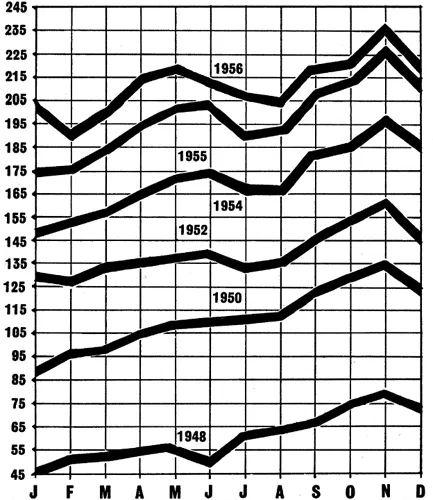
THE DEVELOPMENT OF INDUSTRIAL OUTPUT
The production index for industry as a whole (1936 = 100) has risen year by year since 1948. The pre-war level was achieved again in 1950. Meanwhile the output for industry as a whole has more than doubled (1956=213).
As well as these measures by the Bank Deutscher Länder other factors began to work restrictively: the creation of money under West German currency reform stopped at the end of September 1948, with the distribution of the second per capita.4 The switch-over of the RM accounts had been completed by the end of the year. A new phenomenon, which is still with us, appeared on the horizon to help us: the budget in the last quarter of 1948 for the first time showed a surplus, with anti-inflationary consequences.
Out of this freedom-loving spirit, which showed itself in the dismantling of the planned economy, grew the desire to regulate the budget through a systematic limitation of spending. On June 28, 1948, the decree to stabilize the currency and public finances was issued. Recruitment for the administration was limited, rises forbidden and official travel abroad limited to a minimum. This decree certainly mirrored good intentions, if they could be implemented in the extensive administrative machinery. When I moved into the Ministry of Economic Affairs at Hoechst, I found 2,500 people working there. By 1949 they had been reduced to 1,647.
The Price Mirror and the Programme for All
The attempts of the economic administration to stabilize prices were expressed in the regular publication of a price mirror, based on information supplied by industry, the retail trade and the unions. This was meant to show what price, calculated carefully, could be regarded as appropriate for individual articles. The first price mirror of September 11, 1948, gave a price of between DM 24.50-30.00 for men’s shoes. At that time the Programme for All was started, under which 700,000 pairs of shoes were produced in August at closely calculated prices.
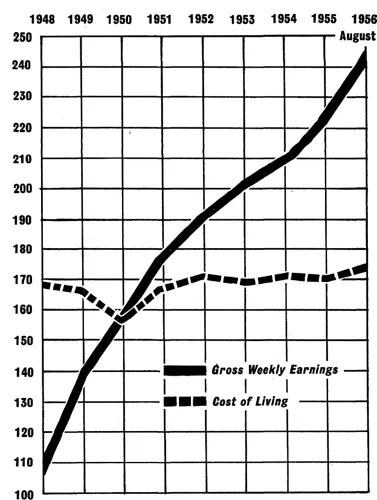
COST OF LIVING FIGURES AND WEEKLY EARNINGS
The above chart shows how the gross weekly earnings of all industrial workers rose (1938 = 100) from 109 in 1948 to nearly 250 at the end of 1956. Only a very small proportion of this wage increase was absorbed by higher prices (Index 1938 = 100; second half-year of 1948 = 168; end of 1956 = 178).
Finally, mention should be made of the ‘law against driving prices up’ which was promulgated on October 7, 1948, and which until the present time has provoked ardent parliamentary debate. But it does not reflect historical truth—no, it really contradicts it—if this law is cited as one of those which later caused the reversal in prices.
This happy change was reached as a result of economic equilibrium, which was helped by falling world-market prices from the end of 1948. Further, it was important that, thanks to the Marshall Plan, the supply of raw materials improved. With the turn of the year companies began to invest more in machinery and raw materials. For example, while during the first half of 1948 commercial and non-commercial imports barely reached DM 1.2 milliard, they rose in the same period of 1949 to DM 3 milliard. These factors helped appreciably to further the success of our aims. Thus the first phase of German reconstruction was marked by turbulent prices, accompanied by a rise in real wages and a marked increase in productivity.
Rapid Increase in Production after Currency Reform
(1936 = 100)
2nd quarter |
4th quarter | |
1948 |
1948 | |
All industry |
52.1 |
75.4 |
Production goods |
46.4 |
68.3 |
Investment goods |
46.6 |
75.7 |
Consumer goods |
43.4 |
66.6 |
Foodstuffs industry |
55.0 |
78.8 |
This correction in prices—whereby I mean the bringing about of an equilibrium at a changed nominal level—proved essential, even compulsory. Now the scissors of prices and consumer purchasing power began to shut, but in favour of the consumer. In a few weeks the picture changed radically. No longer was every price paid; the cancellation of orders increased as a result of shortage of money. One read headlines such as ‘warning signal in the sector of consumer goods’, and pessimists, typically, were tending to turn to the other side.
The Second Phase
While in the first phase after currency reform many believed that higher prices might remain, a drastic fall was as passionately feared, for it was thought that it would not permit the economy to cover its costs. Falling prices, until the outbreak of the Korean crisis at least, revealed to the consumer the outstanding advantage of the market economy over any forms of State planning. This knowledge would have been more convincing if the man in the street had been in a position to compare prices internationally, for while prices in West Germany were still dropping, appreciable increases were taking place elsewhere.
Cost of Living Index
1949 |
1950 | |
Federal Republic |
107 |
100 |
France |
90 |
100 |
Australia |
91 |
100 |
Netherlands |
92 |
100 |
Great Britain |
97 |
100 |
Canada |
97 |
100 |
U.S.A. |
99 |
100 |
Italy |
101 |
100 |
Sweden |
101 |
100 |
By the middle of 1950—and this is typical of this period of steadiness as far as prices are concerned—most representative indices had sunk back to the level of the middle of 1948. The cost of living index of a working class family of four people in the combined economic area fell from 166 in the last quarter of 1948 to 160 for the average of 1949 and to 149 for July 1950 (1936 = 100). This incidence of falling prices was all the more impressive as during this period wages were rising.
The movement had already begun in the second half of 1948, but it was the year of 1949 that was remarkable for the strong increase in real wages. Unlike later periods of sharper increases in wages, the increases in 1949 were combined with price falls, and consequently led to particularly strong real wage improvements. In this lay the special characteristic of the second phase after reform from the middle of 1948.
The gross hourly earnings of male industrial workers grew from DM 1.22 in December 1948, to DM 1.33 in December of the following year. In June 1950, they were DM 1.36. At the same time the cost of living index sank to 168 in January 1949, and to 151 in June 1950 (1938 = 100). The real wages of industrial workers (i.e. the relationship between gross weekly earnings and the cost of living index) rose by 20.5% in 1949.
These opposing trends of wages and prices brought home the facts about the social market economy. In those months I repeatedly drew the attention of the public to these developments, in order to demonstrate in a practical manner the inner laws of market economy, which finds its best expression in rising incomes while prices are falling. But this phase, too, did not pass without tensions. The factors making for this development were briefly: an adjustment of the price level to the amount of purchasing power in the hands of the public while production of goods rises; at the same time, a damping down of the economy through a budget surplus, and in addition the belated effects of the American recession. Further, the liberalization of imports begun in the autumn of 1948 forced more adjustments.
These deliberate measures led, for the first time in one and a half decades, to heavy international competition hitting the German home market. Industry was forced to re-examine its production programmes which had been drawn up when its economy was cut off from abroad, and thus revealed the marks of an autarchic ideology. It was then necessary for industry to look to its markets.
The Customer is Right
The pressure of falling prices led to a state of affairs which the German public could barely remember. The customer became king again; a buyers’ market began. How clumsy were the consumers’ first attempts to walk in this new land which German economic policy had opened up ! In the understandable hope of buying even more cheaply tomorrow or the day after, the consumer held back; he learned to judge more carefully. This comprehension by the public was absolutely essential for our further development, since without this hard lesson the deeply rooted attitude of a sellers’ market—one utterly foreign to the market economy—could never have been eradicated.
The newly created buyers’ market in the nature of things led to certain consequences. Insofar as the eagerness for capital investment aimed only to increase capacity, some holding back was noticeable. It was no longer a question merely of producing, but increasingly it was one of producing for the market. First place was given to investment for increased efficiency. Many plans, based on a sellers’ market, turned out to be wrong and unworkable.
Statistics of the trend of production clearly reflected this phase. From December 1948, to June 1950, the output per hour in the Federal Republic rose from 70.3 to 89.0% of that of 1936. The most thorough increase in efficiency took place in those sectors where pressure of competition was especially strong. If, for example, productivity in the first and second half of 1949 is compared, it is seen that in this short time the textile industry showed an increase from 82.2 to 95.7; the shoe industry from 69.0 to 75.8; building of vehicles from 49.1 to 65.7, while—characteristically—mining, which at the time was outside the sphere of the market economy, showed only an increase from 61.3 to 62.5 (1936 = 100 for output per working hour). It needs no stressing that only these great successes in greater efficiency made possible these marked wage increases without endangering price stability.
The Inheritance of False Full Employment
It was inevitable that unemployment should develop into a serious problem. This undoubtedly unpleasant result afforded many opportunities to damn the new economic policy.
Such a reaction is typical of the impatience shown by people when faced with essentially long-term developments. I repeatedly explained that neither the German worker nor the German people would be well served by providing them with mere employment—it was necessary to create certain, that is, real jobs.
Currency and Economic Reform Increases
Productivity Production per Working Hour (1936 = 100)
1948* |
Annual growth | |
June = 62.8 |
1949= 83 |
|
*British and U.S. zone only.
Unemployment then grew from the unreal full employment of the days before currency reform to 760,000 at the end of 1948. During the whole of 1949 unemployment mounted, even during the summer months. Month by month the number of the unemployed increased, from 962,000 in January to 1.56 millions at the end of the year. A hard time for a responsible economist! Once more the collapse of my economic policy was being predicted.
The increase in unemployment would not have been so large if all the time more people—not least from the stream of refugees—had not demanded work. The sharpness of the criticism made many forget that, for party political reasons, the same people who were now confidently expressing their scorn, had before currency reform predicted an army of unemployed of between four and five million. But statistics of employment showed most clearly how the unemployment resulted almost completely from the search for work by newly available workers. From the end of 1948 to the end of 1949 there was a decline in employment of only 150,000, while the peak of unemployment during the winter, i.e. in February 1950, was only 1.2 million more than at the end of 1948. This enormous stream persuaded the knowledgeable in favour rather than against the free economic system, since it proved how many people in West Germany thought work once more worth while, and also necessary.
At this time another event took place, which is hardly less important than the reforms of the middle of 1948. This was the transition to a fundamentally different foreign trade policy, which deliberately exposed the German economy to international competition. In this connection the devaluation by 20% of the DM on September 19, 1949, must be mentioned. A new level of dollar parity of DM 4.20 against DM 3.33 hitherto, was established. This devaluation was reflected in the development of foreign trade.
Foreign Trade and DM Devaluation
Monthly |
Export |
Import | |||
Average |
DM |
$ |
DM |
$ | |
1949 |
3rd quarter |
326.4 |
93.2 |
579.8 |
177.9 |
4th „ |
399.3 |
94.6 |
875.8 |
211.7 | |
1950 |
1st „ |
502.3 |
118.8 |
823.3 |
197.9 |
2nd „ |
596.3 |
140.6 |
737.8 |
l75.5 | |
3rd „ |
727.3 |
171.3 |
939.7 |
223.3 | |
4th „ |
963.5 |
229.4 |
1,280.5 |
304.4 | |
Finally it should be mentioned as a specially important factor that the Federal Republic—when, following the British example, most European currencies were devalued—devalued less than Britain and France, thus losing some competitive power.
How fundamentally, then, the situation changed during the first fifteen months of the first Federal Government administration! Between October 1949 and December 1950, exports trebled. As expected, the liberalization of foreign trade also led to rapidly increasing imports, so that the balance of payments, in spite of the rise in exports, worsened. Imports not only fed rising consumption, but in the form of raw materials were essential for eventual exports of high quality products. This process needed time—and nerves. Added to the troubles of unemployment were worries about the worsening foreign trade balance, which on private account alone in 1949 ended with an over-all deficit of $158 million and in 1950 of $243 million. The total adverse trade balance in 1949 came to $1,114 milliard and in 1950 to $723 milliard.
Freer Credit as Cure for All?
In this situation the Minister for Economic Affairs could not just stand idle. His diagnosis of the situation was: the internal economy is inhibited, the existing productive facilities are not being fully used. But the index of industrial production had risen from 75.2 in December 1948 to 96.1 in December 1949 (136 = 100). In view of the unemployment it seemed possible that the internal economic situation might benefit from a generous credit policy, helped by other measures of expansion. In fact, my so-called deflationary policy was being criticized and increased credits demanded, but it became increasingly clear that these critics were deliberately glossing over the importance of currency stability.
Thus, from the Opposition to the Allies, a chorus of criticism grew up. The latter, in a heated ‘war of memoranda’, preferred full employment more than the stability of our currency. This quarrel, begun in December 1949, on the occasion of the memorandum from the Federal Government discussing the basis for further Marshall aid, dominated the following weeks.
The disciples of the English full employment thesis, the followers of ‘cheap money’ and of ‘austerity’ surprisingly made a pact with American officials of the High Commission. The latter, alarmed by the large import surplus, worried about the approaching end of Marshall aid. Thus nearly all forces joined for a general attack on the market economy, forgetting that only through greater productivity and free competition, on the basis of the stability of our money, could we secure our position in the world market. Only thus was it possible to find a way to care for the greatly increased number of people in West Germany.
I firmly opposed forced artificial expansion. I had to put up with being scolded for inactivity, which was all the more grotesque since hitherto I had always been criticized for too much vitality. I was in no doubt at all that such a frivolous policy of expansion would not only have endangered the stability of the currency, but also our balance of payments for a considerable time. Thus we would have become dishonest at the beginning of the path which aimed at making us an honest partner in world trade. In view of the decisive importance of our foreign trade, such a disaster had to be avoided.
How much this growing interest in exports in the period before the Korean conflict became conscious can be proved by my speeches of the time. To give just one of many examples, at the annual meeting of the Union of German Dockyards on September 20, 1950, I declared:
‘The foreign trade policy which we are pursuing, in spite of much criticism over the past nine months, is based on the conviction that our economic task—the employment and maintenance of over 12 million more people than before the war—cannot be carried through, but must founder in a cul de sac unless we create more air in this manner …
‘Above all we must not try to achieve an apparent success through increasingly watering down our money, which has at last become stable, and thus move towards inflation. In that way we would steal imperceptibly the money of those who have saved. That would be the most damnable method which could be conceived.’
Thus, against all advice, West German economic policy was carefully directed; on the one hand, to limit the damage of mass unemployment, on the other to avoid endangering the advances already made, particularly towards the security of our currency, which would enable Germany to return to the world markets. In those difficult days it was important to remain firm, and not to do what was advised by real and false friends. I even found it necessary to employ some stratagems to meet strong political pressure in favour of dangerous and unnecessary measures.
Medicine against Recession
In these ways I tried to keep to the narrow path between inflation and deflation. The catalogue of the various measures used by the Ministry for Economic Affairs and the Central Bank confirms that a modern market economy is without doubt in a position to meet a recession effectively without endangering the stability of the currency.
The economic measures taken were carefully thought out. At the end of March 1949 the Bank Deutscher Länder loosened up the credit squeeze which had begun at the end of October 1948 with the limitation of credits. On June 1, 1949, the minimum reserve requirements were lowered from 15 to 12%, or from 10 to 9%. On May 27, 1949, and on July 14, 1949, the rediscount rate was cut by one half per cent on each occasion, bringing it down from 5 to 4%. In the late summer, credit institutions were allowed special help to provide monies for long-term production and investment to the tune of DM 300 milliard. On September 1 a further reduction of the minimum reserves of the banks as well as rates for loans and sight drafts took place.
The pressure of mass unemployment forced a further strengthening of the expansionist economic policy in the winter. Financial help for the creation of public works programmes as well as help for building was granted. Within the framework of this special action DM 3.4 milliard was made available. Short-term credits, which at the end of 1948 stood at DM 4.7 milliard, rose in 1949 by a further DM 5.1 milliard and in the first half-year of 1950 rose again by 2.3 milliard. The volume of medium and long-term credits of the banks, including the Bank for Reconstruction, reached the sum of 2.6 milliard; in the first half-year of 1950 it rose by a further 2 milliard.
In April 1950 the Federal Government decided to lower taxes and to remit others in order to step up consumption and lighten the burden on the economy. It was truly contradictory that in spite of the demands of the Allies in their many memoranda, in which they condemned German inactivity, they at first refused permission for this tax reform. It should be remembered how much energy had to be spent on discussions with the Allies, whether on questions of a steel quota or on the sensible development of dismantling and decartelization, or over the use of the so-called counterpart funds, or about the best methods of bridging the dollar gap or even about the further slackening of controls. It need hardly be mentioned that this phase of the buyers’ market came at a convenient moment for me to throw overboard the meaningless remains of controls and price regulations.
In this situation I declared in an annual survey over the Bavarian Radio on December 27, 1949:
‘The passing year 1949 was one of consolidation, yet, at the same time, of recovery and expansion. If in the past year I promised that we should be successful in handling the social problem, no one can deny that, partly through raising nominal incomes, but particularly through raising a supply of better quality goods at lower prices, the standard of living of the German people has improved.’
Even without Korea . . .
It would not be historically accurate to ascribe to the Korean boom the solution of difficulties which here had been carefully studied, analysed and overcome. Our resistance to all attempts to weaken our policy of stable money had already borne fruit. The index of production climbed from 90.9 in January 1950 to 107.6 in June of that year, a rise of nearly 20%, and appreciably more than in the same period of the previous year.
The steady pressure on prices and the growing buyers’ market at home made exports doubly attractive. As a result, exports increased from DM 485.5 million in December 1949 to DM 651.9 million in June 1950. In these six months the import surplus declined from DM 532.7 million in January 1950 to DM 138.6 in June of that year. Unemployment dropped during this period by 360,000; the number of employed increased even more.
Today, with all relevant statistics available, we know that it would not have needed the Korean conflict to continue the advance of the economy, or to increase its speed. The contrary is true: the Korean boom brought more difficulty than help to German economic policy.
It should be remembered that for the consumer a favourable trend was interrupted. The cost of living index had dropped from 168 in January 1949 to 148 in September 1950 (1936 = 100), while simultaneously earnings registered a rising trend. With the outbreak of the Korean conflict in September 1950 the world received its most serious shock since 1939. German economic policy had just paved the way for further expansion, and a further healthy and natural development was thus deeply disturbed.
Prosperity Through Competition
Read the whole book online · Book details
Free to read online and to download from this archive.