
Chapter 19 of 62 · Strictly Confidential: The Private Volker Fund Memos of Murray N. Rothbard by Murray N. Rothbard
2. Fisher's Equation of Exchange: A Critique
2. Fisher’s Equation of Exchange: A Critique
October 1952
I
Fisher describes the chief purpose of his work35 as “the causes determining the purchasing power of money.” Money is a generally acceptable medium of exchange, and purchasing power is rightly defined as the “quantity of other goods which a given quantity of goods will buy.” He explains that the lower the prices of goods, the larger will be the quantities that can be bought by a given amount of money, and therefore the larger the purchasing power of money. Vice versa if the prices of goods rise. This is correct; but then comes this flagrant non sequitur: “In short, the purchasing power of money is the reciprocal of the level of prices; so that the study of the purchasing power of money is identical with the study of price levels.”
From then on, Fisher proceeds to investigate the causes of the “price level.” Thus, by a simple “in short,” Fisher has leaped from the real world of an array of individual prices for an innumerable list of concrete goods, into the misleading fiction of a “price level,” without discussing the grave difficulties that any such concept faces. The fallacy of the “price level” concept will be treated further below.
The “price level” is allegedly caused by three aggregative concepts: the quantity of money in circulation, its velocity of circulation (the average number of times in a period that money is exchanged for goods), and the total volume of goods bought for money. These are related by the famous equation of exchange: MV = PT. This equation of exchange is built up by Fisher in the following way: first, suppose an individual exchange transaction. Smith buys 10 pounds of sugar for 7 cents a pound. An exchange has been made, Smith giving up 70 cents to Jones, and Jones transferring 10 pounds of sugar to Smith.
From this fact, Fisher somehow deduces that “10 pounds of sugar have been regarded as equal to 70 cents, and this fact may be expressed thus: 70 cents = 10 pounds of sugar multiplied by 7 cents a pound.” This offhand assumption of equality is not self-evident, as Fisher apparently assumes, but a tangle of fallacy and irrelevance. Thus, who has regarded the 10 pounds of sugar as equal to the 70 cents? Certainly not Smith, the buyer of the sugar. He bought the sugar precisely because he considered the two quantities as unequal; to him the value of the sugar was greater than the value of the 70 cents and that is why he made the exchange. On the other hand, Jones, the seller of the sugar, made the exchange precisely because the values of the two goods were unequal in the opposite direction, i.e., he valued the cents more than he did the sugar. There is thus never any equality of values in an exchange; on the contrary, there is a reverse double inequality of values on the part of the two participants.
The assumption that an exchange presumes some sort of equality has been the bugaboo of economic theory since Aristotle and it is surprising that Fisher, an exponent of the subjective theory of value in many respects, falls into the ancient trap. Thus, there is certainly no equality of values between the two goods, or, in this case, between the money and the good. Is there an equality in anything else, and can Fisher be redeemed by finding such an equality? Obviously not; there is no equality in weight, length, or any other magnitude. But to Fisher, the equation represents an equality in value between the “money side” and the “goods side”; thus Fisher states,
The total money paid is equal in value to the total value of the goods bought. The equation thus has a money side and a goods side. The money side is the total money paid.... The goods side is made up of the products of the quantities of goods exchanged multiplied by their respective prices.
We have seen, however, that even for the individual exchange, and setting aside the holistic problem of referring to “total exchanges,” there is no such equality that tells us anything about the facts of economic life. There is no “value of money” side equaling a “value of goods” side. The equal sign is an illegitimate one in Fisher’s equation.
How then do we account for the general acceptance of the equal sign and the equation? The answer is that, mathematically, the equation is of course an obvious truism:
70 cents = 10 pounds of sugar × 7 cents per pound of sugar
In other words, 70 cents = 70 cents. But this truism conveys to us no knowledge of economic fact whatsoever. Indeed, it is possible to discover an endless number of such equations, on which esoteric articles could be published. Thus:

+ 70 cents – number of students in a class.
Then, we could say that the causal factors determining the quantity or money are: the number of grains of sand, the number of students per grain of sand, and the quantity of money. Thus, what we have in Fisher’s equation is two money sides, one identical with the other. To say that such an equation is not very enlightening is self-evident. All that his equation tells us about economic life is that the total money received in a transaction is equal to the total money given up in a transaction—surely an uninteresting truism.
Let us reconsider on the basis of the determinants of price, since that is the center of interest. Fisher’s equation of exchange for an individual transaction can be rearranged as follows:

Fisher considers that this equation yields the significant information that the price is determined by the total money spent divided by the total supply of goods sold. Actually, of course, the equation, as an equation, tells us nothing about the determinants of price; thus, we could set up an equally truistic equation:

This equation is just as mathematically true as the other, and, on Fisher’s own mathematical grounds, we could argue cogently that Fisher has “left out the important wheat price in the equation.” We could easily add innumerable equations with an infinite number of complex factors to “determine” price.
The only knowledge we have of the determinants of price is the knowledge deduced logically from the axioms of praxeology. This will give us our theory of the determinants of price; reliance on mathematics can at best only translate our previous knowledge into a relatively unintelligible form—or, at worst, it misleads the reader, as in the present case. The price of the sugar transaction may be made to equal any number of truistic equations; but it is determined by the supply and demand of the participants, in turn governed by the utility of the two quantities of goods on the value scales of the participants in the exchange. This is the fruitful approach in economic theory, not the sterile mathematical one.
If we consider the equation of exchange as revealing the determinants of price, we find that Fisher must be implying that the determinants are the “70 cents” and the “10 pounds of sugar.” It should be clear that, if we are interested in causal determinants, things cannot determine prices. Things, whether pieces of money or pieces of sugar or pieces of anything else, can never act—they cannot set prices or supply-and-demand schedules. All this can only be done by human action—only individual actors can decide whether or not to buy, only their value scales determine prices. It is this profound mistake that is at the root of the fallacies of the Fisherine equation of exchange—that human action is abstracted out of the picture, and things are assumed to be in control of economic life. Thus, either the equation of exchange is a trivial truism—in which case it is no better than a million other such truistic equations and holds no place in science, which rests on simplicity and economy of methods—or else it is supposed to convey some important truths about economics and determination of prices.
In this case, it makes the profound error of substituting for correct logical analysis of causes based on human action misleading assumptions based on an absence of human action and action by things instead. At best, the Fisher equation is superfluous and trivial; at worst, it is wrong and misleading. Fisher himself thought it conveyed important causal truths and proved this by use of the trivial truisms.
II
Thus, Fisher’s equation of exchange is seen to be a pernicious one even for the individual transaction. How much more so when he extends it to the “economy as a whole”? For Fisher, as in the other parts of his theory, this is also a simple step. “The equation of exchange is simply the sum of the equations involved in all individual exchanges” in a time period. Let us now, for the sake of argument, assume that there is nothing wrong with Fisher’s individual equations, and consider his “summing up” to bring about the total equation for the economy as a whole. Let us also abstract from the statistical difficulties in discovering the magnitudes for any given historical situation. Let us look at several individual transactions that Fisher tries to build into a total equation of exchange:
- exchanges 70 cents for 10 pounds of sugar.
- exchanges 10 dollars for 1 hat.
- exchanges 60 cents for 1 pound of butter.
- exchanges 500 dollars for 1 television set.
What is the “equation of exchange” for the community of four? Obviously there is no problem in summing up the total amount of money spent: $511.30. But what about the other side of the equation? Of course, if we wish to be meaninglessly truistic, we could simply write $511.30 on the other side of the equation, without any laborious building up at all. But if we merely do this, there seems to be no point in the whole procedure. Furthermore, Fisher wants to get at the determination of prices, or “the price level,” so that he cannot rest content at this trivial stage. Yet, he continues on the truistic level:
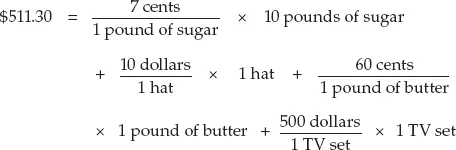
This is what Fisher does, and this is still the same trivial truism that total money spent equals total money spent. This triviality is not redeemed by referring to the quantities in the parentheses as p × Q, p′ × Q′ etc., with each p referring to a price and each Q referring to the quantity of a good, so that:
E = Total money spent = pQ + p′Q′ + p″Q″, etc. Writing the equation in this symbolic form does not add to its value.
Fisher, attempting to find the causes of the determination of the price level, has to proceed further to try to discover the determinants by means of this equation. We have already seen that, even for the individual transaction, the equation p = E/Q (price equals total money spent divided by quantity of good sold—the price of sugar equation in Fisherine symbolic form) is only a trivial truism and is erroneous when one tries to use it to analyze the determinants of price.
How much worse is Fisher’s attempt to arrive at such an equation for the whole community and to use this to arrive at the determinants of a mythical “price level”? For simplicity’s sake, let us take simply the two transactions of A and B, for the sugar and the hat. Total money spent, E, clearly equals $10.70, which of course equals total money received, pQ + p′Q′. But Fisher is looking for an equation to explain the price level; therefore he uses the concept of an “average price level,” P, and a total quantity of goods sold, T, such that E is supposed to equal PT. But the transition from the trivial truism E = Σ pQ + p′Q′... to the equation E = PT cannot be made as blithely as Fisher believes. Indeed, if we are interested in the explanation of economic life, it cannot be made at all.
For example, for the two transactions (or for the four), what is T? How can 10 pounds of sugar be added to 1 hat or to 1 pound of butter to arrive at T? Obviously, no such addition can be performed, and therefore Fisher’s holistic T, total physical quantity of goods exchanged, is a meaningless concept and cannot be used in scientific analysis. If T is a meaningless concept, then P must be also, since the two presumably vary inversely if E remains constant. And what, indeed, is P? Here, we have a whole array of prices, 7 cents a pound, $10 a hat, etc. What is the price level? Clearly, there is no price level here; there are only individual prices of specific goods.
But, here, error is likely to persist. Cannot prices in some way be “averaged” to give us a working definition of a price level? This is Fisher’s solution. Prices of the various goods are in some way averaged to arrive at P, then P = E/T and all that remains is the difficult “statistical” task of arriving at T. The concept of an average for prices is a common fallacy. It is easy to demonstrate that prices can never be averaged for different commodities; we shall use a simple average for our example, but it will be seen that the same conclusion applies to any sort of “weighted average” such as recommended by Fisher or by anyone else.
What is an average? Reflection will show that for several things to be averaged together, they must first be totaled. In order to be thus added together, the things must have some unit in common, and it must be this unit that is being added. Only similar units can be added together. Thus, if one object is 10 yards long, a second is 15 yards long, and a third 20 yards long, we may obtain an average length of 15 yards. Now, money prices are in terms of ratios of units: cents per sugar, cents per hat, cents per butter, etc. Suppose we take the first two prices:

Can these two prices be averaged in any way? Can we add 1,000 and 7 together, get 1,007 cents, and divide by something to get a price level? Obviously not. Simple algebra demonstrates that the only way to add the ratios in terms of cents (certainly there is no other unit available) is as follows:

Obviously, neither the numerator nor the denominator makes sense; the units are incommensurable.
Fisher’s more complicated concept of a weighted average, with the prices weighted by the quantities of goods sold, solves the problem of units in the numerator but not in the denominator:
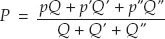
Thus, any form of averaged price-level concept involves the adding or multiplying of the quantities of completely different units of goods, such as butter, hats, sugar, etc., and is therefore meaningless and illegitimate. Even pounds of sugar and pounds of butter cannot be added together, in this equation, because they are two different goods and their valuation is completely different. And if one is tempted to use poundage as the common unit of quantity, what is the weight in pounds of a concert, or a medical or legal service?
It is evident that PT, in the total equation of exchange, is a completely fallacious concept. Whereas the equation E = pQ for an individual transaction is at least a trivial truism, although not very enlightening on causation, the equation E = PT for the whole society is a false one. Neither P nor T can be defined meaningfully, which would be necessary to giving any validity to this equation. We are left only with E = pQ + p′Q′, etc., which only gives us the useless truism, E = E.
Since the P concept is completely fallacious, it is obvious that Fisher’s use of the equation to reveal the determinants of prices is fallacious. He states that if E doubles, and T remains the same, P (the price level) must double. On the holistic level, this is not even a truism; it is false, false because neither P nor T can be meaningfully defined. All we can say is that when E doubles, E doubles. For the individual transaction, the equation is at least meaningful; if a man spends $1.40 on 10 pounds of sugar, it is obvious that the price has doubled from 7 cents to 14 cents a pound. Still, this is only a mathematical truism, which tells us little of the causal forces at work. But Fisher never attempted to use his equation to explain the determinants of individual prices; he recognized that the logical analysis of supply and demand is far superior here. He used only the holistic equation, which he felt explained the determinants of the price level, and was uniquely adapted to such an explanation. Yet the holistic equation is false, and the price level remains pure myth, an undefinable concept.36
Strictly Confidential: The Private Volker Fund Memos of Murray N. Rothbard
Read the whole book online · Book details
This work is published under a Creative Commons licence. You may copy, share, and re-host it with attribution.