
Chapter 7 of 9 · Study Guide to the Theory of Money and Credit by Robert P. Murphy
APPENDICES APPENDIX A ON THE CLASSIFICATION OF MONETARY THEORIES Chapter Outline 1. Catallactic and Acatallactic Monetary Doctrine
Money is such an important part of economic life that writers analyzed it before the development of other areas of economic theory. Even after the development of catallactics and the modern subjective theory of value, acatallactic theories of money persist. Yet a necessary condition of a satisfactory theory of money is that it is embedded in a more general theory of exchanges, within which exchanges involving money are merely a component.
Economic theory is difficult, and requires that the economist first consider the formation of prices in the case of direct exchange. Yet eventually the analysis must be generalized to include indirect exchange and the role of money, or else the conclusions may go astray.
2. The “State” Theory of Money
The “State” theory of money claims that the value of money rests on the authority of the highest civil power, rather than being the result of valuations in the market. Although its proponents may not realize it, the State theory of money doesn’t even attempt to explain the purchasing power of money, which is the primary purpose of a monetary theory.
3. Schumpeter’s Attempt to Formulate a Catallactic Claim Theory
As an analogy, it is acceptable to call money a claim on the general stock of goods. Yet the notion of money as a claim cannot serve as an actual theory of money, seeking to explain the exchange ratio between money and all other goods and services. Schumpeter has made an attempt to do so, but he was forced at the outset to exclude hoards and other important real-world determinants of the value of money. His failure illustrates that it is a dead end to analyze money as a claim.
4. “Metallism”
Knapp defines metallism as the monetary doctrine claiming that the unit of value is a certain quantity of metal. Knapp’s definition is unclear, but he uses the term to include all those theories of money that are notnominalistic.
5. The Concept “Metallism” in Wieser and Philippovich
Knapp’s cumbersome classification scheme has unfortunately been adopted by other economists, allowing the confusion in his work to seep into theirs.
6. Note: The Relation of the Controversy about Nominalism to the Problems of the Two English Schools of Banking Theory
Some writers, influenced by Knapp, interpreted the clash between the Currency and Banking Schools as a clash between metallism and nominalism. However, this is not really the crux of their argument. Because he disdained theory altogether, Knapp was unable to even express the actual controversy between the two English schools of thought on banking.
Technical Notes
• In this chapter (e.g., pp. 464 and 473), Mises rejects the theory that the value of money equals the value of the precious metals. This may surprise some readers, since throughout the book Mises clearly endorses the classical gold standard, and he also states that people in commerce (rightly) evaluate coins on their metal content, not on the stamp placed by the legislature. However, there is no contradiction here. Mises agrees that the monetary unit should ultimately be a fixed weight of gold (or another commodity). However, to explain the value (or the purchasing power) of that monetary unit, one needs a theory of indirect exchange, grounded in the subjective theory of value.
• In his critique of Schumpeter (in section III), Mises explains that a satisfactory theory of money must take into account all determinants of its purchasing power, including “hoards.” For example, if people in the community become fearful and try to accumulate an extra month’s worth of expenses in the form of cash, then other things equal the purchasing power of money will rise (i.e., prices will fall). A theory that disregarded the role of hoards would be unable to explain why the value of money changed.
New Terminology
Catallactics: The study of exchanges or (more narrowly) the study of monetary exchanges, with an emphasis on the determination of price ratios.
Metallism: As defined by Knapp, the monetary doctrine claiming that the unit of value is a certain quantity of metal.
Nominalism: The monetary doctrine claiming that the unit of value derives from the government’s designation of the legaltender unit of account.
Study Questions
1. Explain: “There are problems of theory full comprehension of which can be attained only with the aid of the theory of indirect exchange. To seek a solution of these problems, among which, for example, is the problem of crises, with no instruments but those of the theory of direct exchange, is inevitably to go astray.” (p. 462)
2. Explain: “Facts do not speak; they need to be spoken about by a theory.” (p. 467)
3. Explain: “The State Theory of money—and all acatallactic theories of money in general—breaks down not so much because of the facts, but because it is not able so much as to attempt to explain them.” (p. 467)
4. Explain: “In a strict and exact sense ... all money that is not changing owners at the very moment under consideration is awaiting employment. Nevertheless, it would be incorrect to call such money ‘unemployed’; as part of a reserve it satisfies a demand for money, and consequently fulfils the characteristic function of money.” (p. 471)
5. Does Mises think that the paper money experiences of the war years pose a refutation of catallactic theories of money? (pp. 480–81)
APPENDIX B
TRANSLATOR’S NOTE ON THE TRANSLATION OF CERTAIN TECHNICAL TERMS
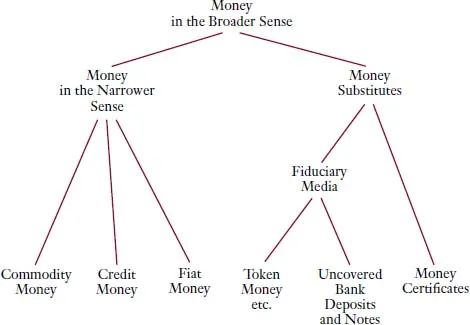
[The translator’s note in Appendix B is self-explanatory and needs no summary here. However, we have reproduced the translator’s excellent diagram to illustrate the Misesian classification scheme regarding different monetary concepts.]
Study Guide to the Theory of Money and Credit
Read the whole book online · Book details
This work is published under a Creative Commons licence. You may copy, share, and re-host it with attribution.