
Chapter 9 of 21 · Tariff History of the United States by F.W. Taussig
VI. Concluding Remarks
The three most important branches of industry to which protection has been applied, have now been examined. It has appeared that the introduction of the cotton manufacture took place before the era of protection, and that—looking aside from the anomalous conditions of the period of restriction from 1808 to 1815—its early progress, though perhaps somewhat promoted by the minimum duty of 1816, would hardly have been much retarded in the absence of protective duties. The manufacture of woollens received little direct assistance before it reached that stage at which it could maintain itself without help, if it were for the advantage of the country that it should be maintained. In the iron manufacture twenty years of heavy protection did not materially alter the proportion of home and foreign supply, and brought about no change in methods of production. It is not possible, and hardly necessary, to carry the inquiry much further. Detailed accounts cannot be obtained of other industries to which protection was applied; but so far as can be seen, the same course of events took place in them as in the three whose history we have followed. The same general conditions affected the manufactures of glass, earthenware, paper, cotton-bagging, sail-duck, cordage, and other articles to which protection was applied during this time with more or less vigor. We may assume that the same general effect, or absence of effect, followed in these as in the other cases. It is not intended to speak of the production of agricultural commodities like sugar, wool, hemp, and flax, to which also protection was applied. In the production of these the natural advantages of one country over another tell more decidedly and surely than in the case of most manufactures, and it has not often been supposed that they come within the scope of the argument we are considering.
Although, therefore, the conditions existed under which it is most likely that protection to young industries may be advantageously applied—a young and undeveloped country in a stage of transition from a purely agricultural to a more diversified industrial condition; this transition, moreover, coinciding in time with great changes in the arts, which made the establishment of new industries peculiarly difficult—notwithstanding the presence of these conditions, little, if anything, was gained by the protection which the United States maintained in the first part of this century. Two causes account for this. On the one hand, the character of the people rendered the transition of productive forces to manufactures comparatively easy; on the other hand, the shock to economic habits during the restrictive period from 1808 to 1815 effectually prepared the way for such a transition. The genius of the people for mechanical arts showed itself early. Naturally it appeared with most striking results in those fields in which the circumstances of the country gave the richest opportunities; as in the application of steam-power to navigation, in the invention and improvement of tools, and especially of agricultural implements, and in the cotton manufacture. The ingenuity and inventiveness of American mechanics have become traditional, and the names of Whitney and Fulton need only be mentioned to show that these qualities were not lacking at the time we are considering. The presence of such men rendered it more easy to remove the obstacles arising from want of skill and experience in manufactures. The political institutions, the high average of intelligence, the habitual freedom of movement from place to place and from occupation to occupation, also made the rise of the existing system of manufacturing production at once more easy and less dangerous than the same change in other countries. At the same time it so happened that the embargo, the non-intercourse acts, and the war of 1812 rudely shook the country out of the grooves in which it was running, and brought about a state of confusion from which the new industrial system could emerge more easily than from a well-settled organization of industry. The restrictive period may indeed be considered to have been one of extreme protection. The stimulus which it gave to some manufactures perhaps shows that the first steps in these were not taken without some artificial help. The intrinsic soundness of the argument for protection to young industries therefore may not be touched by the conclusions drawn from the history of its trial in the United States, which shows only that the intentional protection of the tariffs of 1816, 1824, and 1828 had little effect. The period from 1808 till the financial crisis of 1818–19 was a disturbed and chaotic one, from which the country settled down, with little assistance from protective legislation, into a new arrangement of its productive forces.
The system of protective legislation began in 1816, and was maintained till toward the end of the decade 1830–40. The Compromise Act of 1833 gradually undermined it. By 1842 duties reached a lower point than that from which they had started in 1816. During this whole period the argument for protection to young industries had been essentially the mainstay of the advocates of protection, and the eventual cheapness of the goods was the chief advantage which they proposed to obtain. It goes without saying that this was not the only argument used, and that it was often expressed loosely in connection with other arguments. One does not find in the popular discussions of fifty years ago, more than in those of the present, precision of thought or expression. The “home market” argument, which, though essentially distinct from that for young industries, naturally suggests itself in connection with the latter, was much urged during the period we are considering. The events of the War of 1812 had vividly-impressed on the minds of the people the possible inconvenience, in case of war, of depending on foreign trade for the supply of articles of common use; this point also was much urged by the protectionists. Similarly the want of reciprocity, and the possibility of securing, by retaliation, a relaxation of the restrictive legislation of foreign countries, were often mentioned. But any one who is familiar with the protective literature of that day,—as illustrated, for instance, in the columns of “Niles’s Register,”—cannot fail to note the prominent place held by the young-industries argument. The form in which it most commonly appears is in the assertion that protection normally causes the prices of the protected articles to fall,55 an assertion which was supposed, then as now, to be sufficiently supported by the general tendency toward a fall in the price of manufactured articles, consequent on the great improvement in the methods of producing such articles.
Shortly after 1832, the movement in favor of protection, which had had full sway in the Northern States since 1820, began to lose strength. The young-industries argument at the same time began to be less steadily pressed. About 1840 the protective controversy took a new turn. It seems to have been felt by this time that manufactures had ceased to be young industries, and that the argument for their protection as such, was no longer conclusive. Another position was taken. The argument was advanced that American labor should be protected from the competition of less highly paid foreign labor. The labor argument had hardly been heard in the period which has been treated in the preceding pages. Indeed, the difference between the rate of wages in the United States and in Europe, had furnished, during the early period, an argument for the free-traders, and not for the protectionists. The free-traders were then accustomed to point to the higher wages of labor in the United States as an insuperable obstacle to the successful establishment of manufactures. They used the wages argument as a foil to the young-industries argument, asserting that as long as wages were so much lower in Europe, manufacturers would not be able to maintain themselves without aid from the government. The protectionists, on the other hand, felt called on to explain away the difference of wages; they endeavored to show that this difference was not so great as was commonly supposed, and that, so far as it existed, it afforded no good reason against adopting protection.56 About 1840, the positions of the contending parties began to change.57 The protectionists began to take the offensive on the labor question: the free-traders were forced to the defensive on this point. The protectionists asserted that high duties were necessary to shut out the competition of the ill-paid laborers of Europe, and to maintain the high wages of the laborers of the United States. Their opponents had to explain and defend on the wages question. Obviously this change in the line of argument indicates a change in the industrial situation. Such an argument in favor of protection could not have arisen at a time when protective duties existed but in small degree, and when wages nevertheless were high. Its use implies the existence of industries which are supposed to be dependent on high duties. When the protective system had been in force for some time, and a body of industries had sprung up which were thought to be able to pay current wages only if aided by high duties, the wages argument naturally suggested itself. The fact that the iron manufacture, which had hitherto played no great part in the protective controversy, became, after 1840, the most prominent applicant for aid, accounts in large part for the new aspect of the controversy. The use of the wages argument, and the rise of the economic school of Henry C. Carey, show that the argument for young industries was felt to be no longer sufficient to be the mainstay of the protective system. The economic situation had changed, and the discussion of the tariff underwent a corresponding change.
1 The following tables of imports and exports show the influence of these circumstances on the foreign trade of the country. The exports of foreign produce show the swelling the of the carrying-trade. The price of flour shows the effect on the prices of agricultural produce. The influence of the temporary stoppage of the war in Europe during the time of the Peace of Amiens is clearly seen.
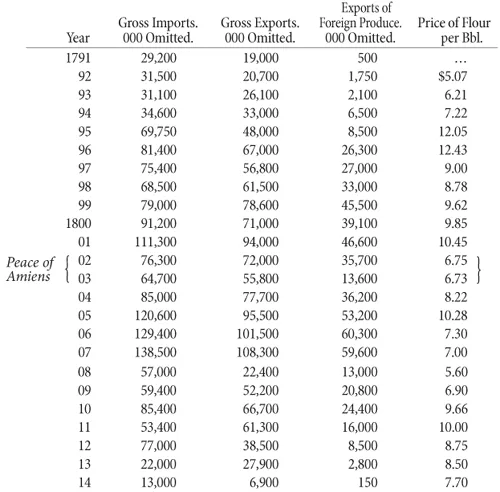
The tables of imports and exports are from the Treasury Reports. The last table, giving the price of flour, is in “American State Papers, Finance.” III., 536.
2 “Annals of Congress,” 1789, pp. 112–114.
3 “Notes on Virginia, Works,” VIII., 404.
4 See Jefferson’s “Report on Commerce, Works,” VII., 637; and Madison’s resolutions of 1794, based on Jefferson’s Report “Annals of Congress,” 1794, pp. 155, 209.
5 “Annals of Congress,” 1789, p. 221; 1794, p. 342.
6 On the act of 1789, see the monograph by William Hill, “The First Stages of the Tariff Policy of the United States,” in Publications of the American Economic Association, vol. VIII., No. 6. This valuable paper has led to a modification of the account of the act of 1789 given in previous editions of the present book.
7 It is curious to note that in 1802–04, during the temporary lull that followed the Peace of Amiens, the committee reports seem to show a drift toward protection. See “American State Papers, Finance,” II., pp. 29, 80, and the report on the Barbary Powers Act of 1804, “Annals of Congress,” 1804, pp. 946–950.
8 See Madison’s message of 1809, “Statesman’s Manual,” I., 289; and Clay’s speech of 1810, “Works,” I., 195. Madison never gave up his general acceptance of the principle of free trade, but admitted it to be inapplicable to articles needed in time of war, and in circumstances to which the young-industries’ argument applied. See his “Works,” III., 42.
9 “The abundance of capital, indicated by the avidity with which loans are taken at the reduced rate of five per cent., the reduction in the wages of labor, and the decline in the price of property of all kinds, all concur favorably for domestic manufactures.”—Clay Speech of 1820. “Works,” I., 419.
10 According to the census returns of 1820 and 1840, the only two of the earlier returns in which occupations are enumerated, there were engaged in manufactures and the mechanic arts in 1820, 13.7 per cent. of the working population in 1840, 17.1 per cent. In New England 21 per cent. were so engaged in 1820, 30.2 per cent, in 1840; in the Middle States 22.6 per cent. in 1820, 28 per cent. in 1840. Mac Gregor, “Progress of America,” II., 101. There are no census figures before 1820. In 1807 it was loosely estimated that out of 2,358,000 persons actively employed, 230,000 were engaged in mechanics and manufactures—less than 10 per cent. Blodgett, “Thoughts on a Plan of Economy,” etc. [1807] p. 6. The fluctuations in the exports of wheat flour, which was the most important article of export among agricultural products during the early part of the century, tell plainly the story of the country’s foreign trade. They were as follows, the figures indicating millions of dollars:
Yearly average |
1803–07 (expanded trade) |
8.2 |
1808–1810 (restriction) |
4.0 | |
1810–12 (restrictions removed) |
13.5 | |
1813–15 (war) |
5.5 | |
1816–17 (temporary revival) |
14.5 | |
1818 |
6.0 | |
1819 |
5.0 | |
1820 |
4.3 |
During the decade 1820–1830, when matters settled down to a normal state, the yearly export was between four and five millions of dollars. See “Quarterly Reports of the Bureau of Statistics,” 1883–84, No. 4, pp. 523, 524.
11 In the next essay, pp. 63–95.
12 In S. Batchelder’s “Introduction and Early Progress of the Cotton Manufacture in the U.S.” (1863); G. S. White’s “Memoir of Samuel Slater” (1836); and N. Appleton’s “Introduction of the Power-loom and Origin of Lowell” (1858).
13 Batchelder, p. 26 seq.; White, ch. III. The cotton-mill at Norwich, built in 1790, was operated for ten years, and then abandoned as unprofitable.—Caulkins, “Hist. of Norwich,” p. 696.
14 Bishop, “Hist. of Manufactures,” II., 102.
15 See the pamphlet by Blodgett “On a Plan of Economy,” etc., already cited, p. 26.
16 Gallatin’s Report on Manufactures in 1810; “Amer. State Papers. Finance,” II., 427.
17 White: “Memoir of Slater,” p. 188.
18 See the Report of a Committee of Congress on the Cotton Manufacture in 1816; “Amer. State Papers, Finance,” III, 82, 84. This estimate refers only to the cotton consumed in factories, and does not include that used in household manufacture. The number of spindles for 1815, as given in this report, is probably much too large. In Woodbury’s Report of 1836 on cotton, the number of spindles in use in factories is given as follows:
Year |
No. of Spindles |
1805 |
4,500 |
1807 |
8,000 |
1809 |
31,000 |
1810 |
87,000 |
1815 |
130,000 |
1820 |
220,000 |
1821 |
230,000 |
1825 |
800,000 |
“Exec. Doc.,” 1 Sess., 24 Congr., No. 146, p. 51. It need not be said that these figures are hopelessly loose but they are sufficient to support the general assertions of the text.
19 Appleton, pp. 7–11; Batchelder, pp. 60–70.
20 The minimum system seems to have been suggested by Lowell. Appleton, p. 13. Compare Appleton’s speech in Congress in 1833.—“Congressional Debates,” IX., 1213.
21 Appleton, p. 16.
22 Appleton, p. 13; Batchelder, pp. 70–73.
23 The following passage, referring to the general revival of manufactures, nay be quoted: “The manufacture of cotton now yields a moderate profit to those who conduct the business with the requisite skill and economy. The extensive factories at Pawtucket are still in operation…. In Philadelphia it is said that about 4,000 looms have been put in operation within the last six months, which are chiefly engaged in making cotton goods, and that in all probability they will, within six months more, be increased to four times that number. In Paterson, N. J., where, two years ago, only three out of sixteen of its extensive factories were in operation … all are now in vigorous employment.”—“Niles’s Register,” XXI., 39 (1821). Compare Ibid., XXII., 225, 250 (1822) XXIII., 35, 88 (1823); and passim. In Woodbury’s cotton report, cited above, it is said (p. 57) that “there was a great increase [in cotton manufacturing] in 1806 and 1807; again during the war of 1812; again from 1820 to 1825; and in 1831–32.”
24 Fox’s “History of Dunstable”; “Earl’s History of Fall River,” p. 20 seq.
25 See the account in Appleton, pp. 17–25. One of the originators of the enterprise said in 1824: “If our business succeeds, as we have reason to expect, we shall have here [at Lowell] as large a population in twenty years from this time as there was in Boston twenty years ago.”—Batchelder, p. 69. In Bishop, II., 309, is a list of the manufacturing villages of 1826, in which some twenty places are enumerated.
26 “In 1816 a new tariff was to be made. The Rhode Island manufacturers were clamorous for a very high specific duty. Mr. Lowell’s views on the tariff were much more moderate, and he finally brought Mr. Lowndes and Mr. Calhoun to support the minimum of 6¼ cents a yard, which was carried.”—Appleton, p. 13.
27 See a sketch of the early history of the woollen manufacture in Taft’s “Notes on the Introduction of the Woollen Manufacture” Compare the same writer’s account in “Bulletin National Ass. of Wool Manufacturers,” II., 475–485 and the scattered notices in Bishop, “Hist. of Manufactures,” I., 421, and II., 106, 109, 118, etc.
28 Bishop, II., 94, 134.
29 The United States were important customers of woollens for England, as appears from the following figures, which give in millions of pounds sterling the total exports of woollens from England, and those of exports to the United States.
Year |
Total |
To the U.S. |
1790 |
5.2 |
1.5 |
1791 |
5.5 |
1.6 |
1792 |
5.5 |
1.4 |
1793 |
3.8 |
1.0 |
1794 |
4.4 |
1.4 |
1795 |
5.2 |
2.0 |
1796 |
6.0 |
2.3 |
1797 |
4.9 |
1.9 |
1798 |
6.5 |
2.4 |
1799 |
6.9 |
2.8 |
Brothers, “Wool and Wool Manufactures of Great Britain,” 143, 144.
30 Gallatin’s report of 1810, “Am. State Papers, Finance,” II. 427; Taft, 44.
31 “Bulletin Wool Manufacturers,” II., 486. This is hardly more than a loose, though significant, guess.
32 Thus a large factory in Northampton, built in 1809 (Bishop, II., 136), was still in operation in 1828 (“Am. State Papers, Finance,” V., 815). In Taft’s “Notes” there is mention (pp. 39–40) of the Peacedale Manufacturing Company, which began in 1804, and has lasted to the present time. It is said that the spinning-jenny was first applied to wool in this factory.
33 Bishop, II., 270, 294; Niles, XXII., 225.
34 Niles, XXV., 148, 189.
35 The testimony is printed in full in “American State Papers, Finance,” V., 792–832.
36 Testimony, p. 824. The same statement is made by Bishop, II., 317. In Taft’s “Notes,” p. 39, there is an account of the application of the power-loom to weaving saddlegirths as early as 1814. In 1822 the power-loom for weaving broadcloths seems to have been in common use.—Taft, p. 43.
37 “Broadcloths are now (1828) made at much less expense of labor and capital than in 1825, by the introduction of a variety of improved and labor-saving machinery, amongst which may be named the dressing-machine and the broad power-loom of American invention” (p. 824). The power-loom was very generally used. “Since the power-looms have been put in operation, the weaving costs ten cents per yard, instead of from eighteen to twenty-eight cents” (p. 814). Shepherd, of Northampton, to whose factory reference has already been made (ante p. 44 note 1), said: “The difference in price of cloths (in the United States and in England) would be the difference in the price of the wool, as, in my opinion, we can manufacture as cheap as they (the English) can” (p. 816). In the same connection another manufacturer said: “The woollen manufacture is not yet fairly established in this country, but I know no reason why we cannot manufacture as well and as cheap as they can in England, except the difference in the price of labor, for which, in my opinion, we are fully compensated by other advantages. Our difficulties are not the cost of manufacturing, but the great fluctuations in the home market, caused by the excessive and irregular foreign importations. The high prices we pay for labor are, in my opinion, beneficial to the American manufacturer, as for those wages we get a much better selection of hands, and those capable and willing to perform a much greater amount of labor in a given time. The American manufacturer also uses a larger share of labor-saving machinery than the English” (p. 829).
38 See, for instance, List, “System of National Economy,” Phila., 1856, pp. 296–300.
39 See the tables in Bishop, I., 629, and Scrivenor, “History of the Iron Trade,” p. 81. In 1740 the total quantity of iron produced in England was about 17,000 tons; at that time from 2,000 to 3,000 tons annually were regularly imported from the American colonies.
40 See the good account of the importance of the use of coke (coal) in Jevons, “The Coal Question,” ch. XV., pp. 309–316.
41 French, “Hist. of Iron Manufacture,” p. 16.
42Ibid., p. 13.
43 The imports of iron, so far as separately stated in the Treasury reports, may be found in Young’s Report on Tariff Legislation, pp. XXVI. XXXVI. Cp. Grosvenor, “Does Protection Protect?” pp. 174, 175.
44 See the tables of prices in French, pp. 35, 36.
45Ante, p. 27.
46 There is nothing in the Congressional debates on the acts of 1818 to show what motives caused them to be passed.
47 “Statutes at Large,” III., 460.
48 Amé, “Études sur les Tarifs de Douanes,” I., 145.
49 On the production and imports of iron in the years after 1830 the reader is referred to the remarks on p. 124, and to the “Quarterly Journal of Economics,” vol. II., p. 377. Until the middle of the decade 1820–30 the annual product of pig-iron is supposed to have been about 50,000 tons, while in the second half of the decade it is put at 100,000 tons and more. The imports of crude iron averaged about 20,000 tons per year in 1818–21, about 30,000 tons in 1822–27, and rose to an average of about 40,000 tons in 1828–30. These figures as to imports refer mainly to bar-iron and as it required in those days about 1 tons of pig to make a ton of bar (French, p. 54), some additions must be made to the imports of bar before a proper comparison can be made between the domestic and the imported supply. An addition must also be made for the considerable imports of steel, sheet-iron, anvils, anchors, and other forms of manufactured iron. Figures of imports are given in Grosvenor, pp. 198, 199; of domestic production, by R. W. Raymond, in A. S. Hewitt’s pamphlet on “A Century of Mining and Metallurgy,” page 31.
50 See an excellent article, by an advocate of protection, in the American Quarterly Review, Vol. IX. (1831), pp. 376, 379, which gives very full information in regard to the state of the iron manufacture at that date.
51 French, p. 56.
52 Swank’s Report on “Iron and Steel Production,” in the Census of 1880, p. 114. A fuller discussion of the introduction of the use of anthracite, and of the effect of protective duties after this had been done, will be found at pages 122–134.
53E.g., Grosvenor, p. 197.
54 Swank, pp. 114, 115.
55 See, for instance, the temperate report of J. Q. Adams, in 1832, in which this is discussed as the chief argument of the protectionists. Adams, though himself a protectionist, refutes it, and bases his faith in protection chiefly on the loss and inconvenience suffered through the interruption of foreign trade in time of war. The report is in “Reports of Committees,” 22d Congress, 1st Session, vol. V., No. 481.
56 See, among others, Clay’s Tariff Speech of 1824,”Works,” I., 465–466.
57 Same signs of the appeal for the benefit of labor appear as early as 1831 in a passage in Gallatin’s “Memorial,” p. 31, and again in a speech of Webster’s in 1833, “Works,” I., 283. In the campaign of 1840, little was heard of it, doubtless because other issues than protection were in the foreground. Yet Calhoun was led to make a keen answer to it in a speech of 1840, “Works,” III., 434. In the debates on the tariff act of 1842, we hear more of it; see the speeches of Choate and Buchanan, Congr. Globe, 1841–42, pp. 950, 953, and Calhoun’s allusion to Choate, in Calhoun’s “Works,” IV., 207. In 1846 the argument appeared full-fledged, in the speeches of Winthrop, Davis, and others, Congr. Globe, 1846, Appendix. pp. 967, 973, 1114. See also a characteristic letter in Niles, vol. 62, p.262. Webster’s speech in 1846, “Works,” V., 231, had much about protection and labor, but in a form somewhat different from that of the argument we are nowadays familiar with. See also the monograph by C.B. Mangold, “The Labor Argument in the American Protective Tariff Discussion,” Bulletin of the University of Wisconsin, No. 246 (1908).
Tariff History of the United States
Read the whole book online · Book details
This work is published under a Creative Commons licence. You may copy, share, and re-host it with attribution.