
Chapter 14 of 18 · The Ethics of Money Production by Jörg Guido Hülsmann
Part 3 Monetary Order and Monetary Systems 14 Monetary Order 1. THE NATURAL ORDER OF MONEY PRODUCTION
The first two parts of this book were devoted to a discussion of the two basic modes of money production: the natural production of money on the free market, and inflation. We studied their general characteristics, but also went into a more detailed study of the subcategories that come into play. Money and money certificates, credit money, paper money, counterfeiting, legal tender, monopoly, and suspension of payments are such subcategories of the production of money. Our theoretical analysis had to dissect them in isolation from one another; and even when we analyzed their interrelations we had to abstract it from any concrete historical context. It is true that we frequently referred to historical events, but these references merely served as illustrations of insights that were in fact obtained through theory. This is standard scientific procedure. It provided us with all we can ever hope to obtain from theory: information about causes and effects, and information about relevant moral aspects of the production of money. Our basic mission has therefore been completed.
In the present third part, we will apply our findings to the analysis of monetary orders. We can define a monetary order as the total network of persons, firms, and other organizations involved in the production of money. Few readers will be surprised to learn that no historical monetary order has been “pure” in the sense of a pure free-market order, or a pure fiat order. A good case could be made that the contemporary paper-money orders are purer than any previous monetary order—which shows that such purity is hardly a virtue per se.
Real-life monetary orders combine the categories that we discussed above into a great variety of more or less complicated settings. But it does not follow that it is pointless to deal with pure orders. We have already demonstrated the usefulness of dealing with the pure order—or rather the pure orders —of the free market. The point of the analysis in Part One was not to provide an accurate description of any concrete historical order of the past, but to make us become acquainted with the workings of a monetary order defined by the universal respect of private property. Probably such an order has never existed in a pure form. But for theoretical and practical purposes this is irrelevant. The point is that it could have existed and could be introduced even today, technically at a moment’s notice. The importance of this purely hypothetical order is that it presents us with a theoretical benchmark. It is an ideal monetary order, and we will therefore call it by the lofty name of monetary Order.
We have seen in Part Two how this Order provided a meaningful standard of comparison for the analysis of the effects that violations of property rights have on money production. Moreover, it provided us with a meaningful basis for the rational criticism of monetary orders that are based on the violation of private property rights. (Such monetary orders we may call monetary systems.) It makes no sense indeed to criticize existing systems for being different from some idealized scheme. But it does make sense to criticize them for being inferior to known alternatives. It makes sense to reject inflation because there is a well-known and ready alternative to inflation, namely, the production of money on the free market, which is superior to inflation both from an economic and from a moral point of view.
The natural production of money on the free market might be an unrealistic order of things in the sense that abandoning the existing monetary systems presently does not find the necessary political support. But it is unrealistic only in that sense. It is not impossible to establish from any technical point of view, it is not unreasonable, and it is not morally offensive—quite the contrary. It does at present confront a problem of the will. But the human will can change, and it will change under the guidance of truth and courage. The significance of the natural production of money is that it gives us a meaningful goal to strive for.
Notice that the free market is by its very nature a global Order of economic relations. Human cooperation in production and trade is beneficial for all parties, not only those within the frontiers of the nation-state. And so are gold and silver—and whatever else free men might discover and develop for monetary service—useful monies not only for the residents of Europe or of North America. There is a natural tendency in the market to spread the use of the most useful monies over the entire world, thus establishing one great network of human cooperation based on indirect exchange.
In the High Middle Ages, when large-scale commerce and the interregional division of labor started to flourish, the great merchants of northern Italy found that no government produced money that was suitable for their new needs. The traditional coin system contained only silver coins, virtually all of which were hopelessly debased and, what is more, were debased to different degrees. The merchants then set out to produce their own money, new and sound gold coins, which at first they used only within their own circles. And because the other governments tolerated this practice—because for once they did not stand in the way—by the thirteenth century the fiorino d’oro from Florence became a generally accepted medium of exchange in central and eastern Europe.
A little liberty of this sort could work wonders in our age, which from a technological point of view is so much better endowed than the medieval merchants were.
2. CARTELSOF CREDIT-MONEY PRODUCERS
We have already pointed out that the production of credit money is congruent with the principles of a free market. Individual sorts of credit money as well as the cooperation of credit-money producers are therefore legitimate parts of a natural monetary Order in the sense in which we have defined the term above. In particular, we must highlight the possibility of free-market cartels of credit-money producers.1
How important would such systems be in a free society? This question can only be answered after the fact. One has to establish a free market for money and see how well credit money fares. It is true that a great success is not very likely because people—and the famous “man on the street” in particular—prefer the tangible security of precious metal, as David Ricardo knew so well. But, again, this is a highly speculative question, and from a moral point of view it does not seem to be very important. The crucial issue is whether the law recognizes the full liberty of the human person within the limits of his own property rights and the like property rights of other persons. Such responsible persons are still free to set up stupid monetary systems, but certainly no inherently evil ones; and there is good hope that they would quickly learn from their errors.
15
Fiat Monetary Systems in the Realm of the Nation-State
1. TOWARD NATIONAL PAPER-MONEY PRODUCERS: EUROPEAN EXPERIENCES
The paper-money systems that presently dominate the scene in all countries of the world have developed out of European fractional-reserve banking starting in the seventeenth century. The driving force behind this development was government finance which found in the new institutions a ready source for ever-increasing loans.1
The most venerable central bank—or rather: paper money producer—of our time, the Bank of England, was established in 1694 by William Patterson, a Scottish promoter, with the express purpose of providing what was at the time the immense loan of £1,200,000 to the English crown.2 Its charter authorized the bank to issue notes within certain statutory limitations, which were subsequently extended to allow for additional loans to the government. The bank was also granted several legal privileges, most notably the privilege of limited liability and the privilege of unilaterally suspending payments to its creditors, which the Bank had to use after a mere two years of operations. Apart from this early incident, however, the bank proved to be reliable and operated without suspending its payments in peacetime. In the following two hundred years, it thrived under the increasing patronage of the government, providing a steady flow of new loans without disrupting the convertibility of its notes.
In the early nineteenth century, Bank of England notes became legal tender, with the consequences that we described in our theoretical analysis: cartelization of the banking system and frequently recurring booms and busts. In 1844, it obtained a monopoly on the issue of banknotes.3 And in 1914, at the behest of the king, the bank again suspended its payments, to help finance World War I with the printing press.
In other countries such as France and Germany, the development of the national monetary system took somewhat different turns, but the main elements of the British case can be readily identified: monopoly status for one precious metal (gold); privileged fractional-reserve banks in the service of government finance; legal-tender status for the notes of these banks; the consequent cartelization of the entire national banking industry; and the eventual authorization to indefinitely suspend redemption of the notes of the privileged bank, thus turning the latter into national paper-money producers.
In the case of the Bank of England, the conjunction of these elements was brought about by a rather slow process. By contrast, the privileged banks established in other countries were often quite reckless and inflated their currencies at much greater rates than the Bank of England, to still the financial appetite of their governments. Not surprisingly, they had to rely much more frequently on the suspension of payments and often experimented with legal-tender paper money. At the end of the eighteenth century, therefore, fractional-reserve banking and paper money had made great inroads in many countries. John Wheatley, a contemporary observer, summarized the events of the preceding century:
Table 2: Milestones in the Development of the Bank of England
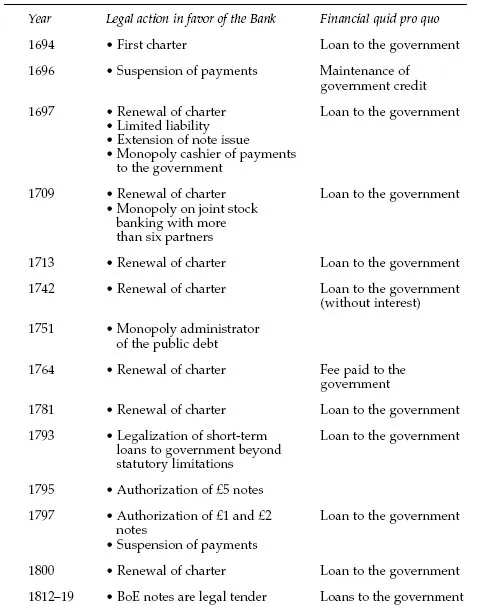
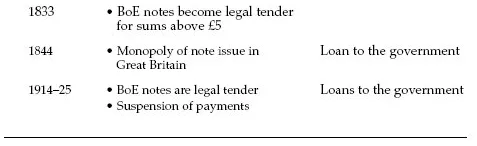
Source: Vera C. Smith, The Rationale of Central Banking (Indianapolis, Liberty Fund, 1990), chap. 2.
During the first fifty years of the 18th century banks were established, or had already been founded in most of the principal cities of Europe, and the circulation of paper was more or less encouraged by all. ...But the circulation of paper during this interval was intermissive and irregular; though pushed to an extreme in England and Scotland during the reign of William and part of the reign of Anne, and in France during the regency of the Duke of Orleans, yet its excess was in neither instance of long duration. ...But from 1750 to 1800 the system of paper currency, however unpropitious in its commencement, was matured and perfected in every part of the civilized world. In England, Scotland, and Ireland, in France, Spain, Portugal, Italy, Austria, Prussia, Denmark, Sweden, and Russia, in America, and even in our Indian provinces, the new medium has been successfully established, and has subjected the intercourse of the world, in all its inferior as well as superior relations, to be carried on in a far greater degree by the intervention of paper than the intervention of specie.4
A few pages later, Wheatley characterized the relative market shares of banknotes and specie in the major European countries as of his writing:
In England, Scotland, and Ireland, in Denmark, and in Austria, scarcely any thing but paper is visible. In Spain, Portugal, Prussia, Sweden, and European Russia, paper has a decisive superiority. And in France, Italy, and Turkey only, the prevalence of specie is apparent.5
This was the situation in 1807. In the following decades, the trend continued. For example, Austria, Russia, and Italy had legal-tender paper monies for many decades in the nineteenth century. These note issues were limited in amount and did not have a full monopoly status; they circulated parallel with coins and banknotes. Eventually, most European countries suspended payments at the onset of Wold War I. From 1914 to 1925, for the first time ever in history, all major nations except for the U.S. used paper monies.
2. TOWARD NATIONAL PAPER-MONEY PRODUCERS: AMERICAN EXPERIENCES
In the history of the North American colonies of the British Empire, the essential features of the European monetary experience can be found as well. But there are two particularities: the American champions of paper money had a more direct approach than their European cousins; and the American opponents of paper money triumphed, at least for a while, more thoroughly than any of their European friends ever would.6
In the seventeenth and eighteenth centuries, the governments of the British colonies more often than not pushed straight for the issue of legal-tender paper notes rather than choosing the more indirect route of promoting privileged fractional-reserve banks. As early as 1690, the colony of Massachusetts issued paper treasury bills that were endowed with legal-tender status. This practice was replicated in five other colonies before 1711, and eventually spread to all British colonies. Among its victims were the creditors of American trade and industry, usually merchants from metropolitan Britain, who were forced to accept the often rapidly depreciating paper notes. They brought their case before Parliament which reacted vigorously starting in the 1720s. It first ordered all New England colonies to seek authorization from Britain before issuing any more legal-tender notes. In 1751, it prohibited the issue of any such notes in New England, and in 1764 prohibited the issue of any legal-tender paper in all colonies. This must have been a heavy blow to the political establishment in the British colonies of North America. It is certainly not farfetched here to see one of the roots of the American Revolution.
However, the Revolution did not bring a legal confirmation of the monetary experiments of the colonial period. Quite to the contrary, the American Constitution is, in the modern history of the West, the most radical legal break with a country’s inflationary past. The fathers of the new republic did all in their power to prevent legal-tender paper issues of the colonies (now the states) ever to be repeated again. They moreover strove to create a monetary order based on the precious metals. These objectives were deemed so important that they were addressed head-on in the very first article of the Constitution. Section 8 of Article I granted the authority to “coin Money, regulate the Value thereof, and of foreign Coin, and fix the Standard of Weights and Measures” to the federal government, not to the states. And Section 10 of Article I specifically prohibited that the states “emit Bills of Credit; make any Thing but gold and silver Coin a Tender in Payment of Debts.”
The Constitution proved to be a serious obstacle for the party of inflation, but it ultimately was breached. For the next sixty years, the battle between pro-inflation and anti-inflation forces went back and forth. The champions of inflation pushed through the charters of two “Banks of the United States” (1792–1812, 1816–1836) and their opponents made sure that the charters were not extended. In the war of 1812–14, the federal government issued legal-tender treasury notes—necessary, in the eyes of the government, for the survival of the new republic (and of course for its own survival). In the 1830s, then, the champions of sound money had their last great triumph when President Jackson refused to extend the charter of the Second Bank of the United States, withdrew all public funds from private or state (fractional-reserve) banks, and cut down the public debt from some $60 million at the beginning of his administration to a mere $33,733.05 on January 1, 1835. His successors managed to neutralize these reforms to some extent, especially by bringing the public debt back to more than $60 million within fifteen years of the end of the second Jackson administration.
But the great breakthrough for the inflation party came only with Abraham Lincoln and the War Between the States. Starting in 1862, the federal government again issued a legal-tender paper money, the so-called greenbacks, to finance its war against the seceding Southern states. This experiment ended in 1875, when the government turned the greenbacks into credit money, by announcing that as from 1879 they would be redeemed into gold.7 Meanwhile, in 1863–65, the Lincoln administration had created a new system of privileged “national banks” that were authorized to issue notes backed by federal government debt, while the notes of all other banks were penalized by a 10 percent federal tax. As a consequence American banking was centralized around the privileged national banks, most notably, the reserve banks of New York City.
In 1913, then, the American banking system finally received a central bank on the European model. The U.S. was the last great nation to introduce central banking. The original interpretation of the Constitution had prevented a quicker procedure for more than a century, but the written word was unable to stem the tide of concentrated financial interests and their pro-inflation public relations campaigns.
The point of the preceding remarks on the early modern monetary history of the West is to highlight the long tradition of our current inflationary regime. It is not the case that monetary affairs were rosy until 1914, when the great inflation of the twentieth century set in. It is true that in our time inflation is incomparably greater than in any previous period, especially due to the current monopoly of paper money. But the roots of our present calamities are much older. This concerns not only the institutional underpinnings, which reach back to the seventeenth century. It also concerns the concrete forms of inflation. Neither paper money, nor today’s other major inflationary practices are inventions of the twentieth century. And even the much-vaunted gold standard, which reigned for a few decades before World War I, was not quite as golden as it appears in many narratives.
3. THE PROBLEMOFTHE FOREIGN EXCHANGES
While national legislation prompted the cartelization of the fractional-reserve banking industry within the boundaries of the nation, no such mechanism existed for a long time in international economic relations. Thus until after World War I, the bulk of international payments were made in specie. But in the four or five decades before the outbreak of that war, the foundations were laid for the later establishment of international monetary systems.
All of these systems until the present day have been essentially cartels among national governments, respectively between national monetary authorities (usually the central banks). Two phases can be distinguished: (1) a phase of banking cartels, which lasted for the century between the end of the Franco-German war in 1871 and the dissolution of the Bretton Woods system in 1971; and (2) a phase of cartels among national paper-money producers, which started in 1971 and is still with us. The next two chapters will deal with them in turn. At this point, let us merely observe that none of these cartels has so far been compulsory. It remains to be seen whether the future development of international political relations will bring about any changes.
16
International Banking Systems, 1871–1971
1. THE CLASSICAL GOLD STANDARD
By the end of the 1860s, only the U.S. and some major parts of the British Empire had been on the gold standard. In the United Kingdom, gold had been monopoly legal tender since 1821, the United States had a de facto gold standard after the Coinage Act of 1834, and Australia and Canada followed suit in the early 1850s. All other states had a silver standard, bimetallic standards, or legal-tender paper monies. Then the German victory over France in the war of 1870–71 ushered in the era known as the classical gold standard. The new German central government under Bismarck obtained a war indemnity of 5 billion francs in gold. It used the money to set up a fiat gold standard, demonetizing the silver coins that had hitherto been dominant in German lands. Four years later, the financial lackey of Bismarck’s Prussian government—the Prussian Bank—was turned into a national central bank (its new name, the Reichsbank, was a marketing coup). Thus the Germans had copied the British model, combining fiat gold with fractional-reserve banking and a central bank, whose notes obtained legal-tender status in 1909.1
Why gold? Why did the Germans not set up a silver standard or join a bimetallist system such as the Latin Currency Union?2 Several factors came into play here. One might mention in particular the influence of “network externalities” that weighed in favor of gold. On the one hand, gold was the money of Great Britain, the country with the world’s largest and most sophisticated capital market. On the other hand, several major silver countries including Russia and Austria had suspended payments at the time of the German victory. Thus silver offered no advantages for the international division of labor, whereas gold did.3 Moreover, one should not neglect that silver, the only serious competitor for gold among the commodity monies, has one grave disadvantage from the point of view of a government bent on inflationary finance. Because of its bulkiness, the use of silver entails higher transportation costs, which makes it less suitable than gold for fractional-reserve banks trying to quash systematic bank runs through cooperation.
Virtually all other Western countries now followed suit. The establishment of international “unity” in monetary affairs required no elaborate justification. It was perfectly congenial to the cosmopolitan spirit of the times, nourished by several decades of free trade and burgeoning international alliances and friendships. Thus it served as the perfect justification for a further massive intervention of national governments into the monetary systems of their countries. Legal privileges were abrogated in all other branches of industry. Monopoly was a curse word more than ever before. But it seemed to be tolerable as a means for that noble cosmopolitan end of international monetary union. By the early 1880s, the countries of the West and their colonies all over the world had adopted the British model.4 This created the great illusion of some profound economic unity of the western world, whereas in fact the movement merely homogenized the national monetary systems. The homogeneity lasted until 1914, when the central banks suspended their payments and prepared to finance World War I by the printing press.
On the positive side, it could be claimed that the classical gold standard eliminated the exchange-rate fluctuations between gold and silver and thus boosted the international division of labor. It is somewhat difficult to evaluate the quantitative impact of this advantage. Let us therefore merely observe that exchange-rate fluctuations between gold and silver are negligible when compared to the fluctuations between our present-day paper monies.
On the negative side, the classical gold standard created a considerable fiat deflation due to the demonetization of silver. From 1873–1896, prices fell more or less sharply in the countries that had adopted the gold standard first (U.K., U.S., Germany) because of the gold exports that resulted when other countries followed their example and established a gold-based currency too.5 This in turn created pressure to reinforce the practice of fractional-reserve banking, both on the level of the central banks and on the level of the commercial banks (see Table 3). Above we have analyzed the inherent fragility of fractional-reserve systems and seen that this fact, because it is known to the bankers, incites them to postpone the crisis through cooperation. Under the classical gold standard, this was the case too.6 Yet for the reasons we have discussed in some detail, cooperation cannot stop the dynamics of inflation inherent in the system itself. Sooner or later this process finds its limits and the fractional-reserve banking system collapses or is transformed into something else. The classical gold standard was no exception. It was spared collapse or transformation into a gold-exchange standard only because another lethal accident (WWI) killed it before it could die from its own cancer. World War I delivered the pretext for the suspension of payments. But sooner or later suspension would have become inevitable anyway. The system did not limit inflation. All of its main protagonists—the national central banks—were fractional-reserve banks, and under their auspices and protection the commercial banks happily trotted down an inflationary expansion path.
Table 3: Evolution of the Money Supply in the German Reich (in Mill. Mark)
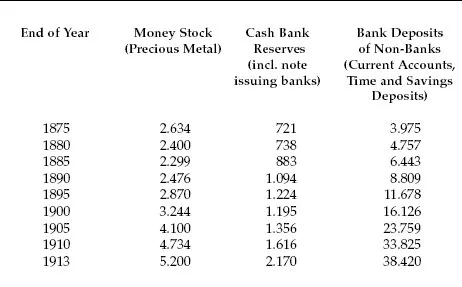
Source: Bernd Sprenger, Das Geld der Deutschen, table 28, p. 201.
The glory of the classical gold standard was that it demonstrated, for the last time so far, how a worldwide monetary system could emerge without political scheming and red tape between national governments. They adopted it independently of one another. There was no treaty, no conference, and no negotiation to bring it about. However, as we have seen, even in this respect the classical gold standard was rather imperfect. It did after all not result from the free choice of free citizens, but from the discretion of national governments. It gave the world a common monetary standard—gold—but this standard sprang from the coercive elimination of all alternative monies. Its ultimate effect was, not to give the citizens of the world an efficient monetary system, but to deliver a pretext for national governments to finally bring the monetary systems of their countries under their control. The classical gold standard was therefore hardly a bulwark of liberty. It was a crucial breakthrough for the societal scourge of our age— government omnipotence.
We have to stress these facts because many advocates of the free market believe the classical gold standard was something like the paradise of monetary systems. This reputation is undeserved. The classical gold standard differed only in degree, not in essence, from its successors, all of which have been widely and deservedly criticized in the literature on our subject.7
2. THE GOLD-EXCHANGE STANDARD
The expression “gold-exchange standard” is usually applied to the organizational set-up of the international monetary system that existed between 1925 and 1931. But this organization was thoroughly unoriginal. It had existed before; in fact it had been part and parcel of the classical gold standard. Rather, the new system that was created in the latter half of the 1920s was characterized by the more or less explicit objective of most of its participants to strive for monetary expansion (inflation) through international cooperation.8
Under the classical gold standard, each central bank was responsible for making sure that its notes could be redeemed into gold. The central banks of Great Britain, France, Germany, Switzerland, and Belgium (and later of the U.S.) kept their entire reserves in gold. These reserves were supposed to be large enough for them to survive emergency situations. Things were different in the realm of the commercial fractional-reserve banks that operated within the national economies of these countries. The commercial banks usually kept the lion’s share of their reserves in the form of central banknotes and only held extremely low gold reserves. The latter were needed only for emergency situations, and in such cases the commercial banks had also learned to rely on the reserves of their central bank. In some countries, this practice predated the classical gold standard by quite a few decades. For example, it was already the practice of the English country banks in the first half of the nineteenth century. They kept Bank of England notes as part of their reserves and, in times of great strain on their gold reserves, often redeemed their own notes, not into gold, but into notes of the Bank.9
Under the classical gold standard, most central banks adopted exactly the same scheme. The central banks of Russia, Austria-Hungary, Japan, the Netherlands, and of the Scandinavian countries, as well as the central banks of British dominions such as South Africa and Australia redeemed their own notes not only in gold, but also in notes of the more important foreign central banks. Still other countries such as India, the Philippines, and various Latin American countries held their reserves exclusively under the form of foreign gold-denominated banknotes.10 The purpose of the structure is patent. The pooling of gold reserves in a few reliable central banks allows a larger inflation of the worldwide note supply than would otherwise have been possible. The pitfall is that it places the entire responsibility of keeping sufficiently large reserves on a small number of “virtuous” fractional-reserve banks. The latter have a reason to accept this burden, however, because their virtue gives them political power over the other banks, especially in times of crises.
The significance of the gold-exchange standard of 1925–31 was that it elevated this practice of coordinated inflation into a principle of international monetary relations.11 Only two banks—the American Fed and the Bank of England—were to remain true central banks, but this time they would be the central banks of the entire world. All other national central banks should keep a more or less large part of their reserves in the form of U.S. dollar notes and British pound notes. This would assure the possibility of inflationary expansion for all banks. The expansion rate would be comparatively low in the case of the central banks of the U.S. and the United Kingdom; but the latter would be repaid in terms of political power.12
Thus from the very outset, the gold-exchange standard was meant to encourage irresponsible behavior. Designed to facilitate inflation, it was not surprising that it lasted only six years. It collapsed when, in the wake of the 1929 financial crisis on Wall Street, various governments turned to protectionist policies (most notably in the U.S.) or imposed foreign exchange controls (as in Germany, Austria, and a number of Latin American countries), thus choking off international payments and making it impossible for the Bank of England to replenish its reserves. As a consequence, the Bank suspended payments in September 1931. The other central banks followed suit, plunging the world into a regime of fluctuating exchange rates that lasted until the end of World War II.
3. THE BRETTON WOODS SYSTEM
In July 1944, at a conference in Bretton Woods, New Hampshire, the western allies agreed on an international monetary system that should be instituted after their victory in World War II. As one might expect, the point of the new scheme was to make the production of banknotes more “flexible” (that is, expansionary) than ever before. How? The trick was to pool the gold reserves of the entire world into just one large pool. There was to be only one remaining bank that would still redeem its notes into gold—the U.S. Fed—while all the other central banks would keep the bulk of their reserves in U.S. dollars and, accordingly, redeem their own notes only into dollars.
Thus the Bretton Woods system was a gold-exchange standard writ large.13 It was far more expansionary than its predecessors because it applied the pooling technique to a far greater extent. Under the classical gold standard, there were many gold pools in the world economy, because the different nations kept their gold pools separate from one another (in the national central banks). Under the gold-exchange standard, the number of gold pools had declined very substantially, and the point of the Bretton Woods system was to go the way of pooling almost to the end. It is true that the system did not exhaust its full potential for inflation. When it collapsed in 1971, there were still substantial gold pools in central banks other than the Fed; thus a further centralization of these resources could have kept the system going for a while. In any case, the Bretton Woods system was so far the most ambitious attempt ever to create an international monetary system through a cartel of fractional-reserve banks.
We have repeatedly highlighted the fact that pooling creates political dependency. In the present case, the other central banks and their governments became dependent on the good will of the Fed, which administered the world gold pool and which therefore had the power to allocate the world’s banknotes—U.S. dollars—at its own discretion. Thus the crucial question is: Why did the other national central banks consent to the centralization of the gold pool, and thus to the centralization of power? Part of the answer is that it might be useful to have an international monetary system (stable exchange rates among the national currencies) even if this entails some measure of dependency. But there were also other aspects that came into play in the present case.
The historical accident was that during World War I and its long aftermath, the United States became a safe haven for European gold. This predestined the Fed to be one of the two great gold pools of the gold-exchange standard in 1925–31. At the end of World War II, then, the Fed controlled the largest gold pool the world had ever seen. Fort Knox was the world’s gold pool even before the postwar system saw the light of day. The conference at Bretton Woods merely acknowledged this reality. The great majority of its delegates sought to create a postwar monetary order along the traditional lines—in which fractional-reserve central banks inflated their banknote currencies, backed up with gold reserves. This order was impossible without having the Fed as its pivot. But this meant that henceforth the monetary systems of France and Britain, and of all other member countries would be dependent on the Fed.14
To alleviate this dependency, the Bretton Woods conference created two international bureaucracies that have survived until the present day: the International Monetary Fund (IMF) and the World Bank. The function of these institutions was to give the other major governments some impact on the global allocation of inflation. Without them, the Fed alone would have picked the first recipients of new banknotes; it alone would have granted or declined credit in times of runs on the national central bank. Through the IMF and the World Bank, a somewhat more collegial principle was introduced into the direction of the postwar monetary order. The boards of the two bureaucracies included representatives from all major western allies, and they provided short-term (IMF) and long-term (World Bank) loans to “member states in difficulties”—that is, primarily to the board members themselves in case of self-inflicted emergencies.
These institutions made the Bretton Woods system politically acceptable to the postwar junior partners of the United States government. But they could not of course turn the system itself into a viable operation. Like its predecessors, it was designed to increase the inflationary potential for all cartel members. Restraint was not a part of its mission, and the very anchor of the system—the Fed—was particularly ruthless in its inflation of the dollar supply. It was therefore just a question of time until the gold reserves of the Fed would be exhausted, forcing the Fed to suspend payments. This point was reached on August 15, 1971 when U.S. President Nixon “closed the gold window.”
The event concluded a period of one hundred years in which three great cartels of central banks had flooded the western world with their banknotes without nominally abandoning the gold standard. Each new cartel was created in such a way as to allow for more inflation than its predecessor, and the Bretton Woods cartel eventually collapsed because it too did not create enough inflation to satisfy the appetites of its members. There has been no other monetary system since that encompassed the entire world.
4. APPENDIX: THE IMF ANDTHE WORLD BANK AFTER BRETTON WOODS
With the demise of the system of Bretton Woods, it would have been only natural to abolish its institutions: the IMF and the World Bank. But large bureaucracies do not die a quick death, especially if they can manage to adopt a new mission. By the late 1970s, the new mission of those two bureaucracies turned out to be the support of Third World countries through short-term and long-term loans.
Thus the IMF and the World Bank do not have anything to do anymore with global monetary organization. And strictly speaking they do not have anything to do anymore with banking either, at least if we understand banking in the narrow commercial meaning of the word. Both institutions are today, in actual fact, large machines for the mere redistribution of income from the taxpaying citizens of the developed countries to irresponsible governments of undeveloped countries.15
Many people let themselves be deluded about the IMF and the World Bank because they tend to evaluate financial institutions in light of their (declared) intentions rather than in light of their true nature. They assimilate the IMF into some sort of collective charity, and chide it for not being generous enough whenever the management insists on granting additional credit only under certain conditions (usually a change of economic policy in the recipient country). But the fact is that both bureaucracies do not obtain their funds on the free market, but out of government budgets. They spend taxpayer money, not money that anybody has entrusted to them. They are therefore not “banks,” certainly not in the commercial sense of the word. And they are not charities in the sense in which private organizations administer charity.
Responsible governments can obtain loans on the free market, and in fact do obtain such loans all the time. Poverty of the nation is not an obstacle, as many examples show, especially from Southeast Asia. It is true that certain governments are unable to find creditors—in particular those that do not pay back loans, or that nationalize foreign investments, or that regulate or tax investors to such an extent that profitable production becomes impossible. Such governments can only obtain “political credit” through intergovernmental organizations such as the IMF and the World Bank. Irresponsible governments make life in their countries miserable. As long as they have the backing of the citizens, they can stay in power. But in most cases they have this backing only as long as they can hand out material benefits, which they themselves obtain through taxation and expropriation. As soon as there is nothing more for them to loot, the population turns against them. This is where the political credit facilities of the IMF and the World Bank come into play. Their effect is to keep corrupt and irresponsible governments in business longer than they otherwise would be. Bokassa, Mobutu, Nkruma, Somoza and other dictators would not have stayed in power as long as they did without the financial support of those institutions.16 The political price to be paid for these political loans usually consists in cooperative behavior in other fields, for example, when it comes to the establishment of Western military bases in these countries, or to international trade agreements, or to special privileges for a few large “multinational” corporations.
The Catholic Church has avidly endorsed the integration of all countries into the international division of labor, as a condition for economic and social development.17 But leaders from the Third World have only very recently begun to demand the abolition of the protectionism that is so pervasive in the developed countries. Could it be that the effect of political credit was to mute for a long time any opposition to Northern protectionism in the underdeveloped South?
Free trade and private property are not some sort of legal privilege to the sole benefit of a small number of “haves” and to the exclusion of the great majority of have-nots. The case is exactly the reverse, as many economists have demonstrated: the have-nots stand to benefit most from a social order based on the undiluted respect of property rights. Governments that systematically expropriate investors and oppose free trade— be it out of ignorance or malice—ruin their citizens, and especially the poor. Organizations that support such governments create misery and death. It follows that political-credit organizations such as the World Bank and the IMF are needless at best—because responsible government would obtain credit anyway—and positively harmful in their actual operation. Support for them is hard to square with concern for the well-being of the poor.
17
International Paper-Money Systems, 1971–?
1. THE EMERGENCEOF PAPER-MONEY STANDARDS
The Fed’s suspension of payments in August 1971 created in one mighty stroke a great number of paper monies. Before that date, all national currencies were basically fractional-reserve certificates for gold (via the U.S. dollar). The suspension “transubstantiated” these certificates into paper monies, with all the concomitant effects we have discussed above.
Many observers believed that the world would remain so fragmented. Advocates of paper money thought this was all well and good, because each government was now at last autonomous in its monetary policy. Others looked with horror on the reality of fluctuating exchange rates, which undermined the international division of labor and thus created misery and death for many millions of people. But the world did not long remain in monetary fragmentation. The events of the past thirty-five years illustrate that there is a tendency for the spontaneous emergence of international paper-money standards. Today the reasons for this development are not difficult to discern.1
One driving force of this process was of course the presence of private individuals and firms operating in many countries. These persons and organizations constantly look for ways of saving money, for example, by minimizing the costs of holding money. One way to do this is to make the bulk of one’s payments in terms of only one kind of money. But this driving force, formidable though it might appear in our present time of multinational corporations, does not go a very long way in explaining the emergence of an international paper-money standard. The reason is that multinational corporations do not play a great role in a world of wildly fluctuating exchange rates. They operate profitably and grow to significant size only when the political framework has already stabilized the foreign exchanges. That is, by and large they come into play only once a monetary standard already exists.
This brings us to the main driving force of the emergence of international paper-money monetary standards, namely, the constant appetite of governments for additional revenue. Most governments that obtain income mostly from their own citizens—be it in the form of taxation or in the form of debt— have a rather small revenue base. To increase revenues they have by and large only two strategies: (1) induce foreign citizens to buy its bonds; (2) adopt policies that make their own citizens richer, so that they can pay more taxes and buy more government bonds.
No investor intentionally wastes his money. When he buys the bonds of a foreign government, he seeks to earn interest. He would abstain from the deal altogether if he had good reasons to believe that the money would be wasted. If he must fear, for example, that the debtor-government will simply print the money needed to pay back the credit, thus provoking a fall in the exchange rate, he will not buy its bonds at all.2 Thus the question is what a susceptible debtor-government can do to dispel such fears. The answer is that it must establish institutional safeguards against a falling exchange rate of its currency in terms of the currency used by its creditors.
The same considerations come into play if we turn to the second fundamental strategy for increasing public revenue. The idea is very simple: adopt policies that permit the citizens to make themselves richer so that they can pay more taxes and buy more government bonds. But the crucial point is that the productive capacity of a nation entirely depends on the capital stock it can use. This capital stock could be increased through savings from current income. But the accumulation of capital through savings can take many years and decades until it reaches any significant proportion. And during this time the government must keep the tax load as small as possible. Unfortunately such restraint requires more virtue than most governments have. The only remaining way out is, again, to encourage foreigners to provide capital that they have accumulated in their home countries—in other words, to make “foreign direct investments” in that country. But this reverts back to our previous consideration. In a paper-money world, foreign capital can be attracted only under sufficient institutional safeguards.
Four such institutions have played a significant role in the past thirty years. They go a long way in explaining the emergence of international paper money standards.
First, debtor-governments have floated bonds that were denominated in a foreign paper money, the production of which they cannot directly control; preferably this would be the paper money used in the country of its creditors. In the past twenty years, this has become a widespread practice. Today many governments issue bonds that are denominated in U.S. dollars or euros.
Second, the government and/or the monetary authority of the country in which the creditors reside could give explicit or implicit guarantees to maintain the market exchange rate. It is widely assumed, for example, that the U.S. Federal Reserve gave such guarantees in the 1990s to the governments of Mexico, Singapore, Malaysia, Thailand, and other countries of the Far East. The great disadvantage of this practice is that it entails moral hazard for the beneficiaries. The receiving governments can set out to inflate their currencies without fearing any negative repercussions on the exchange rate. And thus they are able to expropriate not only their own population, but also the population of the country in which its creditors reside.
In the above-mentioned cases, the exchange-rate policies of the Fed had the effect of making U.S. citizens pay for the monetary abuses of the governments of Mexico and other countries. (They pay by constantly delivering goods and services to Mexico that they could have enjoyed themselves and in payment for which nothing but peso-denominated paper slips are sent to the U.S.) Because no diplomatic solution could be found for this problem, the Fed eventually abolished its policy and thus provoked financial crises in Mexico (1994) and various other countries, especially in Asia (1997). Since then, there have been no new major experiments with exchange-rate stabilization.
Third, debtor-governments have set up currency boards, thus transforming their currency into a substitute for a foreign paper money. This technique too is widely used today, for example, in Hong Kong, Bulgaria, Estonia, Lithuania, Bosnia, and Brunei.
Fourth, debtor-governments have abandoned the use of the national currency altogether and adopted the use of the paper money used by the creditors. Economists call such a policy “dollarization,” even when the government adopts not the U.S. dollar, but a different foreign paper money. Among recently dollarized countries are Ecuador, El Salvador, Kosovo, and Montenegro.3
We conclude that the driving force for the emergence of an international paper-money standard is the quest of governments for additional funds, which most of them can obtain only from abroad. And our analysis also explains which paper monies will tend to be chosen as international standards: the paper monies that are legal tender in the territories with the largest capital markets. In the period under consideration, these territories happened to be the U.S., Japan, and Europe. It is therefore not surprising that the U.S. dollar and the yen have emerged as regional monetary standards of the world economy.
The operation of the same mechanism could be observed in the case of the German mark, which during the 1990s was used as a (unofficial) parallel currency in many countries of the former East Bloc. And it currently brings about a wider geographical circulation of the euro, which was only created in early 1999, and which did not exist in the form of banknotes before the year 2002. The creation of the euro is of some interest because here an international standard did not emerge through the unilateral adoption of paper money used on foreign capital markets, but through merger. This form of monetary integration could play a role in the future development of the international monetary order. We will therefore take a brief look at it.4
2. PAPER-MONEY MERGER: THE CASEOF THE EURO
After the demise of the Bretton Woods system in 1971, the countries of Western Europe for a few years fell into monetary disarray and the fiscal anarchy that typically goes in hand with it. Each national government issued its own paper money and started piling up public debts to an unheard-of extent. The newly available funds were used to expand government welfare services. For a while, things looked rosy and only a few fiscal conservatives bemoaned the new laxity. But soon even the champions of the new policy began to understand that the new monetary order affected their interests in very tangible negative ways. Exchange rates fluctuated very widely and effectively prevented the further development of international trade. The division of labor in Europe, one of the most densely populated regions of the world, lagged behind the American economy and even—or so it seemed in those days—the Soviet economy. It was therefore but a question of time until tax revenues would fall far behind the revenues of the great competitors of the European governments: the governments of the U.S. and of the Soviet Union. Something had to be done.
The first attempts at stabilizing the exchange rates between European paper monies had failed miserably. Then, at a December 1978 conference in the German city of Bremen, the core governments of the European Economic Community, as it was called in those days, launched a new attempt at integration: the European Monetary System (EMS). The EMS was a cartel of the national paper-money producers, who agreed to coordinate their policies in order to stabilize exchange rates between their monies at certain levels or “parities.” As in the case of the previous international banking cartels, the EMS essentially relied on the self-restraint of its members. “Coordination” meant in practice that the least inflationary money producer set the pace of inflation for all others. If for example the supply of the Italian lira increased by 30 percent, whereas the supply of French francs increased only by 15 percent, it was very likely that the lira would drop on the foreign exchanges vis-à-vis the franc. In order to maintain the lirafranc parity, it was necessary either that the Banque de France increase the production of francs, or that the Banco d’Italia reduce its production of lira. As we have said, the EMS essentially relied on self-restraint; thus in our example the Banca d’Italia would be expected to reduce its lira production. If for political reasons it was unwilling to do this, there would be a “realignment” of the parity, and stabilization would henceforth seek to preserve the new parity.
Now by far the least inflationary money producer happened to be the German Bundesbank. Accordingly, for the next twelve years or so, the main problem of European monetary politics was that the Bundesbank did not inflate the supply of the Deutsche mark quite enough to suit the needs of foreign governments. The latter were therefore forced to cut down their money production. It also came to frequent changes or realignments of parities. The problem was settled only in the early 1990s, when the German government sought to take over former communist East Germany and needed the consent of its major western partners. The price for that consent was the abdication of the Deutsche mark.5 Within a few years, the political and legal foundations were laid for merging the different national paper-money producers into one organization: the European System of Central Banks (ESCB), the coordination of which lay in the hands of the European Central Bank (ECB). The ESCB started its operations in January 1999 and three years later issued its euro notes and coins.
From an economic and ethical point of view, the euro does not bring any new aspects into play. It is just another paper money. In public debate, the introduction of the euro has often been justified by the benefits that spring from monetary integration. It is true that such benefits exist. But, as we have repeatedly emphasized in our study, these benefits can be obtained much more conveniently and assuredly by allowing the citizens to choose the best money they can get. If this had been the policy of the European governments, it would not have prevented European monetary unification. But this would have been a spontaneous unification. Gold and silver coins would have been the harbingers of monetary integration under the auspices of liberty and responsibility.
But the European governments never intended to grant their citizens the sovereignty that they have according to the letter of written constitutions. The governments wished above all to stay in control of monetary affairs. It was out of the question to abolish the privileges for paper money. European monetary integration had to be built on paper money, for the sole reason that paper money is the source of virtually unlimited government income, at the expense of the population. This is a point that cannot be emphasized enough. The euro was not introduced out of any economic necessity. All true benefits that it conveys could have been conveyed much better through commodity monies such as gold and silver.
The story of the euro is not a success story, unless the standard of success is to be seen in the expansion of government power. Yet the euro story could be seen as a model for further monetary integration on a global scale.
3. THE DYNAMICSOF MULTIPLE PAPER-MONEY STANDARDS
The international monetary order at the outset of the twentieth-first century is characterized by the presence of several competing paper-money systems. Each of these systems is hierarchical, with standard paper money on the one hand, and a plethora of secondary and tertiary currency on the other hand. The three most important standards are the yen, the dollar, and the euro. Only these standard monies are true monies—paper monies or electronic monies. The secondary currencies in each of the three systems are not monies at all; rather they are national certificates for the standard money, issued on a fractional-reserve basis by a national authority (usually called a “central bank” or “currency board”). And then there are tertiary currencies that are also fractional-reserve certificates, in particular, the demand deposits of commercial banks.
We have already discussed the dialectical power relationship between national central banks and commercial banks under the gold standard. Similar considerations apply in the present case. The difference is, of course, that there is no longer any commodity-money standard that could act as a natural restraint on the drive to inflate. Even more to the point, it is at present equally impossible to restrain this drive by legal means, because the principle of national sovereignty still holds.6 As a consequence, the secondary and tertiary layers have, in the present order of things, far greater power to inflate than they ever had before. Let us explain this in more detail.
The producers of international paper money have the privilege of picking those who receive the newly printed notes first, and they have political leverage on the producers of the secondary currencies in times of crises. But this dependency is mutual. Consider that, within each nation, the commercial banks can exploit the moral hazard of the central bank. They can push inflation with the good hope that the central bank will bail them out in times of a liquidity crisis. In an international paper-money system, the same mechanism bears on the relationship between the producer of the standard money and the producers of the secondary and tertiary currencies. The latter have an incentive to push inflation and speculate on bailouts.
If the producer of the standard money gives in to these demands, the exchange rate of his money will drop and the price level will increase. Both events will tend to make his money less attractive as a financial asset. Moreover, both events will tend to make the economies in which his money is used less attractive places to invest in. If he undertakes a major bailout, he even risks a hyperinflation and subsequent destruction of his product.
But our producer of standard money also runs into difficulties if he does not give in to any bailout demands. Consider the following scenario. The hypothetical country Ruritania has a currency board issuing Rurs backed up with dollars. The dollar exchange-rate of the Rur has been set at a very low level in order to encourage exports to the U.S. The dollars that stream into Ruritania as payment for these exports are not spent on U.S. products, but stockpiled as reserves in the vaults of the local central bank. Suppose further that the commercial banks of that country have created a huge amount of credit out of thin air (inflation) and are now in a liquidity crisis. The Ruritanian currency board turns for help to the U.S. Fed, but the Fed refuses to bail out the Ruritanian banks. At that point, the currency board could threaten to sell all its dollars for euros, thus putting the country on the euro standard. Depending on the size of Ruritania, this action would have a more or less notable impact on the dollar-euro exchange rate. It would harm the U.S. capital markets and thus provide an incentive for investors to leave Manhattan and Chicago, and to turn to Frankfurt and Paris. Moreover, if we assume that Ruritania is a very large country with substantial dollar reserves even by world standards, then the mere announcement that the Ruritanian government will switch to the euro standard might incite other member countries of the dollar standard to do the same. This could precipitate the dollar into a spiralling hyperinflation. The dollars would sooner or later end up in the United States, the only country where people are forced to accept them because of their legal-tender status. Here all prices would soar, possibly entailing a hyperinflation and collapse of the entire monetary system.
The same considerations apply, mutatis mutandis, to all other international paper-money standards. The point is that, in the present regime of virtually unhampered international flows of capital, it is out of the question to prevent the outflow of standard money into foreign countries. And the more of that money that accumulates abroad, the more its producer risks being subject to the sort of blackmail we have already discussed.7 Notice the irony that the potential for such blackmail is greatest precisely when the institutional safeguards against fluctuating exchange rates are strongest—in the case of currency boards and dollarization.
The leadership of the U.S. Federal Reserve is aware of this situation. To guard itself against the danger of switching, it has developed a program of shared seignorage. That is, U.S. authorities actually pay foreign governments for dollarizing their economies, and especially for maintaining the dollarization.
However, such schemes for the integration of standard monies and secondary currencies have been applied, so far, only in relatively unimportant cases. The only realistic scenario that could curb the expansionary drift of monetary blackmail as analyzed above is cooperation between the producers of standard paper money. For example, if in a dollar crisis the euro producers commit to stabilize the dollar-euro exchange rate on the downside, then the financial incentives for going out of dollar-denominated assets and into euro-denominated assets would largely disappear.
But why should producers of standard money such as the euro be willing to assist a competitor in dire straits? There are at least two good reasons for such cooperation. First, they might wish to discourage monetary blackmail by the producers of secondary currencies, because in the next round they themselves could be the victims of such attempts. Second, they themselves would be negatively affected in the event of a currency crisis hitting their competitor. It is true that in the short run they would benefit from investors rushing into euro-denominated assets. However, they could not prevent that the same investors rush out again once the dollar-crisis has been solved, for example, through some monetary reform. Standard paper-money producers would thus be ill-advised to play cat and mouse with international investors, in the hope to profit from a currency crisis hitting one of their competitors.
Now the crucial point is that all relevant parties know all this and that therefore moral hazard comes into play again. Paper-money producers have a strong incentive to expand their production because they know that their competitors, acting in their own interest, would be likely to assist them whenever they are threatened with a currency crisis. Thus we find the same strong incentive for expansionary collusion between paper-money producers that we have already described in earlier sections for the case of domestic fractional-reserve banks. This monetary expansion path results from the very nature of paper-money competition, just as the expansion of fractional-reserve certificates results from the very nature of competitive fractional-reserve banking.
Is there any way out of this monetary quagmire? One solution would be the return to autarky, cutting all ties with the international currency and financial markets; but this would entail misery and starvation, and is therefore not really an option. Another solution would be to merge the standard paper money producers, possibly along the lines of the European System of Central Banks and possibly along with international regulation of capital markets and the banking industry.8 But is world paper-money union a viable solution?
4. DEAD ENDOFTHE WORLD PAPER-MONEY UNION
As we have seen, there is a strong tendency for the formation of currency blocks around the paper monies used in the countries with the largest capital markets. The driving force in this process is the quest of foreign governments for additional revenue. The governments that control the large capital markets have little incentive to adopt the currencies controlled by other governments. But governments that control only a small tax base and cannot tame their appetite for more money must at some point turn to international capital markets; and this sooner or later forces them to adopt a foreign paper money, or to merge its paper money with the paper monies controlled by other governments.
We have also seen that the connectivity between international capital markets creates an incentive for competing standard paper-money producers to cooperate and, eventually, to merge. This consolidation and centralization process is at present far from being completed. Today’s international monetary order is an order in transition. In the preceding section we have analyzed some of the problems that could manifest themselves in the next few years if political leaders do not take appropriate action. We have pointed out that one way of avoiding a world of spiraling hyperinflations and currency wars is global monetary integration on a paper standard. There would then be just one paper money for the entire world, possibly with a few remaining national paper currencies that serve as money certificates for the global money. The great project that Lord Keynes unsuccessfully promoted at the 1944 Bretton Woods conference would then finally have come true.
We have already pointed out all essential implications of such an event. Even a national paper money is a powerful engine of economic, cultural, and spiritual degradation. How much more would this be the case with a global paper money? Such a monetary regime would provide the economic foundation of a totalitarian nightmare.
It is true that we are still far away from this scenario. Great obstacles stand in its way, because it would require no less than a political unification of mankind. But let us assume for the moment that these problems could be overcome in the near future. And let us also assume that fears of totalitarianism could be dispelled by an appropriate moral education of political leaders, who would then excel in the art of self-restraint. Would this solve the problem of monetary constitution? Would it give the world a true monetary order that did not bear in its very bosom a tendency for self-destruction, a tendency inherent in all fiat monetary systems?
In light of our general discussion of paper money, the answer is patent. All paper-money systems, be they national or international, labor under the presence of moral hazard. In the long run, therefore, a global paper money cannot evade the fate of national paper money. It must either collapse in hyperinflation or force the government to adopt a policy of increasing control, and eventually total control, over all economic resources. Both scenarios entail economic disruptions on a scale that we can barely imagine today. The inevitable result would be death for many hundreds of millions of human beings.
There is hope, however. Mankind is free to return at any time to the natural production of money, which is in fact the only ethically justifiable and economically viable monetary order.
The Ethics of Money Production
Read the whole book online · Book details
Free to read online and to download from this archive.