
Chapter 3 of 9 · The Foundations of Austrian Economics by Israel M. Kirzner
Foundations of Austrian Economics I. Supply and Demand
The theory of supply and demand is recognized almost universally as the first step toward understanding how market prices are determined and the way in which these prices help shape production and consumption decisions—the decisions that make up not only the skeleton, but also the flesh and blood of the economic system. Austrian economics thoroughly agrees with this. However, when we dig just a little below the surface of the “law” of supply and demand, we encounter difficulties that have, directly or indirectly, led Austrians to explain the determination of prices differently from how it is often, at least implicitly, presented. I will try to explain the sense in which Austrians are unhappy with the textbook presentations of supply and demand—and are yet fully in agreement with the general emphasis on supply and demand as being the key to economic understanding.
The Basic Proposition
The basic insight underlying the law of supply and demand is that at any given moment a price that is “too high” will leave disappointed would-be sellers with unsold goods, while a price that is “too low” will leave disappointed would-be buyers without the goods they wish to buy. There exists a “right” price, at which all those who wish to buy can find sellers willing to sell and all those who wish to sell can find buyers willing to buy. This “right” price is therefore often called the “market-clearing price.”
Supply-and-demand theory revolves around the proposition that a free, competitive market does in fact successfully generate a powerful tendency toward the market-clearing price. This proposition is often seen as the most important implication of (and premise for) Adam Smith’s famed invisible hand. Without any conscious managing control, a market spontaneously generates a tendency toward the dovetailing of independently made decisions of buyers and sellers to ensure that each of their decisions fits with the decisions made by the other market participants. Were this tendency to be carried to the limit, no buyer (seller) would be misled so as to waste time attempting to buy (sell) at a price below (above) the market-clearing price. No buyer (seller) would in fact pay (receive) a price higher (lower) than necessary to elicit the agreement of his trading partner.
To the extent that this proposition is valid, free competitive markets achieve what F. A. Hayek has justifiably called a “marvel.” But it is in regard to the validity of this proposition (and in particular to our reasons for being convinced that this proposition is both valid and relevant) that Austrians differ sharply with mainstream textbook economics. And it is precisely because of the universally acknowledged centrality of the supply-and-demand proposition for all of economics that this disagreement is so important.
The Role of Knowledge
The mainstream textbook approach to this proposition is, in one way or another, explicitly or implicitly, based on the assumption of perfect knowledge. The Austrian approach does not make the perfect-knowledge assumption the foundation for this proposition; quite the contrary, Austrians base the proposition squarely on the insight that its validity proceeds from market processes set in motion by the inevitable imperfections in knowledge, which characterize human interaction in society.
In certain respects the mainstream view is not unreasonable. In many contexts we generally take it for granted that human beings are aware of the opportunities available to them. When economists believe, for example, that a price increase will cut the quantity people seek to purchase, and a price decrease will stimulate sales, this belief is based on the reasonable assumption that such price increases or decreases are in fact likely to become known to prospective buyers soon enough to make a difference.
The mainstream view takes this not unreasonable assumption and pursues it relentlessly, in effect, to its logical—but no longer quite so reasonable—conclusion. This conclusion is that in any free market, the market-clearing price is instantaneously (or, at least, very rapidly) established. If every market participant knows what every other market participant is prepared to do (including, especially, the quantity he is prepared to buy or sell at any given price), it follows that any price higher than the market-clearing price cannot emerge (since prospective sellers would realize that they would be left with unsold goods). It follows, similarly, that any price lower than the market-clearing price cannot emerge (since prospective buyers would realize that they will be left without the goods they wish to buy and for which they are in fact prepared to pay a higher price if necessary). The proposition that free-market prices are thus inevitably market-clearing prices proceeds inexorably from the belief that market prices are, in effect, instantaneously known to all potential market participants.
The Dangerous Assumption
The assumption that all market participants are always fully aware of market opportunities in which they might be interested is often presented, in mainstream textbook expositions, as part of the assumption of so-called “perfect competition.” Perfect competition explicitly presumes universal market omniscience. One way of expressing the Austrian unhappiness with the mainstream textbook treatment is to point out that to start supply-and-demand analysis by assuming that competition is “perfect” (in the textbook sense) is not only to be wildly (and therefore unhelpfully) unrealistic; it is in fact also to rob the analysis of all significant economic content—since the principal results sought to be shown turn out to be simply statements repeating the governing assumption in slightly different language.
To demonstrate that the interplay of supply and demand in a free market generates a powerful tendency toward the market-clearing price is to meet a daunting analytical challenge. To demonstrate that in a perfectly competitive market the only possible price is the market-clearing price is simply trivially to identify what has already been planted in the initial assumption. To unpack the mathematically implied properties of a definition may, of course, be a significant (mathematical) contribution. But to demonstrate the attainment in free markets of the market-clearing price by restricting analytical attention to the situation in which this price is the only one permitted to be conceivable, is, as a matter of economic analysis, a hollow triumph indeed.
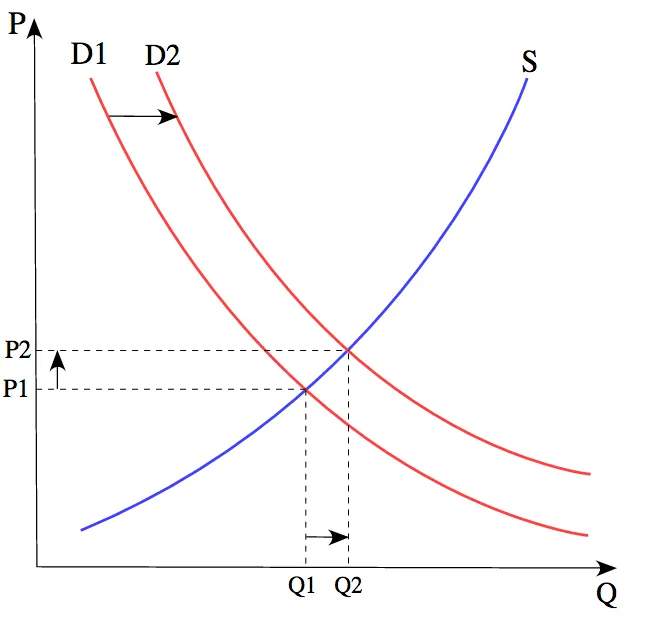
This difficulty that Austrians find with the textbook discussions of supply and demand can be presented in somewhat different terms. The traditional classroom blackboard demonstration of the law proceeds by drawing the classic supply-and-demand diagram—a downward sloping demand curve intersecting an upward sloping supply curve. (For present purposes we forgo the details surrounding the construction of this diagram; it is one familiar to the hosts of students who have ever been exposed to elementary economics.) The core of the classroom analysis generally consists of discussion showing, first, that any market price higher than that indicated by the intersection of the two curves (that is, a price higher than the market-clearing price) must tend to produce competitive pressure toward a decrease in price (since the high price will generate a surplus of unsold merchandise); and second, that any market price lower than that indicated by the point of intersection must produce competitive pressure toward an increase in price (since the low price will generate a shortage of goods offered for sale, as compared with the quantities prospective buyers wish to buy).
Austrians do not have serious disagreement with such discussions in themselves; they simply point out that those discussions are utterly inconsistent with the assumption of perfect competition (which textbook analysis takes as its operative assumption). A little careful analysis of the perfect-competition assumption (which analysis can, however, unfortunately not be fitted into this space) suffices to show that under perfect competition there cannot in fact exist two curves (the demand curve intersecting with the supply curve).
Under perfect competition the supply-and-demand diagram shrivels instantly to a single point—the point where the two curves would have intersected (had the curves themselves existed!). This is so because any point on a market supply curve or on a market demand curve that is not that intersection point can have analytical existence only by suspending some or all of the conditions that define the state of perfect competition. The diagram (valuable though it certainly is!) is simply not consistent with the assumed conditions under which it is supposed to be operating.
Our discussion has unfortunately been overwhelmingly negative. We have pointed out problems that Austrians have with mainstream supply-and-demand analysis—but we have not suggested how an alternative approach might avoid these difficulties. Subsequent articles in the present series will attempt to fill this gap.
For Austrians, the law of supply and demand, properly explained, is at least as centrally important for economic understanding as it is for mainstream economics. We will show how Austrians deploy insight into the entrepreneurial character of dynamically competitive markets (insights that can have no place within the mainstream textbook paradigm) to explain the law of supply and demand in an intuitively and analytically satisfying way.
II. Entrepreneurial Discovery and the Law of Supply and Demand
Austrian economics presents its understanding of the law of supply and demand by invoking the entrepreneurial character of dynamically competitive markets. The key element in this Austrian understanding is the appreciation that individual buying and selling decisions are examples of what Ludwig von Mises called human action. For Mises, each human being is, in a very important sense, an entrepreneur. (See Ludwig von Mises, Human Action, 3rd edition, 1966, p. 252.) And it is the entrepreneurial element in those decisions that is responsible, in the Austrian view, for that crucially important tendency toward market-clearing that (for Austrians as well as for non-Austrians) constitutes the heart of the law of supply and demand.
The Meaning of Human Action
The Misesian notion of human action is significantly richer than the mainstream-economics notion of the economizing decision. An economizing decision is seen as the selection of the most desirable option out of an array of given alternatives with a given ranking of what is more desirable and less desirable. Since both the alternatives available and the ranking are already identified prior to the act of decision, such decision-making consists essentially of the solution to a mathematical maximization exercise; the outcome is predetermined: it is implicit in the given context within which the decision is to be made.
For Misesian human action, on the other hand, the action is, most importantly, seen as including the determination of both what the available alternatives are and what ranking of relative desirability is to be adopted. Determining these elements inevitably exposes the agent to the uncertainties of an open-ended future (in a sense absent in the context of the standard “economizing decision”): action is the present choice between future alternatives that must, in the face of the foggy uncertainty of the future, now be identified in the very act of choice. It is this aspect of human action that renders it, for Mises, essentially entrepreneurial. Mathematical expertise in solving maximization problems is of very limited help in choosing among courses of action when the very alternatives must be “created,” as it were, by the agent’s entrepreneurial imagination and creativity, by his daring and boldness.
The Entrepreneurial Role
For Austrian economics the entrepreneurial role is, despite—or more accurately, precisely because of—its analytical “fuzziness,” responsible for the systematic character of market processes (“fuzzy” since no economist can “model” the creative imagination of the entrepreneur acting under open-ended uncertainty). Going beyond the context of the entrepreneurial elements in each individual human action, Austrian economics focuses on the role of the businessman-entrepreneur in the dynamic market process. The successful businessman-entrepreneur “sees” what other market participants have not yet seen; the entrepreneur sees opportunities to buy at one price and to sell at a higher price. To see such opportunities will typically call for (a) superior imagination and vision (since the perceived opportunity to sell at the higher price is likely to exist only in the future) and (b) creativity (since such a profit opportunity is likely to take the form of selling what one buys in an innovatively different form, and/or different place, than was relevant at the time of purchase).
It is because Mises saw each human being as, to some extent, an entrepreneur that he understood the powerful tendencies that exist in free markets for profit opportunities to be sensed and exploited (and thus eliminated) by profit-oriented entrepreneurial market participants. In a dynamically changing world, new profit opportunities are continually emerging, and their emergence continually generates the incentives toward their discovery and exploitation. It is this ceaseless re-creation and discovery of entrepreneurial opportunities that make up the market process we observe in the world around us.
The Law of Supply and Demand Reconsidered
For Austrians, the law of supply and demand is simply an insight into one particular (but central) element in this more comprehensive, dynamic, entrepreneur-driven market process. For any particular commodity, the market forces acting on the prices at which it will be bought and sold (and thus the market forces acting on the decisions made to produce and to buy it) tend to identify and exploit the opportunities (structured by the technology and the economics of its production on the one hand, and by the urgency with which potential consumers wish to consume it, on the other hand) and thus to ensure that the quantities which are simultaneously worthwhile for producers to produce and for consumers to buy will in fact tend to be produced, offered for sale, and purchased.
If, for example, current production of this commodity is “too low,” this means that opportunities exist for additional units to be produced at an outlay below the highest price potential consumers would be prepared to pay; it is “worthwhile” to produce these additional units. Entrepreneurial producers will tend to discover and act on such opportunities. If, on the other hand, current production is “too high,” this means that the production outlay for at least some units exceeds the highest price potential consumers are prepared to pay for them; these units were produced as a result of entrepreneurial error. Entrepreneurial producers will tend to discover these (marginal) losses and cut back on production.
The entrepreneurial forces acting on the market for any one commodity are thus continually pushing that market toward the market-clearing point—that is, to where (a) the quantity produced is such that (only) all units “worth producing” are indeed produced, and (b) the market price for this commodity is just high enough to make it, as a practical matter, worthwhile for producers to produce this quantity, and is just low enough to make it worthwhile for consumers to buy it.
Clearly, these forces would, were all other dynamic changes in market conditions to be suspended, tend to achieve exactly those outcomes identified, in more conventional mainstream formulations of the law of supply and demand, by the intersection of the supply curve and the demand curve. It is for this reason that we have described Austrian economics as basically in agreement with mainstream economics in its emphasis on the centrality of the law of supply and demand. It is worthwhile, however, briefly to ponder the sense in which the Austrian version of the “law” avoids reliance on any presumption of universal perfect market knowledge (a presumption that, as seen in the preceding article, pervades much standard economics).
The Role of Ignorance and Learning in the Entrepreneurial Market Process
As Austrian economist F. A. Hayek emphasized, the market process we have been describing in entrepreneurial terms can also usefully be understood in terms of learning. The process through which the market tends to generate the “right” quantity of a commodity, and the “right” price for it, can be seen as a series of steps during which market participants gradually tend to discover the gaps or errors in the information on which they had previously been basing their erroneous production and/or buying decisions. Buyers who had overestimated the willingness of producers to produce and sell the commodity had been “incorrectly” refusing to offer higher prices (that they would indeed have been prepared to pay); those who had underestimated that willingness were “incorrectly” offering higher prices than were in fact needed to inspire sellers to produce. Sellers who had overestimated the willingness of buyers to buy were “incorrectly” asking higher prices (and were producing more units of the commodity than it was “really worthwhile” to produce), and so on. The market process is one in which, driven by the entrepreneurial sense for grasping at pure profit opportunities (and for avoiding entrepreneurial losses), market participants, learning more accurate assessments of the attitudes of other market participants, tend toward the market-clearing price-quantity combination.
Two concluding observations are in place at this point. First, we should emphasize, once again, that this “law” is simply an element in the more general dynamic, entrepreneurial market process that is continually at work not only (as in the narrowly defined law of supply and demand) within a particular industry, but also between industries. It is this that renders understanding of the law so important for the broader and deeper understanding of the role of free markets generally in achieving socially effective economic outcomes.
Second, we should emphasize the extent to which the law of supply and demand is being continually buffeted and interrupted—and continually re-asserted and recreated—in the real world of dynamic change. (The circumstance that these dynamic changes typically take the form of forces acting on a particular commodity market from other commodity markets reinforces the observation made in the preceding paragraph.)
III. The Irresistible Force of Market Competition
The systematic character of the market process derives, in the Austrian view, from the interplay of the actions of entrepreneurial human beings. Entrepreneurs act imaginatively and creatively, seeking to identify and to grasp market profit opportunities (generated by earlier entrepreneurial limitations of vision). As a result of the interplay of such entrepreneurial acts of vision, product prices and quantities of product offered for sale tend to be nudged systematically in the direction of the market-clearing price/quantity configuration.
In the present article we draw attention to the essentially competitive character of this entrepreneurial process and draw out some critical implications for any assessment of governmental antitrust policies. We must begin by pointing out certain crucial ambiguities that have long plagued economists’ use of the adjective “competitive.” The problem was identified over half a century ago by F. A. Hayek; despite the valiant efforts of Hayek and others, the problem continues to confuse both economists and the public.
The Meaning of Competition
For the mainstream of economic theory the notion of competition has come to be associated with the absence of market power (to effect change in price or product quality). A competitive market is one in which no firm possesses market power. There is a certain reasonableness to this use of the term. Competition is seen as the antithesis of monopoly. Monopoly is identified with possession of the power to name one’s price without having to worry whether this will encourage one’s potential customers to seek more favorable terms elsewhere.
Competition is therefore reasonably understood to mean the situation in markets where such monopoly power is absent. “Perfect” competition therefore came to mean the situation in markets where each and every participant lacks any power whatever directly to influence product price or product quality. The conditions needed to define such a perfect situation are, as we would expect, completely unrealistic, including (as we saw in the first in this series of articles) universal perfect information concerning all current market events and potential events.
But this is not necessarily a damning weakness; the notion of the state of perfect competition is, after all, seen in mainstream economics not as a description of reality, but as a model able to serve (a) as a theoretical framework helpful for understanding real-world markets, and (b) as a yardstick of perfection against which to assess the seriousness with which real-world situations (of less-than-“perfect” competition) fall short, in terms of the resulting pattern of resource allocation, as compared with the perfectly competitive efficiency ideal. It is this model of perfect competition which is, in mainstream economics, seen as the heart of the law of supply and demand, and which has, in the history of modern antitrust policy, driven governmental efforts to “maintain competition”—that is, to secure a structure of industry reasonably close to the perfectly competitive ideal.
For Austrians, however, the term competition has a completely different meaning, both for understanding how markets work and for formulating public policy in regard to the structure of industry. Austrians find the mainstream meaning of “competition” not only unhelpful, but in fact grossly misleading in terms of economic understanding. For Austrians it is clear that to seek to emulate an “ideal” state in which no single entrepreneur can have impact on market price or output quality is in effect to seek to paralyze the competitive market process.
Following a long tradition in economics going back at least to Adam Smith, Austrians define a competitive market not as a situation where no participant or potential participant has the power to make any difference, but as a market where no potential participant faces nonmarket obstacles to entry. (The adjective “nonmarket” refers, primarily, to government obstacles to entry; it is used to differentiate such obstacles from, for example, high production costs that might discourage entry. These latter do not constitute noncompetitive elements in a market; to be able to enter means to be able to enter a market if one judges such entry to be economically promising-it does not mean to be able to enter without having to bear the relevant costs of production.) That is, a situation is competitive if no incumbent participant possesses privileges that protect him against the possible entry of new competitors.
The achievements that free markets are able to attain depend, in the Austrian view, on freedom of entry, that is, on the absence of privilege. It is because the law of supply and demand (as understood by Austrians) depends crucially on freedom of entry that this meaning of the term “competition” is so important. As we shall see, it is because of this importance that so much twentieth-century antitrust policy can be seen as positively harmful, as seriously obstructing the competitive-entrepreneurial market process.
Semantics and Substance
Certainly the dispute concerning the meaning of “competition” is a semantic one. But, together with, and underlying, the semantic squabble (which, admittedly, should not overly concern us as economists; after all, new terms can be coined that are not subject to misunderstanding), there is a profound substantive disagreement concerning the way in which markets work. The mainstream notion of competition sees it as a state of affairs: the notion of competition has nothing to do with the process through which the market achieves its results. For Austrians, on the other hand, it is the market process that is important. And that market process cannot be imagined at all without necessarily departing from that state of complete powerlessness which mainstream economics sees as perfectly competitive. For Austrians the adjective “competitive” captures the essential feature of the market process.
In other words, entrepreneurial actions that are, in the Austrian sense of the term,* seen as essentially and emphatically competitive, as critical steps in the market process, are, in the mainstream view, seen as anticompetitive, as monopolistic, as aberrations to be eliminated for the sake of the efficient-market ideal. As a result of this confusion of thought in twentieth-century economics, governments ostensibly intent on maintaining the competitiveness of markets have been seen as having the obligation to outlaw and zealously stamp out the very actions through which ordinary competitive strategies are affected. A brief glance at typical tools in the antitrust kit can help illustrate this Austrian critique.
Some Tools of Antitrust
Obstructing mergers. Antitrust policy has traditionally frowned upon (and often prohibited) mergers between hitherto competing firms. The rationale is, given the mainstream perspective, obvious and plausible. Replacing two competing firms by one larger firm cannot but constitute a reduction in the degree of market competition (in the mainstream definition of the term). Two less powerful firms have been replaced by one more powerful firm.
But the Austrian view must be that such a merger, provided the potential entry of others has not been and is not being artificially blocked, is itself an entrepreneurial act, a competitive act; the blockage obstructs the way in which market competition is able to discover the best size of firms and thus the lowest cost at which production can be maintained. (Even if a single firm supplies an entire industry, the industry is still competitive, in Austrian terminology, so long as the firm is kept on its toes by the potential threat of new entrants into this industry, as well as by the threat and/or reality of competition from industries producing substitute commodities.)
Outlawing price collusion. A group of powerful firms may collude to keep prices high; their motives may be to cartelize the industry, to eliminate interfirm competition and thus to force the consumer to pay more. For this reason antitrust policy has of course been directed toward preventing such price collusion. But the Austrian perspective sees matters quite differently. Even where the motive is indeed to paralyze interfirm competition, such collusion is itself a competitive step—since, in the absence of artificial blockage against entry, such collusion can be taken only in the face of the threat of competition from new entrants (who may in fact be able to profit by offering to sell at lower prices). No one knows when a price is “too high”; only the competitive process of entry (or of the threat of potential entry) can reveal the lowest level of price that can be sustained. So long as entry is open, the colluding firms may, in seeking to maintain their higher prices, be unwittingly attracting new entrants to reveal the truth that lower prices are sustainable. Or they may, if no such new entry occurs, be demonstrating that the cost structure indeed dictates these higher prices, as being the lowest ones sustainable in a competitive world.
Preventing predatory price-cutting. What seems, from the mainstream perspective, a clear strategy of eliminating competition occurs where a large firm temporarily keeps prices very low, thus forcing smaller competing firms out of the industry, and is then able to raise prices dramatically with impunity. Careful theoretical and historical analysis has cast serious doubt on even the possibility that such a strategy could be successful and on the validity of the classic claims that such strategies were indeed employed around the turn of the century in U.S. industry. But the Austrian objection to government attempts to limit so-called predatory price cuts does not rest on this analysis. Rather the Austrian objection is that, so long as entry is not artificially blocked, even where “monopoly” positions have indeed been acquired through “predatory” price-cutting, these positions have been acquired as part of the competitive process, and can only be maintained in the teeth of new potential competition.
No one can know when a price cut that eliminates a competitor is intended to establish a “monopoly”; more to the point, even an attempt to establish a “monopoly,” taken in the face of freedom of entry, is itself a competitive step. No one denies that economic muscle may be used to confront consumers with higher prices. But if competition can indeed conceivably serve the consumers better, then these higher prices are themselves the way—the competitive way—through which it becomes profitable for new entrants to discover how better to serve consumers.
Inexorable Market Competition
Our desperately brief glance at antitrust attitudes should perhaps suffice to confirm our central Austrian thesis: What is needed to stimulate that all-powerful entrepreneurial-competitive process upon which the free market depends is nothing more than freedom of entry to anyone with an idea of how to profit by serving consumers more faithfully than they are being currently served. It is important to remember that no claim is made that freedom of entry entails that competitors refrain from attempts to monopolize markets. They may attempt to do so; and certainly their efforts may possibly place the consumer in a worse position (than he might be under a system reflecting perfect knowledge). The Austrian claim is that since no such perfect knowledge can exist, we must rely on the competitive-entrepreneurial process to reveal how the consumer may be better served. To obstruct this process in the name of competition (!) is to undermine the only way through which the tendency toward social efficiency is possible. By obstructing or preventing entrepreneurial steps taken that do not fit the “perfectly competitive” model of universal utter powerlessness—even if such obstruction or prevention stems from the best of intentions on behalf of consumers—government is necessarily tending, to a greater or lesser extent, to paralyze what is truly the competitive process.
IV. An Austrian Critique of Governmental Economic Policy
In preceding articles we outlined the way in which Austrian economists understand the entrepreneurial competitive market process that is responsible for the law of supply and demand. In the present article we pursue this understanding further, to permit us to see why government interventions in spontaneous market processes tend to frustrate and obstruct the coordinative tendencies that the market process generates. The most extreme sense in which such obstruction may occur is in the pure socialist economy (in which all productive activities are governed wholly by a central planning authority). Here the obstruction is total; market tendencies toward spontaneous coordination are completely paralyzed. But less extreme (less “total”) forms of government intervention, particularly so-called “mixed” systems, incorporating significant central regulation of market activity, will be seen to suffer from the same kind of difficulty—the frustration of market tendencies toward spontaneous coordination.
Mises on Socialism
It was in 1920 that renowned Austrian economist Ludwig von Mises enunciated his thesis that centralized socialist planning was, in a definite sense, simply impossible. What he meant by this provocative assertion has often been misinterpreted. Mises did not claim that a socialist system cannot exist; nor did he predict unequivocally that such a system cannot survive for many years. What Mises meant was that, with the best will in the world, with the most dedicated and incorruptible central planners in the world, it is simply impossible to plan centrally for an entire economy. The decisions made by the central authorities in an economy without a market for productive resources cannot possibly take into account all the alternatives that would, in principle, need to be taken into account in order for decisions to be able to be described as socially efficient. Without a market for productive resources (and thus without market prices reflecting the urgency with which consumers in other industries are demanding the services of these resources), central planners have no way of ensuring that resources flow to satisfy the more urgent, rather than the less urgent, demands among consumer preferences.
In a market economy the price of a resource expresses the priority with which consumers wish entrepreneurs to direct that resource for the satisfaction of their preferences; a high resource price means that entrepreneurs, somewhere, are aware of a productive employment for this resource that consumers value highly. For an entrepreneur to allocate this resource to any particular industry, he must, in the market competition for the resource, outbid other entrepreneurs; that is, he must be convinced that he has identified a use for it which consumers value more highly than consumers value alternative uses for that resource. Without themselves necessarily being aware of the nature and value of these alternative uses, the entrepreneurs are led, yes, as if by an invisible hand, to allocate resources in a way that takes account, in effect, of these alternative uses.
But for the central planners, operating as they must without market prices for resources (since there can, by definition, be no resource markets in the socialist economy), a decision made as to whether to allocate steel to the construction of a bridge or to the construction of an apartment building cannot be made on the basis of any measures of alternate urgencies of need; there simply are no such measures. The central authorities may decide to build the bridge, but their decision is not “rational” (in the sense of expressing a rational selection among alternatives). Central planning, in the ordinary sense of the term “to plan” (which expresses the idea of taking into account the need to balance conflicting objectives), is, as Mises showed, impossible.
The Myth of So-Called “Nonmarket” Prices
In the interwar debate that ensued as a result of Mises’s provocative assertion, one attempted socialist response stood out among the others. This was the suggestion, offered separately in the 1930s by two competent socialist economists, Oskar Lange and Abba R. Lerner, that socialist planning might be possible, provided decisions, to be made by socialist employees, could be guided by nonmarket “prices” for resources—that is, by prices promulgated by a central authority, without any resource market, but as based on regular reports to the authority of shortages or surpluses of each particular resource during the preceding production period. Space limitations do not permit us here to spell out the details of this suggestion. As we shall see, its central, damning weakness is the notion that resource “prices” can be promulgated without the spontaneous interplay of the bids and offers of profit-hungry competing entrepreneurs.
Remarkably, but in a sense disastrously, mainstream economics for some four decades ignored this weakness and pronounced the Lange-Lerner suggestion a valid and definitive solution to the problem identified by Mises. Only during the past two decades have economists finally conceded the power of Mises’s argument. In an outstanding 1985 revisionist work devoted to the socialist economic calculation debate—a work rooted in the Austrian understanding of the market process—Donald Lavoie effectively dissected the fallacies that underlay the mainstream illusion that Lange and Lerner had solved the Misesian dilemma.* The source of the illusion is the mainstream preoccupation with states of equilibrium, to the exclusion of any appreciation for the way in which the dynamically competitive ventures initiated by profit-seeking entrepreneurs are responsible for the calculative usefulness of real-world market prices. To imagine that a central planning bureaucracy might generate numbers in a manner that might remotely resemble the way in which prices are generated in the course of market competition is fundamentally to misunderstand the way markets work.
To put this in somewhat different terms: the mainstream’s willingness to accept the Lange-Lerner notion of nonmarket “prices” parallels precisely that mainstream’s enunciation of the “law of supply and demand” in strictly equilibrium, non-entrepreneurial terms. Mises’s (and also F. A. Hayek’s) refusal to acknowledge meaningfulness in such nonmarket “prices” parallels precisely the Austrian insistence on understanding the law of supply and demand as the manifestation of an entrepreneurial process.
The Economics of Government Intervention
Our articulation of the Austrian version of the law of supply and demand, and our corresponding understanding of the Austrian refusal to accept the Lange-Lerner solution (in terms of centrally promulgated nonmarket prices) to the socialist economic calculation problem first identified by Mises permits us to push the logic a little further. It seems reasonable to interpret Mises’s well-known general rejection of government intervention (not only for the socialist model, but more particularly for the “mixed” economy) as a consistent application of his insights into the impossibility of rational central planning in a socialist economy. Each and every act of government regulation constitutes, no matter what noble intentions for social betterment such regulation may reflect, an act of interference with the spontaneous market process generated by entrepreneurial competition.
No one claims that the results of this spontaneous market process are, at any given moment, those that would express perfect social efficiency as seen from a vantage point of imagined omniscience. What Austrians claim for the spontaneous market process is that it is the only procedure available to less-than-omniscient humans to move systematically in the direction of social efficiency, properly defined and understood. For government regulators to believe themselves able systematically and deliberately to improve on the results of the free-market competitive process is not only arrogantly to assume themselves able to approximate the omniscience needed to do so; it is also to fail to realize how their activities are inevitably destined to distort and/or paralyze that market process through which society grapples creatively and constructively with its lack of omniscience. It was Ludwig von Mises who, in his critique of the possibility of socialist planning, drew indirect attention to the central planner’s crippling lack of the knowledge necessary to plan centrally. It was Mises’s subtle understanding of the dynamics of the competitive market process that made him, more than all other twentieth-century economists, the complete skeptic regarding the social usefulness of government intervention in otherwise market economies.
We commenced this four-part series with an Austrian critique of the textbook version of the law of supply and demand. Consideration of the Austrian understanding of that law in terms of a competitive-entrepreneurial process of mutual discovery and coordination led us to a thoroughly negative perspective concerning well-meaning attempts to “maintain competition” through so-called antitrust policies. We have now concluded with brief attention to the manner in which the Austrian view leads, not only to a critique of the pure socialist economy, but also toward the critique of interventionism in all its forms.
The Foundations of Austrian Economics
Read the whole book online · Book details
This work is published under a Creative Commons licence. You may copy, share, and re-host it with attribution.