
Chapter 7 of 10 · The School of Salamanca by Marjorie Grice-Hutichinson
TEXTS I Luís Saravia de la Calle, Instrucctión de mercaderes, Medina del Campo, 1544
CHAPTER 2
Of the Just Price
pp. xxvii–xxviii
EXCLUDING all deceit and malice, the just price of a thing is the price which it commonly fetches at the time and place of the deal, in cash, and bearing in mind the particular circumstances and manner of the sale, the abundance of goods and money, the number of buyers and sellers, the difficulty of procuring the goods, and the benefit to be enjoyed by their use, according to the judgement of an honest man.
I have said ‘in the place’, because the mere change from one place to another raises or lowers the price, according to whether the merchandise is abundant or scarce there. Thus we see by experience that in seaports fish is cheaper than elsewhere. Things are cheaper in the places where they are produced than in those to which they have to be sent.
I have said also ‘in the place’. For we have to consider the place where the contract is arranged, not where the goods are situated. Merchandise in one place is consigned from another where the contract is drawn up, and ownership is transferred from there. If I buy spices in Genoa being myself in Milan, and I agree on the price and pay for the goods in Milan, the just price is the price current in Milan, as Sylvester observes (Usura, II).
I have said ‘at the time’, for time alone raises or lowers the price of a thing. Thus it is clear that wheat is commonly worth more in May than in August, solely on account of time.
I have said ‘bearing in mind the manner of the sale’. For an eager seller generally sets a lower price on his goods than one who is reluctant. Hence we see that a man who has bought a length of cloth from the merchant’s house at its just price will find that in his hands the cloth will be worth less, since he will be inviting merchants and purchasers with it. As the Latin proverb says, ultronee merces vilescunt, goods willingly sold are worth less and fall in price.
I have said ‘the abundance of merchants and money’. For in truth this is the principal reason why things are cheap or dear, and to this are reduced the three already mentioned: time, place, and manner of sale. The mere abundance or scarcity of goods, merchants, and money raises or lowers the price, as bargainers at fairs know by experience. For if a thing is worth more at one time or place than at another, or sold eagerly or reluctantly, it is because of the abundance or scarcity of goods, merchants, and money. If a great deal of merchandise is brought from many parts to the place where the goods are situated, then the latter will be cheap. This is why eggs are cheaper in a village than a city: because in a village there are more eggs, fewer buyers, and less money. And if in August wheat is cheaper than in May, this is because wheat is more abundant in August than in May. And if goods sold eagerly are worth less, it is because buyers are few. If many people wanted to buy them, they would not be sold for less than the cost price. So that in order to determine the just price we need only consider these three things: abundance or scarcity of goods, merchants, and money—of things which people want to barter and exchange for money. This doctrine is founded on Aristotle’s dictum, precium rei humana indigentia mensurat, the price of things is measured by human needs. Thus we see that houses and estates are worth much less after wars and pestilences than before, because there are fewer people to buy them, although the property has not in itself deteriorated. Also, at the end of markets and fairs goods are worth less than when they are in full swing, because many buyers have left and the owners are unwilling to wait for others. From this we infer that the reason why a particular individual wishes to sell does not raise or lower the price.
CHAPTER 3
How the Just Price may be known
p. xxx
Those who measure the just price by the labour, costs, and risk incurred by the person who deals in the merchandise or produces it, or by the cost of transport or the expense of travelling to and from the fair, or by what he has to pay the factors for their industry, risk, and labour, are greatly in error, and still more so are those who allow a certain profit of a fifth or a tenth. For the just price arises from the abundance or scarcity of goods, merchants, and money, as has been said, and not from costs, labour, and risk. If we had to consider labour and risk in order to assess the just price, no merchant would ever suffer loss, nor would abundance or scarcity of goods and money enter into the question. Prices are not commonly fixed on the basis of costs. Why should a bale of linen brought overland from Brittany at great expense be worth more than one which is transported cheaply by sea? Or take the cloth which I brought home from the fair on my horse and which cost me more than that which I carried in the cart. I have both bales in my shop and sell them at the same price, and it would be unjust to ask more for one than for the other, when both were woven at the same time and are of the same quality, colour, and so on.… Why should a book written out by hand be worth more than one which is printed, when the latter is better though it costs less to produce? Finally, why, when the type of Toulouse is the best, should it be cheaper than the vile type of Paris? The just price is found not by counting the cost but by the common estimation.…
The public officials who fix the just price of goods do not consider costs but the scarcity or abundance of goods in the city. This is why first-fruits are dearer, because of their scarcity, not because they cost more to bring to market. Both early and late fruits come from the same orchard and tree.
II
Domingo de Soto, De Justitia et Jure, Salamanca, 1553. Lib. VI, Q. 2, Art. III, PP. 546–9
Should prices be determined according to the judgement of the merchants themselves?
SINCE price is the basis of justice in buying and selling, we shall now consider whether prices should be fixed according to the estimation of merchants themselves.
It is argued in the affirmative:
Firstly, that the rule ‘A thing is worth whatever it can be sold for’, is a celebrated axiom among jurisconsults. Therefore, excluding fraud and malice, we should leave merchants to fix the price of their wares.
Secondly, that in any art we have to take the word of the experts, as Aristotle (Polit. 7) and Paulus (1. in re mandata) remind us; every man is the best judge of his own business. Now, the business of merchants is to understand merchandise. Therefore, we must defer to their opinion in settling prices.
Thirdly, that a man may do as he likes with his own property. Consequently, he may ask and receive whatever price he can extort for his wares, as happens with jewels and other precious objects.
Against this, there is a law cited by Falcidius which says: ‘The price of goods is not determined by the wish or convenience of individuals, but by the community.’ That is, by common estimation.
This Question is answered by four Conclusions:
First Conclusion. The price of goods is not determined by their nature but by the measure in which they serve the needs of mankind. There is a natural reason for this Conclusion. Since the world and everything in it was created for the sake of man, goods are valuable in the eyes of the citizens in so far as they are of service to men. Aristotle (Ethics, 5, ch. 5) says that want is the cause and measure of human commerce. If no one needed the goods or labour of his fellows, men would cease to exchange their products. We have to admit, then, that want is the basis of price. Foodstuffs are especially important for human life; as Augustine says (lib. 2, ch. 16, City of God), a man would rather have corn than mice in his house. And a house is generally worth more than a horse, and a horse often more than a slave: for the nature of man confers no special virtue upon his body to raise its value. When, however, we speak of ‘want’, we understand also that the republic has need of adornment; we include not only such things as are necessary for human life, but also such as render it pleasurable and splendid.
Second Conclusion. In examining the problem of the just price, we have to consider many things, which fall into three classes. We must first take into account the demand which exists for the article, and its abundance or scarcity. Next, we must bear in mind the labour, trouble, and risk which the transaction involves. Finally, we must consider whether the exchange is for better or worse, to the advantage or disadvantage of the vendor, whether buyers are scarce or numerous, and all other things which a prudent man may properly take into account.
Third Conclusion. The just price of an article is twofold: the legal and the natural price. The legal price is always indivisible; but the natural or discretionary price is, broadly speaking, divisible. The just legal price is that which is fixed by the prince. The discretionary or natural price is that which is current when prices are not legally controlled. This distinction between the natural and the legal price is drawn by Aristotle (Ethics, 5, ch. 7).
To understand this Conclusion and to judge its validity, and to see why it is necessary for prices to be controlled, we must realize that the matter is a primary concern of the republic and its governors, who, in spite of the arguments repeated above, ought really to fix the price of every article. But since they cannot possibly do so in all cases, the task is left to the discretion of buyers and sellers. The price which results is called the natural price because it reflects the nature of the goods, and the utility and convenience which they bring.
When the price is fixed by law (for instance, when a measure of wheat or wine, or a length of cloth, is sold for a certain sum) it is not lawful to increase this price by even a single farthing. If the excess be great, then it is mortal sin and a matter for restitution. A trivial increase, however, only constitutes a venial sin. Now we understand why the legal price is said to be indivisible.…
Uncontrolled prices are not indivisible but enjoy a certain latitude within the bounds of justice, of which one extreme is called the ‘rigid’, the other the ‘merciful’, and the middle the ‘moderate’ price. If an article may justly be sold for ten ducats, then it may also be sold for eleven or for nine. …
The natural price is not determined by the judgement of the individual merchant, but by the opinion of prudent and fair-minded men. It would be a most fallacious rule if, whenever a merchant bought an article, he added on to its price the value of his labour and risk, and then expected to sell it at this increased value. In fact, if a merchant ignorantly buys some article at more than the proper price, or if he suffers ill fortune (for instance, if the goods he has bought unexpectedly become abundant), he cannot justly extort the costs which he has incurred. On the other hand, another merchant may be more industrious or more fortunate; perhaps he has been able to buy cheaply, or perhaps he has been lucky enough to see the goods come into short supply after he has bought them. Yet it will hardly be lawful for him to sell more dearly on the same day or in the same place, and he certainly may not do so merely because the goods have increased in value. The art of commerce is largely dependent upon chance, and merchants should learn to bow to misfortune and to wait for better times to come.…
Finally, the Fourth Conclusion will help us to clarify our idea on this subject. Prices rise when buyers are numerous and fall when they are scarce. Likewise, prices fall when sellers are numerous and rise when they are scarce. Indeed, in places where goods are plentiful, there clearly must be more sellers than buyers.
Solution. If, reader, you are puzzled as to whether prices vary because of the reason and manner of the particular sale, you may extract your answer from what has been said above. The reason why a particular article is sold does not in itself affect the price. It is immaterial whether the vendor is compelled by necessity to sell his wares or merely has a sufficiency of them and does not require them. Similarly, whether the purchaser buys from necessity or for pleasure does not alter the price. Nevertheless, if the vendor is forced by necessity to auction his goods, and if there are few purchasers, then their price will fall. And in time of war, when the spoils of victory are divided, very few goods are sold at all. On the other hand, when merchants publicly await buyers, the value of the goods rises, because then more buyers come forward. For the same reason, prices are higher at the beginning than at the end of the fairs.
This Conclusion shows the iniquity of monopolies, which arise when a merchant buys from his prince the sole right to sell an article; or when two or three merchants, forestalling the rest, combine to buy up stocks, so that the public is driven to deal with them; or when they agree not to sell below a certain price. And a monopoly of buyers who combine to reduce prices is equally unjust.…
It remains for us to reply to the affirmative arguments which we mentioned at the beginning of our discussion. First of all, the rule that a thing is worth whatever price it will fetch is plainly not as far-reaching as it sounds. Otherwise we could lawfully sell outside the limits of the just price—perhaps for two or three times as much.… The meaning of the dictum is, that a thing is worth whatever it will fetch excluding fraud and malice.…
To the second argument we reply that experts are to be believed only when their own interests are not concerned, and that a man is the best judge of his own affairs only when these cannot affect other people. But a vendor is not dealing only with his own property, but with something which belongs jointly to himself and the purchaser. And of this he is not a legitimate judge.
Since jewels and other precious objects were mentioned in the third argument, we ought to distinguish between these and ordinary goods. Such things are least necessary to the republic and may be sold for whatever price a prudent and well-informed purchaser may care to pay. Fine horses, jewels, and falcons fall into this class. We look to such things for the adornment, dignity, and splendour of the nobility: and it is for the magnificence of magnates to esteem them magnificently. But food, clothes, and other things of the sort, are necessary to the republic. Let no fraud or malice creep into their pricing: which means, reader, that you are not to sell such things piecemeal for whatever price you can extort.
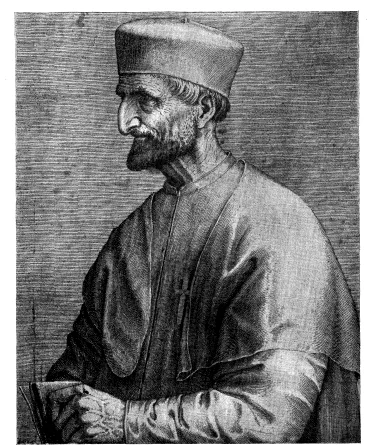
MARTÍN DE AZPILCUETA NAVARRO
From a contemporary engraving
III
Martín de Azpilcueta Navarro, Comentario resolutorio de usuras, Salamanca, 1556.
The Origin and Functions of Money
pp. 57–58
EXCHANGE, or the barter of things other than money, as the jurisconsult Paulus elegantly shows, is a much more ancient contract than that of sale and purchase, which began after money was invented. Before the invention of money, anyone who wished to exchange his house for another was obliged to seek out some person who had the house he wanted and who was willing to exchange it; while a man who had wine and wool but no wheat or shoes would try to find another who had wheat and shoes and was prepared to make the exchange, as is still done by some of the barbarous peoples with whom the Spaniards trade. Later, however, money was invented. Certainly, in one way it was a very necessary invention; and yet, in another, I doubt whether it is really so today, for it destroys souls through avarice, bodies by war and great dangers upon the seas, and even whole fleets (in which it is transported) by fearful tempests and shipwrecks.
The earliest use of money, then, and the principal reason for its invention, was as a price, so that it might promote the sale and purchase of all things needful for human life, and also serve as a kind of public measure of saleable goods. Later on, money of one metal or tale began to be changed for that of another: for example, coins of larger denominations for those of smaller. Still later, when the money of a particular country came to be worth less there than abroad (as today nearly all the gold and silver of Spain is worth less in Spain than in Flanders and France), there came into being the art of exchange, which is the art of giving and taking one kind of money in exchange for another. In this way money began to pass from places where it was worth less to those where it was worth more. Thus, in our own day many people have greatly increased their fortunes by carrying to Flanders and France ducats of two, four, and ten, some in kegs as though they were olives, others in barrels hidden in the wine, on each of which they make a big profit; and they bring merchandise from abroad which is worth little there, and here much, doing us some good in the one, but a great deal of harm in the other.
Now, Aristotle disapproved of this art of exchange and of trading in money: it seemed to him both unnatural and unprofitable to the republic, and to have no end other than gain, which is an end without end. St. Thomas, too, condemned all business whose main object is gain for gain’s sake. But even St. Thomas allows that the merchant’s trade is lawful so long as he undertakes it for a moderate profit in order to maintain himself and his family. After all, the art of exchange benefits the republic to some extent. I myself hold it to be lawful, provided it is conducted as it should be, in order to earn a moderate living. Nor is it true that to use money by changing it at a profit is against nature. Although this is not the first and principal use for which money was invented, it is none the less an important secondary use. To deal in shoes for profit is not the chief use for which they were invented, which is to protect our feet: but this is not to say that to trade in shoes is against nature.
The Value of Money in Exchange
p. 80
The difficulty is to see how a man may change money at a profit while giving the money its just value. To which we reply that this may be done with money as with other goods by paying it over in exchange when or where it is worth less and being repaid when or where it is worth more. As St. Thomas clearly explains, and we have said already, money (even considered purely as money) may justly be exchanged for other money at a profit.
The solution of the problem lies in knowing how and why a given money, which is equal to another according to the common price set upon it by law or custom at the time of its minting, comes to be worth more than the other. We cannot know whether an exchange transaction be just unless we know the value of both moneys; since, as we have seen, the money must be changed at its proper value if the transaction is to be a fair one.
Now, we maintain that the value of the two moneys may diverge for one of eight reasons:
First, because the moneys are of different metals.
Second, because the metal of which they are made is of different fineness.
Third, because the moneys are of different tale or weight.
Fourth, because they are in different countries.
Fifth, because one of them may be repudiated, raised, or lowered.
Sixth, because of diversity in time.
Seventh, because of scarcity and need.
Eighth, because one of the moneys is absent and the other present.
As to the first respect, which is because the moneys are of different metals, sometimes a gold ducat is worth more to its owner than its equivalent in silver or metal, because he can store or transport it more easily. On the other hand, sometimes a ducat of silver or metal will be worth more than one of gold, owing to a scarcity of small change for spending purposes.
As to the second respect, a variation in the metal of the moneys in question, it sometimes happens that of two ducats which are legally estimated at the same value (for example, the ducats of Castile, Portugal, Hungary, and Florence) one may be worth more than another, even if they are in the same country.
As to the third respect, a difference in tale or weight, sometimes one ducat may be worth more than another of the same issue, if, for instance, it weighs a grain too much or is particularly clearly stamped, and if the other weighs a grain too little or is broken, clipped, or otherwise disfigured.
As to the fourth respect, one and the same money may be worth more in one country than in another, as Calderinus admits. This may happen either because the metal of which it is made is more valuable in the one than in the other (gold, for example, is worth more in Spain than in the Indies, and more in France than in Spain), or because the king or the custom of one country sets a higher value upon it than the king or the custom of the other. It happened, for instance, at the time when I was studying in Toulouse, that the King of France greatly raised the tale of his écus d’or au soleil and of the Spanish ducat, and it is said that he has since raised it still higher. So far, nearly everyone is in agreement.
As to the fifth respect, which is that a money may be repudiated and its value lowered, or that such a measure is feared, we have seen in recent years that the tarjas of 10 were worth less at one time than before. And in other countries, where many lords have the right to mint money, they often forbid the circulation of their neighbours’ money in their own territory. Others lower the price of their money, and then its exchange value falls, just as when its circulation is forbidden. Similarly, whenever such repudiation or lowering of the value of money is expected, and the matter is in doubt, the exchange value of the money tends to fall. When, however, there is a possibility of its price being raised, the money begins to exchange for rather more than was formerly the case.…
As to the sixth respect, diversity in time, which causes money to rise or fall in value, a hundred gold, silver, or metal ducats, or a hundred absolutely in quantity, may sometimes be worth more and sometimes less than in a year’s time. They would be worth more if for one of many possible reasons (for instance, if money has been sent abroad to buy provisions, make war, or help friends who have been at war, &c.) there is a shortage of certain coins or of all of them, and if in a year’s time they become abundant, either because provisions or other merchandise of the country have been sold, or because the king has paid his soldiers and servants well, or for other similar reasons. On the other hand, they will be worth less now than in a year’s time if they are now abundant and in a year’s time become scarce, just as a load of wheat is usually worth less in August, when it is plentiful, than in May, when it is scarce or at any rate scarcer.…
As to the seventh respect which causes money to rise or fall in value (namely, whether it is scarce and greatly needed, or abundant), money is worth more when and where it is scarce than where it is abundant, as is maintained by Calderinus, Laurentius de Rodolphis, and Sylvester, with whom Cajetan and Soto agree. The reasons for this opinion are as follows:
First, that this concept is common to all men, good and evil, throughout Christendom, and thus it would seem to be a law of God and Nature.
Second, and of great importance, that all merchandise becomes dearer when it is in great demand and short supply, and that money, in so far as it may be sold, bartered, or exchanged by some other form of contract, is merchandise and therefore also becomes dearer when it is in great demand and short supply.
Third, that (other things being equal) in countries where there is a great scarcity of money all other saleable goods, and even the hands and labour of men, are given for less money than where it is abundant. Thus we see by experience that in France, where money is scarcer than in Spain, bread, wine, cloth, and labour are worth much less. And even in Spain, in times when money was scarcer, saleable goods and labour were given for very much less than after the discovery of the Indies, which flooded the country with gold and silver. The reason for this is that money is worth more where and when it is scarce than where and when it is abundant. What some men say, that a scarcity of money brings down other things, arises from the fact that its excessive rise makes other things seem lower, just as a short man standing beside a very tall one looks shorter than when he is beside a man of his own height.
Fourth, if there is a shortage of gold coins their value may well increase, so that more coins of silver or other metal are given in exchange for them. Thus we now see that because of the great scarcity of gold money some people will give 23, and even 24 and 25 reales for a doubloon, which according to the law and price of the kingdom is worth only 22. Similarly, if silver money becomes scarce its value may rise, so that more gold or metal money is given in exchange for it. Thus in Portugal we have been given 106 maravedís in cetis, at a time when they were abundant, for one testón, which was worth only 100. Afterwards, when cetis became scarce, only 94 were given to the testón. Thus it seems that a general shortage of money produces a general rise in its value.
IV
Tomás de Mercado, Tratos y contratos de mercaderes, Salamanca, 1569
Numisma est virtute omnia, estque fideiussor futurae necessitatis. (Aristotle, Ethics)
p. 77, reverse
ONE of the principal requisites for the prosperity and happiness of a kingdom is always to hold within itself a great quantity of money and an abundance of gold and silver, which are in substance all the temporal riches of this life, or, at least, which come to embrace them all. A kingdom which has money in some sense has all things. Few or none will be lacking in such a nation, for the fame of its wealth will attract even the Unicorns and Elephants of Prester John. And the thing which destroys this abundance and causes poverty is the export of money when this is permitted. For no fertility and plenty can be so great that it will not at last be exhausted if it is continually diminished. And it must necessarily be diminished if the money is carried out of the country. Of this the West Indies can bear good witness though they are most fertile and abundant in these metals, which are their own produce and fruit and which they cultivate and export as others do vines and olives. Often, with the constant drainage of gold to Spain, not the smallest jot of silver can be seen for days together. For this reason some countries remedy the evil by raising the price of their money, a most effective, infallible, and easy way of ensuring that it is never exported. A thing that by no other means can be achieved. For when merchants have to pay a certain price for money they cannot and dare not take it to a place where it is worth less, for fear of loss. If a crown costs me 16 reales in Seville I shall not take it to Florence where it is only worth 12. This good counsel has been followed, I believe, by Guatemala. Seeing her abundant stock of gold disappearing hour by hour, she managed to check the drainage by raising the price of gold, both minted and in bars. From that time forward very little escaped. The money circulates among the Guatemalans, and if goods are imported from abroad the counterlot is sent in the form of silver, cocoa, or blankets of the country. The Guatemalans have thus dammed up their money. The same thing has been done with the bajas and cuartos of Sto Domingo, and this is a much better way of keeping the precious metals in the country than to forbid their export, even on pain of death, as in Spain. However many laws are passed, and however strictly we may try to enforce them, foreigners will continue to despoil the country of gold and silver, and stuff their own with them, finding a thousand frauds and deceits for the purpose. So much so that in Spain, the very source and fount of escudos and crowns, scarcely a handful can be scraped together, whereas if you go to Genoa, Rome, Antwerp, or Venice, you will see in the street of the bankers and money-changers, without exaggeration, as many piles of coins minted in Seville as there are piles of melons in San Salvador or in the Arenal. If this manifest sack and robbery had been remedied at the time of the discovery of the Indies (millions having come since then), I’ll warrant there would now be as much gold and silver in Spain as in all Jerusalem in the reign of Solomon.
The Justice of the Exchanges
p. 92 verso
The third reason which is regarded as the foundation of the exchanges is the diversity that exists in the estimation of money. And in order to understand it (for it is a very weighty reason) we must realize that the value and price of money are not the same thing as its estimation. A very clear proof of this is that in the Indies money is worth the same as here; that is to say, a real is worth 34 maravedís. A peso is worth 13 reales, and its price is the same in Spain, but although the value and price are the same the estimation is very different in the two places. For money is esteemed much less in the Indies than in Spain. The quality and disposition of the country engender in the hearts of all who enter it so generous a temper that they esteem a dozen reales of no greater value than a dozen maravedís here. After the Indies, the place where money is least esteemed is Seville, the city that gathers unto herself all good things from the New World, and, after Seville, the other parts of Spain. Money is highly esteemed in Flanders, Rome, Germany, and England. This estimation and appreciation are brought about, in the first place, by the abundance or scarcity of these metals; since they are found and mined in America, they are there held in little esteem.
Of how the diverse Estimation of Moneys is sufficient to justify the Exchanges
pp. 94–95
There are two points to be investigated and clarified in this chapter. The first is that modern exchange transactions are founded on the diversity in the estimation of money. It is understood that this estimation is to be universal throughout the whole of a kingdom, not peculiar to two or three or five needy persons in a town. Thus we see that in all Flanders and in all Rome money is more highly esteemed than in all Seville, and in Seville more than in the Indies, and in the Indies more than in New Spain, and in New Spain more than in Peru.
What I have said will be clear when we come to examine this sort of commerce. Nowhere is so large an increment charged as in places where it is evident that money is greatly esteemed. The most profitable exchange transactions are those of Flanders and Rome on Spain, where money is clearly worth more than elsewhere [sic.]. This is good proof that money-changers take this diversity of estimation into account.
The second point is that from Seville on Medina, Lisbon, and any other place, the thing that causes a rise or fall in the market is the abundance or scarcity of silver. If it is abundant the rate is low, and, if scarce, high. Clearly, then, abundance or scarcity causes money to be little or greatly esteemed. Hence, if in Seville at the present moment money is esteemed more highly than it will be in a month’s time, this is simply because in some way the market will have been altered and freshly supplied, and, since money will be more abundant, its estimation will fall. Estimation is and always will be the basis of such transactions.
Indeed, these two considerations seem to me to be evident and effective, and I think that they clearly show how important for this type of business is the fact that money is more highly esteemed in one place than in another. In practice we see that when a money-changer knows that money is going to be very scarce in some province he tries to send large sums there in good time.
Our opinion is rendered very probable and even true by the proof which we have given earlier in this treatise that the profit gained in an exchange transaction does not arise because of any variation in the fineness of the two moneys, or because one is present and the other absent, or as a salary for transporting the money, as many people have thought. It follows that the rate can be founded on no other reason (if it is to have a foundation at all) but the diverse estimation in which money is held from city to city. Thus we see that the money-changers make use of all their shrewdness and ingenuity in arranging to place large sums where money is highly esteemed either always or for a few days; and we also understand the reason for the fluctuations in the rate.
If in spite of all these arguments the reader persists that this is not the foundation of the exchanges, I shall not oppose him very strongly but shall request him to show the true reason, or, at any rate, one better and more fitting than my own. In these obscure and complicated matters I am not so obstinate or tenacious of my own judgement that I believe in it like the Gospel. The explanation I have given seems to correspond most nearly to commercial practice, more especially since we are not at present investigating the nature and justice of one sort of exchange transaction, or two, or any in particular, or transactions effected either abroad or within the kingdom, but are considering all exchange business in general. For all such transactions in common I can certainly see no more universal root than this, and no other explanation that harmonizes so many different facts. I well know, of course, that sometimes the necessity of one man, or the tyranny of another, causes the increment to be high. But we need not take this into consideration when we are discussing the exchanges in general terms.
It remains to show that this explanation suffices to justify the profit made in exchange transactions. We have already said that ‘to exchange’ means in plain language to barter. Now barter, if it is to be lawful, must first and foremost be equal. One thing must be worth the same as the other, or there will be injustice and offence. We know, too, that the same article of clothing may vary in price from province to province. A measure of wine is incomparably more valuable in the Indies than in Spain, and a measure of oil in Flanders than in Castile. So much so, that one barrel of wine in Mexico is worth ten in Jerez, and they could lawfully be bartered and exchanged, giving one barrel in New Spain against ten in Cazalla. And, within a single kingdom, a basket of olives in Valladolid may be exchanged for four in Manzanilla, and yet the barter will be just and equal. The same thing happens to sums of money, which, because money is more highly esteemed in one place than in another, come to be equal even though the sums are different, 93 in Flanders to 100 in Seville, not because the ducats are of a different fineness or tale, but because the country in itself, so so speak, causes money to be more highly regarded. We are accustomed to say ‘A real here is better than two elsewhere’; not because a real is not worth 34 maravedís here and two reales 68, but because the 34 here are more highly esteemed than the 68 elsewhere.
Thus, corresponding to the advantage which the Indies enjoy over Spain in their abundance of gold and silver, so are 70 ducats in Madrid esteemed as highly as 100 in Lima and 90 in Vera Cruz; and if I were to state that the excess were larger I do not think that I should be deceived. It is the same between Spain and Rome, for 100 in Burgos are certainly worth 94 in Rome. Therefore, to exchange the 100 for the 94 is a just transaction, even if the 94 in Italy could be paid on the very same night and with no delay or lapse of time. Indeed, people often wish to be paid immediately in this way—for instance, if they are sending the costs of certain dispensations, or if they are eager to make a profit. On the very same day that they deliver the money here, they want, if possible, the bill to be settled within a few hours. And yet they often lose 10 or even 14 per cent.
All the foregoing will be repeated and more extensively explained in the rest of this little book. It is the very foundation of the edifice, the very base of the column, that we are seeking to build up. In fact, little remains but to apply this doctrine and general rule to each particular kind of exchange transaction.
V
Francisco García, Tratado utilísimo y muy general de todos los contractos, Valencia, 1583
Of the just price, what it is, and how it may be known
NOW that we come to treat of the just price, what it is, and how it may be known, we must first of all consider in what the value of things consists, since their value is the rule and measure by which we come to know their just price, in so far as value and price ought to correspond.
The value of things is very differently judged by the Moral Philosopher and by the Politician. When the Philosopher estimates the value of a thing he considers its nature: but the Politician looks only to its use and to the utility it brings, and to the service it can render us for the satisfaction of our needs and our human wants. Ask a philosopher which is better and nobler, a mouse or a measure of corn, and he will answer, the mouse, for it is a substance that has life, and the corn has none. But put the same question to a politician, and he will say that the corn is better and more valuable than the mouse, since it is necessary for preservation of human life, and the mouse has no such utility. For this reason does St. Augustine say that he would rather have his house full of corn than of mice.
This utility, which causes us to esteem things and hold them dear, is of many kinds. A thing may be used in a way that is necessary for the preservation of life, as in eating, drinking, clothing ourselves, and remedying pain and human ailments, Or we may use it for our pleasures and human pastimes, such as when we read a book, contemplate the nature of things, or ride a horse. Or it may serve for the adornment of mankind or to delight our curiosity; and for this use gold and silver, precious stones, silk, brocade, tapestry, and many other such things are particularly appropriate. There are other uses that serve the infinite demands of mankind, which beyond a certain number cannot be comprehended.
Now, there are three ways in which a thing is said to be of greater or less value, bearing in mind its utility. Firstly, one thing may have many uses and serve for more purposes than another. Thus we say that a certain slave is better than his fellows if he has a wider range of skills and can perform more services. We judge between two horses in the same way and say that one is worth more than the other, all else being equal, because he can be used for riding in town or country, drawing a carriage, ploughing, and bearing burdens, whereas the other serves only for riding in town or drawing a carriage. Secondly, one thing may render a greater service than another. Corn is more valuable than stone, because the former serves to sustain life and the latter only to build houses. Thirdly, a service may be better performed by one thing than by another. Corn is worth more than fruit because it is more useful for human nourishment.
All these comparisons must be understood as being true only if all other things remain equal, and not otherwise. For we must now explain that there are reasons for which prices rise and fall, and these, uniting together, may cause the value and estimation of things to decrease or increase quite apart from their utility. For example, we have said that bread is more valuable than meat because it is more necessary for the preservation of human life. But there may come a time when bread is so abundant and meat so scarce that bread is cheaper than meat.
There are four or five other reasons why the value and estimation of things should increase or decrease. The first is the abundance or scarcity of goods. The second is whether buyers and sellers are few or many. The third is whether money is scarce or plentiful: this applies to places where the dealing is on a cash and not a credit basis. The fourth is whether vendors are eager to sell their goods, and buyers much sought after and importuned.… The fifth, according to some authors, is the urgency of the vendor’s need to sell and the purchaser’s to buy, but this reason is not admitted by Dr. Soto, who very truly remarks that the reason which moves a particular individual to buy or sell does not affect the value of the thing sold.
Of the Value of Money
… [Money has two values]. The first of these is the natural value, which will here be called value absolutely; the second is the accidental value, which we shall call estimation.
Now, it happens with money as with other goods, that at one time or place they may be more highly esteemed and valued than at another, although their quality and nature may not have varied. Thus we see that in the Indies, where gold and silver is very plentiful, ducats and reales are not as highly esteemed as in Spain, where there is less gold and silver, and for this reason people there would not hesitate to pay an escudo for something that would not fetch two reales here. This is because an escudo is as little esteemed there as two reales here, even though the natural value of money is exactly the same there as here.
Also, money may be more or less esteemed at different times. Just as in the case of a private individual, so it may be with the whole Republic. If a man is very rich and has plenty of money, he esteems a real as little as a poor man a dinero, and an escudo as little as a poor man a real, or as little as he himself esteemed a real at some other time, when he himself was poor. In just the same way, when the Republic is rich and money is plentiful, so is the latter less esteemed; and when the Republic is poor and money is scarce, so is it much more highly valued.
This greater or lesser degree of estimation usually proceeds from three causes. The first and most important is whether money is scarce or abundant, just as merchandise is little esteemed when it is plentiful, and highly valued and esteemed when it is scarce.…
The second cause is whether there are many or few who wish to give or take money in exchange, just as in the sale or purchase of goods the price of the merchandise rises or falls according to whether there are many or few buyers and sellers.
The third cause is whether the money is in a place where it is subject to risk or in one where it is safe. Thus, if in Flanders a city is in danger of being sacked (as Antwerp was sacked a few years ago), then money would be worth less in that city, quite apart from other considerations.
[Summary]
Abundance or scarcity of money may be general or particular. It will be general if it is common to a whole city or kingdom, or even to all the merchants and money-changers. It will be particular if it is confined to a few individuals. Money may be more abundant in one city than in another, and yet it may be scarce among merchants. In such a case the exchanges will reflect the relative abundance or scarcity of money in the two mercantile colonies, irrespective of conditions in the rest of the city. This is why, when money is sent between Seville and Medina, the exchanges turn sometimes in favour of Seville and sometimes in favour of Medina. If they depended entirely on general abundance they would always be in favour of Medina, since money is always scarcer there than in Seville. The same principles apply to the price of bills.
The rate of exchange depends partly on the conditions of supply and demand, partly on whether the money is present or absent. If a merchant pays out money in exchange at Medina at the rate of 360 maravedís to the ducat, he will make a profit of 50 maravedís on each ducat when he is repaid in Flanders. But if he pays out the same number of ducats in Flanders for repayment in Medina, he will make a profit of 75 maravedís. The same thing happens between Seville and Rome. From Seville to Rome a profit of 8 or 10 per cent, is made, and from Rome to Seville a profit of 18 or 20 per cent., and yet the transaction is just and lawful. The explanation is this: part of the profit arises from the fact that money present is exchanged for money absent in both cases, and the former is more valuable than the latter, and part from the relative abundance and scarcity of money in the different places.
VI
Martín González de Cellorigo, Memorial de la política necessaria y útil restauración a la República de España, Valladolid, 1600
The Reason why so great a Quantity of Gold and Silver is taken out of this Republic
IN such great quantities are gold and silver taken out of this Realm that we seem to hold our riches only by way of deposit, and hand them over to other Kingdoms as though they were the rightful owners. This is because we will not understand that true wealth does not lie in the possession of great quantities of gold and silver (whether wrought, coined, or in bullion) which are destroyed as soon as they are consumed, but in the possession of things which, even though they are consumed by use, are yet preserved in kind by the medium of substitution, which enables us to take gold and silver from out of the hands of friends and enemies, just as we have negligently allowed them to be snatched from our own.
Since money is not real wealth, and since what is noble ever attracts what is base, our gold and silver has been drawn away by what is truly wealth. And this we would prove more particularly to those who claim best to understand the reason of state, when they falsely assert that the wretched poverty of this Kingdom is due to the large quantity of money which is sent out of the country to pay for the wars in Flanders and in other states belonging to the Crown of Castile. This is a sad error, for in truth all our evils proceed from our own idleness and from the great diligence of foreigners, who by their industry take out ten times more gold and silver than all our Orders in Council. Idleness may be avoided, but wars not, except at the risk of losing the states, forces, and munitions of Spain. People who make use of such arguments do not understand the nature of money. If, as the law says, it was invented only to facilitate contracts, then it is the cause and not the effect of exchange. Surely we in Spain should be sufficiently instructed in these principles, when they are daily practised either by or against ourselves. By us, in the West Indian trade, when we attract gold and silver from those parts to Spain with the aid of our natural and manufactured products, of which they stand in need. Against us, because we choose not to make the goods which our manufactures might give us already wrought and finished: and foreigners, applying themselves to the task, wrest from us all the gold, silver, and money we produce.
Of how a great Quantity of Money does not maintain a State, nor does the Wealth of Nations lie therein
It is likewise an error to suppose that in good politics the wealth of a State is increased or decreased because the quantity of money in circulation is larger or smaller. Since money is but the instrument of exchange, a small circulation has as good an effect as a large one, or even better, for instead of clogging the wheels of trade and commerce it makes them run more easily and lightly. And if this is not the rule in all cases, it is nevertheless certain that the great quantity of money which has been coined has raised the poll-tax, and the other taxes and contributions, to a point where they cannot be met unless such a flood of money is kept coursing through the Kingdom that the price of goods corresponds to the sums which the taxpayers are obliged to furnish and which are needed for the support of the monarchy and the honouring of its debts. The same is true with respect to merchandise and foreign trade: speaking generally, Spanish prices are high on account of our large circulation, although our products could find an easy vent if we so desired. But apart from these cases the same may be done with little money as with much, as is well proved by the contracts made a hundred years ago: for a thing that could then be bought for one real is worth fifty today. The Romans were quicker to understand this. When Paulus Aemilius (as the histories relate) brought the gold and silver from out of Macedonia, the estimation of things rose (so Pliny, Plutarch, and other authors say) by a third. And when Julius Caesar caused the spoils of Egypt to be brought to Rome, usury and the exchanges fell heavily and the cost of living rose. The same thing happened to our own people in Peru, where, if we may place our faith in the history-books, the abundance of money and shortage of other things made a frieze dress worth a thousand ducats, a horse six thousand, and a barrel of wine three hundred. And I have been told by a person of credit now living in Valladolid that long afterwards, when he was in those parts, he sold a pound of grapes for a pound of silver, which is two marks if we take the value of the maravedí at that time in Spain, and which would now be rather more. Such are the results of a big circulation and a great quantity of gold and silver, and such will be the value of money when there is a shortage of the things that are needed for human life. In Nations that lack these necessary things, there will true wealth also be lacking.
The Reason why Spain is not enriched by the great Quantity of Riches she imports
… [The cause of the ruin of Spain] is that wealth has been and still is riding upon the wind in the form of papers and contracts, censos and bills of exchange, money and silver and gold, instead of in goods that fructify and by virtue of their greater worth attract to themselves riches from abroad, thus sustaining our people at home. We see, then, that the reason why there is no money, gold, or silver in Spain is because there is too much, and Spain is poor because she is rich. The two things are really contradictory, but though they cannot fittingly be put into a single proposition, yet we must hold them both to be true in our single kingdom of Spain.
VII
Luís de Molina, Disputationes de Contractibus, Venice, 1601
Of the dual value of a single money in different places Summary
1. There are two ways in which money may be more valuable in one place than in another.
2. The need for money, and its abundance, cause its value to rise and fall.
3. As in the case of goods, money in one place may be exchanged for money in another.
IN the three preceding disputations we examined one reason why money may lawfully be exchanged between different places at a profit. We shall now consider two other reasons, and must first explain what we propose.
There are two ways in which a given money may be more valuable in one place than in another. Firstly, by virtue of public law or accepted custom, the value of a money in terms of other moneys may vary from place to place. In Portugal the ducat is worth 400 reais and in Castile 375 maravedís; the silver real is worth 34 maravedís in Castile and 40 in Portugal, while in the kingdom of Valencia it is worth less, and in Catalonia more, of the small bronze coins known as dinars; and its value is different in other places. Though 11 silver reales are worth 375 maravedís in Castile, they are equivalent to 475 reais in Portugal, omitting other places for the present. The gold escudo, which at one time was worth 10 silver reales and 10 maravedís in Castile, or 350 maravedís, was worth 11 julios and 1 dimidio in Rome, although the julio corresponds to the silver real. The escudo was priced differently in France and elsewhere, and it is struck today at a value of 400 maravedís in Castile.
But there is another way in which money may be worth more in one place than in another: namely, because it is scarcer there than elsewhere. Other things being equal, wherever money is most abundant, there will it be least valuable for the purpose of buying goods and comparing things other than money.
Just as an abundance of goods causes prices to fall (the quantity of money and number of merchants being equal), so does an abundance of money cause them to rise (the quantity of goods and number of merchants being equal). The reason is that the money itself becomes less valuable for the purpose of buying and comparing goods. Thus we see that in Spain the purchasing-power of money is far lower, on account of its abundance, than it was eighty years ago. A thing that could be bought for two ducats at that time is nowadays worth 5, 6, or even more. Wages have risen in the same proportion, and so have dowries, the price of estates, the income from benefices, and other things.
We likewise see that money is far less valuable in the New World (especially in Peru, where it is most plentiful) than it is in Spain. But in places where it is scarcer than in Spain, there will it be more valuable. Nor will the value of money be the same in all other places, but will vary: and this will be because of variations in its quantity, other things being equal. Value in this sense is not indivisible, but enjoys a certain freedom, just as goods whose price is not legally controlled are priced according to the judgement of prudent merchants. Even in Spain itself, the value of money varies: it is usually lowest of all in Seville, where the ships come in from the New World and where for that reason money is most abundant.
Wherever the demand for money is greatest, whether for buying or carrying goods, conducting other business, waging war, holding the royal court, or for any other reason, there will its value be highest. It is these things, too, which cause the value of money to vary in course of time in one and the same place.
Certainly, when money in one place is exchanged for money in another, for the purposes of trade or for the other reasons just mentioned, it has, like goods, its minimum legal price, which fluctuates according to the relative scarcity of money in the two places. For just as the value of other goods rises and falls according to their abundance or scarcity, to the greater or lesser need which is felt for them, and to the larger or smaller number of merchants who require them, so does the bigger or smaller quantity of money in a place, the greater or lesser need which is felt for it, and the larger or smaller number of dealers who can and will give and take it in exchange, cause money to be worth more in one place than in another at one and the same time, or, at different times, to be worth more or less in one and the same place, even at the same fair. For at the beginning, middle, and end of a fair there is a variation in the number of those who require money or who wish to exchange it for money abroad, and a similar variation in the number of those who are able and willing to give money in exchange.
When, therefore, the republic fixes the value of larger coins in terms of those of smaller denominations, this is only to facilitate the changing of money in one and the same place, the purchase of goods, and the payment of their price. But the republic never intended to fix this second kind of value when money is exchanged for money in another place. This value is inconstant, and yet it is just, even though the tale of the money is fixed by law. To control it would do a great deal of harm to the republic, because such a course would bring about a shortage of necessary goods. The practice has always been, and rightly, for the value of money in exchange to be left to vary freely; and Pius V approves this kind of transaction undertaken at a profit.
VIII
Pedro de Valencia, Discurso sobre el precio del trigo, 1605 (reprinted in Pedro de Valencia, Escritos sociales, in Biblioteca de clásicos sociales españoles, Madrid, 1945)
p. 91
THOSE who collect more corn than they require for the satisfaction of their own needs do so in order to make a profit, to wait for and instigate a rise in its price, so that they may sell it for an exorbitant sum. The simplest and most universal remedy against such people, and one that has been found and proved by many years’ experience in this Your Majesty’s realm, is to set upon corn a just price that may never be exceeded. This will cause dealers and other powerful men to lose confidence in their ability to sell as dear as they choose, and either they will cease to hoard corn, or else, when the fixed price is reached, they will sell it in case the price drops still further or the corn gets spoilt by weevils, and so as not to keep their money lying idle. Also, everyone will then be able to buy and support himself with corn, for its price will not be beyond the reach of the ordinary common people, who form the greater part of the Republic.
And this possibility is the certain rule of the just and proper price of corn, and any other consideration or calculation that is made in order to measure and assess its natural and just price will be unsure, unequal, and harmful to the community. The value and estimation of money and of the metals from which it is made is diverse and variable in different provinces, occasions, and times, so that by considering the price of money we cannot set upon corn a price that will be universally just and appropriate to all times and places. Moreover, to compare the value of other common articles with that of corn (such as saying that a fanega of corn ought to be worth a certain quantity of wine or oil) will prove equally useless for our purpose, because we should simply be measuring one unknown thing by another, and the value and quality of such articles varies from year to year and from place to place.
If we measure the price of bread by the benefit and utility it brings, and by its own intrinsic value, we shall find that a loaf is worth more than all the gold and diamonds in the world. Yet in this respect air, water, and light are still more valuable, and God willed that these three things should cost us nothing and that corn, which is next to them in the scale of things that are useful and necessary to life, should cost the sweat of man. This is in accordance with natural law and divine ordinance, for the value of corn not only equals but exceeds its price, life being more than meat and the body than raiment. And this is the just and legal price, general and unalterable in every time and place, fixed and decreed by the supreme, universal, and immortal King and Lord of all ages, who announced it to men when He drove them forth from Paradise, saying to Adam and all his descendants: In the sweat of thy face shalt thou eat bread.
God and all reason require that men shall earn their bread by their toil, that this may be sufficient to support them in life, and that those who will not work, neither shall they eat. Setting all else aside, we should consider only how many working days ought in justice to be given for a measure of corn, so that the labourer may support himself, however poorly and roughly, and may eat, drink, and clothe himself, keep a roof over his head, marry and beget children and support them while they are little, and not have to work every day, because sometimes there will be no work for him, and because there are days of tempest, and of sickness, and of rejoicing. It seems that even if he must go to the workhouse or beg in his old age, a man cannot live unless he can earn a fanega of corn in not more than five or six working days, which at present in this province are worth 14 or 15 reales.
p. III
And those who allege that a thing is worth whatever price it will fetch must be understood as referring only to things that are not essential to life, such as diamonds, falcons, horses, swords, and also to other commoner things when there is no fraud, compulsion, or monopoly, and when vendor and purchaser enjoy equal liberty and suffer equal need. But in the case of bread, in years when it is dear—and it is for such times that the tasa is instituted—the vendor always enjoys liberty and plenty, and the purchaser always suffers urgent need and want. The just price is not whatever a thing will fetch on account of the purchaser’s need, nor can such a price in conscience be demanded. No price is just or should be regarded as current if it is against the public interest, which is the first and principal consideration in justifying the price of things.
The School of Salamanca
Read the whole book online · Book details
Free to read online and to download from this archive.