
Chapter 27 of 29 · The Value of Money by Benjamin Anderson
Chapter XXIV: Credit—Bank Assets and Bank Reserves
IN traditional discussions of banking, the impression is given that commercial paper is the normal and dominant type of banking assets.1 To one accustomed to this view, the figures of the Comptroller of the Currency for banking investments in the United States for 22,491 banks of all kinds (State, national, private, and savings banks, and trust companies) in 1909,2 will occasion dismay:
| (000,000 omitted) | |
| Loans on real estate | $ 2,505 |
| Loans on other collateral security | 3,975 |
| Other loans and discounts | 4,821 |
| Overdrafts | 69 |
| United States bonds | 792 |
| State, county and municipal bonds | 1,091 |
| Railroad bonds and stocks | 1.560 |
| Bonds of other public service corporations | 466 |
| Other stocks, bonds, etc | 703 |
| Due from other banks and bankers | 2,562 |
| Real estate, furniture, etc | 544 |
| Checks and other cash items | 437 |
| Cash on hand | 1.452 |
| Other resources | 111 |
| Total Resources | $21,095 |
These figures, however, call for further analysis. They include figures from institutions which should not be counted with commercial banks. The percentage of real estate loans, especially, is too high to represent the workings of commercial banks, a very high percentage of real estate loans being held by stock and mutual savings banks. The other items, however, are not much changed by the inclusion of savings banks and private banks. It will be well to draw some conclusions from these aggregate figures for all classes of institutions, before taking up a more detailed analysis of State and national banks, and trust companies.
Where, among these items, does one find “commercial paper”? In the reports of the metropolitan papers, giving daily variations in interest rates, it is usual to find “commercial paper” listed as a separate category, coordinate with “sixty day paper,” “ninety day paper,” etc. Recent periodical discussion has gone elaborately into the question as to what should be called “commercial paper,” from the standpoint of the policy of the Federal Reserve Banks. I think it safe to say that no two markets, at present, in the United States will use the term in precisely the same way, and that all would restrict the term to a small portion of the “other loans and discounts” listed above. The most general definition of “commercial paper” would be paper bought through note-brokers. Despite the decided increase in loans and discounts which our war prosperity has involved, there has been very frequent complaint of the scarcity of “commercial paper.” I shall use the term, “commercial paper” in a much more liberal sense than the American money market does, and shall mean by it all loans of a really liquid character, made by banks to merchants and others to pay for the purchase of goods in anticipation of a resale within the term of the loan which will enable the loan to be repaid at maturity. From this should be excluded, however, loans made to speculators. With this liberal, and not very precise, definition of commereial Paper, we raise again the question as to where it may be found in the items above given.
Virtually all of it, I think, must be found in the item, “other loans and discounts”—an item which, in all, is slightly less than 23% of total banking assets.1 But not all of this “other loans and discounts” is commercial paper. Very much indeed represents loans of a non-liquid character, regularly renewed, which manufacturers and others have put, not into moveable goods, but into fixed forms of capital-goods, as machinery, and even buildings. One case in New York, which the writer is informed by a business man well acquainted with both banking and business in many sections of the country is typical of many cases, is as follows: a New York bank is at present lending to a small manufacturer of automobile supplies about $30,000. Of this, about $10,000 is liquid, periodically covered by “bills receivable,” and if the bills receivable should fail, in the period in question, to cover the $10,000, the bank would insist on a reduction of the loan. The remaining $20,000, however, is not liquid. It was spent for non-moveable equipment; the bank expects to renew the notes for this loan periodically, and is well aware that it could not force collection without bringing the business to a close—or else forcing the factory to get accommodation elsewhere. The $10,000 that is liquid is by no means all spent for goods, but is spent, in part, for wages. None of the $10,000 is spent for goods which are to be resold without being transformed by manufacture. None of the $30,000, therefore, is, in the strict sense, “commercial paper.” It is manufacturer’s paper. Part of it is virtually as liquid as commercial paper; two-thirds of it is not liquid.
A very large part indeed of bank-loans are of this character. A large part of the loans made to farmers are in no sense liquid: when the loan is made, for, say, six months,1 it is perfectly understood by both bank and borrower that a renewal will be asked for and granted. It is impossible to say what fraction of this $4,821,000,000 of “other loans and discounts” is really liquid commercial paper, or liquid paper of any kind, in the sense that it can be automatically paid off at maturity. I venture the statement with entire confidence, however, that the proportion of liquid paper is not one-half of the amount. I should question if more than one-fourth of it is truly liquid, in the sense in which that term is commonly used: meaning that the loan is made to put through a transaction which will be completed during the term of the loan, and permit the loan automatically to be paid off. I do not mean by this merely that the banks could not reduce this item by one-fourth suddenly. Even in a market made up wholly of highly liquid paper, an arbitrary refusal to renew one-fourth of the loans, with the effort to reduce loans and discounts by one-fourth, would occasion great embarrassment and even disaster. The test of liquidity here applied relates to the items separately, on the assumption that other things are not radically changed. Even in this sense, however, viewing each loan transaction separately, it may well be questioned if the banks in the United States could find among their “other loans and discounts” items exceeding a fourth of the total (in value) which they could refuse to renew, at least in large part, without disappointing reasonable expectations, and embarrassing good business men.2
Of this paper, not truly liquid, no doubt a good deal is advanced to wholesale and retail merchants, and is, in this sense, commercial paper. The terms, “liquid paper” and “commercial paper” by no means run on all fours! As will later appear, the bulk of liquid banking assets are not commercial paper at all. And only that part of a bank’s loans to a merchant may be called “liquid” which can be paid off by the merchant without disappointing his reasonable expectations,—causing him to seek other banking connections.
There is, however, another item in which we may find some commercial paper, and this is the item, “loans on other collateral security.” This has commonly been supposed to be virtually all stock exchange loans. Thus, Conant1 cites the growth in this item in New York as evidence of the growth of loans on stocks and bonds. For New York, loans on stocks and bonds do make up the great bulk of this item. Even in New York, however, there are other factors in it, absolutely, even though not relatively, important, and in the country outside, the other elements are not at all negligible, even though for the outside country the part secured by stocks and bonds is the major part, and even though the growth of this item in our total banking assets is, in general, fairly indicative of the growth of loans secured by stocks and bonds. Figures for the other items are not available for State banks, trust companies or savings and private banks. They are not till very recently available for national banks. In 1915,2 however, the Comptroller separates the item, “loans on other collateral security,” for national banks, into two parts, (1) loans “secured by stocks and bonds” ($1,750,597,273), and (2) loans “secured by other personal securities, including merchandise, warehouse receipts, etc.” ($882,749,812). Is there any commercial paper in this last, not inconsiderable, item?
Let us locate the item, in the effort to find out. The percentage runs highest in Chicago, where this class of collateral loan exceeds the loans on stocks and bonds. The inference is strongly suggested, therefore, that much of it, there, at least, represents advances to live-stock, grain and produce traders and speculators on the Board of Trade, at the stock yards, etc. The inference is strengthened by the fact that St. Louis, where there is a good deal of grain and commodity speculation, shows more than twice as much of this kind of paper as does Boston, where this kind of speculation is unimportant—despite the fact that Boston’s aggregate collateral loans of all kinds greatly exceed such loans in St. Louis. In New York, where there is a great deal of coffee and cotton speculation, and some other commodity speculation, the amount of this paper, though relatively small, is absolutely greater than in any other city. No doubt, in New York, which is the country’s centre for foreign commerce, a fair amount of the paper secured by “other personal securities, including merchandise, warehouse receipts, etc.,” is really commercial paper, representing advances to importers and exporters—though the difficulties of giving this kind of security where goods are in transit would prevent most of our foreign trade being financed in this manner. The total of this kind of paper in New York—all these figures are for national banks alone—was only 113 millions on June 23, 1915.1 It may be doubted if very much of this paper, in the great cities, represents goods in transit. With the caution that the view here expressed is based on inference, and not on actual knowledge of what the large city banks are doing, the writer concludes that probably the bulk of this paper, in large cities, represents loans to speculators rather than to merchants. It is liquid, but it is not commercial paper.
What of such paper in the country districts? Nearly one-half—$436,000,000 out of $882,000,000—of these national bank-loans on “other personal security, including merchandise, warehouse receipts, etc.,” are in the country, outside the Reserve and Central Reserve Cities. Much of it is in the South. Much of it in the grain and live-stock producing regions. What do such loans mean?1 Much of it is loans to farmers and planters. In the South, much of it is on crop liens. The loans on cotton warehouse receipts, at least in the country parts of the South, are not as great as is commonly supposed. In the North and West, there are a great mass of farmers’ chattel mortgage loans, including loans on horses, grain in cribs, hogs, sheep, cattle, mules, etc. The use of this type of paper for financing the breeding and feeding of live-stock, particularly hogs, cattle and sheep, is very extensive. Virtually all loans to farmers and feeders for these purposes are secured by such chattel mortgages. It seems improbable that a great deal of this paper could represent ordinary commerce. Neither wholesalers nor retailers can easily handle merchandise on which chattel mortgages have been given. The usual method of granting credit to them is to advance loans on one and two name paper, unsecured. Not many loans to retailers and wholesalers will fall in the category under discussion.
To what extent are the loans of this type to farmers liquid? Well, the crop lien loans in the South have a natural term, and, though commonly longer loans than bankers have in mind when speaking of liquid paper, are liquid in the sense that they are automatically paid off at maturity. Loans on work-animals need not have a natural term. Loans on animals being fed for the market have such a natural term, and are truly liquid. Loans, however, on breeding animals are not thus liquid, such loans are commonly regularly renewed at maturity, and the banks do not count on them in emergencies. It is the opinion of Dr. J. E. Pope that fully two-thirds of the aggregate loans on live-stock chattel mortgage security are to breeders rather than to feeders, and hence are not liquid. Of course, none of these loans are commercial paper.
I conclude, therefore, that the thesis with which we started that the overwhelming bulk of commercial paper is to be found in the item, “other loans and discounts” is correct. I see no reason to suppose that an analysis of the loans of State banks and trust companies would show a different conclusion. We lack the figures for breaking up the collateral loans of State banks and trust companies into the two classes, “secured by stocks and bonds” and “secured by other personal securities, including warehouse receipts, merchandise, etc.” We have merely the gross figures for collateral loans. As the State banks are in large degree country banks, it is probable that the percentage of commodity collateral as compared with stock exchange collateral for State banks would be larger than for national banks. However, the total of collateral loans for State banks is relatively small—559 millions, for 1909, as against “other loans and discounts” for State banks in that year of 1,112 millions, and as against a total of collateral loans of all banks reporting in that year of 3,975 millions. On the other hand, the collateral loans of the trust companies are very large: 1,222 millions for 1909, as against “other loans and discounts” for the trust companies in the same year of 460 millions. As the trust companies are chiefly city institutions, and as the concentration of trust company loans and capital in New York City is relatively very great, it would seem pretty clear that taking both State banks and trust companies into account would substantially lessen the percentage of loans “secured by other personal security, including merchandise, warehouse receipts, etc.,” to total collateral loans. As the amount of commercial paper in this class of loans for national banks is probably small, it may be expected to be still smaller in the aggregate of collateral loans.
The following figures, for State and national banks, and trust companies, only, will, in the light of the foregoing, give us basis for some further conclusions regarding the character of banking assets in the United States. As before, the year 1909 is chosen:
(000,000 omitted)1
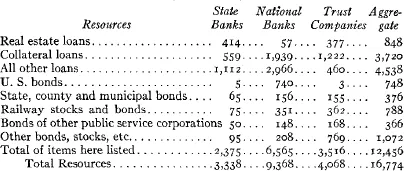
This table makes clear that the figures for real estate loans given in the table for all banks, a few pages preceding, were much too high. It leaves the relations among the other items, however, not greatly changed. “All other loans” increase from slightly less than 23% of total assets to 27%. If we concede that one-half of the “all other loans” represents liquid “commercial paper”—a very liberal estimate, as we have previously concluded—we get about 13½% of the assets of these institutions in the form of “commercial paper,” an increase over the 11½% to be assigned on the basis of the other table. The figure is the roughest sort of approximation. I attach little importance to the exact percentage, and the argument which follows is not dependent on any exact figure here. The proportion of collateral loans to total resources is changed also, and even more: collateral loans are 18% of total bank resources when all kinds of banks are included, and are over 22% of total bank resources when only State and national banks and trust companies are counted. If the foregoing is correct within very wide limits of error as to the amount of commercial paper, collateral loans very substantially exceed commercial paper. If all the “all other loans” should be counted as commercial paper, collateral loans are still not far behind them—22% as against 27½%.
What is the significance of this? We have seen that for national banks, the great bulk (over 66%) of the collateral loans were secured by stocks and bonds in June, 1915. We saw reasons for supposing that a higher percentage of stock exchange collateral would be found when State banks and trust companies are included. Suppose we assume that 75% of the collateral loans of all three classes of institutions here in question are based on stock exchange collateral.1 This Would mean 16½% of the total resources of these institutions in stock exchange loans—still well above the 13½% we have assigned to “commercial paper.” In any case, it is at least justifiable to contend that loans on stock exchange collateral are as great in volume as commercial loans. I think that they very substantially exceed them. But further, we have another large percentage of bank resources invested in stock exchange securities outright—chiefly in bonds. The aggregate for those investments in the institutions under consideration is 3,250 millions. This is something over 19% of the total assets of these institutions. Combining this with the loans on stock exchange collateral, we get nearly 36% of bank and trust company assets invested, directly or indirectly, in stock exchange securities, as against an assumed 13½% in commercial paper. Conceding that all the “all other loans” are commercial loans, the stock exchange assets still exceed them in the ratio of 36 to 27½.
In our second table, we have listed items which aggregate only 12,456 millions of the total resources for these institutions of 16,774 millions. The items listed, however, represent virtually all the credit extended by banks to industry, commerce, agriculture, the stock market, other speculation, and the State. The excluded items of main importance are: Due from other banks and bankers, 2,302 millions; checks and other cash items, 432 millions; and cash on hand, 1,411 millions—the three items aggregating 4,146 millions, which virtually closes the gap. These three items are of immense importance as making for liquidity in banking assets, and as making possible extensions of credit to the business world, but it is not proper to count them when an estimate of the extent of bank-credits is in question. Our second table contains, for the three classes of institutions, all the items properly counted there, except overdrafts (small in amount) and one other big item which does not get into bank statements at all, namely, overcertifications and “morning loans.” Of this last item, more later. We may, then, recalculate our percentages on the basis of the credit extended by the three clasess of institutions, instead of on the basis of total resources. On this basis, the percentages are:
Real estate loans, 7.4%;
Collateral loans, 30%, of which we assign to stock exchange collateral, 22½%, and to other collateral, 7½%;
All other loans, 36.4%, of which we assign to “Commercial paper”18.2%;
Total stocks and bonds, 26%.
Adding the percentages for stock exchange collateral loans and for stocks and bonds owned, we get 48½% of all extensions of bank-credit for these three classes of institutions in the form of credits extended to the security market. If everything else except the real estate loans should be counted as “commercial loans” the stock exchange credit would still exceed the commercial credit. If my estimate of 18.2% of bank-credit based on commercial paper is high enough,1 the banks and trust companies have extended over two and a half times as much credit, at a given time, to the security market as they have to commerce. This on the face of the record. But there is, as above indicated, a further item which does not get into the record, namely, overcertifications and “morning loans.” Every day in the great speculative centres, and very especially in Wall Street, enormous advances are made to brokers, which are canceled during the day, but which, during their short life, are a real addition to bank-credit. To attempt to estimate this with any accuracy is hopeless, but the total on any ordinary day is enormous, and most of it is extended in connection with stock market transactions.
A final comparison,1 which will conclude this perhaps too wearisome analysis of these figures, will consider the loans alone, neglecting the securities owned:
Of total loans:
Real estate loans, 9.3%;
Collateral loans, 40.8%, of which we assign to stock exchange collateral, 30.6%, and to other collateral, 10.2%;
All other loans, 49.6%, of which we assign to “Commercial paper,” 24.8%.
The development of bank loans on stock exchange collateral is a remarkable feature of the three or four decades preceding 1909. The following figures, of national bank loans in New York City,2 illustrate the tendency:
Date |
Loans on |
Advances on |
1886 |
146 |
107 |
1890 |
151 |
145 |
1892 |
160 |
183 |
1894 |
168 |
192 |
1896 |
151 |
162 |
1898 |
181 |
260 |
1900 |
185 |
384 |
1902 |
210 |
396 |
1903 |
239 |
391 |
1904 |
268 |
538 |
The tendency is not peculiar to America, however. The following table gives a classification of the loans and discounts of all the great European banks2 in selected years from 1875 to 1903:
(Figures in francs, 000,000 omitted)
| Date | Note Circulation | Commercial Loans | Advances on Securities |
| 1875 | 9,699 | 4,027 | 828 |
| 1880 | 10,482 | 3,384 | 1,112 |
| 1885 | 11,662 | 4,050 | 1,231 |
| 1890 | 13,194 | 5,192 | 1,549 |
| 1890 | 15,896 | 5,328 | 3,669 |
| 1899 | 14,992 | 8,352 | 4,037 |
| 1900 | 15,906 | 8,514 | 4,171 |
| 1902 | 16,215 | 6,939 | 4,178 |
| 1903 | 16,539 | 6,147 | 4,129 |
We conclude, therefore, that the great bulk of banking credit in the United States, even of “commercial banks,” is not commercial credit. Much of it, in the smaller places, especially, represents in fact, whatever the form, long time advances to agriculture and industry. Most of it, in the great cities, and to a large extent in even the smaller places, represents advances to the permanent financing of corporate industry. Excluding real estate loans, more than half of bank-credit represents either ownership of bonds (with some stocks) or else advances on stocks and bonds. Another important part of bank-credit, which I shall not even attempt to measure, is employed in financing commodity speculation.
It is worth while to compare our figures concerning bank loans with Kinley’s figures, which we have previously considered, for deposits made on March 16 of 1909, the year we have chosen for the bank loans figures. It is important to remember that “deposits,” as used by Kinley in this investigation, does not mean what the term means in a bank balance sheet. Kinley’s figures relate to the actual items deposited on the day in question, and not to the net balance after deposits and withdrawals have been compared when the bank has closed for the day. A large deposit in the balance sheet sense might show no “deposits” in Kinley’s sense, in a given day; while enormous “deposits” in Kinley’s sense might be so offset by incoming checks that virtually nothing is left on the balance sheet at the end of the day, for a given depositor. Kinley’s figures thus give us a means of getting at the degree of activity of different classes of deposits in the balance sheet sense, and so, indirectly, of different classes of loans.
Loans and deposits (in the balance sheet sense) are, as we know, closely correlated. This is true for banks in the aggregate, and for banks individually at a moment of time. It is not generally true of a given individual deposit account at a moment of time, but through a period of time, for business deposits, it tends to be true that the items deposited offset the amounts borrowed.1 If the items deposited are numerous, if the depositor has an “active” deposit account, receiving a large flow of banking funds, as compared with his net deposit balances, we may infer that his loans are also active, that he pays off loans frequently, that his paper, in the assets of the bank, is “liquid.”
I need not give the details of Kinley’s figures again, as they have been elaborately analyzed in connection with the estimate of the “volume of trade.”2 The figures show that retail and wholesale deposits between them make up about 25% of the total deposits. This would serve to show that “commercial paper,” which we have allowed to be about 24.8 of total loans, is slightly more active (and hence “liquid”) than the average of loans.3 It will also suggest, however, that our figure for “commercial paper,” truly liquid, is too high, since we should expect this kind of paper to be more active than the average—unless, indeed, stock exchange collateral loans are so exceedingly active as to make a tremendously high average. I refrain from trying to get a definite answer on this point, since there are many indeterminate elements: among others, uncertainty as To the extent to which wholesale deposits and retail deposits include all commercial deposits, and uncertainty as to the extent to which they exclude manufacturer’s deposits. The great bulk of Kinley’s deposits, however, fall into the “all other” class, and the great bulk of the “all other deposits” are located in the great financial and speculative centres, particularly New York. We have concluded that they represent chiefly (a) transactions in securities; (b) other speculation; (c) loan and other financial transactions, particularly the shifting of call loans on stock exchange collateral. It is, then, the deposits of those connected with the great financial and speculative markets, particularly the stock market, whose deposits are most active, and whose loans are most liquid. Stock market collateral loans thus constitute the most perfectly satisfactory sort of bank loan, from the standpoint of liquidity. Though such loans do not make up the bulk of bank loans (we have concluded that they constitute 30.6% of the loans of State and national banks and trust companies in 1909), they do account for the bulk of banking activity, and supply the greatest part of the liquidity of total bank loans.
When we consider further the item of securities (chiefly bonds) in banking assets, we find another highly important source of liquidity. The sales of bonds in the great banking centres are enormous. The figures of bond sales on the exchanges do not begin to tell the story. One big bank in New York in 1911 sold more than half as many bonds as were sold in that year on the floor of the Stock Exchange.1 It has been frequently stated that ten bonds, of those listed on the Exchange are sold over the counter for one on the floor. This is truer of Boston than New York. The “outside market” for unlisted bonds is a very important matter. Dealings among banks in these items and in foreign exchange are exceedingly important. This is especially true of the business of the great private bankers, as Morgan, Kuhn-Loeb and others. Much of this does not appear in Kinley’s figures, since neither the deposits of the great private banks in other banks, nor the deposits made in the private banks themselves (so far as New York City is concerned) figure in his totals.1 Had they been included, the Percentage of the “all other deposits” would have grown, and we should have had still more impressive evidence of the fact that modern banking in the United States is largely bound up with the security market, and that modern bank-credit gets its liquidity chiefly from that source.
The story is even more impressively told by the figures for bank clearings, which include the transactions between banks, and the transactions of the private bankers. In New York, in 1909, total clearings for the year were 104 billions, as against 62 billions for the whole country outside New York.1 That bank clearings are closely correlated with stock exchange transactions, has been demonstrated fully by N. J. Silberling, who has shown the following correlations: New York Stock Exchange share sales with New York clearings, r = .718; total clearings for the country with New York share sales, r = .607; total clearings for the country with railway gross receipts (as representative of ordinary trade), r = .356.2 The active deposits and the liquid loans are chiefly connected with activities in finance and speculation.
Now two important practical conclusions are suggested by this analysis. The first is that the complaint of many farmers, merchants, politicians, and even scientific writers That too much money and bank-credit are at the disposal of Wall Street and other speculators rests on a misunderstanding of causal relations. Wall Street does not, by using a large amount of bank-credit, take just that much away from ordinary business. Rather, it increases the amount available for ordinary business! Wall Street, and the other financial and speculative centres, supply the liquidity for bank assets, and so make possible loans on non-liquid paper. Banks do not need to have all their assets liquid. If they did, American banks would have long since gone under! The foregoing discussion of loans to farmers, and manufacturers and even merchants should have made that clear. But banks do need a substantial margin of liquidity, to protect the rest. They get it from stock exchange collateral loans, and from ownership of listed and easily marketable bonds, primarily. They get part of it from true commercial paper. Thus, the director of a country bank in Iowa told the writer that banks in his section—where banks owned in large measure by farmers, and dealing largely with farmers, are very numerous and important—make a regular practice of buying, through brokers, a considerable amount of notes of outside merchants. They do this to protect themselves. Their other loans, to farmers, while good, are slow. If pressed themselves, they cannot press their depositors. These notes bought through note-brokers, however, are impersonal. They can refuse to renew them. They can sell them again. They thus buttress the rest of their assets. They can thus lend more, rather than less, to local customers. They can safely get along with much smaller cash reserves. Similarly with the practice of country banks of sending a large part of their cash to Wall Street banks to be lent on call, for which the country banks get, say, 2% from the Wall Street banks. Their country customers would pay 6% or more for that money in some cases, but the banks dare not tie up more of their assets in non-liquid local paper. They lend more, rather than less, at home, because they send part away. Wall Street is not “draining our commerce of its life blood”!1 Wall Street is rather preventing that life blood from coagulating!
A second important practical conclusion relates to the provision in the Federal Reserve Act which forbids Federal Reserve Banks to rediscount stock exchange paper. This provision was intended to keep funds from being diverted from commerce to stock speculation, and doubtless met the approval of many very good students of the subject. If the foregoing be true, however, that provision is a mistake. It is a mistake, first, because it will lessen, rather than increase, the power of the Reserve Banks to provide relief to commerce through aiding in making bank assets liquid via the stock market. It will limit the liquid assets of the Federal Reserve Banks in too great a degree to gold. It is a mistake, in the second place, because it prevents the Reserve Banks, particularly in New York and Boston, from making satisfactory profits—which is one important purpose of a bank! Even more important, however, is the third objection: it prevents, in large degree, the Federal Reserve Banks from being effective weapons against the “Money Trust.” How far we have a “Money Trust” need not be here argued. The Pujo Committee, relying in considerable degree on admissions of prominent financiers that “concentration had gone far enough,” and on the inability of Mr. Baker to find more than one issue of securities of over $10,000,000 within ten years, without the coöperation or participation of one of the members of a small group, concluded that we have a “Money Trust” in the sense that there is “an established and well-defined identity and community of interests between a few leaders of finance . . . which has resulted in a vast and growing concentration of control of money and credit in the hands of a comparatively few men.”1 How far this conclusion is justified is, of course, a matter that would require elaborate discussion. There seems to be evidence that there is, since the death of the elder Morgan, a decided loosening of ties. One feels the need, moreover, of discounting very considerably many of the conclusions of the Pujo Committee. The present writer feels that the case has been made, however, that there has been, and probably continues, a much greater concentration of such control than is desirable. Whether or not there is at present such a “Money Trust,” it seems pretty clear that temporary, if not permanent, alignments, may give effective monopoly control when the issue of very big blocks of securities is involved. For present purposes, however, it is enough to note that if there is, or should come to be, a “Money Trust,” it is a trust concerned with financing industry, through handling security issues, and not a trust in the granting of ordinary commercial credit.2 If, therefore, the Federal Reserve Banks are to compete with it, and break its monopoly, they must do it by entering the market with funds for the financing of corporate industry. Power to rediscount commercial paper seems a feeble and hardly relevant weapon against a combination concerned with purchasing securities, and making collateral loans! No doubt, this power is worth something. If an independent investment banker wishes to compete with a “Money Trust” in financing a new enterprise, he can go to his commercial banker, and offer collateral security for a loan; if the commercial banker wishes to aid him, but is short of lending power, he may, if he has plenty of commercial paper available for rediscount, rediscount it with the Federal Reserve Bank, and so get the additional funds. But a New York bank, or trust company, with the bulk of its assets in stock exchange investments, may well not have enough commercial paper eligible for rediscount, and the Federal Reserve Bank could help very much more effectively if it could take collateral loans directly. A fourth, and even more important objection to the restriction on stock exchange collateral loans for Federal Reserve Banks relates to the power of these banks to aid in a crisis. Crises first hit the stock market. Financial panics are most acute there. The need for immediate and drastic relief is greatest there. If stock exchange loans lose their liquidity, what of the rest of bank loans? Power to lend on stock exchange collateral, in the hands of the Federal Reserve Banks, may well prove, in crises, an essential, if we wish to make our system definitely “panic proof.”1
And now for a vital theoretical conclusion from this lengthy analysis of bank loans. For the quantity theory, and the “equation of exchange,” all exchanges stand on a par. If one exchange takes place, that lessens the money and credit available for another exchange. The more exchanges there are, the less money and credit there are per exchange, and the lower prices must be, as a consequence. Nothing could be more false. Exchanges are not on a par.1 Some classes of exchanges increase, rather than decrease the funds available for handling others. The activity of the speculative markets, making loans fluid, enormously increases the lending power of the banks for all purposes. Exchanges of securities, especially, instead of lowering prices, make it easier for prices to rise.2 The years of extraordinary stock sales have always been “bull” years. There have been big “bear” days,1 but never big bear years, in the record of New York Stock Exchange share sales. The selling and reselling of speculative goods of securities, and of notes and bills are especially important as making it easier for banks to expand loans. To list all manner of items, as Professor Fisher does,2 “real estate, commodities, stocks, bonds, mortgages, private notes, time bills of exchange, rented real estate, rented commodities, hired workers,” and count them all as “actual sales,” all part of the “goods”3 which make up the “volume of trade,” is to put the theory utterly beyond the pale. Seasonal calls on an inelastic money supply for actual cash to move crops and pay agricultural wages may make a real difference in the value of money; scarcity of money of the right denominations for retail trade may give an agio to such money,4 but the money and credit used by speculators, bill brokers, dealers in foreign exchange, investment bankers, etc., increases, rather than decreases, the funds available for ordinary industry and commerce.
I have made clear the distinction between the direct and indirect financing of industry by banks. Great banks in Continental Europe often buy the stocks of new corporations, hold them permanently, put bank officers on the boards of directors, and supervise closely the operations of the companies. In America, while officers of commercial1 banks often are members of boards of directors of the companies which borrow heavily from the banks, the practice is to make short-time loans to such companies (in form, if not in fact), and to lend on their securities, rather than to buy them. Our banks own securities in enormous amount, but they are chiefly seasoned bonds, rather than stocks of new or even well-proved, enterprises.
It is commonly supposed, too, that collateral loans are chiefly or almost wholly made to speculators, who buy securities in the expectation of holding them only till investors take them off their hands, and that investors buy them, not with bank-credit derived from loans, but with money or bank-credit which they accumulate by saving out of current income. It is particularly true of the higher grade securities, which savings banks and insurance companies can buy, that this is the case. The bank-credit thus serves for temporary, rather than for permanent financing, to the extent that this is true. I think, however, that the extent to which bank-credit serves for permanently financing industry is underrated. A good many investors have learned that the short-time money-rates are, on the long time average, lower than the yield on long-time securities.2 They have learned, too, that high-yield securities—securities high in yield as compared with the long-time average of money-rates—can be obtained which can safely be carried on margins of thirty, forty and fifty points, without danger that even such catastrophes as the slump in security prices at the outbreak of the War will wipe the margins out. The old distinction between investors and speculators, the former those who buy for the yield, and the latter those who buy for an anticipated rise in capital value, no longer corresponds to the distinction between those who buy outright and those who buy on a margin. The investor, buying a 6 or 7% preferred stock, carrying it on a forty point margin, with money from his bank or broker at 4 or 5%, is making 6 or 7% on his own forty dollars, and is making the difference between 6 or 7% and 4 or 5% on the sixty dollars lent him by his banker or broker. He substantially increases his yield thereby, and his risks, if he chooses his stocks carefully, and scatters them among a number of issues, are not great. For the banker or broker, such a loan is perfectly satisfactory. The margin of security is wider than that demanded on more speculative securities. Such a borrower will receive consideration when more speculative loans are being called, or not renewed. The investor of this type is, in effect, engaging in a form of banking business. He is lending to the corporation funds which he has borrowed from others; he has put up his own capital for the same purpose that the bank uses its capital—to supply a margin of safety to those who have taken his short-term promises to pay. Like the bank, too, he converts rights to payments at a later date into rights to payment at an earlier date. He is one of the links in the chain whereby the wealth of low saleability employed in industry becomes distilled and refined till it enters the money market. His profits come in the difference in the yield as between more saleable and less saleable forms of rights.
The extent of this practice cannot be stated, so far as any data to which the present writer has access are concerned. The writer has met the practice in a good many cases. One brokerage house, with whose operations the writer has considerable acquaintance, makes a practice of advising its more conservative customers to do this. A good many brokerage houses sell investment securities on the “instalment plan,” which often means, in practice, that the initial margin put up by the investor is his only payment, and that the security is gradually paid for by letting the yield increase the margin. During the extremely easy money of the present War period, occasional reference has been made in the financial papers to the practice of buying even the highest grade bonds on this basis—the yield of the bonds being very substantially higher than the money-rates, giving a comfortable profit to those who hold the bonds on a margin.
That the practice is not wider spread is due primarily, probably, to the temperamental qualities required. The investor, proper, is commonly a very conservative person, who has an unreasoning distrust of speculation, and to whom the word, “margin,” necessarily suggests speculation. That buying a stock on a margin is the same sort of thing as buying the equity in a mortgaged farm, does not occur to him. On the other hand, the man who knows the market well enough to be willing to deal on margins, frequently is not content with the slow process of accumulation which comes from annual yields, and prefers to take larger chances in speculation on capital values. But there is an intermediate class, who buy investment securities, with narrow range of fluctuation in capital values, for the sake of the yield, and who buy them on margins, margins ample to enable them to sleep at night, and to neglect the daily market reports. I think that there are indications that this class is growing larger, and more important. Doubtless much more important than individual “bankers” of this sort, however, is the enormous number of houses dealing in securities, “wholesalers” and “retailers,” who find profit on their “wares” even while on their “shelves,” through the differential between the yield and the charge made by commercial banks on collateral loans. A very large percentage of collateral loans is made to institutions of this type. As this practice becomes more important, the result must be to widen the money market, to increase the proportion of banking capital that goes permanently into financing industry, and to reduce the difference in yield between short-time paper and long-time securities—in other words, to bring the “money-rates” closer and closer to the long-time interest rates.
This would have seemed very strange and weird to Adam Smith. It means, in effect, that the bulk of our banking credit is, directly or indirectly, financing our industry rather than our commerce. Adam Smith thought that a bank could safely lend to its customers only so much as they would otherwise keep by them in the form of money. Perhaps this notion, as growing out of some speculations regarding the general theory of money, should not be taken as the statement of Smith’s practical attitude on the matter, but that practical attitude, as clearly expressed in the paragraph1 following, is that a bank can afford to lend only for mercantile operations that are carried through in a very moderate time, that the bank can afford to supply only the minor part of the circulating capital, and no part of the fixed capital, of a merchant, or manufacturer, no part of his forge and smelting house, etc. Such loans lack the liquidity which the bank must insist upon. Only those persons who have withdrawn from active business, and are content with the income upon their capital, can afford to lend for such purposes. The theory is sound, on the basis of the facts as Smith knew them. But modern corporate organization and modern stock markets have changed all that. Anything that is highly saleable can come into the money market, and the modern corporation organization of business, coupled with organized stock exchanges and a large and active body of speculators, has made the forge and the smelting house as saleable as the finished product.
This is not to accept Schumpeter’s doctrine,1 so far as the United States are concerned, that it is primarily the bankers, the manufacturers of bank-credit, who make the decisions that turn industry from old to new lines. They do not, on the whole. In Continental Europe, particularly Germany, they do to a much greater extent. Criticism has been made of our American commercial bankers, as contrasted with German bankers, that the former are parasites, who insist on sure things, and refuse to take chances with other business men in the development of industry. To the present writer, our banking system seems to be rather a more developed system than that of Germany, in that the “division of labor” has gone further with us, and risk-bearing and the manufacturing of bank-credit have been more sharply differentiated. We have bankers enough who are “risk-bearers.” But they are, on the whole, “private bankers,” “investment bankers,” and the like, who do not manufacture a great deal of deposit credit, but rather borrow heavily from the commercial banks, which are the great manufacturers of bank-credit. Under our system, the decisions which divert industry from old to new lines are more democratically made, by speculators and investors under the leadership of private bankers, and sometimes without that leadership. These constitute the important intermediary which transforms stock exchange securities into the basis of bank-loans. The commercial banker buys, in general, not the stocks, but the note of the private banker, broker, speculator, or investor, with the stocks as collateral. If investment bankers, speculators and investors decide to support old ways of doing things, the banks lend on the securities of the old kinds of businesses; if investment bankers, speculators and investors turn to new things, the commercial banks follow suit. Commercial banks can and do discourage certain types of enterprises by refusing loans with their securities as collateral, or by requiring very heavy margins with such loans, but even these may be developed, and are with us on a large scale developed, on banking credit, advanced by the speculators and private bankers who borrowed it from the commercial banks with other securities as collateral. The commercial banks of the United States may to a very considerable degree check dynamic tendencies, but in general, they do not lead and direct them. Bank-credit, directed by others than commercial bankers, does, however, enormously facilitate both the starting of new enterprises and social readjustment to them.
How far can the total wealth of the country, agricultural as well as industrial, be brought into the circle of the money market? The full answer to the question would go far beyond the limits of this book. If agriculture can be brought under the control of large corporations, there is little reason for supposing that it, too, might not come in. There are some peculiarities of agriculture, special dangers of drought and flood, dangers of over-production and low prices, wide seasonal fluctuations in conditions, which make it hard to standardize in any case. But mining and even the manufacturing of such things as primary steel products have wide variations in prosperity too. So long, however, as agriculture remains a matter of families on a homestead—and for social and political reasons, we may hope that this will always be the case—it is difficult to bring it in. Bonds of agricultural associations or of agricultural banks have had limited sale on the bourses of Europe. The present writer, for example, found it impossible to find in four great libraries in New York and Boston any quotation of the bonds of the Bayerische Land-wirtschaftsbank. Apparently, in general, such securities have not high saleability. While this remains true, agriculture may expect to remain under a handicap of higher interest rates than industry and commerce.
If, however, all forms of wealth could be made equally saleable, we should find interest rates rising for those loans and securities which now have the highest saleability. They would lose the peculiarity which now enables them to perform a service as bearer of options. Money-rates and long-time rates of interest would tend to come together. Long-time rates on formerly unsaleable loans would fall, and rates on highly saleable loans would rise. The present low rates in the “money market” grow out of differential advantages.
We turn now to the third important aspect of the technique of banking, namely, the matter of cash reserves. First I would point out that this is merely a part of the more general problem of liquid assets. The difference between cash and liquid paper is a matter of degree. There is large possibility of substitution of the one for the other, as it becomes more profitable to use one or the other. When money-rates are low, it may well be worth while to carry large reserves; when money-rates are higher, the gains to be made by substituting paper for cash in the bank’s assets are much greater. I have pointed out the use which great European banks, notably the Austro-Hungarian Bank, make of foreign bills of exchange as “reserve,” selling bills when money is “easy,” and the yield on bills is small, buying bills when money is “tight,” and the yield on bills is large.1 The great Joint Stock Banks of England, the chief sources of bank-credit in the great banking country of the world, also make use chiefly of deposits with the Bank of England as their “reserves.” Some cash they keep, but it is “till money,” rather than reserve. They carry, also, “secondary reserves” in highly liquid paper, stock exchange loans and commercial bills. The differences are differences in degree. The Bank of England does keep a large reserve in cash (including notes of the Issue Department and gold bullion) but it denies that it has any definite ratio in mind,2 and it protects its reserves, when they are low, not by ceasing to loan, but by raising its discount-rate. The whole thing is highly flexible.
This is, in general, true throughout the world,3 where banking is highly developed. A country which has expanding business, based on rising values of goods and rising capital values of anticipated incomes, which in turn grow out of increasing business confidence, etc., and out of the development of new enterprises which make readjustment necessary, expands its bank-credit to meet the situation. Expanding bank-credits in time grow so large that bankers feel larger cash reserves to be desirable. Their reserves may be also, in some measure, drawn upon by the growing retail trade and wage-payments, which call for more money in circulation. They meet the situation by raising money-rates. This tends to prevent the exportation of gold, and tends to encourage the importation of gold, which finds its way into bank reserves. Banks may even borrow directly from banks in other countries, to get the gold they need, or to prevent the exportation of the gold they have. The higher money-rates, also, tend to check marginal borrowing—the borrowing by those who see only very small profits to be made by the use of the bank-credit they borrow. If the rising values of goods, however, and the profits to be made by effecting exchanges, speculative and other, are large, the volume of bank-credit will, none the less, grow. If the tide of rising business confidence is strong, the banks will be disposed to accept securities and rights as collateral which they would distrust at other times. A very big difference indeed may appear between bank reserves in active times and bank reserves in dull times. The banks need less reserves in proportion to deposits in active times, because the very activity itself increases the liquidity, the saleability, of their paper assets, and so makes actual cash less necessary. Even in this country, the practice of counting deposits in other banks as reserve is well developed. This is not only true of country banks, or banks outside the reserve cities. It has been, in considerable degree, the practice of the big trust companies in New York City. It is the practice of private bankers connected with the stock exchanges, and the practice of brokers, who are, for many purposes, bankers, especially those who allow their customers to check on their accounts. Such houses may carry no cash at all. One, with whose workings the writer is somewhat familiar, makes the rule—“We pay by check and receive only checks.” None the less, this house allows its customers to check upon it, and checks drawn on it perform all the functions of checks drawn on banks which keep a cash reserve. Of course, our new Federal Reserve system is built, in part, on the principle of collecting reserves in central reservoirs, and our banks will doubtless increase the practice of counting deposits with other banks as reserve.1 They will feel the need for less reserves, also, with a wider rediscount market.
Within a given country, I think that we may safely generalize the doctrine that the causal relation between reserves and deposits is exactly the reverse of that asserted by the quantity theory, within very wide limits indeed. That is to say, increasing reserves are a result, and not a cause, of increasing loans and deposits. We shall further hold that the relation between them instead of being definite, is highly flexible. This is not to assert that reserves may not increase without a prior increase in loans and deposits. That has happened in the United States during the present War. It does mean, however, that increasing loans and deposits will pull gold into a country, and that increasing reserves do not force increasing deposits and loans.2 If a country’s business is growing, if that business is soundly based, so that expectations are being met, obligations being paid out of the income which arrives, on schedule time, to meet anticipations, there need be no effective check to the amount of gold that will come into the country to serve as reserves, within limits that are rarely reached. It is miscalculation, maladjustment of costs and prices in particular enterprises, failure of “interstitial adjustments,” especially failure of particular crucial links in the business chain, as the businesses engaged in producing iron and steel, to respond to the needs of other expanding businesses, that check movements of expansion in business, not inadequacies of bank reserves.1 As long as only wise plans are made, as long as they meet no mishaps, as long as the carrying out of the new plans does not itself so change the facts on which the calculations of business men have been based as to cut under anticipated profits, so long may business, within a given country, expand without danger from inadequate reserves. Of course, if the whole world is simultaneously expanding, the competition for gold in the international money markets may be so severe that all may be hampered.
That reserves will increase, as expanding credit, due to increasing business or rising prices, requires increased reserves, can hardly be disputed, I think, if we look at a country of small size, or (what is the same thing from the angle of economic analysis, so far as the present problem is concerned) if we take a particular part of a country. Seasonal movements of cash for reserves in this country have been obviously determined by the movements of credit, rather than the reverse. Expanding business at crop moving seasons, requiring advances of credit by country banks, and an unusual drain on the cash resources of the country banks, has regularly meant that the country banks draw cash from the New York banks. When the need for such cash in the country banks passes, when they can no longer employ it to advantage at home, they send it back to New York. New York, to meet the emergency caused by the withdrawal of cash, draws to a considerable extent on Europe for gold. It is not as easy for New York to get gold quickly from Europe as it is for France to get gold in an emergency from England. More time is required. Inelasticity, too, in the forms of currency most needed for small transactions, has made very real difficulties for us. But that, within the country, the sections whose business and credit were expanding take cash reserves from those sections where credit is less urgently demanded, needs no debating. This is seasonal. But the same thing is true in the long run. As business and bank-credit have expanded, year by year, in Oklahoma, Oklahoma’s cash reserves have grown. Bank-credit in a country cannot go on indefinitely mounting, if bankers are making unsound loans, if the values on which the loans rest are based on vain imaginings, if anticipated profits are not realized. But if a country have rich resources and intelligent entrepreneurs, with sagacious bankers who can discriminate between sound and unsound business, it may, within very wide limits indeed, expand its bank-credit without check from inadequate reserves, as its business expands, and as prices, particularly prices of lands and securities, rise.1
If the country in question be a very large country, however,—large in the sense that its business and volume of bank-credit are very large, and particularly in the sense that bankers’ assets are of such character that a large volume of reserves is desirable—restraints on the process of expansion may come. Reserves will come in, but the resistance in stiffer money-rates will be felt. Bankers in other countries will compete with the bankers in the country in question for reserves. Rising money-rates will put an end to many marginal exchanges. They will lessen the saleability of many rights which might otherwise be available as banking collateral. The extension of bank-credit will feel a drag. There is large flexibility here. But, in a long run period of many years, the volume of gold in the world will impose a maximum limit upon the possibility of expansion of bank-credit in the world as a whole. This limit is doubtless never reached. Within the limit, the variations in the volume of the world’s credit are primarily determined by the other concrete factors we have been discussing. Proportionality between the world’s gold and the world’s volume of credit does not at all obtain. Under certain conditions, much higher proportions of reserves to bank-credit will be found in a given country than at other times, and the same will be true in the world at large.
I would refer again to the discussion by J. M. Keynes, quoted in Part II.1 Reserves have absorbed enormous quantities of gold, easily obtained as a consequence of abundant gold production, in the past fifteen years. Proportions of gold reserves to bank-credit have grown. In the preceding period, when gold production went on less rapidly than business development, percentages of reserves were lower. Most bankers feel better with large reserves. When they can get gold, they prefer gold to other substitutes. When they cannot easily get gold, they use other substitutes, of the various kinds of paper, particularly, which have been described. Gold differs from other things, in bankers’ assets, in degree, rather than in kind. Instead, therefore, of the law of the proportionality of reserves to volume of bank-credit, I venture the generalization2 that, as gold production increases rapidly, the tendency is for the proportion of gold reserves to volume of bank-credit to rise; with diminished gold production, the tendency is for the proportion of reserves to fall, assuming that the factors other than volume of gold production which make for expansion of business maintain themselves.
Increasing volume of gold tends to increase the volume of trade. But there are other causes for the increase or decrease of trade as well. These causes, working in harmony with rapidly expanding volume of gold, lead to a very rapid growth of trade.1 Working in the face of a drag from less rapidly growing gold supply, they strain the possibilities of bank-credit expansion. Various substitutes for gold in bank reserves are employed. Substitutes in the form of other forms of credit are employed. Barter is resorted to increasingly. Methods of employing other things than gold in the retail trade of a country are resorted to. “Gold-exchange” standards are devised. Countries “wait their turns” to come on the gold standard. Coöperation, not only within countries, but among countries, seeks to economize the scanty stock of the precious metal. Very large slack is thus revealed. But the expansion of business is checked, the volume of business confidence is reduced, the values of future incomes in enterprises is lowered, production is checked, and prices are reduced, (a) because the value of money rises; and (b) because the values of goods and income-bearers is reduced. The exchange side of production is hampered. Substitutes for gold, through increased activities of bankers and other agents of exchange, are costly. Greater tolls on values are taken by those who handle the mechanism of exchange. It does make a difference whether or not the world’s gold is abundant! But the difference is not made solely, or even mainly, in the price-level.2
The reserve function of money is essentially a dynamic function. The reserve function is merely a phase of the bearer of options function.3 It is the practice of quantity theorists to speak of “normal” ratios between reserves and deposits (or reserves and demand liabilities), and to speak of the “static” laws governing this relation. This is true of Kemmerer, of Fisher, of A. P. Andrew, and, in general, of contemporary quantity theorists. Kemmerer very explicitly puts it as a matter of static theory, “If we divide the money of the country into two parts; one, that used directly in daily cash transactions, and the other, that kept in banks as reserves, it may be said that, under perfectly static conditions [italics mine], the proportion of the total represented by each of these parts would be constant. Each banker would find from experience what proportion of reserve to liabilities it was advisable for him to maintain, and would order his business, as far as possible, so that his reserve would neither exceed nor fall below that most desirable proportion.”1 Kemmerer quotes the following passage from A. P. Andrew: “In the long run, as apart from cyclic oscillations, the quantity of bank-credit is governed by the quantity of money.”2 Fisher’s view we have considered at length in Part II. It is essentially the same. He is working with the statics of the problem of money and credit. These different writers differ greatly in the extent to which they would insist on the validity of their static tendency in real life. Professor Fisher, as we have seen, is exceedingly uncompromising, holding tenaciously to his principle as subject only to slight modification during transition periods. Professor Kemmerer, in the chapter from which the quotation just given is taken, gives an important realistic analysis of dynamic conditions, and makes liberal concessions to the view that the ratio is not constant in real life.3 Professor Taussig, whose view was summarized at length in chapter IX, finds, in real life, so many exceptions to the doctrine of proportionality of reserves and deposits that he virtually abandons that doctrine. What I wish to insist on here, however, is that there are no static laws possible in this connection. The reserve function is a dynamic function. The theory of reserves must rest in an analysis of friction, of transitions, of dynamic uncertainty and dynamic change. It is a part of the general theory of liquidity of bank assets, of saleability of rights, and the like. If one can find a “normal” amount of dynamic change, a “normal” amount of uncertainty, a norm for the coming of technical inventions, a normal prospect of war, a normal rate of gold production, a normal rate of growth for population, a normal amount of Jew-baiting in Russia, with a norm for migration, and if one can hold these norms, and a multitude of similar norms, in fixed relation to one another, one might have justification for speaking of a “normal ratio” of bank reserves to bank demand liabilities!
Apart from dynamic changes, from frictional elements which create uncertainties, in general, apart from uncertainty and irregularity and lack of “normality,” there would be no occasion for bank reserves at all! To the extent that static conditions are realized, bank cash reserves may be, and are, dispensed with. It is well known that England gets along with surprisingly little gold. The total stock in the country has been smaller than the gold reserve of the Banque de France, and much of the gold in England was in use among the people, since small paper money (before the War) was not in use in England. The gold reserve of the Bank of England has been usually only a fraction of that of the Banque de France. Some years since, the distribution of gold as between England and the United States, was, roughly, England six hundred million dollars, the United States, one billion, six hundred million. A larger proportion of gold was in reserves in the United States than in England. Yet England was doing the banking business of the world, while we had trouble in doing our own! The Bank of England carries virtually the only reserve in the country. The Joint Stock Banks, with demand liabilities vastly in excess of the demand liabilities of the Bank of England, carry only “till money” in cash or Bank of England notes, and for the rest, carry as their “reserve” their deposit credits with the Bank. A great deal of criticism, from Bagehot down (to go no further back) has been directed at the “inadequacy” of English banking reserves, and many dire predictions have been made as to the dangers that impended unless the reserves were increased. We shall probably hear less of this after the War! The Bank of England still stands! It has never failed to pay out gold over its counters, even though it has, with the aid of the government, doubtless restricted and controlled foreign shipments of gold. But it has met the unprecedented emergency better than any other bank in Europe, and today (Sept. 1916) is in exceedingly good shape. Sterling exchange at New York seems “pegged” at the “lower gold point,” and apprehensions regarding the stability of the English financial system seem definitely allayed. It is aside from our present purpose to discuss war time conditions. I am rather interested in analyzing the features of the English money market which have made it possible, in the period preceding the War, for English bankers to get on with so little gold. As will appear, it is because English business and financial affairs have been more nearly “static,” have come nearer to realizing the assumptions of static economic theory, than is true of any other country on earth.
The very fact, for one thing, that England is the great international banker has meant a scattering of risks. Acute panics do not come in all countries on the same date. Bad business in one country may be offset by good business in another; drains of gold to one country may be met with gold flowing in from others. The same considerations which tend to stabilize the railroad business, as compared with, say, cotton-growing, apply to the international banker as compared with the banks of a single country or section. But further, the London market has developed coöperating agencies for smoothing out friction and eliminating uncertainties to a degree unknown anywhere else. An anonymous writer in The Americas for April, 1916,1 has given an exceedingly interesting account of this organization of the London market,—the product of the development of generations. Let us enumerate some of the points: There is nowhere in the world so much expert judgment in the grading and evaluating of hundreds of commodities from all parts of the world. There is, coupled with this, a worldwide reputation for the experts of absolute integrity, so that producers in remote countries regularly ship (“consign”) to London cargoes without definite arrangements, knowing that there are in London organized facilities by which the commodities are warehoused, expertly and fairly judged, and either sold at once or else made the basis of a collateral loan against which they can draw immediately. The institutions which make this possible are (a) the system of warehousing, with its certificates or warrants which give absolute title to the goods, and which are easily negotiable; (b) the organized arrangements in connection with the warehouses by which commodities are received and either graded as they are, or separated and mixed with others to form standard blends readily marketable—this with rigid integrity and expertness which the whole world trusts; (c) a speculative community which has unlimited banking credit, ready to buy at a concession in price virtually any commodity—honey in the comb, sealing wax, pianos, farm machinery, what not; (d) the organized markets or periodical auctions which speculation and final purchase together support; (e) the banks, which, relying on the standardization of the commodities and the readiness of the speculative community, can without hesitation lend the money on which the distant shipper is relying to conduct his business.
What comes to London is fluid. Everything comes to London! The multiplicity of items dealt in gives stability to that business which deals with all—the banking business. The London Stock Exchange is no provincial affair, easily demoralized by an adverse rate decision! Securities of every country on earth are listed there, and speculated in. It must be a world catastrophe which really demoralizes the London stock market.
It will doubtless seem strange to many to say that New York cannot displace London as the centre of world finance, that the dollar cannot displace the pound sterling in financing international trade, because New Yorkers do not speculate enough! They do speculate enormously, but not in many things. A restricted list of stock exchange securities—almost wholly American; cotton—in which New York is the world centre; coffee, in which New York has the largest volume of speculative futures, though yielding precedence, ordinarily, to Havre, Hamburg and Santos1 in spot transactions. There is extensive sugar speculation at the New York Coffee Exchange, which has, indeed, recently changed its name to indicate the fact. There is a produce exchange in New York, but it is a very small affair as compared with the Chicago Board of Trade, and its operations and scope are infinitesimal when compared with the produce speculation in London. Of course, there is a vast deal of unorganized speculation in many things in New York, as in business everywhere, particularly in America. But, while the pecuniary magnitudes of organized speculation in New York are very great, the range of items dealt in is restricted. New York banks cannot possibly get such a variety of collateral, based on standardized and readily marketable goods and securities, as can London. New York, consequently, cannot finance international trade, save as an auxiliary to London—and New York banks must have vastly more gold in their vaults than London bankers need! As goods and securities become more marketable, gold—whose services are needed because of its superior marketability—becomes less necessary.
The whole story of London’s organization would be a long one. London financial institutions have a degree of expertness, growing out of specialization, in large part, which makes all manner of paper fluid in the London money market which would lack fluidity in New York. The Acceptance Houses are a sort of international Brad-street and Dun. They know intimately the standing and business of houses all over the world. They do not give out their information, but they do put their stamp on the paper of business houses, thus standardizing it, lending, not money, but “pure credit,” while the other banks, relieved of the necessity of investigating the paper, can buy it as a miller might buy No. I wheat. There is the extraordinary extension of insurance, so that virtually any kind of risk may be shifted to those well able to bear it. All this makes for liquidity, for “static” conditions in the money market, and dispenses with the need for gold.
As we approach static conditions, we need less and less gold reserve behind bank demand liabilities. The static law of bank reserves is that none are needed! I think we have here the real reason why writers who have sought to give us the law for a “normal” ratio have given us such vague phrases as “shown by experience to be necessary,” and the like. When irregularity of income and outgo in a bank’s business, non-liquid assets, business cycles, uncertainties, legislative changes affecting business, crop failures, changes in demand, new inventions, wars, are abstracted from, no reason can be given why a banker should keep any reserve at all! But these things are dynamic things. And it is characteristic of irregularities that they are irregular. To get a “normal” ratio out of them is not easy.
On the static assumptions, an “ideal credit economy” is perfectly possible. If everything that needs to be marketed is perfectly marketable, if the stream of business flows regularly and without friction in the same channels, if all contingencies are foreseen and dated in advance, a bank needs no cash reserve. All payments can be made by bank-credit. Banks bookkeeping becomes merely a refinement of barter, with money remaining as a measure of values, a unit for reckoning, but not being used as a medium of exchange, or as a bearer of options, or in reserves. The measure of values function is the great static function of money.
To the extent that static assumptions are not realized, we need money in bank reserves. This extent is a thing that varies from time to time, and from place to place. It is not the same for a given place from time to time, nor is it the same at all places at a given time. It is not the same for the whole world from time to time.
Since friction, preventing the free marketing of goods and securities and services, exists, since there are dynamic changes which require readjustments through exchanges, we need the work of the banker and he needs cash. But there are other things than money which make for the “statification” of the market. The speculator does it. And the other agencies of the sort represented in the London market do it. They are substitutes for gold. Gold has no monopoly. The services performed by gold can be performed in many other ways, and by many other agencies. There is enormous flexibility in the matter.
1Cf., e. g., pp. 135ÌT. of Scott’s excellent Money and Banking, Rev. ed., New York, 1910.
2 The year 1909 is chosen, in order that comparison may be more readily made with the figures of Dean Kinley’s investigations based on reported deposits made on March 16 of that year. The figures quoted are taken from p. 39 of the Report of the Comptroller for 1913.
1 Even excluding the item “due from other banks and bankers,” as representing duplications, the item “other loans and discounts” remains approximately only one-fourth of total banking assets.
1 Almost all agricultural processes require more than six months from their inception to the marketing of the product.
2 This view would seem to correspond with the view of Babson and May [Commercial Paper, 1912), and of W. A. Scott (“Investment vs. Commercial Banking,” Proceedings of Investment Bankers’ Association of America, 1913, PP. 81–84). Both of these discussions appear in Moulton, Money and Banking, Pt. II, pp. 70 and 75–77. Dr. J. E. Pope considers the view correct. On the other hand, Professor O. M. W. Sprague thinks the “other loans and discounts” of large city banks are more liquid than my statement would indicate.
1Principles of Money and Banking, II, p. 52.
2Report of the Comptroller of the Currency, vol. II, pp. 145 et seq.
1 Total collateral loans in New York City on that date were $719,327,596. This is for national banks alone. Report of Comptroller, 1915, II, 144. There is every reason to suppose that if trust companies and private banks were included, the proportion of stock exchange collateral loans would be very much higher.
1 I am very fortunate in having the views of Dr. J. E. Pope on this question. I know no one whose knowledge of agricultural credit, whether of American or of European conditions, is so thorough and extensive.
1 This table is constructed on the basis of data in the Report of the Comptroller for 1913, pp. 774–78.
1 A single observation does not justify very confident conclusions, and figures for subsequent years may alter this. There is reason for supposing that commodity collateral was unusually large in proportion in the Comptroller’s figures for national banks in June, 1915, (1) because the banks had been trying to reduce stock collateral loans, following the collapse of the outbreak of the War, (2) because they were aiding cotton owners to tide over a period of stress, and (3) because of great grain speculation. Later: 1916 figures show this. Comptroller’s Report, I, p. 30. Stock loans increase from 66% to 71.2%, of collateral loans.
1 The preceding argument would indicate that it is much too high.
1 The figures for 1909 are fairly typical of the proportions of these items in the assets of the three classes of institutions for the ten years from 1904 to 1914. Since 1909, there has been some increase in the percentages of real estate loans and “all other loans,” at the expense of the percentage of securities owned, and collateral loans, as these years have been years of reduced activity on the Stock Exchange. The changes are not important enough, however, to modify any conclusions which we shall base on the figures here given. All classes of loans have grown, and investments in securities have grown, but real estate loans and “all other loans,” particularly the latter, have grown somewhat more rapidly.
2 These figures are taken from Conant, Principles of Money and Banking, vol. II, p. 52.
1 The term “commercial paper,” as here used by Conant (whose source is the Comptroller’s Report for 1904 and preceding years), doubtless includes a good many items which we have decided not to count as commercial paper. The item, “advances on securities,” also includes some items other than stock exchange loans, but not a high percentage in New York City. In 1913 the figures for all reporting banks in New York City were: collateral loans, 1,070; “other loans,” 658. Report of Comptroller, 1913, p. 779.
2 Taken by Conant (Ibid., p. 51) from the Économiste Européen (April 29, 1904), XXV, p. 546.
1 For the depositor who borrows from several banks, but deposits only in one,—as a stockbroker—the items deposited will, of course, substantially exceed the amounts borrowed at the bank where the deposits are made. But this will not affect our argument for classes of depositors from representative banks in the community as a w-hole.
2Supra, chapters on “Volume of Money and Volume of Trade,” and “Statistical Demonstrations of the Quantity Theory.”
3 The relevance of comparing wholesale and retail figures with figures for “commercial paper” may well be questioned, since our conception of commercial liquid loans would include manufacturers’ paper which represents raw materials, work in process, and bills receivable. However, we have found reason to conclude that Kinley’s wholesale deposits include a large percentage of manufacturers’ deposits. (Supra, p. 245.) The comparison here is in any case rough. We do not need precise figures for the argument.
1 Pratt, Work of Wall Street, 1912 ed., p. 264.
1 Returns from private banks in Kinley’s investigation of 1909 are virtually negligible, so far as absolute amounts are concerned, for the whole country. For New York City, they are absolutely negligible. The “all other deposits” reported by private banks in New York City for March 16, 1909, are one thousand, nine hundred and eighty-four dollars, in all! The grand total, “all other deposits” for all classes of banks reporting in New York, is over a hundred and ninety-eight millions. The great private banks are, thus, clearly not represented. They are not represented in any form, since Kinley’s figures exclude deposits made by such banks in other banks. How important they would be, if included, one cannot be sure, since they keep their affairs pretty secret. Some information, however, is available. Thus, the Pujo Committee reports (Report, Feb. 28, 1913, p. 145) that on Nov. 1, 1912, there was $114,000,000 on deposit with J. P. Morgan and Company, exclusive of $49,000,000 on deposit with their Philadelphia branch of Drexel and Co. It is understood to be the practice of J. P. Morgan and Co. to keep no cash on hand, and to deposit with other banks all their cash and checks. On this date, they had on deposit with other banks $12,094,000, “which presumably included all their own funds.” It may be assumed, therefore, that the remaining 102 millions was loaned out. There can be no doubt at all, I suppose, that practically all they had lent out was on stock and bond collateral. They are known to be one of the biggest lenders at the “money post” on the Stock Exchange. They are not supposed to do much business with ordinary merchants in the usual discount and deposit way.
I have found no figures for Kuhn-Loeb & Co., for total deposits made with them, nor for their deposits in other banks. The Pujo Committee (Ibid., p. 73) states that for the six years preceding 1913 this firm held, on the average, deposits from interstate corporations amounting to over 17 millions. For J. P. Morgan & Co., this class of deposits amounted to about half of total deposits. (Ibid., p. 57.) There is, of course, no assurance that this proportion holds with Kuhn-Loeb’s deposits.
These figures are very great, however. For the week ending April 3, 1915, for example, only three banks (the National City Bank, the National Bank of Commerce, and the Chase National Bank), and only two trust companies (the Bankers Trust Company and the Guarantee Trust Company), held deposits exceeding those credited to J. P. Morgan and Co., and only one of these, the National City Bank, very markedly exceeded the Morgan deposits. The majority of the New York Clearing House banks had less than the deposits of interstate corporations with Kuhn-Loeb.
As all the big private bankers deal chiefly in stock exchange loans and securities, and foreign exchange, and as this kind of business has been shown to be exceedingly active and to call for large checks and clearings, we may assume that Kinley’s figures would be greatly increased if they were included.
The trust company reports for New York in Kinley’s figures are also very incomplete. New York trust companies report less than twice as much as Boston trust companies, and an absurdly small amount as compared with banks. Cf., supra, the chapter on “Statistical Demonstrations of the Quantity Theory.”
1 It has been supposed by many writers that New York clearings exaggerate New York transactions as compared with the extent to which outside clearings represent transactions. Such evidence as we have would show that this is not true to a sufficient degree to modify the present argument. Clearings are less than deposits in both New York and the country outside. Supra, chapter on “Statistical Demonstrations of Quantity Theory.”
2 “The Mystery of Clearings,” Annalist, Aug. 14, 1916, p. 198. Supra, chapter on “Volume of Money and Volume of Trade.”
1 See any Congressional debate on “the Money Trust.”
1Pujo Committee Report, Feb. 28, 1913, p. 130. Cf. also p. 138 (statements of Messrs. Baker, Reynolds, Schiff, and Perkins), and p. 160 for statements regarding the testimony of Messrs. Morgan and Baker.
2I know no responsible writer who has charged that there is a monopoly, or a tendency toward monopoly, in this matter.
1I am not naive enough to suppose that this suggestion can be much more than an illustration of the bearing of my theory! I should even agree that the political difficulties are so great that we would do well to try out our system in times of stress before seriously raising the question of giving the Federal Reserve Banks the power to rediscount loans on stock exchange collateral.
1 Walker’s version of the quantity theory, excluding credit transactions, escapes much of this criticism. Supra, chapter on “Equation of Exchange.”
2 It is nothing for Wall Street to “turn over” many times two billion dollars worth of securities. In a big bull year, this will be accomplished twelve or more times without effort—prices rising merrily, so long as no new supply of stocks and bonds comes in to make trouble. (See our estimate of New York security transactions, supra, chapter on “Volume of Money and Volume of Trade.”) But let there be a liquidation by investors of anything like two billions, sold once, and the market feels a tremendous drag. It seems universally agreed that foreign selling of securities during the present War has been a great factor in checking advances in security prices in New York. The actual amount of liquidating by foreign investors, however, has been trifling as compared with the volume of sales since the War began. The best estimate of foreign liquidation is probably that of the National City Bank, which has taken careful account of previous estimates, and which has unrivaled sources of “inside information.” The estimate of this institution is that from a billion and a half to a billion six hundred million dollars worth of foreign held securities have been liquidated in America since the beginning of the War. (This does not include foreign loans placed here.) This estimate is given in October of 1916. (Monthly circular of the National City Bank on “Economic Conditions, etc.,” Oct., 1916, p. 3.) It is safe to say that no amount of “churning” of securities already in the market could have anything like the depressing effect on security prices that an unusual amount of liquidation by investors has. It is not increase in number of exchanges that depresses prices. It is increase in the floating supply. Activity in the floating supply makes it easier, rather than harder, for speculators to get banking accommodations which enable them to “hold” and “carry” securities, and activity in sales therefore positively tends to increase rather than to decrease, security prices. The broadening of the range of securities dealt in, moreover, instead of depressing the prices of those already active, helps to sustain them. Thus, brokers and bankers welcomed the recent revival of activity in the rails, following the bull market in war stocks. It gave a broader basis for loans. Banks would lend more liberally, and on narrower margins, if railroad stocks could be mixed with the brokers’ war stock collateral.
Here again we see the significance of the distinction between long-time interest rates, connected with the volume of real capital, and the “money-rates.”
Again, periodic payments of interest and dividends, temporarily locking up considerable sums of bank deposits which have to be built up in anticipation of such payments, have a very much more serious effect on the money market than do payments many times greater in connection with stock sales. The tension in the London money market growing out of periodic accumulations and disbursements of the British Government is well known. The summer of 1916 witnessed a temporary tightening in Wall Street (in what was, generally, the period of easiest money the Street has ever known), from a similar cause—a bunching of dividend and interest payments, with some other large financial transactions. Money rates in New York regularly show the influence of such payments, temporarily. Money rates also show the influence of active speculation, as a rule, as shown by Mr. Silberling’s investigations (“The Mystery of Clearings,” Annalist, Aug. 14, 1916), but it takes a very much greater volume of stock sales than of dividend and interest payments to produce a given effect on money rates.
1 As May 9, 1901, when 3,336,695 shares were sold. Compare Mitchell’s stock barometer, 1890–1911, Business Cycles, p. 175, with records of share sales for those years.
2Purchasing Power of Money, 1913 ed., p. 186. The same criticism applies to Kemmerer, and Jevons. Cf. Kemmerer, Money and Credit Instruments, pp. 70–71. It is applicable to most quantity theorists.
3Ibid., p. 185. It will be noted that at this point, Fisher lapses from the doctrine that volume of trade is determined by “physical capacities and technique.” Ibid., p. 155.
4Cf. our discussion, supra, in the chapter on the “Functions of Money,” of money in retail trade.
1 Our great private banks, bond houses, and investment bankers, etc., of course do buy stocks of new enterprises on a huge scale. Many of our big commercial banks have taken part in underwriting operations.
2 See pp. 428–432, supra.
1Wealth of Nations, Bk. II, ch. 2, ed. Carman, I, pp. 187 and 290–291.
1Theorie der wirtschaftlichen Entwicklung, chs. 2 and 3.
1Supra, chapter on “Volume of Money and Volume of Credit.”
2Interviews on the Banking and Currency Systems of England, Scotland, etc., Senate Document No. 405, 1910 (National Monetary Commission Report), p. 25.
3 This is clearly the opinion of European bankers, as indicated in their statements to interviewers for the Monetary Commission. See, e. g., statements by the Deutsche Bank, Ibid., pp. 374–375, and the Crédit Lyonnais, Ibid., pp. 224–226.
1The item, “Due from other banks and bankers” in our table of total bank resources for 1909, is 2,563 millions—about 12% of the whole and slightly more than the amount we assigned to “commercial paper.” It is a highly important factor making for liquidity. For State, and National banks and trust companies it is almost as great—2,302 millions. The first figure does not include many great private banks.
2Vide Professor Taussig’s history of the years, 1878–1890, in his Silver Situation.
1Cf. Mitchell’s Business Cycles, pp. 495–496; and passim.
1Cf. the chapter, supra, on “The Quantity Theory and International Gold Movements.”
1 “The Prospects of Money,” British Economic Journal, Dec. 1914.
2Cf. Conant’s discussion, Principles of Money and Banking, I, ch. 7.
1 This would seem to be Mitchell’s view. Cf. Business Cycles, p. 494.
2Cf. chapter XIII.
3Cf. the chapter on “The Functions of Money,” supra.
1Money and Credit Instruments, p. 80.
2Ibid., p. 82. Italics mine.
3 Kemmerer, in general, is less concerned, apparently, with defending a causal quantity theory than with defending the “equation of exchange.” To the extent that this is true, I have little quarrel with his doctrines. To “prove” the “equation of exchange,” however, is, first, a work of supererogation, and, second, in no sense a proof of the quantity theory. Vide the chapters, supra, on the equation of exchange and on statistics of the quantity theory.
1 Published by the National City Bank of New York. Vide also Bagehot, Lombard Street, introductory chapter, and Withers, The Meaning of Money.
1 This information is supplied me by an official of the New York Coffee Exchange, through the courtesy of Mr. W. H. Aborn, of Aborn and Cush-man, Coffee Brokers, 77 Front St., New York.
The Value of Money
Read the whole book online · Book details
Free to read online and to download from this archive.