
Chapter 14 of 16 · Theory of Money and Fiduciary Media by Jörg Guido Hülsmann
12. The Monetary Theory of Current Textbooks in Light of The Theory of Money and Credit
12
Renaud Fillieule
The Monetary Theory of Current Textbooks in Light of The Theory of Money and Credit
The Theory of Money and Credit (thereafter: TMC) was published one century ago by a 31-year old Ludwig Mises, with a second edition in 1924. Today, this landmark treatise remains a must-read for anyone wishing to get acquainted with the Austrian monetary theory. Its contributions are deep and numerous[1] but only a few of them will be considered here, in relation to the most basic questions of monetary theory: (i) the definition of monetary theory, (ii) the functions of money, (iii) the typology of money, (iv) the determination of the purchasing power of money, (v) the demand for money, and (vi) the neutrality of money (on the other hand, the following topics go beyond the scope of the present paper and will not be addressed here: monetary and credit policy, the social consequences of inflation, and the theory of the business cycle). The present chapter will show that, in spite of the importance and continuing relevance of the approach and monetary theories of Mises, they are today almost completely unknown to standard neoclassical economists. The standard texts that are going to be used in order to make this point are, first Mankiw’s Economic Principles (2011), a well-known elementary textbook, second Romer’s Advanced Macroeconomics (2006), and third Walsh’s Monetary Theory and Policy (2010), an advanced textbook entirely devoted to monetary questions. Selected entries from the New Palgrave Dictionary of Economics will also be used, for instance on “Money” by Tobin, on “Inflation” by Parkin, on “Neutrality of Money” by Patinkin, etc. As we shall see, the comparison between the Misesian theories and those found in current textbooks does not turn to the advantage of the latter. Indeed, the limits and defects of monetary theory as it is taught today in the reference texts appear vividly in light of the great monetary treatise of Mises.
Monetary Theory
There is no sweeping difference between Mises and current authors as far as the conception of monetary theory is concerned. Mises clearly delineates monetary theory: it has a “chief problem” to solve, namely “that of explaining the exchange-ratios between money and other economic goods,” or in other words that of explaining the purchasing power of money (TMC, pp. 63, 97). The main part of his treatise is, accordingly, devoted to the topic of the value of money. Mankiw (2011) and Romer (2006) do not define monetary theory as such (in fact, the expression “monetary theory” does not appear at all in Mankiw’s textbook). The main focus of their monetary theory, however, is also quite clear. The very first question that they both try to answer is: Where does inflation (that they define as an increase in the price level) come from? This question is narrower than the one asked by Mises, but obviously belongs to the same framework, and it is furthermore quite understandable on account of the inflationist trend that has occurred since the beginning of the twentieth century. Walsh covers the same ground when he states that the “focus in monetary economics” emphasizes “price level determination, inflation, and the role of monetary policy” (2010, p. xvii).
The Functions of Money
Mises strongly emphasizes that money has one main or key function, which is to “facilitate the interchange of goods and services” (TMC, p. 34, and see Hülsmann 2007, p. 216). Other functions exist, of course, and he lists the facilitation of credit transactions and the transmission of value through time and space, but these functions are “secondary” in the sense that they can be deduced from the crucial one of serving as a “common medium of exchange.” Current standard authors do not endorse this idea of a hierarchy between a primary function and subsidiary or derivative functions. Mankiw (2011, p. 621) lists the three usual standard functions—medium of exchange, unit of account, and store of value—without saying if one is more important than the others. And indeed, in his intermediate-level textbook (Mankiw 2002, pp. 76–77), he lists these three functions in a different order. The more advanced textbook by Romer (2006) does not even mention the functions of money. Walsh only briefly evokes the distinction between money as a medium of exchange and money as a store of value (2010, p. xviii).
Neil Wallace, one of the prominent standard monetary theorists, begins his New Palgrave entry on “Fiat Money” with the following sentence: “An object is often said to qualify as money if it plays one or more of the following roles: a unit of account, a medium of exchange, a store of value.” And he adds: “The first and third seem insufficient.” By using the verb “seem,” Wallace indicates that he tends to think that they are insufficient—but is not absolutely sure or does not want to give the impression that he is absolutely sure. Mises would undoubtedly have stated that they are, not only insufficient, but in fact derivative: a medium of exchange, because it is a medium of exchange, will tend to be used as a unit of account; furthermore, a medium of exchange is chosen among durable goods of stable value and is therefore also suitable as a store of value. In his New Palgrave entry on “Money,” Tobin characteristically lists the triad of functions as “(1) unit of account, or numéraire, (2) means of payment, or medium of exchange, and (3) store of value,” and just like Wallace he begins his enumeration with a subordinate function.[2] The convincing Misesian idea of one main and other subordinate functions of money has not made it through the current mainstream.
The Typology of Money
Mises crafts in TMC a systematic and very useful typology of money (TMC, p. 483). He distinguishes between three kinds of moneys in the narrower sense (commodity money, credit money, and fiat money), two kinds of money substitutes (money certificates and fiduciary media), and two kinds of fiduciary media (token money and uncovered bank deposits and notes). In distinct contrast with Mises’s carefully elaborated classification, the current textbooks only offer very rudimentary typologies. Mankiw (2011, pp. 621–622) devotes a few paragraphs to the distinction between commodity money and fiat money, and defines the latter as a money without any “intrinsic value” and “established as money by government decree.” He notes, however, that a government decree is insufficient to induce people to use a fiat money: “expectations and social convention” are according to him as important a factor in the acceptance of a fiat money. Mises went one step further and asserted that even in the case of commodity money it is the “common practice,” not the state, that is the essential element in the adoption of a money.[3]
Romer (2006) and Walsh (2010) never evoke commodity moneys. They probably both believe that there is no need to talk about a kind of money that is not used anymore. And indeed, we read in the entry on “Commodity Money” in the New Palgrave that “Commodity money is a thing of the past; countries worldwide now use fiat money standards.” It is odd but significant that this exact same sentence is repeated twice in the article, once in the introduction and once in the conclusion, as if the key message to be conveyed was that “Commodity money is a thing of the past”—a message that most Austrian economists today try to invalidate by arguing and fighting for the return to commodity (i.e., sound) moneys![4]
The main distinction developed by Mises is between money (or money “in the narrower sense”) and money substitutes. This distinction is indeed crucial in the case of a commodity money, for instance between gold coins (money in the narrower sense) and gold certificates (“perfectly secure claims” to gold coins, 100 percent covered by the coins deposited in the banks’ vaults). The third part of Mises’s treatise is devoted to the analysis of the consequences of the use of a special kind of money substitute that he calls “fiduciary money” and that is a legal claim on money in the narrower sense, but not fully covered by money in the narrower sense due to fractional reserve banking. Under current monetary systems based upon fiat money and central banking, this distinction between money and money substitutes is still relevant. The so-called “monetary base” or high-powered-money is money in the narrower sense, comprised of currency held by the nonbank public plus banks’ reserves held on deposit with the central bank. Walsh (2010, p. 137) briefly defines high-powered money, but never contrasts it with low-powered money (this expression does not appear in his text), and thus does not offer any explicit typology of money in his 613-pages long monetary textbook.
The Purchasing Power of Money (PPM)
The Subjectivist Explanation
The core of monetary theory is the study of the determination of the purchasing power of money (PPM). Even though it may come as a surprise, Mankiw expounds a subjectivist theory of the PPM that is quite similar to the theory developed by Mises in TMC.[5] There are however important differences that will be underlined below between their respective theories.
Mankiw (2011, pp. 645–49) explains that the purchasing power of money is determined by the interplay between the demand for and the supply of money. The demand for money is a demand for cash balances (“Most fundamentally, the demand for money reflects how much wealth people want to hold in liquid form”), and even though this demand depends on a number of different elements, the PPM is an especially important factor (“one variable stands out in importance: the average level of prices in the economy”). If the PPM is lower, i.e., if the level of prices is higher, then people will tend to need a greater quantity of money (“The higher prices are, the more money the typical transaction requires, and the more money people will choose to hold in their wallets and checking accounts”). The demand for money is thus decreasing with the PPM, everything else equal. The supply of money is the quantity M1 (currency + deposits), by hypothesis here determined and controlled by the central bank.
Mankiw then shows that there is a tendency for the PPM to converge toward the equilibrium level that equalizes the demand for and the supply of money (see Figure 1a): if the PPM is above its equilibrium level, it means that the stocks of money of the individuals exceed their demand and they begin to spend more, thus raising the prices and reducing the PPM; if the PPM is below its equilibrium level, then for symmetrical reasons people tend to reduce their monetary spending, prices diminish and the PPM increases. The consequences of an increase in the quantity of money are then easily explained and depicted (see Figure 1b): when the quantity of money increases, the individual stocks of money come to exceed the individual demands for money; consequently, people spend greater quantities of money and prices rise—the PPM falls until it reaches its new and lower equilibrium value at the intersection of the aggregate demand for and supply of money.
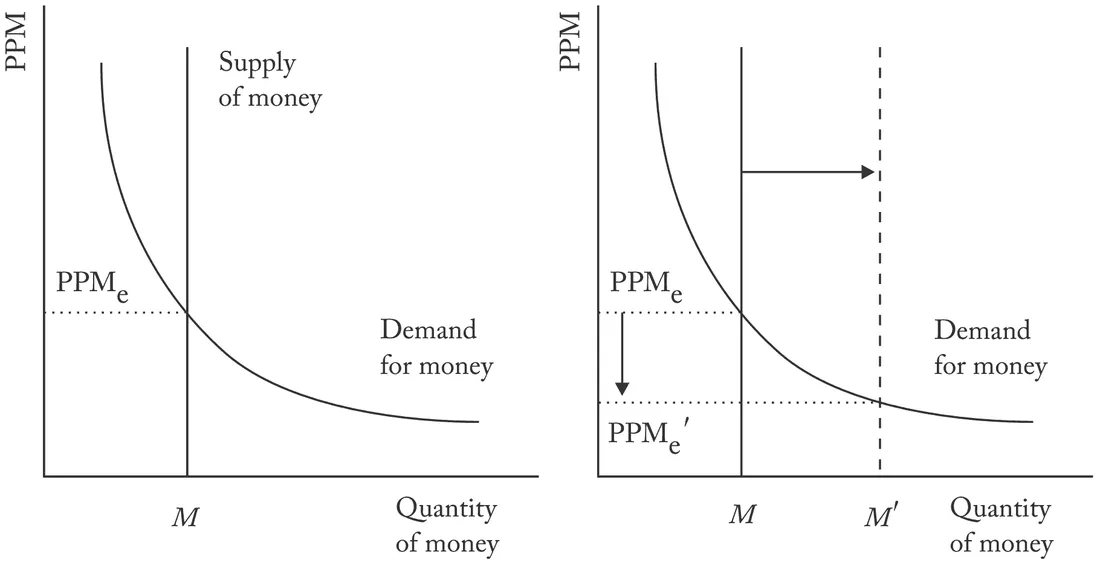
| Figure 1a | Figure 1b |
| The Equilibrium Price Level | An Increase in the Money Stock |
| (adapted from Mankiw, 2011, p. 647) | (adapted from Mankiw, 2011, p. 648) |
This presentation by Mankiw is, in fact, identical to the one offered by Rothbard in Man, Economy, and State (2009 [1962], pp. 756–64).[6] Both authors draw the very same Figures 1a and 1b in order to show the equilibrium point and the effect of an increase in the quantity of money. Furthermore, their explanation of the adjustment process is exactly the same—and also the same as the explanation provided by Mises in TMC. It is very unlikely that Mankiw ever read Rothbard’s treatise. And yet the striking similarity between their respective theories seems to indicate that Rothbard (and thus ultimately Mises) may have had an indirect influence upon Mankiw. Since the latter does not cite any author, the channels of this possible influence are unknown to us.
Let us now turn to Mises. His concept of the demand for money as a demand for cash balances[7] and his theory of the adjustment process following an increase in the quantity of money (TMC, p. 139) are similar to those used by Mankiw. Nonetheless, significant differences exist between the two presentations.
(1) Mises offers a purely subjectivist account of the determination of the purchasing power of money. There is no “price level” in his presentation and the PPM cannot be calculated as a single number (the PPM is the array of the quantities of goods that a given sum of money can buy; even though Mises does not develop this point, each individual can have his own evaluation of the PPM based on a personal knowledge of relevant past prices). The aggregate demand for and supply of money exist at every moment, as they are the sums respectively of the individual demands and of the individual stocks. But Mises never makes any reasoning based on these aggregate functions. He always starts with the individual subjective scales of preferences and the decisions by each individual to change or to preserve his own monetary relation (TMC, pp. 134–35). Either the demand for money of an individual “exceeds his stock of it” and he will buy less goods in order to replenish his cash reserves (hence a tendency for the monetary prices to fall and the PPM to rise), or the stock exceeds the demand and he will spend more money (hence a tendency for the prices to rise and the PPM to fall), or, finally, the demand and the stock are equal. In normal times, the individual changes offset one another and have no overall impact the purchasing power of money. But when the demands or the supplies of many people are affected in the same direction, their cumulative actions based on their subjective evaluations will lead to a change in the PPM.
(2) Since the theory developed by Mises is based upon individual decisions and actions, it cannot be separated from the diffusion process of the new money through the economic system. And indeed, when he analyzes the effects of an increase in the quantity of money, Mises immediately takes into account the fact that the new monetary units enter into the economic system through the cash balances of specific individuals.[8] The first persons who receive the new monetary units “have a relative superfluity of money and a relative shortage of other economic goods,” they increase their monetary spending, the prices of the goods they buy tend to rise, the sellers of these goods get the new money and then in turn spend it, and so on and so forth. Mankiw, on the other hand, totally neglects the question of who gets the new money first and how these additional monetary units propagate through the economic system. He just moves the aggregate supply curve to the right and explains the lowering in “the” PPM as shown in Figure 1b. The main problem with this kind of aggregate reasoning is that it conceals the redistribution effect that occurs during the diffusion process of the new money: the first actors who get the new money benefit from an increase in real income, compensated by the diminished real income of the last actors who get the new money; the economic disadvantage of the latter results from the fact that they must temporarily pay higher prices (due to the diffusion of the new money through the economic system) while their incomes have not yet increased (TMC, pp. 208–09). Mankiw never evokes this redistribution effect in his textbook.
(3) According to Mankiw, it is only in the long run that the PPM adjusts to balance the money demand and supply. In the short run, the PPM cannot play any equilibrating role because “many prices are slow to adjust to changes in the money supply” and therefore the price level “is stuck at some level” (2011, p. 762). The money demand and supply, then, are balanced in the short run by changes in the interest rate, as explained by the Keynesian theory of liquidity preference (“An increase in the interest rate raises the cost of holding money and, as a result, reduces the quantity of money demanded”). So Mankiw puts forward two entirely different adjustment processes of the money demand and supply, through the interest rate in the short run and through the PPM in the long run. From a Misesian perspective, this standard framework is highly questionable. The chief aim of monetary theory is to explain the PPM. Obviously, the Keynesian theory of liquidity preference does not contribute at all to this aim since it explains the interest rate and presupposes that (in the short run) the PPM is an exogenous and given data. Is it true, as Mankiw claims, that the PPM is “stuck at some level” in the short run? No, it is not. Many prices are free to move and will move in the short run if the quantity of money increases. Admittedly, quite a lot of prices are contractually fixed in the short run. So if an unanticipated increase in the quantity of money occurs, the PPM will not change at first as quickly as it would if all prices were flexible (or if the change had been anticipated). In this sense, it can indeed be said that the initial movement of the PPM is “slow.” But the PPM will nevertheless immediately begin to fall; it is not fixed and exogenous in the short run. In TMC, the decrease in the value of money that follows a growth of the money supply is both a short run and a long run phenomenon. It is a process that begins as soon as the first people who receive the new money spend it on markets where prices are flexible,[9] a process that goes on while these additional money units are received and spent, affecting more and more prices through the economic system, until a stable whole new spending pattern finally emerges in the long run.
(4) Last but not least, Mises clearly explains in TMC that money prices have a historical component (he credits Wieser with this discovery). When people spend their money to buy goods, they compare the marginal utility of the goods they demand with the marginal utility of the money that they offer in exchange. In order to evaluate the marginal utility of money, they need to assess its purchasing power. Since they only know past prices, their evaluation is based on the PPM of the immediately preceding “period” (“The valuation of money by the market can only start from a value possessed by the money in the past,” TMC, p. 114). Consequently, the PPM of the current period depends on the PPM of the previous period, which depends in turn on the PPM of the still earlier period, and so on and so forth.[10] Now, the historical component of the PPM is not taken into account in Figures 1a and 1b, where the PPM is implicitly the current one. The demand for money, however, cannot depend on the current PPM since it is still unknown to the economic agents. It depends on the PPM of the previous period, and this time lag needs to be explicitly acknowledged in the theory and the graphical representations.
For all the reasons given above, Mises would probably have considered that the Figures 1a and 1b are very poor representations of the theory of the purchasing power of money, and that they elude some of the most important questions raised by monetary theory. There is no doubt that Mises’s subjectivist theory of the PPM is vastly superior to the textbook version offered by Mankiw a century later.
The Holistic Explanation: The Equation of Exchange
One of the main contributions of Mises’s TMC is his trenchant criticism of the classical equation of exchange MV = PT. This equation, however, is still used today in every standard textbook—what is more, it is often the only formulation of the quantitative theory of money that is offered to students. The criticism by Mises is clearly unknown to the current writers belonging to the “orthodox” paradigm. This is unfortunate because Mises has convincingly shown that the equation of exchange is a superficial and ultimately unsatisfactory theory of the purchasing power of money. His main criticism is aimed at the concept of velocity of money: counting how many times a unit of money changes hands on average in a year cannot replace the concept of the subjective demand for money. The velocity of money is only a manifestation of the effects of the demand for money, and it obfuscates the causal processes through which the value of money is determined. The concept of the subjective demand for money is, as we have seen in the previous section, the necessary foundation for an explanation of the PPM. Mankiw (2011) and Milton Friedman (in his entry “Quantity Theory of Money” in the New Palgrave) both recognize this fact. They begin their respective presentations of the quantity theory with the subjectivist theory expounded above, but then they fall back and focus on the holistic and mathematical equation only.
The way Mankiw addresses this issue is telling. There are two versions of his textbook, an elementary introductory-level version (Mankiw 2011) and a more advanced intermediate-level version (Mankiw 2002). The subjectivist account of the determination of the value of money is presented in his elementary-level textbook (see Figures 1a and 1b above). But this quasi-Misesian account completely disappears in the intermediate-level textbook, in which only the equation of exchange is explained and the demand for money is defined as the ratio of the quantity of money M to the level of prices P: all the subjectivist elements are removed (Mankiw 2002, pp. 81–85). So if we follow Mankiw’s presentation, the subjectivist or Misesian explanation of the determination of the PPM is intended for beginners, but it is not required—is it too simplistic?—for more advanced students. In this presentation, a holistic equation is somehow considered as more elaborated than a subjectivist theory. But the opposite is true, of course. The Misesian theory is much more sophisticated than the equation of exchange. Mises develops a general theoretical framework in which the deductions from the equation of exchange appear as simplistic at best. It is true that a doubling (for instance) of the quantity of money will roughly lead to a doubling of the price level—a halving of the PPM—everything else being equal. But first, this is only an approximate result. And second, some essential theoretical elements are impossible to express with the equation, such as the subjectivist foundation of the PPM, the historical component in the determination of the PPM, and the diffusion process of the money through the economic system.
To sum up, Mises offers in TMC a much more general, improved, and theoretically sound version of the quantity theory of money than the equation of exchange. To this extent, it is all the more unjustifiable that Milton Friedman (2008) acknowledges Keynes as “a major contributor to the quantity theory” (for his book A Tract on Monetary Reform, 1971 [1923]) but totally neglects Mises’s contribution and does not cite him even once.[11]
The Individual Demand for Money
Why do people demand money? More precisely, why do they choose to hold a stock of money? The answer given by Mises in TMC is not entirely satisfactory in that it lacks consistency (see Hülsmann 2007, pp. 785–86). In one place, he states that the subjective use-value of money “is nothing but the anticipated use-value of the things that are to be bought with it” (TMC, p. 108). But this account is too narrow. Money is intended to be exchanged against goods, of course, but people do not strive to spend all of their money as soon as possible. They hold a part of their wealth as a stock of money of a chosen size. These stocks as such, therefore, have a subjective value for their owners. Mises perfectly recognizes this fact in other parts of his monetary treatise, for instance when he writes that “What is called storing money is a way of using wealth” (TMC, p. 147). He also clearly explains the usefulness of holding a stock of money in order to deal with the uncertainty of the future: keeping a stock of money is a suitable way to fulfill urgent but yet unanticipated needs that may arise out of future and still unknown circumstances.[12] Even though the demand for money originates in the subjective preferences, a number of external factors can contribute to increase or to decrease it. Among the factors that tend to enlarge the demand for money, Mises lists the multiplication of monetary transactions that goes with the intensification of the division of labor and population growth. Among the factors that tend to diminish it, he lists the reliability of markets (especially of securities markets) and the system of clearinghouses (TMC, pp. 300–03). In Human Action, Mises resolves the contradiction that affects TMC and conclusively adopts the idea that the demand for money is a demand for cash balances that is fundamentally explained by the radical uncertainty of the future.
How is the individual demand for money understood in current textbooks? Mankiw offers a correct but very brief statement—just one sentence!—that has already been quoted (“Most fundamentally, the demand for money reflects how much wealth people want to hold in liquid form,” 2011, p. 646). Romer (2006, p. 226) only studies the aggregate demand for money in the framework of the equation of exchange. The advanced monetary textbook by Walsh, on the other hand, offers long developments about the individual demand for money. Two main models have been elaborated in the standard framework in order to integrate the individual demand for money into the general equilibrium paradigm: the money-in-the-utility-function or MIU model and the cash-in-advance or CIA model. Walsh writes—and this starting point of his presentation is fine from a Misesian perspective—that “a role for money must be specified so that the agents will wish to hold positive quantities of money” (2010, p. 33). The problem, as we shall see, is that none of the two main standard models gives a satisfactory explanation of the subjective value of cash balances; none of them convincingly explains why people “will wish to hold positive quantities of money.”
The Money-in-the-Utility-Function Model (MIU)
In the MIU model, the demand for money is directly integrated into the utility function ut of the representative household: instead of a utility function ut = u(ct), where ct is consumption at time t, the function becomes ut = u(ct, mt), where mt is the stock of money (in real terms) held by the household at time t.[13] So here, by hypothesis, a stock of money (in real terms) mt brings in utility. But why does it bring utility? As Walsh openly and repeatedly concedes, the model does not answer this question:
In the MIU model, there is a clearly defined reason for individuals to hold money—it provides utility. However, this essentially solves the problem of generating a positive demand for money by assumption; it doesn’t address the reasons that money, particularly money in the form of unbacked pieces of paper, might yield utility. (Walsh, 2010, p. 52, emphases added; see also p. 75)
So the utility of money here is postulated but in no way explained. This model is in this regard highly artificial and does not even try to deal with the initial question of why the agents choose to “hold positive quantities of money.” There is money in the economic system—but we do not know why. And it brings utility—but we do not know why either. The problem, however, is even more serious because in this model the uncertainty of the future has been ruled out by hypothesis. Consequently, holding money is in fact totally useless.[14] The conceptual foundations of the MIU model suffer from insuperable difficulties that can be summed up by saying that, in this model, holding a stock of money is arbitrarily supposed to bring utility in a universe of certainty where money as such is useless.
In spite of these deep conceptual problems, and because it fits nicely within the standard framework of general equilibrium and of Solow’s growth theory, the MIU model has been elaborated for more than three decades now by mainstream economists. Other comments pertaining to its content and results will be made below.
The Cash-in-Advance Model (CIA)
The CIA model addresses the main conceptual problem affecting the MIU model, namely the lack of any explanation of the subjective value of money. In the CIA model:
[Money] is valued because it is useful in facilitating transactions to obtain the consumption goods that do directly provide utility. . . . A medium of exchange that facilitates transactions yields utility indirectly by allowing certain transactions to be made that would not otherwise occur or by reducing the costs associated with transactions . . . the demand for money arises from its use in carrying out transactions. (Walsh 2010, p. 91)
In other words, money is useful because it lowers the transaction costs or allows some transactions to be made that could not take place without it. Here, people supposedly need a sum of money at the beginning of each period—hence the name “cash-in-advance”—in order to proceed to the monetary transactions that they have planned for this period. As far as the conceptual foundations are concerned, this model is an improvement over the MIU model, because an explanation is now offered for the existence of money in the economic system. This explanation is inspired by the theory of the origin of money developed by Menger (2007 [1871]), and to this extent it is satisfactory from an Austrian point of view. Nevertheless, the CIA model shares with the MIU model a very problematic characteristic, namely that there is no uncertainty of the future. As Mises asserted in TMC and convincingly argued in Human Action, in a context where there is no uncertainty of the future, the demand for money is zero (see note 14). Even if we suppose that people need money for their transactions, they will try to maximize their interest returns by withdrawing at the last moment from their savings accounts the exact sum of money that they need in order to spend it immediately as planned. And this means that in between payments they need no money at all: they do not hold any cash balance because they prefer to invest all of their money. In other words, without uncertainty, people do not use any cash-in-advance: outside of the moments when exchanges are made no one wants to hold money, so ultimately there is just no demand for money and thus no money in the economic system. The fact that money is useful in facilitating transactions cannot by itself explain the positive individual demand for money, and the CIA model is thus unsatisfactory.
Finally, the question “Why do people hold cash balances?” does not receive any suitable answer either from the MIU or the CIA model, a problem acknowledged by Walsh when he writes that “neither approach is very specific about the exact role played by money” (2010, p. 115). It is amazing to observe that the two main standard neoclassical models in the theory of money are unable to explain why there is a demand for money in the economic system. From a Misesian perspective, however, this is not at all surprising since these models are not conceived to take the radical uncertainty of the future into account.
The Neutrality of Money
The term “neutrality” of money does not appear in TMC and this is understandable since (according to Patinkin 2008) it was first used at the end of the 1920s—a few years after the publication of the last edition of Mises’s treatise in 1924. But even if the term is missing, the issue is addressed in depth by Mises. He begins by criticizing the classical arguments made by Hume and Stuart Mill. The latter tried to show that money could in some circumstances be neutral in the sense that an increase in the quantity of money would have a proportionate effect on all prices while the quantities produced and sold would not change at all. Mises demonstrates that their arguments are mistaken. However the increase is effected—whether through giving the same sum to everyone, giving a sum proportional to the income or to the wealth or to the cash balance, or in any other way—it will always alter the relations between the prices and affect the quantities produced.
The essential reason for the non-neutrality of money is that the valuation of the money units is subjective and “will depend upon a whole series of individual circumstances” (TMC, p. 141). In the real world, it can simply not happen that the spending patterns all change simultaneously and in the same proportion, because spending decisions are based upon subjective preferences between units of money and units of goods. When a quantity of money is added to the cash balance of one individual, his evaluation of a unit of money decreases and he will spend more, but it is impossible to predict how much more and on which goods. Another individual endowed with the same additional quantity of money, even if placed in similar circumstances, will spend different sums on different goods. Consequently, the initial equilibrium will necessarily be disturbed as different quantities of goods will be demanded and produced. Another (secondary) argument reinforces this conclusion, namely that the additional money enters into the economic system at specific points: the diffusion process that follows necessarily also alters the relative prices since the demands for specific goods are affected first. The conclusion is unmistakable. An increase in the quantity of money will never lead to a proportionate increase in all prices or to a proportionate decrease in the purchasing power of money. Briefly, money can never be neutral. Some decades later, in Human Action, Mises scoffs at “the fable of money neutrality” (1998 [1949], p. 203) and at “the spurious idea of the supposed neutrality of money” (p. 395), and holds that “the notion of a neutral money is unrealizable and inconceivable in itself” (p. 250).
Let us now turn to standard textbooks. Mankiw briefly defines monetary neutrality as “the proposition that changes in the money supply do not affect real variables” (2011, p. 650). Romer adopts a similar definition: “an increase in m leads to an increase in all pi’s, and hence in the overall price index, p. No real variables are affected” (2006, p. 276). Walsh (2010) does not offer a formal definition, but writes that when money is neutral “proportional changes in the level of nominal money balances and prices have no real effects” (2010, p. 43).
In this section, we will first analyze a core idea found across the standard texts, according to which money is not neutral in the short run but nevertheless neutral in the long run.[15] We then address two more technical points: the conception of neutrality in the standard MIU model, and Patinkin’s argument purporting to demonstrate that money can be neutral in certain definite circumstances.
A standard principle: money is non-neutral in the short run, but neutral in the long run
Standard economists perfectly agree that money is not neutral in the short run. Their arguments, however, are not at all the same as those put forward by Mises.
(1) Their first argument is that people can be confused by a change in prices: consumers fall prey to the “money illusion” and confuse a simple increase in prices with a greater scarcity of goods; producers observe a rise in the money demand for their product and mistakenly believe that this rise is limited to their branch, when it is in fact a general phenomenon, so that they will erroneously think that their real profit has risen and act accordingly (Mankiw 2011, pp. 650, 737, and see the next subsection).
(2) The second main standard argument is that some prices are sticky: wages, for instance, adjust slowly because of the labor contracts; some other selling prices are sticky because it is costly to change them (due to so-called “menu costs”); in both cases, stickiness prevents a quick and proportionate adjustment of all prices to the increased quantity of money.
So the non-neutrality of money in the short run is explained either by mistakes and misperceptions (errors of expectations) or by sticky prices. All these arguments are correct and relevant, but the demonstration by Mises is much more general. He shows that, on account of the subjectivity of the individual demands for money and of the fact that money enters in the economic system at specific points, even if people do not commit any mistake and if prices are flexible, money will not be neutral. So the standard arguments are interesting and deserve consideration, but they are subordinate in that they miss the essential reasons why money can never be neutral.
So far, and in spite of dissimilar arguments, there is a kind of agreement between Mises and current standard authors. But then a big problem arises. Standard economists argue that, while money is not neutral in the short run, somehow it can still be neutral in the long run. Writes Walsh:
If prices do not adjust immediately in response to a change in M, then a model might display non-neutrality with respect to changes in M in the short run but still exhibit monetary neutrality in the long run, once all prices have adjusted. (2010, p. 42)
Now, strictly speaking this result is highly questionable if not outright impossible. If the productive relations have been altered in the short run by an increase in the quantity of money, with non-proportionate changes in prices, then these changes cannot magically all become proportionate again in the long run. The limits of the standard approach clearly appear in the following quote by Parkin in his entry on “Inflation” in the New Palgrave.
[In] the case of anticipated inflation and] abstracting from transitory adjustment paths, all economic theories predict monetary neutrality: a one-shot change in the quantity of money leads to a proportionate change in the levels of all prices (and wages) and has no real effects. (Parkin 2008)
First of all, not “all” theories predict monetary neutrality, even in the case when anticipations are correct. And second, “abstracting from transitory adjustment paths” amounts to neglecting the real economic processes that follow a change in the quantity of money. Of course, if the fact that money is not neutral in the short run is neglected, then it can logically be concluded that money is neutral in the long run! But such reasoning ignores the economic reality that it is supposed to analyze. Saying that money is neutral if and only if expectations are correct and all adjustments take place instantly is another way of saying that, indeed, money cannot be neutral in the real world. Mises’s criticism against the neutrality of money was always grounded in a realistic framework and never pertained to a purely imaginary or theoretical world where instantaneous and perfect adjustments can take place.
To be fair, when standard economists speak of long-run neutrality, they sometimes use a weak definition of neutrality. They mean in fact that changes in the quantity of money will not affect the long-run evolution of the real GDP (rate of real growth), nor the natural unemployment rate (vertical long-run Phillips curve). In this sense, long-run neutrality does not imply a proportionate change in all prices, since it rests upon a very simplified macroeconomic reasoning in which there is just one kind of consumer good. This difference in perspective explains the different conclusions reached, by Mises that money is never neutral and by standard macroeconomists that it is neutral in the long run. This point is elaborated in the following subsection.
Neutrality in the MIU Model
In order to properly understand the way standard economists approach the topic of the neutrality of money, it is necessary to come back to the MIU model and to offer a brief overview of the highly technical chapters that Walsh devotes to this subject matter (2010, chap. 2, chap. 5–6). We have already seen that the MIU model is unable to explain the very existence of money. It is just as ill-suited to the study of the neutrality of money, for three simple reasons. First, in this model there is just one consumer good (or one fixed basket of consumer goods) and it is thus impossible to analyze the effects of a change in the quantity of money on the prices of different commodities. Second, the capital goods are represented by their aggregate value K, so that again there is no distinction between the prices of the different factors of production. And third, the differences between individuals are completely removed: the optimizing consumption decision is made by a representative household that maximizes an intertemporal utility function on an infinite time horizon and under a budget constraint (a constraint that takes money balances and return from investment into account). More specifically (Walsh 2010, p. 35), the utility function is ∑βtu(ct, mt), with 0 < β < 1, ct the quantity consumed at time t, and mt = (Mt/NtPt) the money balance in real terms at time t (Mt is the total quantity of money, Nt the number of households, and Pt the price level). When the supply of money is increased by the State (ΔM), a lump sum is directly received by the representative household (ΔM/Nt). If the real money stock demanded does not change (and neither does the number of households Nt), then a change in the quantity of money Mt is instantaneously matched by a proportional change in the price level Pt (i.e., in the price of the consumer good). Likewise, any change in the real stock of money demanded mt (Mt and Nt remaining constant) is instantly translated in an inversely proportional change in the price level Pt.
As this presentation makes clear, the basic MIU model is not at all conceived to analyze the non-neutrality of money. The non-neutrality comes from the existence of different prices for the different consumer and capital goods, from the specific situation and subjective preferences of each individual, and from the diffusion process of the additional units of money through the economic system. All these characteristics that make money non-neutral in the Misesian theory (and in the real world!) are excluded from this model.
Walsh raises the issue of money neutrality nonetheless. He shows that, in the MIU model, money is neutral (2010, pp. 41–43). But money neutrality here has a very specific meaning: it means that the real equilibrium values of consumption, output and capital in the steady state are not affected by a change in the quantity of money M. In the steady state: consumption, output, capital stock, and money balances are constant. Walsh writes down the equations defining the steady state equilibrium and observes that their real solutions do not depend on M. He concludes that money is neutral.[16] Furthermore, in the steady state the real money balance mt = (Mt/NtPt) of the representative household is constant through time; if population does not change (Nt = N), the logical implication is that the price level Pt grows at exactly the same rate and at exactly the same moment as the quantity of money Mt. From a Misesian perspective, the question is: what about disequilibrium or the path toward equilibrium? But Walsh never evokes the disequilibrium case and sticks to the framework of a “static” conception of money neutrality (the following subsection will show that Patinkin does exactly the same). It was explained above that money is useless when there is no uncertainty. It is even more useless—so to speak—in a steady equilibrium in which all the real variables are constant and only nominal prices change.
Now standard economists are perfectly aware that changes in the quantity of money can and do affect the functioning of the economic system. More specifically, an increase in the quantity of money can temporarily boost employment and output. Writes Walsh:
The empirical evidence from the United States is consistent with the notion that positive monetary shocks lead to a hump-shaped positive response of output that persists for appreciable periods of time. (2010, p. 195)
So in the short run at least, money is definitely not neutral and the MIU model needs to be amended in order to account for this well-known phenomenon. It has been enriched indeed, from the early 1970s on, in a series of technical contributions by Lucas, Sargent, Barro, and other New Classical, and (later) New Keynesian economists. Their models provide the foundations for the reasoning of the previous subsection, namely that if prices are flexible then the output disturbances caused by monetary changes are the consequences of “informational rigidities” (i.e., of mistakes committed by the economic actors), and if prices and wages are sticky then the effect on output is the result of the delayed adjustments in prices. In the model by Lucas, for instance, a general rise in price is mistakenly analyzed by some firms as a rise in the relative price of their own products; these firms falsely believe that they are making a profit, they rise wages in order to increase production and thus attract more labor in the economic system, hence the rise in total output. This effect is only temporary, since these firms eventually realize that they have confused a monetary with a real effect. When, on the other hand, the changes in the quantity of money are correctly anticipated, then no such real effect occurs and variations in the quantity of money have no consequences on the real variables of the economic system. In his theory of the business cycle, Mises also explains how monetary creation (credit expansion) can lead at first to an increase in real wage (see Salerno 2010, p. 208).
Here are a few concluding remarks on the very influential MIU model and its weird—weird, that is, from a Misesian perspective—approach to the neutrality of money.
(1) In the basic version of the MIU model, money is neutral (as long as there is no uncertainty and the economic system remains in a steady state). Neutrality is thus the starting point of the model, and non-neutrality can only be obtained through an elaboration and complexification of the basic model. In Mises’s theory, by contrast, the starting point is non-neutrality and the concept of neutrality is evoked only so that it can be immediately rejected: seeking for the conditions in which money can be neutral (or superneutral!) is a futile endeavor.
(2) Traditionally (with Hume, Stuart Mill, Mises) the question of the neutrality of money is analyzed in terms of relative prices. Now in the MIU model there are no relative prices (since there is just one consumer good or basket) and money non-neutrality is understood in a very limited and exclusively macroeconomic sense, through the impact of monetary changes upon the total output (not upon the composition of the output). So in the short run an increase in the quantity of money can in some cases (unanticipated inflation) boost the economic growth rate above its average level, but in the long run (anticipated inflation) the increases in the quantity of money will not affect the growth rate anymore. This is the meaning of the standard idea that money can be non-neutral in the short run and still be neutral in the long run—an idea that appears nonsensical in the Misesian framework of relative prices.
(3) The mathematical formalization and rigor characterizing the MIU model are impressive (with the demonstration of the existence of a steady state equilibrium), but they rest upon the highly questionable hypotheses of a representative household and of an instantaneous adjustment of the price level to the changes in the quantity of or demand for money. Mises would certainly have considered that, with such simplifying assumptions, the MIU model bypasses some of the deepest and most important problems of monetary theory (for instance the historical component in money prices).
Patinkin’s Conception of the Neutrality of Money
Let us now turn to the entry “Neutrality of Money” by Patinkin in the New Palgrave. There, he explains that people will not suffer from the “money illusion” if and only if they make their choices, not according to the nominal prices p1, p2, p3, etc., pn, of the n goods, but rather according to the relative prices p1/p, p2/p, p3/p, etc., pn/p (p being an average index of prices: p = Σwipi), the interest rate r, and their real wealth (K + B/p + M/p). In this case, the demand and supply functions depend entirely on relative (and not on nominal) prices. A change in the unit of money, such as the introduction of the “new franc” in France in 1960 (one new franc represented 100 “old” francs), would then have no effect at all on real variables. There would be no money illusion whatsoever.
Patinkin then combines this hypothesis (the choices are entirely determined by relative prices, the interest rate, and the real wealth of each individual) with the general equilibrium equations. The initial economic system is in a general equilibrium, with prices p1, p2, p3, . . . , pn, p, and an interest rate r. The quantity of money M is changed to kM, and here is what would happen according to Patinkin (this quote is slightly edited as far as the mathematical notations are concerned):
From the preceding system of equations we can immediately see that (on the further assumption that the system is stable) the economy will reach a new equilibrium position with money prices kp1, . . . , kpn, kp and an unchanged rate of interest r. . . . Thus the increased quantity of money does not affect any of the real variables of the system, namely, relative prices, the rate of interest, the real value of money balances, and hence the respective outputs of the n goods. In brief, money is neutral. (Patinkin 2008, emphases added)
Now there are a few problems with this demonstration of the neutrality of money. It must first be realized that it rests upon a highly unrealistic assumption, namely that people only take relative prices and real wealth into account. It is obvious that this hypothesis will never hold in the real world, and this fact alone proves the impossibility for money to be neutral in an actual economic system.
But there is another—and a greater—difficulty. Patinkin does not take the adjustment process from the first general equilibrium to the second one into account. It is true that if the prices p1, p2, p3, . . . , pn, are the solutions of the general equilibrium system of equations, then under the hypotheses postulated the prices kp1, kp2, kp3, . . . , kpn, will also solve this very same system of equations. But in the dynamic process that leads from one equilibrium to another, the initial relations between prices will be altered and the proportionality will not be maintained—even if people are not fooled by any money illusion. Patinkin falls here in the trap that Mises had warned against in TMC, namely the confusion between a dynamic and a static problem. Patinkin compares two static systems, one with prices pi and a quantity of money M, the other with prices kpi and a quantity of money kM, and concludes that since people are free from any money illusion the change in the quantity of money from M to kM leads from the first one to the second one. But as Mises writes, “every variation of the quantity of money introduces a dynamic factor into the static economic system” (TMC, p. 145). In other words, the change in the quantity of money disturbs the initial equilibrium, so that the new equilibrium will not be characterized by prices that are proportionate to the old ones. Money is not neutral and Patinkin’s demonstration fails to take the dynamic nature of money into account.[17] Patinkin, however, seems to acknowledge this problem when he writes that “The conclusions of the foregoing analysis are clearly those of long-run comparative-statics analysis.” So he falls back on the standard but questionable idea that money can be neutral in the long run even though it is not neutral in the short run.
Conclusion
It is a striking and unfortunate result of this inquiry that none of the most important insights originating in Mises’s The Theory of Money and Credit is to be found in contemporary textbooks or reference texts. It can even be observed that the more advanced the standard textbook, the more unsatisfying the presentation of monetary theory from an Austrian perspective. There is more Mises, so to speak, in the elementary textbook by Mankiw than in the very advanced one by Walsh. This is unfortunate because the Misesian theories of the determination of the purchasing power of money and of the neutrality of money are much sounder than their standard neoclassical counterparts. Of course, from a mathematical point of view Mises’s theories are not as impressive as standard models (such as the MIU model). But mathematics is only a tool. It should never be given precedence over theoretical relevance. And as far as theoretical relevance is concerned, one century after its publication the monetary treatise of Mises is as significant as ever—perhaps more significant than ever.
References
Friedman, Milton. 2008. “Quantity Theory of Money.” In The New Palgrave Dictionary of Economics. 2nd ed. New York: Macmillan.
Hülsmann, Jörg G. 2007. Mises: The Last Knight of Liberalism. Auburn, Ala.: Ludwig von Mises Institute.
——. 2008. The Ethics of Money Production. Auburn, Ala.: Ludwig von Mises Institute.
Keynes, John M. [1923] 1971. A Tract on Monetary Reform. The Collected Writings of John Maynard Keynes. Vol. 4. London: Macmillan.
Mankiw, Gregory N. 2002. Macroeconomics. 5th ed. New York: Worth Publishers.
——. 2011. Principles of Economics. 6th ed. South-Western Cengage Learning.
Menger, Carl. [1871] 2007. Principles of Economics. Auburn Ala.: Ludwig von Mises Institute.
Mises, Ludwig von. [1924] 1953. The Theory of Money and Credit. 2nd ed. New Haven, Conn.: Yale University Press. http://mises.org/books/tmc.pdf
——. [1949] 1998. Human Action: A Treatise on Economics. Auburn, Ala.: Ludwig Mises von Institute. http://mises.org/books/humanactionscholars.pdf
North, Gary. 2012. Mises on Money. Auburn, Ala.: Ludwig von Mises Institute.
Parkin, Michael. 2008. “Inflation.” In The New Palgrave Dictionary of Economics. 2nd ed. New York: Macmillan.
Patinkin, Don. 2008. “Neutrality of Money.” In The New Palgrave Dictionary of Economics. 2nd ed. New York: Macmillan.
Polleit, Thorsten. 2011. “Fiat Money and Collective Corruption.” Quarterly Journal of Austrian Economics 14, no. 4: 397–415.
Romer, David. 2006. Advanced Macroeconomics. 3rd ed. New York: McGaw-Hill.
Rothbard, Murray N. [1962] 2009. Man, Economy, and State with Power and Market. 2nd ed. Auburn, Ala.: Ludwig von Mises Institute. http://mises.org/books/mespm.pdf
Salerno, Joseph T. 2010. Money: Sound and Unsound. Auburn, Ala.: Ludwig von Mises Institute.
Tobin, James. 2008. Money. In The New Palgrave Dictionary of Economics. 2nd ed. New York: Macmillan.
Velde, François R., and Warren Weber. 2008. Commodity Money. In The New Palgrave Dictionary of Economics. 2nd ed. New York: Macmillan.
Wallace, Neil. 2008. “Fiat Money.” In The New Palgrave Dictionary of Economics. 2nd ed. New York: Macmillan.
Walsh, Carl E. 2010. Monetary Theory and Policy. 3rd ed. Cambridge, Mass.: MIT Press.
Renaud Fillieule is professor of sociology at the Université Lille Nord de France, and member of the CLERSE research unit.
[1] See Hülsmann (2007, esp. chap. 6) and North (2012) for recent overviews of Mises’s monetary theories.
[2] The advent of the euro clearly showed the difference between money and a unit of account. Many people were accustomed to counting in French francs (for instance) and just kept doing so in spite of the fact that they were using the euro as a medium of exchange. A multiplication by 6.55 was required to calculate prices in francs, but their unit of account was indeed the franc and not the euro.
[3] “Business usage alone can transform a commodity into a common medium of exchange. It is not the State, but the common practice of all those who have dealings in the market, that creates money” (TMC, pp. 77–78).
[4] See for instance the critiques against fiat money by Hülsmann (2008), Salerno (2010, Introduction), and Polleit (2011).
[5] Strictly speaking, Mankiw seeks to explain the price level, not the PPM in the Misesian sense: see the remark (1) below.
[6] The only notable difference is that Rothbard analyzes the total demand for money Dt as the sum of two components, the exchange-demand De and the reservation or cash-balance demand Dr.
[7] Mises’s conception of the demand for money is explored in greater detail in the next section.
[8] “An increase in a community’s stock of money always means an increase in the amount of money held by a number of economic agents, whether these are the issuers of fiat or credit money or the producers of the substance of which commodity money is made” (TMC, p. 139).
[9] If the new influx of money has been correctly anticipated by the first sellers who will get the additional money units spent by the first recipients, then prices might even begin to move up shortly before any additional spending has taken place.
[10] The historical component of money prices ultimately goes back to the period when the good used as money had not yet begun to be used as a medium of exchange—this is the important regression theorem discovered by Mises and expounded in TMC.
[11] The Tract by Keynes is a clear and interesting text (it contains the infamous quote “In the long run we are all dead,” p. 65). But the presentation that it offers of the quantity theory is much shorter and much less thorough than the one provided by Mises. Furthermore, Keynes expounds a quite standard version of the quantity theory and it is a bit difficult to see how this qualifies him as a “major contributor” to this theory. Mises, on the other hand, develops a new and more encompassing monetary paradigm in which the qualities and especially the defects of the standard (i.e., Fisherian) version of the theory are illuminated. Keynes does nothing of the kind in his Tract on Monetary Reform.
[12] “The uncertainty of the future makes it seem advisable to hold a larger or smaller part of one’s possessions in a form that will facilitate a change from one way of using wealth to another, or transition from the ownership of one good to that of another, in order to preserve the opportunity of being able without difficulty to satisfy urgent demands that may possibly arise in the future for goods that will have to be obtained by way of exchange” (TMC, p. 147).
[13] The household real money stock mt is defined as the ratio of the total quantity of money Mt to the number of households Nt and to the price level Pt:mt = (Mt/NtPt). From a Misesian perspective, this definition of the real money balance is problematical because the nominal quantity of money Mt/Nt is associated to a simultaneous purchasing power (1/Pt) (Pt units of money buy one unit of good, one unit of money buys 1/Pt unit of good). But when an individual holds money, he does not yet know with certainty what the prices will be for the goods that he will purchase in the future with this money. Standard economists completely neglect this time lag. In other words, they are not aware of the problem of the historical component of money prices.
[14] Mises trenchantly makes this point when he writes that “Where there is no uncertainty concerning the future, there is no need for any cash holding. As money must necessarily be kept by people in their cash holdings, there cannot be any money. The use of media of exchange and the keeping of cash holdings are conditioned by the changeability of economic data” (1998 [1949], p. 414).
[15] On this point, see Salerno (2010, chap. 8).
[16] In some cases, money is even superneutral, in the sense that the real variables are not affected by a change in the rate of growth of the quantity of money (the term “superneutrality” appears 28 times in Walsh’s textbook!).
[17] Mises (TMC, p. 144) had also very clearly explained that the problem of the effects of a change in the quantity of money must not be confused with the problem of the effects of a simple change in the denomination of money (money illusion).
Theory of Money and Fiduciary Media
Read the whole book online · Book details
This work is published under a Creative Commons licence. You may copy, share, and re-host it with attribution.