
Chapter 2 of 12 · Walk Away: The Rise and Fall of the Home-Ownership Myth by Doug French
1. What is Strategic Default?
ONE
What is Strategic Default?
Strategic default is when homeowners stop paying on their mortgages when, in fact, they can afford to make payments, but choose not to because the house that serves as collateral for the loan is worth considerably less than the loan balance.
These are not people who take out a mortgage and never make a payment. Strategic defaulters borrowed the money in good faith to buy or refinance a home during the housing bubble of the mid-2000’s. They made their payments until they realized it didn’t make sense to feed a mortgage on a house worth a fraction of what they owe.
CBS’s 60 Minutes aired a story on strategic defaults in May of 2009 and estimated that a million homeowners who could pay chose to walk away instead. Nearly a third of all foreclosures in 2010 are believed to strategic defaults, up from 22 percent in the first quarter of 2009.
Academics like Professor Luigi Zingales at the University of Chicago worry that as more people strategic default, the stigma once attached to it will fall away, and “[t]he risk that the number of people doing this might explode is significant,” says the professor.
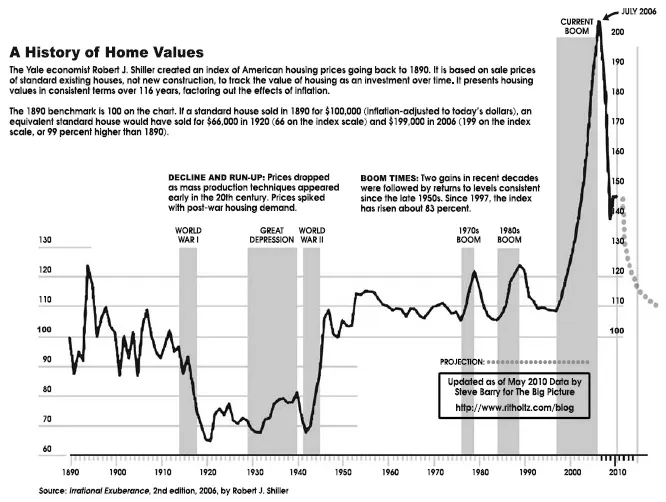
A hypothetical example, created by Brent T. White in his Arizona Legal Studies Discussion Paper, would be that a young couple buys a 3-bedroom, 1380 square foot home in Salinas, California for $585,000 in January 2006, which was the average home price in Salinas at that time. The couple had excellent credit and qualified for a no-money down fixed interest rate 30-year loan at 6.5% with a total payment of $4,300 per month (P & I, taxes, mortgage, and homeowners insurance). This was 31% of their gross monthly income and thus was considered affordable by the lender. With the couple’s other living expenses they struggled to break even each month, but were comfortable stretching to make the purchase, believing the home would increase in value. And the lender was comfortable enough to make the loan.
Unfortunately the housing market collapsed and despite still owing $560,000 on their mortgage, the home securing that loan is only worth $187,000 four years later. There is a similar house in the same subdivision listed for $179,000. If they walk away and buy the similar house, with a 5% down payment of about $9,000—a couple of payments on the current underwater place—the total monthly payment would be $1,200 (compared to the $4,300 they pay now); or the couple could rent a similar house in the neighborhood for $1,000 per month.
As professor White explains, “Assuming they intend to stay in their home ten years, [the couple] would save approximately $340,000 by walking away, including a monthly savings of at least $1,700 on rent versus mortgage payments, even after factoring in the mortgage interest tax deduction.”
It would take 60 years for the couple to recover their equity assuming that the Salinas, California market had hit bottom and the home began appreciating at the historically typical rate of 3.5%.
So what’s our young family to do? Or the bigger question is what are the millions of young families going to do: pay or walk away? And if mortgagees walk away en masse, will they be responsible for destroying modern American society?
Despite the millions of homeowners whose primary asset is now a debilitating liability, the number of foreclosures doesn’t match the under-water estimates.
First American Core Logic estimated that nearly a third of all mortgages (32.3% exactly) were under water in June of 2009.... That’s 15.2 million loans, and the negative equity position totaled $3.4 trillion. A Deutsche Bank report predicted that by 2011 nearly half of all mortgaged Americans, or 25 million homeowners, would be “under water.”
In a number of former boom cities, the vast majority of homeowners are already under water. A number of towns, primarily in the central valley of California, have current percentage of underwater homeowners exceeding 80%. Eighty-one (81) percent of all homeowners in Las Vegas were estimated to be under water, 70% of those in the Miami Beach area and 68% of homeowners in Phoenix owe more than their homes are worth.
Despite the millions of homeowners whose primary asset is now a debilitating liability, the number of foreclosures doesn’t match the under-water estimates. In April of 2010, 337,837 foreclosures were filed nationwide. A record 2.8 million homeowners were sent a foreclosure notice in 2009 and total foreclosures for 2010 were expected to top three million for the first time.
Speaking on CNBC’s “Squawk Box” show in October 2010, Joseph Murin, the former president of the Government National Mortgage Association said there were 2.5 million homes in foreclosure and another three to four million borrowers “on the bubble” or seriously delinquent on their mortgage payments.
But, foreclosures take time. In some states it can be months, in other states years. At this writing, reportedly seven million homes have already been seized by lenders. But with over 300,000 new filings each month (and growing), the estimate of six million properties that have not yet been completed as foreclosures may be conservative.
Nothing makes a suburban American family sleep better than knowing the military is protecting them and the wise economists at the Federal Reserve are making all the right moves.
But if it’s close to being right, the number is a fraction of the 11 to 15 million homes estimated to be under water right now. It is a wonder that the foreclosure filings are not double or triple what are currently being filed.
Government has built a huge stake in the housing market since before the Great Depression, starting with Herbert Hoover’s “Own Your Own Home” initiative. Government has standardized suburban living through its mortgage guarantee guidelines. Government has provided the secondary markets to make 30-year mortgages and the securitization of those loans possible.
Owner-occupied housing not only provides employment, but each homeowner has a stake in their community and their country. An ownership society is a compliant society. Those with an ownership stake recognize the need for the kind of security that big government can provide. Homeowners have something to protect and look to government to provide that protection. And a big mortgage that takes 30 years to retire keeps the family focused on what’s important—paying for their American dream. There’s no time to be concerned with the size of government, there are house payments to make.
No one wants to lose their home to recessions, depressions, or invading Russians or Muslims. Nothing makes a suburban American family sleep better at night than knowing that the military is fighting the bad guys on foreign soil to protect their happy home while their jobs are made secure by wise economists at the Federal Reserve who are making all the right interest rate moves. And the more local cops on the beat keeping an eye on the neighborhood, the better.
Murin claimed that housing should be 25 to 30 percent of GDP and that borrowers must pay their mortgages to maintain confidence in this vital sector of America’s economy. On that same program, Ken Langone, co-founder of Home Depot said, “I can’t believe we live in a society like this,” fretting over the fact that individuals were gaming the system before losing their homes to foreclosure.
So, while those in government and big business are singing from the same choir book, as the housing bubble has deflated the strategic default issue has libertarians divided.
For some libertarian writers like Karen De Coster, the numbers speak for themselves, “Walk away, free yourself from unnecessary bondage, and let the giant banks sort out the mess that they helped to perpetuate and swell,” the CPA wrote on LewRockwell.com.
But other libertarians argue that it is a person’s moral duty to fulfill their obligations: a contract is a contract. To not repay a debt is the equivalent of stealing. The lender held up its end of the bargain by providing the money for the purchase or refinance of the home in this case. Now it’s for the borrower to make the payments as the terms in the note dictate.
A society built and financed by continuous government initiatives is not a free one or a just one. And certainly is not a libertarian nirvana.
After all, promissory notes don’t provide an out for the borrower if the property securing that note falls below the amount of principal remaining to be paid off. Conversely, if the property value soars and the borrower makes out, the lender does not receive any of the upside; just the principal and interest due. The borrower and lender aren’t partners.
Private contracts are the bedrock of a free society, it’s argued. If people are just allowed to walk away from their obligations with no consequences, what kind of world would this be? America’s social fabric would be shredded.
But a society built and financed by continuous government initiatives is not a free one or a just one. And certainly it’s not a libertarian nirvana. “Despots and democratic majorities are drunk with power,” Ludwig von Mises wrote in Austrian Economics: An Anthology. “They must reluctantly admit that they are subject to the laws of nature. But they reject the very notion of economic law ... economic history is a long record of government policies that failed because they were designed with a bold disregard for the laws of economics.”
The laws of economics have leveled the government’s 90-year housing agenda and individuals should not be demonized for obeying those laws.
Walk Away: The Rise and Fall of the Home-Ownership Myth
Read the whole book online · Book details
This work is published under a Creative Commons licence. You may copy, share, and re-host it with attribution.