
Chapter 5 of 12 · Walk Away: The Rise and Fall of the Home-Ownership Myth by Doug French
4. The Government Gets Behind Home Ownership
FOUR
The Government Gets Behind Home Ownership
In an America that was arguably much freer and much more libertarian there was no such thing as a 30-year mortgage. In the late 1800’s credit for home ownership was not readily available. “Much of the lending that did occur was done by land subdividers, builders, brokers, local investors, or friends and relatives of purchasers,” Columbia University’s Marc Weiss explains in “Marketing and Financing Home Ownership: Mortgage Lending and Public Policy in the United States, 1918–1989.”
Some of these loans were done by land contract, which is arguably the worst possible loan structure for a borrower because title to the land is not transferred until all payments are made. “Mortgage loans generally were only one-third to one-half the purchase price of the house and were for very short terms of one to three years.”
Essentially homes were seller financed. Those who bought houses had lots of equity going into the transaction. But homeownership was rare. Only 27.7% owned their homes in 1890. So, there were typically only two types of homeowners; the wealthy who paid cash and working folks who built their own homes. As Thomas J. Sugrue, history and sociology professor at the University of Pennsylvania points out, “even many of the richest rented—because they had better places to invest than in the volatile housing market.”
But after WWI, the federal government launched an “Own Your Own Home” campaign with the objective being to “defeat radical protest and restore political stability by encouraging urban workers to become homeowners,” Weiss writes.
In his book American Individualism, Herbert Hoover defined individualism stripped of the “the laissez faire of the 18th Century.” but instead viewed American individualism as Abraham Lincoln’s “ideal of equality of opportunity” and “fair division can only be obtained by certain restrictions on the strong and dominant.”
Hoover attached home ownership with independence and initiative, believing that an American must own a home to truly be considered an American. Disturbed that the 1920 census reflected a decline in home ownership, “Hoover offered a vigorous, new approach to the housing problem through the application of federal, voluntary, and business cooperative activity,” Janet Hutchinson writes in “Building for Babbitt: The State and the Suburban Home Ideal.” At Hoover’s direction the federal government threw its weight behind four organizations to promote home ownership: the commercial “Own Your Own Home Campaign” and Home Modernization Bureau, the nonprofit Better Homes in America Movement, and the professional Architect’s Small House Service Bureau. This concentrated effort served to foster, as Hutchison points out, “an idealized vision of American home life rooted in the ownership of a suburban residence replete with modern amenities.”
So while it may seem that Americans by their nature have genes that make them aspire to home ownership, this notion is nonsense. Home ownership was sold to Americans with “carefully calculated governmental policies that proselytized Americans about the virtues of suburban home ownership while opposing outright market intervention,” explains Hutchison.
It was during this era that the rise of subdivision development began to form. The National Association of Real Estate Boards (NAREB) provided an organizational framework for builders and land subdividers to operate during the 1920s and 1930s, writes Marc Weis in his book The Rise of the Community Builders: The American Real Estate Industry and Urban Land Planning.
NAREB became a powerful national organization with a seat at the policymaking table beginning in 1917 with the U.S. entering World War I. The organization assisted with the construction of housing for war workers and the mortgage financing for those houses. The organization received another shot in the arm when Herbert Hoover became secretary of the commerce in 1921 and worked “closely with the Commerce Department’s newly created Division of Building and Housing, as well as with other federal agencies,” Weis explains.
With the government promoting home ownership and the emergence of building and loan associations (the predecessors to today’s S&Ls, which operated much like Credit Unions pooling savings and making loans to members), the percentage of Americans owning their homes increased to 39.7% in 1920. But these building and loan associations paid high rates to savers and so in turn the mortgage loans were at high rates.
Herbert Hoover pushed for mass homeownership on a large-scale with the aid of government coordination and regulation of development.
During the roaring ‘20s residential mortgage debt tripled, but “much of this financing consisted of a crazy quilt of land contracts, second and third mortgages, high interest rates and loan fees, short terms, balloon payments, and other high risk practices,” explains Weiss.
The presidential election of 1928 had Secretary of the Commerce Hoover vs. New York governor Alfred E. Smith. Governor Smith was an ardent progressive, believing in the obligation of government to intervene in economic and social affairs, and a belief in the ability of experts and in the efficiency of government intervention. He had set up co-ops and low-cost housing in New York City. But the 1920’s had been a roaring economy and Hoover pledged to continue the good times. Hoover won in a nearly 20 point margin landslide that many historians chalk up to bias against Smith being Catholic and his ties to the corruption of the Tammany Hall political machine. But Gwendolyn Wright, in her book Building the Dream: A Social History of Housing in America, writes, “it was private builders and middle-class suburbanites who won the election for Hoover.”
In the early 1930’s, with Hoover in the White House, NAREB had a key role in the U.S. President’s Conference on Home Building and Home Ownership in 1931 and lobbied intensely for establishing institutions that would be the beginning of government’s direct involvement in mortgage finance: Federal Home Loan Banking System, the Federal Housing Administration and a number of other federal housing programs.
Hoover’s Conference published the first of 11 volumes of reports by conference committees the following year. The committee pushed two agendas in the first volume. First was the idea that “mass homeownership depended on large-scale, well-planned private development,” but that second, these private residential developments “could only succeed with the aid of large-scale public land development, coordination, and regulation,” writes Weiss.
Weiss writes that Community builders were concerned about the government exercising too much control over subdivision development. By 1934, the NAREB struck what they believed to be a good balance between private development and government interference with the fulcrum of this balancing act being the FHA. At the same time, the NAREB, through its Realtors’ Washington Committee lobbied against prefabricated factory-produced housing which would have undercut the influence of local realtors and subdividers and also threw its political weight “against federal funding for any other approach to housing, including new towns and multifamily public housing in the cities,” Dolores Hayden writes in Building Suburbia: Green Fields and Urban Growth 1820–2000. “Allied with the NAREB were the U.S. Chamber of Commerce, the U.S. League of Savings and Loans, the National Retail Lumber Dealers Association, and the National Association of Manufacturers.”
Since then the U.S. has been one of the few developed countries that publically supports its mortgage market, Achim Duebel explains, with income tax relief for mortgage interest paying homeowners, and “public guarantees and regulatory privileges that benefit the mortgage industry. The approach is unchanged since the New Deal era of the 1930s when it was designed to rescue a failing private mortgage industry and fight the Depression through construction-led growth.”
As professor Sugrue notes, since the 1930’s Americans, “are a nation of homeowners and home-speculators because of Uncle Sam.” The NAREB’s “major effort to enhance the old game of land speculation with a new game of federal subsidy gained momentum,” writes Hayden.
The Federal Housing Administration (FHA) was created as part of the National Housing Act of 1934, with the intent being to regulate the rate of interest and the terms of mortgages that it insured, or in the words from the FHA’s first annual report, “to bring the home financing system of the country out of a chaotic situation.” These new lending practices increased the number of people who could afford a down payment on a house and monthly debt service payments on a mortgage, thereby also increasing the size of the market for single-family homes. “FHA’s mutual mortgage insurance plan, by virtually eliminating the risk for lenders, acted as a powerful stimulus for reviving mortgage finance, sales of existing properties, and new construction,” writes Weiss.
The FHA quickly became the vehicle of the reality business to “enforce strict land planning standards, curb speculative subdividing, and stabilize and protect long-term values for new residential developments,” Weiss explains. “Through the powerful inducement of mortgage insurance, FHA’s Land Planning Division was able to transform residential development practices as well as play a key role in shaping and popularizing local land-use regulations.”
It’s no wonder modern suburbia looks the same in every city. With FHA writing the rules, small builders or what Weiss calls the 1920’s-style “curbstone” subdividers* and “jerry-builders” were put out of business, making way for the KB Homes and DR Hortons of today. Buyers couldn’t get mortgage insurance unless the subdivisions complied with FHA guidelines, so as Weiss explains, this “new federal agency, run to a large extent both by and for bankers, builders, and brokers, exercised great political power in pressuring local planners and government officials to conform to its requirements.”
And while builders feared planning from local city halls, they embraced intervention from Washington. After all, city hall couldn’t guarantee mortgages which expanded demand for their product, plus their friends in the industry were running FHA.
The hammer that FHA used to standardize housing and finance was its Underwriting Manual. Loans and the properties securing those loans had to be done “by the book” so to speak. After all, loans on residential property made by lenders operating in the free market were only willing to lend 50 percent of cost with terms lasting three years. FHA was to insure mortgages for 20 years at 80 percent cost (soon to be increased to 90 percent of cost and 25 years, and ultimately 30-year fully amortizing terms and 97 percent loan to cost).
Private property was fine as long as those in government could dictate architecture, house placement, and maintenance. The FHA controlled much of the residential land planning in America for decades all in the name of protecting collateral values.
To take this leap of underwriting faith, FHA placed great reliance on its appraisal guidelines that were designed to expose loan requests on inflated property values or risky properties. “Consequently in order to obtain FHA insurance, lenders, borrowers, subdividers, and builders were required to submit to the collective judgment of the Underwriting Division, who together with the technical Division determined minimum required property and neighborhood standards,” Weiss explains.
The FHA’s “conditional commitment” provided builders with the assurance that qualified buyers could obtain FHA financing. This conditional commitment was verification that the builder’s entire subdivision complied with FHA’s underwriting standards. With this in hand, builders could quickly obtain bank financing for land development and construction.
Builders were quick to take advantage of the FHA program because as Weiss explains, “conditional commitments were based on the projected appraised value of the completed houses and lots, community builders who economized on construction costs through efficient large-scale operations could in some cases borrow more money from the bank or insurance company than it actually cost to acquire and develop the subdivision. The business advantages of this arrangement for large developers were quite intentional on FHA’s part.”
Because FHA controlled what homes could be financed, the agency held extraordinary power. FHA controlled what type of homes could be built, the size and shape of lots that the homes could be built on, how the entire subdivision could be developed and where builders could develop. Those at the FHA considered zoning restrictions and deed restrictions as critical to maintaining home values. Private property was fine as long as those in the government could dictate architecture, house placement, and maintenance. The agency controlled much of the residential land planning in America for decades all in the name of protecting collateral values. The FHA even “encouraged covenants to maintain racial exclusion.”
The builders may have been privately owned but their activities were steered by the hand of government in a velvet glove. “Land-use restrictions, modern planning and improvements, transportation accessibility, and availability of utilities, schools, and public services were all important criteria for risk-rating in FHA’s Underwriting Manual.”
But like all regulators, the FHA would claim not to dictate development practices. “The Administration does not propose to regulate subdividing throughout the country,” the FHA’s Subdivision Development 1935 handbook claimed, “nor to set up stereotype patterns of land development. But in their handbook’s very next sentence, the FHA bares its teeth, “It does, however, insist upon the observance of rational principles of development in those areas in which insured mortgages are desired.”
“Unlike direct government police power regulations, FHA always appeared to be noncoercive to the private sector,” Weiss points out. “Despite the fact that FHA was a government agency, its operations were considered to be more in the nature of private marketplace activity. Property owners and real estate entrepreneurs viewed FHA rules and regulations as similar to deed restrictions—private contracts which were freely entered into by willing parties—rather than as similar to zoning laws, which were sometimes seen as infringing on constitutional liberties.”
But the FHA brass was well aware of their power. James Moffett, who headed the agency in 1935 told his Housing Advisory Council, “Make it conditional that these mortgages must be insured under the Housing Act, and through that we could control over-building in sections, which would undermine values, or though political pull, building in isolated spots, where it is not a good investment. You could also control the population trend, the neighborhood standard, and material and everything else through the President.”
As the Great Depression unfolded, homeowners went under along with small builders and developers. But big builders and developers had the staffs to complete the FHA paperwork and harness the power of government not only to survive but to thrive. And both political parties were fully behind housing and affordable housing finance.
After all, happy homeowners were happy voters, with FHA-approved homes in FHA-approved subdivisions and tied down by conforming FHA mortgages, supported by a professionalized FHA-approved appraisal process that valued the homes supporting those loans.
The FHA’s chief underwriter Fredrick Babcock wrote in the 1936 Underwriting Manual, “The best type of residential district is one in which the values of the individual properties vary within comparatively narrow limits.” Babcock went on, “Such a district is characterized by uniformity and is much more likely to enjoy relatively great stability and permanence of desirability, utility and value ...”
Americans were to enjoy the freedom of property ownership but it came with the strings of Hoover’s individualism.
“Our development of individualism shows an increasing tendency to regard right of property not as an object in itself,” wrote Hoover, “but in the light of a useful and necessary instrument in stimulation of initiative to the individual.” For Hoover, “the sense of mutuality with the prosperity of the community are both vital developments.”
Individualism without the individuality. All for one and one for all, suburban style by the government’s handbook. Perfect for Sinclair Lewis’s “George Babbitt,” a realtor and member of the local planning board, “an individual who instinctively conforms to middle-class values.”* It is clear that housing in the United States has been circumscribed by federal guidelines since the depression of the 1930’s,” writes Gwendolyn Wright. “The government has set standards for construction, for financing, for land-use planning, and, to a certain extent, for family and community life.”
In Ms. Wright’s view, the government’s intervention into housing was the politics of “desperation and idealism.” The attitude was anti-urban and pro-suburbia. A house with a yard surrounded by a picket fence was the place to raise a family, not the city. Buying a house in the suburbs symbolized the settling of roots, as opposed to the cramped apartments in cities. Since the turn of the century, reformers had condemned urban middle-class apartment buildings as human beehives “which fostered sexual immorality, sloth and divorce,” writes Janet Hutchinson. “These Progressive reformers invested the single-family dwelling with positive moral and physical influences.”
“The nationalistic vision of Americans invested in home ownership contained the promise of a stable, hard-working citizenry grounded in private property that would defend its own land and democracy from invasion by foreign influences.”
—Hutchinson
The ideal American home in suburbia housed a working husband, housekeeping mother and a couple of kids. The government’s “Own Your Own Homes” campaign had targeted women with a letter campaign to women’s groups. Rental apartment living was denigrated in the government’s literature as being overcrowded, relegating women to anonymity. As Hutchinson describes, “this solicitation emphasized the historical importance of maintaining the ‘tradition’ as a ‘genuine Home maker, in your own Home,’ a single-family residence that protected women from being ‘stuck in a pigeonhole ... classified like so many pieces of mail.” ”
Business benefited with jobs created to plan, develop, build and maintain these communities. And a whole new world of consumption was created to make life easier to keep the house and feed the family. “This new governmental involvement that championed the private dwelling for Americans intensified the significance of property as a primary factor for evaluating the citizen’s allegiance to the state,” Hutchinson explains. “The nationalistic vision of Americans invested in home ownership contained the promise of a stable, hard-working citizenry grounded in private property that would defend its own land and democracy from invasion by foreign influences.”
Writing in 1981, Ms. Wright explained that a “timeless quality lay over the suburbs. Everyone assumed that things would continue as they were here, with larger cars and more roads, newer houses and better schools, forever and ever. Real events have hit hard on both of these scenarios.”
No wonder, as Dolores Hayden writes, “A very powerful coalition had formed, one with close ties to the Republican Party, but also a lobby the Democrats would not be able to ignore. A new era of suburban development would soon emerge, dominated by large firms with federal backing.”
Government’s housing agenda was given another boost when FDR created the Federal National Mortgage Association (Fannie Mae) in 1938, which created the secondary market in mortgages. Fannie Mae was given the mandate to help make homeownership more available throughout the United States.
These programs boosted home ownership in a hurry. By 1950, 55% of all Americans owned their own homes. By 1970, home ownership was 63%. After WWII ended, the boys came home and the economy boomed, the housing boom took flight. From 1950 to 1970, 1.2 million homes were built, on average, each year. America’s housing stock increased by 21 million units or by 50 percent, and the decade of the 1970’s saw another 20 million units erected.
This building boom, as Robert Fishman explains in Bourgeois Utopias: The Rise and Fall of Suburbia, had its origins in Hoover’s housing agenda of the 1920’s along with the government housing apparatus erected the following decade. “Financially, organizationally, and technologically, the roots of the boom were in the 1930s, for it was then that the building industry streamlined itself,” Fishman writes, “both the Federal Housing Administration mortgage and the mass produced tract house date from that era.”
Fishman goes on to explain that the builder-developer (or Community Builder) was born in the 1930s and post-war these entities could borrow all they needed from savings and loans to build tracts of homes on a large scale. “William Levitt with his Levittowns was the most famous symbol of these industrial style planner-developer-builders, but the real impact came when medium and small builders were able to incorporate these innovations everywhere on the periphery.
“The buyer, in turn had easy access to the thirty-year self amortizing mortgages that the Federal Housing Administration had created in the 1930s and which private lenders soon matched.”
Fishman compares the financing of the post-war housing boom in America to the financing of the French building system in 1860 where massive apartment buildings were financed through “Haussmann’s ‘mobilizing’ of capital through the Crédit foncier. Housing didn’t have to compete with business for credit in post-war America, a “federally insured ‘loop’ directed the savings of small investors into savings and loan institutions, where they were channeled directly into short term loans for builders or mortgages for buyers.”
Another government loan guaranty program was born in 1944 after WWII. The U.S. Department of Veterans Administration (VA) loan program was to make it possible for military veterans “to compete in the market place for credit with persons who were not obliged to forego the pursuit of gainful occupations by reason of service in the Armed Forces of the nation. The VA programs are intended to benefit men and women because of their service to the country, and they are not designed to serve as instruments of attaining general economic or social objectives.”
Initially the VA loan program parameters were modest, with the government guaranty only covering 50 percent of the loan up to $2,000 for a maximum term of 20 years with an interest rate not to exceed 4 percent. However, home prices surged after WWII and the terms were viewed as unpractical. The guarantee maximum was quickly doubled and the maximum term lengthened to 25 years. From 1944 to 1952, the VA backed 2.4 million home loans for veterans.
Residential construction roared ahead in the late 1940’s and in 1950 changes were again made updating the VA program. The guarantee maximum was increased from 50 percent to 60 percent and the amount was nearly doubled again to $7,500, with loan maturities lengthened to 30 years.
As the years and wars passed, amendments were made to the legislation expanding eligibility for VA loans and increasing guarantee amounts. With the Veterans Home Loan Indemnity and Restructuring Act of 1989, the veteran would pay a loan fee of 1.25 percent but no down payment was required and the loan fee could be financed. By the mid-1990s the VA had guaranteed over 15 million home loans.
Ginnie Mae was established to purchase new loans that the FHA would be insuring as a result of the Fair Housing Act because these loans were considered riskier than the traditional FHA mortgages.
Veterans may now borrow up to 102.15% of the sales price or reasonable value of the home, whichever is less. In a refinance, veterans may borrow up to 90% of reasonable value, where allowed by state laws.
At this writing, the VA insures loans up to $417,000 with no down payments ($1,094,625 in some high cost areas) and the borrower’s monthly payment may be 41 percent of gross income as opposed to conventional loan underwriting that would call for mortgage payments to be 28 percent of gross income.
After the VA loan program was established in 1944, the mortgage industry didn’t change until 1965 when the FHA and Fannie Mae became part of a newly formed government agency, the Department of Housing and Urban Development (HUD). Three years later Fannie Mae was divided into Ginnie Mae and a privately-owned Fannie Mae.
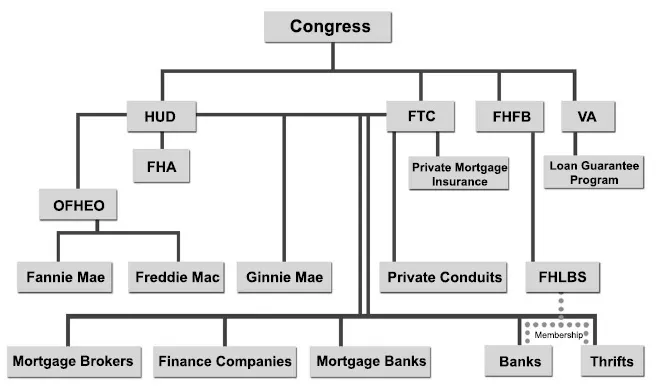
One week after the assassination of civil rights leader Martin Luther King, Jr., Congress passed the federal Fair Housing Act (Title VIII of the Civil Rights Act of 1968). The act’s goal was “a unitary housing market in which a person’s background (as opposed to financial resources) does not arbitrarily restrict access,” writes Wikipedia.
Ginnie Mae was established to purchase the new loans that the FHA would be insuring as a result of the act. “These loans were considered more risky than the traditional FHA mortgages and so were channeled into a separate entity,” Guy Stuart wrote in Discriminating Risk: The U.S. Mortgage Lending Industry in the Twentieth Century.
In 1970 Congress authorized Fannie Mae to buy conventional mortgages and chartered Freddie Mac to be another mortgage buying entity under the control of the Federal Home Loan Bank Board (FHLBB).
With the American public becoming addicted to credit in the 1970’s and the Treasury looking for more tax money, the deductibility of consumer interest payments, including mortgage interest, became a target of the Congress.
Whether it would really make a difference for home values or not, President Reagan wasn’t going to mess with the mortgage interest deduction, telling the National Association of Realtors in 1984, “I want you to know that we will preserve the part of the American dream which the home-mortgage-interest deduction symbolizes.” Two years later, Congress ended the deductibility of interest on credit-card and other consumer loans in the tax-reform act of 1986, but left the mortgage deduction in place.
After the Savings & Loan crisis, the 1989 Congress passed the Financial Institutions Reform, Recovery and Enforcement Act (FIREA) which did away with the FHLBB with Freddie Mac’s board becoming shareholder controlled.
Three years later, in 1992, Congress created the Office of Federal Housing Enterprise Oversight (OFHEO) to regulate Fannie and Freddie’s safety and soundness, a job OFHEO either didn’t do or wasn’t allowed to do due to interference from the GSE’s friends on Capitol Hill.
In 1989, the Department of Housing and Urban Development Reform Act “established over 50 legislative reforms to help ensure ethical, financial, and management integrity,” according to profile of HUD published by the U.S. Department of Housing and Urban Development Office of Management and Planning in October 1982.
Jack Kemp launched his Home Ownership for People Everywhere (HOPE) in 1990. Kemp was Secretary of HUD at the time overseeing a massive increase in that agency’s budget as it ladled out money for affordable homeowner initiatives.
According to profile of HUD, in 1991 more than 11.6 million households benefited directly from HUD mortgage insurance and other housing subsidies. “HUD policies affect the national economy through their influence on the mortgage and homebuilding industries,” the report crows. “The entire population benefits as low-income segments of the rental community move to manage or purchase their properties.
HUD Secretary Kemp was part of The Empowerment Network that adopted the view of author Michael Sherraden, who explained in Assets and the Poor, that policies which he referred to as “stakeholding” were more effective in fighting poverty. Providing assets will lift more people out of poverty than sending them a monthly check was Sherraden’s view. Kemp embraced the message, championing programs for public housing tenants to assume ownership of their units.
In their FY 1993 Budget entitled, Expanding the Opportunities for Empowerment: New Choices for Residents, the agency wrote, “Choice is really another dimension of freedom,” with one of its primary changes “where housing assistance for the poor has been restricted to month-to-month rental properties, the Homeownership Voucher option will permit residents to realize the American dream by turning their vouchers and certificates into equity for ownership.”
While Jack Kemp was trying to use government to drag the great unwashed into the homeownership tent, Fannie Mae and Freddie Mac began to loosen up their loan criteria to accomplish the same thing.
Edward Pinto, who served as an executive vice president and chief credit officer for Fannie Mae in the late 1980’s explained in an article for the Wall Street Journal that aggressive mortgage underwriting was instigated by Fannie and Freddie after the Senate Committee on Banking was advised by Acorn and other community groups in 1991 that “Lenders will respond to the most conservative standards unless [Fannie Mae and Freddie Mac] are aggressive and convincing in their efforts to expand historically narrow underwriting.”
HUD’s National Homeownership Strategy championed looser loan standards and worked to reduce homebuyer downpayment requirements causing a chain reaction in the mortgage industry.
Congress gave Fannie Mae and Freddie Mac a mandate to increase their purchases of mortgages going to low and moderate income borrowers by passing the Federal Housing Enterprise Financial Safety and Soundness Act of 1992.
The very next year, regulators threw standard historical underwriting out the window. Forget about down payments, good credit, and adequate income to service a mortgage. “Substituted were liberalized lending standards that led to an unprecedented number of no down payment, minimal down payment and other weak loans, and a housing finance system ill-prepared to absorb the shock of declining prices,” writes Pinto.
In 1994, HUD Secretary Henry Cisneros, working in the Clinton Administration, rolled out a National Homeownership Strategy that championed the looser loan standards and partnered with most of the private mortgage industry, announcing that “Lending institutions, secondary market investors, mortgage insurers, and other members of the partnership [including Countrywide] should work collaboratively to reduce homebuyer downpayment requirements.”
A document entitled “The National Homeownership Strategy: Partners in the American Dream” was posted on HUD’s website until being removed in 2007 and the following paragraph from that report illustrates the strategy:
For many potential homebuyers, the lack of cash available to accumulate the required downpayment and closing costs is the major impediment to purchasing a home. Other households do not have sufficient available income to make the monthly payments on mortgages financed at market interest rates for standard loan terms. Financing strategies, fueled by the creativity and resources of the private and public sectors, should address both of these financial barriers to homeownership.
The looser lending standards had a chain reaction on the mortgage industry. Financial institutions had to compete with Fannie and Freddie that “only needed $900 in capital behind a $200,000 mortgage—many of which had no down payment,” as Pinto points out. Private institutions did their best to lever up like the GSEs and they relaxed their underwriting to HUD’s affordable housing policies.
By 1996, Fannie and Freddie were to make 42% of their mortgage financing available to borrowers with income below the median in their area. That target increased to 50% in 2000 and 52% in 2005.
Homeownership jumped from 64% in 1994 to 69% in 2004, the result of increased loans to low-income, high risk borrowers. So government programs have created the typical mortgage deal—an impossibly long term for which to forecast property values, interest rates, income levels and the like.
“There are two important phenomena to note here,” writes Guy Stuart. “One is the prominent role the federal government has played in the [mortgage] industry since 1932. The second is the long-term tendency toward centralization of the industry, mostly as a product of the growth of Fannie Mae and Freddie Mac, though the consolidation of the banking industry through mergers and acquisitions in the 1990s has also contributed to this centralization.”
At the time when homeownership was hitting its peak, the conventional wisdom was that housing prices never go down. Mortgage lenders evidently believed that because required down payments went to zero in some cases and negative amortizing loan structures required continued increases in home prices.
In 2002, then Federal Reserve Chairman Alan Greenspan pooh-poohed the notion of a nationwide bubble in home prices.
The ongoing strength in the housing market has raised concerns about the possible emergence of a bubble in home prices. However, the analogy often made to the building and bursting of a stock price bubble is imperfect. First, unlike in the stock market, sales in the real estate market incur substantial transactions costs and, when most homes are sold, the seller must physically move out. Doing so often entails significant financial and emotional costs and is an obvious impediment to stimulating a bubble through speculative trading in homes. Thus, while stock market turnover is more than 100 percent annually, the turnover of home ownership is less than 10 percent annually—scarcely tinder for speculative conflagration. Second, arbitrage opportunities are much more limited in housing markets than in securities markets. A home in Portland, Oregon is not a close substitute for a home in Portland, Maine, and the “national” housing market is better understood as a collection of small, local housing markets. Even if a bubble were to develop in a local market, it would not necessarily have implications for the nation as a whole.
The nation’s deposit insurer and bank regulator, Federal Deposit Insurance Corporation (FDIC) published a report in 2004 that concluded,
[I]t is unlikely that home prices are poised to plunge nationwide, even when mortgage rates rise. Housing markets by nature are local, and significant price declines historically have been observed only in markets experiencing serious economic distress. Furthermore, housing markets have characteristics not inherent in other assets that temper speculative tendencies and generally mitigate against price collapse. Because most of the factors affecting home prices are local in nature, it is highly unlikely that home prices would decline simultaneously and uniformly in different cities as a result of some shift such as a rise in interest rates.
Later that same year, in a report entitled “Are Home Prices The Next ‘Bubble’?” senior economist Jonathan McCarthy and vice president Richard W. Peach for the Federal Reserve Bank of New York wrote, “Our observations also suggest that home prices are not likely to plunge in response to deteriorating fundamentals to the extent envisioned by some analysts. Real home prices have been less volatile than other asset prices, such as equity prices.”
When Federal Reserve Chairman Ben Bernanke was questioned in 2005 about whether house prices might be getting ahead of the fundamentals, he replied:
Well, I guess I don’t buy your premise. It’s a pretty unlikely possibility. We’ve never had a decline in house prices on a nationwide basis. So what I think is more likely is that house prices will slow, maybe stabilize: might slow consumption spending a bit. I don’t think it’s going to drive the economy too far from its full employment path, though.
The same year Bernanke was testifying that housing prices wouldn’t go down, “economists estimated that roughly half of all economic activity was tied to housing,” wrote Peter S. Goodman in Past Due: The End of Easy Money and the Renewal of the American Economy, “either through home-building, the purchase of housing-related goods like furniture and appliances, or spending unleashed by people borrowing against the increased value of their homes.”
Echoing the words of Herbert Hoover, President George W. Bush, said on June 17, 2004 “... if you own something, you have a vital stake in the future of our country. The more ownership there is in America, the more vitality there is in America, and the more people have a vital stake in the future of this country.”
In October of that year as the housing bubble expanded, Bush told the nation, “We’re creating ... an ownership society in this country, where more Americans than ever will be able to open up their door where they live and say, welcome to my house, welcome to my piece of property.”
However, the ownership society came with a huge debt burden. Mortgage debt in the U.S. more than doubled form $6.3 trillion at the start of the decade to $14.4 trillion by the end of 2009 two years after the market crashed. Nationwide, the price of housing rose 86 percent. “The economy became governed by a new exercise in make-believe, the notion that housing prices could never fall,” wrote Peter Goodman. “Still the responsibility for the housing bubble cannot be hung on any single person or institution. The bubble was the product of years of government policies that aimed to make it easier for more Americans to own homes.”
Anthony Sanders at George Mason University wrote that GSEs not only pump-primed the housing market far beyond what the stated policy goals justified, but also caused more damage by actively helping to push up household leverage during the real estate boom. “Fannie Mae CEO James Johnson said in Q3 1998 that they were going to ramp up homeownership when it was 66.8%,” Sanders notes. “Now, it is 66.9%. So, after trillions of dollars, a housing bubble, a banking sector crash, and a 90%+ market share for Fannie, Freddie and the FHA, we are back where we started. Not to mention about $6 trillion in wealth destruction. Can we politely ask that the Feds please stop screwing up the U.S. housing market?”
*“Curbstoners” or “curbstone” subdividers referred to those who subdivided land hastily, sold the lots and walked away, leaving individual property owners to build their own homes or hire a builder to build their homes. The result was neighborhoods with no continuity or standard architecture.
*From the “Note” to Babbitt, Dover Thrift Editions, 2003, Dover Publications, Inc., New York.
Walk Away: The Rise and Fall of the Home-Ownership Myth
Read the whole book online · Book details
This work is published under a Creative Commons licence. You may copy, share, and re-host it with attribution.