
Chapter 7 of 13 · Deep Freeze: Iceland's Economic Collapse by Philipp Bagus
Chapter 5 The Consequences of the Boom: Malinvestments
Austrian business cycle theory describes the process whereby a general error-induced boom is produced.1 Credit expansion misdirects spending and investment in three main ways.
First, malinvestments develop from misallocation of capital. Sustainable investments are those investments that are financed out of real savings. An increase in real savings reduces the interest rate, indicating to entrepreneurs that additional resources are available. Entrepreneurs can then engage in more investment projects using the resources that have been saved. Credit expansion implies an increase in the money supply but not an increase in real savings. Producing more money, or increasing the supply of credit, does not make more resources available. Credit expansion causes interest rates to fall even though there is no increase in real savings. Interest rates are artificially low. At these reduced rates, investment projects become profitable that would not be profitable with higher rates. Consequently investment projects are undertaken that cannot be successfully completed with the real savings that are available. In the words of Mises,
The whole entrepreneurial class is, as it were, in the position of a master-builder whose task it is to erect a building out of a limited supply of building materials. If this man overestimates the quantity of the available supply, he drafts a plan for the execution of which the means at his disposal are not sufficient. He oversizes the groundwork and the foundations and only discovers later in the progress of the construction that he lacks the material needed for the completion of the structure. It is obvious that our master-builder’s fault was not overinvestment, but an inappropriate employment of the means at his disposal.2
Second, consumption increases beyond what it would have been if interest rates had been at their natural higher level. Enticed by the artificially low interest rate, people increase their consumption, thereby reducing their savings. They indebt themselves more and increase their purchases, typically of durable consumers goods.3
Third, there is a shift to the sector where credit expansion creates the greatest profits, i.e., the financial sector. An increased money supply filters to the economy via large banks making loans to smaller business and extending consumer credit. By making use of the fresh liquidity prior to its use by others, banks reap profits before Cantillon effects set in. Prices will only rise after other firms employ the money. Additionally, as the financial sector endogenously creates new money, extending loans against its deposit base, its profits soar, attracting resources from all over the economy. If this process continues long enough, the banking system fails to maintain its supreme relative profit rates, being surpassed by firms engaging solely in financial speculation. It no longer remains advantageous to earn money solely by relying on the loans to the now dwindling production based economy. Speculation becomes a profit driver, with profits relying on the continual influx of money and credit to maintain price buoyancy.4 Again, this shift is marked by a resource loss not only to the real economy, but also to the previously thriving banking industry.
We will consider in turn how these three distortions of spending and investment developed in the specific case of Iceland.
In the Icelandic case, the malinvestments at home were brought about by the domestic credit expansion, as well as by currency-mismatching investors using foreign-denominated funds to invest in Iceland. Malinvestment also occurred abroad as Icelandic banks borrowed and lent in foreign currencies, allowing Icelandic companies to buy foreign companies and participate in the international credit-induced boom.
The domestic investments financed by maturity mismatching and currency mismatching were mainly in the aluminum smelting and construction industries. Both aluminum smelters and residential and commercial housing are long-term investment projects that were financed by short-term funds, and not by savings of an equal term.
During smelting, aluminum is extracted from its oxide alumina, which in turn is extracted from the ore Bauxite. Iceland has no aluminum mines, but it is endowed with two abundant sources of cheap energy: glacial rivers running from the interior and geothermal heat. While Iceland cannot export energy due to its geographic isolation it can use it for production processes requiring much energy. Aluminum smelters use prodigious amounts of electricity. In this production process, aluminum ore is transported to Iceland, it is smelted using cheap energy, and the aluminum is shipped back to other countries to be used in production processes. At the turn of the century, Iceland already accounted for four percent of worldwide aluminum production.
Aluminum production is a very capital-intensive and timeconsuming process, what Eugen von Böhm-Bawerk5 would have called a very “round about” process. Its viability depends on high savings and low interest rates, as well as high aluminum prices. During the credit boom of 2001–2007 central banks all over the world increased money supplies, resulting in booms in capital-intensive industries. Aluminum, which is a prime input factor for many of these industries, consequently experienced a boom. As aluminum prices soared and interest rates stayed at historic low levels, expanding Icelandic smelting appeared to be profitable. As a result, Iceland became involved in the international asset price bubble.
In 2003 Iceland’s parliament, the Althing, approved plans to provide new power plants in order to run two additional aluminum smelters. They would be located on opposite sides of the island, east and west. The plant in the west would be geothermal, constructed by the national power company of Iceland, Landsvirkjun, and would be one of the largest hydroelectric power plants in Europe when finished. The total investment would tally to almost $4 billion, about thirty-five percent of Iceland’s GDP.6 Holes would be drilled into the ground and into the volcanic hotbed of the island. Emerging steam would power the generators. In the east, the largest gravel dam in the world would be built, creating a new artificial lake filled with glacier meltwater. Water going through underground tunnels would provide electricity for a new smelter owned by the American aluminum producer Alcoa. The power companies would be public, and would constitute a malinvestment directly financed by the government. The dimensions of these projects were enormous. Operating costs would amount to approximately thirty-five percent of the country’s GDP.7 This was a huge investment that increased foreign debts and the trade deficit, since the investment goods necessary for their construction had to be imported.
The other main domestic malinvestment was made in housing. Houses are a very capital-intensive good with lengthy periods of serviceableness. Decades, or even centuries, may expire before a house is consumed fully. Due to the length of the production and use processes, the construction sector is especially sensitive to interest rates. Low interest rates boost the capital value of houses, making it attractive to build or purchase them. Interest rates were low not only due to Icelandic credit expansion but also due to currency mismatching, as houses were financed with mortgages denominated in yen or Swiss francs at low rates. The housing boom fueled by currency mismatching is another way that the international credit expansion affected and filtered into the Icelandic economy.
The existence of a particular state institution may explain why a housing bubble developed in Iceland in the first place, or at least why the problem became so exaggerated. The Icelandic government formed the Housing Financing Fund (HFF) in 1999 to provide low-interest mortgages. It is the Icelandic counterpart of America’s Freddie Mac and Fannie Mae, with the difference that it deals directly with customers. The U.S. government implicitly guarantees the debt of Freddie Mac and Fannie Mae (which were themselves protagonists in America’s housing bubble), but the Icelandic government had gone farther in institutionalizing moral hazard into the HFF’s operations; it had explicitly guaranteed the HFF’s debt.
In many countries, state-controlled mortgage assistance schemes like the HFF are reserved for those deemed most in need. Icelandic society, however, prides itself on treating everyone equally. (Equality is such an ingrained feature of Icelandic life that passport controls when entering the country do not distinguish between foreigners and Icelanders.) All citizens were given equal access to HFF mortgages provided at artificially lowered rates. The result was increased demand for housing across the board (not just among the lower income brackets, as occurs in other countries). By mid-2004 almost ninety percent of Icelandic households held an HFF loan, and HFF-issued bonds comprised more than half of the Icelandic bond market.
Hunt, Tchaidze, and Westin8 provided one early warning of the imbalances and dangers that could be created by the HFF. Enhanced access to international capital markets led the big three banks to enter the primary mortgage market for the first time. The HFF had enhanced the efficiency of the mortgage market significantly by the second half of 2004, leading to a sharp increase in mortgage lending and a steep decline in mortgage interest rates. Mortgage lending increased by sixty-three percent during 2004, and most of the increase occurred in the final half of the year. Mortgage rates fell by 5.10 percent in nominal terms, 4.15 percent when adjusted for inflation.9 Had these efficiency increases been brought on by free competition restrained by the threat of losses, there would have been no immediate cause for concern. Instead, the publicly guaranteed fund was able to reduce mortgage rates unilaterally, enticing unsuspecting homebuyers to take on increasing indebtedness unaware that the situation was unsustainable.
Compared to other countries, the Icelandic government’s involvement in the mortgage market was large. Most other Western European countries that encouraged state-guaranteed loans and mortgages did so via a private banking sector. Few countries exhibited widespread public support for a government-controlled mortgage system such as was implemented in Iceland.10
At times, the HFF went above its already-lenient core operating mandate. In 2005, the Fund funneled its excess liquidity to the commercial banking system, making approximately eighty billion krónur (around one billion euros) available, an activity not covered in its original mission.11
These distortions had long been noted, particularly by the IMF during the HFF’s dominance in the mortgage market in the first five years of the 2000s.12 By August 2006, repeated calls for reform of the HFF had failed, and artificially cheap state-guaranteed debt had caused noticeable distortions in the mortgage market.13 An IMF report from 2005 recommended altering the scope of the HFF’s operations:14 the HFF should assume a role closer to those of the American giants Fannie Mae and Freddie Mac, with operations contained in the secondary mortgage market. Securitizing mortgages and then selling them to investors as mortgage-backed securities, it was reckoned, would provide a more stable mortgage market.
The HFF was a large presence in the mortgage market, but the banks were flush with cash and looking for a way to use it, and they decided to enter the market themselves. They originally offered mortgages at a fixed real interest rate of 4.3 percent. This was lower than the HFF’s rate of 4.8 percent. The banks set maturities at twenty-five to forty years. Finally, they removed króna loan limits and allowed a maximum loan-to-value ratio of eighty percent. These features bettered the HFF’s offerings on both counts: the state agency had a maximum loan limit of 9.7 million krónur, and its rules allowed for maximum loan-tovalue ratios of 65–70 percent.
Mortgages offered through the banks were not limited to construction or housing loans. In contrast to the HFF, the banking system would offer loans towards equity withdrawals or the refinancing of previous mortgages. In an attempt to compete against their state-supported counterpart, Icelandic banks created features previously unknown to Icelandic borrowers. In doing so, they increased the amount of consumer credit beyond anything previously conceivable.
By mid-2004 the HFF had reduced its own rates to remain competitive. All parties were offering mortgages at 4.15 percent. The banks, in an attempt to maintain competiveness both against the HFF and among themselves, increased their lending limits by offering 100-percent mortgages. It was now possible to finance all of your home purchase with borrowed money.
The banks soon realized that they were at a disadvantage to the HFF when it came to gross lending power. The Housing Financing Fund could match every change the banks made, whether it be loan-to-value ratios, maximum loan limits, or other related options. Iceland’s newly privatized banks, led by the big three, found themselves unable to compete with the state-supported system based on low interest rates alone. Instead, they were increasingly forced to reduce the quality of the collateral posted for their mortgages, an occurrence which resulted in a general underpricing of risk. As price-based competition was all but eliminated due to the equality of interest rates, alternative avenues were sought. Banks were competing aggressively against a state-guaranteed entity that held almost half of the mortgage market.
Typically, banks grant mortgages to only the most creditworthy individuals, those with secure jobs or large amounts of savings, for example. As banks sought additional ways to compete in the mortgage market, they took on less creditworthy individuals as clients. As mortgages could not be sold at higher interest rates lest the borrowers seek lower rates elsewhere, an increasing number of mortgages were issued to people who would previously, and normally, have been considered non-creditworthy individuals. The drive to maintain competitiveness resulted in a general underpricing of risk.15
The short-term risk of heavily mismatching the durations of loans and debts was soon overshadowed by the longer-term risk of poorly collateralized mortgages. By 2006, over sixteen percent of new mortgages had loan-to-value ratios greater than ninety percent.16 By issuing longer-termed mortgages, sometimes up to forty years, in their drive to compete with the HFF, the banks had exposed themselves to greater interest rate risk. By the end of 2006, a two percentage point rise in market interest rates would have caused $465 million in losses for the banking sector alone.17
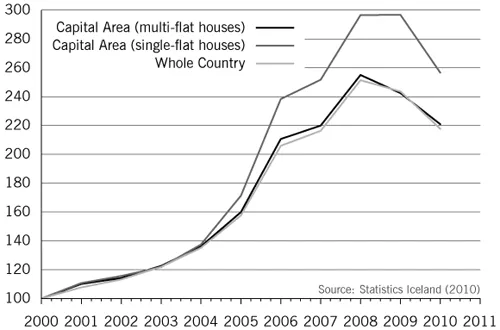
Figure 8: Housing prices (2000 = 100)
Eventually, banks found themselves unable to compete with the HFF in terms of mortgage rates and collateral alone. Riskadjusted rates of return were suffering from the combined effects of decreased collateral requirements, reduced interest rates, and lower down-payments. Banks began bundling other services, such as insurance, with their mortgages in an attempt to generate ancillary profits from these additional products. Tchaidze, Annert, and Ong18 noted that “Over the longer-term, such strategies are likely to be unsustainable and could potentially weaken bank soundness.”
The interest-rate disadvantage that banks shared relative to the HFF was removed in the summer of 2004 when Kaupthing began to offer the same rates as the HFF.19 The HFF answered the challenge by lowering its rates and lending at higher loanto-value ratios. Competitive bidding to get larger shares of the mortgage market ensued, with the banks at a disadvantage to the HFF since they lacked its direct explicit state guarantee.20
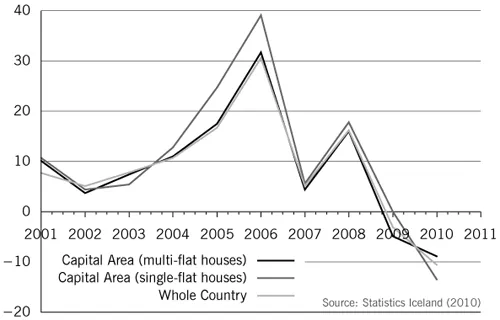
Figure 9: Average yearly house price appreciation (percent)
As mortgage lending skyrocketed, the demand for Icelandic housing did likewise. The immediate result was a steady surge in housing prices, which had already commenced in the late 1990s but really picked up its pace in mid-2004. Every year between 2003 and 2006 saw a greater than ten percent annual price appreciation. In the eight years between 2000 and 2008, housing prices increased by almost 300 percent (see Figures 8 and 9).21
The CBI tried to arrest the boom by raising interest rates from 10.5 percent at the end of 2006 to fourteen percent a year later, but this sharp increase did little to restrain the boom. The CBI’s action did not strongly affect the rates consumers had to pay to buy houses, which were typically financed with inflationindexed mortgages, or cars, which were normally financed with foreign loans. Instead, the CBI incentivized the carry trade as the high interest rate attracted foreign investors to invest in krónur. This strengthened the exchange rate, reducing real financing costs for those who were indebted in foreign currency. It also reduced the prices of imports, thus spurring an overconsumption-based boom. This created an unstable situation.
Not only did both the Central Bank of Iceland and the Icelandic government do too little, too late, to arrest the boom that they themselves had caused, but once the bust had begun they took measures that exacerbated it. The HFF made several changes in its lending practices during 2008, just as the boom was collapsing into a severe bust. It increased loan-to-value ratios by more than ten percent and increased maximum mortgage values from eighteen to twenty million krónur.22 Such changes tended to prevent interest rates from declining to the levels necessary to curtail the boom. Collateral requirements were never seen as problematic, even on the eve of the bust. Jaime Caruana and Ajai Chopra, writing an IMF stability assessment in 2008, noted that nonperforming loans had only increased slightly between 2006 and 2007. Assessing the largest financial institutions, they found ninety percent of them to have loan books of “good quality”.23 As there was no perception of danger from the quality of the collateral on the mortgages they issued, Icelandic banks continued finding investors as well as avenues for investment.
Foreign investors, spurred on by the increasing interest rate differential between Icelandic bonds and still-low foreign ones, started issuing what would later come to be known as the “glacier bond.” Denominated in krónur, these bonds gave individuals the ability to invest in the high-yielding country. The first such bond was issued in August 2005 and was internationally heralded because of its high yield relative to low foreign rates coupled with the perception that the Icelandic króna had stabilized and would maintain its high valuation. Issuances reached their apex in the spring of 2007, when $6.3 billion of these bonds were outstanding—equivalent to almost thirtyseven percent of the island’s GDP. These glacier bonds were a source of extra liquidity that emerged near the end of Iceland’s boom. They came forth at the exact moment when Iceland needed to have its excesses curbed. The liquidity risk that these bonds posed was important, as the carry-trade that the glacier bonds provided led to increasing debt levels for most large financial institutions.24 As interest rates increased, liquidity flooded in. Icelandic investors poured more money into the many malinvestments, worsening the existing erroneous investments and forming new ones.
Once confidence in the króna became tenuous, additional investments via glacier bonds began to subside. An important short-term source of financing was lost at exactly the moment when the world’s supply of short-term liquidity was also waning.
While we can explain much of Iceland’s boom and subsequent bust by the malinvestment of capital along the structure of production, there was also a coincident shift of resources from the production sector into the financial sector. Because the credit injections were made possible via loans issued by the country’s banking sector, relative profits increased among these issuers at the expense of the old production-based sectors. The result was a resource shift into the banks, as well as other financial companies.
The extent of these distortions is often unrecognized. As banks expanded their capacity and scope of operations, their own physical resource utilization was increased. Buildings were enlarged, departments were developed, and new employees were hired. What is often missed are the shifts that prepare individuals for a life in banking or finance. Universities altered the courses they offered as demand for certain courses exceeded demand for other, previously more popular, choices.
“Everyone was learning Black—Scholes” (the option-pricing model), says Ragnar Arnason, a professor of fishing economics at the University of Iceland, who watched students flee the economics of fishing for the economics of money. “The schools of engineering and math were offering courses on financial engineering. We had hundreds and hundreds of people studying finance.”25
The financial system attracted the talents of the country. Banks offered high salaries to the best students of any discipline even before they finished University. As recently as 2006, starting salaries of 100,000 for new graduates were the norm. “An apocryphal story went that the car park at the university was so full of student cars that the professors had difficulties finding places to park their bicycles.”26
The demand for financiers and bankers displaced the traditional disciplines that had been mainstays of the Icelandic economy and education system. As workers were enticed to work in the increasingly attractive financial industry, the labor force in the real productive sector dwindled. Perhaps more important was the dearth of entrepreneurial talent in the productive sector as the ambitious left for greener financial pastures. Productivity suffered, and the Icelandic economy became more reliant on imported goods. Iceland became an exporter of financial services and an importer of goods. Iceland borrowed foreign money and used it to buy foreign goods, without improving its productivity so as to be able to service this debt in the future; an unsustainable situation was worsening. As Iceland began importing more goods, and at the same time produced fewer “real” goods and services, a substantial trade deficit developed, reaching thirty percent of GDP in 2006, as shown in Figure 10.
This distorted structure of production threatened to starve the population during the currency breakdown in the fall of 2008 when Iceland had problems obtaining foreign exchange to pay for the imports on which the country had become so reliant. Iceland had become dependent on imported goods not only because the economy had lost some of its productive capacity but also because the strong króna made imports relatively attractive. When times were good, Icelanders had access to a nearly endless supply of goods at attractive prices. Attractive, at least, to those fortunate enough to be earning krónur as well as spending them. For foreigners, the strength of the króna made Iceland a financially unattractive travel destination, as even the most mundane items were many multiples more expensive than in even the most expensive European capitals. When the króna weakened, Iceland’s dependence on imported goods became a plague. The prices of basic foodstuffs skyrocketed, making previously affluent Icelanders suddenly aware of how tenuous, indeed unsustainable, the previous situation had been.
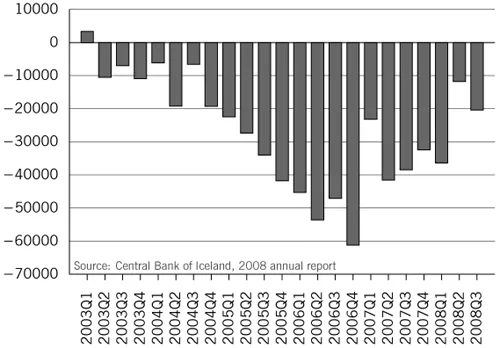
Figure 10: Balance of Trade (million krónur)
Icelandic banks and intertwined investment companies made further malinvestments outside the island. They used the ample short-term foreign liquidity to invest in foreign countries, mainly in Great Britain and continental Europe. Because Icelanders were offering generous prices, they found willing sellers of banks, retailers, supermarkets, jewelers, shoe shops, and toy stores. They invested in asset markets by taking on private equity positions, acquiring the British retailers Debenhams, Woolworths, and Hamleys, fully or partly, as well as the Danish companies Magasin du Nord and Royal Unibrew. The FL Group, an international investment company headquartered in Reykjavík, bought a 16.2 percent stake in EasyJet to add to their portfolio that already included Icelandair. The company Baugur, owned by businessman Jon Asgeir, with the help of Kaupthing bought the fashion chain Oasis. As Thorvaldsson27 puts it: “Baugur was also acquiring businesses as if a worldwide ban on takeovers was looming.” In November 2006 another Icelandic businessman, Bjogolfur Gudmundsson, bought the English football club West Ham United.
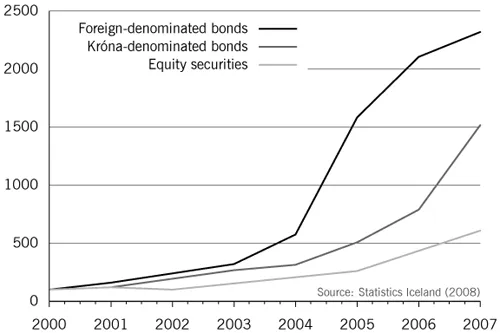
Figure 11: Value of securities outstanding (2000 = 100)
This interest in equity not only drove Icelanders to purchase foreign-listed securities, it also sent the prices of domestic equities shooting upwards. While Icelanders were getting drunk on cheap credit denominated in foreign currencies, they directed only a small portion of the proceeds to similarly denominated assets, as can be seen in Figure 11. Icelandic equities soared in value, increasing over 2,300 percent in value from 2000 to the end of 2007. In 2005 alone, equity values almost doubled.
As long as the international asset-price boom fueled by credit expansion went on, assets kept increasing in price, and so they could serve as collateral for further loans. Icelanders were making big money by using debt to buy foreign companies during a liquidity-induced asset-price bubble. This brought the Icelanders the nickname of “marauding Vikings,” which recalled their ancestors who fell upon Europe destroying and plundering. Likewise, the period between 2000 and 2008 when Icelandic companies were aggressively acquiring foreign companies has been called an “outvasion.” In contrast to the Vikings who invaded much of Europe in the middle ages, Icelandic businessmen found that newly created money was better than outright violence for amassing riches.
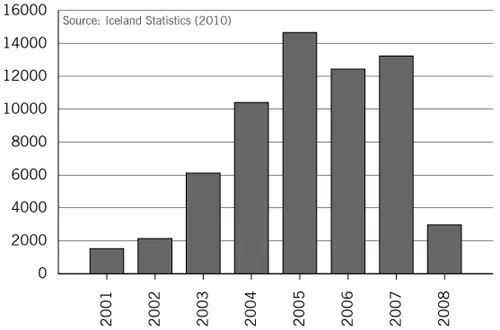
Figure 12: New automobile registrations
While the malinvestments increased, eventually shifting into the banking and finally the financing sectors, consumers had commenced consuming beyond their means. Artificially reduced interest rates were not just enticing entrepreneurs to undertake more and longer-dated investments. As the reward for foregoing consumption was artificially reduced, consumers were saving less and consuming the excess. Soaring housing prices, high salaries, and low interest rates made Icelanders feel rich. Since foreign-denominated loans were cheap, Icelanders often used yen-denominated or Swiss-franc-denominated loans to buy cars. As can be seen in Figure 12, new car registrations surged in the mid 2000s. Since Iceland has only about 300,000 citizens, the fact that almost 15,000 new cars were sold in 2005 means that almost five percent of Icelanders bought a new car in 2005.28
Iceland often appeared to be a big party. Unemployment rates barely even reached one percent. As businesses were almost fully utilizing the labor force, workers had to be imported. Polish and Lithuanian workers amounted to almost ten percent of the total work force by the end of 2006. The result was that not only were entrepreneurs investing in projects with a firstorder effect of insufficient resource availability, but consumers were creating a second-order resource constraint by consuming more. Icelanders soon found themselves working two jobs as business’s insatiable hunger for labor could not be satisfied even by temporary migrant workers from Eastern Europe.
Inflation generated overconsumption and new habits. Prudence and conservatism were thrown to the wayside as shortsightedness came into fashion. The inflationary economy increased the time preference of the nation; saving was no longer necessary as easy profits abounded. Nor was it sensible, as inflation quickly removed the purchasing power of any saved money. Consumers rushed to buy flat-screen TVs and cars at artificial low interest rates with a strong króna.
The older generation shook their heads as their children purchased jacuzzis, trampolines, and chocolate fountains. The sale of champagne increased 82%. The luxury electronics maker Bang and Olufsen sold more in its store in Reykjavik than in any other store worldwide except for Moscow. And amazingly, more Range Rovers were sold in Iceland in 2006 than collectively in the other Nordic countries combined! By the age of fifteen, I had been on a holiday abroad just once.… Now the typical family was going abroad once or even twice a year. Armani was doing such business in Iceland that they sent a tailor from Italy to make suits to measure.29
The younger population embraced debt, which previous generations had viewed as a thing to avoid. Inflation had made savings a thing of the past; as a corollary, debt was the way of the future. Icelanders had had a taste of the world that debt could provide to them, but had not considered the day of reckoning when the bills would come due. “They had entered a world in which debt—the same debt that had been a ball and chain for their grandfathers—had become a plaything, even sexy. Farmers and fishermen understood derivatives; they took bets on their harvests, their catch”.30
Armann Thorvaldsson, former CEO of the Kaupthing subsidiary Singer and Friedlander, tells other stories showing the decadence caused by inflation and the change in habits. Elton John was flown into Iceland to sing on the fiftieth birthday party of one of the country’s leading businessmen. New problems confronted the nouveau riche. Service staff, such as drivers or cleaning personnel, had to be trained and instructed. Children were tired of travelling constantly to St. Tropez or Dubai and began crying out to stay at home for vacation. Instead of just drinking gin and tonic, one now had the problem of selecting expensive wines.31 Money creation seemed to make wealth creation effortless. Just by cleverly participating in the global liquidity tide while remaining highly and fully leveraged, many Icelanders got rich almost without effort. Many of them lost respect for hard work and money. Inflation changed their habits for the worse.32
Tony Shearer, who was CEO of the British bank Singer and Friedlander when Kaupthing took it over, was shocked when he started looking into his new employer’s books.33 The giant Icelandic bank had only one board member who was not Icelandic. All directors were hired on four-year contracts, and they were granted loans to buy shares in the bank. The 19 million worth of shares also included embedded options to sell the shares back to the bank at a guaranteed profit.
More troubling, almost all of Kaupthing’s stated profits were “earned” by marking up assets it had previously bought at inflated prices. Actual profits related to the activity that used to be known as banking were less than ten percent, as estimated by Shearer.34
Hülsmann35 outlines the financing shift inherent in inflationary conditions. As debtors gain at the expense of creditors, financing becomes increasingly centered on borrowing funds via the banking system or bond markets at the expense of the traditional equity market. The highly inflationary Icelandic environment had shifted the economy into a highly indebted position. Icelandic firms employed debt-to-equity ratios 3.6 times higher than comparable firms in other Scandinavian countries.36 Another reason why equity funds were a less attractive option than debt-based financing was that the stock market in Reykjavík was small and poorly developed.
Iceland’s party was also apparent by a stock market boom. Credit expansion and optimism pushed the Icelandic stock index to ever-greater heights (see Figure 13). With highly leveraged companies, small increases in productivity resulted in huge profits. In the three years from 2003 to 2006 the stock market created paper wealth amounting to more than the country’s total GDP. The Icelandic stock exchange became home to the second largest prosthetics company in the world (Ossur), the fourth largest pharmaceutical business in the world (Actavis), the UK’s largest producer of fresh food (Bakkavor), and France’s leading producer of foie gras and smoked salmon (Alfesca).37 The new wealth provided by higher housing and stock prices spurred overconsumption, overoptimism, and party mood in Iceland.
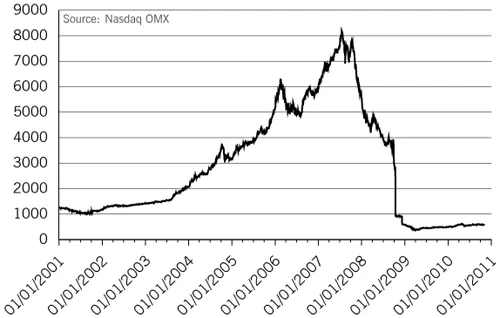
Figure 13: Icelandic Stock Market (OMX All Share Index, January 1, 2000–December 1, 2010, krónur)
A significant boom had materialized, much of it realized in foreign currency at captivatingly low interest rates. Borrowing short and lending long, combined with a currency mismatch, had prepared the perfect storm. Iceland had become a kind of hedge fund. Its citizens, companies, and banks had indebted themselves in foreign currency. They had invested for the long term in both foreign- and domestic-denominated assets. With more and more short-term liabilities denominated in foreign currency, a precarious situation loomed.
1The Austrian theory of the business cycle was originally developed in Ludwig von Mises (The Theory of Money and Credit; Human Action: A Treatise on Economics [Auburn, Ala.: Ludwig von Mises Institute, 1949]) and F. A. Hayek (Prices and Production [London: Routledge, 1931]; Profits, Interest, and Investment [New York: Kelley, 1939]). Additional refinements and additions are found in Richard von Strigl (Capital and Production, trans. M. Hoppe and H. Hoppe [Auburn, Ala.: Ludwig von Mises Institute, 1934]), Hülsmann (“Error Cycles”), Roger W. Garrison (Time and Money. The Macroeconomics of Capital Structure [London: Routledge, 2001]; “Overconsumption and Forced Saving in the Mises–Hayek Theory of the Business Cycle,” History of Political Economy 36, no. 2 [2004]: pp. 323–349), Huerta de Soto (Money, Bank Credit, and Economic Cycles), Toby Baxendale and Anthony Evans (“Austrian Business Cycle Theory in Light of Rational Expectations: The Role of Heterogeneity, the Monetary Footprint, and Adverse Selection in Monetary Expansion,” Quarterly Journal of Austrian Economics 11, no. 2 [2008]: pp. 81–93), Philipp Bagus (“Monetary Policy as Bad Medicine: The Volatile Relationship Between Business Cycles and Asset Prices,” Review of Austrian Economics 21, no. 4 [2009]: pp. 283–300; “Austrian Business cycle Theory”), and David Howden, (“Knowledge Shifts and the Business Cycle: When Boom Turns to Bust,” Review of Austrian Economics 23, no. 2 [2010]: pp. 165–182).
2Mises, Human Action, p. 560.
3The increase in consumption goods is most pronounced in the durable goods category. Just as longer-dated production projects are favored as they are relatively more profitable at decreased interest rates than short-term projects, those consumers’ goods which are durable will become relatively more valued than nondurables. A longer serviceable life will create greater net present value consumption opportunities as the interest rate is reduced.
4Philipp Bagus (“Asset Prices—An Austrian Perspective,” Procesos de Mercado: Revista Europea de Economía Política 4, no. 2 [2007]: pp. 57–93, “Monetary Policy as Bad Medicine”) discusses the herd behavior that results from this process. As the driver of high profits shifts through the economy over time, entrepreneurs chase these disequilibrium opportunities. Since the profits from financial speculation mark the logical conclusion of the necessary link of prices determined by the “vicissitudes of the [underlying] market” (Mises, Human Action, p. 810), financial speculation must become rampant, as the continuance of profits relies on a maintained volume of transactions. Entrepreneurs, seeing these maintained or strengthened profits, continue flooding into the financial sector, maintaining or strengthening profits as long as the credit influx remains.
5Eugen von Böhm-Bawerk, Capital and Interest, vol. 2, Positive Theory of Capital (South Holland, Ill.: Libertarian Press, [1889] 1959).
6Thorvaldsson, Frozen Assets, p. 150.
7Jónsson, Why Iceland? p. 64.
8Hunt, Tchaidze, and Westin, “Iceland: Selected Issues,” p. 31.
9Luckily, the majority of Icelandic mortgages are inflation-indexed, making the inflation-adjusted rates largely moot.
10Hunt, Tchaidze and Westin (“Iceland: Selected Issues”) provide a comparison of Iceland, Finland, Sweden, Denmark, Germany and France’s public mortgage support systems.
11íslandsbanki, lSB Weekly (July 26, 2005).
12See, for example, International Monetary Fund, “Iceland—2005 Article IV Consultation Concluding Statement” (June 13, 2005) and Tchaidze, Annett and Ong, “Iceland: Selected Issues,” p. 32.
13Honjo and Mitra, “Iceland: Selected Issues.”
14Hunt, Tchaidze, and Westin, “Iceland: Selected Issues,” p. 42.
15Tchaidze, Annett, and Ong, “Iceland: Selected Issues,” p. 24.
16Honjo and Mitra, “Iceland: Selected Issues.”
17Tchaidze, Annett, and Ong, “Iceland: Selected Issues,” pp. 24–5.
18Ibid., p. 25.
19Thovarldsson, Frozen Assets, p. 150.
20It is true that the Icelandic banks benefited from CBI guarantee on their liquidity. The main institutional difference is that the banks had private shareholders and were ultimately constrained by the possibility of loan losses. Private shareholders do not favor continual reductions in the interest rate spread as their ensuing profits were commensurately reduced. The HFF, in opposition, was not constrained by this profit motive, and consequently continued lowering mortgage rates irrespective of their profit margin; the HFF did not care so much about profits, being a public entity.
21Working for the Central Bank of Iceland, Lúdvík Elíasson and Thórarinn G. Pétursson (“The Residential Housing Market in Iceland: Analysing the Effects of the Recent Mortgage Market Restructuring,” Central Bank of Iceland Working Paper no. 29 [2006]) derive a model that shows that structural changes in the Icelandic housing market (i.e., substantial declines in real long-term mortgage rates) led to a strong increase in housing demand. This structural change in the mortgage market led to a permanent lowering of real mortgage interest rates, and contributed to a domestic spending spree and overheating of the economy. The decline in mortgage rates had secondary effects through the economy as funds were freed for other uses.
22International Monetary Fund, “Iceland: Article IV Consultation—Staff Report; Staff Supplement; Public Information Notice on the Executive Board discussion; and Statement by the Executive Director for Iceland,” IMF Country Report no. 08/367 (2008), p. 15–16.
23Jaime Caruana and Ajai Chopra, “Iceland: Financial System Stability Assessment,” p. 16.
24Tchaidze, Annett, and Ong, “Iceland: Selected Issues,” p. 32.
25Michael Lewis, “Wall Street on the Tundra: The Implosion of Iceland’s Economy,” reprinted in The Great Hangover: 21 Tales of the New Recession, ed. Graydon Carter, pp. 203–228 (New York: Harper Perennial, [2009] 2010).
261horvaldsson, Frozen Assets, p. 147. Jörg Guido Hülsmann (The Ethics of Money Production [Auburn, Ala.: Ludwig von Mises Institute, 2008], pp. 186–87) explains how an inflationary boom entices individuals to pursue monetary goals in life before those which otherwise would take precedence. Students seeking higher fulfillment through education were soon drawn to the increasingly attractive wages in the financial sector that resulted from inflationary policies, leading them to postpone their studies for immediate monetary goals.
27Thorvaldsson, Frozen Assets, p. 134.
28Proportionately, Iceland’s automobile buying boom was about twenty--five percent larger than other developed countries’. Germany, for example, had 3.3 million new registrations in 2005 for a population of eighty-two million: approximately four percent of its population.
29Thorvaldsson Frozen Assets, p. 156. As Mises similarly described the byproducts of the inflationary process that gripped Germany over eighty years earlier, these effects are “especially strong among the youth. They learn to live in the present and scorn those who try to teach them ‘old-fashioned’ morality and thrift” (Ludwig von Mises, “Inflation and You,” in Economic Freedom and Intervention: An Anthology of Articles and Essays, ed. Bettina Bien Greaves, pp. 83–87 [Indianapolis: Liberty Fund, 1942], p. 86). Inflationary periods not only cause the elder generation to feel uneasy about the younger’s spending habits, but the younger generation views the restrained elderly with disdain.
30Boyes, Meltdown Iceland, pp. 87–88.
31Thorvaldsson Frozen Assets, p. 158.
32Hülsmann (The Ethics of Money Production, Ch. 13) outlines the effects that a legacy of inflation can have on individuals’ personal behavior.
33Lewis, “Wall Street on the Tundra.”
34As quoted in Lewis, “Wall Street on the Tundra.”
35Hülsmann, The Ethics of Money Production, pp. 179–82.
36Hunt, Tchaidze and Westin, “Iceland: Selected Issues,” p. 48.
37Thorvaldsson, Frozen Assets, p. 148.
Deep Freeze: Iceland's Economic Collapse
Read the whole book online · Book details
This work is published under a Creative Commons licence. You may copy, share, and re-host it with attribution.