
Chapter 8 of 13 · Deep Freeze: Iceland's Economic Collapse by Philipp Bagus
Chapter 6 A Timeline of the Collapse
Icelandic banks had no difficulties as long as international liquidity was ample and they could easily renew their short-term foreign-denominated debts. In early 2006, however, problems in the interbank market surfaced, in what would later be called the “Geyser crisis.” Price inflation increased and the króna depreciated as foreign money started getting nervous about the sustainability of the Icelandic boom.
Credit default swaps written on Icelandic banks soared. A credit default swap (CDS) is a form of insurance that investors buy to compensate for a loss if a particular debtor defaults on its obligation. Thus, when an investor holds a million-dollar bond issued by Glitnir and the insurance premium is twenty-five basis points or 0.25 percent, he can insure himself against a default by paying an annual fee of 0.25 percent of one million, i.e., $2,500. An intriguing aspect of credit default swaps is that you may buy them even though you do not own any debt issued by the company, Glitnir in this example. Lacking ownership in the underlying company, you are just betting that Glitnir will default on its obligation. By paying just $2,500 a hedge fund could make a gross profit $1 million if Glitnir defaulted on its obligations. Funds could bet on the downfall of Icelandic banks by buying credit default swaps, and by the very act of buying the swaps they could hope to undermine confidence in the banks and promote their own investment. The CDS spread on a bond is like an insurance premium in that it indicates the confidence in the bond. At the beginning of 2006 investors started to bet against Icelandic banks because of the banks’ high dependence on wholesale short-term funding and their burgeoning size, which made them too big to be bailed out by the Icelandic government. As foreign investors increased their demand for protection against defaults by Icelandic banks, the price of the insurance increased in CDS markets; that is, spreads on the banks rose.
At a moment such as this, a vicious spiral may set in. Rising spreads indicate the market’s distrust of the banks, spurring even further demand for insurance, leading to even higher spreads on the debt, and so on, until the distrust in the bank reaches a point where the bank cannot receive further funding and it fails. Due to this self-reinforcing spiral of distrust and rising bank funding costs, reputable investors, commentators, and economists (most notably Warren Buffet), have called CDS instruments weapons of mass destruction. Indeed, CDSs can be used to take banks down by lowering the confidence in them. Yet they can only work if banks are vulnerable; that is, if they violate the golden rule of banking and mismatch maturities, or they mismatch currencies, or they do both. Only then will the distrust translate into funding problems that threaten the bank’s liquidity and eventually its solvency. When the bank matches maturities and currencies and holds 100 percent reserves to cover its deposits, the distrust may lead to a loss of consumers as some depositors do not continue rolling their funding over; that is, they withdraw their deposits. This, however, will not take down the bank, as no liquidity loss will result. Only a mismatch makes the banks vulnerable to this type of failure.
In the Geyser crisis, international hedge funds attacked Iceland’s leveraged and mismatched banking system, as well as its government, by shorting the currency and the bonds of the banks via credit default swaps. Even the government’s own bonds were not immune to this attack. Iceland became an international headline. Banks tried to defend themselves against the distrust by pointing to their stellar ratings from the rating agencies. Yet high default swap spreads indicated a general distrust of the Icelandic financial system. Newspaper articles about the faltering currency and the widening CDS spreads further eroded confidence in the banks, causing the spreads to widen. The króna weakened, making the situation a focal point of media attention. The market view that the Icelandic banks would not be able to refinance themselves turned into a self-fulfilling prophecy, but only because the financial system was vulnerable due to its mismatching and credit expansion. Credit default swaps would eventually reach almost 1,000 basis points; the cost to insure $1,000 of debt was almost $100.
Yet Iceland’s time had not yet run out. As Armann Thorvalddsson, himself a leading Icelandic banker, recognizes, “What eventually got us out of the situation was the fact that the world was still drowning in liquidity. Although the European bond market had had its fill of Icelandic bank exposure, money was available from other markets at a price.”1 Market participants realized that Icelandic banks still had access to funding and would not yet become illiquid. Moreover, the CBI increased interest rates (from 9 to 12.75 percent) to attract foreign funds and raise confidence. The króna stabilized and CDS spreads narrowed gradually, though they never reached their previous low levels. The collapse was prevented for the time being. Thanks to the ample liquidity in the interbank markets, the party could continue. From 2006 to 2007, asset prices soared, for everything from companies to wine to fine art. Everyone in Iceland seemed to become a millionaire. Even so, Icelandic banks became somewhat more cautious and tried to improve their liquidity situation. Landsbanki tried to increase its access to wholesale funding markets by tapping the internet deposit market with Icesave, an online retail bank that attracted billions of pounds when it opened in the UK. Kaupthing followed suit with its own internet deposit platform, Kaupthing Edge.
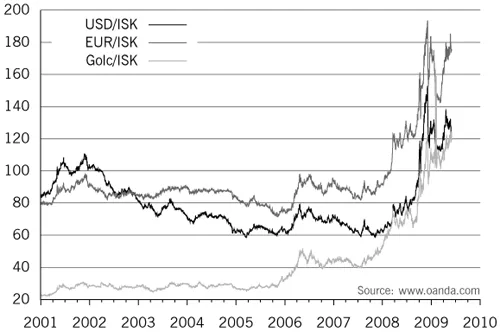
Figure 14: Króna exchange rates2
In August 2007, when BNP Paribas suspended three investment funds that had invested heavily in subprime mortgages, liquidity in the interbank markets was again constrained, despite several central bank interventions. Icelandic banks soon encountered renewed problems in refinancing their short-term debt. They had no other option than to borrow krónur from the CBI to exchange for foreign currency. As a consequence, the króna started to depreciate, not only against the world’s major fiat currencies but against the timeless hard money par excellence, gold. The price of gold doubled in krónur during 2008.
In March 2008, with the tensions connected with the bailout of the investment bank Bear Stearns, the króna lost even more value. Icelandic banks, such as Kaupthing, tried to shrink their balance sheets to reduce króna exposure. UK newspapers started writing about the problems of the Icelandic banks, drawing attention to the fact that British depositors were already withdrawing their funds and causing still others to start doing so. The Icelandic government and the Icelandic banks responded with a public relations campaign to restore confidence. The government and the central bank also worked on a bond sale to boost currency reserves. In May, the króna was collapsing but an emergency loan from the Swedish, Norwegian, and Danish central banks of €1.5 billion aided the CBI by almost doubling its foreign reserves. The CBI tried to defend its currency by raising interest rates to fifteen percent in September 2008 in order to entice foreign investors to convert their currencies into krónur and invest more heavily in the island. The falling króna caused problems for bank clients in Iceland who had debts denominated in foreign currency. The quality of loans to these clients deteriorated substantially. As Thorvaldsson3 describes the situation, “One of the large mistakes made by Kaupthing during the crisis was not to cut down the stock market positions of its best clients more aggressively. When they began to deteriorate the bank continued to support them.” But at this point there was almost no alternative. If one of the bank’s best clients went bankrupt, they would take the bank down with them.
In September 2008, events followed in quick succession. Banks suffered high losses due to malinvestments, mainly in the housing sector. Even though Icelandic banks had low exposure to the U.S. subprime market, the crisis in that market took its toll. In many countries, the loss of confidence and the fear of further credit losses and insolvencies triggered a run on the banking system. Wholesale investors—banks, large companies, pension funds, insurance companies, and investment funds (hedge funds, short-term fixed-income funds, and money market mutual funds)—withdrew their money from banks. Short-term funding dried up and banks were unable to roll their loans over.
The event that contributed most to this accelerating loss of confidence was when the investment bank Lehman Brothers filed for U.S. Chapter 11 bankruptcy protection. This watershed event occurred on September 15, 2008. The world financial system would never be what it had been before.
Lehman Brothers was broadly exposed to residential mortgages as well as commercial property funded by short-term borrowing.4 During the late summer of 2008 Lehman’s share price eroded and confidence declined. Lehman’s losses threatened to wipe out its shareholders’ equity. Over the weekend of the thirteenth and fourteenth of September, U.S. authorities tried to save Lehman Brothers by organizing a takeover deal similar to the one that had “rescued” Bear Stearns by having JP Morgan purchase its assets with the backing of a Federal Reserve–brokered loan. As investors of the proposed rescue plan wanted the U.S. Treasury to guarantee them against substantial losses, no deal was achieved on time, and when markets opened on the morning of Monday the fifteenth, Lehman made its bankruptcy filing.
This event caused a panic in the global money markets. If Lehman had been able to hide enormous losses for such a long time, what were other banks hiding? And who, exactly, would be affected by the bankruptcy of Lehman Brothers? Due to the interconnectivity of the banking system, the loss of Lehman would cause losses for other banks, and they might be forced into bankruptcy as well. Most importantly, why was Lehman allowed to fail? Why was Bear Stearns rescued and Lehman not? This raised doubts about the implicit guarantee of a bailout. If the authorities had not considered Lehman to be too big to fail then other banks were in grave danger too. Conversely, if Lehman had been considered too big to bail then how many other precariously positioned banks were also too large to be saved?
On the same day, the debt of American Insurance Group (AIG) was downgraded, triggering a dramatic withdrawal from money market mutual funds. As a result, one money market mutual fund, Reserve Primary, had to freeze withdrawals to save liquidity. Several other funds “broke the buck”: the value of the fund’s assets fell below the value of the money invested in them. These funds could no longer honor withdrawals at par. Money market mutual funds, which are one of the safest investments, and one considered by many to be a cash equivalent, suddenly seemed not so safe.
Confidence eroded as pressures mounted on all banks that depended on short-term wholesale funding. In the United Kingdom, the Bank of England rescued the Halifax Bank of Scotland. Stability was short lived, however. Once the regulatory authorities supported one bank, the next weak bank in line presented a new danger of destabilization. The Royal Bank of Scotland was the next British bank to find itself in stormy waters as funding became less available. The British government could only stabilize the bank on October 8, when it announced an emergency funding package aimed at supporting all British banks.
As liquidity evaporated, many investors and banks had to sell their assets at fire sale prices to redeem their liabilities. Asset prices consequently collapsed, placing further pressure on bank capital and weakening investors’ confidence.
Doubts arose concerning the soundness of the American investment banks Morgan Stanley and Goldman Sachs, which had secured capital from outsiders. These two banks could be stabilized for a short while, but the Federal Deposit Insurance Company (FDIC) shut down another American giant, Washington Mutual, on Thursday the twenty-fifth of September. The British bank Bradford and Bingley was nationalized on September 29 and the U.S. bank Wachovia was taken over, first by Citigroup and later by Wells Fargo when the latter offered a better bid.
In continental Europe, too, the business model of maturity mismatching—borrowing short and lending long—proved to be a lethal combination when confidence eroded and short-term credit evaporated.
On Monday the twenty-ninth of September the bank Fortis was supported by the Benelux countries (Belgium, the Netherlands, and Luxemburg). The German bank Hypo Real Estate, which was dependent on short-term wholesale funding, was saved the same day via a €35 billion loan guaranteed by the German government. Shortly thereafter, Benelux was called upon again to provide capital injections, this time to Dexia, the Belgian-French financial group.
The liquidity squeeze also affected Icelandic banks, which were reliant on wholesale funding. Retail deposits backed only thirty percent of their balance sheets. Retail funding tended to be less fugitive during the crisis than short-term wholesale funding. This stability arose from the deposit guarantees that retail depositors enjoyed, and which their wholesale counterparts lacked.5 In fact, the Icelandic internet-based bank Kaupthing Edge received an increasing stream of deposits, guaranteed and insured in amounts up to 35,000 by the British government.6
The problem for the Icelandic banks was that they had not financed their long-term assets with long-term liabilities but with short-term loans that needed to be continually rolled over. In September 2008 the interbank loan market where they secured this short-term funding dried up. If they had financed themselves with krónur, the CBI could have saved Icelandic banks with króna loans. However, they had financed themselves largely in foreign currency. The combined currency and maturity mismatch meant their end.
Icelandic banks had no alternative other than to sell their long-term assets, foreign and domestic. Due to the currency mismatch, they had to exchange the revenues from the sale of their domestic assets for krónur to pay the short-term foreign debt. As the króna exchange rate plunged they had to sell ever more króna-denominated assets to get the foreign currency they needed. Soon they were selling their domestic and foreign assets at near fire sale prices.
As funding dried up in early 2008, all three big Icelandic banks attempted to wind down their positions, both in magnitude and in the extent to which they were mismatched. Glitnir was by far the bank in the worst shape as 2008 progressed, or at least its liquidity issues were the most pressing. With more than 360 billion krónur more in foreign-denominated liabilities coming due within the next three months than it had assets to cover them, Glitnir was only one maturity term away from a serious liquidity crunch. During the first half of 2008 the bank worked furiously to reduce its exposure, and managed to cut down its unmatched short-term foreign positions by more than fifty percent.
Landsbanki was not faring much better. Despite all efforts to reduce its foreign exposure, by June 2008 the bank still needed over 140 billion krónur in foreign funds within the next three months to remain solvent. The bank had plenty of assets, both in krónur and foreign currencies, but they were locked away at the long end of the maturity spectrum. If the bank could remain solvent for only another five years, more than 100 billion krónur of foreign funding could be made available when the assets it had splurged on during the boom matured. But the bank would be lucky to get by for another five weeks, let alone five years.
Kaupthing suffered its own problems through its UK subsidiary, Kaupthing Edge, an online deposit bank aimed at attracting foreign depositors with its high interest rates. As the year 2008 progressed, the bank was flush with cash. More than 400 billion krónur sat in its coffers awaiting a good use. As the year wore on and depositors grew increasingly doubtful of the bank’s solvency, redemptions intensified. Internet bankers may be more fickle than the average depositor. Kaupthing’s British clients had no reason for doing business with Kaupthing other than its attractive interest offerings. As the bank’s security came into doubt, its internet clients vanished as quickly as they had appeared, taking a substantial portion of the bank’s deposits with them. During the first half of 2008 Kaupthing hemorrhaged forty-six percent of its foreign assets.8
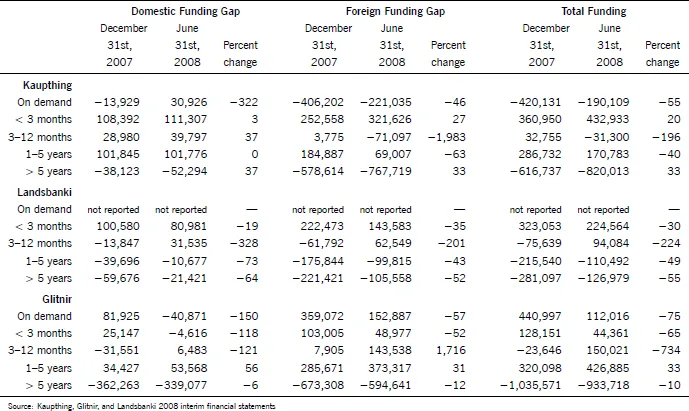
Table 5: The big three banks’ funding gaps (million ISK)7
All three large banks were furiously selling assets to cover their burgeoning liabilities. This had its own consequences as the banks were collateralized primarily by equity holdings whose values did not hold up well when not just one but all three of the small country’s largest financial institutions were holding a giant fire sale.
Due to this fire sale, the Icelandic stock market plunged as bank valuations based on plunging asset values deteriorated. All over the world, maturity-mismatched investors were finding themselves in similar positions. As a liquidity squeeze emerged, global investors sold assets and rushed to hard currency. As a result, asset prices collapsed. Icelandic banks suffered severe losses on their asset holdings. A double-edged sword cut them: the fire sale of long-term assets in the panic and the reduction of depreciating króna proceeds into foreign funds. Haircuts for Icelandic banks kept increasing. For the same amount of posted collateral they received a diminishing amount of funding.
On September 29, the Icelandic government announced it would take a seventy-five percent equity stake in Glitnir, the weakest of the big three Icelandic banks, for 600 million krónur. In contrast to Landsbanki and Kaupthing, Glitnir was entirely reliant on wholesale funding. Owing to the government insurance scheme, it had failed to attract a demand deposit base that was more stable than the short-term debt financing it would continually need to roll over to remain liquid. The bank faced a looming $750 million worth of debt repayment, coming due on October 15. It lacked the funds, and there was little hope of finding a lender, given the prevailing credit situation. The government never carried out its plan to take an equity stake in Glitnir. Before shareholders could approve the plan, the Icelandic Financial Supervisory Authority put Glitnir into receivership.
This intervention triggered a loss of confidence in the Icelandic banking model and a run on the other two big banks. Over the weekend of October fourth and fifth, British newspapers wrote on the extensive leverage of Icelandic banks and the nationalization of Glitnir. In an article titled “Markets call time on Iceland,” BBC business editor Robert Preston wrote,
The best way of seeing Iceland is as a country that turned itself into a giant hedge fund.… Here are the lethal statistics about Iceland: the value of its economic output, its GDP, is about $20bn; but its big banks have borrowed some $120bn in foreign currencies.… Or to put it another way, Iceland simply doesn’t have the domestic earnings to service this kind of debt.9
An article in The Guardian complemented this grim outlook. Tracey McVeigh proclaimed, “The party’s over for Iceland,” later adding,
Iceland is on the brink of collapse. Inflation and interest rates are raging upwards. The króna, Iceland’s currency, is in free-fall and is rated just above those of Zimbabwe and Turkmenistan. One of the country’s three independent banks has been nationalised, another is asking customers for money, and the discredited government and officials from the central bank have been huddled behind closed doors for three days with still no sign of a plan. International banks won’t send any more money and supplies of foreign currency are running out.10
The news coverage caused a run on Icesave, the online retail bank of Landsbanki in Great Britain and the Netherlands. When Icesave’s internet site went down due to volume, depositors further spurred on the run as they worried that the bank had collapsed. The British run on the bank’s deposits was especially damaging since sixty-five percent of Landsbanki’s short-term deposits were denominated in pounds.11
On Monday October 6, Icelandic Prime Minister Geir H. Haarde addressed the nation in a dramatic speech on national television announcing that “There is a very real danger, fellow citizens, that the Icelandic economy, in the worst case, could be sucked with the banks into the whirlpool and the result could be national bankruptcy.” His ending the speech with “God save Iceland” contributed to the general atmosphere of doom.12
The panic soon reached the public, with Icelanders queuing at banks to withdraw cash. Violence erupted in the normally serene country as Polish workers were not allowed to change their salaries into Euros at some banks. The interbank markets completely shut out the Icelandic banks on October 6. To prevent further bank runs in Iceland, the government fully guaranteed domestic retail deposits.
On Tuesday October 7, the Icelandic Financial Supervisory Authority placed Landsbanki into receivership. The British government used the Banking Special Provision Act to transfer deposits from Landsbanki’s UK subsidiary Heritable Bank to a Treasury holding company. Glitnir was put into receivership the same day.
The events of that day culminated with a memorable telephone conversation between the UK Chancellor of the Exchequer Alistair Darling and the Icelandic Finance Minister Árni Mathiesen. Darling tried to find out if the Icelandic government would guarantee UK deposits of Icelandic subsidiaries. While the Central Bank had guaranteed all domestic deposits, they had not guaranteed foreign ones. Mathiesen would not give such a guarantee, and later that evening Davíð Oddsson, chairman of the board of governors of the Central Bank of Iceland, announced in a broadcast interview that the government would not pay the debts of heedless banks.
As a reaction, and in order to defend the interest of British depositors, Darling announced that the British authorities would freeze Landsbanki’s UK assets at the opening of business the next morning. The freezing order used a provision from the Anti-terrorism, Crime, and Security Act of 2001. The sale of Landsbanki’s assets within the United Kingdom was effectively prohibited. The UK government compensated British retail deposit holders for an estimated four billion pounds. Gordon Brown even announced that the UK would sue Iceland if it did not compensate the 300,000 affected British savers, and additional Icelandic assets in the UK would be frozen. Icelanders were outraged that a provision of anti-terrorism legislation would be used against them, a country that had for decades allowed the British and American navies to establish bases on its shores to fight their own battles. In fact, for many Icelanders, the announcement that the anti-terrorism legislation would be used against them “was tantamount to a declaration of war. At one stroke Britain had placed Iceland on the same level as Al Quaeda, even though it was a fellow NATO partner, and crippled what seemed to Reykjavik to be a healthy bank.”13
Meanwhile the conflict between the United Kingdom and little Iceland provoked even more distrust of the Icelandic banks. By declaring Icelandic bankers to be the legal equivalent of terrorists, the British government had all but sealed the fate of the Icelandic banking industry’s foreign branches. Retail investors fled the Icelandic banks. There was a run on Kaupthing Edge, the internet banking arm of Kaupthing’s UK subsidiary Kaupthing Singer and Friedlander. The UK Financial Services Authority (FSA) took Kaupthing Singer and Friedlander into administration the same day. Kaupthing’s Swedish subsidiary, Kaupthing Bank Sverige was rescued by a credit facility of five billion Swedish krona (€530 million) the same day.
Kaupthing was placed in receivership on October 9. After its UK subsidiary had been placed in administration, the bank was cut off from all credit markets and had to default on its loan agreements. Its subsidiaries in Luxembourg, Geneva, Helsinki, and the Isle of Man quickly defaulted also. Effectively, the financial markets wiped out all three major banks in a matter of days. In contrast to the other cases we have mentioned of banks that ran into trouble during the world financial crisis, such as German, British, or U.S. banks, the Icelandic banks were simply too big to save with the country’s modest resources. Even the central bank could not save them, due to their enormous obligations denominated in foreign currency.
This had a major effect on what was left of Iceland’s financial system. The Central Bank of Iceland demanded new collateral for their outstanding loans to the remaining financial institutions, because the old collateral consisting of shares in Glitnir, Landsbanki and Kaupthing had become almost worthless. This took down Sparisjóðabanki, a bank jointly owned by the country’s twenty-one savings banks to provide wholesale and investment services, when it could not provide new collateral. Sparisjóðabanki sought government aid to avoid insolvency and the contagion problem this would have caused for related domestic savings institutions.
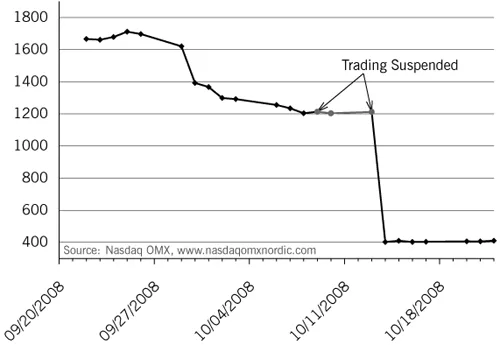
Figure 15: OMX Iceland All-Share Index (daily close, September 22–October 22, 2008, krónur)
Only three years earlier the IMF, through its Deputy Managing Director, Anne Krueger, had implicitly promised support in case of a crisis. Entrepreneurs developed investment plans under the assumption that such IMF assistance would be available. The artificially strong króna sustained by implicit support guarantees from the IMF had allowed the economy to soar to breathtaking heights and then come crashing down to earth, and now the IMF was leaving Iceland to fend for itself.
The country was on the verge of total financial collapse. For three days, from the ninth to the thirteenth of October, stock market trading in Iceland was suspended. When the market reopened on Tuesday October 14, it lost sixty-seven percent in a single day. The credit crunch had wiped out many companies listed on the stock exchange, including the largest clients of the banks, further damaging bank loan portfolios.
The sudden decline in the stock market would reverberate through the Icelandic economy more quickly and detrimentally than in other countries. Icelandic banks were not exposed to the subprime loan market, but they were heavily securitized.14 As security prices were halved by the hour, capital and collateral values evaporated.15
Housing prices began to crash. Overextended mortgage holders who had denominated their loans in foreign currencies during the boom now found themselves unable to maintain payments during the bust. As the króna exchange rate deteriorated, their mortgages denominated in Japanese yen and Swiss francs became ever more burdensome to hold. The swift deterioration of the króna exchange rate, particularly during the last half of 2008, left debtors with no time to negotiate more prudent and sustainable loans. The Swiss franc gained 107 percent in value against the króna during 2008. The yen gained 145 percent. Icelandic mortgage holders who had benefited from the low interest rates these currencies offered during the boom now saw their monthly payments increase by 100 to 150 percent in a few months. Less than a decade earlier, economists heralded the inception of the floating exchange rate as a harbinger of future stability.16 Now Iceland’s stability was crumbling, thanks in part to the floating rates.
Iceland’s financial markets lay in tatters. The total debt of Icelandic banks was eleven times the country’s GDP, and a large part of it was denominated in foreign currencies. In October 2008 the foreign debts of the island were thirty-two times higher than the foreign exchange reserves of the Central Bank of Iceland. Because of the financial collapse, the liabilities of the Central Bank of Iceland—the monetary base of the króna—were backed mostly by loans to an insolvent banking system. Collateralized by worthless assets and by loans to a government that had taken over crushing foreign liabilities, the CBI could not stem the tide without outside help.
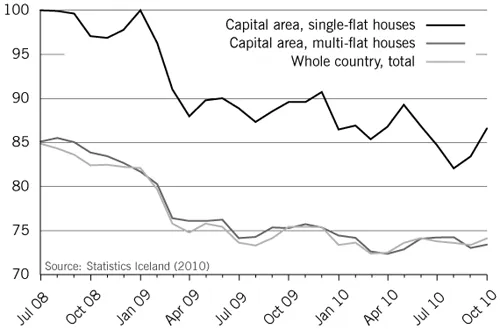
Figure 16: Housing prices (July 2008 to October 2010, capital area single flat houses = 100)
When the Icelandic financial system had come under pressure in the last days of September 2008, the decline of the króna had accelerated. No one wanted the currency of a bankrupt financial system, and Icelandic banks were converting their krónadenominated assets into the foreign currencies they needed to pay foreign-denominated debts. In one of the shortest-lived currency pegs in history, the Central Bank of Iceland tried to peg the króna to the euro at a rate of 131 krónur. Fixing a rate far above what the market could bear resulted in a tremendous excess demand for euros. Investors fled from the króna to the euro. Only two days later, on October 8, 2008, the peg was abandoned, and by October 9, the króna had already collapsed to 340 to the euro as the government took over Kaupthing. With the króna in free fall, the central bank of Iceland reverted to its last resort of intervening in the foreign exchange market. It restricted the purchase of foreign currency within Iceland. From the ninth of October to the third of December here was no free currency market in Iceland.
By October 2008, the outflow of foreign exchange had become so severe that further action was necessary. The CBI issued a memorandum to its member banks outlining measures to facilitate the retention of any foreign reserves they held or were receiving.17 Banks could only give foreign exchange for expenditure abroad to those clients in possession of a travel ticket or other proof of exiting the country. Bankers would exercise discretion with their clients, focusing on providing foreign currency only for the necessary importation of essential goods; the CBI recommended that foodstuffs, pharmaceuticals, oil products, and public expenditure abroad be considered priority categories. Banks were to avoid using foreign currency for financial-related activities. Banks with access to the central bank’s credit facilities would have to submit special accounting records, itemizing their foreign currency transactions daily.
By January 2009, the central bank was exchanging only a negligible amount of foreign currency for domestic krónur. During December 2008, for example, a net sale of €11.1 million was made, of which some €10.8 million was derived from Treasury notes owned by nonresidents, which could be exchanged for foreign currency.
With the currency markets officially closed, the only way to obtain foreign currency was through central bank auctions. The Central Bank of Iceland was auctioning off its foreign exchange reserves, losing $289 million during October 2008.
On November 28, new regulations were imposed to control foreign exchange. Investors, both domestic and foreign, could only move capital in and out of Iceland with a license from the central bank. Thus, foreign investors would be required to obtain a license prior to selling their króna-denominated assets. Icelanders were required to deposit all foreign currency they received with an Icelandic bank. In response, several Icelandic exporters fled the increased control and scrutiny to informal offshore markets where they could conduct foreign exchange transactions away from the watchful eye of a regulator.
Foreign aid was necessary to arrest the free fall of the króna. Swap lines from sympathetic countries made foreign exchange available to pay for imports that the Icelandic economy needed but was unable to produce. Iceland’s economy had become so distorted, focusing heavily on the financial industry, that it was unable to produce sufficient goods and services to provide capital for the needed imports. Foreign exchange reserves and foreign loans paid for necessary imports. These foreign loans gave the central bank reserves to back up the króna, and gave the Icelandic economy time to restructure.
In the first days of October 2008, a team of experts from the International Monetary Fund came to talk to the government about aid to stabilize the króna. On October 7, the day that the Icelandic government announced that the talks were favorable and that resolution neared, the same day that it placed Landsbanki into receivership, one of the most bizarre events of the Icelandic tragedy occurred. The Central Bank of Iceland announced that it had negotiated with the Russian ambassador, Victor I. Tatarintsev, for a possible €4 billion loan from Russia over a period of three to four years at a very low interest rate: LIBOR plus thirty to fifty basis points. One may be intrigued by this move by the CBI. Its main purpose was to stop the flight of foreign capital from Iceland. Yet Prime Minister Geir Haarde revealed a secondary purpose: “We have not received the kind of support that we were requesting from our friends. So in a situation like that one has to look for new friends.”18
Since the European Central Bank and the Federal Reserve did not install swap agreements with the CBI, Iceland changed strategy. By asking for Russian help, Iceland was hoping to shock its former allies into rushing to its defense. Iceland had been home to an American military base for decades. Its strategic geopolitical position makes it attractive to both Russia and NATO. Asking Russia for a loan would not only trouble the consciences of Iceland’s “friends” but also put pressure on them to grant a loan to Iceland in order to maintain their own military and political status vis-à-vis Russia.
In the end, the Russians backed out of the loan offer as the financial crisis reached their own borders. Although the Russian loan never materialized, the CBI was able to draw upon swap facilities granted by the central banks of Denmark and Norway for €200 million each. This foreign currency helped Iceland to import essential foodstuffs. On October 24 the IMF tentatively agreed to a loan of €1.57 billion. Following this loan, additional foreign loans were expected. However, the UK and the Netherlands halted the IMF loan, as they demanded that Landsbanki reimburse their depositors for their losses from investing in its subsidiary Icesave. Icesave was backed by the Icelandic deposit insurance fund, which had been increased to cover all domestic deposits without limit. According to the European Economic Area Treaty, the Icelandic government was obliged to guarantee at least the first €20,000 of all Icesave accounts. Since the Icelandic government had announced that it would not guarantee the foreign debts of the insolvent banks or provide deposit insurance, Dutch and British depositors stood to lose their deposits. Another reason why the British were taking a hard line was that the two Icelandic internet banks (Icesave and Kaupthing Edge) had attracted almost ten billion pounds of demand deposits away from UK banks. British banks were understandably not delighted with this competition and wanted their Icelandic competitors gone.
Loans from the Faroe Islands, Norway, and Poland (which had sent workers to the Iceland during boom times), were announced at the end of October and beginning of November, giving Icelanders time and reserves to pay for imports. It was especially important to ensure that import trade remained robust, since Iceland imports almost all tradable goods except fish, dairy products, and meat.
Finally, on the nineteenth of November an agreement was reached with the IMF. The rescue package of $4.6 billion comprised $2.1 billion from the IMF and $2.5 billion of loans and currency swaps from Norway, Sweden, Finland and Denmark).
The following day, Iceland received an additional joint loan of $6.3 billion (€5 billion) from Germany, the United Kingdom, and the Netherlands to pay Icesave depositors in those countries. The additional debt imposed on the Icelandic government by this loan and the IMF loan package together amounted to almost $36,000 per Icelandic citizen, all to pay for the adventures of the banks.19
Only thanks to these rescue loans was it possible to stabilize the króna, secure essential imports, and gain enough time to restructure the economy. When the Icelandic interbank foreign exchange market reopened on December 2, the króna, which had fallen by more than fifty-eight percent during 2008, climbed to 153.3 to the euro. In January 2009 it finally stabilized. Technically the banking sector remained bankrupt, but it still functioned thanks to external credits, like a delinquent firm that honors old payments thanks to fresh credit.
It is by no means a coincidence that the markets lost confidence in the banks at a time when they were so vulnerable. Extreme levels of maturity mismatching ultimately caused the loss of confidence. The maturity mismatching increased the availability of long-term funds, thus artificially lowering long-term interest rates. The lower rates triggered malinvestments, such as those in the housing and aluminum smelting sectors. These malinvestments finally led to losses for the banks, damaging investor confidence and ending the rollover that was necessary to sustain them.
1Thorvaldsson, Frozen Assets, pp. 172–73.
2Prices are per unit of currency. Gold prices are krónur per 1/1000 ounce.
3Thorvaldsson, Frozen Assets, p. 196.
4Alistar Milne, The Fall of the House of Credit. What Went Wrong in Banking and What Can Be Done to Repair the Damage? (Cambridge, UK: Cambridge University Press, 2009), p. 286.
5Milne, The Fall of the House of Credit, p. 295.
6In a similar movement massive flows of money left the UK banking system when Ireland guaranteed all their deposits, even though each depositor openly knew it was an economy in a worse position than the UK, and with a poorer banking system; moral hazard writ large.
7Calculated as liabilities less assets, as at December 31, 2007, and June 30, 2008. The currency breakdown of the term structure of individual banks’ assets and liabilities is not publicly disclosed. Therefore, the respective currency mismatches are calculated assuming the share of foreign-currency assets and liabilities in the balance sheet total is constant over all maturities.
8This was especially damaging as the Icelandic banks typically relied on retail deposits as a more stable source of funding than the capital markets (see, for example, Landsbanki’s 2008 annual report).
9Robert Preston, “Markets Call Time on Iceland,” BBC News (October 4, 2008).
10Tracy McVeigh, “The Party’s Over for Iceland, the Island That Tried to Buy the World,” The Guardian (October 5, 2008).
11Li Lian Ong and Martin Čihák, “Of Runes and Sagas: Perspectives on Liquidity Stress Testing Using an Icelandic Example,” IMF working paper WP/10/156 (2010), p. 13. Landsbanki would eventually lose almost half of its pound funding, as forty-three percent of British account holders withdrew their deposits during the bust (Ibid., p. 17).
12Geir H. Haarde, “Address to the Nation, Prime Minister’s Office,” (October 6, 2008).
13Boyes, Meltdown Iceland, p. 174.
14Thorvaldsson Frozen Assets, pp. 178–79.
15Iceland’s equivalent to the United State’s Dow Jones Industrial Average, the “OMX Iceland 15,” listed the fifteen companies with the highest market capitalization listed on the OMX Iceland Stock Exchange. At the point of the crash’s apex on October fourteenth 2008 the big three Icelandic banks comprised seventy-three percent of the index’s value and witnessed their value completely erased. The index was discontinued in July 2009 and replaced with a new benchmark index, the “OMX Iceland 6.” Notably, three of the six companies listed on this new benchmark index comprising approximately one third of its total value (as at November 1st, 2010) are Faroese.
16Eduardo Aninat, “IMF Welcomes Flotation.”
17Central Bank of Iceland, “New Rules on Foreign Exchange Balance,” Press release no. 18/2008 (June 4, 2008), “Temporary Modifications in Currency Outflow,” (October 10, 2008).
18As quoted in Kerry Capell, “The Stunning Collapse of Iceland,” Bloomberg Businessweek on msnbc.com (October 10, 2008).
19Rowena Mason, “UK Treasury Lends Iceland £2.2 Billion to Compensate Icesave Customers,” The Telegraph (November 20, 2008).
Deep Freeze: Iceland's Economic Collapse
Read the whole book online · Book details
This work is published under a Creative Commons licence. You may copy, share, and re-host it with attribution.