
Chapter 9 of 13 · Deep Freeze: Iceland's Economic Collapse by Philipp Bagus
Chapter 7 Why the Fed Could Save Its Bankers, But the CBI Could Not
On November 13, 2001, the Central Bank of Iceland, headed by Davíð Oddsson, issued a press release announcing it would effectively become a lender of last resort for the nation’s financial community. While almost all central banks in the world implicitly undertake this role, Iceland’s central bank explicitly committed itself to shouldering the weight of the banking system’s bad decisions.
Commitment requires credibility. A central bank usually gains credibility as the lender of last resort through one oddity of its balance sheet: it can retire liabilities by creating more liabilities. As the central bank is that institution empowered to supply an area with money, it can settle claims against it by unilaterally increasing the money supply. Consequently, any debt obligations of the banking sector can easily, though not necessarily painlessly, be absorbed and nominally covered by the central bank.
The difficulty that arises with any lender of last resort, implicitly or explicitly guaranteed, is the problem of moral hazard. Privatizing benefits while socializing costs will always result in some degree of moral hazard. The lender of last resort skews the incentive structure, and a turn to riskier undertakings will result.
But what if a banking system is saddled with debt that is not denominated in domestic currency but is instead primarily foreign-denominated? In this case, the central monetary authority is limited in its power as a lender of last resort, as its monetary powers are limited to regulatory changes of the domestic banking sector (i.e., reserve requirements, capital adequacy ratios, etc.), open-market operations using its balance sheet assets to offset transactions, or inflating the domestic money supply. Assets denominated in foreign currencies become the lynchpin to the solvency of a banking system that is heavily indebted in foreign currencies.
In 2007, after ten years of growth, the big three Icelandic banks, Kaupthing, Glitnir, and Landsbanki, owned assets in excess of 1100 percent of Iceland’s GDP, comprising nearly eighty percent of the island’s total banking assets. An oversized and unviable banking model had developed.1 The pretense under which this system developed—that a central bank stood ready and able to bail it out if it came under pressure—would be called into question as the crisis progressed.
Over the course of the year 2008, Iceland’s stock of foreign exchange reserves was becoming critically low relative to the banking sector’s liquidity demands. An even more pressing problem was that the flow of foreign exchange into the country was greatly diminished. The trade deficit that had developed in the early 2000s had remained steady throughout the decade. As the economy continually switched from a net exporter to a strong demander of imports, demand for the króna decreased. The trade deficit reached its peak in the fourth quarter of 2006, when the Icelandic economy was importing goods worth over sixty billion krónur more than it was exporting. This imbalance eased as the decade progressed, but by late 2008, the Icelandic economy was still importing over twenty-five billion krónur more in foreign goods (and foreign currency) than it was exporting.
The Central Bank of Iceland was in a difficult position, with scant foreign exchange reserves available to serve the needs of the banking system and with no chance of replenishing its coffers due to the persistent trade imbalance. It had committed to bailing out the banking sector if and when the need arose. The need had arisen, but the means were not available. The banking sector had taken on too many foreign-denominated liabilities that could not easily be satisfied by the supply of funds available. It was apparent that only outside support could save the financial system.
Early requests to various central banks for liquidity swaps mostly fell on deaf ears. Faced with the looming probability of a liquidity crisis within their own borders, foreign nations, even previously friendly ones, were less than anxious to lend money to Iceland. A plentiful supply of krónur was available to be swapped, but foreign nations were not keen on accepting the relatively unimportant currency in exchange for hard money that could be used to settle debt obligations. Finally, on May 16, 2008, the central banks of Sweden, Norway, and Denmark entered into bilateral euro/króna swap agreements. Each agreement allowed for up to €50 million on demand.
But €50 million was a drop in the bucket compared to the €70 billion of outstanding foreign-denominated liabilities that the Icelandic private banking system had accumulated.
The Bank of England was enthusiastic at first about an eventual swap agreement but turned decidedly colder as the year wore on. The European Central Bank was unwilling to enter into an agreement without an assessment by the IMF of Iceland’s economy and the position of its banking system. The IMF and the Fed were approached about helping Iceland, either by loaning money themselves or by assessing the economy’s potential to see if other counterparties could be found.
Initial optimism about brokered swap agreements quickly dissipated, however, as the year progressed and the size and true nature of the Icelandic banking system became apparent. The Fed determined that the Icelandic banking system needed more aid than it could credibly commit to giving. Despite offering swap agreements to a plethora of other foreign central banks, it left the Central Bank of Iceland to fend for itself.
Lacking external support, the central bank attempted to expand its foreign exchange reserves on the open market by issuing short-term bills. Illiquid credit markets hindered this attempt, making any successful recapitalization via a bond issue all but impossible. Icelandic assets, which had until recently been in great demand, were now universally unwanted. Foreign countries had increasing credit problems of their own. They could not continue committing to provide for Iceland.
By October, the CBI had drawn on its Nordic euro swap lines to the order of €40 million. These friendly nations extended the swap agreements to year-end 2009, and it was expected that this would provide sustained relief for the central bank.
But by October 9 the situation had deteriorated to the point where the CBI issued a statement to the public reiterating that the economy was sound and that the central bank was committed to maintaining a solid credit rating. This commitment had been evidenced just days earlier, when the CBI negotiated its €4 billion Russian loan.
International opposition to the Russian bailout was apparent, and many countries that had previously given Iceland the cold shoulder now warmed to the idea of a bailout. The Russian loan soon fell through as the IMF worked to negotiate a stand-by arrangement (SBA).
The Icelandic government was able to reach the SBA ad referendum with the IMF on October 24, 2008 allowing for approximately $2.2 billion to be made available for two years. The IMF would disburse $830 million immediately, with the remainder spread over the remaining life of the agreement. On November 19, 2008, the agreement was finalized and the first payment was made. The IMF later extended the SBA to May 31, 2011.
This agreement did much to stem the tide of insolvency that the CBI was facing in the short term. However, it did little to relieve the longer-term problems of the Icelandic economy. The badly depreciated exchange rate put Iceland in danger of being cut off from imports it desperately needed: food, pharmaceuticals, and oil.
The crisis strained friendships. Previously close allies ignored Iceland’s initial pleas for help.2
It was only with some foreign help that the króna was stabilized at the beginning of January 2009. The CBI received high-quality assets and thereby increased the average quality of the assets backing its currency, commencing a period of “qualitative enhancement.”3 New foreign exchange reserves were used to pay for imports and to begin restoring confidence in the currency. The króna stabilized, and inflation rates moderated throughout the spring of 2009. As the average quality of the assets backing the currency increased due to foreign loans providing higher-quality liquidity, the quality of the króna increased.
The explicit commitment of the Central Bank of Iceland to act as the lender of last resort had endangered the stability of the nation. While the CBI was capitalized well enough in terms of foreign assets relative to its own foreign-denominated liabilities to weather any storms from adverse exchange rate movements, once it shouldered the burden of the private banking sector’s liabilities, the situation changed starkly. In Figure 17, we can see that throughout 2007–08, the CBI was covering foreign-denominated liabilities amounting to between 3,000 and 4,000 times its foreign-denominated asset base. Since the private banking sector’s liabilities had effectively become CBI liabilities, regardless of their denomination, we must assess the financial position of the central bank in light of these obligations. The huge foreign indebtedness of the domestic banking sector weighed heavily on the central bank, reducing the ratio of foreign assets to liabilities to a mere 4–6 percent.4
This ratio peaked in August 2008 as the CBI bought foreign reserves in order to increase its liquidity. The International Monetary Fund increased Icelandic Special Drawing Rights (SDR) by almost fifteen billion krónur, providing support to the dwindling foreign exchange reserves of the CBI.6 While this spike may have given the impression that the CBI had abundant, or at least sufficient, foreign assets to fund its import obligations, in fact the effect of the foreign asset infusions was short-lived. They did at least succeed in stabilizing the currency.
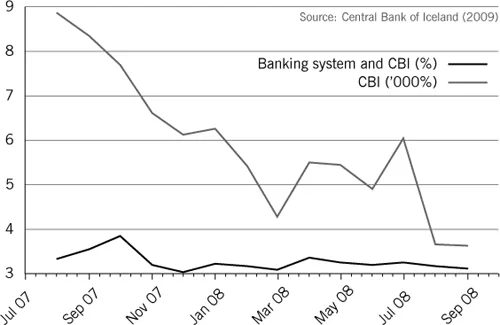
Figure 17: Central Bank of Iceland liquidity ratio (August 2007–September 2009).5
Not only did the CBI lack sufficient liquidity to cover the banking system’s foreign-denominated debts, it also lacked liquidity of an applicable maturity. Figure 18 shows the funding gaps across different maturities of the Icelandic debt market, including both liabilities of the Central Bank of Iceland and liabilities of the big three financial institutions. Positive funding gaps imply an excess of liabilities without corresponding assets with which to fund them.
The heavy maturity mismatch of the financial system becomes evident. There were ample assets of long maturity, both in krónur and in foreign funds. As a consequence of borrowing short and investing long, there were 1.5 trillion krónur ($210 billion) more long-term assets maturing than there were long-term liabilities in need of funding. The banking system would unfortunately require its liquidity much sooner than the minimum five years that it would have to wait for these long-term assets to mature. In the meantime, these long-term ventures were funded by taking advantage of the low interest rates offered by short-term debt, especially for maturities of under three months. A burgeoning gap of 740 billion krónur ($10.5 billion) of unfunded short-term liabilities sat on the financial system’s balance sheet, requiring that willing savers continually roll over new funds into it.
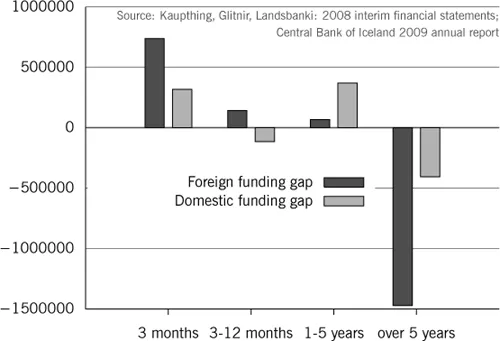
Figure 18: Funding gaps, Central Bank of Iceland and big three banks combined (million krónur).
The banking system relied on a continual flow of short-term funding, especially foreign funding, but the central bank had very little funding to offer, and the meager supplies it did have would not be available until several years in the future. A short-term liquidity constraint brought the banking system to insolvency. Short-term loans proffered by the international community alleviated this liquidity crunch but failed to provide a lasting solution. The banking system will solve this liquidity problem only when it rematches its debt obligations to its funding assets.
Today the central bank has essentially no net foreign reserves. Provided that exchange rate volatility remains low, this causes no significant problem. The short-term liquidity constraint is not binding, as foreign lending to Icelandic banks is not pressingly low and foreign investors’ future purchasing power guarded by a stable exchange rate. However, today’s underfunded banking system is no improvement on the old unsustainable system. If there is another liquidity crisis Iceland will find itself in an even more perilous position than it did in late 2008, as it lacks any ability to fund imports with non-króna-denominated liabilities.
The seemingly innocuous promise that the Central Bank of Iceland made in 2001 to act as the lender of last resort contributed to the downfall of Iceland’s banking sector, of its central bank, of its national finances and, eventually, of its government. This promise lulled the banks into taking on increasing levels of foreign indebtedness and increasingly risky foreign liabilities, secured by the word of the Central Bank of Iceland that it would aid them when a liquidity crunch came. This was to be the undoing of the CBI, as it lacked sufficient resources to carry out such a rescue. It was capitalized more than well enough to sustain its own operations, but the sheer size and international scope of the lending operations of the Icelandic banking sector, led by the big three banks, made it impossible for the CBI to offer them meaningful aid.
1Buiter and Sibert, “The Icelandic Banking Crisis”; Jon Danielsson, “The First Casualty of the Crisis: Iceland,” VoxEU (November 12, 2008).
2Jónsson, Why Iceland? pp. 138, 188.
3Qualitative enhancement consists in the improvement of the average quality of assets backing a currency. Qualitative enhancement is, thus, the opposite of qualitative easing. It can be achieved while the balance sheet total is changing by adding higher-quality assets or liquidating lower quality ones, or with a constant balance sheet total by selling lower quality assets and buying higher quality assets. The term qualitative easing, which denotes a new form of monetary policy used heavily during the recession following the liquidity crisis of 2008 distinct from the more well-known quantitative easing, was coined by Philipp Bagus and Markus H. Schiml (“New Modes of Monetary Policy: Qualitative Easing by the Fed,” Economic Affairs 29, no. 2 [2009]: pp. 81–93) and later developed by Philipp Bagus and David Howden (“Qualitative Easing in Support of a Tumbling Financial System: A Look at the Eurosystem’s Recent Balance Sheet Policies,” Economic Affairs 29, no. 4 [2009]: pp. 60–65; “The Federal Reserve and Eurosystem’s Balance Sheet Policies During the Financial Crisis: A Comparative Analysis,” Romanian Economic and Business Review 4, no. 3 [2009]: pp. 165–85).
4Accounting for these banking obligations, the Central Bank of Iceland was insolvent on its balance sheet, a rare situation for a central bank to find itself in, as analyzed in Maxwell J. Fry (“Can Central Banks Go Bust?” The Manchester School of Economics and Social Studies 60 [Supplement 1992]: pp. 85–98) and Willem H. Buiter (“Can Central Banks Go Broke?” Centre for Economic Policy Research Policy Insight no. 24 [May 2008]).
5Calculated as the sum of foreign-denominated assets (including gold) divided by total foreign liabilities.
6Positive equity is essential for a central bank to retain its independence from its central government. The risk of recapitalization may entail a sacrifice in this independence, as the fiscal authority provides the central bank with new capital. While previous work has focused on a central bank’s own fiscal authority recapitalizing it (Claudio Borio and Piti Disyatat, “Unconventional Monetary Policies: An Appraisal,” The Manchester School 78 [September 2010]: pp. 53–89; Olivier Jeanne and Lars Svensson, “Credible Commitment to Optimal Escape from a Liquidity Trap: The Role of the Balance Sheet of an Independent Central Bank,” American Economic Review 97, no. 1 [2007]: pp. 474–490), the Icelandic case is unique as the Icelandic government lacked the ability to do this. Instead, neighboring Nordic countries and the IMF provided the loans and capital necessary for continued operations. The effects of these foreign interventions on the CBI’s independence remain to be seen.
Deep Freeze: Iceland's Economic Collapse
Read the whole book online · Book details
This work is published under a Creative Commons licence. You may copy, share, and re-host it with attribution.