
Chapter 7 of 13 · Defending the Undefendable by Walter Block
III. FREE SPEECH 6 THE BLACKMAILER
At first glance it is not hard to answer the question, “Is blackmail really illegitimate?” The only problem it would seem to pose is, “Why is it being asked at all?” Do not blackmailers, well … blackmail people? And what could be worse? Blackmailers prey on people’s dark hidden secrets. They threaten to expose and publicize them. They bleed their victims, and often drive them to suicide.
We will find, however, that the case against the blackmailer cannot stand serious analysis; that it is based upon a tissue of unexamined shibboleths and deep philosophical misunderstandings.
What, exactly, is blackmail? Blackmail is the offer of trade. It is the offer to trade something, usually silence, for some other good, usually money. If the offer of the trade is accepted, the blackmailer then maintains his silence and the blackmailee pays the agreed-upon price. If the blackmail offer is rejected, the blackmailer may exercise his rights of free speech and publicize the secret. There is nothing amiss here. All that is happening is that an offer to maintain silence is being made. If the offer is rejected, the blackmailer does no more than exercise his right of free speech.
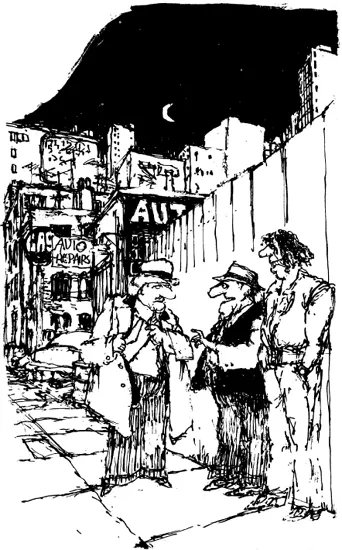
“This is my kid, Mr. T. He’ll be blackmailing you from now on—I’m retiring to Florida.”
The sole difference between a gossip and a blackmailer is that the blackmailer will refrain from speaking—for a price. In a sense, the gossip is much worse than the blackmailer, for the blackmailer has given the blackmailee a chance to silence him. The gossip exposes the secret without warning. Is not the person with a secret better off at the hands of a blackmailer than a gossip? With the gossip, all is lost; with the blackmailer, one can only gain, or at least be no worse off. If the price requested by the blackmailer is lower than the secret is worth, the secretholder will pay the blackmailer—this being the lesser of the two evils. He thus gains the difference to him between the value of the secret and the price of the blackmail. When the blackmailer demands more than the secret is worth, his demand will not be met and the information will become public. However, in this case the person is no worse off with the blackmailer than he would have been with the inveterate gossip. It is indeed difficult, then, to account for the vilification suffered by the blackmailer, at least compared to the gossip, who is usually dismissed with slight contempt and smugness.
Blackmail need not entail the offer of silence in return for money. This is only the best known form. But blackmail may be defined without reference to either. Defined in general terms, blackmail is the threat to do something—anything which is not in itself illegal—unless certain demands are met.
Many actions in the public arena qualify as acts of blackmail, but, instead of being vilified, they have often attained a status of respectability! For example, the recent lettuce boycott is a form of blackmail. Through the lettuce boycott (or any boycott) threats are made to retailers and wholesalers of fruits and vegetables. If they handle nonunion lettuce, the boycotters assert, people will be asked not to patronize their establishments. This conforms perfectly to the definition: a threat that something, not in itself illegal, will take place unless certain demands are met.
But what about the threats involved in blackmail? This perhaps more than anything else, is the aspect of blackmail that is most misunderstood and feared. At first glance, one is inclined to agree that threats are immoral. The usual dictum against aggression, for example, warns not only against aggression per se but also against the threat of aggression. If a highwayman accosts a traveler, it is usually the threat of aggression alone that will compel obedience.
Consider the nature of threats. When what is threatened is aggressive violence, the threat is condemnable. No individual has the right to initiate aggressive violence against another. In blackmail, however, what is being “threatened” is something that the blackmailer does have a right to do!—whether it be exercising the right of free speech, or refusing to patronize certain stores, or persuading others to do likewise. What is being threatened is not in itself illegitimate; it is, therefore, not possible to call the “threat” an illegitimate threat.
Blackmail can only be illegitimate when there is a special foresworn relationship between the blackmailer and the blackmailee. A secret-keeper may take a lawyer or a private investigator into his confidence on the condition that the confidence be maintained in secrecy. If the lawyer or private investigator attempts to blackmail the secret-keeper, that would be in violation of the contract and, therefore, illegitimate. However, if a stranger holds the secret without contractual obligations, then it is legitimate to offer to “sell” his silence.
In addition to being a legitimate activity, blackmail has some good effects, litanies to the contrary notwithstanding. Apart from some innocent victims who are caught in the net, whom does the blackmailer usually prey upon? In the main, there are two groups. One group is composed of criminals: murderers, thieves, swindlers, embezzlers, cheaters, rapists, etc. The other group consists of people who engage in activities, not illegitimate in themselves, but which are contrary to the mores and habits of the majority: homosexuals, sado-masochists, sexual perverts, communists, adulterers, etc. The institution of blackmail has beneficial, but different, effects upon each of these groups.
In the case of criminals, blackmail and the threat of blackmail serves as a deterrent. They add to the risks involved in criminal activity. How many of the anonymous “tips” received by the police—the value of which cannot be overestimated—can be traced, directly or indirectly, to blackmail? How many criminals are led to pursue crime on their own, eschewing the aid of fellow criminals in “jobs” that call for cooperation, out of the fear of possible blackmail? Finally, there are those individuals who are on the verge of committing crimes, or at the “margin of criminality” (as the economist would say), where the least factor will propel them one way or another. The additional fear of blackmail may be enough, in some cases, to dissuade them from crime.
If blackmail itself were legalized, it would undoubtedly be an even more effective deterrent. Legalization would undoubtedly result in an increase in blackmail, with attendant depredations upon the criminal class.
It is sometimes said that what diminishes crime is not the penalty attached to the crime but the certainty of being caught. Although this controversy rages with great relevance in current debates on capital punishment, it will suffice to point out that the institution of blackmail does both. It increases the penalty associated with crime, as it forces criminals to share part of their loot with the blackmailer. It also raises the probability of being apprehended, as blackmailers are added to police forces, private citizen and vigilante groups, and other anticrime units. Blackmailers, who are often members in good standing in the criminal world, are in an advantageous position to foil crimes. Their “inside” status surpasses even that of the spy or infiltrator, who is forced to play a role. Legalizing blackmail would thus allow anticrime units to take advantage of two basic crime fighting adages at the same time: “divide and conquer,” and “lack of honor among thieves.” It is quite clear that one important effect of legalizing blackmail would be to diminish crime, real crime, that is.
The legalization of blackmail would also have a beneficial effect upon actions which do not involve aggression, but are at variance with the mores of society as a whole. On these actions, the legalization of blackmail would have a liberating effect. Even with blackmail still illegal, we are witnessing some of its beneficial effects. Homosexuality, for instance, is technically illegal in some instances, but not really criminal, since it involves no aggression. For individual homosexuals, blackmail very often causes considerable harm and can hardly be considered beneficial. But for the group as a whole, that is, for each individual as a member of the group, blackmail has helped by making the public more aware and accustomed to homosexuality. Forcing individual members of a socially oppressed group into the open, or “out of the closet,” cannot, of course, be considered a service. The use of force is a violation of an individual’s rights. But still, it does engender an awareness on the part of members of a group of one another’s existence. In forcing this perception, blackmail can legitimately take some small share of the credit in liberating people whose only crime is a deviation from the norm in a noncriminal way.
In reflecting on the old aphorism, “the truth shall make you free,” the only “weapon” at the disposal of the blackmailer is the truth. In using the truth to back up his threats (as on occasion he must), he sets the truth free, very often without intent, to do whatever good or bad it is capable of doing.
7
THE SLANDERER AND LIBELER
It is easy to be an advocate of free speech when it applies to the rights of those with whom one is in agreement. But the crucial test concerns controversial speech—statements which we may consider vicious and nasty and which may, in fact, even be vicious and nasty.
Now, there is perhaps nothing more repugnant or vicious than libel. We must, therefore, take particular care to defend the free speech rights of libelers, for if they can be protected, the rights of all others—who do not give as much offense—will certainly be more secure. But if the rights of free speech of libelers and slanderers are not protected, the rights of others will be less secure.
The reason civil libertarians have not been involved in the protection of the rights of libelers and slanderers is clear—libel is ruinous to reputations. Harsh tales about lost jobs, friends, etc., abound. Far from being concerned with the free speech rights of the libeler and slanderer, civil libertarians have been concerned with protecting those who have had their reputations destroyed, as though that in itself was unpardonable. But obviously, protecting a person’s reputation is not an absolute value. If it were, if that is, reputations were really sacrosanct, then we would have to prohibit most categories of denigration, even truthful ones. Unfavorable literary criticism, satire in movies, plays, music or book reviews could not be allowed. Anything which diminished any individual’s or any institution’s reputation would have to be forbidden.
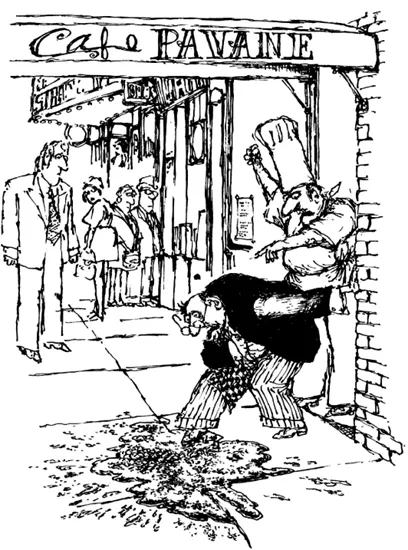
“This is calumny, slander! You’ll hear from my attorney—I spent years building up the reputation of my restaurant!”
Of course, civil libertarians would deny that their objection to slander and libel commits them to the view described. They would admit that a person’s reputation cannot always be protected, that sometimes it must be sacrificed. But this, they might say, does not exonerate the libeler. For a person’s reputation is not something to be taken lightly. It may not be damaged without good reason.
But what is a person’s “reputation”? What is this thing which may not be “taken lightly”? Clearly, it is not a possession which may be said to belong to him in the way, for example, his clothes do. In fact, a person’s reputation does not “belong” to him at all. A person’s reputation is what other people think of him; it consists of the thoughts which other people have.
A man does not own his reputation any more than he owns the thoughts of others—because that is all his reputation consists of A man’s reputation cannot be stolen from him any more than can the thoughts of other people be stolen from him. Whether his reputation was “taken from him” by fair means or foul, by truth or falsehood, he did not own it in the first place and, hence, should have no recourse to the law for damages.
What then are we doing when we object to, or prohibit, libel? We are prohibiting someone from affecting or trying to affect the thoughts of other people. But what does the right of free speech mean if not that we are all free to try to affect the thoughts of those around us? So we must conclude that libel and slander are consistent with the rights of free speech.
Finally, paradoxical though it may be, reputations would probably be more secure without the laws which prohibit libelous speech! With the present laws prohibiting libelous falsehoods, there is a natural tendency to believe any publicized slur on someone’s character. “It would not be printed if it were not true,” reasons the gullible public. If libel and slander were allowed, however, the public would not be so easily deceived. Attacks would come so thick and fast that they would have to be substantiated before they could have any impact. Agencies similar to Consumers Union or the Better Business Bureau might be organized to meet the public’s demand for accurate scurrilous information.
The public would soon learn to digest and evaluate the statements of libelers and slanderers—if the latter were allowed free rein. No longer would a libeler or slanderer have the automatic power to ruin a person’s reputation.
8
THE DENIER OF ACADEMIC FREEDOM
More crocodile tears have been shed over the issue of academic freedom than perhaps any other. Academics are possibly more eloquent on this freedom than any other topic receiving their attention. In the eyes of some, it seems to be equated with the very basis of Western civilization! Hardly a day passes without indignant statements from the American Civil Liberties Union over some real or imagined violation of academic freedom. And all this seems pale in comparison with the anger of the labor unions of professional academics and teachers.
From the name itself, academic freedom would seem to be innocuous enough. Certainly “academics,” like everyone else, should have freedom—freedom of speech, freedom to travel, freedom to take or leave a job—the usual freedoms that everyone enjoys. But that is not what is meant by the phrase “academic freedom.” Instead, it has a very special meaning—the freedom to teach the subject matter in whatever form the academic wishes to teach it, despite any wishes to the contrary his employer may harbor. Therefore, “academic freedom” prohibits the employer from firing the teacher as long as he teaches the subject matter, no matter how objectionable the teaching is.
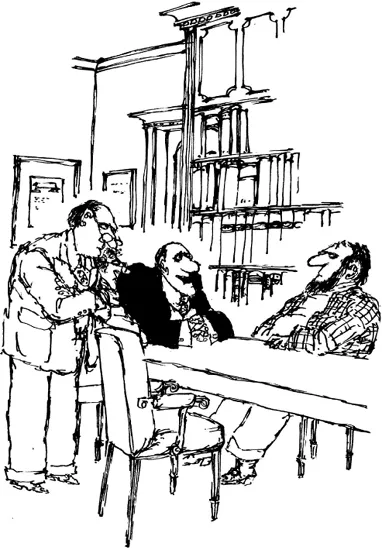
“Please understand, Professor Rand, we are not questioning your academic freedom. We’re just curious. As a favor could you fill us in a trifle about your course, ‘John Wayne, Father of Nato’.”
Now this is a very special and spectacular doctrine. Consider what would happen if it were applied to almost any other occupation—sanitation work or plumbing. “Plumber’s freedom” would consist of the right to install pipes and plumbing equipment in a way the plumber thought best. What if a customer wanted his plumbing done in a way which differed with the plumber’s professional judgment. Without the doctrine of “plumber’s freedom” the plumber would, of course, be free to refuse the job. But under the doctrine of “plumber’s freedom," he would not have to turn it down. He would have the right to take the job and do it his way. He would have the right to say that his views should prevail, and the customer would not have the right to dismiss him.
“Taxi driver’s freedom,” would guarantee to drivers the right to go where they wanted to go, regardless of where the paying customer wanted to be taken. “Waiter’s freedom,” would give the waiter the right to decide what you will eat. Why should not plumbers, waiters, and taxi drivers have a “vocational freedom”? Why should it be reserved for academics?
Basically, the difference which is said to exist between these vocations and the academics is that the academics require free inquiry, untrammeled rights of expression, and the right to pursue thoughts wherever they may lead. This claim and this distinction is, of course, made by the academics. In addition to being objectionably elitist, this argument also misses an important point, one which is not concerned with the question, of what is involved in intellectual activity. It is the impropriety of “vocational freedom” in upholding the employee’s “right” to a job on the basis of purely formalistic requirements, regardless of the wishes and desires of customers and employers.
If there is an acceptance of the elitist argument which claims that the “intellectual” professions must be granted a freedom inappropriate to other professions, what of others which qualify as “intellectual”? What about “medical freedom” for doctors, “legal freedom” for lawyers, “artistic freedom” for artists, etc. “Medical freedom” might give doctors the right to perform operations, regardless of whether the patient approved. Would it prevent patients from firing doctors whose procedures they disapproved of? Would “artist freedom” give artists the right to charge for art which is neither wanted nor appreciated? Considering the way “academic freedom” operates, these questions must all be answered affirmatively. One shudders at the possibility that these freedoms be granted to chemists, lawyers, or politicians.
What is really at issue in the question of “academic freedom” is the right of individuals to freely contract with one another. The doctrine of academic freedom is a denial of the sanctity of contract. The odds are against the employer, and freezes the situation in favor of the academic. It resembles nothing so much as a medieval guild system, with its restrictions, protectionism, and the fostering of a caste system.
Thus far, it has been implicitly assumed that the schools and universities are privately owned. The contention has been that academic freedom amounts to a violation of the rights of these property owners.
But virtually all of the institutions of learning in the United States are controlled by the government, i.e., they are stolen property. Academic freedom, therefore may be defended on the ground that it is perhaps the only device by which control over the educational system may be wrested away, at least in part, from the ruling class or power elite, which controls it.1 Assuming that this claim is true, for the sake of argument, there is a powerful defense of academic freedom.
In this view, it would not be the innocent student-consumer who is being defrauded by claims to academic freedom; for it is not the innocent student-consumer who is presently being forced to maintain in employment an academic whose services he does not wish. It would be the non-innocent ruling class which is being so forced. If the ruling class theory is correct, academicians with views favorable to the ruling class have nothing to gain from academic freedom. They will be retained in their jobs in any case. It is the academic with views that are not amenable to the ruling class, and he alone, who benefits. He gains from academic freedom because it prevents ruling classemployers from dismissing him on ideological or other nonformalistic grounds.
Academic freedom, as such, can be looked upon as a fraud and theft, because it denies individuals the right of free and voluntary contracts. But that a “bad” means can also be used for good ends should occasion no surprise.
1See G. William Domhoff, The Higher Circles (New York: Random House, 1970).
9
THE ADVERTISER
Advertising has long had a “bad press.” The case against it is detailed and seemingly compelling. It is claimed that advertising entices people, forcing them to buy products they would otherwise not buy. It preys on the fears and psychological weaknesses of people. It is misleading, with its justaposition of a beautiful woman and a commercial product, implying that she is somehow part of the deal. It is foolish, what with its contests, marching bands, and jingles. It is an insult to our intelligence.
The argument is usually capped with an appeal to our selfish natures—advertising is very costly. A minute of prime television time or a full-page adverstisement in a popular magazine or newspaper can run into thousands of dollars. The advertising industry as a whole is a multibillion dollar industry. If we banned advertising, it is alleged, all of this money could be saved. The money could then be used to improve the product, or lower its price, or both. The advertising industry could be replaced with a governmental board which would present objective descriptions and ratings. Instead of sexy misleading jingles, we would have product descriptions, perhaps summarized by a grade level of “Grade A,” “Grade B,” etc. In any case, the advertisers, who are nonproductive and essentially parasitical, would be put out of business.
There is much that is wrong with this view of advertising, but it is not without its historical precedents. In fact, it is only the most recent in a long line of arguments purporting to show that one or another industry is parasitical and unproductive. The physiocrats, a school of economic thought in mid-eighteenth century France, thought all industries except farming, fishing, and hunting were wasteful. They reasoned that anything not connected with the soil was sterile, and dependent and parasitical upon the soil-based industries. Other economists have distinguished between goods, which were considered productive, and services, which were not. Still others have held that all goods but only some services were productive. For example, it has been denied that monetary services such as financial intermediation, brokerage, banking, and speculation have any value. It is easy, nowadays, to see the limitations of these theories. A good need not come directly from the soil to be productive, nor need a service be “tangible,” such as medical care, to be productive. We know that brokers bring people together at lower costs than they could manage on their own. We know that the nontangible product of the insurance industry provides for the pooling and consequent lessening of risks. But even in these sophisticated times the advertising industry enjoys a widespread reputation as a parasite.
How strong is the case? First, it seems clear that advertising does not lure or force people to buy what they would not otherwise buy. Advertising attempts to persuade people—perhaps in ways some members of the community find objectionable. But it does not and cannot coerce. (Fraudulent advertising is logically equivalent to theft, and is not to be confused with advertising per se. If the seller advertises wheat but delivers rocks, he has actually stolen the money price of “wheat.”)
Subliminal advertising, if it exists, would be considered coercive. But it cannot be claimed that ordinary advertising is coercive without completely obliterating the distinction between coercion and persuasion.
Second, advertising does have an informational content. This is conceded even by its most fervent detractors, although they think that the government could do a better job. But governmental action in the field of advertising is no less advertising just because it is government advertising. If anything, there are more problems which are harder to deal with in “government issued” advertisements. Unencumbered by the usual necessity to make profits by pleasing consumers, when the government gets out of hand, there is very little that can be done. Governmental advertising for United States War Bonds or the military draft are but two examples that come to mind.
Third, the importance of advertising in helping new companies, and thus encouraging competition, should not be underestimated. If advertising were prohibited, the large established companies would have a powerful advantage in the market. Even with things as they are, older firms are more likely to monopolize a given industry than newer ones. Advertising, by giving a comparative advantage to newcomers, lessens the degree of concentration in the economy.
Finally, much if not all of the advertising that violates community standards of intelligence and decency can be traced to and blamed on governmental edicts in other areas. For example, the government1 does not allow airlines to compete with one another in trivial areas. Their advertising campaigns bombard us with “news” about early bird specials, new decor, the number of seats in an aisle, airplanes named after stewardesses, etc. (“I’m Marybeth. Fly me to Miami”). If airlines were free to compete with respect to price, the passengers might be spared this constant reiteration about nonessential affectations.
The same is true for banks. Banks are limited in the amount of interest they can pay to depositors (zero percent to demand depositors, 5½ percent–7½ percent to time depositors, as of this date). They compete, therefore, with each other as to which can give the best kitchen utensils, radios, etc., as lures for new depositors. (Note that since they can charge as much as the market will bear for loans, they spend far less advertising money to try to convince anyone to borrow money from them.) The true blame for advertisements of this kind belongs not to the advertising industry, but to the government.
These four arguments, when taken together, constitute a valid defense against the critics of advertising. Yet they do not strike at the heart of the matter. For they ignore the main fallacy of the critics—the assumption that deep down, there is a distinction to be made between motivational advertising and informational advertising, that motivational advertising is “bad” in various ways while informational advertising is “good.” The truth is, however, that exposing people to information and motivating them are so inextricably bound up together that it makes little sense to even distinguish between them.
For a better perspective, consider several examples where it is not they who are trying to impart information and motivation to us, but we who are trying to impart information and motivation to them. Most of us, for instance, have had the experience of being interviewed for a new position. How do we prepare? We commence by writing an advertising brochure about ourselves. (This document is sometimes called a “resume” by those anxious to obfuscate and to hide the fact that each of us is, at almost all times, an advertiser.) In this advertising brochure we put the facts of our employment life as they pertain to the prospective job. And in splendid advertising tradition, we try to make these facts appear as flattering as possible. We hire a professional typist to help “entice” an employer into hiring us, and we have the brochure printed on fine paper in order to “create an impression,” as a good advertiser should.
Strictly speaking, we are only providing information on the brochure. It is “merely” informational advertising on the face of it, but the attempt to present the information in a favorable light involves us, willy nilly, in motivational advertising.
During the interview, we continue to advertise. We “package” ourselves as best we can. Even though we might not do so every day, at the job interview we will give special attention to grooming effects.
Even when not engaged in job-hunting, we advertise, by constantly trying to portray ourselves in a good light. Even unconsciously we try to package ourselves well. From the very cradle parents are busy advertising us or laying the groundwork for future advertising. How else can we explain those ballet, violin and piano lessons and visits to the orthodontist or skin doctor?
The “Jewish mother,” with her constant exhortations about good posture and good eating habits (“Eat, eat, children are starving in Europe and you’re not eating”), is the great unsung heroine of the advertising business. And the Jewish mother’s bragging about her children? Just more advertising.
As we grow up we carry on the fine traditions of advertising. We wear clothing that flatters our figures. We diet, or try to. At least part of our expenditures on education, psychiatry, hair grooming, and clothing can only be understood as advertising expenditures. Later on we purchase cars, houses, recreation, in large part as advertisements for ourselves. Incidentally, the greater expenditures (as a percentage of income) on “luxury” items such as clothing and cars, made by groups who are discriminated against, such as women and blacks, can be explained by advertising.2 They feel they must engage in greater advertising expenses in order to counteract the discrimination. The rest need not invest so heavily in advertising because we are in.
Even members of the radical left, who are among the bitterest critics of advertising, engage in advertising themselves. (This should not be surprising, since we are defining advertising in its proper but broad sense of creative and interesting packaging.) Usually whenever the radical left has access to a bulletin board, the messages placed on it are at first uniformly small, neat, and similarly printed. After a while, in order to attract attention, some of the messages are printed in different colors, and on different-size placards. Eventually, in the competition to attract attention, larger and larger placards are used, with bolder printing, coloring, and illustrations. In their attempt to spread information, they are led “as if by an invisible hand” to engage in motivational advertising. The reason radicals write messages such as, “OFF THE PIG” or “FUCK THE STATE” on walls or buildings in big red letters, is not entirely out of a desire to shock. It is also out of a desire to impart the revolutionary message, by first attracting attention to it. If it is not read, however informational it may be, it will impart no information. But as much can be said for the typical soap opera advertisement.
Anyone who has ever been called upon to give a speech where there was a distinct possibility of putting the audience to sleep will understand the difficulty of distinguishing between imparting information and packaging a speech. Surely, no more boring a speech can be imagined than a lecture on economics. The public speaker or teacher will engage in certain practices, such as maintaining eye contact, telling jokes, or posing rhetorical questions. These are sometimes known as public speaking techniques. A more appropriate term would be “advertising techniques”—packaging the product well, making it appear interesting, highlighting the talk, bringing points into focus, and capturing the attention of the audience. These advertising techniques have about as much to do with the subject of the talk as bicycling has to do with Coca-Cola, as deep throaty, sexy female voices have to do with shaving cream, or as the sporting events of “the more than one beer men” have to do with beer. That is not the point. The point is that if one hopes to get information across—even to people who are well-motivated, such as the student in the economics class who has to stay awake to receive a good grade—one must engage in advertising techniques. If this is important when dealing with people who are well-motivated, imagine how much more important it is to “advertise” information when your “audience” is not well-motivated. Television advertising should be interpreted at least as favorably, if not more so, than the advertising engaged in by public speakers. They are both attempts to impart information by making that information interesting and attractive. But the television ad faces the additional burden of keeping the viewer away from his refrigerator. If all content which was not strictly informational was banned, we would have to prevent speakers and teachers from even attempting to be interesting. They would not be allowed to tell jokes, maintain eye contact, or discuss questions with the audience. These techniques are above and beyond the strict imparting of information. Like television advertising gimmicks, they are attempts to “waylay the audience.”
Is it possible to ban motivational advertising while allowing informational advertising? No. Information can be presented well or badly (i.e., in such a way as to bore and alienate the audience, or charm and amuse it), but it must be “packaged” or “presented” in some way. For example, imagine that a magic carpet was invented, and it was decided that information about it was to be given out (the flying speed, cruising range, upkeep costs, how to roll it up and store it while not in use, etc.), but the presentation was to be purely informational. Anything which even hinted at “promotion” of the carpet would be banned. Given this condition, a regular television announcer, with his good looks, forcefulness and self-confidence, could not present the information. His personality might promote the carpet. Nor could there be music in the background. It might seem “inspirational.” The carpet certainly could not be shown “in action,” that is, with an attractive woman on it. We could not risk fooling people into believing that if they bought the carpet they would get a copy of the inspirational music or of the inspirational woman.
If we could not use a professional announcer, could we use a nonprofessional one, or just an ordinary man off the street? We could not. Some advertising companies with their low cunning are already using testimonials from the “man-in-the-street” with great success, proving that this procedure has a motivational content.
If the information cannot be read, can it be printed? But what kind of typeface should be used? Certainly not a style that would induce someone to—horrors!—buy the flying carpet. It would have to be an almost indecipherable typeface so that people could hardly read it. Otherwise, at a low enough price, many people would be led down the garden path into making a purchase. The whole message would have to be presented in a purposely inferior manner so as not to attract any attention to itself.
Clearly, there is no way to separate the “package” from what it contains. There is no way to present “pure” information. To believe that the presentation of information without motivation is foolishness of the highest degree.
The objection that advertising adds to the cost of the product is an objection that has not been clearly thought out. Would the critics object because wrapping a product adds to the cost? Or transporting it? They would not. It is understood that these additional costs are necessarily incurred if the product is to be made available to the consumer. But the same is true of advertising! Suppose the magic carpet previously mentioned costs $950 to manufacture, $10 to wrap it, and $40 for transportation. If customers want to take advantage of the wrapping and delivery services, they must pay the full $1,000. But they have the choice of picking up a wrapped carpet at $960, an unwrapped one for $950, or an unwrapped one delivered to their homes for $990.
So is it with advertising costs. If it costs $100 to advertise the carpet, the customers have a choice between the advertised brand for $1,100 and an unadvertised brand (which presumably, they could find if they searched long enough) for $1,000. If a substantial number of consumers were willing to find unadvertised brands or outlets, manufacturers would be foolish to advertise. However, some consumers may not be so enterprising or energetic in shopping for unadvertised brands at cheaper prices. This would give the manufacturer the incentive to advertise, and the costs of the advertisements would be added to the purchase price. It is true, therefore, that advertising would add to the cost of the product. But then it is true that advertising is necessary in order to bring the product to the people. If some refused to buy unwrapped, undelivered magic carpets, but would buy wrapped, delivered ones, could it be said that wrapping costs and delivery costs were added to the total costs unnecessarily? Decidedly not. In the same manner, advertising does not add unnecessarily to the costs of the product.
What of a governmental ratings board for advertising? Before giving the government still another task, because of alleged “imperfections” in the market, consider the dismal record of the government to date. The graft and corruption unearthed by Ralph Nader and his associates should give pause for thought. Regulation agency after regulation agency, from ICC and CAB to FTC, FPC, and others, have been shown to be regulating industry not for the benefit of the consumer, but for the benefit of the industry as against the consumer. And this is not just an accident. There is a reason for it.
Each of us is a purchaser of literally thousands of items, but producers of only one. Our ability to influence regulatory legislation passed by the state is, therefore, much more concentrated as producers than as consumers. Government agencies, accordingly, tend to regulate in favor of the producing industry rather than the mass of consumers. In fact, government regulatory agencies tend to be set up by the very industries they are to regulate. Milton Friedman, in the chapter entitled “Occupational Licensure” in Capitalism and Freedom,3 brilliantly demonstrates the dismal record of governmental rating agencies in the medical field. There is no reason to assume that a rating agency in advertising would be any different. Rather, it would not be surprising if the calls for governmentally regulated “objective,” “informational” advertising were begun by the larger, established, advertising firms as a way of slowing down the rising competition from smaller firms and newcomers.
But the strongest argument against governmental regulation of advertising is not the empirical one showing its dismal record to date, strong though that may be. The strongest argument is the logical one. The reasoning employed by those who want governmental regulation contains a self-contradiction. On the one hand they assert that the American people are unalterably gullible. They must be protected because, left to their own devices, they become victims. They can be made to think, for example, that if they use a certain brand of aftershave lotion, they will end up with the girl in the ad. On the other hand, the argument assumes that the boobs are smart enough to pick political leaders capable of regulating these sirens. This is impossible.
In any case, if the public is sufficiently enamored of “objective” information on consumer products, it can avail itself of the services of firms and organizations such as Consumer Reports, Good Housekeeping, the Better Business Bureau, commercial testing laboratories, and other private-enterprise certification agencies. The free market is flexible. It can provide this kind of service too. (But the inability to separate motivational and informational advertising still holds. When Consumer Reports states that Zilch Flakes are the best flakes to buy, it is necessarily motivating people to “buy Zilch” over and above other flakes. It cannot provide information without providing any motivation to do anything.)
Advertising can be defended only when it occurs on the free market. In the case of government or government-aided big business advertising, none of the free-market defenses hold. Here, people are forced to pay for the advertising whether they choose to buy the product or not. When the government advertises, it is with tax money collected on an involuntary basis. The advertising in which the government engages is highly motivational (“Uncle Sam Wants You”) and not infrequently fraudulent. It is strange that government advertising has been so completely ignored, even by the most vociferous critics of advertising. Imagine what would ensue if a private businessman were to engage in fraudulent advertising on even 1 percent of the scale committed by Franklin Roosevelt, Lyndon Johnson, or Richard Nixon, who campaigned on advertised peace planks, and yet involved the country in foreign wars. How can we entrust punishment of fraudulent advertising to the worst fraudulent advertisers of all time—the government?
Finally, advertising must be defended by those who believe in freedom of speech—for that is all advertising is. It is all too easy to defend the right to speak of those whose speech we favor in any case. But if the rights of free speech are to mean anything at all, those who are not in public favor must be defended. Libertarians anxiously await a defense by the American Civil Liberties Union of the free speech rights of advertisers. This organization was ominously quiet during the banning of cigarette commercials from television.
1For the view that it was not the government that initiated controls of this type in an effort to regulate business in the public interest, but rather business in an effort to control the competition of newcomers, see Gabriel Kolko, Triumph of Conservatism (New York: Quadrangle, 1967).
2This point has been made by Professor Benjamin Klein of the department of economics, University of California, Los Angeles.
3Milton Friedman, Capitalism and Freedom (Chicago: University of Chicago Press, 1962).
10
THE PERSON WHO YELLS “FIRE!” IN A CROWDED THEATER
In a case against free speech, the “fire!” screamer is Exhibit A. Even those who argue in defense of civil liberties and the right of free speech stipulate that these rights do not include the right to yell “fire!” in a crowded theater. This is the one case where all parties seem to agree that the right to free speech is not as important as other rights.
But to override the right of free speech, for any reason, is a dangerous precedent, and never necessary. Certainly it is not necessary in the case of the person who yells “fire!” The rights of theater patrons can be protected without legally prohibiting free speech. For example, theater owners could contract with their customers not to yell “fire!” (unless, of course, there is a fire in the theater). The contract might take the form of an agreement, in small print, on the back of a theater ticket or a large message on wall posters placed throughout the theater, prohibiting any disturbance of the entertainment or singling out the shouting of the word, “fire!” But however the prohibition appeared, the contract would effectively put an end to the supposed conflict between the right of free speech and other rights. For the person who yelled “fire!” would then simply be violating a contract and could be dealt with accordingly. The situation would be entirely analogous to that of someone under contract to sing at a concert, but who refuses to sing, and instead lectures on economics. What is involved in both cases is not the right of free speech, but the obligation to honor a contract. Why look at the prohibition in this way? There are several important reasons.
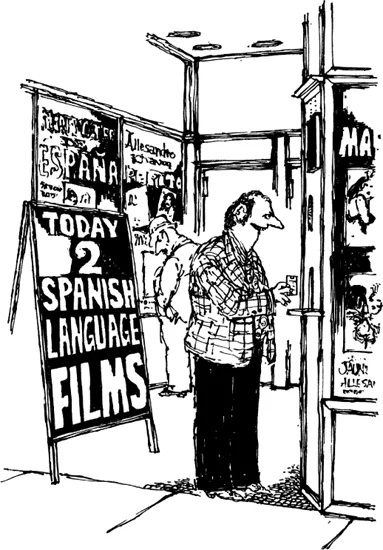
“Oh, miss, would you happen to know the Spanish word for ’Fire’?”
First, the market would be much more effective in removing threats to the public health and safety—such as the one posed by the “fire!” screamer—than an all-encompassing governmental prohibition. A market contract system would work more efficiently because theater entrepreneurs would be in competition with each other with regard to the efficiency with which they prevented outbursts disruptive to the audience. Thus, they would have a great incentive to diminish the number and severity of such outburts. The government, on the other hand, offers no incentive. No one automatically loses money when the government fails to maintain order in a theater.
A second reason we can expect greater success from the market than from the government is that the market is, by its very nature, more flexible. The government can only make one all-embracing rule, with at best, one or two exceptions. The market does not have such restrictions. The flexibility and complexity of the market are limited only by the inventiveness of the actors in it.
Third, the government system of protection against yelling “fire!”—outright prohibition—violates the rights of perhaps one of the most oppressed minorities: the sadists and the masochists. What of the rights of the sadists who enjoy yelling “fire!” in a crowded theater, and then watching the crowd tear itself to pieces in the resultant mad rush for the exits? What of the masochists who relish the thought of having “fire!” yelled at them while in the confines of a crowded theater with the same mad but “exhilarating” crush at the door? Under the government system of outright prohibition, these people are denied what may be their most fervent wish—their chance to go out in a blaze of glory. In the flexible market system, however, where there is a demand for a service, a supply will soon arise. Where there is an unfulfilled demand for sado-masochists screaming “fire!” and then watching the frantic crushes, entrepreneurs will rise to the occasion and provide the requisite service.
Such musings will undoubtedly strike the “straights” on the sado-masochistic question as just so much idle talk. But that is only to be expected. No ruling class ever viewed the plight of their downtrodden with anything but contempt and scorn. Nonaggressing adult sado-masochists have just as much right to their mutually agreeable practices as anyone else. To dismiss the rights of sado-masochists as not being worthy of consideration provides evidence of the fascistic habits of thought to which most “straights” have succumbed. Sado-masochists should be free to indulge in their nonaggressive practices. The public, after all, need not attend any theater which clearly advertises that “unplanned disruptions” will be permitted. Sado-masochists, for their part, would still have to curb their enthusiasm when patronizing “straight” theaters.
Finally, unless the prohibition against yelling “fire!” in a crowded theater stems from a private contract, the right of free speech will be in conflict with what is held in very high esteem—namely the rights of people not to have their show interrupted and themselves crushed at the exits.
Freedom of speech is at best a weak reed. It is always in danger of being suppressed. Our hold on it is sometimes very tenuous indeed. Therefore, anything which tends to weaken it even further must be opposed. There is hardly a scare tactic better designed to destroy freedom of speech than the creation of a false conflict between the right to speak freely and other rights held in vastly higher esteem. Yet this is precisely what the usual interpretation of yelling “fire!” accomplishes. If “exceptions” to the right of free speech are granted, our tenuous hold on the right of free speech is weakened. There are no legitimate exceptions to the right of free speech. There are no cases in which the right of free speech is in conflict with any other right we hold dear.
Therefore, the person who yells “fire!” in a crowded theater can be considered a hero. He forces a consideration of what is involved and what needs to be done to protect a precious right that is endangered.
Defending the Undefendable
Read the whole book online · Book details
This work is published under a Creative Commons licence. You may copy, share, and re-host it with attribution.