
Chapter 10 of 13 · Defending the Undefendable by Walter Block
VI. BUSINESS AND TRADE 19 THE CURMUDGEON
Imagine, if you will, the problems of the real estate developer who is trying to supplant a city block of crumbling tenements with a modern residential complex, replete with gardens, swimming pools, balconies, and other accoutrements of comfortable living. Many problems arise, some by governmental obstacles (zoning laws, licensing requirements, bribes for acceptance of architectural plans). Nowadays, these are widespread, and stultifying. However, in some cases, an even greater problem is posed by the curmudgeon who owns and lives in the most decrepit tenement on the block. He is overly fond of his building and refuses to sell at any price. The builder offers preposterous sums of money, but the curmudgeon steadfastly refuses.
The curmudgeon, who may be a little old lady or a bitter old man, has long been active defending his homestead against the inroads of highway builders, railroad magnates, mining companies, or dam and irrigation control projects. Indeed, the plots of many western movies are based on this resistance. The curmudgeon and his spiritual soulmates served as the inspiration for the enactment of eminent domain legislation. He has been portrayed as a staunch human barrier to progress, with feet planted firmly at the crossroads, and his motto a strident, defiant “no.”
Cases like this abound, and are said to demonstrate the curmudgeon’s interference with the progress and well-being of the multitude. This popular view, however, is mistaken. The curmudgeon, who is depicted as standing in the way of progress, actually represents one of the greatest hopes that progress ever had—the institution of property rights. For the abuse heaped upon him is a disguised attack on the concept of private property itself.
Now if private property means anything, it means that owners have the right to make decisions with regard to the use of their property, as long as this use does not interfere with other property owners and their rights to the use of their own property. In the case of eminent domain, when the state forces the property owner to give up the rights to his property on terms that he would not voluntarily choose, the rights to private property are abridged.
The two primary arguments for private property are the moral and the practical. According to the moral argument, each man is, first of all, the complete owner of himself, and of the fruits of his labor. The principle behind his ownership of himself and his artifacts is the principle of homesteading or natural governance. Each person is the natural owner of himself because, in the nature of things, his will controls his actions. According to the principle of homesteading, each man owns his own person, and he therefore owns the things which he produces—those parts of nature hitherto unowned and which, when mixed with his labor, are transformed into productive entities. The only moral ways for these entities to change ownership are voluntary trade and voluntary gift-giving. These ways are consistent with the original owner’s natural homesteading rights, for they are methods by which ownership is given up voluntarily, in accordance with the owner’s will.
Let us assume that the property owned by the curmudgeon was gained by this process of natural homesteading. If so, there was an original homesteader, there were voluntary sales of the land or the land may have been given in the form of a gift at one time or another. The land then passed into the control of the curmudgeon through an unbroken chain of voluntary events, all consistent with the principle of homesteading; in other words, his land title would be legitimate.
Any attempt to wrest it from him without his consent thus violates the principle of homesteading, and hence is immoral. It is an act of aggression against an innocent party. (The question will be raised regarding land which has been stolen. In fact, most of the earth’s surface meets this criteria. In such cases, if there is evidence that (1) the land has been stolen, and (2) another individual can be found who is the rightful owner or heir, this person’s right of ownership must be respected. In all other cases, the actual owner must be considered the rightful owner. De facto ownership is sufficient when the owner is the original homesteader or when no other legitimate claimant can be found.)
Many recognize this when the curmudgeon resists the demands on his property by private business. It is clear that one private interest does not have the right to intrude upon another private interest. However, when it is the state, as represented by eminent domain laws, the case seems different. For the state, it is assumed, represents all the people, and the curmudgeon purportedly is blocking progress. Yet in many cases—if not all—governmental laws of eminent domain are used to further private interests. Many urban relocation programs, for example, are at the behest of private universities and hospitals. Much of the condemnation of private property by eminent domain laws is accomplished for the special interests of lobbies and other pressure groups. The condemnation of the land on which Lincoln Center for the Performing Arts in New York City was built is a case in point. This tract of land was condemned to make way for “high culture.” People were forced to sell their land at prices the government was willing to pay. Whose culture this center serves is clear to anyone who reads the list of subscribers to Lincoln Center. It is a Who’s Who of the ruling class.
In considering the second set of arguments for private property rights, the practical arguments, there is one based on the concept of stewardship. Under private stewardship, it is claimed, property receives the “best” possible care. Who controls the piece of property is not important. What is important is that all property be privately owned, that precise delineations between the properties be clearly marked off, and that no forced or involuntary transfers of property be allowed. If these conditions are met, and a laissez faire market is maintained, those who “mishandle” their property lose profits they could otherwise earn, and those who nurture their property can accumulate funds. Thus, those better able to maintain a good stewardship eventually become responsible for more and more, since they can afford to buy up extra property with their earnings, while the poor stewards will have less and less. The general level of stewardship, therefore, will rise, and better care will be taken of property in general. The stewardship system, by rewarding good stewards and penalizing poor ones, increases the average level of stewardship. It does so automatically, without political votes, without political purges, and without fuss or fanfare.
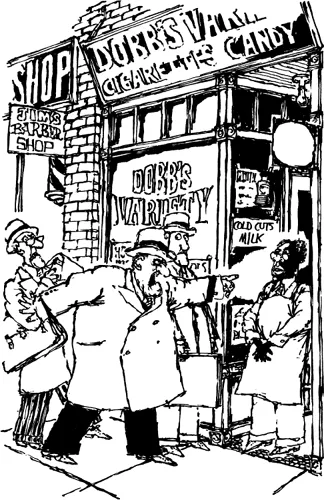
“Enough, enough of this pleading and cajoling! As president of the university I tell you this—we’ll get your property for our humanities building one way or another, so watch out, nigger!”
What happens when the government steps in and props up, by means of loans and subsidies, failing enterprises managed by incompetents? The effectiveness of the stewardship system is vitiated, if not destroyed altogether. The failing enterprises are protected by government subsidies from the consequences of their mismanagement. Such government infringements take many forms—the granting of franchises, licenses, and other types of monopoly advantages to one select individual or group; the granting of tariffs and quotas to protect inefficient domestic “caretakers” against competition from more efficient foreign stewards; and the awarding of government contracts which pervert the original consumption wishes of the public. All perform the same function. They enable the government to interpose itself between a bad caretaker and a public which has chosen not to patronize him.
What if the government interposes itself in the opposite way? What if it tries to hasten the process by which good stewards acquire more and more property? Since the sign of good stewardship in a free market is success, why can’t the government simply analyze the present distribution of property and wealth, ascertain who the successes and the failures are, and then complete the transfer of property from poor to wealthy? The answer is that the market system works automatically, making day-to-day adjustments in immediate response to the competence of the various stewards. Governmental attempts to hasten the process by transferring money and property from the poor to the rich can only be done on the basis of the past behavior of the stewards in question. But there is no guarantee that the future will resemble the past, that those who were successful entrepreneurs in the past will be successful entrepreneurs in the future! Similarly, there is no way of knowing who among the present poor have the innate competence to eventually succeed in a free market. Governmental programs, based as they would have to be on past accomplishments, would be arbitrary and inherently contrived.
Now the curmudgeon is a prototype of a “backward,” poor individual, who is, by all standards, a bad manager. Thus he is a prime candidate for a governmental scheme whose goal is to speed up the market process by which good stewards acquire more property and bad stewards lose theirs. But this, as we have seen, is a scheme bound to fail.
The second practical defense of private property may be called the praxeological argument. This view focuses on the question of who is to evaluate transactions. According to it, the only scientific evaluation that can be made of a voluntary trade is that all parties to it gain in the ex ante sense. That is, at the time of the trade, both parties value what they will gain more than they value what they will give up in exchange. The parties would not voluntarily make the trade unless, at that time, each valued what is to be received more than what is to be given up. Thus a mistake in a trade will not be made in the ex ante sense. However, a mistake can be made in the ex post sense—after the trade has been completed, one can change one’s evaluation. However, in most instances, the trade usually reflects the desires of both parties.
How is this relevant to the situation of the curmudgeon, who is charged with blocking progress and thwarting the natural transfer of property from the less able to the more able? According to the praxeologist, the answer to the question, “Shouldn’t he be forced to sell his property to those who can manage it more productively?” is a resounding “no.” The only evaluation that can be made, from a scientific perspective, is of a voluntary trade. A voluntary trade is, in the ex ante sense, good. If the curmudgeon refuses to trade, no negative evaluation is possible. All that can be said is that the curmudgeon values his property at more than the developer was willing or able to pay. Since no interpersonal comparisons of utility or welfare have scientific foundation (there is no unit by which such things can be measured, let alone compared between different people), there is no legitimate basis on which to say that the curmudgeon’s refusal to sell his property is harmful or causes problems. True, the curmudgeon’s choice serves to obstruct the real estate developer’s goal. But then, the goals of the real estate developer are just as obstructive of the goals of the old curmudgeon. Clearly, the curmudgeon is under no obligation to frustrate his own desires in order to satisfy another’s. Yet the curmudgeon is usually the object of unjustified censure and criticism as he continues to act with integrity and courage in the face of enormous social pressures. This must stop.
20
THE SLUMLORD
To many people, the slumlord—alias ghetto landlord and rent gouger—is proof that man can, while still alive, attain a satanic image. Recipient of vile curses, pincushion for needle bearing tenants with a penchant for voodoo, perceived as exploiter of the downtrodden, the slumlord is surely one of the most hated figures of the day. The indictment is manifold: he charges unconscionably high rents; he allows his buildings to fall into disrepair; his apartments are painted with cheap lead paint which poisons babies, and he allows junkies, rapists, and drunks to harass the tenants. The falling plaster, the overflowing garbage, the omnipresent roaches, the leaky plumbing, the roof cave-ins and the fires, are all integral parts of the slumlord’s domain. And the only creatures who thrive in his premises are the rats.
The indictment, highly charged though it is, is spurious. The owner of ghetto housing differs little from any other purveyor of low cost merchandise. In fact, he is no different from any purveyor of any kind of merchandise. They all charge as much as they can.
First consider the purveyors of cheap, inferior, and secondhand merchandise as a class. One thing above all else stands out about merchandise they buy and sell: it is cheaply built, inferior in quality, or secondhand. A rational person would not expect high quality, exquisite workmanship, or superior new merchandise at bargain rate prices; he would not feel outraged and cheated if bargain rate merchandise proved to have only bargain rate qualities. Our expectations from margarine are not those of butter. We are satisfied with lesser qualities from a used car than from a new car. However, when it comes to housing, especially in the urban setting, people expect, even insist upon, quality housing at bargain prices.
But what of the claim that the slumlord overcharges for his decrepit housing? This is erroneous. Everyone tries to obtain the highest price possible for what he produces, and to pay the lowest price possible for what he buys. Landlords operate this way, as do workers, minority group members, socialists, babysitters, and communal farmers. Even widows and pensioners who save their money for an emergency try to get the highest interest rates possible for their savings. According to the reasoning which finds slumlords contemptible, all these people must also be condemned. For they “exploit” the people to whom they sell or rent their services and capital in the same way when they try to obtain the highest return possible. But, of course, they are not contemptible—at least not because of their desire to obtain as high a return as possible from their products and services. And neither are slumlords. Landlords of dilapidated houses are singled out for something which is almost a basic part of human nature—the desire to barter and trade and to get the best possible bargain.
The critics of the slumlord fail to distinguish between the desire to charge high prices, which everyone has, and the ability to do so, which not everyone has. Slumlords are distinct, not because they want to charge high prices, but because they can. The question which is, therefore, central to the issue—and which the critics totally disregard—is why this is so.
What usually stops people from charging inordinately high prices is the competition which arises as soon as the price and profit margin of any given product or service begins to rise. If the price of frisbees, for example, starts to rise, established manufacturers will expand production, new entrepreneurs will enter the industry, used frisbees will perhaps be sold in secondhand markets, etc. All these activities tend to counter the original rise in price. If the price of rental apartments suddenly began to rise because of a sudden housing shortage, similar forces would come into play. New housing would be built by established real estate owners and by new ones who would be drawn into the industry by the price rise. Old housing would tend to be renovated; basements and attics would be pressed into use. All these activities would tend to drive the price of housing down, and cure the housing shortage.
If landlords tried to raise the rents in the absence of a housing shortage, they would find it difficult to keep their apartments rented. For both old and new tenants would be tempted away by the relatively lower rents charged elsewhere. Even if landlords banded together to raise rents, they would not be able to maintain the rise in the absence of a housing shortage. Such an attempt would be countered by new entrepreneurs, not party to the cartel agreement, who would rush in to meet the demand for lower priced housing. They would buy existing housing, and build new housing. Tenants would, of course, flock to the noncartel housing. Those who remained in the high price buildings would tend to use less space, either by doubling up or by seeking less space than before. As this occurs it would become more difficult for the cartel landlords to keep their buildings fully rented. Inevitably, the cartel would break up, as the landlords sought to find and keep tenants in the only way possible: by lowering rents. It is, therefore, specious to claim that landlords charge whatever they please. They charge whatever the market will bear, as does everyone else.
An additional reason for calling the claim unwarranted is that there is, at bottom, no really legitimate sense to the concept of overcharging. “Overcharging” can only mean “charging more than the buyer would like to pay.” But since we would all really like to pay nothing for our dwelling space (or perhaps minus infinity, which would be equivalent to the landlord paying the tenant an infinite amount of money for living in his building), landlords who charge anything at all can be said to be overcharging. Everyone who sells at any price greater than zero can be said to be overcharging, because we would all like to pay nothing (or minus infinity) for what we buy.
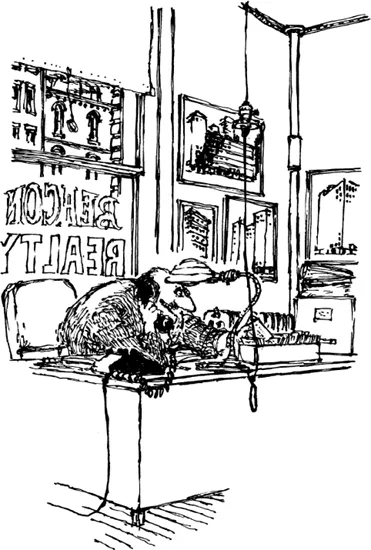
“Let’s see, I have a nice 3 room apartment on the upper West Side—No, no Madam, not a speck of lead paint on the woodwork—it’s been all chewed off.”
Disregarding as spurious the claim that the slumlord overcharges, what of the vision of rats, garbage, falling plaster, etc.? Is the slumlord responsible for these conditions? Although it is fashionable in the extreme to say “yes,” this will not do. For the problem of slum housing is not really a problem of slums or of housing at all. It is a problem of poverty—a problem for which the landlord cannot be held responsible. And when it is not the result of poverty, it is not a social problem at all.
Slum housing with all its horrors is not a problem when the inhabitants are people who can afford higher quality housing, but prefer to live in slum housing because of the money they can save thereby. Such a choice might not be a popular one, but other people’s freely made choices which affect only them cannot be classified as a social problem. (If that could be done, we would all be in danger of having our most deliberate choices, our most cherished tastes and desires characterized as “social problems” by people whose taste differs from ours.)
Slum housing is a problem when the inhabitants live there of necessity—not wishing to remain there, but unable to afford anything better. Their situation is certainly distressing, but the fault does not lie with the landlord. On the contrary, he is providing a necessary service, given the poverty of the tenants. For proof, consider a law prohibiting the existence of slums, and, therefore, of slumlords, without making provisions for the slumdwellers in any other way, such as providing decent housing for the poor, or an adequate income to buy or rent good housing. The argument is that if the slumlord truly harms the slumdweller, then his elimination, with everything else unchanged, ought to increase the net well-being of the slum tenant. But the law would not accomplish this. It would greatly harm not only the slumlords but the slumdwellers as well. If anything, it would harm the slumdwellers even more, for the slumlords would lose only one of perhaps many sources of income; the slumdwellers would lose their very homes. They would be forced to rent more expensive dwelling space, with consequent decreases in the amount of money available for food, medicines, and other necessities. No. The problem is not the slumlord; it is poverty. Only if the slumlord were the cause of poverty could he be legitimately blamed for the evils of slum housing.
Why is it then, if he is no more guilty of underhandedness than other merchants, that the slumlord has been singled out for vilification? After all, those who sell used clothes to Bowery bums are not reviled, even though their wares are inferior, the prices high, and the purchasers poor and helpless. Instead of blaming the merchants, however, we seem to know where the blame lies—in the poverty and hopeless conditon of the Bowery bum. In like manner, people do not blame the owners of junkyards for the poor condition of their wares or the dire straits of their customers. People do not blame the owners of “day-old bakeries” for the staleness of the bread. They realize, instead, that were it not for junkyards and these bakeries, poor people would be in an even worse condition than they are now in.
Although the answer can only be speculative, it would seem that there is a positive relationship between the amount of governmental interference in an economic arena, and the abuse and invective heaped upon the businessmen serving that arena. There have been few laws interfering with the “day-old bakeries” or junkyards, but many in the housing area. The link between government involvement in the housing market and the plight of the slumlord’s public image should, therefore, be pinpointed.
That there is strong and varied government involvement in the housing market cannot be denied. Scatter-site housing projects, “public” housing and urban renewal projects, zoning ordinances and building codes, are just a few examples. Each of these has created more problems than it has solved. More housing has been destroyed than created, racial tensions have been exacerbated, and neighborhoods and community life have been shattered. In each case, it seems that the spillover effects of bureaucratic red tape and bungling are visited upon the slumlord. He bears the blame for much of the overcrowding engendered by the urban renewal program. He is blamed for not keeping his buildings up to the standards set forth in unrealistic building codes which, if met, would radically worsen the situation of the slumdweller. (Compelling “Cadillac housing” can only harm the inhabitants of “Volkswagen housing.” It puts all housing out of the financial reach of the poor.)
Perhaps the most critical link between the government and the disrepute in which the slumlord is held is the rent control law. For rent control legislation changes the usual profit incentives, which put the entrepreneur in the service of his customers, to incentives which make him the direct enemy of his tenantcustomers.
Ordinarily the landlord (or any other businessman) earns money by serving the needs of his tenants. If he fails to meet these needs, the tenants will tend to move out. Vacant apartments mean, of course, a loss of income. Advertising, rental agents, repairs, painting, and other conditions involved in rerenting an apartment mean extra expenditures. In addition, the landlord who fails to meet the needs of the tenants may have to charge lower rents than he otherwise could. As in other businesses, the customer is “always right,” and the merchant ignores this dictum only at his own peril.
But with rent control the incentive system is turned around. Here the landlord can earn the greatest return not by serving his tenants well, but by mistreating them, by malingering, by refusing to make repairs, by insulting them. When the rents are legally controlled at rates below their market value, the landlord earns the greatest return not by serving his tenants, but by getting rid of them. For then he can replace them with higher paying non-rent-controlled tenants.
If the incentive system is turned around under rent control, it is the self-selection process through which entry to the landlord “industry” is determined. The types of people attracted to an occupation are influenced by the type of work that must be done in the industry. If the occupation calls (financially) for service to consumers, one type of landlord will be attracted. If the occupation calls (financially) for harassment of consumers, then quite a different type of landlord will be attracted. In other words, in many cases the reputation of the slumlord as cunning, avaricious, etc., might be well-deserved, but it is the rent control program in the first place which encourages people of this type to become landlords.
If the slumlord were prohibited from lording over slums, and if this prohibition were actively enforced, the welfare of the poor slumdweller would be immeasurably worsened, as we have seen. It is the prohibition of high rents, by rent control and similar legislation, that causes the deterioration of housing. It is the prohibition of low-quality housing, by housing codes and the like, that causes landlords to leave the field of housing. The result is that tenants have fewer choices, and the choices they have are of low quality. If landlords cannot make as much profit in supplying housing to the poor as they can in other endeavors, they will leave the field. Attempts to lower rents and maintain high quality through prohibitions only lower profits and drive slumlords out of the field, leaving poor tenants immeasurably worse off.
It should be remembered that the basic cause of slums is not the slumlord, and that the worst “excesses” of the slumlord are due to governmental programs, especially rent control. The slumlord does make a positive contribution to society; without him, the economy would be worse off. That he continues in his thankless task, amidst all the abuse and vilification, can only be evidence of his basically heroic nature.
21
THE GHETTO MERCHANT
“How dare he charge such outrageously high prices for such shoddy merchandise? The store is filthy, the service horrible, and the guarantees worthless. The installment buying will keep you in debt to them for the rest of your life. The customers of these leeches are among the poorest, the most financially naïve to be found anywhere. The only remedy is to prohibit the high prices, low quality products, the devious installment plans, and the general exploitation of poor people.”
Such is the view of a majority of those who have spoken out on the ghetto merchant “problem.” And indeed, it has a certain plausibility. After all, ghetto merchants are mainly rich and white and their customers are mainly poor minority group members. The merchandise sold in ghetto shops is often more expensive than that sold in other areas, and of inferior quality. However, the proposed solution, to compel ghetto merchants to follow the practices of nonghetto neighborhoods, will not work. Rather, such compulsion will hurt the people it is designed to help—the poor.
It is easy to argue that if you prohibit something that is bad, something good will follow. It is simple, but not always true. And it is clearly untrue in the case of the ghetto merchant and his business practices. This facile argument blithely ignores the causes of the problem—why prices are really higher in the ghetto.
Although at first glance it might appear that prices are higher in luxury neighborhoods than in the ghetto, this is due to the fact that stores in the ghettos and the luxury neighborhoods do not really sell the same goods. The quality of the merchandise sold is lower in the ghetto. This holds even in the case of seemingly identical merchandise. A bottle of Heinz ketchup, for example, might be priced higher in the luxury neighborhood, but the product being sold there is the ketchup, plus the decor of the store, delivery and other services, and the convenience of shopping close to home or at all hours of the day and night. These amenities are either lacking altogether in the ghetto shop, or are present in a lesser form. When they are taken into account, it is clear that the ghetto consumer gets less for his money than the consumer in a luxury neighborhood.
This must be true because the price charged by the ghetto merchant reflects “hidden” operating expenses which the nonghetto merchant does not have to contend with. In the ghetto, there are higher rates of theft and crime of all types. There is more damage by fire, and greater chance of damage from riots. All this increases the insurance premiums that the merchant must pay. And it increases the necessary expenditures on burglar alarms, locks and gates, guard dogs, private policemen, etc.
Given that the costs of doing business are higher in the ghetto, the prices charged there must be greater. If they were not, ghetto merchants would earn a smaller profit than those outside the ghetto and they would abandon the area for greener pastures. What keeps prices in the ghetto high is not the “greed” of the ghetto merchant; all merchants, inside the ghetto and out, are greedy. What keeps the prices in the ghetto high are the high costs of doing business in these areas.
In fact, there is a constant tendency for profits in different fields of endeavor to become equalized or to come to equilibrium (given the expected variation in profit risk, and other nonpecuniary advantages or disadvantages). And the situation of ghetto merchants exemplifies this tendency. When profits in area A are higher than those in area B, merchants are drawn from B to A. When, as a result, only a few merchants are left in area B, competition there decreases and profits rise. And, as more and more merchants arrive in area A, competition increases and profits fall. Thus, even if at some point, ghetto merchants realized greater profits than others, they could not continue to earn greater profits for long. If there were more profits to be made in the ghetto, merchants would be drawn there, and the resulting competition would tend to drive profits down to equilibrium. And, in response to the lessened competition outside the ghetto, profits there would rise to equilibrium.
THE GHETTO MERCHANT AS BENEFACTOR
The question of nonpecuniary advantages and disadvantages have not yet been dealt with. But they exist. And all the nonpecuniary advantages are on the side of the merchant located outside the ghetto. The ghetto merchant, apart from the risk he faces to life and property, must bear in addition, the scorn of an outraged public who are angry and resentful at him for, among other things, selling shoddy merchandise at high prices.
Because of the indignities suffered by the ghetto merchant, the equilibrium profit rate will be higher in the ghetto than outside. In other words, profits will remain stable at a point at which ghetto merchants earn a greater profit than other merchants, but not so much greater that it tempts other merchants to enter the ghetto. The merchants outside the ghetto will not be attracted to the ghetto by this extra profit because it will be less than sufficient to compensate them for the extra indignities and risks they would suffer as ghetto merchants. The merchants who remain in the ghetto are those who are least put off by the indignities and risks involved. For them, the extra profit is enough compensation. In other words, there will be (and always is) a self-selection procedure whereby those with the greatest tolerance for the risks and indignities of the ghetto will be swayed by the extra profit to remain there. Those with the least tolerance will not be compensated by the extra profits and will head for greener (whiter) fields.
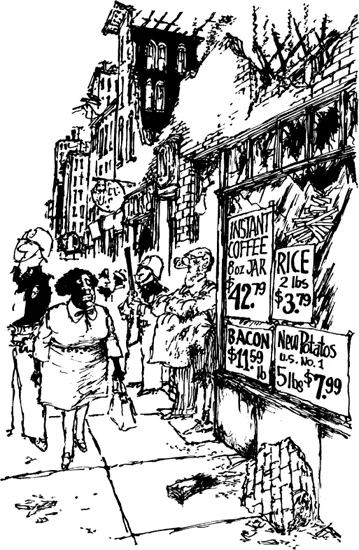
If the tolerance of the ghetto merchants decreases, the equilibrium profit rate will have to rise. If it does not rise, those among the ghetto merchants who have the least capacity to bear the indignities will leave. Competition will decrease, and the remaining merchants will be able to raise their prices and, hence, their profits. This rise in profits will be just enough to compensate the remaining merchants in the face of their heightened sensitivities. The reason, then, that prices are not higher than they are in the ghetto is that these merchants have a great ability to bear the risks, scorn, and abuse.
In the light of this, the ghetto merchant who charges outrageously high prices can be considered a benefactor. For it is his ability to withstand the pressures placed upon him that keeps prices in the ghetto no higher than they are. But for this ability, prices would be even higher.
Another startling aspect should be considered. The villain, if anyone, is not the ghetto merchant whose tolerance for outrages keeps prices down; the villain is, rather, those who heap scorn and abuse upon him and revile him for charging high prices for shoddy merchandise. It is these “nattering nabobs of negativism” who are instrumental in keeping ghetto prices up. It is these grumblers, usually local politicians and community “leaders,” seeking power and a political base, who raise the equilibrium profit differential necessary to keep merchants in the ghetto. If they were to cease their ill-advised condemnations, the nonpecuniary disadvantages of merchandising in the ghetto would diminish along with the equilibrium price differential, and hence, ghetto prices. Paradoxical though it may be, those who are most vociferous in their complaints about the high prices charged by ghetto merchants are actually responsible for keeping those prices higher than they would otherwise be!
This analysis is not restricted to cases in which the ghetto community is Hispanic or black and the merchants are white. For the risks of theft, fire, and damage by vandalism and riots would cause a black or Puerto Rican merchant to charge higher prices too. And the resulting abuse to which he would be subject would drive the prices even higher. If anything, the minority member merchant would have a more painful criticism to bear—the charge that he is a traitor to his ethnic group. The analysis, then, will become even more applicable when and if blacks and Puerto Ricans begin to replace whites as ghetto merchants.
RESTRICTIONS CAN ONLY BE HARMFUL
The effect of a law prohibiting the ghetto merchant from charging higher prices than those charged elsewhere can now be appreciated. It would simply drive merchants out of the ghetto! Higher costs of doing business with no opportunity to recoup them through higher prices, means lower profits. No merchant would voluntarily remain in such a business situation. In fact, merchants will not remain in ghettos unless they can earn a higher profit than can be earned elsewhere, to compensate them for the nonpecuniary disadvantages.
If the prohibition was strictly enforced, virtually all the merchants would leave the ghetto and seek their fortunes elsewhere, with a minute fraction remaining. Customers would then be forced to queue up at whatever shops were available, thereby reducing costs and increasing revenues to the point at which the merchants might be compensated for the higher costs of operating in the ghetto. But this would mean that residents of the ghetto would have to wait in line for long periods of time in order to make a purchase. And it is more than likely that customers would heap even greater abuse upon ghetto merchants for the even poorer service they would be receiving. Such crowds might even prove uncontrollable. In such a situation, the few remaining merchants would be forced to shut down. The citizens of the ghetto, the community “leaders,” pundits, and commentators, would then blame the ghetto merchants for leaving the community.
The departure of the ghetto merchants would cause pain and suffering on a truly monumental scale. Ghetto residents would be compelled to travel great distances to make purchases which were formerly made in their neighborhoods. They would pay slightly lower prices for goods of slightly higher quality, but these gains would be more than counteracted by the increased carfare, and time lost in transit. We know this because these options are always open to ghetto inhabitants. Since local people patronize neighborhood stores presently, they must feel they do better closer to home.
The ghetto dwellers could not even make deals with one another by which some would do the shopping for the rest. This would implicitly convert some of them to ghetto merchants, and the same choice would be open to these new ghetto merchants as were available to the old ones. There is no reason to suppose that they would be oblivious to the financial incentives which would sweep the old ones out of the ghetto. The only reasonable way for ghetto dwellers to handle this unruly situation would be to form a “shopping collective,” with members helping one another in the arduous task of shopping. But to do this would be to revert to a way of life in which food gathering becomes a very time-consuming activity. Instead of developing skills as producers and pulling themselves out of poverty, ghetto dwellers would be reduced to working on collectivist schemes made necessary by the disappearance of the ghetto merchants. The proof that this is an inefficient alternative is that it is not presently used, in the face of competition from the ghetto merchant.
If this came to pass, the “progressive forces” of city planning would undoubtedly come forth with an alternative solution of letting the government take over by nationalizing the (ghetto) merchant business. The logic here defies analysis. For since it is clear that government intervention would create the chaos (by prohibiting price differentials in the ghetto) in the first place, how can the solution lie in still more government intervention?
The first problem with the suggested solution is that it is immoral. It involves forcing everyone to pay for a nationalized food industry whether or not they wish to. It also curtails the freedom of citizens by prohibiting them from entering this industry.
The second problem is pragmatic. Based on the evidence available, such a solution would be unworkable. Up to the present time, all government involvement in the economy has been marked by inefficiency, venality, and corruption, and the evidence suggests that this is not merely accidental.
The inefficiency is easy to explain, and rather widely understood. A government “enterprise” can be expected to be inefficient because it is immune to the selective process of the marketplace. In the market, the entrepreneurs who are most able to satisfy consumer desires reap the greatest profits. Obversely, the entrepreneurs who are least efficient, who provide the fewest satisfactions to consumers, suffer losses. They tend, therefore, to drop out of the market, and make it possible for those most adept at consumer satisfaction to grow and expand. This continual process of the selection of the fittest ensures the efficiency of entrepreneurs. Since the government is immune to it, it fails to regulate governmental economic activity.
The venality and corruption of the government is, if anything, even easier to see. What is difficult, however, is to realize that corruption is a necessary part of governmental operation of business. This is more difficult to comprehend because of our basic assumption about the motivations of those who enter government. We readily concede that people enter business in order to gain money, prestige, or power. These are basic human drives. But when it comes to government, we lose contact with this basic insight. We feel that those who enter government service are “above the fray.” They are “neutral” and “objective.” We may acknowledge that some government officials are venal, corrupt, and profit seeking, but these are considered exceptions to the rule. The basic motive of those in government is, we insist, selfless service to others.
It is time to challenge this erroneous concept. Individuals who enter government are no different from any other group. They are heir to all the temptations that flesh is heir to. We know we can assume self-seeking on the part of businessmen, unionists, and others. It can be assumed just as clearly to be operative in government officials. Not in some of them, but in all of them.
It is hardly necessary to point out the significance of all the government failures in the food area: agricultural subsidies, tariffs, minimum prices, maximum prices, and the “don’t grow on this land” policies. Clearly, these programs are not merely inefficient attempts to provide for the public weal, although they are that. But the giveaways to big-business farmers and the payments for not growing food are also thinly disguised attempts on the part of government-bureaucrats to bilk the public.
If the government became the merchant of the ghetto, the situation would be far worse than that under private ghetto merchants. Both groups are seeking profits. The only difference is that one has the power to compel us to obey; the other does not. The government can compel our patronage; private merchants can only compete for it.
22
THE SPECULATOR
Kill the speculators! is a cry made during every famine that has ever existed. Uttered by demagogues, who think that the speculator causes death through starvation by raising food prices, this cry is fervently supported by the masses of economic illiterates. This kind of thinking, or rather nonthinking, has allowed dictators to impose even the death penalty for traders in food who charge high prices during famines. And without the feeblest of protests from those usually concerned with civil rights and liberties.
Yet the truth of the matter is that far from causing starvation and famines, it is the speculator who prevents them. And far from safeguarding the lives of the people, it is the dictator who must bear the prime responsibility for causing the famine in the first place. Thus, the popular hatred for the speculator is as great a perversion of justice as can be imagined. We can best see this by realizing that the speculator is a person who buys and sells commodities in the hope of making a profit. He is the one who, in the time-honored phrase, tries to “buy low and sell high.”
But, what does buying low, selling high, and making large profits have to do with saving people from starvation? Adam Smith explained it best with the doctrine of “the invisible hand.” According to this doctrine, “every individual endeavors to employ his capital so that its produce may be of the greatest value. He generally neither intends to promote the public interest, nor knows how much he is promoting it. And he intends only his own security, his own gain. He is led in this as if by an invisible hand to promote an end which was no part of his intention. By pursuing his own interest he frequently promotes that of society more effectually than when he really intends to promote it.”1 The successful speculator, therefore, acting in his own selfish interest, neither knowing nor caring about the public good, promotes it.
First, the speculator lessens the effects of famine by storing food in times of plenty, through a motive of personal profit. He buys and stores food against the day when it might be scarce, enabling him to sell at a higher price. The consequences of his activity are far-reaching. They act as a signal to other people in the society, who are encouraged by the speculator’s activity to do likewise. Consumers are encouraged to eat less and save more, importers to import more, farmers to improve their crop yields, builders to erect more storage facilities, and merchants to store more food. Thus, fulfilling the doctrine of the “invisible hand,” the speculator, by his profit-seeking activity, causes more food to be stored during years of plenty than otherwise would have been the case, thereby lessening the effects of the lean years to come.
However, objections will be raised that these good consequences will follow only if the speculator is correct in his assessment of future conditions. What if he is wrong? What if he predicts years of plenty—and by selling, encourages others to do likewise—and lean years follow? In this case, wouldn’t he be responsible for increasing the severity of the famine?
Yes. If the speculator is wrong, he would be responsible for a great deal of harm. But there are powerful forces at work which tend to eliminate incompetent speculators. Thus, the danger they represent and the harm they do are more theoretical than real. The speculator who guesses wrong will suffer severe financial losses. Buying high and selling low may misdirect the economy, but it surely creates havoc with the speculator’s pocketbook. A speculator cannot be expected to have a perfect record of prediction, but if the speculator guesses wrong more often than right, he will tend to lose his stock of capital. Thus he will not remain in a position where he can increase the severity of famines by his errors. The same activity which harms the public automatically harms the speculator, and so prevents him from continuing such activities. Thus at any given time, existing speculators are likely to be very efficient indeed, and, therefore, beneficial to the economy.
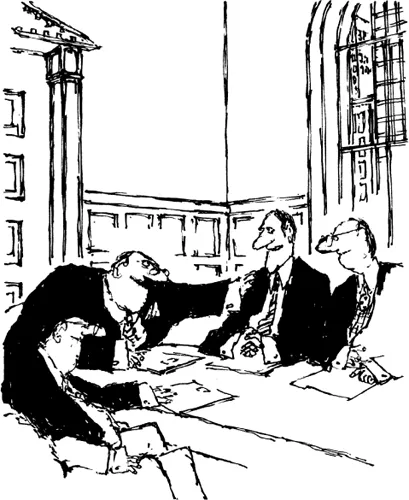
“Excellent idea, Winslow. The rich too must eat in a famine. Along with staples we’ll store up ten thousand tons of gourmet foods.”
Contrast this with the activity of governmental agencies when they assume the speculator’s task of stabilizing the food market. They too try to steer a fine line between storing up too little food and storing up too much. But if they are in error, there is no weeding-out process. The salary of a government employee does not rise and fall with the success of his speculative ventures. Since it is not his own money which will be gained or lost, the care with which bureaucrats can be expected to attend to their speculations leaves much to be desired. There is no automatic, ongoing daily improvement in the accuracy of bureaucrats, as there is for private speculators.
The oft-quoted objection remains that the speculator causes food prices to rise. If his activity is carefully studied, however, it will be seen that the total effect is rather the stabilization of prices.
In times of plenty, when food prices are unusually low, the speculator buys. He takes some of the food off the market, thus causing prices to rise. In the lean years which follow, this stored food goes on the market, thus causing prices to fall. Of course, food will be costly during a famine, and the speculator will sell it for more than his original purchase price. But food will not be as costly as it would have been without his activity! (It should be remembered that the speculator does not cause food shortages which are usually the result of crop failures and other natural or man-made disasters.)
The effect of the speculator on food prices is to level them off. In times of plenty, when food prices are low, the speculator by buying up and storing food causes them to rise. In times of famine, when food prices are high, the speculator sells off and causes prices to fall. The effect on him is to earn profits. This is not villainous; on the contrary, the speculator performs a valuable service.
Yet instead of honoring the speculator, demagogues and their followers revile him. But prohibiting food speculation has the same effect on society as preventing squirrels from storing up nuts for winter—it leads to starvation.
1Adam Smith, An Inquiry into the Nature and Causes of the Wealth of Nations (New York: Random House, 1973), p. 243, paraphrased.
23
THE IMPORTER
The International Ladies’ Garment Workers’ Union (ILGWU) has recently launched an unusual, extensive, and costly advertising campaign. For racist, jingoistic appeal, it is unparalleled. The theme of the campaign is that “foreigners” (dishonest and undeserving) are taking jobs away from Americans (honest, upstanding, and forthright). Perhaps the most famous ad in the series is the one which depicts an American flag above the caption “Made in Japan.” Another presents a picture of a baseball glove, with the caption “The Great Un-American Game.” The accompanying copy explains that baseball gloves and American flags are imported.
The raison d’etre, we are told, for these scathing attacks on imports is that they create unemployment in America. And on a superficial level, the argument seems plausible. After all, every American flag or baseball glove that could have been produced domestically, but was instead imported, represents work that could have been produced by Americans. Certainly, this means less employment for American workers than would otherwise be the case. If the argument was limited to this aspect, the ILGWU’s case for the restriction, if not prohibition of imports, would be well-made.
1. The argument, however, is fallacious, and the consequences to which it logically leads are clearly unsound. The premise which justifies protectionism on the national level also justifies it on the state level. We shall ignore the political impossibility (unconstitutionality) of one state setting up tariffs between it and other states. This is, after all, irrelevant to the economic argument of the antifree trade ILGWU. Theoretically, any one state could justify its policy in exactly the same way that a nation can. For example, the state of Montana could bar imports from other states on the grounds that they represent labor which a Montanan could have been given but was not. A “Buy Montana” program would then be in order. It would be just as illogical and unsound as the ILGWU’s “Buy American” campaign.
The argument, however, does not end at the state level. It can, with equal justification, be applied to cities. Consider the importation of a baseball glove into the city of Billings, Montana. The production of this item could have created employment for an inhabitant of Billings, but it did not. Rather, it created jobs, say, for the citizens of Roundup, Montana, where it was manufactured. The city fathers of Billings could take the ILGWU position and “patriotically” declare a moratorium on trade between the citizens of their city and the foreign economic aggressors in Roundup. This tariff, like those of the larger political subdivisions, would be designed to save the jobs of the citizens.
But there is no logical reason to halt the process at the city level. The ILGWU thesis can be logically extended to neighborhoods in Billings, or to streets within neighborhoods. “Buy Elm Street” or “Stop exporting jobs to Maple Street” could become rallying cries for the protectionists. Likewise, the inhabitants of any one block on Elm Street could turn on their neighbors on another block along the street. And even there the argument would not stop. We would have to conclude that it applies even to individuals. For clearly, every time an individual makes a purchase, he is forgoing the manufacture of it himself. Every time he buys shoes, a pair of pants, a baseball glove, or a flag, he is creating employment opportunities for someone else and, thereby, foreclosing those of his own. Thus the internal logic of the ILGWU’s protectionist argument leads to an insistence upon absolute self-sufficiency, to a total economic interest in forgoing trade with all other people, and self-manufacture of all items necessary for well-being.
Clearly, such a view is absurd. The entire fabric of civilization rests upon mutual support, cooperation, and trade between people. To advocate the cessation of all trade is nonsense, and yet it follows ineluctably from the protectionist position. If the argument for the prohibition of trade at the national level is accepted, there is no logical stopping place at the level of the state, the city, the neighborhood, the street, or the block. The only stopping place is the individual, because the individual is the smallest possible unit. Premises which lead ineluctably to an absurd conclusion are themselves absurd. Thus, however convincing the protectionist argument might seem on the surface, there is something terribly wrong with it.
Specifically, the essence of the fallacy is a misunderstanding of the nature and function of free trade. Trade, we believe, outstrips fire, the wheel, and the opposable thumb in explaining man’s superiority over the animals. For it and it alone makes specialization and the division of labor possible.
In their daily lives people consume virtually hundreds of thousands of different items every year. If not for specialization, each person would be forced to manufacture these items by himself. This would be an impossible task. As a matter of fact, people would not even be able to produce enough food for themselves, let alone produce all other goods which they might desire. Efficient production of food involves the production of many other things, including capital equipment. The production of these things would involve every person in the manufacture of all the items that are now distributed over an entire population. It is quite true that without fire, the wheel, and opposable thumbs, mankind would find itself in a sorry state indeed. But without specialization, since it would be impossible for virtually anyone to even feed himself, everyone would be faced with the prospect of starvation and death.
With specialization, each person can limit his productive efforts to those areas he performs best in. But trade is the linchpin that holds this system together. Without the possibility of trade, people would amass enormous quantities of unusable safety pins, paper clips, or whatever. Without the possibility of trade, the incentive for specialization and the division of labor would be gone. Everyone would be forced back into the suicidal attempt to become self-sufficient.
2. Another significant reason for rejecting the protectionist argument is that it fails to take exports into account. It is true that for every American flag or baseball glove imported into this country, some domestic jobs are lost. But what the protectionists conveniently forget is that for every job lost in a domestic industry because of competition with imports, a job can be gained in an export industry.
Let us assume that the states of Vermont and Florida are self-sufficient. Both produce, among other things, maple syrup and oranges. Because of the differing climatic conditions, maple syrup is scarce and expensive in Florida, and oranges are scarce and expensive in Vermont. Vermont oranges have to be grown in greenhouses, and Florida maple syrup comes from maple trees grown in large refrigerators.
What would happen if trade were suddenly begun between the two states? Vermont would of course begin to import oranges and Florida would import maple syrup. Were the ILGWU, or any other protectionist pressure group on the scene, it would quickly point out that importing maple syrup into Florida would ruin that state’s small maple syrup industry, and the importation of oranges into Vermont would ruin the orange industry there. The protectionists would ignore the fact that jobs would be gained in Florida in the orange industry, and in Vermont, in the maple syrup industry. They would focus our attention on the jobs lost due to imports and would completely ignore the jobs gained because of exports. It is, of course, true that jobs will be lost in Vermont in the orange industry and in the maple syrup industry in Florida. But it is no less true that jobs will increase in the maple syrup industry of Vermont and in the orange industry in Florida.
There may well be fewer jobs available in both industries in both states since orange growing can be done with less manpower in Florida than in Vermont, and maple syrup can be manufactured more efficiently in Vermont than in Florida. But far from being a bad effect, this is one of the gains of trade! The workers freed from these industries become available for projects that could not be undertaken before. For example, if a modern system of transportation did not exist, and industry had to rely on individuals carrying 100 pound loads on their backs, hundreds and thousands of people would have to be withdrawn from other fields to fill the needs of the transport industry. Thus, many projects and industries would have to be abandoned. With modern methods, fewer workers are needed. The extra workers are thus free to move into other areas, with all the consequent benefits to society.
Whether or not there will be fewer jobs in the orange and maple syrup industries in Vermont and Florida in the final analysis depends upon the way the people wish to spend their newfound income. It is only if these people decide to spend all the newfound income on extra oranges and maple syrup that the total employment in these two industries will not change after trade begins. Then the same number of workers will produce more maple syrup and oranges. More likely, though, the people will decide to spend some of their newfound income in these two goods, and the rest on other goods. In that case, employment in these two areas will decrease somewhat (although this decreased workforce may still be able to produce more than before), but employment will increase in the industries whose products are most wanted by the consumers.
Viewed in its totality then, the opening of trade between the two regions benefits both of them. Although employment will fall in the industries supplanted by imports, it will rise in export industries and in the new industries developing because of the availability of workers. But the protectionists are not entirely wrong. Trade does create problems in the industries supplanted and some workers will suffer in the short run. There will, for example, no longer be a brisk demand for Vermonters who specialize in the production of oranges, or for Floridians who produce maple syrup. There will be jobs for these people in other industries, but since they will have to enter these fields as beginners, they will probably have to accept a salary cut. They may also need considerable retraining.
So the question arises: Who is to pay for the retraining, and who is to bear the loss associated with the lower salaries in the new industry? The protectionists, of course, would advocate that the government or the capitalists should pick up the tab. But this is not justified.
First, it should be noted that only skilled workers face a cut in wages because of a move to a new industry. The others will enter the new industry on much the same level as that in which they functioned in the old. Instead of sweeping the floors of a maple syrup plant, they will sweep the floors of perhaps a textile factory. The skilled worker, by contrast, has specific skills which are of greater use in one industry than in another. He is not equally useful in the new industry, and cannot command the same salary.
Second, it should be understood that the skilled worker is an investor, just as the capitalist. The capitalist invests in material things, and the worker invests in his skills. All investors have one thing in common, and that is that the returns on their investment are uncertain. In fact, the greater the risk involved, the more the investor may gain. In the example given, part of the reason skilled orange growers in Vermont and skilled maple syrup producers in Florida were earning high salaries, before the advent of trade between the states, was the risk that some day such trade might begin.
Should the skilled orange growers, now that they must leave the industry in which they were highly paid specialists, be subsidized for retraining and for the salary cuts they must accept in the interim? Or should they bear the expenses and losses themselves? It seems clear that any subsidy would be an attempt to maintain the skilled worker in the style to which he had become accustomed, without asking him to bear any of the risk that made such a high standard of living possible in the first place. In addition, such a subsidy, coming out of tax revenues which are paid mainly by the poor, would constitute a forced subsidy to rich skilled workers from poor, unskilled workers.
3. Now consider a situation which, on the surface, seems to be the protectionist’s nightmare come true. Imagine that there is one country which can outproduce the others in all industries. Suppose Japan (the ILGWU’s bugaboo), can produce everything more efficiently than America—not only flags, baseball gloves, radios, televisions, cars, and tape recorders, but everything. Would the ILGWU’s contention that we should forcibly restrict trade be valid then?
The answer is that it is never justifiable to restrict trade between two consenting adults, or even nations of consenting adults, certainly not on the ground that the trade will harm one of them. For if one party to the trade thought it was harmful, he would simply refuse it. Prohibition would not be needed. And if both parties consent to the trade, what right would any third party have to prohibit it? Prohibition would be tantamount to a denial of the adulthood of one or both of the trading parties, by treating them as juveniles who did not have the sense or the right to enter into contractual obligations.
In spite of all such moral arguments, the protectionists would still want to prohibit trade on the grounds that a disaster would follow if it were not done. Let us trace the situation which would exist between the United States and Japan under the nightmare conditions that have been stipulated. Supposedly, Japan would export goods and services without importing anything from the United States. This would bring prosperity to Japanese industry, and depression to our own. Eventually, Japan would supply all our needs and, as there would be no exports to counterbalance this, American industry would come to a grinding halt. Unemployment would rise to epidemic proportions and there would be a complete dependency on Japan.
This description may sound a bit absurd, yet the history of protectionism in the United States, and the success of the ILGWU campaign, indicate that such “nightmares” have more currency than might be imagined. Perhaps this horrid dream prevails because it is easier to shrink back in horror from it than to confront it head-on.
In contemplating this nightmare, the question arises as to what the Americans will use to buy the Japanese goods with. They cannot use gold (or any of the other precious monetary metals), because gold is itself a commodity. If Americans used gold to pay for the imports they would in effect be exporting gold. This would counter the loss of jobs due to imports, and we would be back to the prototypical situation. Americans might lose jobs in radio and television, but gain them in gold mining. The American economy would resemble that of South Africa, which pays for its imports largely with exports of gold.
The only other means of payment would be in the form of United States dollars. But what would the Japanese do with dollars? There are only three possibilities: they could return these dollars to us as payment for our exports to them, they could keep these dollars, or they could spend them on the produce of countries other than the United States. If they opted for the last alternative, the countries with whom they traded would have the same three options: spending in the United States, hoarding, or spending in other countries, and so on for the countries these nations trade with in turn. If we divide the world into two parts—the United States and all the other countries, we can see that the three possibilities reduce to two: either the paper money we send out comes back to buy our goods or it does not.
Assume that the “worst” possibility happens—that none of the money comes back to stimulate our exports. Far from being a disaster, as the protectionists allege, this would actually be an unmitigated blessing! The paper dollars we would be sending abroad would be just that, paper, worthless paper. And we would not even have to “waste” much paper—we could simply print dollars with extra zeroes added on. So, in this ILGWU nightmare, Japan would be sending us the products of their industry, and we would be sending Japan nothing but pieces of green paper with many zeroes printed on them. It would be a prime example of a giveaway. The refusal of foreigners to cash in their dollars would amount to a large gift to the United States. We would receive the products, and they would receive worthless paper!
Contrary to the fantasies of the ILGWU and other protectionist groups, the recipients of large gifts do not usually suffer untold agonies. Israel has received reparations from Germany for many years, and gifts from the United States, without any obvious deleterious effects. The recipient country does not have to discontinue its own production. For the desires of any populace are infinite. If the Japanese gave a Toyota car to every individual in the United States, they would soon want two, three, or many Toyotas. Clearly, it is inconceivable for the Japanese (or anyone else) to be so self-sacrificing as to even try to satiate all the desires of the American people without recompense. Yet only if they succeeded in this impossible task would domestic industries collapse, because then everyone would have all he wanted of everything.
But in this imaginary case, the collapse of domestic industry would be something to be praised, not condemned. People in the United States would discontinue all production only if they felt they had enough material possessions and would continue to have enough in the future. Such a situation is not only not horrible, it would be welcomed by Americans as the closest thing to a Utopia.
In reality, of course, the Japanese and others would not be content to pile up the dollars we gave them as payment for their products. As soon as their dollar balances went above the level they chose, they would turn the dollars in, thereby stimulating export manufacturing in the United States. They might buy American goods, and thus directly stimulate American exports. Or they might demand gold for their dollars (“attack” the dollar), necessitating a devaluation which would make American exports more competitive in the world markets. Either way, the dollars would come back to the United States, and our domestic export industries would be stimulated. The employment lost due to imports would be countered by increases elsewhere, just as in the Vermont-Florida case.
Why would the Japanese trade with a country whose manufacturing was less efficient than their own? Because of the difference between what is called absolute advantage and comparative advantage. Trade takes place between two parties (countries, states, cities, towns, neighborhoods, streets, persons) not in accordance with their absolute ability to produce, but in accordance with their relative ability. The classical example is that of the best lawyer in town who is also the best typist. This person has an absolute advantage over his secretary in the provision of both legal and typing services. Nevertheless, the lawyer decides to specialize in the profession in which he has a comparative advantage—the law. For suppose he is 100 times as good a lawyer as his secretary, but only twice as efficient a typist. It is more advantageous for him to pursue the legal profession, and to hire (trade with) a typist. The secretary has a comparative advantage in typing: she has only 1 percent of the effectiveness in law, compared to her employer, but she is fully one half as good as he is typing. She is able to earn a living through trade even though she is poorer at both skills.
The Japan we have been imagining has an absolute advantage in the production of all goods. But when the Japanese return our dollars to us in return for our goods, America will export the goods in which it has a comparative advantage. If we are half as good as the Japanese in the production of wheat, but only one quarter as good in the production of radios, we will export wheat in payment for our importation of radios. And we will all gain.
Thus, no matter what situation is envisioned—even the most extreme—the protectionist argument proves inadequate. But because of the emotional potency of its appeal, importers have long been vilified. For their persistence in a task which is inherently helpful, importers should be looked upon as the great benefactors they are.
24
THE MIDDLEMAN
We are told that middlemen are exploitative. Even worse than other profiteers—who at least provide some type of service—the middleman is considered entirely unproductive. He buys a product which someone else has made, and resells it at a higher price, having added nothing whatsoever to it, except the cost to the consumer. If there were no middlemen, goods and services would be cheaper, with no reduction in quantity or quality.
Although this concept is popular and prevalent, it is an incorrect one. It reveals a shocking ignorance of the economic function of middlemen, who do indeed perform a service. If they were eliminated, the whole order of production would be thrown into chaos. Goods and services would be in short supply, if they were available at all, and the money that would have to be spent to obtain them would rise wildly.
The production process of a typical “commodity” consists of raw materials which must be gathered and worked on. Machinery and other factors used in production must be obtained, set up, repaired, etc. When the final product emerges, it must be insured, transported, and kept track of. It must be advertised and retailed. Records must be kept, legal work must be done, and the finances must be in good order.
Production and consumption of our typical commodity could be portrayed in the following manner:
No. 10
9
8
7
6
5
4
3
2
1
Number 10 represents the first stage in the production of our commodity and no. 1 the last stage when the commodity is in the hands of the consumer. Stages no. 2 through no. 9 indicate the intermediate stages of production. All of these are handled by middlemen. For example, no. 4 may be an advertiser, a retailer, wholesaler, jobber, agent, intermediary, financier, assembler, or shipper. No matter what his specific title or function, this middleman buys from no. 5 and resells the product to no. 3. Without specifying, or even knowing exactly what he does, it is obvious that the middleman performs a necessary service in an efficient manner.
If it were not a necessary service, no. 3 would not buy the product from no. 4 at a higher price than that at which he could buy the product from no. 5. If no. 4 were not performing a valuable service, no. 3 would “cut out the middleman” and buy the product directly from no. 5.
So it is apparent that no. 4 is doing an efficient job—at least a more efficient job than no. 3 could do himself. If he were not, no. 3 would again cut out middleman no. 4, and do the job himself.
It is also true that no. 4, although performing a necessary function in an efficient manner, does not overcharge for his efforts. If he did, it would pay for no. 3 to circumvent him, and either take on the task himself, or subcontract it to another middleman. In addition, if no. 4 were earning a higher profit than that earned in the other stages of production, entrepreneurs in the other stages would tend to move into this stage, and drive down the rate of profit until it was equivalent to the profit earned at the other stages (with given risk and uncertainty).
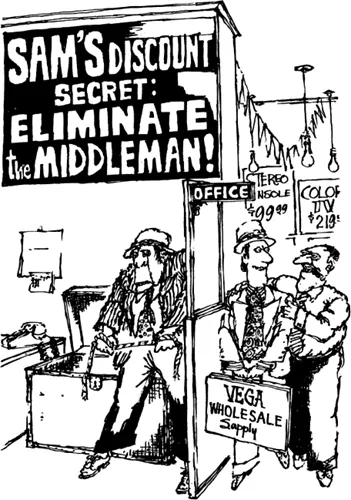
If the no. 4 middleman were eliminated by a legal decree, his job would have to be taken over by the no. 3s, no. 5s, or others, or they would not get done at all. If the no. 3s, or the no. 5s took over the job, the cost of production would rise. The fact that they dealt with no. 4 as long as it was legally possible to do so indicates that they cannot do the job as well—that is, for the same price or less. If the no. 4 stage were completely eliminated, and nobody took over this function, then the process of production would be seriously disrupted at this point.
The present analysis notwithstanding, many people will continue to think that there is something more “pure” and “direct” in exchanges which do not involve a middleman. Perhaps the problems involved with what economists call the “double coincidence of wants” will disabuse them of this view.
Consider the plight of the person who has in his possession a barrel of pickles which he would like to trade for a chicken. He must find someone who has a chicken and would like to trade it for a barrel of pickles. Imagine how rare a coincidence would have to occur for the desires of each of these people to be met. Such a “double coincidence of wants” is so rare, in fact, that both people would naturally gravitate toward an intermediary, if one were available. For example, the chicken-wanting pickle owner could trade his wares to the middleman for a more marketable commodity (gold) and then use the gold to buy a chicken. If he did, it would no longer be necessary for him to find a chicken-owning pickle wanter. Any chicken owner will do, whether he wants pickles or not. Obviously, the trade is vastly simplified by the advent of the middleman. He makes a double coincidence of wants unnecessary. Far from preying on the consumer, it is the middleman who in many instances makes the trade the consumer wishes possible.
Some attacks on the middleman are based on arguments which are represented in the following diagrams. In an earlier time, represented by diagram 1, the price of the good was low, and the share that went to the middleman was low. Then (diagram 2), the share of the value of the final good that went to the middleman rose, and so did the cost of the good. Examples such as these were used to prove that the high prices of meat in the spring of 1973 were due to middlemen. But they prove, if anything, quite the opposite. The share going to the middlemen may have risen, but only because the contributions made by middlemen have also increased! An increased share without an increased contribution would simply raise profits and attract many more entrepreneurs to the area. And their entry would dissipate the profits. So if the share which goes to middlemen rises, it must be because of their productivity.
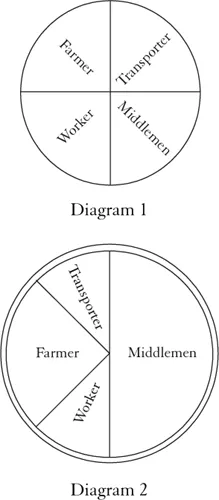
Examples of this phenomenon abound in the annals of business economics. Who can deny that department stores and supermarkets play a greater role (and take a greater share of the market) than middlemen in times past? Yet department stores and supermarkets lead to more efficiency, and lower prices. These new modes of retailing necessitate more expenditures on the middleman phases of production, but greater efficiency leads to lower prices.
25
THE PROFITEER
It is clear that profits and everything associated with them have been under attack for a long time. What is not so clear is the reason for these attacks.
Several different patterns can be discerned. The objection most often made is that profits, unlike other sources of income such as wages, rents, or even interest (payment for waiting risk), are unearned. There is no honest labor or effort associated with profit making to justify the benefits. Most people do not understand the process by which profits are attained, and assume there is something untoward going on. . . . “It isn’t fair to make profits without having to work for them.”
Another objection often voiced against profits, and especially against profiteering (unreasonable profits), is that such profits impoverish the rest of mankind. The notion is that there is only a finite amount of wealth available and if the profiteers get more of it, there is less for everyone else. Thus, not only are profits “undeserved” because they are “unearned,” but they actually harm people by diverting funds from the rest of society.
It also appears to many that profits are earned by taking advantage of the helplessness of others. This view constitutes a third type of objection, and is reflected in the scornful popular expression that profiteers earn their income “from the misery of others.” When the “helplessness” consists of a lack of knowledge, the critics of profits are especially vociferous in their condemnation. For example, the case where a profit is earned solely because the customer is unaware that the same commodity is being sold close by at a lower price, is particularly vexing. When the customer is poor, the profiteer is even more condemned.
The usual defenses of the idea and practice of earning a profit leave a great deal to be desired. They have in the past been limited to pointing out: (1) profits are patriotic, and that to attack them is un-American or perhaps communistic; (2) they are not very big, anyway; and (3) they are used, in many cases, for charitable contributions. Needless to say, these are not very formidable defenses. Consideration must be given to the function of profits in a modern economy, and an effort made to provide a somewhat more spirited defense for the ancient and honorable vocation of profiteering.
First, profits are earned by entrepreneurs who see and seize upon opportunities which are not readily apparent to other people. The opportunity grasped by the entrepreneur may vary from case to case, but in all cases people are offered trades which they hold to be in their advantage, and which would not be offered in the absence of the entrepreneur. In the most usual case, the entrepreneur sees a discrepancy between different prices—strawberries selling at 25¢ per jar in New Jersey, and 45¢ in New York. As long as the costs associated with the transport of strawberries (transportation, insurance, storage, breakage, spoilage, etc.) are less than the price differential of 20¢ per jar, the enterprising entrepreneur is in a position to offer two sets of trades. He can offer to buy strawberries in New Jersey at a price slightly higher than the prevailing 25¢ per jar, and then offer to sell strawberries to New Yorkers at a price below the 45¢ per jar that prevails in that market. In both cases, if he finds any takers, he will benefit those he deals with, either by offering a higher price for their goods than they have been accustomed to receiving, or by offering to sell them goods at a lower price than they are accustomed to paying.
In addition to the intratemporal price discrepancy case, there is the intertemporal case, where a price discrepancy between present goods and future goods is perceived. Take frisbees as an example. Consider all the factors of production—land, labor, and capital—which are embodied in the final good of the frisbees offered for sale. The factors of production are goods of a sort themselves, and, therefore, have prices attached to them. After taking due account of the time it will take to convert these factors into the final good, three possibilities emerge: (1) there is no price discrepancy between the prices of the factors and the price of the future good; (2) there is a discrepancy, and the factor prices are high, relative to the price of the good; and (3) there is a discrepancy, and the price of the final good is high relative to the prices of the factors.
If there is no price discrepancy, the successful entrepreneur will not act. But if the factor prices are relatively high, the entrepreneur will withdraw from production. It would be wasteful to devote relatively valuable resources on a final good that will be relatively valueless. He might sell his shares in the companies which engage in such production. Or, if he does not hold shares, he can contract to sell them in the future at their present high price (which does not yet reflect the production error of manufacturing frisbees with resources that are more valuable than the frisbees themselves will be). He can cover these sales by purchases of the same amount of shares in the future, when he expects their value to be lower, because of the production error. There are many people who are mystified by this process, often called “selling short.” They wonder how it is possible to sell something that you do not own, in the future, but at today’s prices. Strictly speaking, one cannot sell anything that one does not own. But it is certainly possible to promise to sell something in the future that one does not yet own, on the understanding that one can always buy it in the future, and then deliver it, in fulfillment of the sales contract. In order to test the understanding of this concept, we can ask who would agree to buy shares in the future at the present price? People who expect the price to rise even further, but do not want to invest their money now.
If, on the other hand, the entrepreneur thinks that the price of the final good is likely to be greater than the combined costs of all the factors, he will engage in the opposite behavior. He will produce the frisbees and/or invest in companies which undertake such production.
The third type of hidden opportunity which the entrepreneur can seize upon does not involve any price discrepancies, either inter- or intratemporal. This type of opportunity involves goods that have not yet been produced, and therefore have no prices at all. Consider in this regard the frisbee before it was produced or invented. There was no guarantee, at that time, that the public would accept it. In cases of this kind, the entrepreneur feels, thinks, or divines that there is something, the lack of which may not even be apparent to anyone else, that consumers would greatly value if they could but be told of its existence and convinced of its beneficial attributes. In this case the entrepreneur plays nursemaid to the idea, through the processes of invention, financing, advertising, and all other steps necessary to bring an idea to public acceptance.
After having considered some of the types of activities profit making entrepreneurs are likely to engage in, the results of profit seeking can be assessed.
One result is immediately apparent—the collection and dissemination of knowledge. The knowledge of hitherto unproduced products is an obvious and dramatic example, but as we have seen, the knowledge engendered by profit seeking behavior is by no means limited to such exotic occurrences. On a daily basis, the profit seeker is constantly bringing to the market knowledge about price differentials, both inter- and intratemporal.
This knowledge is of great benefit to all concerned. Without it, people in New Jersey would be eating strawberries which they would much rather sell, if they could find someone willing to pay more than 25¢ per jar. That is, the New Jerseyans only eat the berries because of their lack of knowledge of people who value them more than they themselves. In addition, without this knowledge, there would be people in New York not eating strawberries because they assume that the only way to get them is to pay 45¢ a jar, when in truth, they could be had for less.
Of course, the profit seeker does not bring this knowledge to bear as a teacher might. He is not one who goes about the countryside explicitly imparting information. As a matter of fact, after his work is done, none of the people in New Jersey and New York may even be aware of the relative prices of strawberries in those markets. What the profit seeker does is make sure that the effects of knowledge of prices in the different areas are felt. The profit seeker does not directly spread the knowledge himself; he merely spreads the strawberries which, in the absence of knowledge of their prices, would not have been so allocated.
It is perfectly true then, that the profit maker takes advantage of the ignorance of other people. If the relevant knowledge were present, the entrepreneur could hardly earn profits by shipping strawberries from New Jersey to New York. Although true, however, it is hardly reprehensible. Anyone whose function it is to sell a commodity must sell it to those who lack it. The fact that the lack is determined by ignorance does not make the lack—or the need—any less real. The profit seeker “takes advantage” of the lack of knowledge of his customers in the same way that the farmer “takes advantage” of the hunger of his customer—by providing that which his customer lacks.
The profits of the entrepreneur, therefore, are not made at the expense of anyone else. It is not true that there must be losses elsewhere in the economy equal to the gains of the entrepreneur, because it is not true that the entrepreneur fails to create anything. The entrepreneur does create. He creates the possibility of cooperation between disparate, and in many cases widely separated, groups. He is a broker or intermediary in opportunities, as it were. It is his function to see to it that mutually beneficial opportunities are not bypassed. Why this type of effort should be singled out and denigrated as “not honest work” is beyond the scope of reason.
In addition to serving as a focal point for the utilization of knowledge, the profit seeking entrepreneur benefits people by offering them choices otherwise not open to them. The case in which the entrepreneur presents the public with an entirely new product is again an obvious example. But the principle has applications even in the more mundane case of intertemporal price discrepancies. For society benefits when valuable resources are not committed to final products which are less valuable than the resources themselves. Such resources can be used in the production of more valuable final products, that is to say, in the production of final products which consumers value more.
“Ah! I suspected as much. He’s a masochist!”
It should be borne in mind that all entrepreneurial transactions are strictly voluntary. The people with whom the entrepreneur deals are just as free to reject as to accept his offers. If they accept, therefore, it can only be because they feel that they benefit from trading with him. They may rue their decision, and wish they had made their purchase at a lower price, or sold their goods at a higher price. But this does not alter the claim that the profit seeking entrepreneur offers a trade which, at the time it is offered, is considered beneficial by all the parties to it. This is an important claim, and it speaks well for the entrepreneur. It is a claim which cannot, for example, be made on behalf of government transactions because they cannot be said to be fully voluntary.
Another result of the profit making process is that after it is undergone in any given market, there is less scope for its continuation. Its success sows the seeds for its demise. Once the opportunity has been pointed out and fulfilled by the entrepreneur, his function is completed. Like the Lone Ranger of a bygone era, the “lone entrepreneur” must move on to make other pastures greener. However, if imbalances in prices should arise shortly thereafter, the profit seeker will return.
The incentive behind the entrepreneur’s attempt to hold together the disparate parts of the economy is, of course, the profits he hopes to gain thereby. This is an excellent example of the beneficial effects of a profit and loss system. For the successful entrepreneur—the one who earns profits—holds the economy together by decreasing price discrepancies. But the entrepreneur who buys when he should sell, or sells when he should buy (who instead of decreasing price discrepancies and holding the economy together, increases them and disrupts the economy), loses money. The more mistakes he makes, the less able he is to continue in his error. We cannot hope to completely rid the economy of errors. But a mechanism that automatically tends to improve the performance of the entrepreneurial class at every given instant is not to be dismissed lightly.
Although a case has been made for the beneficial effects of profits, profiteering has not been mentioned. It is important to do so, for there are many who would contend, in the spirit of the Aristotelian “golden mean,” that profits in moderation are acceptable, perhaps even beneficial, but that the extremism of profiteering can only be deleterious.
The word “profiteering” has always been used in a smear context. “Profits” plus “I hate the son of a bitch” equals “profiteering” in the same way that “firmness” plus “I think he is wrong” equals “stubbornness.” (Bertrand Russell has said, to illustrate this point, “I’m firm, you’re stubborn, and he’s a pigheaded son of a bitch.”) We do not have an equivalent term of opprobrium for the wage earner (wageer?) who seeks “exorbitant” or “unconscionable” wage rates. Perhaps because “public opinion” (the mass media establishment) favors high wages but not high profits.
Semantics aside, it would appear that if profits are a benefit to our society, then profiteering is of even greater benefit. The possibility of profits, as has been demonstrated, is a sign that something is amiss in the economy, indicating that people are not taking advantage of mutually beneficial trades. The actualization of profits indicates that something is being done about these missed opportunities (entrepreneurs are seeing to it that “the strawberries get properly spread around.” But if the possibility of profits indicates something amiss, then the possibility of profiteering signifies even greater gaps in the economic fabric. And if mere profits indicate an economic cure in progress, then profiteering is a sign that something of a substantial magnitude is operating to rectify the situation. Instead of moderate profits being acceptable, and profiteering being “exploitative,” we can see that the greater the profits, and the greater the profiteering, the better off the economy is. A medical analogy comes to mind: If Band-Aids are “good” because the body can be cared for by them, then surgery (“profiteering”) is better, because it shows that a much more needy patient is being cared for.
The most important defense of profit making is based on political freedom:
There are basically only two ways to run an economy. The first, voluntaristically, with decentralism and reliance on the price and profit-and-loss system to provide information and incentive. The second, compulsorily, with central planning, economic orders and directives, reliance on the initiative of the economic dictators, and the obedience of everyone else. These two systems are the two polar extremes. All other economic systems are permutations and combinations of these two “pure” types.
The compulsory or command economy is simplicity itself in outlook. The economic leaders simply decide what is to be produced, who is to produce it and how, and who is to reap the benefits of such production.
By contrast, the voluntary or free market economy is quite complex. The individual must decide what to produce and how to produce it. The incentive is his own enjoyment of the product and what he may get for it by trading it with other people. Instead of being coordinated by economic directives, the freemarket economy, as we have seen, is coordinated by the profit-and-loss mechanism.
Now consider this paradox: Those who are frequently the most virulent critics of “profiteers” and, by extension, of the whole free market system, are frequently also vociferous champions of decentralism and the rights of the individual in personal matters. Yet, insofar as they attack “profits” and “profiteering,” they are attacking not only the right of individuals to function freely in the economic domain, but the very foundation for freedom in every other area of human life.
In their attacks on profits and profiteering—indeed on all things “profitable”—they show themselves to be in league with despots and dictators.
If they were to have their way, and profits were severely restricted or outlawed entirely, coercive collectivism would be to that degree strengthened. Personal liberties would be washed away in a tide of orders from the top. The individual cannot be free if his economic existence is based on the decree of an economic dictator from whose dictates there is no appeal. In a free market, if you quit your job, an employee leaves your service, a customer refuses to buy from you, or a supplier refuses to sell to you, there are other actual or potential bosses, employees, customers or suppliers. But in a controlled economy, there are no other alternatives. Deviations, eccentricities or nonorthodox inclinations are not tolerated.
The champions of civil liberties have a uniquely brilliant insight, and a truly humane dictum which they apply assiduously in the area of sexual morality—"Anything goes between consenting adults, and (implicitly), nothing goes but that which is between consenting adults.” But they steadfastly refuse to apply this rule to any area other than that of sexual morality! Specifically, they refuse to apply it to the economic arena. But this humane dictum should be applied to all parts of human life, including the profiteer as well as the sexual pervert or deviant; to the entrepreneur as well as the fetishist; to the speculator as well as the sado-masochist.
To argue that perverts, deviants, and others of this ilk have been unjustly denigrated is one of the main burdens of this book. We cannot, therefore, be accused of having played fast and loose with the deviant community. But it is just as unfair to treat members of the profiteering community as pariahs.
One last criticism of profiteering and the free market is the view that in the distant past, when there was an agrarian economy and “life was simpler,” perhaps a free enterprise system was viable. Today, what might have been appropriate for farmers and small tradesmen simply will not do. In our complex industrial society, we cannot afford to leave things to the anachronistic whims of individuals. We need the strong central control of an economic planning board, and the elimination of profits and profiteering from our transactions.
This view is widespread. In some circles it is thought to be “self-evident.” But the analysis of profits as intimately tied up with a lack of knowledge must lead to the opposite view. The institution of profits is an invaluable aid in the gathering and dissemination of knowledge and the effects of knowledge. If anything can be taken as a mark of “a highly complex modern, nonagrarian economy,” it is this selfsame lack of economic knowledge and the utilization of it. It would, therefore, seem to follow that the profit system becomes more valuable as the economy becomes more complex! For in such an economy, the information provided by the automatic price and profit and loss system is essential. Economic dictatorship, if it is ever viable, which it is not, is so only in a simple economy, one which can be easily managed by one group of bureaucrats.
In conclusion, a sharp, rigid, and basic distinction must be drawn between the profits that can be earned in the marketplace, and the profits that can be “earned” through government subsidies and influence, in short, through the system of corporate-state capitalism. In the marketplace, all transfers of funds must be voluntary. Therefore, all profits must be based on the voluntary choices of the economic actors, and must hence be indicative of, and bring about solutions for, the wants of the economy. Thus, the assertion that the possibility of profits shows the scope of unrequited trades and that the actual earning of profits indicates that these gaps are being filled, applies only to the free-market economy.
These assertions cannot be made in the absence of the free market. Profits in the “mixed” economy (an economy that has elements of the free market as well as elements of coercion) might well be due to no more than the prohibition of competition. For example, a tariff on imports will increase the demand for the domestic product, and profits in the domestic industry will rise. But it can hardly be concluded from this that any new information was uncovered, or that consumer satisfaction was in any way increased. If anything, the opposite would be the case. The tie between profits and well-being is thus sundered and we can no longer infer the latter from the former.
Defending the Undefendable
Read the whole book online · Book details
This work is published under a Creative Commons licence. You may copy, share, and re-host it with attribution.