
Chapter 11 of 13 · Defending the Undefendable by Walter Block
VII. ECOLOGY 26 THE STRIPMINER
There are basically two methods of mining coal: strip mining and deep mining. In deep mining, an intricate set of tunnels, shafts, and braces are set deep in the earth. People who work in such mines for long periods of time commonly contract “black lung disease,” the dreaded miner’s malady caused by breathing in coal particles. Deep mining is hazardous to workers in other ways. Mine entrapments, for example, in which hundreds of miners are trapped far below the surface of the earth, occur with deadly regularity. The immediate cause may be a cave-in, escaping gas, an explosion, or water seepage, but the ultimate cause is the deep-mining method itself.
In strip mining, as the name implies, the earth is stripped, layer by layer, until the coal stream is unearthed. Although especially well suited for coal beds that lie close to the surface, strip mining has also proven feasible at moderate depths. Strip mining is free of the danger of cave-ins, and other forms of entrapment, and of black lung disease. It is also a much cheaper method than deep mining. In spite of these advantages, strip mining has been roundly condemned by practically all sources of “informed,” “liberal,” and “progressive” opinion.
The supposed explanation for this otherwise inexplicable state of affairs centers around two criticisms of strip mining: it is said to cause pollution, and to despoil the natural beauty of the landscape. But as can be seen from even a cursory examination, these criticisms hardly suffice. Even if they were correct, it would be difficult to reconcile humanistic impulses with a preference for deep mining. For there is no black lung disease among miners who work on the surface of the earth; there is no danger of cave-ins or entrapment. Clearly, life is on the side of strip mining.
But, upon examination, it is clear that the criticism is by no means correct. First consider pollution. Although it is true that pollution does in fact result from strip mining, it is not a necessary concomitant. It can be eliminated, and it would be eliminated, if laws prohibiting trespass were enforced.
What is presently done during the strip mining of coal is to pile up in high mounds the earth that must be peeled away to expose the coal. These mounds are usually piled near streams of water. Substantial amounts are borne away by the streams, contaminating them and the lakes and waterways into which they feed. Also, the denuded land becomes a source of mudslides; thus, as a result of what the strip miner does, the whole environment is damaged.
But these are not necessary elements of the strip mining process. Although a person may do whatever he wishes with land that he owns, if what he does damages land belonging to others, he should be made to bear the costs of the damage. If, for example, the strip miner’s activities result in mudslides and destruction of other people’s land and goods, he is liable. Part of his responsibility may be to reseed or otherwise rehabilitate the land to eliminate the possibility of future mudslides. If strip miners were made to bear the full costs of their activity, and if the property owners downstream were granted preventative injunctions if they were unwilling to be compensated for damages, then the pollution would cease.
It is most important to see that the present link between pollution and strip mining has no inherent status, but is rather entirely due to the failure to apply the common laws of trespass against the strip miners. Imagine any other industry, such as the hula hoop industry, that was allowed to violate the law in this manner. Now there is no necessary connection between the hula hoop industry and pollution. But if excess plastic clutter were allowed, there soon would be a connection between this industry and pollution, at least in the mind of the public. And so it is with the coal mining industry, and with strip mining in particular. There is nothing about the strip mining method of coal mining that is inherently pollution-causing. It is only because the laws of trespass have not been rigidly applied to the strip miners that the link between stripping and pollution exists. Let these laws be fully adhered to and this argument against strip mining will disappear.
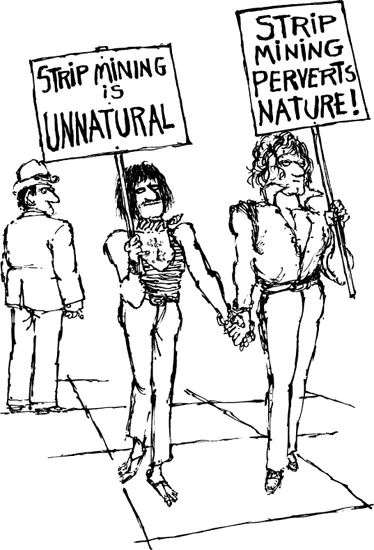
What of the other argument against the strip miner: that stripping spoils the natural beauty of the landscape? This is a shaky objection at best because, when it comes to beauty or aesthetics, there are no objective standards. What is beautiful to one person may be ugly to another and vice versa. It is true that strip mining removes the vegetation, grass, and trees from the landscape. It can turn a lush, fertile landscape into a veritable desert. But some people prefer the desolation and emptiness of the desert! The Painted Desert in Arizona, the salt flats of Utah, and the Grand Canyon of Colorado are considered by many people to be places of great beauty.
If contrast is one of the concomitants of natural beauty, then the small bits of barren land created by strip miners amidst the lush greenery of the Appalachians actually add to the beauty of the scene. Certainly we cannot unambiguously and objectively fault the strip miner on the grounds that he destroys the beauty of the landscape.
But discussions about aesthetic criteria will not resolve the issue raised by the critics, since the issue is not really about beauty, though it is phrased as if it were. The real objection seems to be that strip mining is an intrusion upon nature by an offensive industrial society. The notion that land areas should be left in their “natural state” seems to be the operative one. But if the lovers and protectors of “nature as-is” have the right to prevent strip miners from operating, then they also have the right to prevent farmers from clearing virgin soil and planting upon it, and to prevent builders from erecting buildings, bridges, factories, airports, and hospitals. The “argument from nature” is really an argument against civilization and against the use of human intelligence.
Actually, many among those who condemn strip mining as “unnatural” would themselves object vigorously if other conditions—homosexuality or miscegenation, for example—were objected to on those grounds. They would point out very little is “natural” to man, and that sometimes what is natural—murderous rage, for example—is not what is best. Civilization depends to a great extent upon our being able to transcend nature.
To say of a thing that it is “natural” or “unnatural” is not to say anything about that thing’s intrinsic value. A thing’s value depends upon whether or not it satisfies our needs, and contributes to our well-being. Strip mining, when evaluated rationally, fulfills these more rational criteria.
27
THE LITTERER
The litterer today will find few defenders. He is beset on all sides, bearing the brunt of the barbs of do-gooder groups. Radio and television stations beam anti-litter messages as a “public service,” neighborhood and parent-teacher associations, church groups, and civic organizations are in agreement on the issue of littering. The film industry, which must pass over many topics as too controversial, is united in its hatred for litter. Litter is a great unifier.
There is, however, one small, seemingly insignificant detail which destroys the case against litter and the litterer. Litter can only take place in the public domain, never in the private domain. The ads showing the supposed evils of litter take place on highways, beaches, streets, parks, subways, or public bathrooms—all public areas. This is not because most littering occurs in public places. It is definitional. If something resembling littering in all other aspects were to occur in a private place, it would not be considered littering. When large crowds leave a ballpark, movie, theater, concert, or circus, what remains among the seats and aisles is not and cannot be litter. It is garbage, dirt, or waste, but not litter. After normal working hours in the downtown area of our cities, a horde of cleaners descend upon the privately owned banks, stores, restaurants, office buildings, factories, etc. What they do is clean, and under no circumstances do they pick up litter. Concurrent with this, the department of sanitation cleans the public streets and sidewalks, picking up litter.
Now there is no real distinction to be drawn between leaving garbage in public places and leaving garbage in private places. There is no reason to call the former and not the latter “littering,” since what is being done in both cases is the same. In both cases, the creation of garbage is a concomitant of the process of producing or of consuming.
In some instances, leaving garbage to be picked up later is the optimal solution. For example, it is too time-consuming for a carpenter to clean up the wood shavings as he works. It is easier and cheaper to allow the “litter” (wood shavings) to accumulate and be swept away at the end of the day or at periodic intervals. The factory manager could institute an anti-“litter” campaign and force the carpenters to keep their work area free of any accumulation of wood shavings. He might even enforce this edict with the threat of a $50 fine. However, with these rules his workforce might quit, or, if they did not quit, the costs of production would rise inordinately, and he would lose business to competitive factories.
In the medical practice, on the other hand, littering cannot be tolerated. Operating, consulting, or treatment rooms must be sanitary, well-scrubbed and free of debris. Failure to adopt a strong anti-litter campaign here would involve the administrator of the hospital in financial failure, as it became known that his institution was unsanitary.
In the case of consumption, most restaurants, for example, do not pursue anti-litter campaigns. There are no signs on restaurant walls forbidding the dropping of forks, napkins, or bread crumbs. A restaurant could prohibit litter, but it would lose its customers to other establishments.
What these seemingly disparate examples have in common is to illustrate that in the market, the decision of whether and how much litter to allow is based ultimately on the wishes and desires of the consumers! The question is not treated simplistically and there is no general outcry to “get rid of litterbugs.” There is rather, a careful weighing of the costs and benefits of allowing waste materials to accumulate. To the extent that the costs of garbage collection are low and the harm caused by garbage accumulating is high, there tend to be frequent collections and severe penalties for leaving garbage around, as in the example given of littering in a medical facility. If the costs of garbage collection are high and the harm caused by the accumulation is low, there tend to be less frequent collections and no penalties for littering. These differences in policy are not the result of any governmental law, but are a result of the market process. Entrepreneurs who do not act in accordance with an accurate cost-benefit analysis lose customers, either directly, as customers stalk out in anger, or indirectly, as the higher costs of operation allow the competition price advantages.
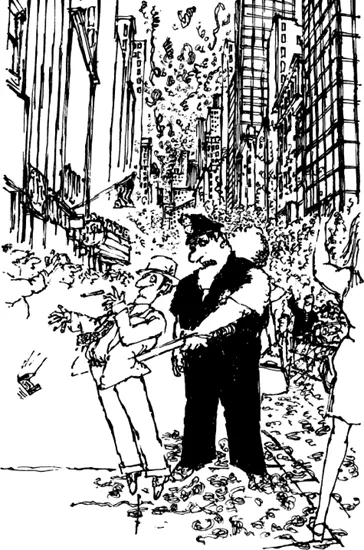
“Hey, Bozo, you want a citation for litterin’? Pick up that matchbook cover!”
A system which is based on the needs and desires of the people involved is very flexible. In each example, a policy on littering was tailored to the requirements of the specific situation. Moreover, such a system is capable of responding quickly to changes, whether they be in the costs of litter collection or in the harm caused by uncollected litter. If, for instance, a system were installed in hospitals enabling litter to be taken out at very little cost, or if consumer desires regarding litter underwent a marked change, hospital administrators would have to relax their stringent anti-litter stance. The hospitals which failed to adjust to the new technology and tastes would tend to lose patients to competing institutions. (These are private, profit making hospitals. Public hospitals, which obtain their funds through compulsory taxation, have no such incentives to please customers.)
On the other hand, if it were discovered that soda cans and popcorn boxes, left under the seats at baseball stadiums, were disease carriers, or interfered with the viewing of the game, the stadium rules concerning litter would be changed automatically by stadium owners, without any government edict.
In considering litter in the public domain, there is no finely attuned system responding to the needs and desires of the people. Rather, the public domain is the ward of the government, and the government treats consumer demands in a rather cavalier manner, virtually ignoring them. Government enterprise is the only enterprise that will deal with an increased desire to litter with a steadfast determination to eliminate it, thereby refusing to adapt to either consumer desires or changing technology.1 The law is the law. The government can function this way because it is outside the market. It does not obtain its revenues from the market process of voluntary trade. It obtains its revenues through taxation, a process completely unrelated to its ability to satisfy customers.
The governmental argument against litter is that it is done out of disrespect for others’ rights. But this argument is without merit. The whole concept of private litter is a case in point. If litter were a violation of rights and a refusal to consider the comfort of others, what of the “litter” in restaurants, ballparks, factories, etc.? Litter comes about in the private market precisely as a means of satisfying the desires of consumers for comfort. One no more violates the restaurant owner’s rights by littering than by eating, since both are paid for.
How is the government’s failure to maintain a flexible litterbug policy in the public sector to be interpreted? It is not entirely due to indifference, although it is far simpler to totally prohibit something than to deal with it in a reasonable manner. The explanation is that no government, no matter how interested or beneficent, could maintain a flexible litterbug policy. Such a policy must be supported by a price system—a profit and loss system—to measure the cost and benefits of littering, and to automatically penalize managers who failed to adjust accordingly. If the government enacted a system of this type, it would no longer be a governmental system, for it could not rely on the bête noir of government—a tax system completely unrelated to success in satisfying the wants of consumers.
The inability of the government to be flexible can occasionally take strange turns. For many years there was no effective restriction in New York City of dog owners who allowed their dogs to defecate on the streets and sidewalks. Presently there is a movement afoot to prohibit dog defecation on any street or sidewalk, launched by citizens’ groups organized under the banner of “children before dogs.” The flexibility of the market is completely ignored by both of these factions. Nowhere is it realized that dog “litter” can be restricted to certain places. The issue is seen as a choice between prohibiting it altogether or allowing it everywhere. Imagine the beneficent results that would ensue if the streets and sidewalks were privately owned. A greater flexibility would result because of the rewards entrepreneurs would gain for devising methods of satisfying both groups.
Some might object to the private ownership of the sidewalks on the grounds that dog owners would have to pay for the use of a “dog lot” which they now use free (assuming, there is no prohibition of dog defecation). But this is incorrect, because no individual, including the dog owner, has the free use of the sidewalks. The sidewalks, as all other goods and services provided by the government, are paid for by the citizens through taxes! Citizens pay not only for the original cost of the sidewalks, but also for upkeep, maintenance, policing, and cleaning services.
It is difficult to anticipate the exact way a free market would function in this area, but some guesses may be hazarded. Perhaps several enterprising entrepreneurs could set up fenced-in sandy areas which dogs could use. These entrepreneurs could have two separate contracts, one, with the dog owners, which would specify the fee for use of the area, the other with garbage truck owners, specifying the cost of maintaining the areas. The exact location and number of these areas would, as with any service, be determined by the needs of the people involved.
In the light of the inflexibility of the government, and its apparent lack of interest in accommodating public tastes, how is the litterbug to be viewed? The litterbug treats public property in much the same way he would treat private property if he were but free to. Namely, he leaves garbage around on it. It has been demonstrated that there is nothing intrinsically evil about this activity, and that but for governmental calcification, it would be as widely accepted in the public arena as it is in the private. It is an activity which should be regulated by people’s needs, not by government fiat.
We must conclude, therefore, that far from being a public enemy, the litterer is actually a hero. The courage exhibited by the litterer, given the intense campaign of vilification directed against him, is considerable. Even more important, the behavior of the litterer who purposefully “takes the law into his own hands” can serve as a protest against an unjust system.
1Only a nonprofit government agency could react to increased consumer desires for road use (traffic tie-ups) with a threat to ban cars. Only a government agency free from the necessity of earning profits could react to increased consumer desires for park use by forbidding people to enter parks after dark.
28
THE WASTEMAKERS
People have long suspected that a basic business practice is to purposely manufacture products which are inferior. Businessmen, it is assumed, do not want to turn out high-quality, long lasting products. Instead, they manufacture shoddy products with “built-in” or “planned” obsolescence. When these products wear out, they must be replaced, thus manufacturers stay in business and prosper. This idea, always with us even if somewhat below the surface, received an unneeded, but widely publicized shot in the arm several years ago with the publication of Vance Packard’s book, Waste Makers.1
The theory of “built-in” obsolescence is fallacious. And, with the advent of the ecology movement and the neo-Malthusian Zero Population Growth adherents, it is more important than ever to lay the fallacy to rest. According to the overpopulationists, we have or are soon going to have too many people in relation to the earth’s resources. In the view of the environmentalists, we are (that is, the free-market system is) presently wasting the resources we have. In the view of still others, built-in obsolescence is a tragic, totally unnecessary component of this waste. Taken together, these groups pose an intellectual, moral, and even physical threat to a healthy and sane economy.
It is important to begin this critique by noting a truism. Either it costs more to build a product in the “proper” way, so that it does not wear out “before its time,” or it does not. A product is shoddy because the manufacturer instructs the workers to turn out inferior merchandise, or because it is cheaper to make it that way.
A true example of built-in obsolescence is the case where no cost saving is gained by making an inferior product. It is as if a time bomb were placed in an otherwise sound piece of merchandise. The consumer does not know it, but the object is scheduled to “self-destruct.” This practice clearly is wasteful. In economic parlance, society is forgoing higher quality goods which have no alternative uses.
Such behavior, however, will not take place in a private enterprise market economy because it is not survival oriented. Businessmen who engage in planned obsolescence of this sort will decrease their profits, increase their losses, and eventually go bankrupt. Some customers will surely stop buying from a firm which sells inferior quality merchandise at standard prices, and patronize other firms which sell standard quality merchandise at the same standard prices. The firm in question will lose customers, without any compensation in the form of lower costs, and the other firms will gain the customers lost by the wastemaking company.
But the fear which many consumers have is not that one businessman will manufacture products with built-in obsolescence, but that all manufacturers will. In that case, it is supposed, the consumer would be trapped.
What would the consequences be if all the manufacturers in an industry agreed, via a cartel arrangement, to turn out low-quality products in order to increase replacement sales? It seems clear that every manufacturer who was a party to the agreement would be powerfully tempted to raise the quality of the goods he was making—in other words, to cheat on the agreement. Because if all the others were turning out products of the same poor quality (as they agreed to do) and he made products which were only slightly better, he would gain customers and increase his profits. Given the profit motive (which was the incentive for the cartel) the members are not likely to honor the agreement.
Second, there will be great temptations for businessmen outside the cartel agreement to enter the industry. By turning out products even slightly better than those turned out by the cartel manufacturers, they will attract customers and profits.
Paradoxically, the forces tending to break up the cartel would become stronger as the cartel became more successful. For the stronger the cartel, the greater the decrease in the quality of the product. The lower the quality, the easier it would become to attract competitors’ customers. Even a slight increase in quality would accomplish this.
Advertising also hastens the process of breaking up cartels which try to restrict quality. In fact, advertising tends to prevent their formation in the first place. Advertising builds up brand names with attached good will. The brand name stands for a certain level of quality. If a firm allows the quality of its product to deteriorate, it loses the good will it has spent millions attaining.
Independent rating agencies like Consumers Union also tend to prevent cartels from forming, and to break them up if they do occur. By keeping strict tabs on the quality of merchandise, such rating agencies keep the public apprised of even slight deteriorations of quality.
Finally, even if all members maintain the agreement, and no outsiders step in, the restriction on quality is still more likely to fail than to succeed. For it is impossible for all manufacturers to restrict quality to exactly the same degree. The ones who restrict quality least will inevitably gain better reputations, more customers, and increased profits. The market will continue to be a testing ground, weeding out companies which produce inferior goods. Failing the test means bankruptcy; passing the test means survival.
It seems clear then, that in a free market, cartels cannot be maintained. But they can be maintained, and built-in obsolescence with them, if the government steps in. For example, when the government sets up guild-like restrictions on entry into an industry, cartels are encouraged because competition is discouraged. Thus the interests of those already in the field are protected. Whatever agreements they may have made with one another can be maintained. If they have agreed, as a matter of policy, to restrict the quality of production, that policy has a chance to succeed. The effects of government participation can be seen in many fields. Consider medicine. The government, at the behest of the American Medical Association, has succeeded in banning the use of acupuncture. Acupuncture practitioners threatened the positions of licensed doctors, and the AMA, which functions as a cartel, exerted great pressure against them. This was, of course, in line with its general policy of keeping doctors’ salaries high regardless of the quality of service. In the same way, psychologists and psychiatrists, with the help of the government, harass practitioners who are in competition with them. They are seeking to ban all those (encounter group leaders, etc.), whom they themselves have not licensed to practice.
The government has also at times prevented the operation of the internal forces which tend to break up cartels. The railroad cartel is a case in point. Member companies of the railroad cartel agreed to cut back on the quantity of service in order to force prices up. But, as could have been predicted, with higher prices there were fewer passengers. Each railroad began to try to attract the customers of the other railroads by cutting back on the stated price. This would of course have destroyed the cartel. As it happened, the price-cutting took the form of price rebates. But instead of allowing this practice to continue, and thus ruin the waste-making cartel, the government prohibited railroad rebates. And the railroad industry has not recovered yet.
A third way in which the government contributes to the problem of built-in obsolescence is by propping up companies which, because of the low quality of the goods they produce, cannot survive the competition of the market. Many of the subsidies that the government makes available to businessmen serve only to support businesses which are failing because they have been unable to serve their customers.
Let us now consider the second alternative, the case where it costs more money to increase the quality of the product. Here the analysis is just the opposite. This kind of planned obsolescence occurs on the unhampered market every day, but it is by no means wasteful or senseless! It is part and parcel of the choice of quality offered to consumers.
Consider the following hypothetical table of the cost of automobile tires and the life expectancy of each tire.
| Brand | Cost | Average Longevity |
Tire A |
$10 |
1 year |
Tire B |
$50 |
2 years |
Tire C |
$150 |
5 years |
When purchasing tires, the consumer is given a choice between higher quality, and higher-priced tires, or lower quality, and lower priced tires. Of course the $10 tire is not expected to last as long as the $150 tire! It was made in such a way that it will wear out sooner. This might be termed “built-in” obsolescence. But where is the waste? There is none. The manufacturers of cheap tires are not taking advantage of a helpless consumer market. They are not trapping people into buying low quality goods. They are manufacturing what people want. If some manufacturers of low quality tires were convinced by the ecologists that their products were “wasteful,” and stopped producing them, the price of the low quality tires still available would simply rise, because the demand would continue to exist while the supply decreased. This would in turn set up irresistible pressures for manufacturers to get back into (or enter for the first time) the low quality tire field, as profits there began to rise. In this way the market would tend to bring about consumer satisfaction.
The lowly paper plate can serve to further illustrate the point that built-in obsolescence is not wasteful when low quality products are cheaper to make than high quality products. Who would ever think of blaming paper plate manufacturers for built-in obsolescence? Yet there is the same quality-price combination of choices in plates as in the tires. One can buy, at increasing prices, paper plates, plastic plates of varying quality, ceramic and clay baked plates, on and up through plates of the finest quality china.
It is indeed strange that people blame built-in obsolescence for breakdowns in their cars, and not for the rapid deterioration of their paper napkins. But in both cases there is higher quality merchandise available, at higher prices. The choice is the consumer’s. There is no more sense in complaining that low quality cars break down than there is in complaining that paper cups do not last very long. Less expensive products are not made to last as long as more expensive products! That is why they cost less. Clearly, built-in obsolescence which reflects consumer choice is not wasteful.
But isn’t low quality in and of itself wasteful because it uses up our resources? Even if built-in obsolescence is not a problem in paper plates, aren’t paper plates themselves wasteful because they use up wood?
One problem with this way of looking at the matter is that it assumes that lower quality products use up more resources than higher quality products. To be sure, the lower the quality of the product, the more likely it is that replacement and repair will be necessary. But, on the other hand, higher quality products use up more resources at the outset! The issue is really one between a high initial outlay and small subsequent outlays for a high quality product, versus a low initial outlay and greater subsequent outlays (repairs, replacements) for low quality products.
In a free market, the consumers decide between these alternatives. Products are made which are least wasteful in the view of the consumers. If consumers decide that, given rapid changes in fashion, it is wasteful to buy clothing that lasts for five years or more, manufacturers will find it more profitable to produce less durable, less expensive clothing. If the market called for it, manufacturers would offer clothing made out of paper. Similarly, if consumers wanted cars that would last longer, producers would offer such cars. They would offer them at a higher price, if consumers wanted these with all the present frills and comforts. If the consumers preferred, the manufacturers would offer them at the same price as lower quality cars, but without the extras.
Furthermore, in a free market, “using up” resources does not pose a serious threat. As scarcities develop, powerful forces automatically come into play to correct them. For example, if wood were to fall into short supply, its price would be forced up. As a consequence, consumers would buy fewer products made of wood. Producers would tend to substitute other materials for wood wherever possible. Cabinets, furniture, boats, etc., would be made of other, less expensive materials. New, possibly synthetic, materials would be developed. Greater care would be taken to recycle the suddenly more valuable “used” wood. Old newsprint, for example, would be chemically treated and reused with greater efforts. The increased price of wood would provide incentives for entrepreneurs to plant more seedlings and take care of forests more intensively. In short, given a dearth of one or even several resources, a free economy automatically adjusts. As long as its adjustment mechanism, the price system, is not interfered with, other cheaper and more plentiful resources will be substituted, and those in short supply will be better preserved.
But what would happen, it may be asked, if not just one or several, but all resources were in short supply? What would happen if we depleted all our resources at the same time? This is the stuff from which science fiction is made, so we will have to indulge in a bit of science fiction ourselves to deal with it. But we will stop short of assuming that everything magically vanishes from the face of the earth. In that eventuality, we would have nothing helpful to suggest.
In order to make sense of the view, we will not assume that all resources suddenly disappear, or that the earth suddenly shrinks and shrivels away, but that economic resources get used up and turn into ashes, waste, and dust. For example, we will assume not that coal disappears entirely, but that it gets used up and replaced by ashes, dust, pollutants, and chemical derivatives of the burning process. We will also assume that all other resources get “used up” in the same sense; that is, that they become useless to us.
To deal with this horror, two things must be borne in mind. First, there is good reason to believe that new sources of energy will be discovered or invented as present sources are depleted. There are no reasons to assume that this will not be the case. The human race has passed from the stone age, to the bronze age, to the iron age. When coal sources were depleted, oil was used. After oil, there will be other sources of energy, possibly nuclear. To ignore this technological phenomenon would be to hopelessly distort the issue.
In the second place, we must realize that the direct and indirect source of all energy is the sun. It is the source of every type of energy presently used, and it will be the source of whatever types of energy our technology may produce in the future. But the sun itself will not last forever. When it goes, humanity goes, unless we are technologically advanced enough to either reenergize the sun or relocate on another planet with a younger sun. Whether we will have a technology competent to accomplish this when the time comes depends on choices we are making now. If we exploit the resources of the earth, use them, find replacements for them, and learn from such exploitation, our technology will continue to develop. If we do not, and are motivated by fear, and have no faith in our ability to meet challenges, we will hoard the resources we have at present, and we will not grow any further. We will be waiting, ostrich-like, for the sun to go out and the world to end, having forgone the advanced technology that only increased population and exploitation of the resources the earth makes possible.
1Vance Packard, Waste Makers (New York: David McKay, 1960).
Defending the Undefendable
Read the whole book online · Book details
This work is published under a Creative Commons licence. You may copy, share, and re-host it with attribution.