
Chapter 12 of 13 · Defending the Undefendable by Walter Block
VIII. LABOR 29 THE FAT CAPITALIST-PIG EMPLOYER
“If not for the minimum wage law and other progressive legislation, the employers, the fat-capitalist-pig exploiting employers, to be precise, would lower wages to whatever level they wanted. At best, we would be pushed back to the days of the sweatshop; at worst, to the days of the industrial revolution and before, when mankind waged an often losing battle with starvation.”
So goes the conventional wisdom on the merits of minimum wage legislation. It will be shown, however, that this conventional wisdom is wrong, tragically wrong. It assumes a villain where none exists. What does the law actually accomplish and what are its consequences?
The minimum wage law is, on the face of it, not an employment law but an unemployment law. It does not force an employer to hire an employee at the minimum wage level, or at any other level. It compels the employer not to hire the employee at certain wage levels, namely, those below the minimum set by law. It coerces the worker, no matter how anxious he may be to accept a job at a wage level below the minimum, not to accept the job. It obligates the worker who is faced with a choice between a low-wage job and unemployment to choose unemployment. Nor does the law even push any wage up; it only lops off jobs which do not meet the standard.
How would wages be determined in the absence of minimum wage legislation? If the labor market consists of many suppliers of labor (employees) and many demanders of labor (employers), then the wage rate will tend to be set in accordance with what the economist calls the “marginal productivity of labor.” The marginal productivity of labor is the extra amount of receipts an employer would have if he employs a given worker. In other words, if by adding a given worker to the payroll, the employer’s total receipts rise by $60 per week, then the marginal productivity of that worker is $60 per week. The wage rate paid to the worker tends to equal the worker’s marginal productivity. Why is this so, in view of the fact that the employer would prefer to pay the worker virtually nothing, no matter what his productivity? The answer is, competition between employers.
For example, assume the worker’s marginal productivity is equal to $1.00 per hour. If he were hired at 5¢ per hour, the employer would make 95¢ per hour profit. Other employers would bid for that worker. Even if they paid him 6¢, 7¢, or 10¢ an hour, their profit would still make the bidding worthwhile. The bidding would end at the wage level of $1.00 per hour. For only when the wages paid equal the worker’s marginal productivity will the incentive to bid for the worker stop.
But suppose the employers mutually agree not to hire workers at more than 5¢ per hour? This occurred in the Middle Ages when cartels of employers got together, with the aid of the state, to pass laws which prohibited wage levels above a certain maximum. Such agreements can only succeed with state aid and there are good reasons why this is so.
In the noncartel situation, the employer hires a certain number of workers—the number which he believes will yield the maximum profit. If an employer hires only ten workers, it is because he thinks the productivity of the tenth will be greater than the wage he must pay and that the productivity of an eleventh would be less than this amount.
If, then, a cartel succeeds in lowering the wage of workers with a marginal productivity of $1.00 to 5¢ per hour, each employer will want to hire many more workers. This is known as the “law of downward sloping demand” (the lower the price, the more buyers will want to purchase). The worker whose productivity was, in the eyes of the employer, just below $1.00, and therefore not worth hiring at $1.00 per hour, will be eagerly sought at 5¢ per hour.
This leads to the first flaw in the cartel: each employer who is a party to the cartel has a great financial incentive to cheat. Each employer will try to bid workers away from the others. The only way he can do this is by offering higher wages. How much higher? All the way up to $1.00, as we have seen before, and for the same reason.
The second flaw is that nonmembers of the cartel arrangement would want to hire these workers at 5¢ per hour, even assuming no “cheating” by members. This also tends to drive up the wage from 5¢ to $1.00 per hour. Others, such as would-be employers in noncartel geographical areas, self-employed artisans who could not before afford employees, and employers who had previously hired only part-time workers, would all contribute to an upward trend in the wage level.
Even if the workers themselves are ignorant of wage levels paid elsewhere, or are located in isolated areas where there is no alternative employment, these forces will apply. It is not necessary that both parties to a trade have knowledge of all relevant conditions. It has been said that unless both parties are equally well-informed, “imperfect competition” results, and economic laws somehow do not apply. But this is mistaken. Workers usually have little overall knowledge of the labor market, but employers are supposedly much better informed. And this is all that is necessary. While the worker may not be well-informed about alternative job opportunities, he knows well enough to take the highest paying job. All that is necessary is that the employer present himself to the employee who is earning less than his marginal productivity, and offer him a higher wage.
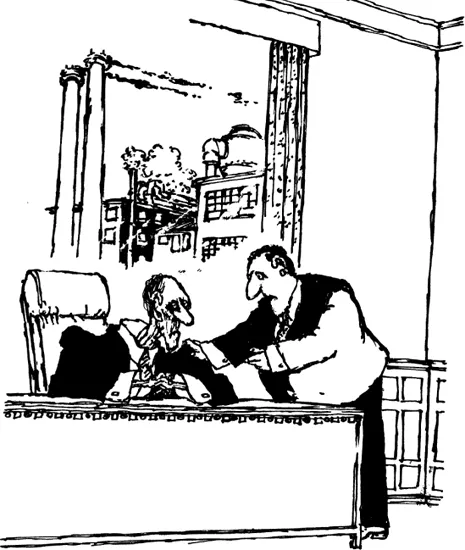
“You must stop this insane diet, J.T.—so what if the union does call you a ’FAT CAPITLISTIC PIG’!”
And this is exactly what naturally happens. The self-interest of employers leads them “as if by an invisible hand” to ferret out low-wage workers, offer them higher wages, and spirit them away. The whole process tends to raise wages to the level of marginal productivity. This applies not only to urban workers, but to workers in isolated areas who are ignorant of alternative job opportunities and would not have the money to get there even if aware of them. It is true that the differential between the wage level and the productivity of the unsophisticated worker will have to be great enough to compensate the employer for the costs of coming to the worker, informing him of job alternatives, and paying the costs of sending him there. But this is almost always the case, and employers have long been cognizant of it.
The Mexican “wetbacks” are a case in point. Few groups have less knowledge of the labor market in the United States, and less money for traveling to more lucrative jobs. Not only do employers from southern California travel hundreds of miles to find them, but they also furnish trucks or travel money to transport them northward. In fact, employers from as far away as Wisconsin travel to Mexico for “cheap labor” (workers receiving less than their marginal product). This is eloquent testimony to the workings of an obscure economic law they have never heard of. (There are complaints about the poor working conditions of these migrant workers. But these complaints are mainly from either well-intentioned people who are unaware of the economic realities, or from those not in sympathy with these hapless workers receiving full value for their labors. The Mexican workers themselves view the package of wages and working conditions as favorable compared to alternatives at home. This is seen in their willingness, year after year, to come to the United States during the harvesting season.)
It is not the minimum wage law, therefore, that stands between Western civilization and a return to the stone age. There are market forces and profit maximizing behavior on the part of entrepreneurs, which ensure that wages do not fall below the level of productivity. And the level of productivity is itself determined by technology, education, and the amount of capital equipment in a society, not by the amount of “socially progressive” legislation enacted. Minimum wage legislation does not do what its press claims. What does it do? What are its actual effects?
What will be the reaction of the typical worker to a legislated increase in wages from $1.00 to $2.00? If he is already fully employed, he may want to work more hours. If he is partially employed or unemployed, it is virtually certain that he will want to work more.
The typical employer, on the other hand, will react in the opposite way. He will want to fire virtually all of the workers he is forced to give raises to. (Otherwise he would have granted raises before he was compelled to.) Now, he has to keep production up, so he might not be able to adjust this situation immediately. But as time passes he will replace his unexpectedly expensive unskilled workers with fewer but more skilled workers and with more sophisticated machinery, so that his total productivity remains constant.
Students of an introductory economics course learn that when a price level above equilibrium is set, the result is a surplus. In the example, when a minimum wage level above $1.00 per hour is set, the result is a surplus of labor—otherwise called unemployment. Iconoclastic as it may sound, it is, therefore, true that the minimum wage law causes unemployment. At the higher wage level it creates more people willing to work and fewer jobs available.
The only debatable question is: how much unemployment does the minimum wage law create? This depends on how quickly the unskilled workers are replaced by equivalently productive skilled workers in conjunction with machines. In our own recent history, for example, when the minimum wage law increased from 40¢ to 75¢ per hour, elevator operators began to be replaced. It has taken some time, but most elevators are now automatic. The same thing happened to unskilled dishwashers. They have been and are still being replaced by automatic dishwashing machinery, operated and repaired by semi-skilled and skilled workers. The process continues. As the minimum wage law is applied to greater and greater segments of the unskilled population, and as its level rises, more and more unskilled people will become unemployed.
Finally, it is important to note that a minimum wage law only directly affects those earning less than the minimum wage level. A law requiring that everyone be paid at least $2.00 per hour has no effect on an individual earning $10.00 per hour. But before assuming that the minimum wage law simply results in pay raises for low-wage earners, consider what would happen if a $100.00 per hour minimum wage law went into effect. How many of us have such great productivity that an employer would be willing to pay $100.00 for an hour of our services? Only those thought to be worth that much money would retain their jobs. The rest would be unemployed. The example is extreme, of course, but the principle which would operate if such a law were passed does operate now. When wages are raised by law, the workers with low productivity are discharged.
Who is hurt by the minimum wage law? The unskilled, whose productivity level is below the wage level legislated. The unemployment rate of black male teenagers is usually (under-) estimated at 50 percent, three times the unemployment level of the 1933 depression. And this percentage does not even begin to take into account the great numbers who have given up searching for a job in the face of this unemployment rate.
The lost income that this represents is only the tip of the iceberg. More important is the on-the-job-training these young men could be receiving. Were they working at $1.00 per hour (or even less) instead of being unemployed at $2.00 per hour, they would be learning skills that would enable them to raise their productivity and wage rates above $2.00 in the future. Instead they are condemned to street corners, idleness, learning only those skills which will earn them jail sentences at some early future time.
One of the greatest hurdles facing a black teenager is looking for his first job. Every employer demands work experience, but how can the young black get it if no one will hire him? This is not because of some “employer conspiracy” to denigrate minority teenagers. It is because of the minimum wage law. If an employer is forced to pay for an experienced-level worker, is it any wonder that he demands this kind of labor?
A paradox is that many black teenagers are worth more than the minimum wage but are unemployed because of it. In order to be employed with a $2.00 an hour minimum wage law, it is not enough just to be worth $2.00. You have to be thought to be worth $2.00 per hour by an employer who stands to lose money if he guesses wrong and may go broke if he guesses wrong too often. With a minimum wage law, an employer cannot afford to take a chance. And, unfortunately, black teenagers are frequently viewed as “risky,” as a class. When confronted with a reluctant employer, a Horatio Alger hero could stride over manfully and offer to work for a token salary, or even for nothing, for a term of two weeks. During this time our hero would prove to the employer that his productivity deserved a higher wage rate. More important, he would bear with the employer part of the risk of hiring an untried worker. The employer would go along with this arrangement because he would be risking little.
But the Horatio Alger hero did not have to do battle with a minimum wage law which made such an arrangement illegal. The law thus insures that there is less chance for the black teenager to prove his worth in an honest way.
The minimum wage law hurts not only the black teenager, but the black ghetto merchant and industrialist as well. Without this law, he would have access, in a way which his white counterpart would not, to a cheap labor pool of black teenager labor. The young black worker would be more accessible to him since he tends to live in the ghetto and would have easier access to the job site. He would undoubtedly have less resentment toward, and a smoother work relationship with, a black entrepreneur. Since this is one of the most important determinants of productivity for jobs of this type, the black employer could pay his workers more than the white one could—and still make a profit.
Unfortunate as the effects on young black workers are, a greater tragedy of the minimum wage law concerns the handicapped worker (the lame, the blind, the deaf, the amputee, the paralyzed, and the mentally handicapped). The minimum wage law effectively makes it illegal for a profit-seeking employer to hire a handicapped person. All hopes of even a modicum of self-reliance are dashed. The choice the handicapped person faces is between idleness and governmentally supported make-work schemes which consist of trivial activities and are as demoralizing as idleness. That such schemes are supported by a government which makes honest employment impossible in the first place, is an irony few handicapped people would find amusing.
Recently, certain classes of handicapped people (the slightly handicapped) have become exempt from the minimum wage law. It is, therefore, in the interest of employers to hire the “slightly handicapped,” and they now have jobs. But if it has been realized that the minimum wage law hurts the employment chances of “slightly handicaped” people, surely it should be realized that it hurts the chances of others. Why are seriously handicapped people not exempt?
If the minimum wage law does not protect the individual it seems designed to protect, whose interests does it serve? Why was such legislation passed?
Among the most vociferous proponents of minimum wage legislation is organized labor—and this must give us pause for thought. For the average union member earns much more than the minimum wage level of $2.00 per hour. If he is already earning $10.00 per hour, as we have seen, his wage level is in accordance with the law, and is not, therefore, affected by it. What then accounts for his passionate commitment to it?
His concern is hardly with the downtrodden worker—his black, Puerto Rican, Mexican-American and American-Indian brethren. For his union is typically 99.44 percent white, and he strenuously resists the attempts by members of minority groups to enter his union. What then stands behind organized labor’s interest in minimum wage legislation?
When the minimum wage law forced up the wages of unskilled labor, the law of downward sloping demand caused employers to substitute skilled labor for unskilled labor. In the same way, when a labor union, composed mainly of skilled laborers, obtains a wage increase, the law of downward sloping demand causes employers to substitute unskilled laborers for skilled laborers! In other words, because skilled and unskilled laborers are, within certain bounds, substitutable for each other, they are actually in competition with one another. It might well be that it is 10 or 20 unskilled workers who are in competition with, and hence substitutable for two or three skilled workers, plus a more sophisticated machine. But of the substitutability itself, especially in the long run, there can be no doubt.
What better way to get rid of your competition than to force it to price itself out of the market? What better way for a union to insure that the next wage hike will not tempt employers to hire unskilled, nonunion scabs (especially minority group members)? The tactic is to get a law passed that makes the wage of the unskilled so high that they cannot be hired, no matter how outrageous the wage demands of the union are. (If minority groups could get a law passed requiring all union wages to rise ten times their present amount, they could virtually destroy the unions. Union membership would decline precipitously. Employers would fire all unionists, and in cases where they could not, or did not, they would go bankrupt.)
Do the unions purposefully and knowingly advocate such a harmful law? It is not motives that concern us here. It is only acts and their effects. The effects of the minimum wage law are disastrous. It adversely affects the poor, the unskilled, and minority group members, the very people it was supposedly designed to help.
30
THE SCAB
One of the most universally shared attitudes is that the scab is a wretched character. He is unscrupulous and sneakily in league with the “boss.” Together, scab and boss plot to deprive union workers of their rights, and of the jobs that are legitimately theirs. Scabs are hired to force union workers to accept lower wages. When it becomes known that scabs are also used to beat up union workers and pickets, the case is virtually complete—the scab is the greatest enemy of the worker.
These are the facts that are taught in many of our centers of learning, to be challenged only at the risk of one’s reputation as a scholar. Nevertheless, this flummery must be refuted.
The first point to establish is that a job is not a thing which can be owned by a worker—or by anyone else. A job is the manifestation of a trade between a worker and an employer. The worker trades his labor for the money of the employer, at some mutually agreeable rate of exchange. So when we speak of “my job,” we are only talking figuratively.
Although we are in the habit of using such phrases as “my job,” “my customer,” and “my tailor,” we do not presume ownership in any of these instances. Take first the case of “my customer.” If this phrase were taken literally, it would denote that the merchant has an ownership right over the “custom” of the people who habitually buy from him. He would own the customer’s patronage and he would, therefore, have a right to object if “his” customer patronized another merchant.
The sword cuts both ways. Let us take the case of “my tailor.” If we were to take this phrase literally, we would have to say that the tailor may not shut down his shop, relocate, or declare himself bankrupt, without the permission of the customers. He is “their” tailor.
In both these cases, of course, it is clear that the possessive pronoun is not meant to imply literal possession. Clearly, neither buyer or seller has the right to insist upon the permanence of a business relationship, unless of course, a long-term contract has been agreed upon by both parties. Then, and only then, would the merchant and the customer have the right to object if either party ended the relationship without the consent of the other.
Now let us consider “my job.” What is the worker implying when he objects to the scab taking “his” job away? The worker is arguing as though he owned the job. He is, in other words, assuming that service, after a certain period of time, obligates the employer to the employee as strictly as if they had agreed to a contract. But in fact, the employer has never obligated himself contractually.
One wonders how the workers would react if the principle upon which their anti-scab feeling is based were adopted by the employer. How would they feel if employers assumed the right to forbid long-term workers from leaving their employment? What if he accused another employer who dared to hire “his” worker of being a scab! Yet the situation is entirely symmetrical.
Clearly, there is something wrong with an argument which asserts that once people voluntarily agree to trade, they are thereafter compelled to continue to trade. By what shift in logic is a voluntary relationship converted into a strictly involuntary relationship? Hiring an individual does not imply slave-holding rights over that person, nor does having worked for an employer give one the right to a job. It should be evident that the worker never “owns” the job, that it is not “his” job. The scab, therefore, is guilty of no irregularity when he takes the job which the worker formerly held.
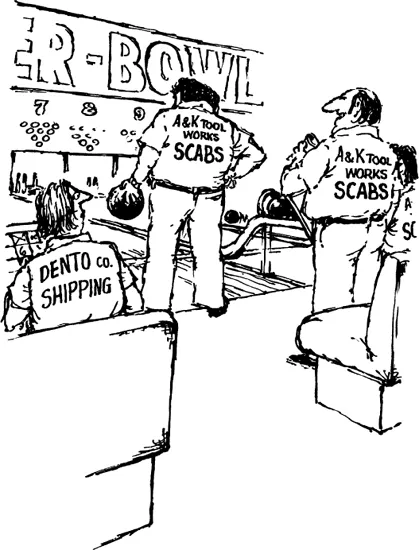
The issue of violence between workers and scabs is a separate issue. The initiation of violence is condemnable, and when scabs initiate violence, they deserve our censure. But the initiation of violence is not their defining characteristic. When they engage in it, they do so as individuals, not as scabs qua scabs. Milkmen, after all, sometimes go berserk and commit aggression against nonaggressors. No one would take this as proof that the delivery of milk is an intrinsically evil enterprise. In like manner, the use of illegitimate violence on the part of scabs does not render the enterprise of scabbing illegitimate.
In recent times, the muddled and inconsistent thinking about scabs has become increasingly evident. Liberals, traditionally most vociferous in denouncing scabs, have of late shown signs of confusion on this issue. They have come to realize that in virtually all cases the scabs are poorer than the workers they seek to replace. And liberals have almost always championed the poor worker. Also, the specter of racism has been raised. In many cases, black scabs have been pitted against white (unionized) workers, Mexican workers against Mexican-American workers, Japanese workers against higher paid American workers.
The Ocean Hill-Brownsville decentralization school board clash in Brooklyn, New York, is a dramatic case in point. Under the local school board system, Rhody McCoy, the black school board administrator, fired several white teachers for alleged racist behavior toward their young black pupils. In response, the white dominated United Federation of Teachers Union struck the entire New York City educational system, including Ocean Hill-Brownsville. If the black Ocean Hill-Brownsville school district was to continue to function, unit administrator McCoy would have to find replacements for the striking white teachers. He did, and they were, naturally, scabs. Hence, the quandary faced by the liberals: on the one hand, they were unalterably opposed to scabs, but on the other hand, they were unalterably opposed to the racism of the United Federation of Teachers. Clearly, there was more heat than light in their attitudes.
Scabs obviously have been unjustly maligned. Employment does not give the employee any proprietary privileges closed to workers who wish to compete for the same job. Scabbing and free competition are opposite sides of the same coin.
31
THE RATE BUSTER
The scene is familiar from hundreds of movies featuring labor themes: the young eager worker comes to the factory for the first time, determined to be a productive worker. In his enthusiasm, he happily produces more than the other workers who have been at the factory many years, and who are tired, stooped, and arthritic. He is a “rate buster.”
Not unnaturally, antipathy springs up between our eager young worker and his senior colleagues. After all, they are cast in a slothful role. In contrast to his youthful exuberance, their production levels look meager indeed.
As the young worker continues his accelerated work output, he becomes more and more alienated from the other workers. He becomes haughty. The older workers, for their part, try to treat him with compassion. But when he remains resistant, they subject him to a silent treatment and commit him to a worker’s purgatory.
As the film continues, there occurs a climactic moment when the youthful rate buster comes to his senses. This comes about in any number of ways, all dramatic. Perhaps he sees a sick old woman, an ex-factory worker, or a worker who has been injured in the factory. If the movie in question is avant garde, the conversion can be sparked through the good offices of a cat grousing around in an overturned garbage can. Whatever the method, the young man does come to see the error of his ways.
Then, in the last dramatic scene, which usually ends with all the workers—reformed rate buster included—walking off armin-arm, a kindly old worker-philosopher takes over center stage. He gives the young worker a five-minute course in labor history, from ancient Roman times down to the present, showing the constant perfidy of the “bosses,” and proving beyond question that the only hope of the workers lies in “solidarity.”
There has always been, he explains, a class struggle between the workers and the capitalists, with the workers continually struggling for decent wages and working conditions. The bosses are portrayed as always trying to pay the workers less than they deserve, pushing them as far as they can until they drop from exhaustion. Any worker who cooperates with the bosses in their unceasing, merciless, and ruthless efforts to “speed up” the workers, and to force them to increase their productivity levels, is an enemy of the working class. With this summation by the worker-philosopher, the movie ends.
This view of labor economics contains a tangle of fallacies which is interwoven with each part resting in complex ways on other parts. However, there is one core fallacy.
The core fallacy is the assumption that there is only so much work to be done in the world. Sometimes called the “lump of labor” fallacy, this economic view holds that the peoples of the world only require a limited amount of labor in their behalf. When this amount is surpassed, there will be no more work to be done, and hence, there will be no more jobs for the workers. For those who hold this view, limiting the productivity of the eager young workers is of overriding importance. For if these workers work too hard, they will ruin things for everyone. By “hogging up” the limited amount of work which exists, they leave too little for everyone else. It is as if the amount of work that can be done resembles a pie of a fixed size. If some people take more than their share, everyone else will suffer with less.
If this economic view of the world were correct, there would indeed be some justification for the theory espoused by the labor-philosopher of the movie. There would be some justification for insisting that the younger and more active worker not take away more than his share of the “pie.” However, adherence to this theory has proved to be inefficient and uneconomic, with tragic results.
This false view is based upon the assumption that people’s desires—for creature comforts, leisure, intellectual, and aesthetic achievements—have a sharp upward boundary which can be reached in a finite amount of time; and that when it is reached, production must cease. Nothing could be further from the truth.
To assume that human desires can be fully and finally satisfied is to assume that we can reach a point at which human perfection—material, intellectual, and aesthetic—has been fully realized. Paradise? Perhaps. If it were somehow achieved, then certainly there would be no “unemployment” problem—for who would need a job?
There is as much work to be done as there are unfulfilled desires. Since human desires are, for all practical purposes, limitless, the amount of work to be done is also limitless. Therefore, no matter how much work the eager young man completes, he cannot possibly exhaust or even make an appreciable dent in the amount of work to be done.
If the eager worker does not “take work away from others” (because there is a limitless amount of work to be done), what effect does he have? The effect of working harder and more efficiently is to increase production. By his energy and efficiency, he increases the size of the pie—the pie that will then be shared among all those who took part in its production.
The rate buster should also be considered from another vantage point. Consider the plight of a family shipwrecked on a tropical island.
When the Swiss Family Robinson sought refuge on an island, their store of belongings consisted only of what was salvaged from the ship. The meager supply of capital goods, plus their own laboring ability, will determine whether or not they survive.
If we strip away all the novelistic superficialities, the economic situation that the Swiss Family Robinson found itself in was facing an unending list of desires, while the means at their disposal for the satisfaction of these desires was extremely limited.
If we suppose that all the members of the family set to work with the material resources at their disposal, we would find that they can satisfy only some of their desires.
What would be the effect of “rate busting” in their situation? Suppose one of the children suddenly becomes a rate buster and is able to produce twice as much per day as the other members of the family. Will this young punk be the ruination of the family, “take work away” from the other family members, and wreak havoc upon the mini-society they have created?
It is obvious that the Swiss Family Robinson rate buster will not bring ruination upon his family. On the contrary, the rate buster will be seen as the hero he is, since there is no danger that his increased productivity would cause the family to run out of work. We have seen that for practical and even philosophical reasons, the wants and desires of the family were limitless. The family would hardly be in trouble even if several members were rate busters.
If the rate busting family member can produce ten extra units of clothing, it may become possible for other members of the family to be relieved of their clothing manufacturing chores. New jobs will be assigned to them. There will be a sorting out period during which it is decided which jobs should be undertaken. But clearly, the end result will be greater satisfaction for the family. In a modern, complex economy, the results would be identical, though the process more complicated. The sorting out period, for example, may take some time. The point remains, however, that because of rate busting, society as a whole will move toward greater and greater satisfaction and prosperity.
Another aspect of rate busting is the creation of new items. Thomas Edison, Isaac Newton, Wolfgang Mozart, J.S. Bach, Henry Ford, Jonas Salk, Albert Einstein, plus innumerable others, were the rate busters of their day, not of quantity, but of quality. Each “busted” through what was considered by their society to be a “normal” rate and type of productivity. Yet each of these rate busters contributed incalculably to our civilization.
In addition to understanding rate busting from the point of view of quantity and innovation, rate busting should also be considered in terms of the new lives on this earth that it makes possible. The amount of human life which the earth can support is related to the level of productivity human beings achieve. If there are fewer rate busters, the number of lives this earth can support will be severely limited. If however, the number of rate busters increases significantly in each respective field, the earth will then be able to support an ever-expanding population.
The conclusion then is that not only are rate busters responsible for satisfying more of our desires than a slower, less efficient rate of production, they are also responsible for preserving the very lives of all those who would have to die were it not for the rate busters enlarging the scope of human satisfactions. They provide the means with which the increasing global birth rate can be supported.
32
THE EMPLOYER OF CHILD LABOR
High on the list of the enemies of society, one can always find the employer of child labor—cruel, cold hearted, exploitative, cunning, and evil. In the public mind, child labor is almost equivalent to slave labor, and the children’s employer is no better than the slave owner.
It is important to correct this view. Simple justice demands it, for the majority opinion on this question is completely fallacious. The archetypical child labor employer is as kindly, benevolent, and filled with the milk of human kindness as anyone else. Moreover, the institution of child labor is an honorable one, with a long and glorious history of good works. And the villains of the piece are not the employers, but rather those who prohibit the free market in child labor. These do-gooders are responsible for the untold immiseration of those who are thus forced out of employment. Although the harm done was greater in the past, when great poverty made widespread child labor necessary, there are still people in dire straits today. Present prohibitions of child labor are thus an unconscionable interference with their lives.
The first plank in the defense is that the employer of child labor has not forced anyone to join his employ. Any and all labor agreements are completely voluntary. As such, unless they were thought to be mutually beneficial, they would not be agreed to.
But in what sense can a labor contract with a child be completely voluntary? Does not complete voluntarism imply an awareness that a child is not capable of? To answer this question, consideration should be given to a proper definition of what a child is.
This is an ancient question which has never been fully resolved. Nevertheless, we shall consider several ages which have been suggested as dividing the child from the adult, analyze them, and then offer an alternative.
Among the earliest ages for the cut-off point between childhood and adulthood are those proposed by the various religions. The age of confirmation into the religion, which usually occurs in the very early teens, or even before, is the age at which many religions define adulthood. But the person (child) at, for example, age 13 also is, except in rare instances, still immature, relatively helpless, and ignorant of the skills necessary to care for himself. So it must be rejected.
The next candidate for adulthood is age 18. Usually picked because this is the age at which a young man becomes eligible for the draft, this age also has several problems as a definition of adulthood. We may start off by questioning whether or not fighting in wars is an “adult” action. All too often, going to war is virtually the opposite of behavior usually indicative of adulthood. Also, merely following orders (the be-all and end-all of the enlisted soldier) cannot be considered an adult paradigm. In addition, there is the problem that the draft, an involuntary institution if ever there was one, serves as the very basis for the order-taking that follows. At least if the original decision to obey orders was made on a voluntary basis, such as the decision to join an orchestra, and then to follow all (musical) orders of the conductor, there might be some adult-like behavior involved in the draft. However, based as it is on original involuntarism, even so much cannot be said for the 18 year old draftable age. Another problem with the 18 year cut-off point is that the original reason for our search was the fear that a mere child would be unable to make voluntary contracts on his own. How then can we base such an age on a patently involuntary institution such as the draft?
Perhaps the latest candidate for adulthood is the voting age—21 years old. But even this is open to harsh criticism. There is first the problem that several, if not many 10 year olds, have a greater grasp of political, social, historical, psychological, and economic factors, presumably the factors that enable one to vote “wisely,” than do many people over the age of 21. One would then think that if this were true, there would be some recognition of the fact in the form of a movement to enfranchise all bright 10 year olds, or rather, all bright children of any age. But this would defeat the original goal of allowing only adults to vote. Through this circularity of reasoning, we can see that the age of 21 is only an arbitrary cutoff point.
We can likewise see all other arbitrary definitions of adulthood to be without merit. What is needed is not an arbitrary age limit which will apply to all people regardless of ability, temperment, and behavior, but rather a criteria which can take all these qualities into account. Moreover, the criteria should be consistent with the libertarian principle of self-ownership of property: namely homesteading. What is wanted is an application of the principle of homesteading, which establishes self-ownership and ownership of property, but applied now to the perplexing problem of when a child becomes an adult.
Such a theory has been put forth by Professor Murray N. Rothbard. According to Rothbard, a child becomes an adult not when he reaches some arbitrary age limit, but rather when he does something to establish his ownership and control over his own person: namely, when he leaves home, and becomes able to support himself. This criteria, and only this criteria, is free of all the objections to arbitrary age limits. Moreover, not only is it consistent with the libertarian homesteading theory, it is but an application of it. For by leaving home and becoming his own means of support, the ex-child becomes an initiator, as the homesteader, and owes his improved state to his own actions.
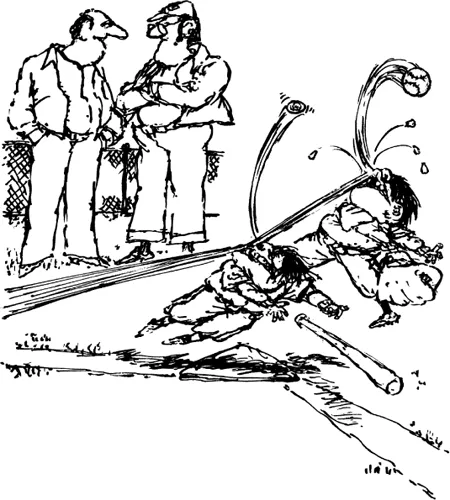
“When I was their age my old man got me a job in a boatyard. Man did I have calluses. The kids today got it made.”
The theory has several implications. If the only way a child may become an adult is by picking himself up and establishing such adulthood of and by his own volition, then the parent has no right to interfere with this choice. The parent cannot, then, forbid the child from leaving the parental household. The parent has other rights and obligations over the child as long as the child remains in the house of the parents. (This accounts for the validity of the oft-heard parental order: “As long as you’re in this house, you’ll do things my way.”) But the one thing the parent cannot do is forbid the child’s departure. To do this would be to violate the volitional aspects of growing up from a child to an adult.
It should be noted that this theory of the passage from childhood to adulthood is the only one consistent with the problem of mental deficiency. According to the specific arbitrary theories of adulthood, a mental incompetent, aged 50, ought to be considered an adult, even though he manifestly is not. These theories then come up with further arbitrary ad hoc “exceptions” to fit the case. But the mental incompetent is no embarrassment to the homesteading theory. Since he has not (been able to) seized ownership and adulthood of and for himself, the mental incompetent of whatever age is simply not an adult.
The most important implication of the homesteading theory of adulthood is, of course, the one regarding the prohibition of so-called “child” labor, where a child is defined as someone with less than a certain arbitrary number of years. For this prohibition of so-called “child” labor, as in the case of parental interference with the child’s decision to leave home, will effectively remove the possibility of “voluntarily” becoming an adult. If a person of tender years is effectively prohibited from working, the option to leave home and to support himself is removed from him. He is then excluded from “homesteading his own adulthood” and must perforce wait until the arbitrary number of years “defining” adulthood has been reached.
However, the adult homesteading theory does not require employers to hire young persons who are trying to establish their adulthood. It is, of course, true that unless some employer hires such a person, he will find it as difficult to become an adult as in the case where his parents forbade his departure, or the government prohibited it. But the key difference is that the voluntaristic nature of the passage from childhood to adulthood will not be infringed upon by employers refusing to hire young people. This is so because true voluntarism requires voluntary action on the part of both parties to an agreement. The employer, as well as the employee, must agree. In any case, since there can be no positive obligations, unless the individual himself contracts for them, and the employer has made no advance commitment to employ the youngster, there is no moral obligation on the part of the employer. (Employers will of course, employ young people when they feel it is to their advantage to do so, as they have always done when not prohibited by law.)
Not only is it important to end prohibitions of employment of children for the sake of their peaceful and voluntaristic transition into adulthood; it is also of overriding importance to the small but growing “kid liberation” movement. The prohibition against job opportunities will have to be ended if children are to be truly liberated from their parents while in residence in the parental abode. Of what value is the right to leave the family household and seek a living outside, if a youngster is prohibited from supporting himself? The right of every kid to “fire his parents” if they become too onerous, is completely compromised by the laws against child labor.
Can a labor contract with a mere “child” be truly voluntary, given his tender years, lack of experience, etc.? The answer is yes. A person, any person, who has had the ability to leave home and to attempt to earn his own living is mature enough to enter into a contract on a voluntary basis, since such a person is a child no longer. The opposite answer, as we have seen, would effectively bar young people from striking out on their own and becoming adults through homesteading. Their only alternative would be to wait until they have reached whatever arbitrary number of years “society,” in its infinite wisdom, has determined to be necessary for adulthood.
There are other objections, however, to the legalization of “child” labor. It will be said that a destitute youngster, even though an adult through homesteading, will be taken advantage of by employers; that the employer will “make profit” from the plight the youngster happens to find himself in.
But it would be far more harmful if his one source of support, however bleak, were legislated out of existence. Despite the fact that the employer might be cruel, the job menial, and the salary low, it would be far more injurious to forbid him the opportunity. If there are other, more favorable, alternatives, the young person will avail himself of them even if the law allows the choice of accepting or rejecting the unfavorable job. If there are no other opportunities, the law prohibiting child labor will take from him this one opportunity, however unfavorable.
In a free market society, the employer will not be able to take advantage of the misery of the young worker, if by this it is meant that he will not be able to pay him less than his marginal product. As we have seen in the chapter on the capitalist-pig-employer, there exist powerful forces on an open market which will tend to force all wages up toward the level of productivity of the worker in question.
However destitute and helpless the youngster who is looking for work may be, it is not the fault of the potential employer. Even if the destitution and “lack of bargaining power” of the worker were very extreme, and even if the employer were able to “take advantage of this” (as we have seen is not the case), it would still not be the fault of the employer. If anything, the unfortunate situation would have to be blamed on the background of the (ex-) child.
The question arises as to what degree the parent is obligated to support the child. As a general principle, the parent has no positive obligations whatsoever in regard to the child. The argument to the contrary, that a parent does have some positive obligations toward the child, based upon the supposed contractual nature, or voluntary decision on the part of the parents to bear the child, may be easily shaken. Consider the following:
1. All children are equal in rights due them from their parents, regardless of the way in which they were conceived.
2. Specifically, the child who is a product of rape has as many obligations due him from his female parent as any other child. (We assume that the male parent, the rapist, has gone.) No matter what views we have on rape, the child who is a product of such rape is entirely guiltless of this crime, or any other crime.
3. The voluntary nature of child rearing and conception does not apply in the case of rape.
4. Therefore, the argument that the parent owes some obligations to the child which arise out of the voluntary nature of the conception, or out of an “implicit contract,” cannot apply in the case of rape, i.e., in the case of rape, at least, the female parent owes no positive obligation to the child, because she did not consent to its inception.
5. All children, being equally guiltless of any crime, in spite of any theory to the contrary, such as “original sin,” have equal rights due them from their parents. Since all such rights (supposedly) flow from the voluntary nature of conception, and the children born of rape manifestly lack this voluntary aspect, they, at least have no rights due them from their (female) parent. But their rights are equal to those of all other children. Therefore, no child, whosoever, has any positive obligations due him from his parents.
Nor is it immediately or intuitively obvious that there are any other grounds for establishing any parental duties to children. Given, then, that nothing but a voluntary agreement on the part of the parent could establish obligations to children, and that this argument fails, it is obvious that there are no positive obligations incumbent upon parents toward their children.
“No positive obligations” implies that the parent has no more of an obligation to feed, clothe, and shelter his own child than he has to serve the children of other people, or, for that matter, than to serve other adults who are completely unrelated to him, by birth, agreement, etc. This is not to suggest, however, that the parent may kill the child. Just as the parent has no right to kill the children of other parents, he has no right to kill his “own” children, or rather, children he has given birth to.
The parent, when he assumes the role of parenthood, is a sort of caretaker for the child. If ever the parent wishes to relinquish this role that he or she has voluntarily adopted, or not assume this obligation in the first place, she is completely free to do so. She can offer the baby for adoption, or, in the old tradition of the natural law, leave the baby on the steps of a church or charitable institution specializing in the care of children.
But the parent may not secret the baby in a hidden corner of the house without food, or refuse to offer it for adoption, and wait for it to die. To do this would be equivalent to murder—a crime which must always be severely condemned. The parent who keeps the child hidden while starving it (so as not to actually commit violent murder upon it) has renounced his caretakership or the parental relationship others might be willing to assume.
Perhaps the parental-caretaker role may be made clearer by entering it into a hierarchy of homesteading: the child falls into a realm between that of another adult and that of an animal. If one adult helps another, he cannot by that help alone, come to be the owner of the other person. If an adult domesticates an animal, and through his own efforts brings the animal into productive use (productive for mankind), he can thereby come to own it. The child, an intermediate case, can be “owned” through homesteading, but only on a caretaker basis, until he is ready to assert ownership over his own person; namely, to assume adulthood by becoming independent of his parents. The parent can exercise control over the child and rear it only as long as he continues his homesteading efforts. (With an animal, or with land, once it is homesteaded, the owner need no longer continue to homestead it in order to own it. He can, for example, be an absentee landlord or animal owner.) If he discontinues his homesteading operations with the child, he must then either offer it for adoption, if it is too young and helpless to fend for itself, or he must allow it to run away to set up its own life, if it is able and willing.
If the parent brought up the child with just enough help and aid to qualify as a continuance of homesteading, but no more, and if the child is in a relatively deprived background, this cannot be laid at the door of the prospective employer. Prohibiting an employer from hiring such a youngster will in no way improve his lot—it can only worsen it.
True, there are parents who make unwise decisions concerning children, unwise from the vantage point of outside observers. It does not follow, however, that the welfare of children will be raised by placing them in the hands of the state apparatus. The state, too, makes unwise, and even unhealthy decisions concerning children, and a child can much more easily leave his parent than leave his government, which rules us all.
We must conclude, then, that all labor contracts concerning young people are valid as long as they are voluntary—and they can be voluntary. Either the young person is an adult (whatever his age), who has earned his adulthood and hence is able to consent to contracts, or else he is still a child, and is able to work on a voluntary basis through the intermediation of parental consent.
Defending the Undefendable
Read the whole book online · Book details
This work is published under a Creative Commons licence. You may copy, share, and re-host it with attribution.