
Chapter 13 of 25 · Lessons for the Young Economist by Robert P. Murphy
ADVANCED LESSON 12 Interest, Credit, and Debt
In this lesson you will learn:
- The function of interest in a market economy.
- Common types of credit transactions.
- The pros and cons of going into debt.
Interest: It’s About Time
As we have already learned in Lesson 10, interest is the amount of money paid to a lender above and beyond the return of the principal. For example, if someone lends out $1,000 and receives $1,080 back one year later, the principal is $1,000 and the lender has earned $80 in interest. Usually people discuss the interest rate, which is the interest expressed as a percentage of the principal, and is also usually quoted on a yearly basis. In our example, the loan carried an 8% annual interest rate.
The subject of interest, and the explanation of how markets determine particular interest rates, can be one of the most complicated areas in economic theory. In the present lesson we will obviously just cover the basics. Essentially, interest has to do with time. Lenders must be compensated (with interest) to give up money available to them now, in exchange for a promise to be paid back with money not available until the future. On the other hand, the reason borrowers are willing to pay interest is that they value having money (and the things it can buy) right now, rather than having to put off their purchases until the future. A positive interest rate goes hand in hand with time preference, which is the desire (other things equal) to enjoy goods sooner rather than later.
The interest rate tells us how much the market price of a current dollar is, compared to a future dollar. Right now, the “market price” of a $100 bill is, well, $100. But how much right now is an ironclad guarantee that a crisp $100 bill will be delivered in exactly one year? It’s certainly not worth a full $100; except under very unusual circumstances, nobody would give up a $100 bill today, in exchange for receiving the same $100 bill back in 12 months. We know that in practice, people pay less than $100 today, in order to receive a promise—even a very reliable promise from a trustworthy borrower—of a future payment of $100. The market interest rate shows us exactly what the discount on future dollars is, or (equivalently) what the premium on current dollars is. For example, at an interest rate of 5%, people would pay about $95.24 today, in order to receive an ironclad claim on a $100 payment in exactly one year.1
In a sense, the interest rate is an exchange rate between currencies, except that the two currencies are “current U.S. dollars” and “future U.S. dollars.” A normal exchange rate shows how many current U.S. dollar bills trade for one euro or Mexican peso, whereas an interest rate shows how many “2010” US dollar bills trade for one “2011” U.S. dollar bill, if the current year is 2010.
A business firm needs to use exchange rates if it operates in several countries, in order to keep its accounts in a common denominator. For example, if a firm buys certain Chinese components priced in yuan, pays pesos to workers in Mexico to assemble the parts into finished goods, and finally sells the products in the United States for dollars, then the firm’s accountants will need to translate the three currencies into a common denominator (presumably U.S. dollars) to tell if the business is making a profit.
By the same token, interest rates for varying time durations or maturities allow businesses to keep track of their books for operations that unfold over several years (not countries). If the firm buys raw materials from U.S. suppliers in 2010, then pays American workers to process the materials during 2011, and finally sells the finished goods gradually during the course of 2012, the firm’s accountants cannot ignore the time element for the various expenditures and revenues. The dollars paid for materials in 2010, as well as the dollars paid for labor in 2011, have a higher market value than the dollars received from customers in 2012, and so the accountants need to discount the later money. Market interest rates help them determine the appropriate discount to apply, in order to look at the entire three-year operation and decide, “Did we turn a profit?”
It is important to point out that the higher the interest rate, the more present-oriented business operations will be. If there is a very long operation, requiring inputs of labor and raw materials for many years before the finished product emerges, then the higher the interest rate, the less profitable such an operation will be. This is because the entrepreneur running the operation will spend money today and for many years, in the hopes of receiving revenue at some far future date. The higher the interest rate, the bigger the “penalty” on the duration of an operation, and the greater the encouragement that the market gives to entrepreneurs to quickly convert their resources into final goods for their customers.
On the other hand, a low interest rate gives a “green light” to entrepreneurs to start longer production processes. Even if we keep all of the prices for materials and the final product the same, a given project can appear unprofitable at a high interest rate, but profitable at a lower interest rate. Like all other market prices, interest rates guide entrepreneurs to invest their limited resources efficiently.
Savings, Investment, and Economic Growth
Remember that in Lesson 10 we saw how an increase in savings allows more investment and faster economic growth. We are now in a position to show how the market interest rate helps this process.
First, imagine an initial scenario where the interest rate is 8%. We can use supply and demand curves (as discussed in Lesson 11) to illustrate this initial equilibrium interest rate for the loanable funds market:
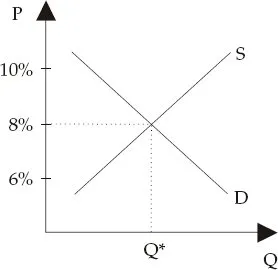
Market for Loanable Funds
Notice that the x-axis on the above refers to the total amount of money being borrowed (demanded) and lent (supplied). The y-axis refers to the price of the loan, which is the same thing as the interest rate. Some people say that interest is the “price of money” but that is inaccurate; it is the price of borrowing money. In our example, to borrow $100 for a year carries a price of $8; after a person borrows and repays the loan principal, he still has to fork out an additional $8 fee.
The equilibrium interest rate equates the quantity demanded of borrowed money with the quantity supplied of money to be lent. If the interest rate were too high, then lenders would want to lend out more money than borrowers wanted to borrow. (Convince yourself that at higher interest rates—other things equal—lenders would want to supply more funds while borrowers would demand fewer funds.) On the other hand, if the interest rate were below 8% in our chart above, then there would be a shortage of loanable funds, as borrowers would seek to borrow more (measured in total dollars) than lenders collectively would be willing to supply. With our supply and demand curves as shown above, only at an interest rate of 8% do we have an equilibrium, where the lenders want to provide exactly as much money in loans as people wish to borrow.
Now what happens if most people in the community decide to save more? In a supply and demand framework, we illustrate this change by shifting the supply curve of loanable funds to the right, because at every hypothetical interest rate (price), the suppliers are willing to bring more of their saved funds to the market to lend out to borrowers. Suppose that the community’s increased willingness to save leads to a fall in the rate of interest (the price of a loan) down to 6%, and an increase in the total amount of dollars lent and borrowed.
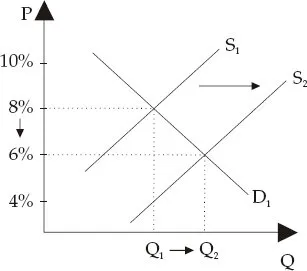
Market for Loanable Funds
We now have a more complete understanding of the process described in Lesson 10. When a community saves more in general, this pushes down interest rates and leads to more total funds available for borrowers. The lower interest rates send a signal to entrepreneurs to engage in longer-term projects that are now profitable. In Lesson 10 we already saw that when people in the community on average reduced their present consumption (spending on restaurant meals, vacations, electronics goods, etc.), this frugality freed up physical resources and allowed for increased investment in machinery, tools, and other capital goods that would eventually boost future output. But now we see how the market interest rate plays a role in helping the entrepreneurs adjust to the new preferences of their customers, and guides them into shifting the entire structure of production to become more future-oriented.
Common Credit Transactions
In a simple credit transaction, one party trades money that he has saved in exchange for a claim (or a promise) from another party that she will give a specified payment of money at a future date, or a stream of money payments at various specified dates.2
In the examples we discuss in this section, credit transactions do not create money, they simply shift money from one holder to another.3 When someone buys a pack of gum, money isn’t created; the buyer hands over money in exchange for the pack of gum. In the same way, a simple credit transaction doesn’t create money either—the lender hands over money in exchange for an I.O.U. from the borrower. Because of this fact, credit transactions per se do not tend to “push prices up” as many people believe. The borrower is able to spend more in the present than he otherwise would be able to, it’s true, but the lender can spend that much less. At the time of the repayment, the borrower must restrict his spending in order to pay back the principal (plus interest), but the influx of money gives that much more spending ability to the lender.
Bonds
When a company wishes to borrow money, it sells a bond which is a legal claim entitling the bondholder to a stream of cash payments from the bond issuer (i.e., the company). There is nothing mysterious behind “issuing” a bond; it is simply a standardized contract in which a company borrows money from someone else in the community. The person “buying the bond” is really doing nothing more than lending money (the bond price) in exchange for the company’s official promise to make interest payments at regular intervals and eventually return the principal.
Banks
When an individual wants to borrow money he can make individual arrangements with various people. However, in many cases borrowers use the services of a credit intermediary, such as a bank. The bank is an intermediary between the ultimate lenders and borrowers in the market. First, the bank acts as a borrower, when depositors lend their funds to the bank (and earn a certain interest rate on their deposits). Second, the bank uses these funds to act as a lender to people in the market who wish to borrow from the bank (and pay a certain, higher interest rate on their loans).
A successful bank is able to earn enough money on the spread (the difference between the interest rate it charges borrowers and the interest rate it pays to depositors) in order to pay its staff and other expenses, as well as provide an income to the entrepreneur(s) running the bank. One of the main reasons the bank is able to maintain this spread is that different borrowers have different degrees of credit risk.
Consider a young couple who want a mortgage to buy a new house for $200,000. Ultimately, they are going to borrow the money from various savers scattered throughout the community. But if the prospective borrowers went knocking door to door, trying to find 200 people who would each put up $1,000 in exchange for the couple’s signatures on a loan contract, they probably wouldn’t find many takers, or if they did, the interest rate they charged would be quite high. The problem is that the individual saver doesn’t really know the couple very well, and even if the couple is hardworking and sincere, a job layoff or medical condition could make them default on the loan.
Now we understand the function of a credit intermediary such as a bank. People in the community are willing to deposit their money with the bank, because it is much less likely to lose their savings than any individual borrower. Thus they are willing to lend at a much lower contractual interest rate than they would have insisted from the couple trying to buy a house. On the other hand, the bank can afford to lend to the couple, because it has experts whose job is to evaluate the likelihood that the couple will make their mortgage payments on time. By making mortgage loans not just to one couple, but to hundreds or thousands of home buyers, the bank reduces the damage of any particular loan default. So long as the bank has properly estimated the credit risks of its various borrowers, the bank will absorb the expected number of delinquencies and defaults as part of the cost of doing business. The interest rates it charges in its various mortgage and other loan contracts will have already reflected the riskiness of each borrower.
When the savers in a community lend to the borrowers through credit intermediaries such as banks, it allows the risks to be pooled and distributed more uniformly. If, say, 1% of the couples borrowing money for a home purchase end up defaulting on the mortgage payments, that loss doesn’t fall entirely on an unlucky 1% of the lenders who lose their life savings. On the contrary—assuming the banks have done their jobs properly—the loss in contractual mortgage payments is spread evenly among all the lenders, reflected in the fact that they earn a lower interest rate on their bank deposits than the ultimate borrowers are paying on their mortgages.
Credit Cards
A popular form of credit transactions nowadays involves the use of a credit card. When a customer buys, say, a pair of shoes at the mall and swipes her credit card at the register, what actually happens is that the credit card issuer pays money to the store, and then records the loan on the customer’s account. As with the other transactions discussed above, here too no new money is created. In principle, the transaction is equivalent to one where a representative of the credit card company walks into the store, hands the customer the money in exchange for a signature promising to pay it back with interest, and then the customer hands the newly-borrowed money to the store clerk. The familiar use of plastic cards is just a matter of convenience, allowing the cumbersome two-step process to be executed in a matter of seconds.
As with other lenders, credit card issuers must be careful when lending money to borrowers. When someone applies for a credit card, the issuing company will review the applicant’s credit history to judge the likelihood that the applicant will pay back any borrowed money. There are several companies that provide the service of keeping up with borrowers’ debts and repayment history. These companies sell lenders “scores” on each applicant, to make it easier for the lender to determine if the borrower is likely to repay on time. Applicants with “good credit” (meaning a high credit score) have shown that they are responsible and can be trusted to pay off their credit card balances. On the other hand, an applicant who has a high amount of debt with other companies, and has a history of missing payments, will have “poor credit” (meaning a low credit score) and may not be approved for a new card, or will be granted a card but with a very modest credit limit. Ironically someone who has never had a credit card or otherwise borrowed money may find it difficult to secure a card with a high credit limit, because there is no history that the issuer can review to see how this applicant handles debt.
The Pros and Cons of Debt
Some people understandably warn that “you should never get into debt,” and that “if you can’t pay cash for something, then you can’t afford it.” Indeed there is much truth to this warning, and many people would testify that excessive credit card debt ruined their lives. In a free market, if a consumer chooses to buy on credit this is a voluntary action, and the consumer thought at the time of purchase that the benefits of the immediate availability outweighed the costs of having to pay back the loan (with interest) in the future. So when some criticize the wisdom of credit purchases, they are relying on the fact that people can often regret their previous, voluntary choices.
When it comes to consumer purchases on credit, there is an important distinction between a secured versus an unsecured loan. A secured loan has collateral backing it up, often the object being purchased with the loan. Typical examples include a mortgage, in which the house (and land on which it sits) serves as collateral, or a car loan in which the vehicle is the collateral. Although these are credit transactions too, it certainly changes our evaluation of the wisdom of a large increase in debt if we find out that there is a valuable new asset being acquired. For example, if someone borrowed $10,000 to take a cruise, there would be nothing (except memories) to show for it down the road, whereas someone borrowing $10,000 to buy a new car could sell the car and pay off most of the remaining debt if his circumstances changed.4
The most obvious example of what is called productive debt occurs when an entrepreneur borrows money in order to expand his or her business operations. For example, a large corporation may decide to issue $10 million in new bonds in order to finance the construction of a new factory. So long as things go according to plan, what happens is that the corporation borrows $10 million from savers in the community, and uses the lent funds to purchase raw materials, equipment, and labor services from workers. After the factory is up and running, the corporation’s revenues are higher than they otherwise would have been, and out of this surplus the corporation can make its periodic interest payments to the new bondholders, and eventually eliminate the debt completely by paying back the principal. In many respects, debt is simply one way that businesses can raise funds for new investment spending, with another method being the issuance of stock, a topic we address in Lesson 14.
Individuals too can borrow productive debt, if they receive loans to put themselves through college or medical school. The essential feature of productive debt is that the borrowed money is invested in order to increase the borrower’s future income, so that paying back the loan will not be a burden.
Lesson Recap...
- In a market economy, interest rates help to coordinate consumers’ preferences to enjoy goods sooner versus later, with producers’ investments in projects that take shorter or longer to complete. If people are impatient, then the interest rate will be high and producers will invest in relatively quick projects. If people are willing to postpone immediate gratification by saving, then the interest rate will be low and producers can invest in longer projects.
- Common credit transactions include cases where corporations borrow money by issuing bonds, homebuyers take out mortgages from banks, and individuals pay for purchases using credit cards.
- There are pros and cons of going into debt. On the positive side, debt allows the borrower to make purchases sooner. On the negative side, a higher debt load forces the borrower to devote more of his income to paying interest (or “finance charges”) to the lender, leaving less income available for enjoyments in the future. In some situations taking on debt can be “productive” if the borrowed money is invested rather than spent on immediate enjoyments.
NEW TERMS
Time preference: The degree to which people prefer to consume sooner rather than later; a gauge of people’s impatience to receive enjoyments.
Discount: The percentage by which the value of a unit of money is reduced, because it will not be received until the future.
Exchange rate: The “price” of one currency in terms of another, or how many units of one currency will trade for one unit of another currency.
Maturity: The time duration of a specific loan, and the interest rate that applies to it. (Loans and their corresponding bonds can have shorter or longer maturities.)
Loanable funds market: The market in which lenders give money to borrowers at an agreed-upon interest rate.
Credit transaction: An exchange where one person gives up something (such as money) today, while the other person promises to give up something (such as money) in the future.
Bond: A corporation’s IOU, which is a legally binding promise to repay borrowed money plus interest. The buyer of a bond gives money to the corporation today, in the hopes of receiving back the principal plus interest in the future.
Fractional reserve banking: The typical practice where banks do not keep all of their customers’ deposits in the vault. In other words, all of the bank’s customers have more money on deposit, than the bank has cash in the vault.
Credit intermediary: A person or organization that is the “middleman” between lenders and borrowers.
Bank: A common credit intermediary, which takes deposits from many different lenders and makes loans to many different borrowers.
Depositors: People who give their money to a bank.
Spread: The difference between the interest rate that a credit intermediary (such as a bank) earns from its borrowers, compared to the interest rate it pays to its lenders or depositors. A positive spread allows the credit intermediary to earn income from its activities, so long as it has correctly estimated the likelihood of default by its borrowers.
Credit risk: The likelihood that a borrower will be unable to pay back a loan.
Mortgage: A special type of loan in which the borrower buys a house (or other real estate) with the funds. Usually the property serves as collateral for the mortgage.
Default: A situation when a borrower stops making repayments on a loan.
Delinquencies: Cases where borrowers are not in good standing with the lender (such as a bank), because they have not been keeping up with their required payments.
Credit card: A device that allows the borrower to achieve virtually instant loans from the credit card company when making purchases.
Credit history: A person’s record of borrowing and repayment behavior.
Credit score: A number that an agency will assign to a person based on his or her credit history, which helps potential lenders decide on the riskiness of lending money to the person.
Credit limit: The maximum amount of money that a person can borrow from a pre-approved source (such as a credit card).
Secured loan: A loan that has an asset (such as a house, car, etc.) pledged as collateral, in case the borrower defaults. The advantage to the borrower is that the interest rate is lower than it would be for a comparable unsecured loan.
Unsecured loan: A loan that has no collateral serving as a backup. If the borrower defaults, the lender has no other options. The advantage to the borrower is that none of his or her other assets can be seized (or “repossessed”) in the case of default.
Collateral: An asset that a borrower “puts up” when applying for a loan. If the borrower defaults, the lender may take possession of the collateral as compensation. (For example, if a borrower wants money to buy a house or a car, these items themselves can serve as the collateral, meaning that if the borrower fails to make his or her payments on schedule, the lender can take control of the house or car.)
Productive debt: Debt used to finance investments. Ideally, the extra income from the investment spending will allow the borrower to make the interest payments resulting from the increase in debt, so that the extra borrowing “pays for itself.”
STUDY QUESTIONS
- Why is the first section titled, “Interest: It’s About Time”?
- *What is the connection between interest rates and currency exchange rates?
- Why does a low interest rate give a “green light” to long production processes?
- What is exchanged in a credit transaction?
- What is “productive debt”?
Lessons for the Young Economist
Read the whole book online · Book details
This work is published under a Creative Commons licence. You may copy, share, and re-host it with attribution.