
Chapter 14 of 25 · Lessons for the Young Economist by Robert P. Murphy
ADVANCED LESSON 13 Profit and Loss Accounting
In this lesson you will learn:
- The distinction between interest and profit.
- The social function of profit and loss accounting.
- The limits of profit and loss accounting.
Profit and Loss Guide Entrepreneurs
In previous lessons we have shown how market prices guide the actions of everyone in a market economy. For example, if an unexpected cold snap decimates the orange crop, then the sudden drop in supply will cause the prices of oranges and orange juice to rise,1 which in turn will lead consumers to buy fewer oranges and cartons of orange juice. For a different example, if people become more concerned about having straight teeth, the demand for braces will rise, which will ultimately lead to more students choosing a career in orthodontics.2 Market prices act as signals about underlying changes in both the physical world and subjective preferences, allowing people to adjust their behavior in light of new realities.
Entrepreneurs do not respond to particular prices but rather to the difference between certain prices. Specifically entrepreneurs estimate the amount they must spend on their ingredients or inputs (hired workers, raw materials, electricity bill, etc.), and then forecast the total revenues they will receive from customers when selling their finished products or services. In short, entrepreneurs estimate whether their proposed course of action will yield a profit or a loss, where this calculation involves current and future market prices.
Generally speaking, activities that generate high (monetary) profits will attract more entrepreneurs, while those that cause losses will repel entrepreneurs. In a market economy with open competition, there is a tendency for monetary profits and losses to be whittled away over time, as entrepreneurs adjust to the situation. When more entrepreneurs flock into a highly profitable activity, their efforts to buy the necessary inputs cause their prices to rise, while the increased output of the finished good or service causes the price to the consumer to fall. The gap between the two sets of prices—which was driving the originally high profit margin—tends to shrink, so that the monetary profits disappear as well.
The reverse occurs when an activity is plagued by recurring losses. New entrepreneurs will shy away from the industry, and entrepreneurs who are originally in the industry will either scale back their operations or abandon them and move to a different line of work. The entrepreneurs’ total demand for the necessary inputs drops, leading to lower prices for the workers, raw materials, and other items used in this particular activity. On the other hand, the diminished supply of the finished good or service tends to raise the price that the consumer must pay. This process continues until the finished price has risen enough, and the input prices have fallen enough, so that the remaining entrepreneurs no longer suffer losses from producing the good or service in question.
Interest versus Profit
We have explained that when an entrepreneur calculates whether or not his business is turning a profit, he must consider the prices of the various inputs he uses in his operations. For example, if he runs a factory that produces television sets, he must take account of (a) the wages he pays to his assembly line workers, (b) the prices for the metals and plastics that he buys in bulk, and even (c) the payments that he makes to the utility company for the electricity his operation requires. Only if the revenues he earns from selling television sets is great enough to cover these expenses will the operation be profitable.
However, up until now we have ignored a very important “input” into any long-term business operation: the financial capital invested in it, and the associated “price” of this investment as expressed by interest payments. To see how interest payments factor into profitability, it’s easiest to use a concrete illustration.
Suppose someone can spend $10,000 in January buying a plot of land that contains a young crop of Christmas trees. The new owner doesn’t need to spend any more money. All she has to do is wait until December when she can sell the 100 mature trees for an average of $30 apiece. After the trees have all been sold, she can also sell the bare land for $7,300. From the revenue from the trees and the land sale, the entrepreneur would have turned her original $10,000 investment into $3,000 + $7,300 = $10,300, which is certainly more money than she started out with. Can we conclude that the Christmas tree venture was profitable?
Before answering the question, our tree entrepreneur needs to consider interest payments. For example, if she originally borrowed the $10,000 from someone at a 5% annual interest rate, then she actually lost money on the whole arrangement. With her $10,300 in hand, she tries to pay off the creditor who lent her the money, and finds that she still owes a balance of $200.3
Even if the tree entrepreneur uses her own saved funds, most economists would say she still “lost” money on the deal, if alternative investments yielded a rate of return higher (and less risky) than the implicit 3% return in the Christmas tree business. For example, back in January if the woman could have taken $10,000 out of her savings and purchased a 12-month corporate bond yielding 5%—and if the woman viewed this investment at least as “safe” as plowing her money into a crop of Christmas trees—then in a sense she would be $200 poorer if she invested the money in the land with the young crop of trees. In this case the monetary “loss” would not show up in the official records compiled by her accountant, because the $500 in forfeited interest on the corporate bond would be an opportunity cost, rather than an explicit out-of-pocket expenditure.
In Lesson 12 we learned that people usually attach a higher value to current dollars (and other forms of money) over future dollars, meaning that interest rates are positive. We need to keep this fact in mind when discussing competition and its impacts on profit margins. Even in the long run, it is not true that competition will completely whittle away the gap between the revenues an entrepreneur receives from selling his product or service, versus the out-of-pocket expenditures on inputs such as labor and raw materials. This is because a portion of what is called the gross profit (or accounting profit) must go to pay interest on the financial capital invested in the business. When we say that a high profit attracts more entrepreneurs into an industry, to be correct we mean high net profit (or economic profit), i.e., the profit when an implicit interest payment on invested capital has been included as one of the “inputs” into the operation.4
The Social Function of Profit and Loss Accounting
Many naïve observers of the market economy dismiss concern with the “bottom line” as a purely arbitrary social convention. To these critics, it seems senseless that a factory producing, say, medicine or shoes for toddlers stops at the point when the owner decides that profit has been maximized. It would certainly be physically possible to produce more bottles of aspirin or more shoes in size 3T, yet the boss doesn’t allow it, because to do so would “lose money.” On the other hand, many apparently superfluous gadgets and unnecessary luxury items are produced every day in a market economy, because they are profitable. Observers who are outraged by this system may adopt the slogan: “Production for people, not profit!”
Such critics do not appreciate the indispensable service that the profit-and-loss test provides to members of a market economy. Whatever the social system in place, the regrettable fact is that the material world is one of scarcity—there are not enough resources to produce all the goods and services that people desire. Because of scarcity, every economic decision involves tradeoffs. When scarce resources are devoted to producing more bottles of aspirin, for example, there are necessarily fewer resources available to produce everything else. It’s not enough to ask, “Would the world be a better place if there were more medicine?” The relevant question is, “Would the world be a better place if there were more medicine and less of the other goods and services that would have to be sacrificed to produce more medicine?”
In standard introductory textbooks, they often define the economic problem as society’s decision on how to allocate scarce resources into the production of particular goods and services. In reality, “society” doesn’t decide anything; individual members of society make decisions that interact to determine the ultimate fate of all the resources at humanity’s disposal. In the pure market economy that we are studying in this section of the book, everyone in society obeys the rules of private property which assign ownership claims to particular units of resources. In this context, market prices are formed when individuals engage in voluntary exchanges with each other. The resulting prices in turn give entrepreneurs the ability to calculate (expected) profits and losses from various possible activities. It is the interaction of property owners in voluntary trades that “determines” what goods and services get produced, but the signals provided by market prices—and the resulting calculations of profit and loss—help the property owners make informed decisions.
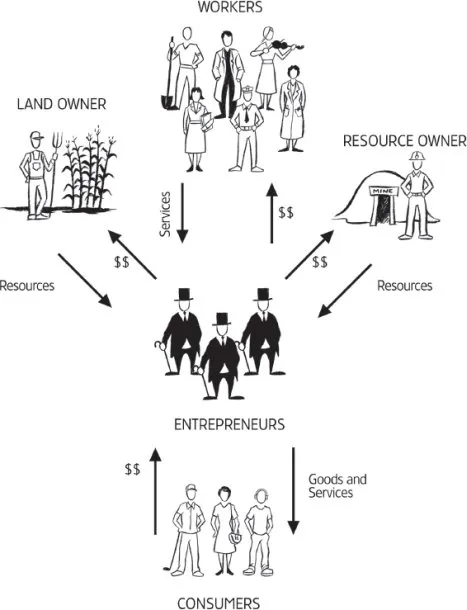
It might be useful to step back and look at the big picture. The entrepreneurs offer money to the owners of labor services, capital goods, and natural resources. The entrepreneurs then use these inputs to produce goods and services which they sell to consumers for money (see figure on the next page).
The Customer Is Always Right
The real bosses [under capitalism] are the consumers. They, by their buying and by their abstention from buying, decide who should own the capital and run the plants. They determine what should be produced and in what quantity and quality. Their attitudes result either in profit or in loss for the enterpriser. They make poor men rich and rich men poor. They are no easy bosses. They are full of whims and fancies, changeable and unpredictable. They do not care a whit for past merit. As soon as something is offered to them that they like better or is cheaper, they desert their old purveyors.
—Ludwig von Mises, Bureaucracy, p. 227
When a particular entrepreneurial venture goes “out of business,” what that ultimately means is that consumers were not willing to spend enough money on its finished output, to cover the offers the entrepreneur needed to make in order to bid the scarce inputs away from other entrepreneurs who wanted the inputs for their enterprises.
To see this principle more concretely, let’s work with a silly example. Suppose a successful builder dies and passes on his business to his foolish son. The son gets the bright idea to build new apartment buildings covered with pure gold. He correctly estimates that there would be high demand for apartments where the elevator, hallways, and kitchen shelves were coated with gold. In fact the son can rent his units for much higher monthly fees than the owners of normal apartments in similar locations.
The Big Picture: Entrepreneurs Buy Inputs to Make Goods and Services for Consumers
Of course, this isn’t the whole story. Even though his revenues are very high, the foolish son’s production costs are astronomical. In addition to the labor, wood, concrete, and other items, he must spend hundreds of millions of dollars buying large quantities of gold. His accountants inform him that despite the higher revenues, he is losing incredible amounts of money because of his decision to coat the apartments with gold. The son will have to either wisen up quickly, or he will squander all of his wealth. Either way, he won’t be building apartments coated with gold for very long.
Now if we were to interview the son and ask him what happened, he might say, “It’s too expensive to use gold in my business.” But notice that this can’t be true for all entrepreneurs. After all, the reason gold is so expensive is that other buyers are paying such high prices for it. For example, jewelers still find it profitable to buy gold in order to make necklaces and earrings, and dentists still find it profitable to use gold for fillings. No jeweler would say, “It’s too expensive to use gold in my business.”
Loosely speaking, the profit and loss system communicates the desires of consumers to the resource owners and entrepreneurs when they are deciding how many resources to send into each potential line of production. It’s ultimately not the owners of gold mines nor the captains of industry who determine how gold will be used in a market economy. Instead, these decisions are largely guided by the spending decisions of the consumers. It is the consumers’ demands for normal versus gold-coated apartments, in conjunction with their demands for silver versus gold-coated necklaces, that leads to the outcome that gold-coated apartments are ridiculously unprofitable while gold-coated necklaces are perfectly sensible.
The profit and loss test provides structure to the free enterprise system. People are free to start new businesses, and to sell their resources (including the labor services of their bodies) to whomever they wish. In a market based on the institution of private property, profits occur when an entrepreneur takes resources of a certain market value and transforms them into finished goods (or services) of a higher market value. This is the important sense in which profitable entrepreneurs are providing a definite service to others in the economy. Without the feedback of profit and loss calculations, entrepreneurs would have no idea if they were making economical use of the resources used up by their business operations.
The Social Function of Profits
“In a free economy, in which wages, costs, and prices are left to the free play of the competitive market, the prospect of profits decides what articles will be made, and in what quantities—and what articles will not be made at all. If there is no profit in making an article, it is a sign that the labor and capital devoted to its production are misdirected: the value of the resources that must be used up in making the article is greater than the value of the article itself.
“One function of profits, in brief, is to guide and channel the factors of production so as to apportion the relative output of thousands of different commodities in accordance with demand. No bureaucrat, no matter how brilliant, can solve this problem arbitrarily.”
—Henry Hazlitt, Economics In One Lesson (New York: Crown Trade Paperbacks, 1979), pp. 161–62
The Limits of Profit and Loss Accounting
Profit and loss calculations do not determine the actions of people in a market economy but merely guide them. The rules of accounting are a mental tool similar to the more fundamental tool of arithmetic. Young students are forced to memorize the times tables, but most people recognize that there is nothing arbitrary about these “rules”—they are simply shortcuts to expressing objective truths about reality. Adults are free to ignore multiplication if they want, but they will probably not get very far in life. If too many people decided they no longer “believed in” arithmetic, civilization would come crashing down.
In an analogous fashion, entrepreneurs (or their accountants or the programmers who design their business software) must learn the proper way to construct a balance sheet and an income statement to understand if their enterprises are profitable. These techniques are not arbitrary, and they express truths about the physical world as well as other people’s (subjective) preferences. Any particular entrepreneur can choose to ignore the bottom line if he wishes, but he won’t be in business for long. And if too many entrepreneurs went this route, there would soon be mass starvation.
Notwithstanding the tremendous importance of mental tools such as arithmetic and financial accounting, there are limits to their usefulness. After all, young students learn much more than math—depending on their background, they might also memorize the Ten Commandments, read Aristotle, and study the French Revolution, in order to become responsible members of society. Arithmetic (or mathematics more generally) helps guide people’s decisions, but obviously such knowledge only goes so far in what it can say.
A similar limitation applies to financial accounting and the profit and loss test. Entrepreneurs in a market economy aren’t slaves to profit maximization; a business owner can close the shop from Christmas Eve through New Year’s, and spend the holidays with his family. An entrepreneur is also perfectly free to give discounts to the elderly, or to perform services for free for the indigent, as acts of charity. There is nothing “uneconomical” or “inefficient” about such decisions.
However, the crucial point is that financial accounting allows the entrepreneurs to realize just how expensive these decisions are. Someone who owns a movie theater probably won’t close it down during the holiday season, simply because the potential revenues are so lucrative.5 Yet this seemingly deplorable fact—that the profit motive “forces” some merchants to work even on Christmas!—is really just a reflection of how much consumers enjoy going to movies during the holidays.
In terms of a social institution, private property (and its offshoots of market prices and profit and loss accounting) is extremely beneficial to mankind because it provides coherence to economic activities. To recognize this fact is not to say that, “Profit makes right.” For example, many consumers may be willing to spend large sums of money on things that are immoral, and the resulting profitability of producing these items or services doesn’t wash away their flaws. Economics does not say, “A movie studio must produce violent films if they make the most money.” In practice, it probably will be the case that entrepreneurs will enter an industry and produce those things which command the highest profits, but strictly speaking economic science does not instruct entrepreneurs to devote their lives to the accumulation of as much money as possible.
Even in cases where many people consider certain profitable activities to be immoral, it is not the profit motive per se that is at fault, but rather consumer demands for iniquitous ends. For example, it is true that large amounts of arable land are devoted to tobacco rather than tomatoes. But ultimately it is not the capitalist system that “forces” farmers to plant so much tobacco, it is instead the willingness of so many consumers to spend their money on cigarettes rather than salads. Critics of this unhealthful outcome really have a problem not with private property per se, but with the voluntary choices of smokers.
There is more to the good life than earning profits, and not everything can be reduced to dollars and cents. However, the money prices formed in a market economy allow individuals to put their affairs into perspective, in order to realize just how much they are ignoring the desires of others when they use their property in particular ways.
Lesson Recap...
- Interest refers to the normal return from lending or investing savings in a project, which could just as well have been earned in other projects. Economic profit refers to the extra return an entrepreneur earns from a particular project, over and above the normal interest return on the invested capital that could have been earned on similar projects.
- Profits and losses help guide entrepreneurs to use scarce resources in ways that best satisfy the preferences of their customers. If an activity is profitable, it is a signal that the entrepreneur is transforming resources into goods and services of higher value. If an entrepreneur is losing money, it is a signal that consumers would prefer that resources stop flowing into the losing operation, and go elsewhere to create more valuable goods and services.
- Profit and loss accounting can only reflect the monetary aspects of an operation. An entrepreneur may continue operating a business that “loses money” because he gets personal enjoyment from it, and there is nothing “uneconomical” about this decision. Even so, accurate profit and loss accounting allows entrepreneurs to make informed decisions about the use of scarce resources; it lets them take into account other people’s preferences about how those resources shall be used.
NEW TERMS
Gross profit / accounting profit: The excess of revenues over out-of-pocket expenses. This is what newspapers mean when they report on a corporation’s “profits” for a given time period.
Net profit / economic profit: The portion of gross profits over and above the normal interest return on the invested capital.
Economic problem: How to allocate society’s scarce resources (including labor) in order to produce the combination of goods and services that best satisfies people’s preferences.
STUDY QUESTIONS
- Explain: “Entrepreneurs do not respond to particular prices but rather to the difference between certain prices.”
- Explain: “In a market economy with open competition, there is a tendency for monetary profits and losses to be whittled away over time, as entrepreneurs adjust to the situation.”
- *How does interest relate to profit, specifically the difference between accounting and economic profit?
- In what sense do consumers—rather than the “captains of industry”—guide the production decisions in a market economy?
- Does a market economy force entrepreneurs to do whatever makes the most profit?
Lessons for the Young Economist
Read the whole book online · Book details
This work is published under a Creative Commons licence. You may copy, share, and re-host it with attribution.